Nissan Fairlady 240Z European Specification (1972)
Publication: Motor Fan
Format: Test Drive Report
Date: July 1972
Author: Jun Narue
Fairlady 240Z European Specification: A Chassis We’d Like to Have Here at Home
The Fairlady 240Z has become enormously popular in the United States, but there is also a European-market 240Z with suspension and chassis settings quite different from the American version. What is it like to drive?
A Three-Car 240Z Convoy
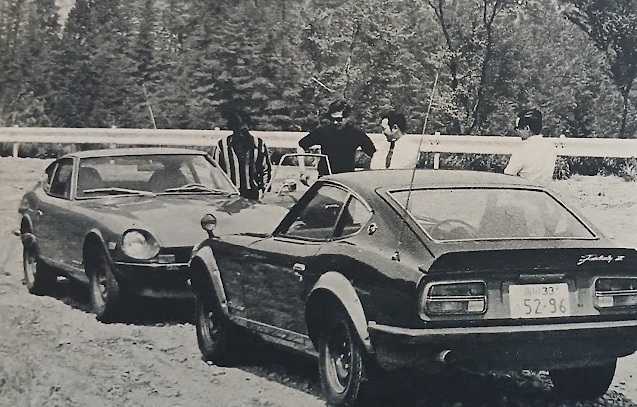
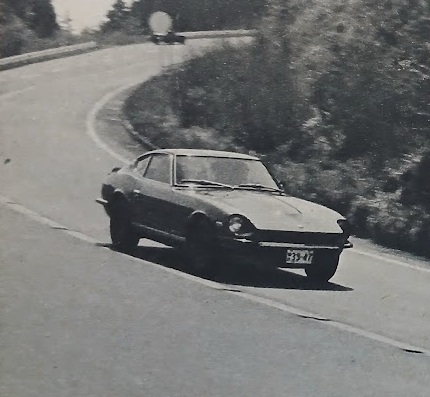
This month brought another day of driving around Hakone, this time with three 240Zs.
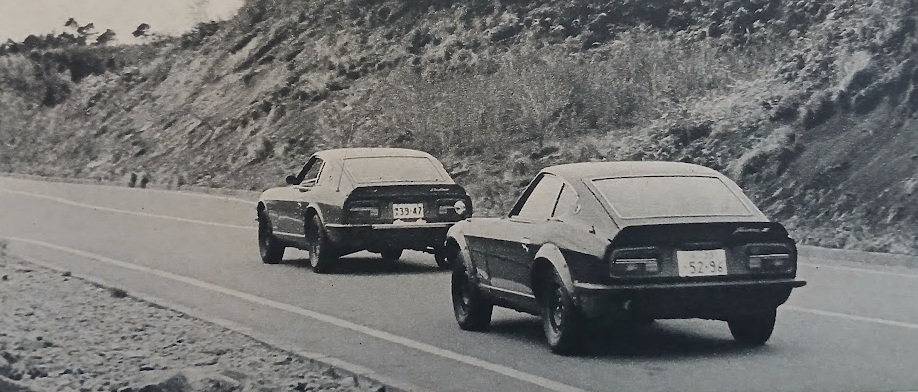
The first was a 240Z-L automatic supplied by Mr. Oishi of Nissan’s Public Relations Department. The second was a privately owned 240ZG, while the third was a Datsun 240Z HLS30Q–European specification–provided by the Second Vehicle Testing Division.
Note: “H” denotes the 2.4-liter engine, “L” left-hand drive, “S30” the Z’s body code, and “Q” European specification. Hereafter it will be referred to simply as the European-specification model.
As reported previously, Mr. O was so taken with the 240ZG we tested for the January issue that he immediately signed an order form. By the time he joined us for this test, the car had already covered 15,000km and had become a machine of which he was justifiably proud, having been fitted with 185-section Michelin XAS tires and an 18mm-diameter rear stabilizer bar.
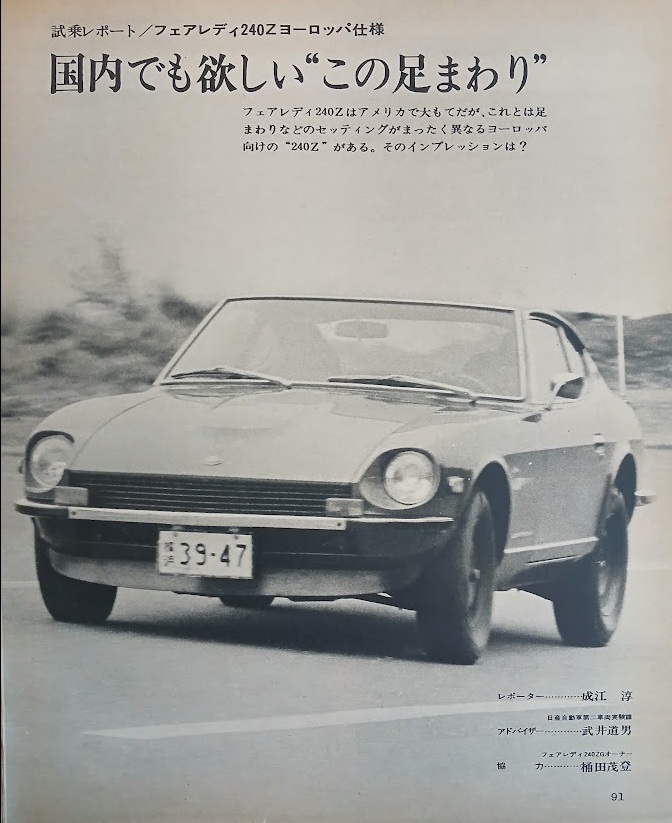
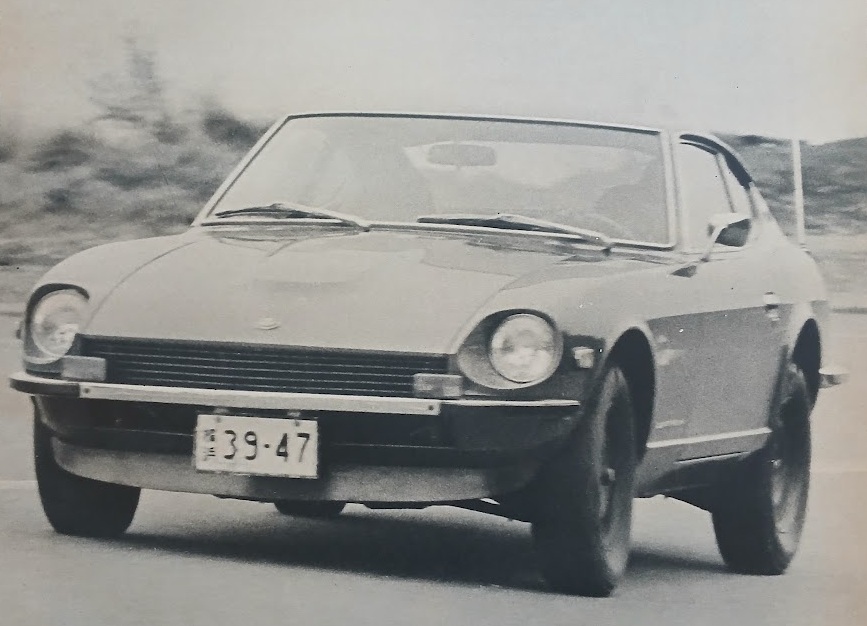
The car I regarded as our main subject for the day was a metallic-green 240Z that looked particularly striking under the early-summer sun. The lettering on the sides of its front fenders read simply: “DATSUN.”
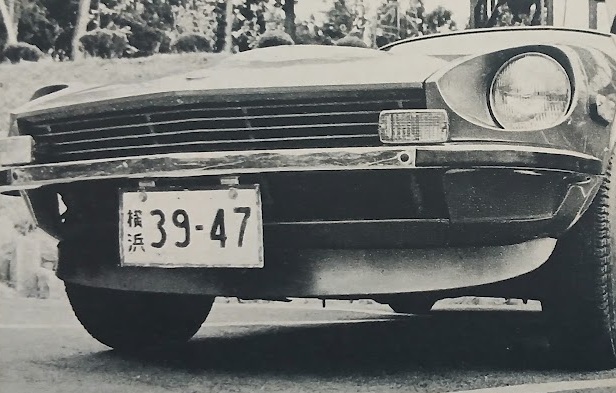
It was not fitted with the Aerodyna Nose, but rather had the normal, more subdued front end. Beneath the front bumper, however–on the apron, in other words–was a rubber spoiler. And of course, it was left-hand drive.
The Datsun 240Z was initially exported to the United States, where it has proved enormously popular, and was finally released last autumn here in its home country. During our previous test, I had asked Michio Takei if he could arrange for me to drive the European export version, and that request had now been fulfilled.
I had been told that they would take one car off the line and run it in for us. Sure enough, a glance at the Bridgestone RD-150 175/HR-14 tires fitted to the test car made it clear that it had already been driven quite hard and thoroughly broken in.
Compared with the tires fitted to the normal 240Z, these were of a stiffer construction developed specifically for the European version.
Another reason the European 240Z looks so striking is that its front end sits considerably lower than that of the standard 240Z. This results from the body being set nose-down by an angle of 0.5°.
More important than its lower stance, however, is the fact that the suspension is significantly firmer. Even among export models, the chassis settings differ from one market to another. In this regard, the American-specification HLS30U is virtually identical to the Japanese domestic model.
This is common practice even among European manufacturers. Cars intended for their home markets are generally quite firm, while those exported to the United States are softened somewhat by using lower spring rates. Models intended for “off-road” countries such as those in Africa are given heavier-duty specifications, together with greater ground clearance. Once a car becomes an international product, a wide variety of settings is naturally required, as Kyoichi Yamaguchi explained in detail in his report in the June issue of Motor Fan.
Within the Limits of 100km/h
“Be prepared—it’s a firm-riding car.”
That was Michio Takei’s preliminary advice, prompting me to joke that perhaps I ought to bring along a cushion. In truth, however, having spent much of my career road-testing European cars, I found the European-specification Fairlady Z’s tuning to be just right. It was refreshing to experience such a thoroughly satisfying chassis once again.
For reference, let’s take a brief look at the specifications. The front and rear stabilizer bars measure 22mm and 20mm respectively. The standard 240Z uses only an 18mm front bar, and in the report on the 240ZG it was noted that it ought to have one at the rear as well. On the European version, that point is already addressed.
Incidentally, while the front bar has been increased to 22mm, it would hardly be an exaggeration to say that European family sedans commonly use stabilizer bars of this size, while sports cars routinely use bars in the 30mm range.
Spring rates have likewise been increased. Whereas the standard model uses rates of 1.49kg/mm at the front and 1.80kg/mm at the rear, the European version’s rates are 2.20kg/mm and 2.50kg/mm respectively. For comparison, the Fairlady Z432 uses 1.80kg/mm at the front and 2.07kg/mm at the rear. Shock absorber damping, measured at a piston speed of 0.3m/sec, rises from 40/20kg to 100/50kg at the front, and from 100/20kg to 100/50kg at the rear.
On the road, this suspension feels entirely appropriate for a spoiler-equipped sporting machine. It is firm, certainly, but by no means harsh or unyielding.
The European-specification model derives almost all of its distinctive character from this chassis tuning. The engine, gearbox, and final drive, for example, are unchanged from the standard 240ZG. If any component enjoys an advantage, it is the engine. Since European emissions regulations have not yet become particularly stringent, there is no need for devices such as an air pump. The L24 engine is therefore free to display its true character without compromise, while at the same time making matters much simpler for the manufacturer.
Indeed, the test car revved with remarkable eagerness, and throttle response was exceptionally crisp. Regrettably, it is an aspect of this engine’s natural character that we can no longer experience in the Japanese market.
Whether in town or on the highway, the firmer suspension gives the 240Z the feel of a true continental sports car. Owners in Europe, with unrestricted speeds, well-surfaced roads, and freedom from chronic traffic congestion, naturally take this sort of sports-car character for granted.
The design concept behind the European-specification Datsun 240Z—“capable of cruising comfortably at 180km/h in a 10m/sec crosswind”—belongs to an entirely different operating environment. One would have to spend hours cruising at 180km/h to fully appreciate its virtues.
The conditions we must drive in are simply too different. Tell a European manufacturer that our highways have a legal speed limit of 100km/h, and the response would likely be: “What—?”
Outstanding Cornering Ability
Our group soon decided there was little point trying to challenge this Datsun in terms of speed, and instead changed tactics, heading for Hakone to enjoy its cornering ability. In retrospect, it was the right approach. Even so, the composure with which the European-specification car settled into a 100km/h cruise was impressive. Its straight-line stability was excellent, as was its resistance to crosswinds. The 240ZG also has outstanding directional stability; both cars have qualities that simply cannot be measured by a yardstick of only 100km/h.
That said, there are differences in how those qualities are achieved. In the ZG, much of the credit goes to the long nose, whereas the European version combines the same advantages with a lower, firmer suspension. According to Nissan’s testing, the simple semi-rigid polyurethane spoiler is fully capable of matching the benefits of the long Aerodyna Nose. If that is the case, owners more interested in driving than appearance would be well advised to choose this straightforward polyurethane spoiler instead.
The Aerodyna Nose is perhaps best left to the style-conscious. Extended by 190mm, this nose is certainly an asset on the highway, but in everyday use it demands a considerable period of acclimatization.
The European-specification spoiler is made of polyurethane, so even if it scrapes a ramp when entering a service station, it is unlikely to suffer damage. As a practical solution, it is excellent. At high speeds on the highway, lane changes with the European version’s firmer suspension are noticeably flatter and easier than with the ZG.
Having foregone outright speed tests and headed to Hakone instead, we had ample opportunity to appreciate just how much more manageable the car was with this spoiler. Threading through tight-radius corners or tucking in close behind the ZG, the difference compared to the long-nose model was unmistakeable–even if much of it was psychological.
With its greater roll stiffness, the European-specification car negotiates tight corners with noticeably greater ease than the ZG. Its cornering capability is exceptionally high–so high, in fact, that it would be almost impossible for the average driver to explore its limits on public roads.
To evaluate a car like this properly, one really needs the kind of closed-course testing favored by Hiroshi Okazaki. Given the opportunity, I would very much like to do exactly that.
That said, even if I am testing a Ferrari or a Lamborghini, I generally prefer to drive them on public roads. This makes comparisons with other cars possible, and when different versions of the same model are available side by side, as on this occasion, it is the easiest and most realistic way to evaluate their relative performance.
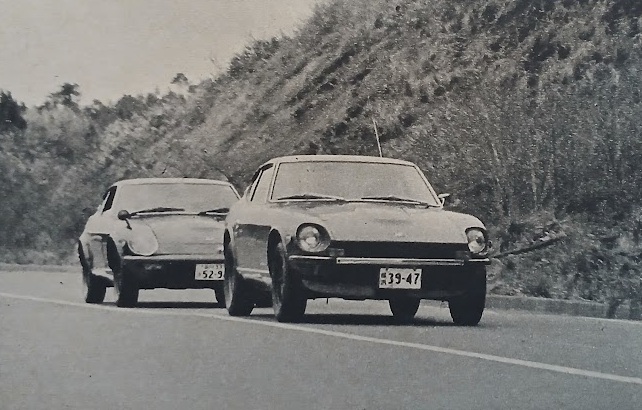
With its lower, firmer suspension, the European-specification car maintains an unfailingly neutral steering balance through typical corners. The ZG following behind can easily keep pace on the straights, but in curves it is plainly struggling with considerably more body roll–a fact readily apparent in the rearview mirror.
In practice, taking the same corner at the same speed requires a very different level of confidence from the driver. The European version simply passes through as if it were nothing, whereas the standard ZG, with its pronounced body roll and understeer, constantly leaves one wondering what might happen next. It soon became clear that the pace was quite different from that of our earlier ZG test.
Throughout the day we took turns driving all three cars to compare their individual character, but since I spent most of my time in the European-specification model, my companions repeatedly teased me, saying, “You’re certainly enthusiastic today.”
As mentioned earlier, the accompanying ZG had been fitted with an excellent set of Michelin XAS tires together with an 18mm rear stabilizer bar, and its road-holding was noticeably better than that of the standard car.
The Michelin XAS tires, in particular, proved exceptionally effective, fully justifying the owner’s investment in them.
Still, on the narrow Nagao Pass the ZG would inevitably begin to fall behind, while inside the European-specification car we enjoyed corner after corner, casually chatting about the days before the pass was completely paved.
Whenever a succession of tight bends appeared, the ZG disappeared from the rearview mirror, only to catch up again on the following straight. I suspect the amount of sweat required from the two drivers–perhaps cold sweat in one case–was rather different.
The European-specification car will happily accept full power through long-radius corners without worry. It feels so composed, in fact, that one can deliberately make substantial changes in steering angle mid-corner while maintaining precise control.
If necessary, a touch of opposite lock combined with the throttle is enough to bring the nose neatly back onto the intended line.
At one point I deliberately aimed the nose toward photographer Hokazono, who was set up on the inside of a corner. Afterwards, he admitted that it had made him more than a little uneasy–though, of course, I still had a comfortable margin in hand.
Mr. Takei remarked that this same corner could be negotiated at far higher speeds, and without the slightest anxiety. Even so, I think that is something best verified on a closed circuit. The reason is simple: although the European-specification car’s breakaway point is exceptionally high, there is one important qualification: it arrives all at once, and when it does, the car lets go abruptly.
Other Impressions
The engine was in superb condition. Running alongside the ZG, it demonstrated crisp throttle response even at low engine speeds. One cannot help but regret the effects of increasingly stringent emissions regulations. Unfortunately, this engine will probably never be offered to us in this state again.
It left me once again with the impression that, while the countries of Europe pioneered the automobile, in certain respects they also seem somewhat behind the times.
Although we did not venture onto rough roads, the ride over broken pavement, like that so often encountered in Europe, was firm yet surprisingly comfortable. Even with its lower ride height, the car could be thrown onto such surfaces with complete confidence.
One particularly impressive characteristic was the way the suspension settled after passing at high speed over long, undulating sections of road. Here again, the ZG exhibited considerably more pitching.
The steering transmits an appropriate amount of kickback and has a reassuringly solid feel, yet it is by no means excessively heavy. On the European-specification model, the rigidity of the steering mounts has been increased, although neither the steering assembly itself nor the steering ratio has been changed.
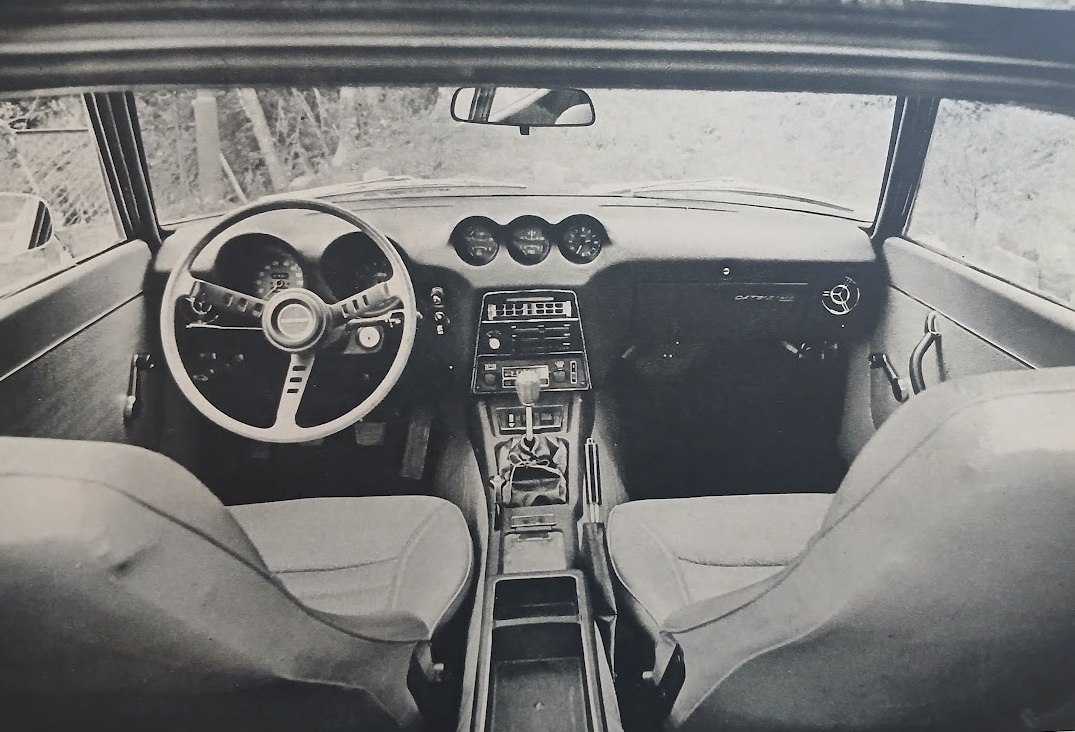
The left-hand-drive cockpit addressed nearly every complaint I had previously made about the right-hand-drive ZG. Admittedly, I have become accustomed to left-hand-drive cars, but operating the 5-speed gearbox with my right hand felt entirely natural. The shifts seemed remarkably smooth. That said, the ZG owner, accustomed to right-hand drive, found the left-hand-drive arrangement awkward.
I was also able to confirm my earlier observation that the pedal layout is far superior to that of the right-hand-drive car.
The three pedals are each positioned about 1cm closer together, making them ideally suited to heel-and-toe downshifts. I only wish the right-hand-drive model had received the same consideration from the beginning. The left-foot rest is also well positioned, providing a firm brace for the driver.
As a general rule, Japanese-market sports cars suffer from insufficient rigidity in the steering system. There also often seems to be a lack of lateral rigidity in the suspension, but this is clearly not a matter of suspension design itself. Rather, it appears to stem from insufficient rigidity in the mounting points, causing the car to recover more slowly from every movement. The European-specification tuning successfully addresses this exact weakness. Although the suspension is firm, it sacrifices nothing in ride quality.
I have a very high regard for the suspension tuning of the European-specification Datsun 240Z. A sports car, in my view, ought to have this level of chassis tuning even in Japanese specification. It is difficult not to feel a certain frustration that it does not.
Postscript: Story Photos