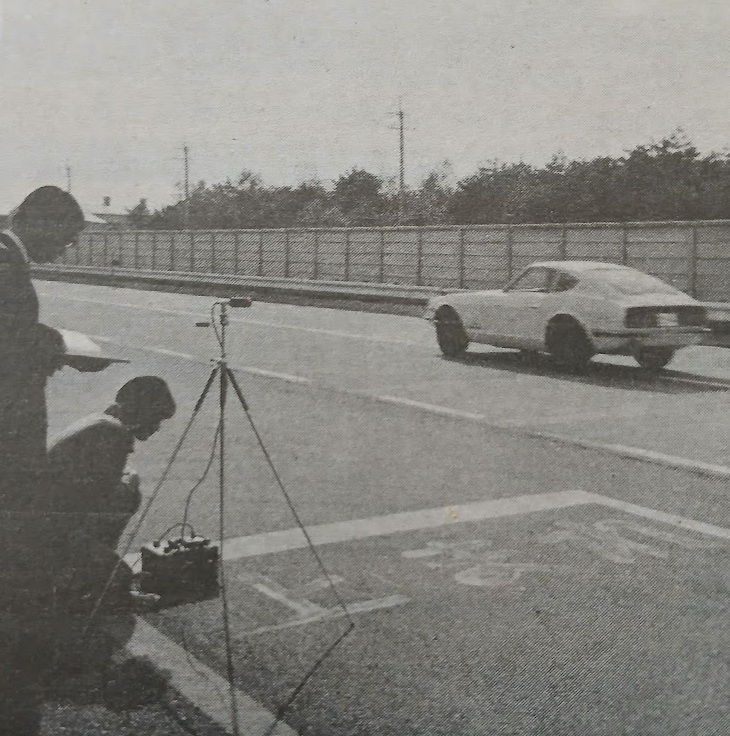
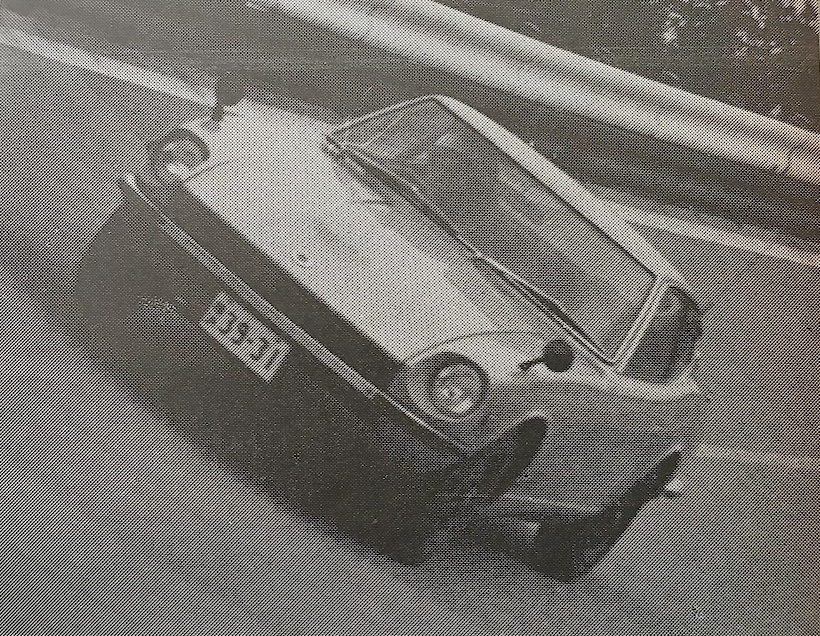
Nissan Fairlady Z432 (1970)
Publication: Motor Fan
Format: Road Test
Date: January 1970
Author (Roundtable): Hajime Mizutsu, Osamu Hirao, Kazumi Yotsumoto, Kenji Higuchi, Kuniyuki Tanabe, Yuji Sakakibara, Yasuhei Oguchi, Kunitaka Furitani, Masahide Sano, Taizo Tateishi, Atsushi Watari, Hiroshi Okazaki, Minoru Onda, Mineo Yamamoto, Kenzaburo Ishikawa, Toshihide Hirata, Motor Fan Editorial Staff (uncredited)
With America in Mind
Magazine: First, please tell us about the aim of development for this car.
Mizutsu: The planning for this car dates back to the year before the current Bluebird was announced, the same year the R380 achieved its victory at the Japanese Grand Prix. In that sense, the technical foundations for the Fairlady Z were already in place: the Bluebird’s suspension on the one hand, and the R380’s engine on the other. The project was conceived on that basis.
The brief given to us contained two requirements which were, in a way, opposed to one another. First, the car had to have sufficient inherent capability to compete seriously in racing and rallying. At the same time, it had to provide ride comfort comparable to a passenger car, with enough practicality to be used much like a sedan.
It was also required to be suitable for mass production, which naturally implied a reasonable price and appropriate weight. In addition, it had to be suitable for the American market, which has traditionally been the main market for the Fairlady.
So, while positioning it as a high-performance sports car capable of long-distance touring, we placed emphasis on allowing it to be used for a variety purposes according to varying tastes. For that reason, we decided to offer two engines: the S20 from the R380 as the high-performance unit, and the six-cylinder engine from the Cedric for a more passenger-car-like specification.
For the American market in particular, displacement was increased to 2.4 liters. This was related in part to U.S. emissions requirements, but also for reasons of production commonality. We export a considerable number of Bluebirds to the United States, and the L24 has the same bore and stroke dimensions as the 1.6-liter engine, allowing a high degree of component sharing.
At the beginning, there was a fair amount of uncertainty regarding the body configuration–whether it should be open or closed, and whether to make it a two-seater or four-seater. However, as expressways continue to develop, vehicle speeds will naturally rise and the distances traveled will grow longer. In such an environment, a convertible does not always offer the greatest comfort. Issues of noise, airtightness, and the effectiveness of heating and ventilation–in short, overall livability–become increasingly important. Rollover safety was also considered, and for these reasons we decided on a closed body. As for seating capacity, market research in the United States indicated that two seats would be sufficient.
Strut-type suspension was adopted at both the front and rear. At the front, the strut was chosen for its lateral rigidity, while also allowing a certain degree of fore-and-aft compliance to address harshness. At the rear, the two-seat layout permitted sufficient height to incorporate the strut towers in the interior. This configuration minimizes camber change, virtually eliminates axle steer, and can even bring the jacking tendency in cornering into the negative range. From the standpoint of stability, it offers considerable latitude in tuning.
Regarding the steering, the rack-and-pinion gear is shared with the Laurel, but the overall ratio has been made more direct. Lock-to-lock is 2.59 turns, resulting in improved response.
As for ride comfort, the spring rates differ between the Z432 and the Z equipped with the Cedric-based six-cylinder engine. The standard Z uses the same spring rates as the Bluebird, while the Z432 is set firmer in the interest of improved handling and running performance.
In this way, we began with two principal goals, and sought to offer a choice of engine and suspension specifications in order to appeal to a broad range of users. I would say that reconciling these factors was the central issue in the planning stage.
At present, we have a production capacity of 2,000 units per month, of which approximately 1,500 are planned for export and 500 for the domestic market.
Hirao: Will this be produced in parallel with the previous Fairlady?
Mizutsu: Yes, production will continue in parallel. Market research in the United States indicates that there remains demand for open cars, so rather than changing over all at once, we intend to observe the situation for the time being.
A Style Typical of Mass-Produced Sports Cars
Hirao: How would you describe this styling?
Yotsumoto: At the outset, when we began considering the design, it was unclear which direction we should take. We debated whether to pursue an overtly aerodynamic form, something more overtly “hot,” or perhaps a specialty car in the manner of the Mustang. We even began exploring the Mustang-like direction at one stage. In the end, however, we concluded that it would be best to proceed with a genuine sports-car image.
As a sports car, we felt that an aerodynamic visual impression would naturally become one of the central themes. Small-scale models were made and examined by aerodynamic specialists. The overall length of the car and strictly aerodynamic principles do not necessarily match, but from the standpoint of image, that was the direction we chose.
One of the more difficult aspects concerned the relationship between bumper height and the angle of the nose, as well as regulations governing headlamp height. A major theme became how to reconcile legally mandated safety dimensions with an appearance that could still be considered attractive.
In a sports car intended to look low and long, regulatory dimensions present quite a constraint. From the standpoint of more advanced experimental cars, such as the Mercedes C111 or the Lotus Europa, this car may be regarded as somewhat conservative. However, when one considers production realities and regulatory requirements, I believe its style represents a typical example of the contemporary mass-produced sports car.
If we view it within the broader shift in styling–from the flowing, streamlined shapes of the past to the cut-off tail and wedge forms of the present–then this car may also be seen as typical of the times. During development, we also examined more overtly “hot” proposals, but when mass production and export to the United States were taken into account, it was only natural that the design would settle in this direction.
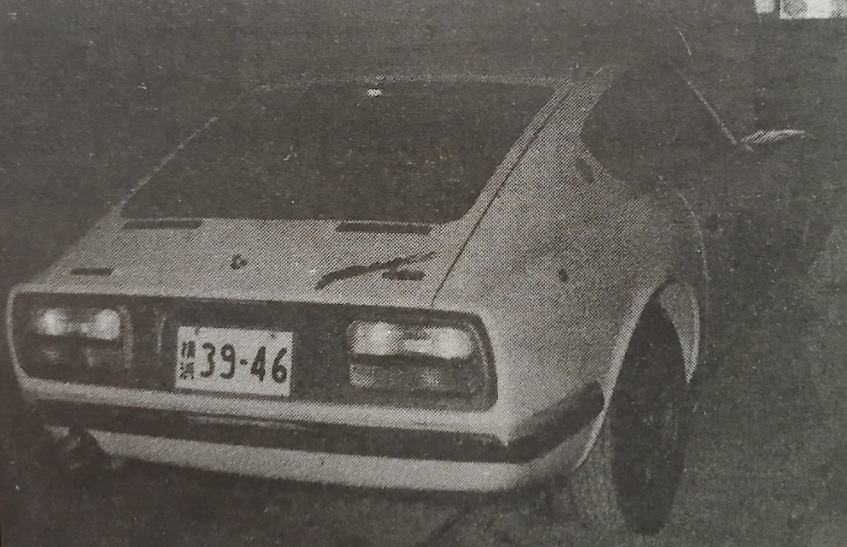
Higuchi: The version shown at the Motor Show had something like a rear spoiler attached, which looked quite good.
Yotsumoto: From a styling standpoint, I feel that a spoiler is best treated as an optional item for a sport version. Moreover, since the car was developed primarily for export, the roofline has been set generously high, so there isn’t enough room in the slope of the fastback to incorporate a proper ducktail.
Watari: Is it possible to enlarge the glass area in the doors somewhat? If the window sills were a little lower, you could lean your arm out more comfortably.
Hirao: As it is, it feels a bit like sitting down in a well.
Yotsumoto: It may be that the seat is positioned slightly too low. Actually, the seat is adjustable for height.
Considering a 2+2
Magazine: As for the possibility of a 2+2…
Mizutsu: Regarding a 2+2, we feel it would be best to wait and see for a while. There do seem to be many voices domestically expressing interest in such a version. If the numbers were to reach a certain level, then it might be possible to consider it further–that is how I see it at present.
Magazine: Is it feasible in terms of styling?
Yotsumoto: The biggest issue is head clearance in the rear seats. I think it would be quite difficult, to be honest.
Mizutsu: And the strut towers are positioned right where the seat would be, so that presents another difficulty…
Tanabe: We did examine it from a design perspective. However, after doing some research, we found that even the Jaguar E-type 2+2 is not seen in great numbers in America. In Japan as well, actual purchases are not especially common. In the end, the question is whether buyers–particularly in the United States, which we regard as the primary market–truly want a 2+2, given the emphasis on individual character in such cars.
There is also the issue of whether a 2+2 that complies with Japanese regulations can be given an attractive shape. Overseas, a 2+2 is often understood as a car that can technically accommodate rear passengers, if not practically. Here, however, approval requires a seat width of 400mm per occupant and seat height to specified standards. If one observes those requirements properly, the result becomes quite a large car…
Magazine: Now, please tell us a bit about the engine.
Sakakibara: The basic structure of the engine is that of the R380 unit. It has been modified with considerations such as ease of production, installation within the car, serviceability, and maintenance. At the planning stage, the Skyline 2000GT-R and this Z series were being developed almost simultaneously, so the engines were made largely the same. However, certain changes were required due to differences in vehicle character and installation layout. Specifically, external components such as the shape of the oil pan and the air cleaner are different.
Oguchi: There is a considerable difference in price between the standard Z and the Z432. How much of the difference is due to the engines themselves? I have heard that even the wheel discs–made of magnesium versus steel–cost something like 50,000 yen each…
Mizutsu: The Z432 engine costs approximately three times as much. That reflects both production volume and the fact that it is very close to being a tuned unit.
Sakakibara: It is an engine that involves a great deal of hand work, built with a relatively high level of manual finishing. For example, certain aspects are finished to tolerances beyond ordinary machining standards, which naturally requires additional man-hours. We also manufacture it with the intention of making it easier for owners to tune it in the future. I believe these factors contribute to the higher cost.
Magazine: What is the production volume?
Tanabe: We receive orders for several dozen units per month. Given the price, we do not expect demand to be especially high.
For “Second Youth”
Magazine: Now, please tell us the results of the power performance.
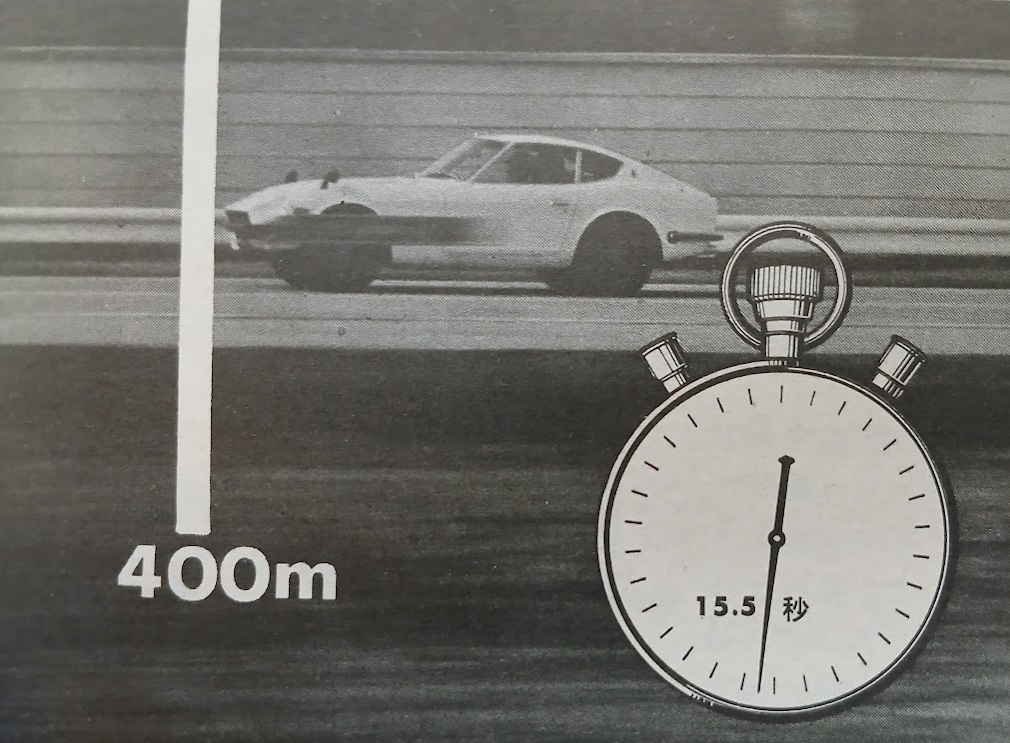
Furutani: First, in the time-to-distance acceleration tests, it took 4.0 seconds to reach 50m, 6.3 seconds to reach 100m, 9.8 seconds to reach 200m, and 15.5 seconds to reach 400m. In terms of time to speed, it took 2.6 seconds to reach 40km/h, 3.8 seconds to reach 60km/h, 6.3 seconds to reach 80km/h, 8.7 seconds to reach 100km/h, 11.7 seconds to reach 120km/h, and 15.3 seconds to reach 140km/h.
For overtaking acceleration, from a speed of 30km/h in third gear, it took 1.9 seconds to reach 40km/h, 4.6 seconds to reach 60km/h, 7.8 seconds to reach 80km/h, 11.0 seconds to reach 100km/h, and 15.2 seconds to reach 120km/h. From 40km/h in top gear, it took 2.9 seconds to reach 50km/h, 4.9 seconds to reach 60km/h, 9.2 seconds to reach 80km/h, 14.5 seconds to reach 100km/h, and 19.6 seconds to reach 120km/h.
The 0-50m time of 4.0 seconds matches that of the Skyline GT-R, and the non-slip differential works very effectively, giving excellent traction off the line.
Magazine: How about the fuel economy?
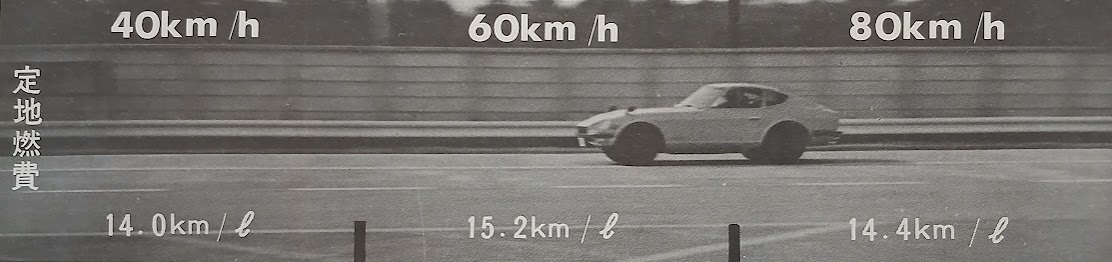
Sano: Constant-speed fuel economy was measured at 14km/l at 40km/h, 15.2km/l at 60km/h, 14.4km/l at 80km/h, 12.8km/l at 100km/h, 11.1km/l at 120km/h, and 9.4km/l at 140km/h. The most economical speed is around 60km/h, but even at highway speeds the drop-off isn’t too severe.
In the practical fuel economy test, when the target speed was 40km/h, the result was 7.1km/l with an average speed of 22.1km/h. When the target speed was 60km/h, it was 6.5km/l with an average speed of 26.2km/h.
Magazine: And the ride and noise results from the Watari Laboratory?
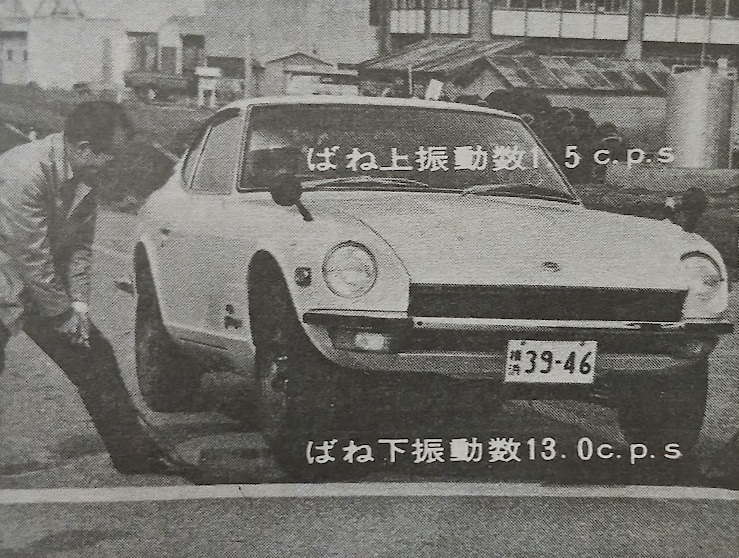
Tateishi: First, in terms of suspension vibration frequency, the vibration frequency is 1.5cps for the sprung mass and 13cps for the unsprung mass.
Interior noise was 65 phons at 40km/h, 67 phons at 60km/h, 72 phons at 80km/h, 75 phons at 100km/h, 79 phons at 120km/h, 84 phons at 140km/h, and 84 phons at 150km/h.
External noise while driving in second gear was 74 phons at a steady 50km/h and 81 phons when accelerating through 50km/h, with background noise at 46 phons.
Watari: Evaluating the sound character of this car depends on how it will be used. For long-distance cruising, the sound level feels a bit high. On a circuit, it wouldn’t matter. There are some peaks in the noise, though, so if those were smoothed out, the overall level would feel less intrusive even if it’s technically louder.
Magazine: The ride is quite firm. Are any optional suspension settings available?
Mizutsu: We simply adjust the spring rates to match the engine.
Tanabe: The car is aimed at grand touring as well. When we asked what kind of people drive sports cars in the US, we were told that young couples of course drive them, but later they have children, and a sports car becomes impractical. So they move on to larger station wagons, but when their children grow up and leave home, they’ll often want to enjoy their “second youth.” At that time, a sports car becomes appealing again.
At that point, you want a two-seater where you don’t have to carry extra people and your privacy is respected. So, in that sense, the idea was to create a car you could drive when that “second youth” arrives (laughs).
Magazine: Although we did not conduct any instrumented handling or stability tests this time, stability is said to be good with the rear strut-type suspension.
Oguchi: The strut is positioned ahead of the rear axle in this car. How would stability differ if it were mounted above or behind the axle?
Hirao: I don’t think you can say in general.
Tanabe: The main idea was to avoid having the struts protrude too high and intrude on interior packaging… it didn’t really have anything to do with handling.
Mizutsu: We worked on the geometry, such as the height of the differential and the strut-side link angle, to see where we could minimize the camber change… we’ve set it up with the characteristic that it sinks into the corner when you turn in.
Exceptional Cornering
Okazaki: We pushed it as far as we could on the Murayama test course, with the speedometer reading speeds up to 200km/h. Even at that speed, when you swing it left and right, it settles nicely, and I felt it was quite stable to drive. That said, if you compare it to the sharp handling characteristics of the SP and SR Fairladys, which are pure sports cars, I’d say the Z series’ handling characteristics lean more toward stability than agility, maybe a 60/40 ratio of stability to responsiveness. Considering the car’s character, I actually think that’s a good balance.
Tanabe: Back in the SR days, our goal was to increase the number of people racing, so we designed it as a car that could be used in amateur races without much preparation. Over time, that was the way it was used, both domestically and in the US. However, market research in the United States showed that about 20% of the users were women. This created a dilemma, in that if we made the suspension too stiff, it wouldn’t be suitable for everyone, and at the same time, if we made it only somewhat stiffer, it wouldn’t be hard enough for serious racing. It would be a classic case of “too short for the sash, too long for the belt"–in other words, not suitable for either purpose. Ultimately, we decided that if we made it any harder, it would not be marketable to general users, so we stopped trying to make it stiffer and instead focused on making it softer as more of a specialty car.
However, although it has not yet been released, we are planning to offer much stiffer springs as an option for the “Z432R.”
Okazaki: I thought the steering response at high speeds was good, but there was a sense of elasticity that I found a little unpleasant…
Tanabe: I think it is partly because of the tires, but when used for racing, the rigidity of the rubber in the steering link is increased, so that may be why the street model has a softer feel.
Watari: I think it could be made a little better by choosing the stiffness of the suspension material more carefully.
Mizutsu: We could stiffen the upper part a bit more, but that would affect harshness and make the ride less comfortable, so we’ve kept it a little softer.
Tanabe: The springs of the Z432R are 5.5kg/mm in the front compared to the standard 1.8kg/mm, and 5.6kg/mm in the rear compared to 2.1kg/mm. The front dampers are also stiffer, with 130kg on the rebound side compared to the standard 35kg, and 90kg on the compression side compared to the standard 20kg. The rear dampers are also very stiff, with 120kg compared to the standard 80kg on the rebound side, and 85kg on the compression side compared to the standard 20kg. When combined with tires with high lateral rigidity, it becomes a car with very good handling, suitable for circuits.
Okazaki: The 432’s engine is quite heavy. Does that cause excessive understeer on the track?
Tanabe: It depends on the stabilizer settings to some extent, but there’s a tendency toward slight understeer. When running this car at Fuji Speedway, even without any modifications, our race drivers found that compared with a tuned SR311 Fairlady, it’s a little slower on the straights, but cornering is very easy, and you can really pull through the turns.
Tall Interior Height
Magazine: Next, please present the data from the Higuchi Laboratory.
Onda: In terms of dimensions, it’s very similar to the Toyota 2000GT. The overall length is a little shorter, the height slightly higher, and the width a bit wider. The interior was designed with the American market in mind, and the headroom is also quite high at 1045mm. The seats hold the body well, giving a snug, enveloping feel.
Yamamoto: Are the magnesium wheels die-cast?
Tanabe: No, they’re conventionally-cast. We don’t make many of them.
Yamamoto: How much do they weigh?
Tanabe: About two-thirds the weight of steel wheels.
Okazaki: I’m a bit on the thin side, with an average height, and the shape of the seat itself is fine, such as the support around the lower back and the curve of the seatback. But perhaps because the seat is tailored to the American market, it feels loose when I sit in it–very spacious, almost too much so. If enough units are sold domestically, I’d like to see seats that fit us more snugly… (laughs).
Watari: They fit me perfectly (laughs). However, the headrests get in the way when backing up, so I think a retractable type would be better.
Repeated Crash Tests
Magazine: Professor Higuchi, please tell us about safety.
Higuchi: Our scoring system is mainly designed with sedans in mind, so a sporty car like this naturally gets lower scores in some areas. For example, if the bumpers were wider and stronger, the score would be higher. This is purely a visual assessment, so we don’t know about the effectiveness of things like collapsible or breakaway parts, since we don’t actually crash the car. But if something looks dangerous, it gets slightly lower marks. For instance, the front grille is pointed, so it scores one point lower. Everything else is at least average. Overall, the car scores 89 out of 100. That’s slightly below the 92-93 points typical for a 2-liter sedan.
Tanabe: We’ve actually crash-tested this car quite extensively. We’ve crashed about 60 cars, including prototypes and pre-production cars. As for the issue of collapsible and breakaway parts, we paid a lot of attention there and did quite a bit of testing.
Ishikawa: In a real crash, say at 30mph (48km/h), how far would the steering wheel be pushed inward?
Tanabe: We gave it a long nose partly with aerodynamic considerations in mind, of course, but from a safety standpoint, it also serves the purpose of absorbing energy. For that reason, we have not made it too rigid to absorb an impact. The steering shaft is also staggered midway for this reason.
Higuchi: The steering wheel is also energy absorbing, isn’t it?
Tanabe: Yes, it’s a collapsible, lantern-shaped type.
Magazine: Next, let’s look at the weight and capacity data from the Funaken Ship Institute.
Ishikawa: Starting with vehicle weight, with a spare tire, tools, and the fuel tank filled to about 80% (the capacity is 60 liters), the car was 1,075kg. The distribution is 557kg for the front wheels and 518kg for the rear wheels, which is a ratio of 52:48. With two people on board, it becomes nearly 50:50.
The right front wheel is about 35kg heavier than the left, which I think is due to the fact that it will be left-hand drive when exported. As for the alignment, the toe-in and camber are quite strong, but they decrease when two people are on board. The rear also had a strong toe-in, but the camber was almost zero.
The brakes are discs at the front and leading-trailing drums at the rear, arranged in a dual-circuit system with a servo booster. In addition, the rear brakes are fitted with a pressure control valve. In short, all the appropriate elements are in place.
The hydraulic pressure regulator begins to operate at about 10kg of pedal effort, corresponding to roughly 0.3g deceleration. The servo’s rest point appears to be around 20-25kg of pedal effort, or about 0.5g. As a result, the pedal effort to obtain 0.6g deceleration is somewhat high, coming in at 33kg under test conditions. On the road, however, this was lighter, at about 26kg for 0.6g.
Brake force distribution at 33kg of pedal effort was 66:34 front to rear. There was a slight left-right imbalance at the front, despite the use of discs, but the rear brakes were well balanced.
The parking brake operates mechanically on the rear wheels. Left and right braking forces were well matched. A force of 27kg was required to generate braking equivalent to 20% of total vehicle weight. The ratchet mechanism was very effective, and with 30kg of effort the car could be held on a 1-in-5 gradient.
As for control efforts: the gear lever is light, requiring about 2kg. The clutch requires 12kg to disengage and 8.5kg to engage, which are ordinary values. The accelerator requires 0.5kg to maintain a constant 50km/h, and roughly 3kg under hard acceleration.
Okazaki: The braking performance itself is extremely good. Slowing from 130-140km/h down to 100km/h seems to happen in an instant.
Ishikawa: The parking brake is also auto-adjusting, correct?
Tanabe: That’s right. When you pull the handbrake, the rear brakes are automatically adjusted.
Magazine: What do you think of the Porsche-synchro transmission?
Oguchi: I like it personally, but some people don’t, and want a more definite, crisp feeling.
Watari: Isn’t the gear lever a little too long to hold at the top? However, I suppose if it were shorter, it would become heavy.
Tanabe: The Porsche synchro does tend to become smoother with use.
Magazine: Did you ever think about putting the SR Fairlady’s four-cylinder engine in the Z series?
Mizutsu: At the beginning, the plan did call for a four-cylinder. However, the idea was not only to make the car “hot” in performance, but also to improve quietness and ride comfort. In the course of development, we decided to go with a six-cylinder instead. For now, we are not considering a four-cylinder.
Magazine: Finally, can you tell us about the field of view?
Hirata: With the seat in the center of its sliding range, the height of the eyepoint was measured at 106.9cm. The distance to the windshield was 56.5cm, and to the rearview mirror 55.5cm.
At that position, the visible range through the windshield is 90.5° degrees horizontally (combined left and right) and 26.5° vertically. The rear window provides 46.0° horizontally and 13° vertically. The wiper sweep covers 74.5°.
The total blind angle in the horizontal plane, including the eyepoint, equals 56°. Expressed as solid angle, the forward field from the eyepoint is 1.08 steradians; the interior forward glass area accounts for 0.641 steradians; and the wiper sweep covers 0.46 steradians, or 64.9% of the visible area.
Rearward visible area measures 11.7 steradians. For a car of this type, that is to be expected, but overall visibility is slightly below average.
Magazine: Thank you all very much.
Postscript: Story Photos