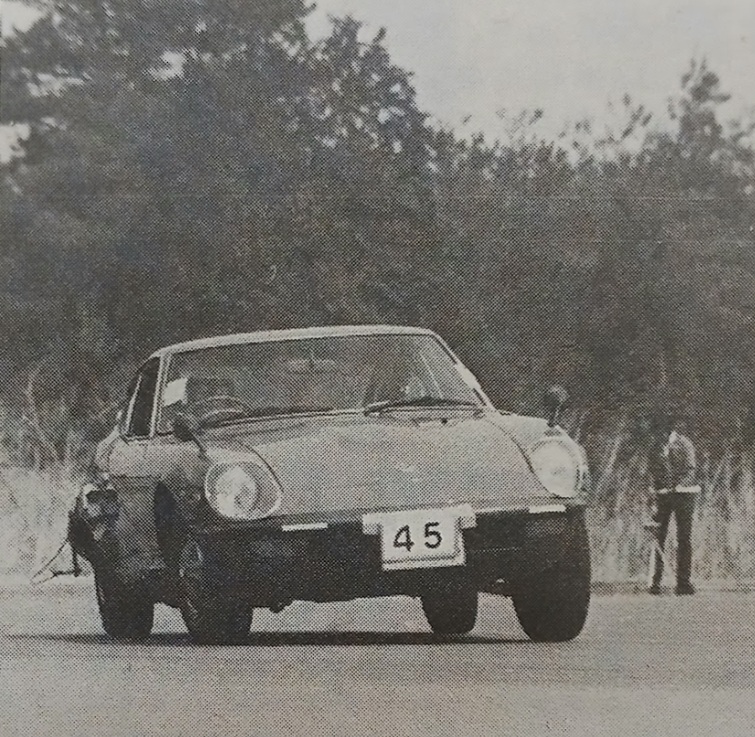
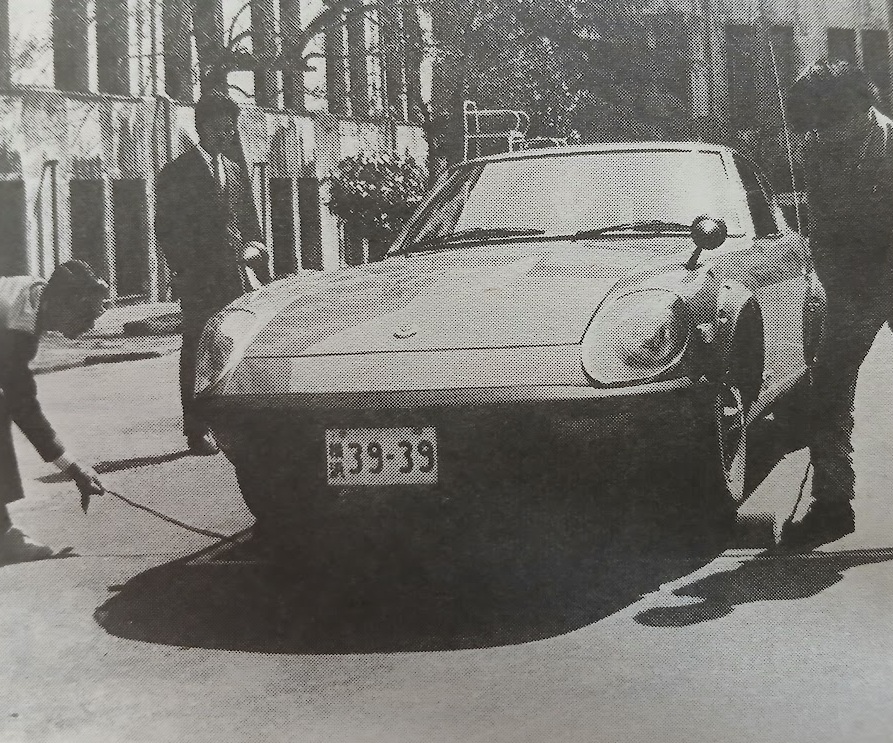
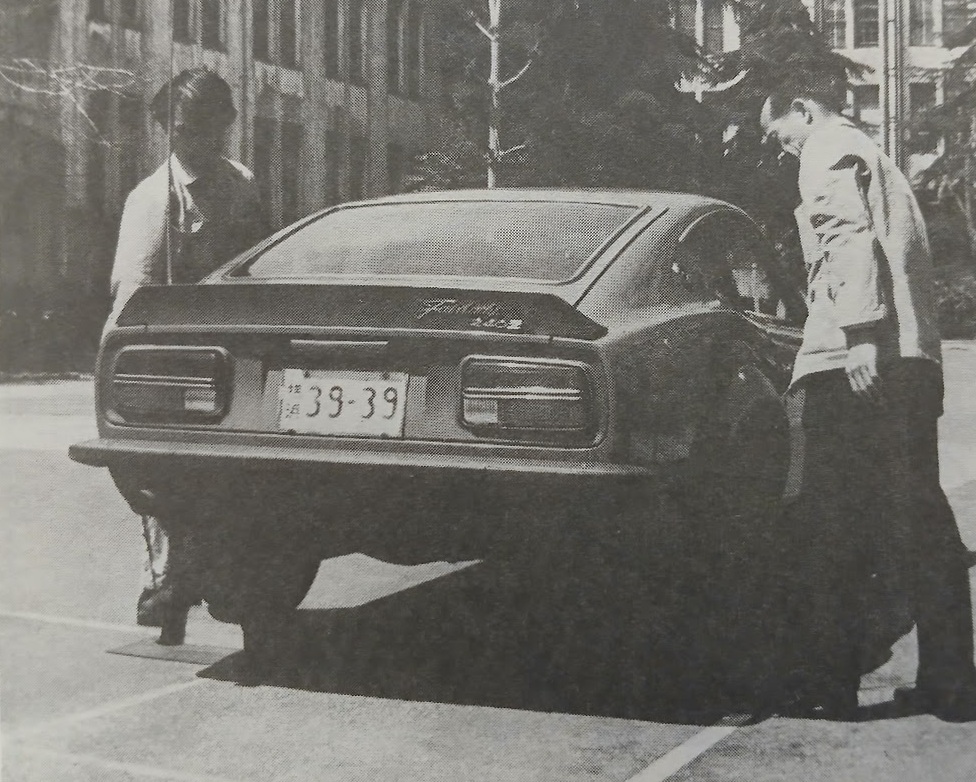
Nissan Fairlady 240ZG (1972)
Publication: Motor Fan
Format: Road Test
Date: November 1972
Authors (Roundtable): Hajime Mizutsu, Yasuhei Oguchi, Osamu Hirao, Michio Takei, Atsushi Watari, Hiroshi Okazaki, Yasuo Ishikawa, Hiroshi Hoshijima, Kenzaburo Ishikawa, Kunitaka Furutani, Masahide Sano, Katsuzo Kageyama, Taizo Tateishi, Takeshi Toba, Minoru Onda, Fusaki Inosaki, Motor Fan Editorial Staff (uncredited)
Leader of the Mass-Produced Sports Cars
Magazine: First, could you give us an overview of the Fairlady ZG?
Mizutsu: Let me begin with the background behind the introduction of the Fairlady 240Z.
The Z first went on sale in October 1969, and to date we have sold approximately 100,000 units. Of those, roughly 80-90% have gone to the American market. Export models were fitted with the 2.4-liter engine from the beginning.
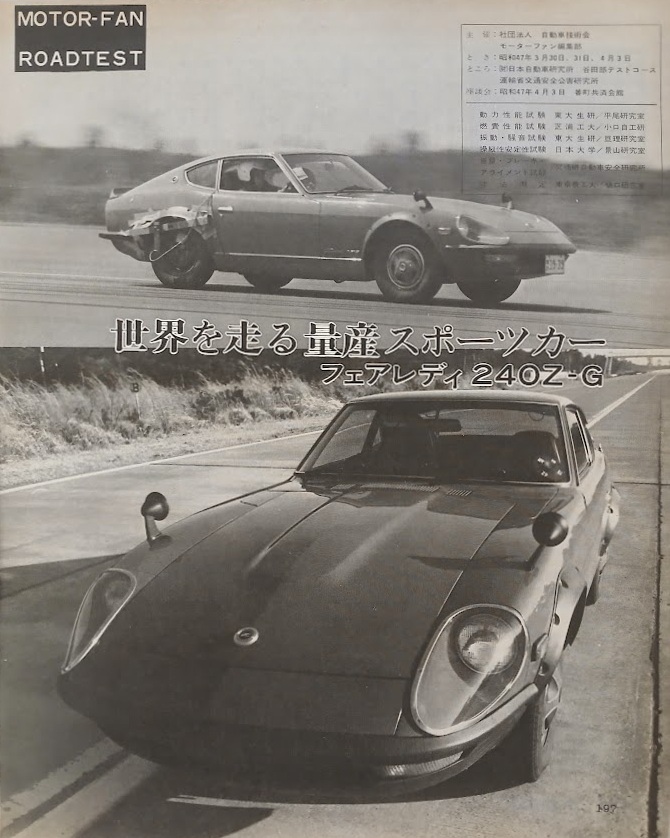
As a result, the name “240Z” first became familiar overseas, and later there was strong demand for it in Japan as well, leading us to introduce it domestically in November of last year. Within the 240Z lineup, the ZG model is distinguished by the addition of an Aerodyna Nose at the front, which was developed to improve high-speed stability and other performance characteristics. The range consists of two models, the second being the automatic-transmission version.
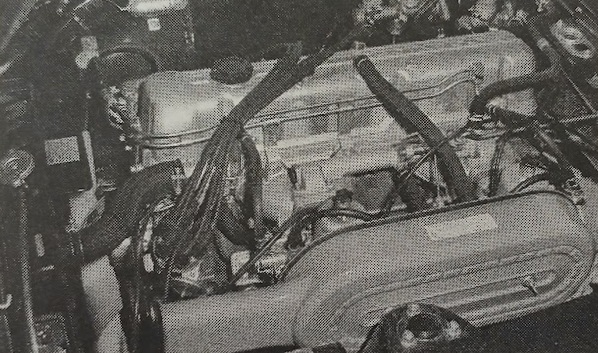
The engine displaces 2393cc. Starting with the twin-carburetor L20 engine previously offered in the Japanese-market Z, we created an enlarged, long-stroke unit with bore and stroke dimensions of 83 × 73.7mm.
To take advantage of production economies, the pistons and certain block components are shared with the 2.6-liter Cedric engine introduced last year–the L26, with an 83 × 79mm bore and stroke. The result is the L24 engine fitted to the 240ZG. All models are designed to run on regular-grade gasoline.
We have also revised the SU carburetor system. The previous exhaust-heated arrangement has been replaced with a hot-water-heated system, making carbon monoxide emissions less sensitive to changes in outside temperature. Our target is to maintain CO levels at a consistent 3%.
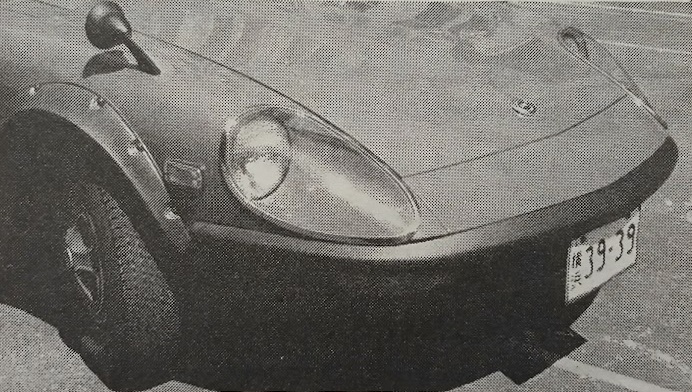
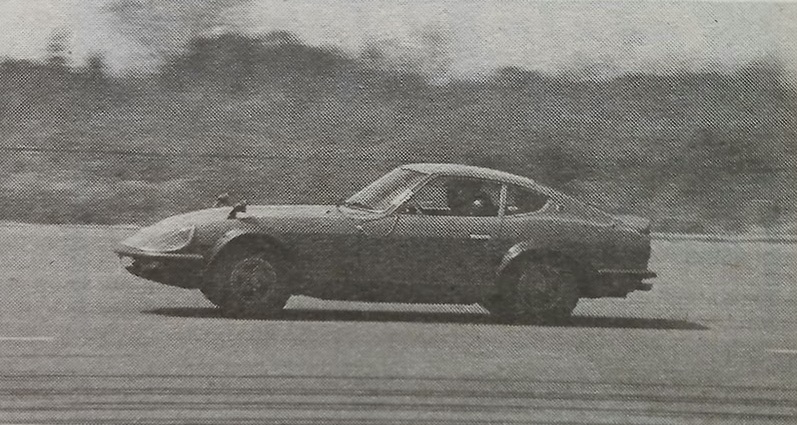
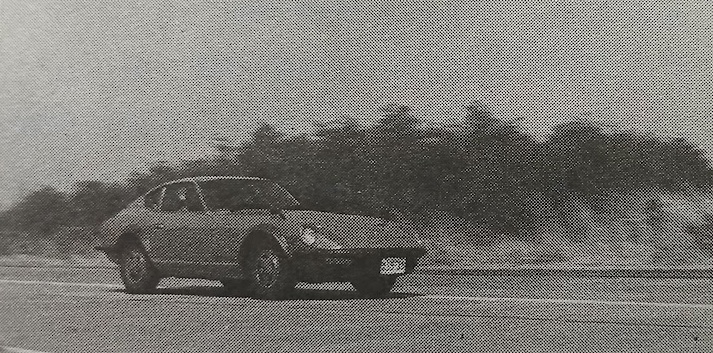
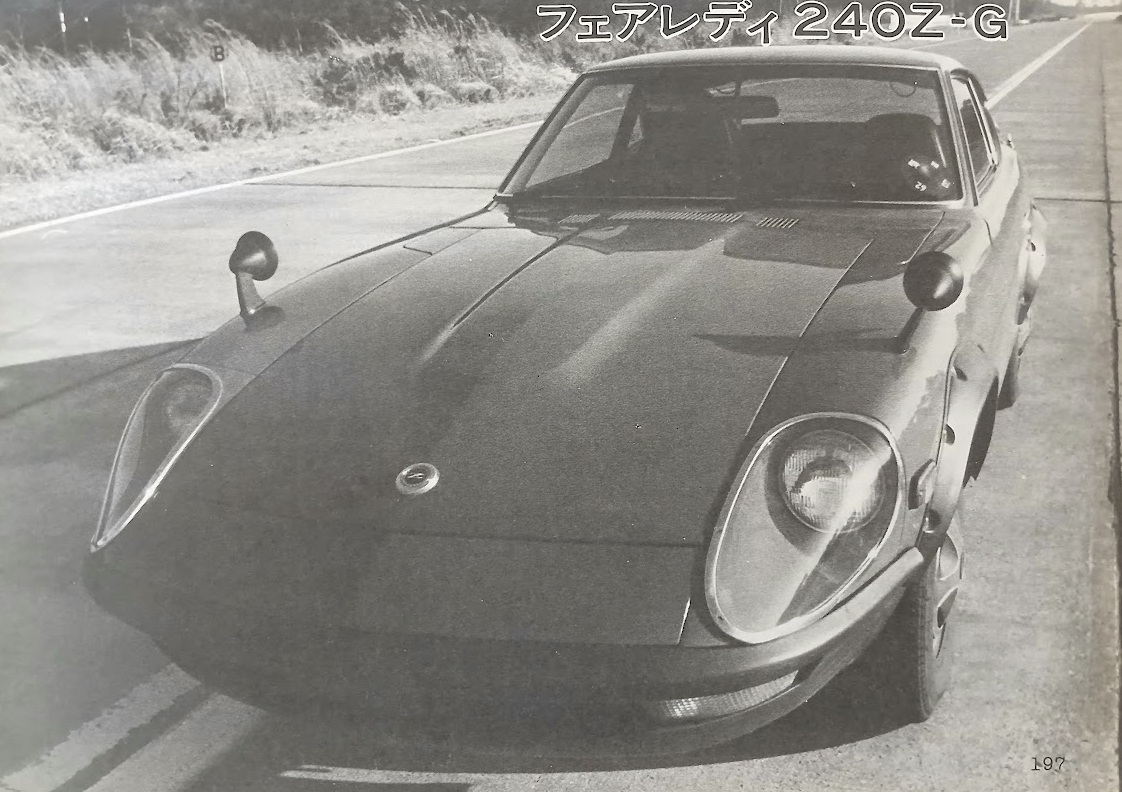
The most significant body change compared with previous Z models is at the front end. The hood itself is unchanged, but the Aerodyna Nose extends approximately 190mm farther forward. This nose is molded from polyester-based FRP, and the front overfenders are also made of FRP.
As a result of the overfenders, overall width has increased by 60mm to 1690mm, while overall length has grown by 190mm to 4305mm.
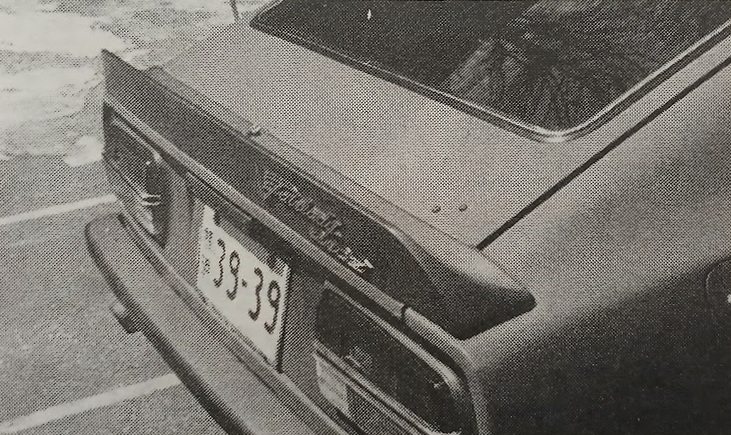
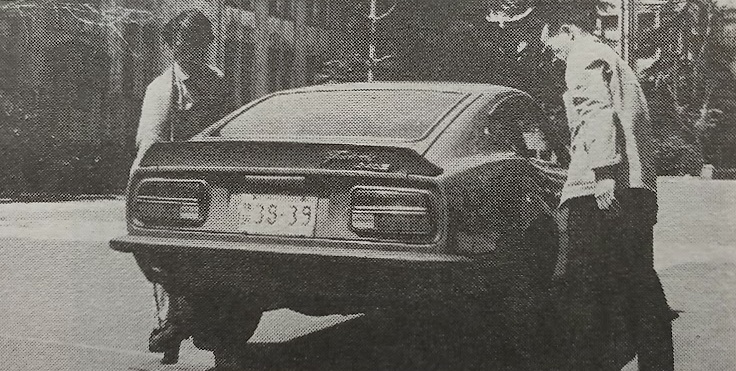
The front and rear bumpers are both urethane rubber units reinforced with metal cores. A rear spoiler, as equipped on the car provided for this test, is available as an option.
There have been no major changes to the chassis itself, though a number of measures have been incorporated to reduce noise and vibration.
First, the fore-and-aft offset in the rear independent suspension’s driveshaft arrangement, previously 35mm, has been reduced to zero in order to eliminate vibration caused by that offset. In addition, the engine’s rear support has been changed to a dual-isolation mounting system.
A 5-speed transmission is fitted as standard. It uses Porsche-type synchromesh, and fifth gear is an overdrive ratio.
The suspension and brakes are unchanged from before.
All models use 5J × 14-inch rims fitted with 6.45H-14 4PR tubeless tires.
As for emissions equipment, in addition to the carburetor revisions I mentioned earlier, a closed-type blow-by gas recirculation system has been adopted.
Oguchi: In Japan, the Fairlady is virtually the only true sports car available. Looking at it from a global perspective, however, and considering that production has already reached 100,000 units, where would you place it among the world’s sports cars in terms of production volume?
Mizutsu: In terms of mass production, it’s at the very top. There really isn’t anything else comparable.
Hirao: I wonder how it compares in terms of total production to date. If it’s still at the top by that measure, that’s quite an achievement.
Mizutsu: We built 6,000 cars in April, making this the first sports car to exceed the 6,000-unit mark in a single month. Of those, 5,500 went to the United States, with the remainder serving domestic demand.
The engine shares components with the Cedric, the suspension shares components with the Laurel, and only the body is entirely new. Given that approach, I think it’s fair to say it’s number one when it comes to mass production.
Hirao: You must not be able to stop smiling these days.
Watari: Looking at the figures alone, the Z432 and this ZG don’t seem all that different in terms of performance. The main difference appears to be engine size. Why is that?
Takei: The Z432’s engine is essentially a detuned racing engine. It uses a highly sophisticated 4-valve design, and its torque curve is very peaky, which can make it difficult to handle.
The 240Z, on the other hand, has an exceptionally flat low-speed torque curve and is very easy to drive. The two cars simply have different characters.
Hirao: That’s certainly true. The 240Z is very easy to drive.
Watari: Even so, isn’t there some criticism that it runs out of breath at high speeds?
Mizutsu: We hardly ever hear that in America. In parts of Europe, though, there are some who say they’d like a little more.
Watari: That’s unavoidable to some extent. Gear ratio selection plays a role in that as well.
Hirao: The redline starts at 6500rpm, doesn’t it? So it will rev fairly high.
Takei: It can be taken to around 7000rpm without any trouble.
Watari: In that respect, it felt like a very usable sports car.
Okazaki: I think the power is entirely adequate. My only reservation is the feel of the engine in the upper rev range.
I’ve always had the impression that Nissan’s L-series engines aren’t particularly happy at high rpm. If it could spin a little more smoothly, from a subjective standpoint, I’d have no complaints at all.
Oguchi: With a Mercedes engine, to put it somewhat dramatically, the tachometer needle seems to start climbing before your foot has even finished pressing the accelerator.
Takei: Well, this is still an engine that’s used in cars like the Cedric, so inevitably…
Hirao: How about the automatic-transmission version? What’s the situation in America?
Mizutsu: It appears that automatics are actually more popular there. People don’t necessarily use the car purely as a sports car.
Hirao: In that case, would there be an argument for making the springs a little softer?
Mizutsu: We believe we’ve already softened them quite a bit, but apparently not enough. (laughs)
Takei: If we softened them any further, the car’s character would suffer. Cornering speeds are inevitably higher in a car like this, and body roll would become excessive. It would simply be too dangerous. We’ve already reached the practical limit.
Aerodynamics That Complement the Styling
Magazine: Was a separate specification developed for the European market?
Ishikawa (Yasuo): In terms of styling, it’s basically the same as the American-market version. However, front and rear spoilers are fitted as standard.
The front spoiler is a fairly large piece made of flexible FRP, while the rear spoiler is the same design fitted to the test car here today.
European customers are also much more demanding when it comes to crosswind stability, and cruising speeds can easily be twice what is typical in North America. To cope with those conditions, the suspension has been stiffened further. Front and rear stabilizer bars are fitted, and the springs are firm enough that some might call them rock-solid. In addition, the spoilers and other aerodynamic devices are used to further improve aerodynamic performance.
Watari: Having driven it, I’d say the ZG is about as firm as you’d want to go for Japanese roads. It gives the impression that you couldn’t really take it any further.
Magazine: We’ve heard that the Aerodyna Nose has a significant aerodynamic effect.
Watari: The ZG may well be the first Japanese car to integrate that kind of aerodynamic treatment so successfully into the styling.
The theory and experimental results have long shown that reducing lift improves stability. Even so, I’d imagine the effects at the front and rear are quite different.
Takei: Wind-tunnel testing shows that fitting only the nose section reduces drag by about 15%, and rear lift drops by less than 10%.
Add the rear spoiler, however, and it can actually generate negative lift. The effect is very significant. Without the rear spoiler, you don’t really achieve the full aerodynamic benefit of the package as a whole.
Okazaki: If the car is left as it is, without a front spoiler, front-end lift becomes quite pronounced.
From around 130-140km/h onward, you can clearly feel the nose beginning to float. By 160km/h, steering feel changes noticeably. It made me think that the European-spec front spoiler would be a worthwhile addition.
Hoshijima: By chance, I was able to alternate between the long-nose version and the standard car while driving, and the difference was obvious. The long-nose car handles better.
You can really feel the increase in front-end grip.
Takei: The difference is quite clear. In terms of front lift, the nose-equipped version reduces it by roughly 50% compared with the original design.
Oguchi: That’s an enormous difference.
Ishikawa (Ken): It was very windy at Yatabe, and I came away thinking the car might be somewhat vulnerable to crosswinds.
It felt rather unsettled.
Takei: In the gusts we had that day, any car would have been blown around.
And with a ZG, drivers naturally tend to travel faster than they would in an ordinary car. When you’re cruising at 130-150km/h and suddenly encounter a strong crosswind, it’s bound to get your attention.
Oguchi: I drove it in that same strong wind and even tried a hands-off test up to around 160km/h. The car didn’t seem to deviate from its course all that much.
My impression was actually that it handled crosswinds quite well.
Ishikawa (Ken): The verdict in our laboratory wasn’t quite so favorable. The feeling was that a car this expensive shouldn’t be wandering around as much as it did. (laughs)
Takei: One characteristic of this car is that if you grip the steering wheel too tightly, you’ll actually end up making it wander yourself.
It’s better to hold the wheel lightly and let the car follow its natural course.
Hirao: It uses rack-and-pinion steering, and the overall steering ratio is quite quick. The steering gain is high as well, so when a crosswind hits and the driver instinctively corrects for it, the response is magnified.
In that case, it’s not so much an external disturbance as an internally created one. (laughs)
Watari: How far apart are the aerodynamic center and the center of gravity? Is the aerodynamic center ahead of or behind the wheelbase center, and by what percentage?
Takei: It’s about 3% ahead, so the two are very close together.
Watari: Which is advantageous in crosswinds.
Takei: Exactly.
There’s ongoing debate over whether crosswind stability is governed primarily by yaw behavior or by side force, but the factor that corresponds most closely with what the driver actually feels is yaw moment.
With this car, our objective was to minimize yaw moment as much as possible. I think the result gives a very reassuring feel.
Oguchi: Does the Aerodyna Nose contribute to that?
Takei: Very much so.
When the car passes a crosswind generator during testing, it’s immediately obvious that the version without the nose lifts its front end. Because that lift is accompanied by a sense of roll, the driver perceives it as instability.
Magazine: Is there any possibility of a 2+2 version?
Mizutsu: There is a view that turning a pure two-seater into a 2+2 inevitably dilutes its image, so we have to approach the idea cautiously.
Ishikawa (Yasuo): Weight at the rear is one issue, but packaging dimensions are an even bigger one.
Cars like the Porsche have successfully adopted a 2+2 layout, but even if we created the most compact possible 2+2 version of the Z, we’d still be forced to raise the roofline. The question then becomes whether the resulting shape would remain true to the styling.
Mizutsu: The challenge is how far we can go without compromising the character of the car.
Ishikawa (Yasuo): Japan doesn’t really have a separate 2+2 classification. In practice, it would simply be treated as a four- or five-passenger car.
And if you’re going to seat people in the rear, regulations require roughly 800mm between the seat cushion and the roof. That makes the problem considerably more difficult for a car intended for the domestic market.
Hoshijima: Whenever I sketch one for fun, it ends up looking exactly like the Jaguar E-Type 2+2.
Mizutsu: The Jaguar is often cited as an example that didn’t work out very well, which makes us all the more cautious about the idea…
0-400m in 15.7 Seconds
Magazine: Let’s move on to the performance figures.
Furutani: The standing-start acceleration times were 0-50m in 4.6 seconds, 0-100m in 6.9 seconds, 0-200m in 10.6 seconds, and 0-400m in 16.3 seconds.
Top speed was 204.6km/h over the 400m measured section, although there was a slight tailwind. Around the full 5.5km circuit lap, maximum speed was 192.7km/h.
These figures were obtained with three occupants plus measuring equipment, even though the car is technically a two-seater. For reference, with only two occupants aboard, standing-start acceleration improved to 0-50m in 4.4 seconds, 0-100m in 6.6 seconds, 0-200m in 10.1 seconds, and 0-400m in 15.7 seconds.
With three people aboard, one passenger rode in the rear luggage compartment along with the measuring instruments, which put a considerable load over the rear wheels.
Ordinarily, maximum traction is obtained at a slip ratio of around 50%. In this case, however, the additional load on the rear wheels allowed them to bite into the road before reaching that point. At that moment, engine speed was below the rpm corresponding to peak torque.
I think that, together with the increase in overall weight, affected the results.
Oguchi: Normally, in a powerful car of that class, adding one extra passenger slows the 0-400m time by perhaps 0.2 or 0.3 seconds.
The effect is much greater with small-displacement cars, so I wouldn’t have expected such a large difference in a car of this type.
Hoshijima: That’s generally true. But once a car becomes as quick as this one, perhaps things change.
Oguchi: In that case, weight distribution must be the more important factor.
Takei: In the ZG’s case, yes, weight distribution is crucial.
Because the car’s weight distribution is very close to 50:50, adding another load over the rear axle causes the nose to lift, which also increases aerodynamic drag and results in a noticeable loss.
Oguchi: So in that sense, you’ve placed the center of gravity in a very favorable position.
Watari: That’s why loading baggage in the rear has such an effect.
Magazine: Are there any plans for a fuel-injected version?
Hirao: This is certainly the sort of car that could justify a fuel-injected model.
Oguchi: With fuel injection, there’d be no issue with engine pick-up. The improvement would be dramatic.
Mizutsu: It certainly would. Fuel injection offers extremely good throttle response.
Maybe one day… (laughs)
Magazine: How did everyone find the feel of the Porsche-type synchromesh?
Hirao: In an actual Porsche, you push firmly against the lever and it will always snap cleanly into gear at a certain point.
With this one, you ease it in more gradually.
Hoshijima: The feel is bound to differ because the shift linkage and gearbox location are different. You can’t really expect it to be exactly the same as a Porsche.
Mizutsu: This one has a sort of two-stage gu-, gu- feel, and that doesn’t go over well in America.
American drivers tend to assume that a Porsche-type synchromesh should slip into gear in one clean motion. With this arrangement, once they feel that first resistance, they think the gear is already engaged. That misunderstanding has caused quite a few problems, so we’ve discontinued Porsche-type synchros for the American market.
Takei: Porsche-type synchromesh is very sensitive to the characteristics of the engine it’s paired with.
With an engine like Porsche’s, which has very little rotational inertia and gains or sheds revs quickly, that crisp, rifle-bolt shift feel works beautifully. But with an ordinary water-cooled inline-six like this one, inertia is much greater. Even if you try to shift with that same quick action, it doesn’t work nearly as well, and the synchronizers wear out very quickly.
Japanese drivers also still seem to have a strong preference for the traditional British-style shift feel—something with a definite, mechanical click-click to it.
Hirao: That’s certainly true.
Takei: Which makes it difficult for many people to appreciate the unique character of Porsche-type synchromesh.
And because this design goes into gear so easily, the rate of damage tends to be quite high. For those reasons, we’ve aimed for something of a compromise between the two.
Magazine: How about the fuel-economy figures?
Sano: Constant-speed fuel consumption was measured in fifth gear. At 40km/h, we recorded 13.8km/l; at 60km/h, 15.4km/l; at 80km/h, 14.5km/l; at 100km/h, 13.3km/l; at 120km/h, 11.8km/l; and at 140km/h, 10.0km/l.
For the model-route fuel-economy test, the results were 6.6km/l at the 40km/h indicated-speed setting and 5.9km/l at the 60km/h setting. During the constant-speed portions of that test, we used fourth gear.
The constant-speed figures are notably flat. The best result was 15.4km/l at 60km/h.
Hirao: The fuel tank holds 60 liters, correct? By today’s standards, isn’t that rather small?
Takei: For Japan it’s adequate, but in America or Europe it can seem a little on the small side.
Kageyama: The Skyline GT-R’s tank is 100 liters, isn’t it?
Takei: That’s right. The Z also has a 100-liter tank available as a racing option.
One advantage of the Aerodyna Nose is that it improves fuel economy as well, since aerodynamic drag has been reduced.
Oguchi: That would explain why fuel consumption falls off so little at higher speeds.
Takei: Fuel economy during high-speed cruising has improved substantially.
We have data showing approximately 8km/l at 180km/h.
Passenger-Car-Like Comfort
Magazine: Let’s have the vibration and noise results.
Tateishi: For ride frequencies, the sprung mass measured 1.4Hz at the front and 1.6Hz at the rear. Unsprung frequencies were 14.5Hz at both front and rear.
As for noise, because of the strong winds, exterior noise testing was cancelled and only interior noise was measured. The readings were taken in fifth gear, the overdrive ratio, so the figures may be somewhat lower than they would otherwise be.
The results were 60 phons at 40km/h, 65 phons at 60km/h, 68 phons at 80km/h, 71 phons at 100km/h, and 76 phons at 120km/h.
Watari: A sprung frequency of 1.4Hz is quite soft.
As for noise, the absolute values in fifth gear are close to the lower limit of the evaluation zone. If the measurements had been taken in fourth gear, I think the results would have been better for comparison purposes.
On the other hand, C-weighted readings are normally about 20 phons higher than A-weighted values, but this car’s figures are somewhat higher than that. I suspect there’s a certain amount of high-frequency harshness present.
When it comes to running flat-out in Europe, I don’t think there’s much point in worrying about noise and vibration at those speeds. It’s more important to make the car quiet at the speeds typically encountered in America.
Ishikawa (Yasuo): In practice, that’s exactly what we’ve done.
Takei: Even so, European customers are extremely sensitive to mechanical noise. They associate it with the feeling that something is breaking.
Watari: Yet European cars themselves tend to have fairly high noise levels. Japanese cars are generally quieter in absolute terms.
Hirao: It’s a matter of sound quality.
Magazine: How does it compare with the 2-liter Z?
Tateishi: The 2-liter Z was measured in top gear–that is, fourth–and its readings were about 2 phons higher across the board.
Watari: That would make the ZG quieter.
Then again, one could argue that at around 100km/h you’d naturally be using overdrive, so perhaps these figures are perfectly appropriate.
Oguchi: One thing that caught my attention was a rumbling noise from the rear when lifting off the throttle at around 5000rpm.
Mizutsu: That’s a difficult one to eliminate. We’ve tried a number of things, but so far we haven’t found a completely satisfactory solution.
Watari: If you got rid of that noise, I suspect some other noise would simply appear in its place.
My impression is that, after a great deal of effort, they decided that was the compromise they could live with.
Hoshijima: When this model first appeared in Japan, it produced much the same kind of noise.
The engineers said they understood the cause and expected it would be easy to cure. They worked on countermeasures, but in the end all they discovered was just how difficult it was to eliminate. (laughs)
Watari: That certainly happens. Knowing the cause and being able to fix it are two different things.
Looking at the noise figures, the A-weighted results are good, but the C-weighted values are rather high. The differential noise is definitely prominent.
I suspect it’s a question of the differential mounting.
Mizutsu: We can stop it by using very thick reinforcing plates, but then the car would no longer be profitable. So we’re still working on a solution.
Ishikawa (Yasuo): If we improve the machining accuracy of the differential itself, that noise will be reduced.
So there are two possible approaches: spend more money on the differential, or improve production efficiency and address the problem through the differential-to-body mountings. At present we’re concentrating on the differential machining side.
Watari: That’s right. It would be unfair to expect the body structure alone to solve that problem.
Ishikawa (Yasuo): We’ve been making continual detail improvements since the car’s introduction.
One of the more significant changes was moving the differential 35mm farther rearward. That completely eliminated a vibration that had been noticeable at around 100km/h.
But once the vibration disappeared, the remaining noise became much more apparent.
There are very few cars that operate comfortably over such a broad speed range, and with a noise issue like this, the acceptable compromise differs from market to market.
In America, the maximum speed limit is 70mph (112km/h), and even in a sports car like this, relatively few drivers go much faster. So if you optimize the car for around 70mph, you’ve done most of what is required.
In Europe, however, 100km/h is merely a speed you pass through on the way to something faster. It isn’t regarded as much of an issue. Instead, refinement has to be maintained at speeds approaching 200km/h.
As a result, compromises are sometimes made around the 100km/h range.
Surprisingly Strong Understeer Characteristics
Magazine: Next, let’s have the handling and stability results.
Toba: The practical minimum turning radius is 5.35m on the outside and 2.94m on the inside. Compared with other sports cars we’ve tested so far–the Porsche 911, Mercedes-Benz 350SL, and Toyota 2000GT–the figures are very similar.
That said, even though the numbers are comparable, forward visibility isn’t quite as good. I found myself wondering whether I could place the car accurately through a tight turn.
The overall steering ratio is 16.8. The increase in steering effort is nearly linear all the way to full lock.
At a standstill, steering effort reaches about 15kg at roughly 300° of wheel angle, and exceeds 20kg at full lock. Subjectively, it feels quite heavy.
The roll rate is 3.7°. Since the Porsche and Mercedes mentioned earlier were in the 3.3-3.4° range, this is somewhat higher by comparison. I think that is related to the use of relatively soft springs.
As for understeer/oversteer characteristics, the car exhibits somewhat stronger understeer than is typical for this class.
A notable feature is that the understeer increases almost linearly from about 0.1g to 0.5g of lateral acceleration.
Steering holding force is also on the heavy side, much like the stationary steering effort. It reaches 4.7kg at 0.45g, then shows a slight tendency to decrease beyond that point.
Steering effort measured in the slalom was around 5kg.
Because of the strong winds, we also measured steering correction force while driving straight ahead. Under the test conditions, it reached a maximum of 0.87kg.
We conducted hands-off stability testing up to 130km/h, though the analysis is not yet complete. From a subjective standpoint, however, I think the results are very good.
Kageyama: The defining characteristics of this car seem to be two things: a fairly quick steering ratio, which gives it a sharp response, and very heavy steering effort.
Toba: The car does exhibit a fairly strong degree of understeer. Was that intentional, from the standpoint of making it easier to drive?
Takei: Yes, that’s right. It was a major topic during development. We had to decide whether to build a true sports car or a sporting car with passenger-car ride comfort. The understeer/oversteer characteristics are completely different depending on which direction you take.
Since North America is our primary export market, we aimed for a car that women could also drive comfortably and confidently. As a result, we deliberately built in stronger understeer.
The European-specification cars, however, are tuned much closer to neutral.
Magazine: What was the reasoning behind adopting strut suspension front and rear?
Ishikawa (Yasuo): One objective was to use the rear struts to fine-tune the jacking characteristics.
Another was that we examined a variety of independent rear suspension layouts and wanted, as much as possible, to utilize mechanisms already suitable for mass production. In the end, I think we achieved the level we were aiming for.
Mizutsu: Rather than jacking-up, it’s really jacking-down.
Ishikawa (Yasuo): That’s true. In practice, the effect is in the jacking-down direction.
Ordinarily, tuning rear suspension jacking characteristics is very difficult, and that’s where many designs run into trouble. We wanted to find a way around that problem.
The tradeoff is that noise and vibration are transmitted much more directly, which brings us back to the issues we were discussing earlier.
Hirao: There is a tendency for it to hit the floor with a real thump over bumps.
Ishikawa (Yasuo): We made every effort to keep the floor from behaving like a drum.
Okazaki: As a compromise between handling and stability, I think they’ve found about the right balance for Japanese drivers.
The suspension is soft, yet the car follows faithfully through a slalom and never feels unsettling.
The one thing that stood out to me was the strong understeer that appears when applying power in a corner while in a low gear. I’d like to see that reduced a bit. Situations like that are especially common on Japanese roads.
Takei: For drivers who feel that way, there’s always the optional suspension package…
Okazaki: But I wouldn’t want to lose this ride quality. The balance is excellent, and even when going over fairly large bumps, the motions are well-controlled.
It’s really only that understeer under power in the lower gears that bothers me.
Takei: If that’s the only issue, fitting the optional rear stabilizer bar should eliminate it. The mounting brackets are already fitted to the domestic-spec cars.
Oguchi: Would changing the tire pressures front to rear accomplish the same thing?
Takei: No, that alone wouldn’t be enough.
Strong, Progressive Braking Performance
Magazine: Let’s hear the results from the Traffic Engineering Research Institute.
Ishikawa (Ken): Vehicle weight came to 1,057kg, with a weight distribution of 52:48. With two occupants aboard, it approaches an almost perfect 50:50 balance.
Alignment settings are quite conservative. Front camber and toe-in are both very small, with the wheels tending slightly toward negative camber.
The brakes are servo-assisted front discs and rear leading-trailing drums, and the rear is fitted with a proportioning valve as well.
The pedal effort required to generate 0.6g deceleration measured about 29kg on the brake tester, but on the road it was noticeably lighter. In fact, braking effort seemed to decrease somewhat once the brakes had warmed up.
At 100km/h, 0.6g deceleration required 18kg of pedal force; from 130km/h, approximately 21kg.
Fade characteristics stabilized after about the third stop, and even after roughly ten consecutive applications there was almost no change in required pedal effort.
Brake-force distribution was 67:33 front-to-rear, and left-to-right balance was excellent.
Operating efforts throughout the car were surprisingly light.
Magazine: So fade resistance is quite impressive.
Ishikawa (Ken): Yes, very much so. Even braking from 130km/h, the car remained stable and composed, and repeated stops from 100km/h produced very little increase in pedal effort.
Overall, the impression was of a braking system that remains extremely stable at high speeds.
Hirao: I thought the braking feel was excellent as well.
Magazine: Do the export-spec cars use different brake pads or other components?
Ishikawa (Yasuo): No, they’re the same as the domestic specification. The system has a considerable margin of capacity, so there’s no need to change anything.
Magazine: We weren’t able to complete our visibility measurements, but unless you’re used to a car like this, it’s easy to worry about where the front end actually ends.
Kageyama: That’s certainly true. Sitting in the driver’s seat, I found myself wishing my eye point were a little higher. Forward visibility is somewhat difficult.
And rearward visibility isn’t especially good either, is it?
Hirao: No. Even when you turn around, it’s hard to see. If you try sticking your head out of the window, that’s awkward too. In the end, the only real solution is to open the door and lean your body out.
Ishikawa (Yasuo): Since it has a cut-off tail, once you keep that in mind, I actually think it’s easier than it seems. Just turning your head and looking is often enough.
Hirao: I see. Because the tail is so short, there isn’t really much to worry about back there.
Ishikawa (Yasuo): Exactly. Until you get used to it, though, you tend to feel as if there’s more car behind you than there really is.
Watari: More than the rear, I’d be worried about putting the front end into a wall.
Hoshijima: When you’re driving, you have to remind yourself that there’s still nearly a meter of bodywork beyond the fender mirrors.
You eventually get used to judging following distances, but when backing up while turning, you can’t help worrying that the nose is going to scrape a wall. The funny thing is that, because the tip is so rounded, it doesn’t actually happen very often.
Still, the anxiety is there.
Hirao: It’s just a matter of familiarity. Once you’re used to it, I don’t think it’s anything to worry about.
Ashtray Poorly Placed for Japanese Drivers
Magazine: Let’s move on to the dimensional measurements.
Onda: The body dimensions are naturally larger than those of the original Z because of the extended nose section. Overall length has increased, as has front overhang.
Width is also greater due to the addition of the overfenders, but the basic body shell itself appears unchanged from before.
Interior dimensions are virtually identical to those we recorded earlier for the Z432.
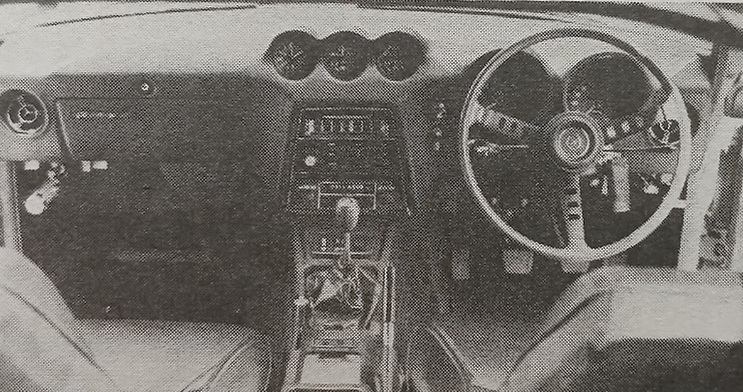
Reach distances to switches and controls have changed very little as well. The hand throttle has been eliminated, and the parking-light switch has been moved slightly farther forward, but otherwise the layout is essentially unchanged.
The instruments are likewise much the same. There are some scale revisions reflecting the different engine, but few substantive changes.
When we adjusted the driver’s seat to suit our physiques, the seating position ended up rather far forward relative to the door opening, making entry and exit feel somewhat cramped. Is the neutral seat position set farther forward on the Japanese-market model?
Ishikawa (Yasuo): It’s 90mm different from the export specification.
Watari: Getting in and out didn’t particularly bother me, but that ashtray position looks troublesome. If you’re not careful, you’ll either scorch your jacket or end up scattering ash all over the area around the shift lever.
Oguchi: It certainly caught my attention.
Watari: I’d much rather have the ashtray somewhere further forward–even if it meant having to hunt around a little for things like the rear-window defogger switch. At least put the ashtray within easier reach.
Takei: The previous model actually had it there, but we were told the area ahead of the shift lever was awkward to use, so it was moved to where it is now.
Watari: Personally, I think the best solution would be separate ashtrays mounted on the dashboard, one for each side. Then again, perhaps the current arrangement works if the seat is positioned farther back. Japanese drivers tend to move the seat forward, after all…
Magazine: Could it be fitted with a sliding roof?
Mizutsu: The roof is a little too short. If it were somewhat longer, it could be done.
There was demand for one, and we did consider it, but because the roof is so short the opening would have been very small, so we abandoned the idea.
Hirao: I noticed there’s a footrest to the left of the clutch pedal. At first I wasn’t sure what it was, and I cautiously pressed down on it. No matter how hard I pushed, it wouldn’t move. (laughs) I thought maybe it might release the parking brake.
Ishikawa (Yasuo): On long-distance drives, it really does make a difference.
Hirao: Around Tokyo, though, you’re using the clutch constantly, so I didn’t find it especially beneficial.
Magazine: Finally, we’ve heard exports are going well, but could you tell us about the sales plan?
Inosaki: Domestic sales of the Z series are running at around 400 units per month. Of those, the ZG accounts for roughly 100 units.
As was mentioned earlier, exports are currently around 5,000 units per month.
Magazine: We’ve heard that in places like America these cars are selling with a premium attached.
Inosaki: Yes, fortunately demand has been very strong. We’ve heard reports that in the US customers are waiting several months before they can take delivery.
Magazine: Thank you very much.
Postscript: Story Photos