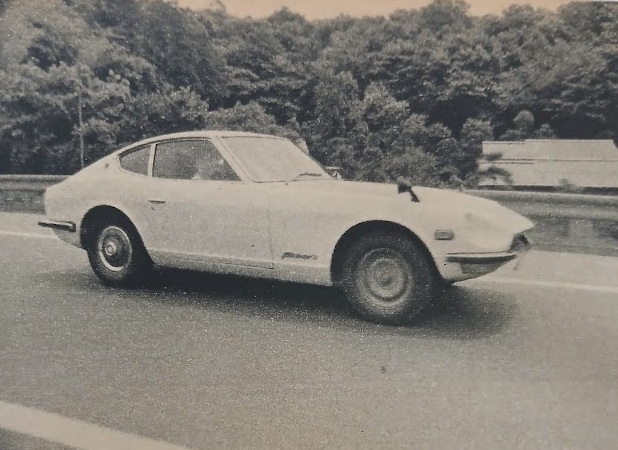
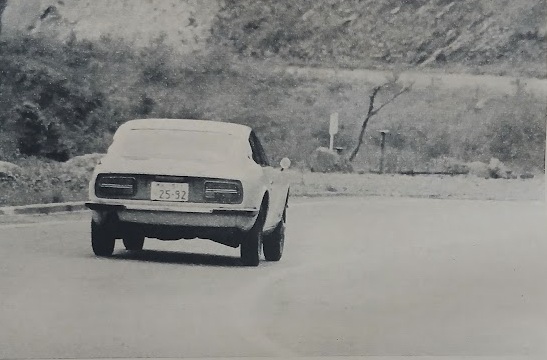
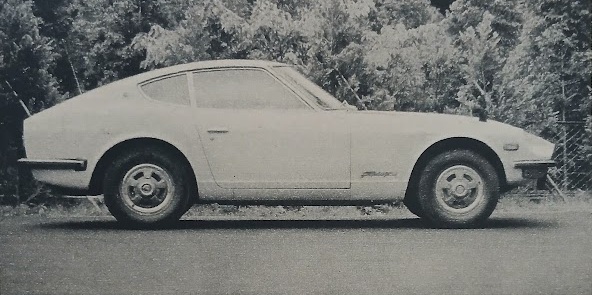
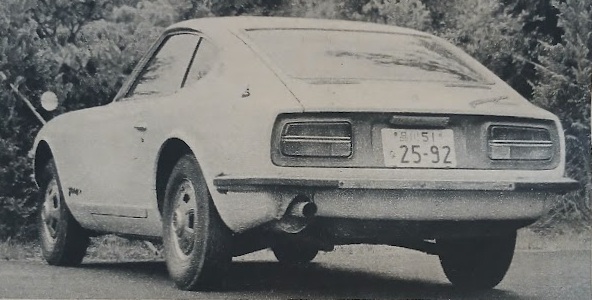
Nissan Fairlady Z-L (1971)
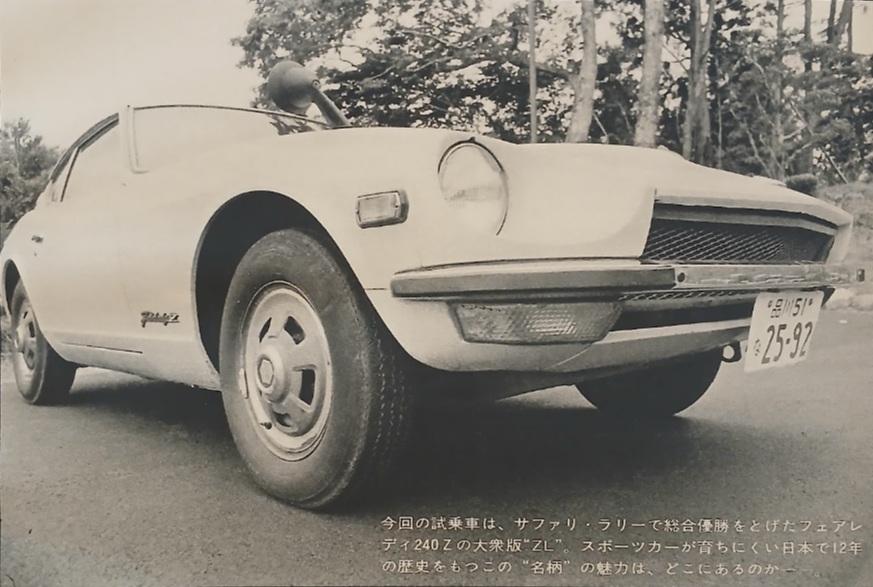
Publication: Motor Fan
Format: “Bubble Index” Road Test
Date: August 1971
Author: Osamu Mochizuki, Katsuzo Kageyama, Shigeki Asaoka, Yasuhei Oguchi, Reiko Ikuuchi, Kensuke Ishizu
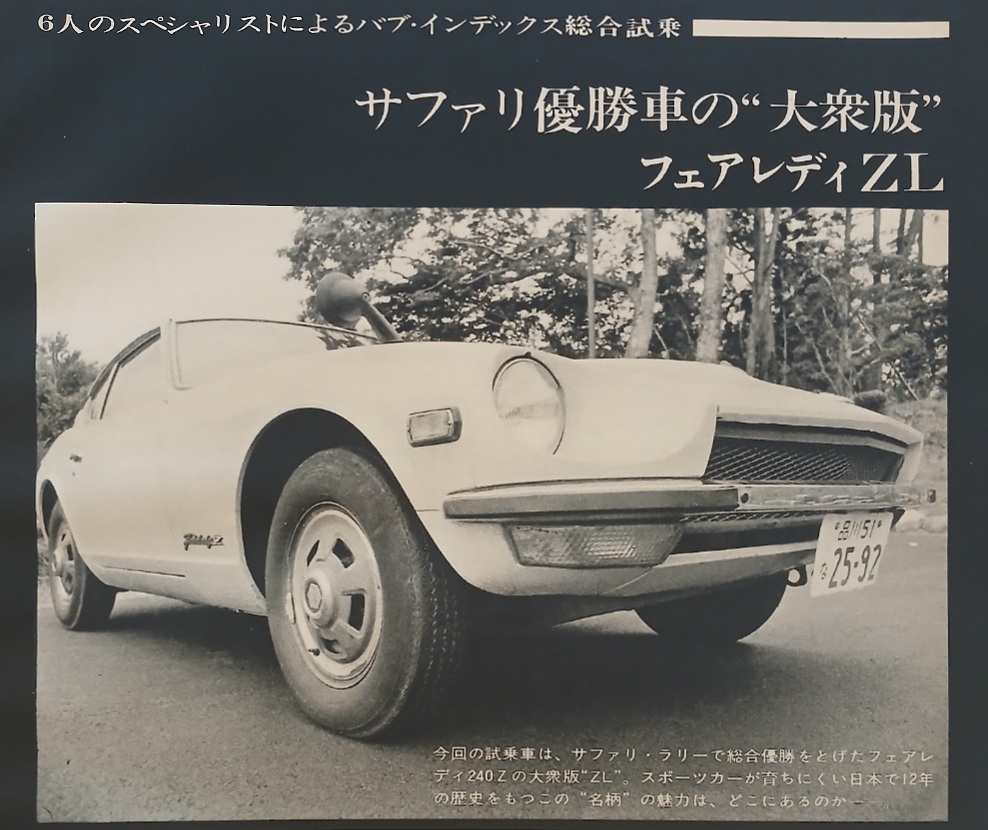
The “Popular Edition” of the Safari-Winning Car
The test car this time is the “Z-L,” the popular version of the Nissan Fairlady 240Z that achieved overall victory in the Safari Rally. In a country like Japan, where sports cars have traditionally struggled to gain a foothold, this celebrated nameplate has already built a history spanning twelve years. Just where does the appeal of this “famous marque” lie? Here, we take a closer look.
The Fairlady That Survived
A blazing summer day—there is something exhilarating about driving a sports car flat out, the wind rushing full against one’s face. The origins of Japan’s domestic sports cars date back exactly twelve years, to June 1959, when the first model of its kind was introduced. That car was the Datsun Sports S211, which may be regarded as the predecessor of the Fairlady. Its body was made of plastic.
The history of the Fairlady itself begins the following year, in 1960, with the launch of the Datsun Fairlady SP211. In 1962 came the Datsun Fairlady SP310, which combined the Bluebird’s frame with the Cedric’s 1488cc G-type engine. Though it underwent several minor revisions, this basic model remained in production until 1965.
In 1965, the two-seat Nissan Silvia CSP311 was introduced, and alongside it appeared the Datsun Fairlady 1600 (SP311), equipped with the same engine. That same year saw the release of several sports cars from other manufacturers as well: the Toyota Sports 800, the Honda S800, and the Skyline 2000GT-B (with triple Weber carburetors) and 2000GT-A sports sedans.
Then, in March 1967, the Fairlady advanced further with the arrival of the Datsun Fairlady 2000 (SR311), powered by the 145-horsepower U20 engine. Despite the increase in performance, its weight was actually 20kg lighter than that of the 1600. Two months later, in May of that same year, the Mazda Cosmo Sport and the Toyota 2000GT followed in quick succession.
At last, in the autumn of 1969, a new model appeared that drew the full attention of sports-car enthusiasts: the Fairlady Z, in the form we know today. The letter “Z,” like X and Y, represents an unknown quantity, chosen to symbolize a car striving toward the ultimate.
There were, of course, other sports cars along the way, such as the Prince Skyline Sport, the Honda S500, and the S800 mentioned earlier. Yet one by one they disappeared from the scene. Today, aside from the Fairlady, there are few genuine Japanese sports cars still offered to the public.
In the scorching heat of summer, rather than creeping through the city in a plain sedan, one naturally wants to take to the highway in a sports car and enjoy the breeze. Among the members of our test group, someone casually suggested that this month’s subject should be the Fairlady, the domestic sports car with the longest history. After all, it had only recently finished in first and second place in the East African Safari Rally.
The winning car there was the Nissan Fairlady 240Z. However, since the purpose of this test was to examine a model closer to what readers might come to own, we ultimately settled on the more popular, regular-production version: the Nissan Fairlady Z-L.
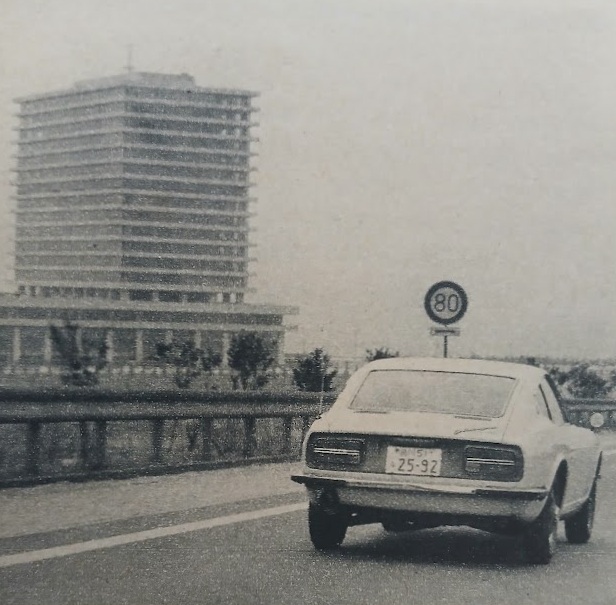
As usual, the test group set out along our established route: onto the Tomei Expressway from the Tokyo IC to Gotemba IC, over Otome Pass, up the Hakone Turnpike, back again via Otome Pass, and then onto the Tomei from Gotemba for the return to Tokyo, before convening again at our base, the Fantasy Drive-In near the entrance to the expressway on Tamagawa-dori.
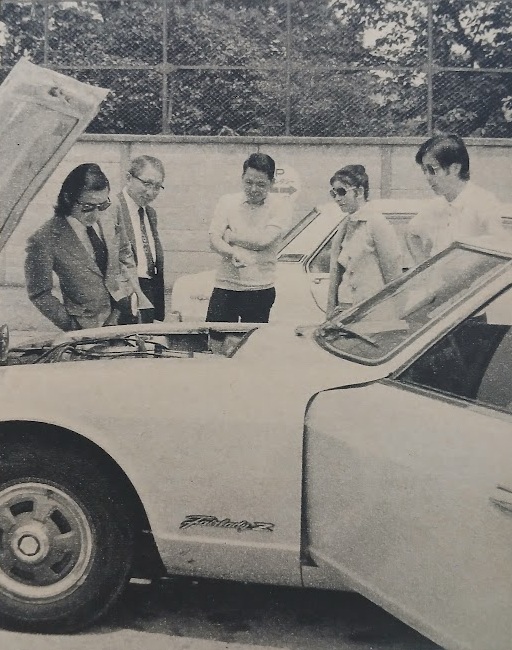
Since this Bubble Index test involved a full-fledged sports car for the first time, the discussion at the post-drive meeting produced a flood of opinions. Taking the newly discussed ESV (Experimental Safety Vehicle) standards–now being formulated in Japan–as a reference point, we examined the Fairlady’s safety, while spirited debate ranged across topics such as price versus performance and the car’s international character. For the details, we invite readers to turn to the reports from each of our specialists.
Power Performance: Lives Up to Its Reputation (Osamu Mochizuki)
The Nissan Fairlady Z can be regarded as a representative example of the mass-produced sports car. Viewed from a global perspective, its class position might be described as slightly above cars such as those from MG and Triumph, while still somewhat below that of Porsche.
In terms of performance, it strikes a well-judged balance for a 2-liter GT car, delivering 125ps and a top speed of 190km/h. The L20-type engine itself originates from the Cedric line, and its power characteristics are relatively mild, making it extremely easy to handle. For a mass-produced sports car, this may be counted as one of its principal strengths.
It combines 0-100km/h acceleration in the ten-second range with the ability to cruise comfortably at around 160km/h. At the same time, its flexibility is such that even when running at speeds as low as 40km/h in overdrive fifth gear–roughly 1200rpm–the engine shows little sign of strain.
In practical terms, useful response in fifth gear begins at around 60km/h and 1700rpm. This flexibility has undoubtedly been one factor in expanding the Fairlady Z’s appeal to a wider range of drivers.
The test car had already covered some 38,000 kilometers and showed a certain degree of wear, being a somewhat tired example of the Fairlady Z-L. Even so, over the course of a full day’s test run, combining expressway driving with mountain roads, it demonstrated performance fully worthy of a 2-liter GT car.
This reflects the fact that the car was engineered from the outset without pushing its mechanical components to unreasonable limits. As a result, it is capable of maintaining its performance level over long periods, while requiring comparatively little attention in terms of maintenance.
Looking at the engine’s output characteristics, torque already exceeds 13kgm at 1000rpm. That is more than sufficient to pull a body weighing just over one ton, and in fourth gear it allows the car to negotiate city traffic at around 30km/h without difficulty. At 6000rpm in fourth gear, the speed reaches approximately 170km/h.
Unless particularly rapid acceleration is required, most city driving can therefore be covered almost entirely in fourth gear. Fifth gear has a ratio of 0.852:1, and even when combined with the 3.90 final drive, it remains a fairly tall overdrive ratio. As a result, the engine turns only about 3000rpm at 100km/h, providing a reassuring sense of mechanical ease during expressway cruising.
The condition of the test car’s engine, however, was not ideal. Pulling it all the way to 6000rpm, where maximum output is produced, proved difficult. The rise in revs above 5000rpm became extremely sluggish, effectively leveling off at around 5500rpm.
“Because there is ample reserve power, acceleration from 100km/h in fifth gear is still brisk and very tractable.” —Kageyama
“That generous reserve of pulling power makes mountain-road driving both comfortable and safe.” —Oguchi
Handling and Stability: A Practical Sports Car (Katsuzo Kageyama)
The first impression upon settling into the driver’s seat is that one is sunk deeply into the cockpit. The seats themselves are excellent–long in the fore-and-aft direction and providing good support for the body. This impression likely results from the low seating position combined with the relatively high window line.
Naturally, the consequence is that outward visibility is not especially good. While driving, I often found myself stretching my back and neck as far as possible in an effort to see more clearly. To be honest, I sometimes felt as though I would like to put a pillow on the seat. In addition, the windshield wipers come to rest rather high on the glass, which further obstructs what is already a somewhat limited field of view.
Viewed from the outside, the car appears extremely low, yet inside the cabin the roof height is surprisingly generous–leaving ample room even for that imagined pillow.
The relationship between the steering wheel, pedals, and seat position did not feel entirely natural to me. Being a bit stocky by Japanese standards, I could not quite find a position that felt perfectly comfortable. Since many aspects of this car’s basic design appear to have been strongly influenced by the American export market, however, it may be somewhat beside the point for me to complain.
The gear lever is well positioned and easy to operate. Both the clutch pedal and the accelerator are quite heavy, though that is to be expected in a car of this sort. In fact, if the accelerator were too light, maintaining a steady throttle would become tiring, so a certain amount of weight is preferable.
The steering itself has a small ratio, befitting a sports car, and responds very sensitively. It is also fairly heavy. Considering the need for firm control at high speeds, however, this degree of effort seems appropriate. In fact, it contributes to the feeling of commanding a properly masculine sports car, bringing with it a certain pleasure in the act of driving. The steering’s accuracy is, as one would expect, excellent.
Road holding is strong, with the suspension planting the car firmly on the road and providing a reassuring sense of stability. When trying a few back-and-forth overtaking maneuvers on the expressway, the car’s lightness of movement, its quick steering response, and the way it settles immediately afterward allowed us to fully enjoy the virtues of a two-seat sports car.
When one speaks of high-performance sports cars, it is easy to imagine something difficult to control, like an unruly horse. This car, however, is not that sort of machine. The suspension is actually softer than one might expect. For those who still cling to the old notion that one must simply endure a poor ride in a sports car as the price of performance, it may even seem somewhat too compliant.
Handling and stability are often mentioned together, but in fact they represent opposing characteristics. Where the balance between them is struck determines the personality of the car. In this case, the emphasis has clearly been placed somewhat more on stability. The razor-sharp edge one might expect from a pure sports machine is less pronounced.
This is probably because the car was designed with a different aim in mind: a machine that provides the atmosphere of a sports car while remaining practical and relatively mild in character.
“The steering effort is quite heavy. For a GT car that sells about 5,000 units a year worldwide, it could perhaps be a little lighter. Power steering would not feel out of place.” —Mochizuki
Ride and Comfort: A Thoroughbred with a Classical Flavor (Shigeki Asaoka)
Although the Nissan Fairlady Z is a familiar sight at racing circuits, this was actually my first opportunity to drive the road-going version, so I was looking forward to it. As it turned out, however, the test car had clearly been used for numerous demonstrations and tests over a long period, and it was already showing signs of fatigue.
Even so, the Fairlady carries considerable significance. In Japan–where GT cars have traditionally struggled to take root–it possesses a long history of its own. The long bonnet, reminiscent of the Jaguar E-Type, and the cockpit set well rearward evoke a feeling of nostalgia for the sports cars of an earlier era. In that sense, it may be described as a classical-style GT.
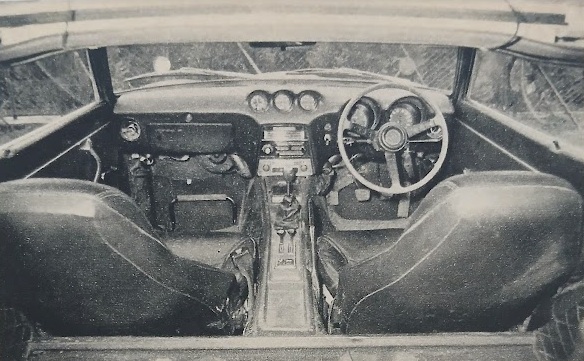
The interior showed a fair amount of wear, but overall it was quite nice and conveyed the atmosphere of a GT car perfectly. The arrangement of the instruments across the dashboard is also well done. Although it is a closed-roof coupe, it is a true two-seater, and the space behind the cockpit can therefore be used as a cargo area. Like the arrangement seen on certain models from Porsche, it even includes a belt for securing luggage.
Smaller items can easily be reached from the cockpit by simply stretching an arm behind the seat, while larger objects can be loaded through the wide-opening rear hatch. Since the car does not have a separate trunk like an ordinary sedan, any cargo inside is visible from outside when the car is parked. However, in a car of this type, where space is inevitably limited, it is hardly worth dwelling on.
The engine is the same 2-liter six-cylinder unit used in the Nissan Cedric, though for its displacement it seems somewhat large dimensionally. The engine noise was quite pronounced–so much so that it seemed unlikely it had sounded like this when new. The torque begins to come on slightly below 4000rpm, but the noise level is such that in ordinary driving one does not feel inclined to rev it much beyond that point.
Even so, there is more than sufficient power available without revving the engine hard, and with the close-ratio transmission, driving remains quite relaxed. The steering did feel somewhat heavy, though that may have been partly due to the tires. The tires fitted to the test car were noticeably worse than the standard equipment–indeed, they were in such poor condition that they looked almost like slicks.
During this test drive, I felt as though I had, for the first time in a long while, encountered a genuine GT car–one that retains the classical character I had almost forgotten. Personally, I have always liked cars that possess this sort of spirit, and I hope such qualities will continue to survive.
At the same time, GT cars, which are expected to stand at the forefront of automotive development, are inevitably destined to adopt new technologies first. If that is the case, this car may eventually evolve in new directions, perhaps adopting a mid-engine layout to further improve its dynamic performance, or a more rational engine design that allows the interior space to be used more effectively through a revised body shape.
One cannot help wondering whether a successor developed along these lines–a “Z II,” perhaps–might appear before long.
“There is little sensation of speed, and before you realize it the car is moving quite fast.” —Kageyama
“While driving, the booming noise coming up from the rear suspension is rather loud and irritating.” —Mochizuki
“The hood over the gauges is so deep that they can’t be read from the passenger seat. That might be a problem during a rally…” —Ikuuchi
“The hand throttle lever is a bit awkward to operate, but it’s enjoyable all the same.” —Oguchi
Safety: Aerodynamic Efficiency and a Crushable Nose (Yasuhei Oguchi)
Today, the Fairlady Z stands virtually alone as a genuine Japanese sports car, carrying the mantle of the entire category on its shoulders. Part of its success comes from a carefully-judged balance between performance and price, a combination that continues to earn praise.
Even a year and a half after its debut, its popularity remains high both domestically and abroad, ranking it among the biggest “hits” in sports-car history. Of course, in terms of safety, the Fairlady Z was ahead of its time compared with other domestic vehicles. Its energy-absorbing body is thoughtfully engineered, and complements the designers’ pursuit of aerodynamic efficiency.
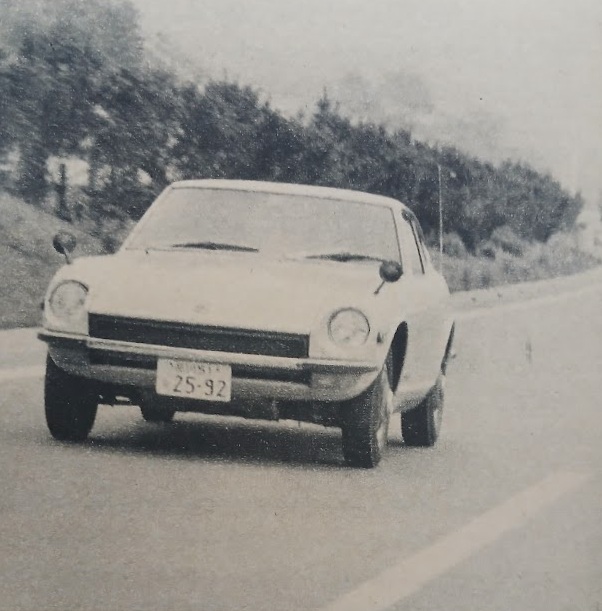
The sporty side profile is striking, but the long nose does more than look good. It reduces air resistance at high speed and, by leaving a generous space between the grille and engine, creates a structure that is more crushable in a collision.
For example, in a barrier collision test at 50km/h, the front crossmember crumples completely, and even parts of the suspension deform–but the peak deceleration measured at the cabin floor is reduced to 44g. By comparison, ordinary cars can experience as much as 80g in a similar impact.
The severity of an accident is not only about peak deceleration; duration matters too. The test results show that deceleration stays around 16g for the first 60 milliseconds, peaking at 70 milliseconds. Deceleration above 30g lasts only about 5 milliseconds, while the time above 25g is just 25 milliseconds.
This demonstrates that the collision energy is absorbed first by the crushable structure and then dispersed, keeping the forces on the occupants within survivable limits.
With the car’s development focused on export to the safety-conscious American market, this approach seems natural, and in fact it aligns closely with the safety targets of recent experimental safety vehicles (ESVs). Deformation from the rear gate to the roof pillars is expected to be effective in rear-end collisions. However, in the case of rollovers, the front-and-rear impact measures cannot be relied on to the same extent; additional side deformation would likely be necessary.
One point of concern is the three-point seatbelt. When worn in a straight-arm driving position, it can press uncomfortably against the neck for people of typical Japanese build–a reminder that the export-oriented design may have influenced its placement.
“It’s not ideal for the seatbelt to ride up on the stomach instead of the hips.” —Kageyama
“This isn’t unique to this car, but the installation position and design of the safety belts are extremely poor.” —Asaoka
Economy: Affordable Despite High Performance (Reiko Ikuuchi)
The Tokyo price for the regular-fuel specification Fairlady Z-L is 1,080,000 yen. For a 2.0-liter sports car with a 5-speed transmission, a top speed of 190km/h (195km/h on high-octane fuel), and 125ps (130ps on high-octane), this is a very agreeable figure. With over half of production destined for export, it’s hardly surprising that the car enjoys strong popularity overseas. At the same time, the high export volume generates production efficiencies, so that even here at home, the car is available at a relatively modest price.
Within the Fairlady model line, the lowest-specification Z sells for 930,000 yen–a difference of 150,000 yen. What does the extra cost bring? The Z-L comes with a 5-speed transmission, which raises top speed by 10km/h and improves fuel efficiency from the Z’s 15km/l to 16km/l.
Accessories also account for part of the difference: a car stereo, stopwatch-equipped clock (the Z has a simple two-hand clock), recline adjustment for the seats, passing flasher, heated rear window, and a footrest for the passenger. Considering the number of additional features, the extra 150,000 yen seems like a rather good value.
Recorded fuel economy during the test was as follows: 11.3km/l over the first measured section, 7.1km/l over the second section, and 12.2km/l over the third.
Compared with cars of a similar displacement featured previously in this series, the Fairlady achieves quite respectable results. The Gloria (1998cc) recorded 9.1 km/l, 6.4 km/l, and 8.8 km/l over three measured sections; the Pinto (1992cc) returned 9.3 km/l, 8.0 km/l, and 8.8 km/l.
Sports cars are generally thought to consume a great deal of fuel, but with figures like these the Fairlady can easily double as a town car without much difficulty. Of course, if it were kept strictly as a second car used only for sporting purposes, the evaluation of its economy would naturally suffer somewhat—but even so, it would still pass without complaint.
Repair costs and parts prices also do not appear to be especially high simply because it is a sports car. One point to note is that resale values tend to be slightly lower than those of sedans. However, since used examples are currently in short supply, it seems that owners can often obtain a fairly good price if they find the right buyer.
Returning to the purchase price, since there are essentially no other domestic sports cars of the same type, direct comparisons are difficult. If one looks at similarly priced two-door sedans, however, the closest examples include the Crown DX with 4-speed floor shift at 1,078,000 yen, and the Cedric and Gloria Custom DX with 4-speed floor shift at around 1,075,000 yen.
Among imported sports cars of roughly the same class, the following may be cited:
Opel GT 1900S: 1897cc, 102ps, 2,350,000 yen
Porsche 914/6: 1991cc, 125ps, 3,350,000 yen
Volvo 1800E: 1986cc, 130ps, 2,490,000 yen
“Compared with imported sports cars in the same class, it is extremely inexpensive. Considering its performance, the price is very reasonable.” —Kageyama
Product Appeal: A Truly International Offering (Kensuke Ishizu)
Some time ago–though it already feels like quite a while back–I saw the film Seven Samurai, starring Toshiro Mifune. I had seen several of Mifune’s films before that, but it was with Seven Samurai that I felt I truly understood his essence. He seemed to possess a quality that pushed outward toward the world.
Later, drawing inspiration from Seven Samurai, director John Sturges filmed The Magnificent Seven. It featured Charles Bronson, who at the time was still largely unknown, though his name would later become famous.
Whether it was director Akira Kurosawa’s brilliance or Mifune’s talent, I cannot say–I am hardly an expert in cinema. But now, Mifune’s status has undeniably become global–“Mifune of the World,” so to speak.
The Fairlady has a history of only about a dozen years. Yet in terms of its sensibility and its quality, I do not believe it is in any way inferior when compared with sports cars from abroad. Since the Fairlady first appeared as Japan’s pioneering sports car, several other domestic sports cars have emerged, only to disappear again like bubbles on the surface of water.
This is partly because Japan has not yet developed a cultural habit of using sports cars according to time, place, and occasion. Our standard of living has not entirely caught up to that point either.
And yet, despite these domestic circumstances, the Fairlady has managed to endure. I believe that is largely because it has been so highly regarded in foreign markets.
The same can be said of any product competing in the international marketplace. In today’s mass-consumption society, it is no longer enough to simply be “cheap and durable.” As the spread of information accelerates, the world is gradually becoming a single market. Under such conditions, what is required of a product is high quality enriched with originality, together with a fresh sensibility that brings new ideas into established traditions.
Cars, when viewed as products, are no exception. With the liberalization of capital markets, Japanese automakers will inevitably be drawn into competition on the global stage. Their sights can no longer remain fixed solely on the domestic market; they must always be directed toward the markets of the world.
In that respect, the Fairlady deserves high praise.
“The sporty long-nose styling represents a pursuit of functional beauty, harmonizing design with performance.” —Oguchi
“With DOHC and even an automatic transmission available, it offers an unusually broad range for a GT car.” —Asaoka
“It’s a shame there’s no visual distinction between the Z and the Z-L. You can tell by details like the heated rear window, but it really ought to have its own badge.” —Ikuuchi
How to Read the Bubble Index
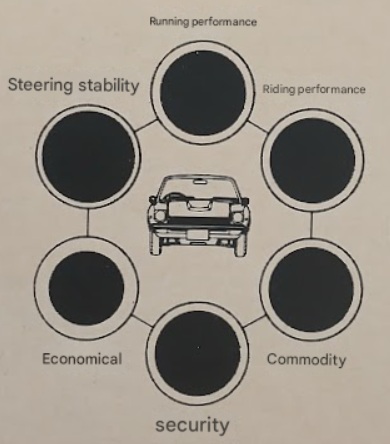
The goal of this comprehensive test drive series is to assess a car’s overall performance through six key pillars: driving performance, handling and stability, ride quality, safety, economy, and product appeal. The evaluation method used is the “Bubble Session”—a system-engineering approach in which six specialists from different fields gather around a hexagonal table (bubble = beehive) to share and debate their opinions.
Each of the six circles shows a black segment representing the evaluation for that pillar. When the black segments are roughly equal in size, the car is considered well-balanced across all categories. If they differ significantly, it indicates a car with a more distinctive, individual character.
Postscript: Story Photos