Nissan Fairlady Z432 (1970)
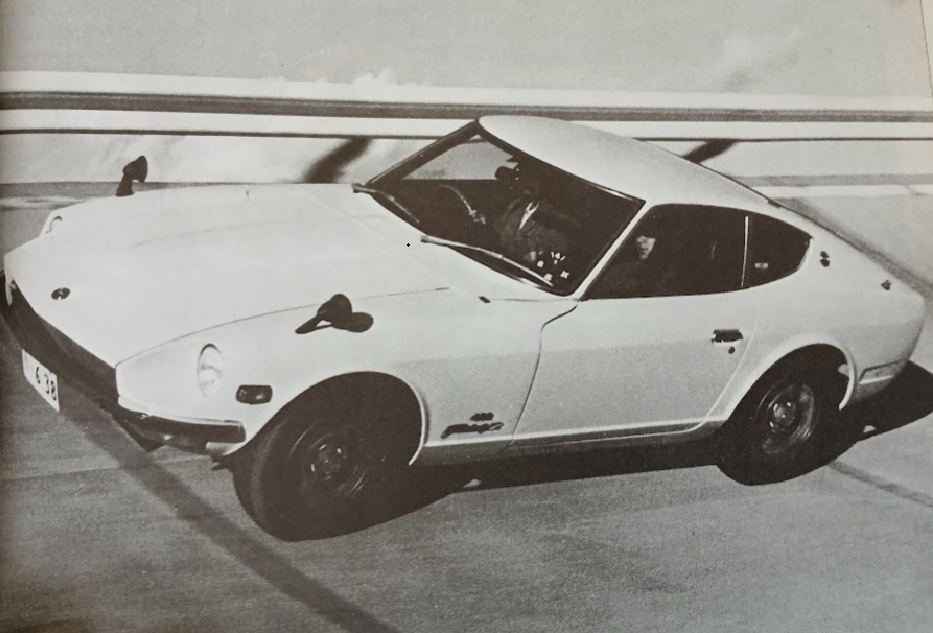
Publication: Car Graphic
Format: Road Test
Date: February 1970
Author: “C/G Test Group” (uncredited)
Summary: A practical two-seater GT with a DOHC six-cylinder engine based on the R380. More flexible at slower speeds than the GT-R, extremely economical when using fifth gear. Very good handling even on bias-ply tires, good support from bucket seats, excellent heater and ventilation, high price.
Road testing the Fairlady Z432
The Fairlady Z, announced in December 1969, is available in three versions. There is the standard Fairlady Z (930,000 yen), powered by the same 1998cc SOHC, six-cylinder 130ps/6000rpm engine as the Skyline GT; the Z-L (1,080,000 yen), which adds the Custom Kit (a 5-speed gearbox and deluxe equipment); and the high-performance Z432 (1,850,000 yen), fitted with the same 160ps/7000rpm DOHC six-cylinder engine as the Skyline 2000GT-R (itself derived from the R380).
For this test we chose the highest-performance Z432 (so named for its 4 valves, 3 carburetors, and 2 camshafts), putting it through some 900km of everyday road use, conducting a full series of instrumented tests at Yatabe, and thoroughly evaluating its handling at racing speeds on Fuji Speedway.
The previous Fairlady 2000 (still immensely popular in domestic club racing, and with more than 88% of the 13,690 cars produced in 1968 being exported to the United States; production will continue for the time being) was a classic open two-seater that sacrificed everything in the pursuit of performance. By contrast, the new Fairlady Z replaces the rough four-cylinder with a smooth six-cylinder engine, the vintage-car-like stiff springs with a more “civilized” fully independent suspension, and places it all in a weatherproof two-seat fastback coupe body, making it a grand touring car in the true sense of the term.
To begin, let us compare the Z432 with other 2-liter GT cars currently on the market.
| Engine | Displ. | Output | Torque | Kg/ps | |
|---|---|---|---|---|---|
| Fairlady Z432 | DOHC 6 | 1989cc | 160ps/7000rpm | 18.0kgm/5600rpm | 6.50kg/ps |
| Fairlady Z | SOHC 6 | 1998cc | 130ps/6000rpm | 17.5kgm/5600rpm | 7.50kg/ps |
| Fairlady 2000 | SOHC 4 | 1982cc | 145ps/6000rpm | 18.0kgm/4800rpm | 6.26kg/ps |
| Skyline 2000GT-R | DOHC 6 | 1989cc | 160ps/7000rpm | 18.0kgm/5600rpm | 7.00kg/ps |
| Toyota 2000GT | DOHC 6 | 1988cc | 150ps/6600rpm | 18.0kgm/5000rpm | 7.63kg/ps |
| Mazda Cosmo | Rotary | 491cc x 2 | 128ps/7000rpm | 14.2kgm/5000rpm | 7.50kg/ps |
As the figures show, the Z432 enjoys an exceptionally favorable power-to-weight ratio of 6.50kg/ps unloaded, and on paper should therefore be the fastest of the group. Unfortunately, our test car, which had covered approximately 4,400km, was not in perfect tune. Its maximum speed was only 175.6km/h, while its overall acceleration performance fell short of even the Fairlady 2000’s. We shall return to this point in more detail later.
The interior is that of a luxurious two-seat GT coupe, in the same category as those of cars like the Jaguar E-Type Coupe. The layout is well thought out, and the styling is consistently restrained and tasteful. The driving position is excellent. The generously proportioned bucket seats support the body in all the right places, allowing the driver to adopt an ideal driving position with arms and legs comfortably extended. The wood-rim steering wheel, 5-speed gear lever, and pedals are all comparatively well positioned.
Since the pedals are mounted well forward from the toe board, a proper footrest is provided for the left foot, helping the driver brace their body during cornering. All of the instruments are deeply recessed into the crash pad, but their clean design, with white lettering on a black background, makes them easy to read day or night.
In a sports car, the dashboard is generally farther away, and because the driver is more likely to be wearing a seat belt, the placement of frequently used switches requires especially careful thought to avoid them becoming inconvenient. Here too, the Fairlady earns a passing grade. The lever projecting to the left of the steering column incorporates rotary switches for the lights and windshield wipers, while the tip of the lever has a push button for the washer. The choke and hand throttle are mounted on the console behind the gear lever, allowing the driver to operate them without changing position.
The rear compartment provides a spacious luggage area, carpeted throughout and suitable even for delicate items. However, since the floor is completely flat, smaller objects may slide about during cornering or braking. Straps are provided for securing suitcases, which is a thoughtful touch, although they are not long enough for especially large pieces of luggage. The spare tire is stowed under the floor, while the jack and tools are stored behind the seats beneath a plastic cover (which looks a bit cheap).
Luggage is loaded through a large tailgate, much like that of the Jaguar E-Type or MGB GT. On our test car, however, the locks for both the tailgate and the dashboard glove box failed, so that neither could be opened.
As noted earlier, the Fairlady Z432 is powered by exactly the same DOHC 24-valve six-cylinder engine producing 160ps at 7000rpm as the Skyline 2000GT-R. As we described in our test of the GT-R (May 1969 issue), this semi-racing engine is by no means temperamental, and it maintained exactly the same condition throughout some 900km of demanding testing. Even on cold mornings of around 5°C, two or three blips of the throttle were all that was needed for it to spring instantly to life. After a few minutes of warming up at approximately 2500rpm using the hand throttle, the engine settles into a steady idle of around 800rpm, and it pulls cleanly even if driven away immediately.
Despite its sleek appearance, the controls all require a considerable amount of effort, so the Fairlady Z is still a “man’s car,” or at least not one that a lady in high heels would choose for a shopping trip in the city. The cowl is relatively high, so a driver of average build cannot see the road immediately ahead of the hood. The clutch and brakes are both heavy, and the steering becomes extremely heavy at parking speeds, so it is naturally not well-suited to practical use in crowded city streets.
What surprised us, however, was that compared with the Skyline 2000GT-R, which uses the same engine, the Fairlady Z432 proved noticeably more flexible and easier to drive at low speeds. This is probably due to the slightly different routing of the exhaust system dictated by the body layout (with a semi-racing engine such as this, it is entirely conceivable that this alone could subtly alter its characteristics), as well as the fact that the Z432 weighs some 80kg less than the GT-R. (The overall gearing of the two cars is, in practice, almost identical.)
For example, the GT-R required at least 4000rpm and careful clutch work to make a clean start from rest. The Z432, on the other hand, will pull away from below 2000rpm as smoothly as a normal passenger car, if one is so inclined. It was also possible to use up to fourth gear easily while keeping road speed below 60km/h. As an example, it would cruise smoothly at 50km/h in fourth (1800rpm).
The engine’s torque curve shows a pronounced dip between 2500 and 3000rpm, and this is readily apparent from behind the wheel. At 60km/h in third gear (approximately 2800rpm), the driveshaft joints begin to shudder, making the car unpleasant to drive. Curiously, shifting up into fourth (approximately 2300rpm) actually makes it run more smoothly.
Real power, however, does not arrive until the engine passes 3000rpm. From there it continues to pull with such eagerness that it seems to want to keep revving even beyond the red line, revealing its R380 lineage. Beyond 6500rpm, however, torque falls away sharply, so the effective power band is surprisingly narrow. In practice, the engine is at its best between about 3500-6500rpm.
The Z432 is equipped with the same Porsche-type servo synchronized 5-speed gearbox as the Skyline 2000GT-R. Its final-drive ratio, at 4.444:1, is the lowest of the three Fairlady Z models. The wheels are 5J×14 magnesium alloys (the Z and Z-L use 4J×14 wheels), fitted with 6.95H-14-4PR tires (the other two models use 6.45H-14-4PR). Our test car wore Bridgestone Super Speed-5 H.T. Nylon tires.
As might be expected from the combination of its relatively heavy 1040kg curb weight, relatively tall first gear (overall ratio 13.12:1), and an engine that delivers torque at higher speeds, standing starts are rather sluggish. Indeed, off the line, it is liable to be outpaced by the liveliest 1-liter sedans.
Unfortunately, the engine in our test car was not performing properly at high engine speeds, and its high-speed performance fell well short of expectations. Our Yatabe maximum-speed tests are conducted over both the 1km straight and the 5.5km banked circuit, with two occupants aboard.
The Fairlady Z432 covered the 1km straight in 20.5 seconds, averaging 175.60km/h (the car’s speedometer indicated no less than 194km/h), while the 5.5km lap took 1 minute 53.9 seconds, for an average of 173.83km/h—figures that could only be described as unsatisfactory.
For comparison, the Fairlady 2000 tested by C/G reached 190.0km/h, while the Skyline 2000GT-R recorded 179.55km/h. The latter, in particular, fell well short of its catalog figure, but the Fairlady Z fell shorter still. Nissan’s own published top speed for the Z432 (admittedly described as an estimate) is 210km/h.
This was naturally disappointing for us, so we arranged to have the car serviced and scheduled a second round of testing. However, when we arrived to collect it on the appointed day, we discovered that another car magazine had crashed it the previous day. As a result, there was no longer sufficient time to complete a retest for this month’s issue.
For some reason, the engine also seemed quieter than the one in the GT-R. The main source of noise was the whine of the timing chain, while in our test car—which appeared to have been driven rather hard—mechanical noise from the valve gear joined in once the engine passed 4000rpm. The exhaust note, unlike the metallic, high-pitched sound of the GT-R, was surprisingly subdued.
As mentioned earlier, the clutch requires considerable pedal effort, and its stroke is also rather excessive. Engagement is as smooth as that of an ordinary passenger car, but when it came time to record acceleration runs it began to slip quite noticeably. Since our GT-R test was also spoiled by severe clutch slip, this may be an inherent weakness of the S20 engine. The disappointing 0-400m time of 16.4 seconds (against a claimed 15.8 seconds) can, at least in part, be attributed to this clutch slip.
The 5-speed gearbox, shared with the GT-R, is every bit as impressive as we noted during our GT-R test. Its action is smooth, the lever travel is agreeably short, and the synchronizers are exceptionally strong. As mentioned previously, the engine in our test car failed to pull strongly at high engine speeds, so there was little point in extending it beyond 6500rpm. That said, when revved to the beginning of the yellow zone at 7000rpm, the car reaches 57km/h in first gear, 91km/h in second, and 132km/h in third. Maximum speed in fourth was the same as in fifth, at 175km/h. Fifth gear is a 0.852:1 overdrive, yet it is perfectly usable from about 60km/h upward.
One pleasant surprise was the car’s generally excellent fuel economy. Around town it was unremarkable, but on open roads and expressways it returned unexpectedly good figures. For example, driving the Tōmei Expressway from Matsuda to Gotemba at a steady 100km/h (approximately 3300rpm in fifth) produced 12.56km/l. The run from Gotemba to Fuji Speedway along the lightly trafficked National Route 246 at entirely legal speeds (!) returned 9.19km/l, while approximately ten laps of the clockwise course at Fuji Speedway returned an unexpectedly respectable 5.55km/l.
The excellent cruising economy is clearly attributable to the overdrive fifth gear. Looking at the constant-speed fuel-consumption figures, fourth gear at 120km/h returned 8.9km/l compared with 9.8km/l in fifth, while at 160km/h the respective figures were 5.9km/l and 7.6km/l. These results clearly demonstrate the economy advantage of fifth gear.
The Z432’s brakes are, in short, fully worthy of the car’s performance. The combination of front discs and Alfin rear drums with a 6-inch brake servo delivers smooth, stable braking even from high speeds. Pedal effort is by no means light, but is entirely appropriate, and there is no perceptible servo lag.
However, during our 0–100–0 fade test (ten repeated decelerations from 100km/h at 0.5g), pedal effort increased from an initial 12kg to 20kg by the fifth stop, and 34kg by the tenth. Braking effectiveness also began to fluctuate from about the eighth stop onward. This was clearly a case of brake fade, although normal performance returned after only a few minutes of driving. It is also commendable that there is very little nose dive under hard braking (by contrast, the nose rises under hard acceleration).
The new Fairlady Z range surpasses the previous Fairlady 2000 in many respects, but its handling is perhaps the greatest improvement of all. The suspension is fully independent at all four wheels, with MacPherson struts at the front and struts combined with wishbone-type transverse links at the rear.
The rear suspension is unique to the Z. The transverse-link pivots are parallel to the body, and the distance between the bushings is comparatively large. As a result, toe change is effectively zero, while camber change is also kept to a minimum—a significant advantage. The Z432 has wider tires than the other Z models, fitting 6.95H-14 tires on 5J×14 magnesium wheels. Steering is by rack and pinion, requiring only a sharp 2.5 turns from lock to lock.
By any standard, the handling is outstanding. Our test car was fitted with Bridgestone Super Speed-5 cross-ply tires, yet simply increasing tire pressures to 2.5kg/cm² front and rear allowed it to lap Fuji Speedway at speeds approaching those of a racing car without the slightest concern.
The handling is characterized by just the right amount of very mild understeer, which continues up to the limit, at which point the tail begins to slide gradually—an almost ideal balance. The rear end’s progression into the slide is really quite exquisite, never snapping abruptly as it can in the Skyline 2000GT and GT-R. One is given the impression that the balance of front and rear cornering power is extremely well matched.
The engine is powerful enough that, at least through third gear, the tail can be steered with the throttle. In such situations, the quick steering is a great help in making rapid corrections. The price paid is consistently heavy steering effort and pronounced kickback through the wheel. Body roll, meanwhile, is so slight that it is almost imperceptible, at least from the driver’s seat.
Straight-line stability is exceptionally good. Even at maximum speed, the car can be driven with one’s hands off the wheel.
However, this is true only in calm conditions. In a crosswind it is affected quite significantly, no doubt because of its body shape.
Compared with the Fairlady 2000, the ride is considerably softer, but by ordinary standards it is still quite firm. Even at the recommended tire pressures of 1.8kg/cm² front and rear, the Bridgestone Super Speed-5 tires feel almost as stiff as six-ply tires, transmitting small irregularities in the road surface with a constant patter. However, on good surfaces such as expressways, the ride becomes flat, smooth, and exceptionally comfortable. Combined with the excellent support provided by the seats, this allows long distances to be covered without undue fatigue.
Its ability over rough roads is also impressive, aided by ample suspension stroke and generous ground clearance. The powerful dampers (especially at the rear) do, however, produce sharp upward jolts over larger bumps. Overall, the body gives the impression of being highly rigid, although some vibration was noticeable around the cowl when driven over rough surfaces. Road noise and gear noise from the body-mounted differential are both well suppressed. Since the suspension incorporates a generous degree of compliance, even the optional 175HR-14 radial tires should present no particular problems in terms of noise or ride harshness.
It was unfortunate that, because the engine in our test car was not in perfect condition, we were unable to experience the Z432’s full performance. Even so, its outstanding handling left a deep impression on us. A competition version is due to be released shortly, some 110kg lighter (through the use of acrylic windows, an FRP hood, and similar measures) and fitted with much stiffer suspension (front spring rate increased from 1.80kg/mm to 5.50kg/mm, rear from 2.07kg/mm to 5.57kg/mm). If possible, we should very much like to put that version through testing as well.
Postscript: Story Photos


