Nissan Fairlady 240ZG (1972)
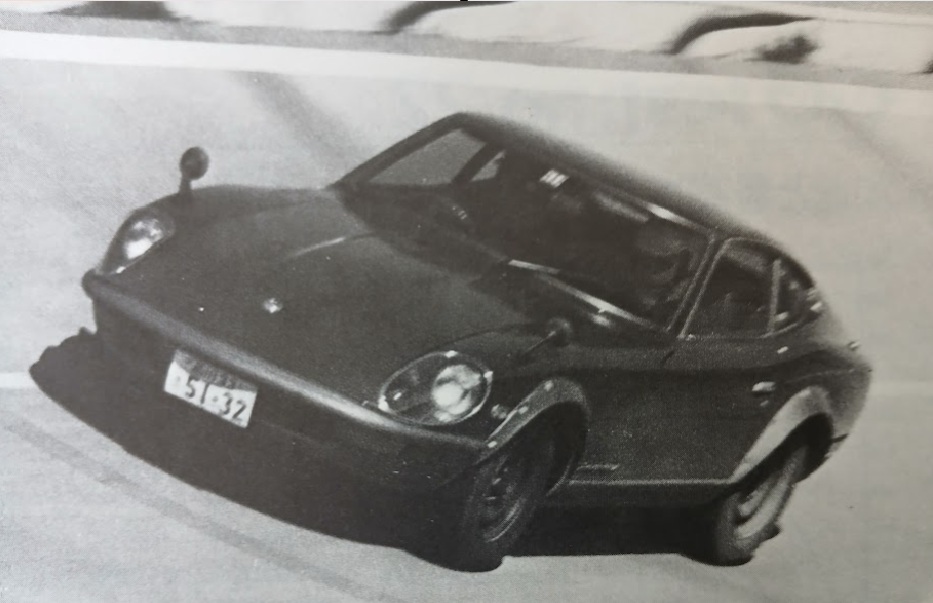
Publication: Car Graphic
Format: Road Test
Date: March 1972
Author: “C/G Test Group” (uncredited)
Summary: The Z enlarged to 2.4 liters. Acceleration is markedly improved over the two-liter model, while flexibility has increased further. Fuel economy is impressive when fifth gear is used frequently. In other respects, it is unchanged from the earlier model, including the tendency for the clutch to slip too easily.
Road testing the Fairlady 240ZG
Since the debut of the Nissan Fairlady Z in December 1969, Car Graphic has tested a variety of models whenever the opportunity arose. First came a full-scale test of the 160ps DOHC 2-liter Nissan Fairlady Z432 at Yatabe. Then we sampled the racing-specification Nissan Fairlady 240Z at FISCO–a SCCN team car fitted with a 200ps+ tuned SOHC 2.4-liter engine in Z432-R specification. After the 240Z was formally introduced, we also conducted a brief road test of an automatic-transmission model, something we had never tried before. And just last month, we headed once again to Yatabe to test a 5-speed Nissan Fairlady 240ZG, only to suffer the misfortune of valve gear failure, forcing us to abandon the test halfway through. Thus, at the very beginning of the new year, we returned for another attempt with a different 240Z.
The 240Z lineup is offered in three variations distinguished by body and trim specification. First is the standard 240Z (1.15 million yen). Next comes the Z-L (1.35 million yen), equipped with items such as a car stereo, reclining seats, and headlamp covers. At the top of the range sits the ZG (1.5 million yen), fitted with an FRP nose cowl and urethane bumper that extend the front end by some 200mm for improved aerodynamic efficiency. FRP overfenders are also added to accommodate wider tires, while 175HR-14 radial tires are fitted as standard equipment. According to the catalog, the ZG’s top speed is rated at 210km/h—5km/h faster than the other 240Z variants.
The car tested here was this long-nosed 240ZG.
Let us begin with performance. In terms of maximum speed alone, the 240Z proved somewhat disappointing. Its average through the 1km straight fell well short of the catalog figures–as is true of most domestic cars–and reached only 192.52km/h, while the average speed around the 5.5km circuit was 189.56km/h.
The Yatabe high-speed oval is not perfectly flat, and includes one very slight downhill section of roughly 200m. It was there that the car briefly touched 198km/h–the speedometer, unusually accurate for a Japanese car, indicating exactly 200, while the tachometer showed approximately 5800rpm. That was the absolute maximum attained.
Even so, among all the domestic cars we have tested, this 240ZG recorded the highest top speed achieved so far. The previous record holder had been the earlier Datsun Fairlady 2000 (SOHC four-cylinder) at 190.0km/h, followed by the Mazda Capella Rotary Coupe at 187.50km/h.
The character of the 240Z, for better or worse, is defined almost entirely by its large and rather heavy engine–an engine derived from a family sedan unit and only mildly tuned by sports-car standards. Though a SOHC design, it does not have even a crossflow head, and it is by no means the sort of engine that delights in high revs.
When foreign magazines describe the 240Z as “a modernized Big Healey,” the comparison is remarkably apt. The Healey 3000, with its large, slightly sleepy three-liter six-cylinder engine, earned a formidable reputation for toughness and made its name in racing and rallying before finally disappearing a few years ago. Many British enthusiasts still remember it fondly, and it is easy to see why they recognize something familiar in the 240Z.
The 240Z’s peak output of 150ps arrives at 5600rpm, and beyond 6000rpm the engine begins to sound somewhat strained. The tachometer optimistically marks 6500-7000rpm as the yellow zone, but this is unrealistic; in truth, anything above 6500rpm ought to be considered the red zone.
That said, this seven-bearing engine is impressively smooth from its 650rpm idle all the way to 6000rpm and beyond–apart from a slight vibration cycle around 5000rpm. Fed by a pair of large 46mm SU carburetors, cold starting is effortless: pull the well-positioned choke mounted on the floor and the engine starts immediately, even on very cold mornings. Warm-up is exceptionally quick as well. The choke itself has a long travel and allows delicate adjustment, making fast-idle warm-up operation especially easy.
The previous two 240Zs we tested–one automatic and one manual–both suffered from excessive resistance at the initial movement of the throttle, requiring concentration to move away smoothly from a stop. The test car this time, however, operated with complete smoothness.
On paper, peak torque arrives surprisingly high in the rev range, at 4800rpm. In practice, however, the engine’s absolute torque output is so substantial that it delivers strong and remarkably smooth acceleration across an extremely broad operating range.
For example, in third gear the car requires almost exactly seven seconds to accelerate through each successive 40km/h interval between 20km/h and 120km/h. Repeat the same test in fourth gear, and every interval falls within the nine-second range. Remarkably, while 20km/h in fourth corresponds to barely more than idle speed–around 700rpm–when the throttle is opened, the engine hesitates only briefly before pulling away with uncanny smoothness from roughly 1000rpm upward.
To drive truly quickly, however, it is necessary to extend each gear to at least 4000rpm.
In absolute terms, acceleration is unquestionably quick. The 0-400m time of 15.5 seconds surpassed even the factory catalog figure of 15.8 seconds, making it the fastest-accelerating car yet tested by Car Graphic. The previous record holder had been the earlier Fairlady 2000 at 15.8 seconds.
We have never formally measured the two-liter Fairlady Z, so direct comparison is impossible, but the 240Z was a full 0.9 seconds quicker than the DOHC-powered Z432, which recorded 16.4 seconds during our earlier test–though unfortunately that particular car was not in perfect tune at the crucial top end.
For 0–160km/h acceleration, the figures are 24.05 seconds for the 240ZG, 26.8 seconds for the Z432, and 23.4 seconds for the previous Fairlady 2000.
It is rather interesting that the old Fairlady 2000–with its smaller, lighter body and rough-and-ready character–is still the record holder in that test.
The Porsche-type synchromesh 5-speed gearbox is one of the 240Z’s major attractions. If there is anything to criticize, it is that the shift throws are somewhat too long. Otherwise, the synchros are immensely strong and require little effort to operate. Some members of the staff also complained that the spring pressure centering the lever toward the third–fourth gate was too strong.
That aside, the gear ratios themselves are close to ideal.
If extended to 7000rpm, first, second, and third gears will reach 69, 111, and 153km/h respectively. Fourth gear, being direct drive, is capable of nearly the car’s maximum speed–191km/h at 6600rpm. The gearbox constantly emits a faint gear whine, and the propeller shaft appeared not to be perfectly balanced, as vibrations were transmitted into the body at high speed. Mechanical noise from the engine itself, however, is low, and high-speed cruising in fourth and fifth gear is unquestionably one of the 240Z’s greatest strengths.
Using fifth gear frequently also revealed something unexpected: fuel economy during high-speed cruising was surprisingly good.
Driving back from FISCO to the Car Graphic offices in central Tokyo, using almost entirely expressways and maintaining a comparatively restrained pace, the car returned an impressive 8.52km/l.
The economy advantage of fifth gear is also clearly reflected in the steady-speed consumption figures. At 60km/h, fifth gear returned 14.1km/l versus 13.1 km/l in fourth; at 100km/h, the result was 11.5km/l (10.6km/l), and at 160km/h, 7.1km/l (6.3km/l).
As these figures demonstrate, an engine with torque reserves such as the 240Z’s can achieve surprisingly good real-world fuel economy simply through frequent use of the higher gears.
Regular gasoline is specified, and there was no trace of pinking even at low speeds. Curiously, however, the engine exhibited severe dieseling after shutdown. For the record, this remained unchanged even after replacing the standard NGK BP6E plugs with colder BP8Es.
The fuel tank holds 60 liters, giving the car a dependable cruising range of well over 400km.
The 222mm front discs and 228mm rear drums with well-judged servo assistance deliver smooth, progressive braking feel regardless of speed. Nose dive under hard braking is remarkably well controlled. Under hard acceleration, by contrast, the rear of the car sinks noticeably.
In the 0-100-0 fade test, pedal effort rose only slightly–from an initial 15kg to 19kg by the eighth stop and 23kg by the tenth–while braking effectiveness itself remained stable throughout. It is fair to say that the system possesses more than adequate resistance to fade.
The handbrake, positioned conveniently behind the gear lever, is light in operation and extremely powerful.
Even at speeds approaching the maximum, directional stability is superb. Simply resting one’s hands lightly on the steering wheel is enough for the car to track straight as an arrow. The addition of a front spoiler and ducktail would likely improve matters still further.
Thanks to the substantial front weight bias (53/47) and the wide contact patch of the 175HR-14 radial tires–Bridgestone RD150s on the test car–there is always a definite sense of heft to the steering. In a powerful GT car, this actually feels entirely appropriate and rather pleasing.
As is typical of rack-and-pinion steering, response is quite quick–2.34 turns lock-to-lock, with a minimum turning radius of 4.8m–and the system communicates road feel very effectively. On rough surfaces, however, kickback can become almost excessively strong; driving gloves are practically a necessity.
The steering wheel itself is appropriately sized, although a softer, thicker leather-wrapped rim might be preferable to the current wood-rim design.
To fully explore the handling limits of a high-performance machine like the 240Z, one must ultimately take it to the circuit. We therefore put the car through its paces on the counterclockwise course at FISCO.
Simply increasing tire pressures from the standard 2.0/2.0kg/cm² to 2.5/2.5kg/cm² allowed the 240Z to lap the circuit in complete safety. Cornering stability proved extremely high.
The handling balance maintains a very mild understeer even at elevated cornering speeds. The Bridgestone RD150 tires offer excellent adhesion, at least on dry pavement. For a radial tire, their lateral stiffness is also notably high, allowing them to hold on tenaciously.
In fast bends, however, the engine lacks sufficient power to steer the tail with the throttle. In that sense, the car is actually somewhat more difficult to drive quickly.
We have previously driven this same course in both the Z432 and the race-prepared 240Z. Curiously enough, the race-specification 240Z exhibited the strongest understeer of the three. Yet because it possessed substantially more power, it was easier to control with the throttle, and despite being dramatically faster overall, it actually felt easier to drive.
The Z432, meanwhile, ran not on radials but on Bridgestone Super Speed-5 cross-ply tires. These offered less outright grip than the radials and slipped more progressively, making the car easier to control at the limit. Naturally, the Z432 also featured stiffer suspension than the standard 240Z, making it better suited to this sort of driving.
As a result, lap times fell in exactly that order: the standard 240Z was the slowest, the Z432 roughly one second quicker, and the race-specification 240Z fully sixteen seconds faster still.
The suspension offers generous wheel travel, but largely because of its firm gas-filled dampers, the ride over small irregularities at town speeds is not quite as smooth as one might expect from a fully independent suspension system. Nor can it be said that road noise and fine vibration are completely isolated from the cabin.
As speeds rise, however, ride quality improves noticeably. Large undulations are absorbed cleanly by the suspension, and there is virtually no tendency for the car to float or pitch.
One of the Fairlady’s greatest attractions as a GT car is the remarkably comfortable accommodation it provides for two occupants.
The high-back seats are generously sized and offer excellent support. Their fore-and-aft adjustment range is unusually wide; slid fully rearward, even a tester standing 178cm tall can barely reach the pedals. For drivers of average build, the seating position may in fact feel slightly too low. At least initially, it can be difficult to judge the position of the left front fender, and in the case of the ZG especially, the driver must remain constantly aware that the unseen nose extends roughly 30cm farther ahead.
In this respect the car resembles the E-Type, though the Fairlady places the driver in an even deeper, more reclined position, making the body feel larger still. For many drivers, it would probably be easier to control if the seat were raised slightly using the 2cm spacers provided beneath it.
The various controls are extremely well arranged and easy to operate. Particularly commendable are the pedals, which are ideally positioned for heel-and-toe driving, while the provision of a proper left footrest is a significant aid during cornering.
Especially worthy of praise is the combination control stalk mounted to the left of the steering wheel, which allows the lights and wiper/washer functions all to be operated at the fingertips. It is a design other manufacturers would do well to imitate.
All the controls can be reached while wearing the standard three-point seatbelt, making night driving and operation under difficult conditions notably safer.
The standard headlights, however, with their plastic covers, are simply incapable of keeping pace with the performance of this car. We would strongly recommend replacing them with more powerful iodine lamps.
The tailgate opens wide and lifts easily on hydraulic struts, very much in the manner of the E-Type, making loading and unloading the huge luggage area behind the seats extremely easy.
The amount of luggage space available for two-person long-distance touring is almost unbelievable. During our testing we were able to carry the fifth-wheel speedometer equipment with ease, so even a folding motorcycle would probably fit without difficulty.
This raises an unavoidable question: is the 240Z truly worth the additional 220,000 to 350,000 yen over the two-liter Z–not to mention the higher taxation associated with its three-number classification?
In terms of performance, especially acceleration, the extra 400cc unquestionably makes itself felt, and the greater reserve of power certainly makes the car easier to drive.
Yet if ease of driving is what one seeks in a machine like this, then the automatic-transmission 240Z is arguably the more suitable choice.
As for the buyer prepared to spend 1.5 million yen on a 240ZG and use it as a GT car in the fullest sense, one cannot help feeling that he ought to stretch just a little further and buy the Z432 instead.
Postscript: Story Photos
