Datsun Fairlady 2000 (1969)
Publication: Car Graphic
Format: Road Test
Date: April 1969
Author: “C/G Test Group” (uncredited)
Summary: A “classical” two-seat sports car, uncivilized and exhilarating. Rugged 2-liter four-cylinder engine is powerful but rough. Excellent 5-speed gearbox. Brakes are strong but require heavy pedal effort, with excellent fade resistance. Outstanding handling, but requires good road surfaces to show its best. Hardtop offers excellent weather protection. Noise levels are high, ride is extremely hard.
Road testing the Fairlady 2000
In this society of the 1970s, where men have grown increasingly effeminate and “sports cars” are ceasing to be sports cars, the Datsun Fairlady is becoming a truly rare breed.
Technically speaking, it is “old-fashioned” and “classical” in every respect. Although the Fairlady first appeared in 1961, its design—defined by its separate ladder frame and live rear axle—belongs to the same generation as such 1950s sports cars as the Triumph TR2/TR3 and the MGA.
Of course, through continuous development, the Fairlady has evolved into a 2-liter sports car with outstanding performance and handling to match. To achieve that, however, it has completely rejected such “luxuries” as a comfortable ride and generous accommodation. It is a sports car in the truest sense–built solely for sports, with no room for compromise.
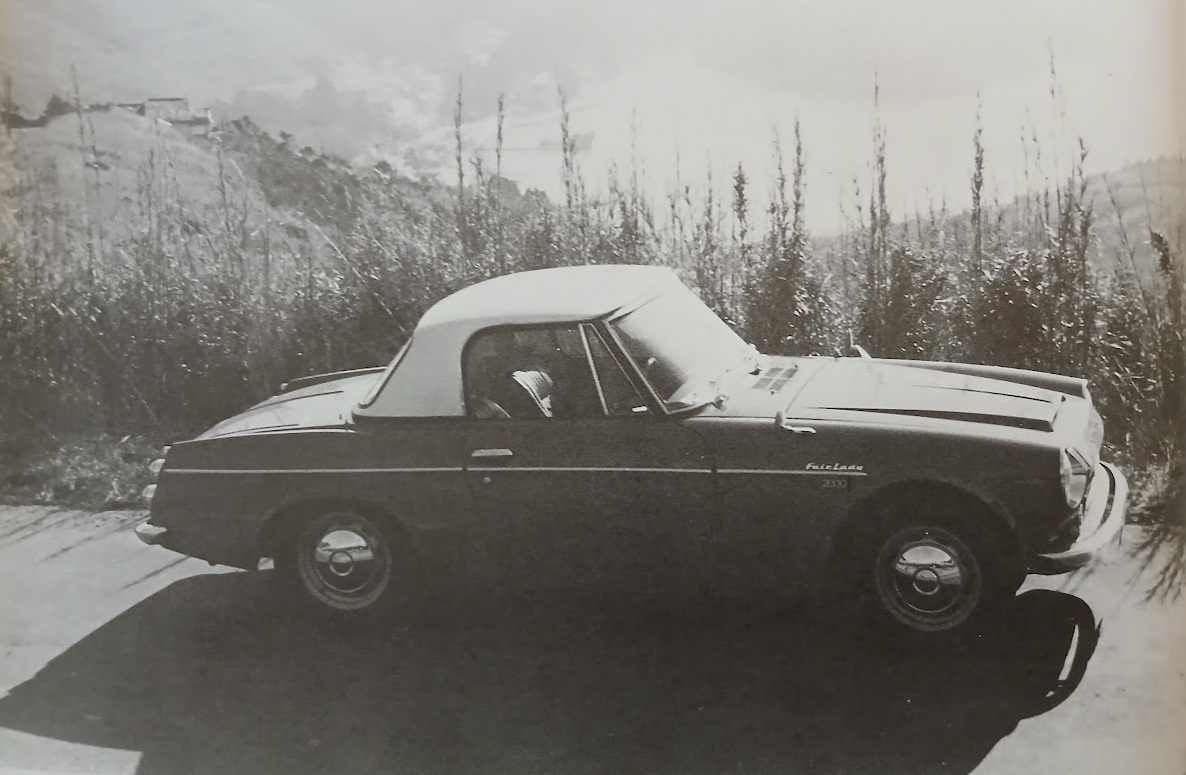
The Fairlady tested here over approximately 800km was the 2000 fitted with the optional hardtop. (The 1600, with its 90ps OHV engine, has essentially gone out of production.) Since the great majority of Fairlady owners purchase a hardtop separately, Nissan now offers a version fitted only with the hardtop (910,000 yen). (Adding the soft top later costs a further 42,000 yen.) This was the model tested.
The car was still practically new, having covered approximately 3,000km, and was completely stock apart from a set of Dunlop SP3 165/SR-14 radial tires.
First impressions of the Fairlady are rather like that of a single-engine piston fighter from the Second World War. (During the test period we also happened to drive the Mazda Cosmo, which is equally the equivalent of a jet.) Yet these two cars, whose characters sit at opposite extremes, are almost evenly matched in performance. According to the catalog figures, the Fairlady reaches 205km/h against the Cosmo’s 200km/h, while the 0-400m times are 15.4 and 15.8 seconds respectively.
The difference is in the manner in which that performance is delivered. The Cosmo produces it with the smoothness and subdued hum of an electric motor, while the Fairlady—more masculine than the man who drives it—delivers its performance with the vibration and roar of a single-engine propeller aircraft.
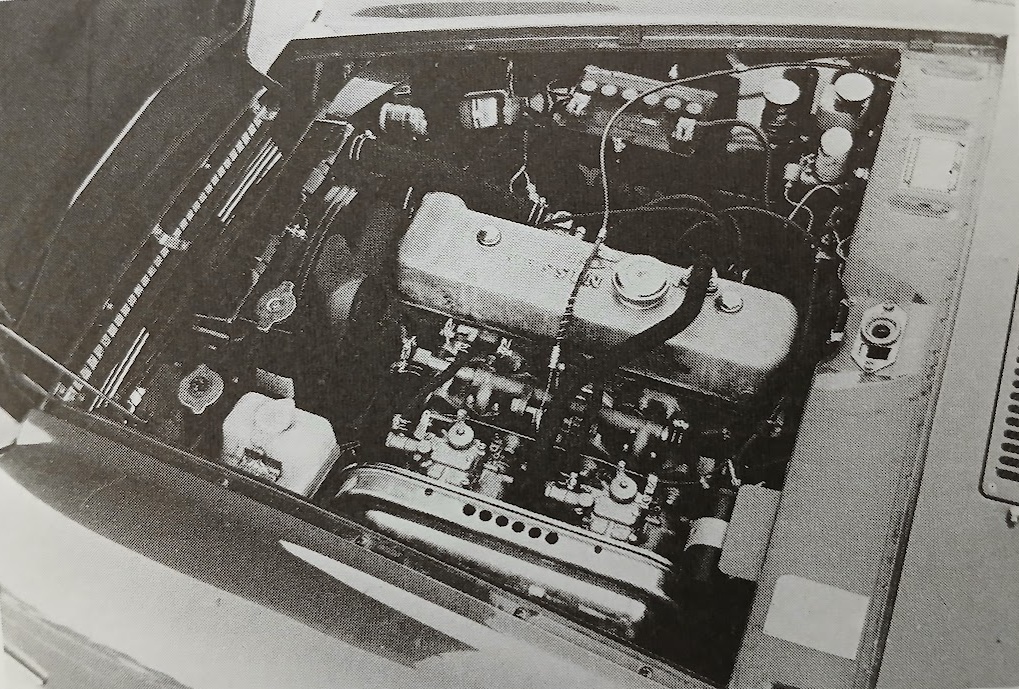
Untuned and exactly as it leaves the production line, the 2-liter 145ps engine idles with all the roughness one expects of a large-displacement four-cylinder sports unit. By modern standards, the engine mountings seem exceptionally rigid. Like a vintage car, engine vibration is transmitted directly into the separate chassis and from there into the body.
On our test car, the mixture supplied by its twin twin-choke Solex 44PHH carburetors was set noticeably rich—a fact borne out by the generally poor fuel consumption. Even on cold early mornings, however, the engine always fired on the first attempt after two or three pumps of the throttle. These Solexes do not use a conventional butterfly choke. Instead, they simply inject raw fuel directly into the intake. Used excessively during starting, they can easily foul the spark plugs. (We managed to do exactly that ourselves on one cold morning. The plugs were standard NGK B6Es. Once fouled, they would not clear unless the car was driven steadily at around 3000rpm for some time.)
For fast idling, a separate hand throttle is provided on the dashboard. This is very convenient during warm-up. On our test car, coolant temperature rose rather slowly. If driven away before it had fully warmed up, the gauge would barely climb above the lower limit of the normal range, only reaching 80°C after getting stuck in heavy traffic.
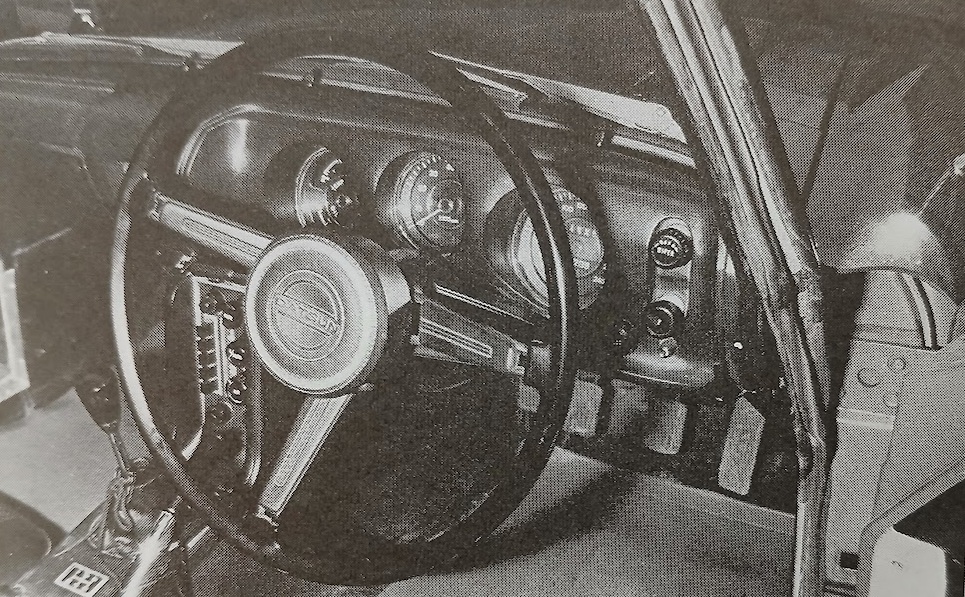
This engine is very much tuned for high-speed torque, developing its peak of 18.0kgm at 4800rpm, and from around 4000rpm the power comes on with real authority. The tachometer is marked with a yellow zone from 6500-7000rpm and a red zone from 7000-8000rpm. Since the engine produces so much torque in absolute terms, however, everyday town driving rarely requires more than about 1500-4000rpm, even in the lower gears.
The Fairlady 2000 comes standard with a 5-speed gearbox, fifth being an overdrive ratio of 0.852. The clutch, if released smoothly, engages just as gently as that of a normal passenger car. With its 3.889 final drive and large 14-inch tires, however, the Fairlady is geared unusually high for a 2-liter sports car. Even first gear has an overall ratio of only 11.49, so an ordinary start from a traffic light is surprisingly lacking in urgency. The ride, meanwhile, is so stiff that the car practically leaps into the air over manhole covers, and few rational drivers will dare to use full throttle in city traffic. Anyone who simply takes the Fairlady for a brief drive around the block will almost certainly come away with the impression of a coarse, rather unapproachable machine.
Our conclusions, however, are quite different. We not only used the car daily for about a week, but also subjected it to maximum-speed testing at Yatabe, and fully explored its cornering abilities on the lightly traveled roads of Hakone during the week.
As an affordable 2-liter sports car, its performance ranks among the very best in the world. As already noted, our test car was essentially new with only about 3,000km on the odometer, and the engine did not yet seem to be producing its full output. Even so, it reached 190km/h in both fourth and fifth gear, while recording 15.8 seconds from 0-400m with two occupants aboard.
Although rough-running at low speeds, the engine becomes relatively smooth above 3500rpm, where its strongest operating range begins, and in the lower gears it will spin easily to 7500rpm. However, vibration and noise remain excessive by any standard. The main sources of noise are the engine and transmission, with wind noise joining them at higher speeds.
Engine noise reaches one especially objectionable peak at around 2800rpm, reverberating through the cramped cabin to such an extent that one must raise their voice to be heard. Unfortunately, the legal highway speed limit of 100km/h corresponds to approximately 3000rpm in fifth gear—very near this resonance peak. As a result, the overdrive fifth gear is little quieter than fourth (about 3400rpm) at 100km/h.
The fully synchronized 5-speed gearbox is one of the Fairlady’s best points. Its Porsche-type servo synchronizers are extremely effective, giving light, positive shifts with short lever throws. The closely spaced gear ratios—2.957 (overall 11.49), 1.858 (7.23), 1.311 (5.098), 1.000 (3.889), and 0.852 (3.31)—are well matched to the engine’s relatively narrow useful power band. Pulled to the beginning of the yellow zone at 6500rpm, second gear reaches approximately 105km/h and third about 147km/h.
Maximum speed proved to be 190km/h in both fourth gear at 6500rpm (the speedometer indicated 200km/h) and in fifth. We were unable to reach the catalog figure of 205km/h. As this demonstrates, the main purpose of fifth gear is not to increase top speed, but to reduce engine speed during high-speed cruising, thereby easing engine load and improving fuel economy. In that respect, its design objective has been achieved. (Road speed per 1000rpm is 29.0km/h in fourth gear and 34.5km/h in fifth.)
Once the test car reached about 180km/h, however, a pronounced vibration developed throughout the driveline in both fourth and fifth gear, causing the entire body to shudder. Since the vibration continued even with the transmission in neutral, it clearly did not come from the engine. Nor was it transmitted through the steering, ruling out the front wheels. It therefore seems almost certain that the source was either the propeller shaft or an imbalance in the rear wheels.
As the engine approached 6500rpm in fourth gear, the gear lever also developed a pronounced high-frequency vibration, with the result that the shift knob repeatedly worked itself loose no matter how much we re-tightened it. Most foreign sports cars use a rubber locking insert on the shift-knob threads to prevent exactly this problem.
The engine’s relatively peaky torque characteristics, together with its high overall gearing, are also reflected in its overtaking-acceleration figures. Starting with this test, we have adopted a new method of measuring overtaking performance, recording the time required to accelerate through successive 40km/h intervals, such as 20-60km/h and 40-80km/h.
Taking third gear as an example, the Fairlady requires 7.6 seconds to accelerate from 40-80km/h, but only 6.8 seconds from 80-120km/h—an 0.8 second advantage in the higher-speed range. With most sporting cars, the opposite is true. For example, the Skyline 2000GT recorded 7.6 seconds from 40-80km/h in third gear, but 8.5 seconds from 80-120km/h. The Corona Mark II 1900SL recorded 7.5 and 9.1 seconds respectively, while the Mazda Rotary Coupe (the Cosmo would be a better comparison, but C/G has not yet conducted instrumented tests) required 9.4 and 14.2 seconds.
The same is true in direct fourth gear. The Fairlady is actually quicker at higher speeds, recording 11.2 seconds from 40-80km/h and 10.1 seconds from 80-120km/h.
At the same time, the engine’s generous torque in absolute terms allows these high gear ratios to be used surprisingly far down the speed range. Fifth gear is perfectly usable from about 50km/h (approximately 1500rpm). Since it develops roughly the same power in fifth as the direct fourth gear of the average 2-liter passenger car, one finds oneself using fifth even in city traffic.
As mentioned earlier, the clutch engages with the gentleness of a normal passenger car if released smoothly. During the acceleration tests, however, raising the engine speed to around 5000rpm and dropping it produces a rapid, racing-car-like engagement, making it easy to achieve clean starts while leaving two black tire marks stretching some five meters behind the car. The live rear axle, well controlled by its torque rods, transmits the engine’s power effectively to the road even under these hard standing starts.
Few aspects of a car vary more with driving style than fuel consumption, and if the Fairlady is driven as its character invites, it consumes fuel accordingly. In our experience, the worst figure came in city driving, where consumption fell to just under 5km/l. The best was achieved by maintaining a steady 100km/h on the expressway, where it returned 10.5km/l. Under more typical conditions—roughly equal proportions of city streets and normal highways—fuel consumption falls in the range of 6.5-7km/l, about the same as the previous Skyline 2000GT-B. The 43-liter fuel tank is rather too small for a car with this level of consumption.
The brakes are excellent. They consist of Dunlop-Sumitomo Mk II discs at the front and Alfin finned drums at the rear. There is no brake servo (or more likely, not enough space to accommodate one), so pedal effort is generally quite high. Even a moderate stop from traffic speeds—about 0.4g—requires nearly 30kg of pedal pressure, while maximum deceleration approaching 1g demands a heavy 50kg.
Even so, braking force increases in direct proportion to pedal effort, front-to-rear balance is ideal, and above all the brakes have an exceptionally smooth action, as though the car were being grabbed from behind by an invisible giant hand. Pedal travel is not too long, nor is there any trace of brake squeal.
Beginning with this test, we have also slightly revised our fade-test procedure. Previously, we performed ten successive 0.5g stops from 100km/h at one-kilometer intervals, recording the increase in pedal effort. Instead, and as the name “0-100-0” implies, we now accelerate from rest to 100km/h, apply 0.5g braking to a complete stop, then immediately accelerate again to 100km/h before repeating the braking sequence.
This procedure is repeated ten times. Under this method, a faster car spends less time between braking applications than a slower one, making it a correspondingly more severe test of the brakes. Since high-performance cars naturally have more opportunities to subject their brakes to hard use, we believe this is a more rational approach.
In the Fairlady’s case, pedal effort increased from an initial 30kg to 40kg by the fourth stop, reaching only 48kg on the tenth stop. Since there was virtually no sign of reduced effectiveness, its resistance to fade can be judged fully satisfactory.
The steering requires 2¼ turns from lock to lock. Considering its tight 4.9m turning circle, this may be described as quite quick. Even when turning a street corner, one rarely needs to rotate the wheel through a full turn. Steering effort is somewhat heavy at parking speeds, but once under way it becomes surprisingly light. (The test car was fitted with Dunlop SP3 tires inflated to 2.0/2.0kg/cm².)
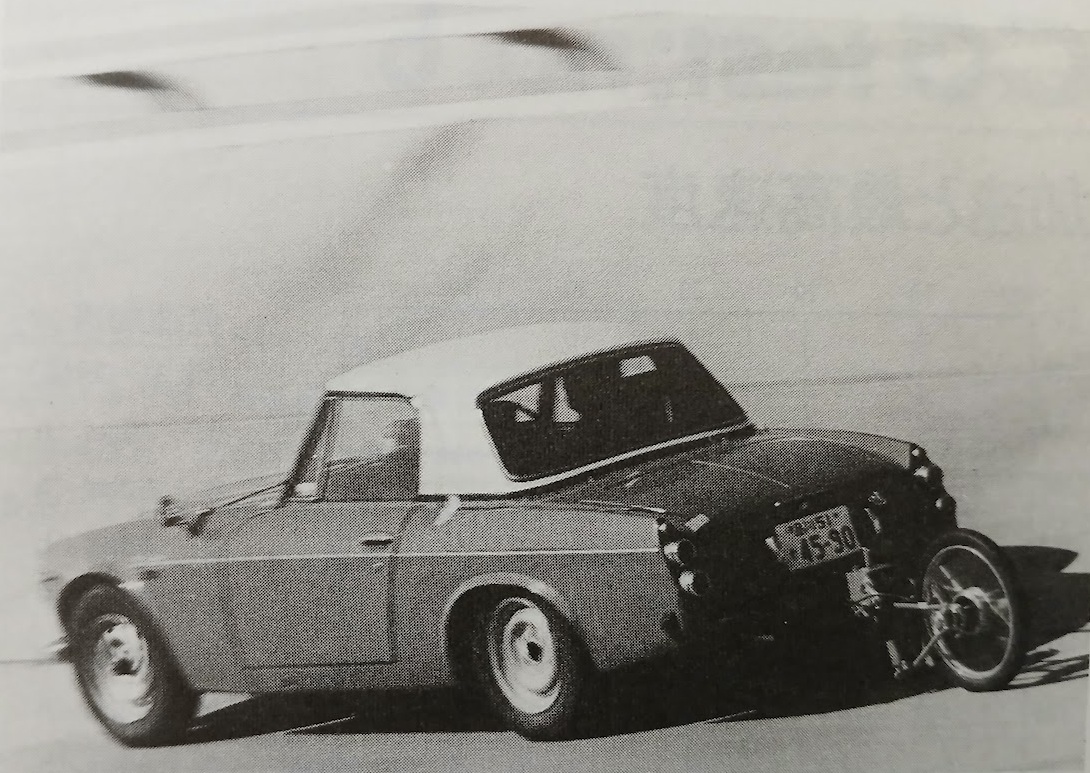
At town speeds the steering feels rather lifeless, but its response improves at higher speeds, becoming quite precise. With its front-heavy weight distribution (55.3/44.7 with two occupants), the Fairlady naturally displays pronounced understeer, which is maintained all the way to the limit.
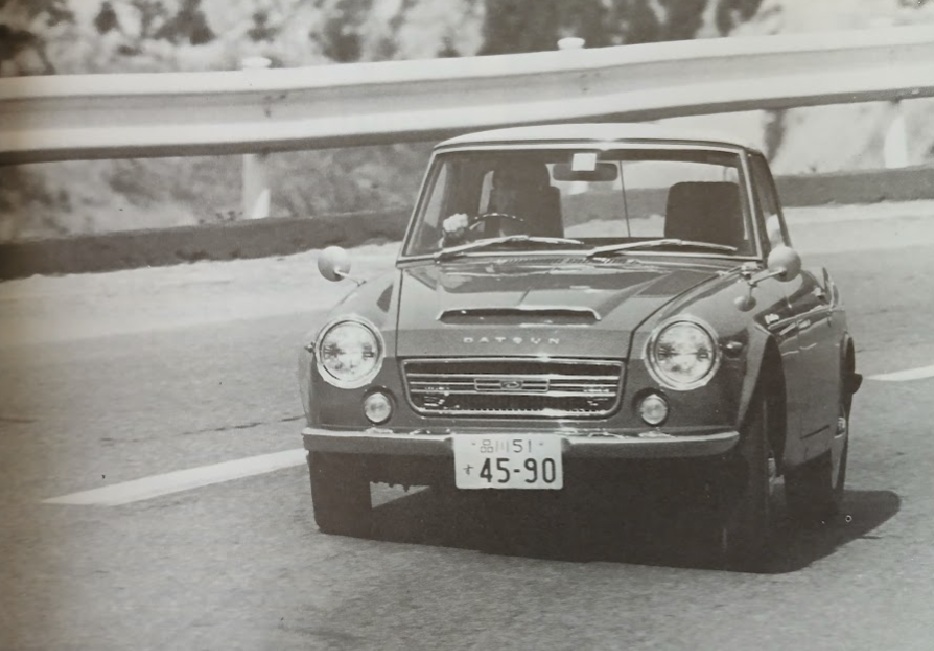
The Fairlady showed its best qualities on the smooth, winding roads of Hakone. Climbing Otome Pass, we thoroughly enjoyed a spirited hillclimb, keeping the engine between 5000-6000rpm in second and third gear. Body roll is minimal, the Dunlop SP3s provide excellent grip, and the car corners with a consistently stable attitude.
Strong understeer remains the basic handling balance, and steering effort is on the heavy side. Yet in tight corners there is plenty of power to neatly tighten the line with a small power slide by applying throttle in second gear. The steering is quick enough that such slides are easy to control, and almost instinctive to catch. Because the onset of the slide is gradual rather than abrupt, even an inexperienced driver can anticipate it without difficulty.
In short, the Fairlady’s handling is fundamentally safe.
The Dunlop SP3 tires are well matched to the suspension. Even with tire pressures above 2kg/cm², there is almost no kickback through the steering. Thanks to the separate chassis frame, tire noise is also well suppressed. (Although, in the Fairlady, where every sort of noise is conspicuous, tire noise is hardly the greatest concern.) Even after more than thirty consecutive minutes at speeds between 150-190km/h, tire temperature had changed very little, while tire pressure increased by only 0.2kg/cm².
As noted several times already, the ride is exceedingly stiff. Suspension travel is extremely limited, and even slight road irregularities are met with sharp jolts from below. After several hours driving on the poorly surfaced streets of Tokyo, one is left thoroughly fatigued.
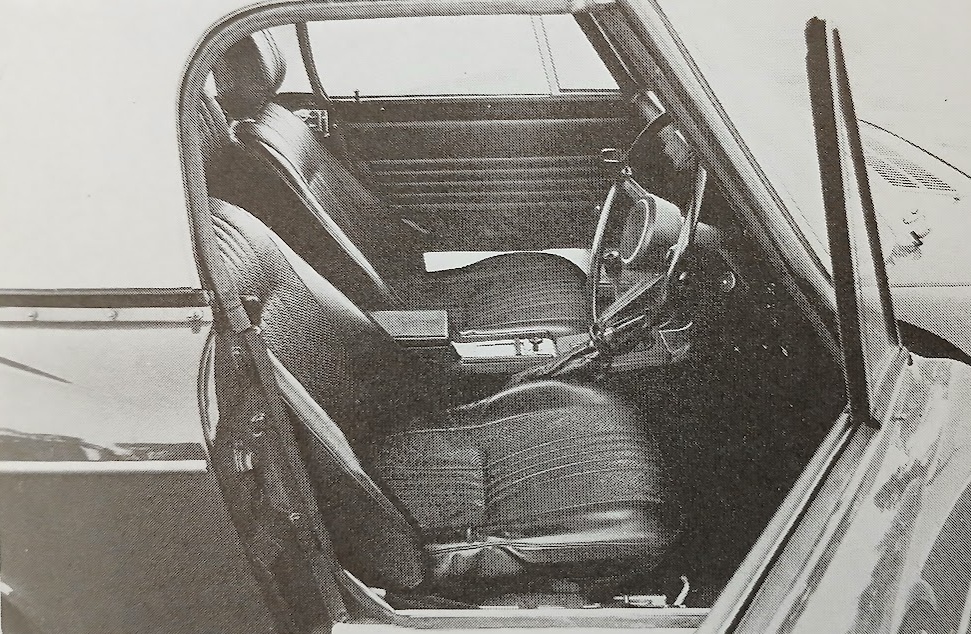
The seats are very thin, but among Nissan products they are probably the most comfortable. The driving position is, in a word, “vintage.” The steering wheel sits high and close to the driver’s chest, making bent-arm steering almost unavoidable. The cockpit is narrow, with little room to spare for two large adults. With the seat adjusted fully rearward, however, there is plenty of legroom even for a tall driver. The controls are generally well positioned.
The pedal layout is particularly commendable, making heel-and-toe downshifts entirely natural. A sturdy footrest for the left foot provides excellent support for bracing through corners. A grab handle on the passenger’s side would be a welcome addition.
As mentioned earlier, this car was equipped with an FRP hardtop as standard.
Its weather protection is far better than that of the soft-top model, and if anything, there is more headroom than one really needs. It does, however, create large rear-quarter blind spots (the soft-top has large triangular quarter windows in this area), while the fixed headrests restrict the view through the rearview mirror.
On our test car, the fit between the hardtop and the body was poor, producing an awful racket over uneven road surfaces.
With the model revision of November 1967, the Fairlady was brought into compliance with all applicable US safety standards (apart from the emissions controls left off of domestic-market cars). One of the most significant improvements was the adoption of parallel windshield wipers in place of the earlier cross-over type. The blades were also lengthened by about 80mm, greatly improving forward visibility in wet weather. At the same time, heater performance was increased, and a switch was added to the ventilation system allowing the driver to choose between outside and recirculated air.
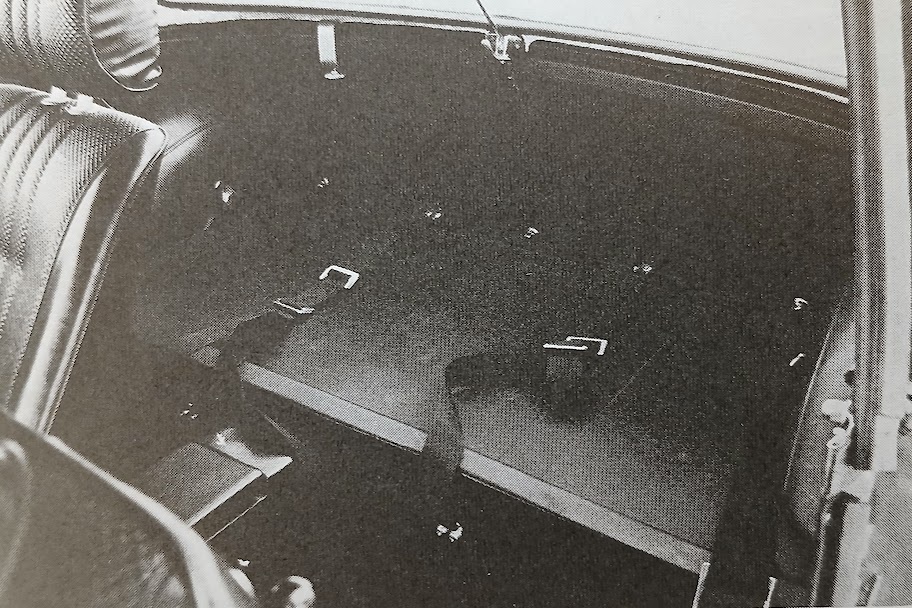
The Fairlady is a pure two-seater—nothing more, nothing less. Behind the seats, though, is a genuinely spacious luggage shelf with enough room for two large suitcases. While very simple, it even includes fabric retaining straps to keep baggage securely in place.
Storage space consists of the dashboard glovebox, a locker between the seats large enough for a camera, and map pockets in both doors. Behind the gear lever is a covered sliding ashtray. Those who do not smoke will probably find it equally useful as a place to store coins. The entire dashboard is covered by matte-black crash padding, while every switch is of a low-profile, safety-conscious design.
One feature still unusual on a Japanese car is a warning lamp on the console to indicate brake-fluid leakage. Nissan has gone so far as to provide a separate switch for checking that the warning-lamp bulb itself has not failed. The instruments are all mounted high directly ahead of the driver, where they are easy to read day or night.
As we have said more than once, the Fairlady is not a modern grand touring car. It is a traditional—perhaps the last—two-seat sports car. As all-purpose transportation, it has many inconveniences. But for the driver who understands how to enjoy a sports car as a sports car, it offers satisfaction far beyond what its price would suggest.
Postscript: Story Photos