Nissan Fairlady Z432 (1970)
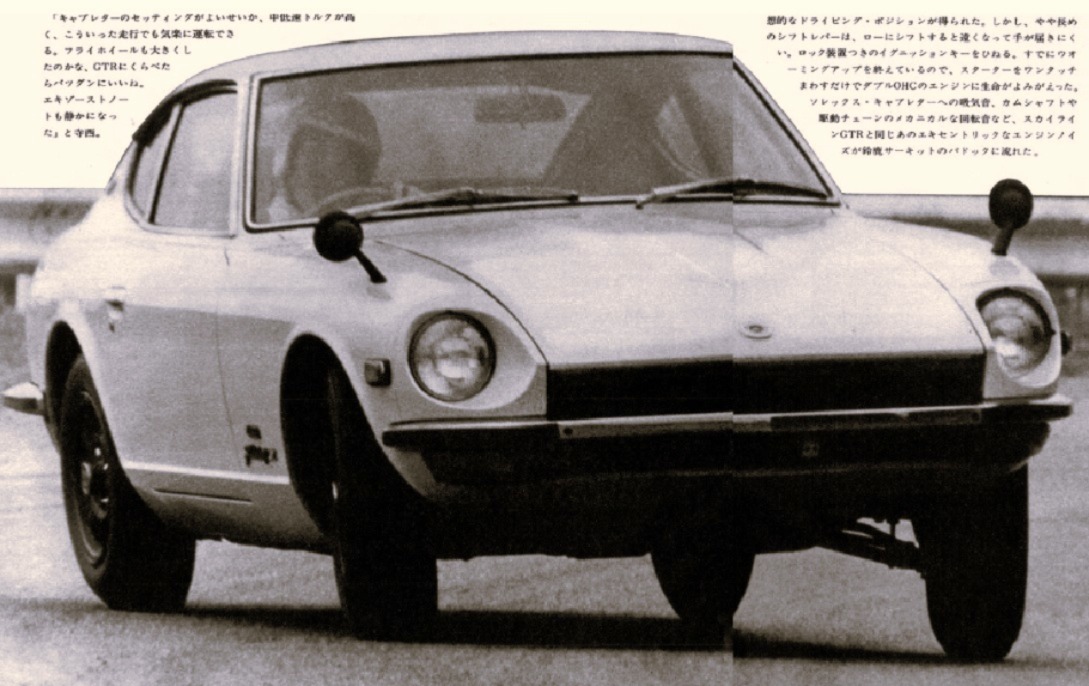
Publication: Auto Sport
Format: Auto Sport Impression
Date: January 1970
Author: Takatoshi Teranishi, Auto Sport Editorial Staff (uncredited)
Takatoshi Teranishi Takes on Suzuka in the Fairlady Z432!
The Fairlady, the “champion of GT racing,” has undergone its first model change in seven years. How will the hard-edged Z432 version of the new Fairlady respond on city streets and at Suzuka Circuit? The man at the wheel is “Tiger” Takatoshi Teranishi.
A Dynamic Man and a Formidable Machine
“Wow, this is an easy car to drive!”—that was Takatoshi Teranishi’s first impression. Teranishi first drove the Fairlady Z432 on November 21, in front of the Nissan Gallery in Osaka, where he works.
Powered by the S20 engine of the Skyline 2000GT-R, the Fairlady Z432 is the hottest production model in the new Fairlady range, which recently underwent its first full model change in seven years. There is also a racing version, the “Z432R,” but this is virtually built to order.
The Fairlady Z was designed from the outset with motorsports such as racing and rallying in mind. It is no mere “luxury coupe.” So, we decided to take this new sports car to Suzuka Circuit and see just how much performance it could deliver in completely standard form. The man chosen to bring out that performance was Takatoshi Teranishi.
Takatoshi Teranishi, born in September 1933, is 36 years old. His driving style can be summed up in one word: dynamic. His drifting technique, making full use of countersteer, is among the best in Japanese racing. In 1968, driving a Fairlady 2000 (SR311) with a white body and blue stripes, he won race after race to capture the GT-II class All-Japan Championship.
Then there are his natural instinct for racing and his tenacity when victory is at stake—qualities that put him in a class of his own. At Suzuka in August two years ago, he recorded an official lap time of 2 minutes 37.2 seconds, and at Fuji that October, in the NET Speed Cup, he recorded 2 minutes 9.5 seconds during the race. For a Fairlady, these were astonishing times, surpassing even those of the factory drivers. It was around this time that he acquired the nickname “Crazy Teranishi.”
Today, as readers will know, Teranishi works as a sports consultant at the aforementioned Nissan Gallery in Osaka, advising customers on motorsports-related matters, while continuing to compete in races with the Skyline GT-R and Fairlady 2000.
And then there is the Fairlady Z432. Ever since Genichiro Tahara, now chairman of the Nissan Sports Car Club, drove the original Fairlady to victory in the first Japan Grand Prix in 1963, the model has formed the backbone of sports driving in Japan. Now it has been fitted with the GT-R’s formidable 160ps powerplant—an inline six-cylinder, DOHC engine with four valves per cylinder. The suspension, too, has been “transformed”: where the old model used double wishbones at the front and leaf springs at the rear, the new car has independent strut suspension with coil springs at all four wheels.
All this is wrapped in a monocoque body with styling that combines a purposeful look with elegance. The fastback tail is sharply cut off, a shape intended to reduce aerodynamic drag.
Impeccable Around Town
Teranishi set off for Suzuka Circuit in the Z432. The clutch and steering have just the right amount of weight, giving the car a suitably sporting feel. Compared with the old model, Teranishi was surprised by the spaciousness of the interior. There is ample foot room, and thanks to the fastback body, there is plenty of luggage space behind the seats as well.
“And the visibility is excellent, both front and rear.” Both the windshield and the glass in the tailgate are quite large. The wood-grain steering wheel, at 38cm in diameter, is a size smaller than the GT-R’s 40.3cm wheel, with the horn button only in the center.
Beyond it, two large gauges stand out in the depths of the thick crash pad. On the right is a speedometer reading to 240km/h, with a trip meter; on the left is a tachometer reading to 10000rpm, with a yellow zone from 7000-7800rpm and the red zone above that.
Three smaller gauges are arranged above the center console. The two on the right are divided into upper and lower sections, housing four readings: water temperature, oil pressure, ammeter, and fuel level. At the far left is a clock incorporating a stopwatch. Below these are the map light, heater controls, and a stereo car radio. Ahead of the wood-grain gearshift lever are the choke and hand-throttle levers, while behind it are the heated rear-window switch, parking-light switch, and other controls. All of these are labeled with pictograms, making it unlikely that any of the controls will be operated by mistake.
We joined the Hanshin Expressway. It was rush hour, and the slow crawl continued all the way to the Toyonaka interchange of the Meishin Expressway.
“Maybe it’s because the carburetors are so well set up, but there’s plenty of low- and mid-range torque, so even in traffic like this it’s easy to drive. I wonder if they made the flywheel heavier, too. Compared with the GT-R, it’s outstanding. The exhaust note is quieter as well,” Teranishi observed.
Once on the Meishin Expressway, Teranishi guided the Z432 right and left, and in what seemed no time at all we had reached the Ritto interchange. The brakes use discs at the front and leading-trailing drums at the rear, with servo assistance. They proved highly dependable, providing firm braking with normal pedal pressure.
The turn-signal lever on the right side of the steering column also incorporates the headlight dimmer switch, with a push button for flashing the headlights at its tip. The lever on the left combines the parking-light and headlight switches, the wiper switch, and, at its outer end, a push button for the windshield washer. This arrangement is extremely easy to use. In a car of this type, where the seat is set back and the driver adopts a straight-arm driving position, reaching the switches can often be a problem, but in this respect the Z432 has been particularly well thought out.
From the Ritto interchange we turned onto National Route 1 and headed for Suzuka. Along the way, the suspension picked up the regularly spaced joints in the pavement quite noticeably. Teranishi, however, said, “Compared with the old Fairlady, it’s so much better there’s really no comparison. It’s only a little firmer than a Bluebird. A soft ride is fine, but with coil springs at the rear, I wonder how it’s going to be on the circuit….” Despite the good ride, he looked almost concerned.
A 2 Minute 55 Second Lap!
Morning at Suzuka. Teranishi put on his racing suit and set the Fairlady’s tire pressures to 2.8kg/cm² at the front and 2.5kg/cm² at the rear. The tires were Bridgestone “Super Speed 5s.” Rather than radials, these are of conventional bias-ply construction, but are tubeless, low-profile high-speed tires. The size was 6.95H-14-4PR.
The standard models, such as the Z and Z-L (with their SOHC engines), use the same type of tire, but these are called “Super Speed 2” and are sized 6.45H-14, with a somewhat narrower tread and smaller overall diameter. The “H” denotes high speed, with a permissible speed range from 175km/h up to 200-210km/h. The tread pattern had previously been used only on tires supplied to Mercedes-Benz, so in this sense it could fairly be said to have been newly developed for the Fairlady Z432. The Z and Z-L use 4.5J steel wheels, while the Z432 has 5.5J magnesium wheels.
Teranishi went a step further, removing the felt and mats from the floor and leaving the bare sheet metal exposed. As if to make certain, he pressed his left foot against the footrest. Seated in the perforated leather seat with the three-point belt firmly fastened, he had an ideal driving position. The somewhat long gearshift lever, however, was difficult to reach when shifted into first, as it moved too far away. He turned the ignition key, which incorporates a steering lock. With the engine already warmed up, a single touch of the starter brought the DOHC engine back to life.
The sound of air being drawn into the Solex carburetors, the mechanical whir of the camshafts and drive chain—the same eccentric engine noises familiar from the Skyline GT-R—flowed through the paddock at Suzuka Circuit.
Leaving behind the circuit workers who had spotted Teranishi and gathered around the Z432, he drove through the gate and onto the course. With a heavy, dry exhaust note that seemed to reverberate in the pit of the stomach, Teranishi began his dash toward the first corner. From first to second and then third, he shifted up each time the tachometer needle reached exactly 7000rpm.
The gearbox is the same Porsche-type 5-speed used in the old Fairlady 2000 and the Skyline GT-R, with exactly the same ratios. The final-drive ratio also remains 4.444. For the first two laps, Teranishi did not run at full speed, using them instead to see how well these ratios worked together.
From the third lap onward, Teranishi came charging down the straight in front of the grandstand at full throttle. Just before the first corner, the engine was turning 6600rpm at 200km/h. Here he shifted down from fifth to fourth. The second and third compound corners were taken in third at 6000rpm, then he plunged into the S-bends at full throttle. Through this section, Teranishi used his specialty, a four-wheel-drift, to keep the body sliding sideways.
The tires shrieked under the extreme load, and the body was rolling more than expected. Yet the tires gripped the surface firmly and showed no inclination to let go. Compared with the Skyline GT-R, there seems to be noticeably more roll. At the Degner Curve, still at 6000rpm in third, the Z432 ran all the way to the outside, dropping its tires briefly onto the grass and throwing up a cloud of dust.
At the Hairpin, Teranishi made a couple of rather awkward attempts at cornering. This was because the limited-slip differential was not locking strongly enough and, at the same time, the tires were gripping the road more firmly than expected, preventing the tail from coming around. From the next lap onward the tires began to slide, but Teranishi commented, “For racing, it will need a stronger limited-slip differential.”
Through Spoon Corner, and again through the 130R beyond the grade-separated crossing, Teranishi held a four-wheel drift while clipping the inside. Sensing the way the car was moving, he skillfully alternated between half and full throttle. From 130R through the final corner and onto the straight, the accelerator remained all the way down, and the tachometer needle rapidly climbed from 6000 to 6800rpm. Near the middle of the grandstand, around the beginning of the pits, it reached 7000rpm, and there he shifted into fifth.
In this way, Takatoshi Teranishi drove the Fairlady Z432 for about ten laps of Suzuka Circuit in the early morning. During his flat-out laps, the times ranged from 2 minutes 55.7 seconds to 2 minutes 56.4 seconds, a variation of less than one second.
When he heard the times, however, Teranishi looked momentarily puzzled. “That’s a little surprising. It has plenty of low- and mid-range torque, but once you get above 7000rpm, it stops pulling.” Even so, when SCCN driver Seiichi Suzuki drove a standard Skyline GT-R around this circuit in March of the previous year, his lap times had been around three minutes, so the Z432 was four to five seconds faster.
The tires had taken quite a lot of punishment, and the tread blocks showed a sharply angled pattern of wear. This was hardly surprising: at times, the smell of burning rubber could be detected even from the side of the track.
From Prototype to Production GT Car
So, how did it feel?
“The steering is very good. The ratio is just right, and even the steering wheel could be used for racing just as it is. Judging from the front-heavy styling, I had expected there to be understeer, but it remained neutral. The seat feels suitable for racing as well.”
—What about the engine power?
“There’s plenty of power. The cornering is so good that you don’t have much sense of speed, so you have to be careful not to carry too much speed. Compared with the GT-R, the engine is much easier to use.”
—How about the suspension?
“The ride was so good that I decided to push it hard, but the independent rear suspension was firm and had plenty of stability under load.”
—Was there anything that made it difficult to drive?
“Let’s see. The accelerator pedal is set too far forward compared with the brake pedal, which makes heel-and-toe difficult. The emergency flashlight fell out of its holder and rolled around inside the car. And at high engine speeds, the response became sluggish.”
—And overall?
“It’s a huge improvement over the previous Fairlady. Even as it is, I think it would do a 2 minute 50 second lap if driven absolutely flat out. Personally, though, I’m still not entirely satisfied with the styling and finish….”
Those were Teranishi’s impressions of the Fairlady Z432.
Certainly, the Fairlady Z shows the results of seven years of technical progress. In ordinary road driving it displayed extremely flexible performance, while on the circuit it demonstrated ample power and sure-footed roadholding.
What kind of impact will it have on the motor sport world in the years ahead?
One indication may be found in the Z432’s racing version, the “Z432R.” On the R, the hood is made of FRP, while FRP aerodynamic panels are fitted beneath the engine compartment and at the tail. With these fitted, its coefficient of drag is said to be better than that of the Porsche 911.
It also comes with an oil cooler from the outset, has its interior trim removed, and the ignition key relocated beside the gearshift lever. In other words, its specification is such that it can enter competition virtually as-is. The Z432 weighs 1040kg, but the R is reduced to 960kg. Taking into account the homologated weight required for approval and the domestic competition regulations, it is said that the car can be lightened still further to approximately 800kg.
Teranishi commented, “If you gave this a higher-geared transmission and fitted the fuel injection used on the GT-R, wouldn’t it break 2 minutes 25 seconds at Suzuka?”—2 minutes 25 seconds! Converted to Fuji Speedway times, that would mean comfortably breaking 2 minutes 5 seconds. In the near future, it might even break the two-minute barrier.
At the time of the third Japan Grand Prix in 1966, it was said that the original Prince R380 might—or might not—be capable of breaking two minutes at Fuji. Yet the technical achievements of that prototype have now borne fruit, to the point where a production GT car is about to reproduce a similar level of performance.
A car in which racing experience and production-car practicality have been superbly combined—that was the conclusion Takatoshi Teranishi drew from the Fairlady Z432.