Nissan Fairlady Z432 (1970)
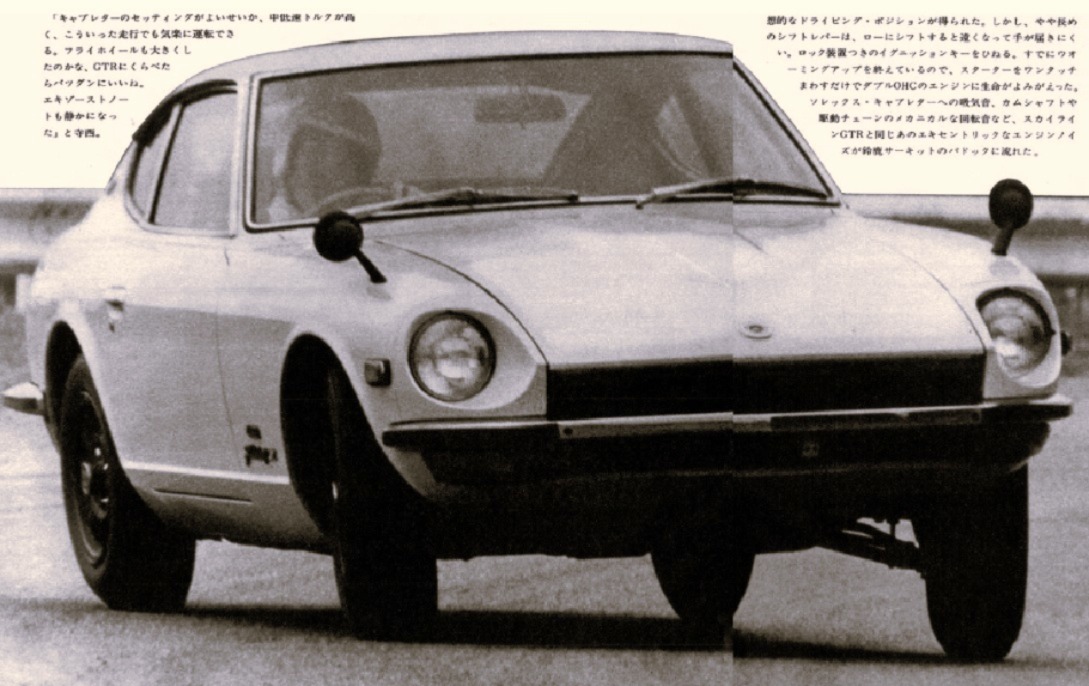
Publication: Auto Sport
Format: Auto Sport Impression
Date: January 1970
Author: Takatoshi Teranishi, Auto Sport Editorial Staff (uncredited)
The Fairlady, the “giant of GT car racing,” has undergone a full model change for the first time in seven years. How will the new high-performance Fairlady Z432 respond in city driving and at the Suzuka Circuit? The driver is Takatoshi Teranishi.
Dynamic Driver and Machine
“Wow, what an easy car to drive!” That was Takatoshi Teranishi’s first impression from behind the wheel of the Fairlady Z432. Teranishi was driving the car for the first time on November 21st, in front of the Nissan Gallery in Osaka where he works.
The Fairlady Z432, equipped with the same S20 engine as the Skyline 2000GT-R, is the hottest mass-produced model in the new Fairlady Z line, which was recently introduced as the first full model change for the Fairlady in seven years. There is also a race-spec “Z432R,” but this is essentially a made-to-order competition model.
The Fairlady Z, with a design based on experience in motorsports such as circuit racing and rallies, is more than just a luxury coupe. So, to see how much performance this new sports car could exhibit in its stock form, we decided to put its capabilities to the test at Suzuka Circuit. The person in charge of bringing out that performance was Takatoshi Teranishi.
Teranishi, born in September 1933, is now 36 years old. His driving style can be summed up in one word: dynamic. His drifting technique, which makes full use of countersteering, is among the best in the Japanese racing world. In 1968, he won many races in a white, blue-striped Fairlady 2000 (SR311) and dominated the All Japan Championship in the GT-II class.
Furthermore, he has a natural instinct for racing and a strong determination to win. In August of last year, he recorded an official lap time of 2 minutes and 37.2 seconds at Suzuka, and in October of the same year at Fuji (NET Speed Cup), he recorded a time of 2 minutes and 9.5 seconds during the race, which was an amazing time for a Fairlady, surpassing Nissan’s factory drivers. It was around this time that he earned the nickname “Crazy Teranishi.”
As readers are well aware, he currently works as a sports consultant at the Nissan Gallery in Osaka, where he gives advice to customers about participating in motorsports, and also competes in races with a Skyline GT-R and a Fairlady 2000.
Then we have the Fairlady Z432 itself. The old Fairlady has been the backbone of domestic sports car racing since the current Nissan Sports Club Chairman Hara Masaru won the Japanese Grand Prix in 1963. In the Z432, the Fairlady is equipped with the GT-R’s inline six, DOHC, four-valve-per-cylinder, 160ps power plant. Moreover, compared to the old model’s front double wishbone, leaf spring rear suspension, the new model has been transformed by a four-wheel independent suspension, with struts and coil springs for all four wheels.
The monocoque body that encases these features has a style that combines boldness and elegance, and the fastback tail has been cleanly cut off to reduce air resistance.
Perfect City Running
We met Teranishi at Nissan Gallery and started off for Suzuka Circuit. The Z432’s clutch and steering had just the right amount of weight, and the sporting mood of the cockpit was superb. Teranishi was surprised at how spacious the interior was compared to the previous Fairlady. The foot space was quite large, and because it is a fastback, there was ample luggage space behind the seats.
“The visibility is expansive both in front and behind,” offered Teranishi. The windscreen and rear liftgate window are quite large. The steering wheel is made of wood, and it is 38cm in diameter, a size smaller than the GT-R’s 40.3cm, and the horn button is in the center pad.
Beyond that, two large gauges stand out in the depths of the thick crash pad. The speedometer on the right goes up to 240km/h, while the tachometer on the left has a yellow zone from 7000 to 7800rpm and a red zone above that, reading up to 10000rpm.
There are three small gauges lined up on top of the center console. The two on the right are split into upper and lower sections, housing four gauges: temperature, oil pressure, ammeter, and fuel, while the leftmost one is a clock with a stopwatch. Below that are map lights, heater controls, and a car stereo, and to the rear of the wooden shift lever are the choke and hand throttle levers, with the switches for the rear window defogger, parking lights, and so on just behind. All of these are labeled, so it’s unlikely that you’ll use the wrong control.
We got onto the Hanshin Expressway from Osaka. Since it was rush hour, we continued to drive slowly all the way to the Toyonaka interchange on the Meishin Expressway. Probably because of the good carburetor settings, the torque is strong at low- and mid-range engine speeds, so the Z432 is easy to drive even in this kind of traffic. The flywheel seems to be larger than the GT-R’s, which is nice under these conditions. The exhaust note is quieter, too.
On the Meishin Expressway, the Z432 carved effortlessly left and right through the shallow curves, and before I knew it, we had arrived at the Ekimae Interchange. The brakes are discs at the front and leading/trailing drums at the rear, and they are servo-assisted, so they were reliable and stopped the car firmly with normal pressure.
The turn-signal lever on the right side of the steering column doubles as the headlight dimmer switch, and at its tip is a push button for the hazard lights. The lever on the left side of the column headlight and wiper switches, and on its tip is a push button for the windshield washer. This is extremely convenient. In this type of car, where the driving position tends to be low with the driver’s arms outstretched, it is often difficult to reach these kinds of secondary controls, but in this car, their layout has been well considered.
We got off at the Higashi Interchange and onto Route 1 heading for Suzuka. Along the way, the ride ofen picked up the evenly-spaced joints in the pavement. However, Teranishi commented, “compared to the previous Fairlady, it’s no problem. It’s only a little stiffer than the Bluebird. It’s good that it’s more comfortable, but with the rear coil springs, I wonder how it will perform on the circuit…” The ride comfort makes him look worried.
Lap Time is 2 Minutes, 55 Seconds
During the Suzuka session, Teranishi donned his racing suit and set the tire pressures to 2.8kg front, 2.5kg rear. The tires were Bridgestone Super Speed S, a low-profile high-speed bias-ply tire, rather than radial. The size was 6.95-14-4PR.
Standard Fairlady models such as the Z and Z-L (with single OHC) use the same type of tire, but the size is 6.45-14-4PR, with a narrower tread width.
When it comes to tires, the term “high speed” refers to the ability to run continuously at speeds of 175km/h or more, and for these tires, the maximum permissible speed is 200 to 210km/h. The tread pattern was previously only used in Mercedes-Benz products, so in this sense it can be said to have been developed specifically for the Z432. The wheels are 5J steel rims for the 2.0-liter Fairlady Z models, and 5J magnesium rims for the Z432.
Teranishi removed the carpets and mats from the floor, exposing the metal underneath, and checked the position of the footrest with his left foot. He adjusted the leather seat and the three-point seatbelt for the ideal driving position. However, the somewhat long shift lever was a bit difficult to reach when shifting into first gear, as was the ignition key. Since the car had already been warmed up from a practice run, the DOHC engine started with a single twist of the key. The same eccentric engine sounds as the Skyline GT-R, with its passionate-sounding Solex carburetors and busy mechanical noise from the camshafts, flowed through the paddock at Suzuka.
After speaking with the circuit attendants who had gathered around the Z432 when they saw Teranishi appear, he headed out of the gate and onto the course as we watched from the stands. Teranishi dashed towards the first corner, leaving behind a dry exhaust roar that resonated in my stomach. He shifted up from first, to second, to third gears at exactly 7000rpm.
The gearbox is the same Porsche-type unit used in the old Fairlady 2000 and Skyline GT-R, and the final drive ratio remains the same at 4.44. No full-throttle driving will be done for the first two laps, in order to check the matching of these gears to the course.
For the third lap, the Z432 raced in front of the stands at full throttle. Just before the first corner, it was at 6600rpm and 200km/h. Here, Teranishi shifted down from fifth to fourth. For the second and third compound corners, he was in third gear at 6000rpm and then entered the S-bends at full throttle. Around this section, Teranishi kept the car sliding sideways, using his trademark four-wheel drifting technique. The tires scream under the extreme load, and the car’s body rolls to an unexpected degree. However, the tires grip the road firmly and do not seem to want to let go. Still, compared to the Skyline GT-R, it seems like the car has a lot of body roll. At Icha Curve, with the car in third gear at 6000rpm, one rear tire drops slightly off the track, kicking up a cloud of dust.
In the next two turns, the cornering appeared to become awkward. This was because the limited-slip differential was not working effectively and the tires stuck to the road more than expected, so the tail did not slide. The tires started to slide more from the next corner, but Teranishi said later, “if we want to use this car in a race, we’ll need to install a stronger differential lock first.”
At the Spoon and 130R corners after the intersection, he clipped the inside and drifted with all four wheels, skillfully alternating between half throttle and full throttle while grasping the flow of the course.
On the straightaway, the throttle was clearly fully open, and the tachometer rose from 6000 to 6800rpm. At the center of the grandstand, near the pits, the tachometer reached 7000rpm, and finally it was time to shift into fifth gear.
In this way, Takatoshi Teranishi completed about ten early morning laps of the Suzuka Circuit in the Fairlady Z432. When driving at full speed, his lap times ranged from 2 minutes and 55.7 seconds to 2 minutes 56.4 seconds, with little variation between laps.
However, when Teranishi returned to the paddock and heard these results, he said with a confused expression, “That’s surprising. It has torque at low- and mid-range engine speeds, but it doesn’t grow any faster above 7000rpm or more.” He seemed to expect slower times. However, when Seiichi Suzuki of SCCN drove a Skyline GT-R on this circuit in March last year, the lap time was about three minutes, so the Z432’s time was about four to five seconds faster.
The tires had clearly been used very hard, with the treads wearing down at sharp angles. At one point the smell of burning rubber could be detected on the sidelines of the track, so it’s no wonder.
From Prototype to Production GT Car
So, how did the Z432 feel? In Teranishi’s own words:
“The steering is very good. The gear ratio is just right, and can be used for racing just as it is. I thought there would be understeer because of the heavy front end, but the balance remained fully neutral. The seat also feels like it can be used for racing.”
And the engine power?
“It certainly has power. Its cornering performance is good and you don’t feel the sensation of speed, so you have to be careful not to get going too fast. The engine is much easier to use than in the GT-R.”
What about the suspension?
“After feeling how comfortable the ride was, I decided to test the limits of its capabilities at Suzuka, but the independent rear suspension was firm and stable.”
Was there anything that made it difficult for you to run at Suzuka?
“Well, the accelerator was too far forward in relation to the brake pedal, which made heel-and-toeing difficult. The emergency flashlight fell off its mounting and rolled around the interior of the car. Engine response became slow at high rpm.”
So, overall?
“It’s much better than the previous Fairlady. If we had time to keep pushing, we should be able to turn 2 minute and 50 second laps. However, I’m personally not satisfied with the style and finish…”
These were Teranishi’s impressions of the Z432.
As expected, the Fairlady Z exhibited the fruits of seven years of technological advancement. It showed extremely flexible performance in city driving, and on the circuit it showed ample power and solid roadholding ability.
What kind of ripples will this have on the world of motorsports in the future? One indicator of this is the racing version of the Z432, the Z432R. The R features an FRP bonnet and FRP air deflectors on the underside of the engine bay and on the tail. With these in place, the drag coefficient is said to be better than the Porsche 911’s.
In addition, it is equipped with an oil cooler, has many of the interior parts removed, and has the ignition key placed next to the shift lever, making it possible to participate in races straight from the factory. The weight of the Z432 is 1040kg, but there are plans to reduce it to 960kg in the future. Furthermore, if the official weight required for homologation and the domestic competition vehicle regulations are taken into account, it should be possible to reduce the vehicle weight to about 800kg.
Teranishi mused, “If we put a higher gear on this transmission and add the injection system that comes with the GT-R, is it possible we could break the 2 minute 25 second mark at Suzuka?” 2 minutes, 25 seconds! Converted to Fuji Speedway times, that means it may be possible to break the two minute mark in the near future.
At the time of the third Japanese Grand Prix, in 1966, the first Prince R380 was said to be unable to break the two minute mark. However, thanks to the experience gained through the car, the same level of performance is now being replicated in production GT cars.
A car that perfectly combines racing experience and marketability: this was the conclusion that Takatoshi Teranishi reached after thoroughly examining the Z432.