Nissan Cherry Coupe 1200 X-1 (1971)
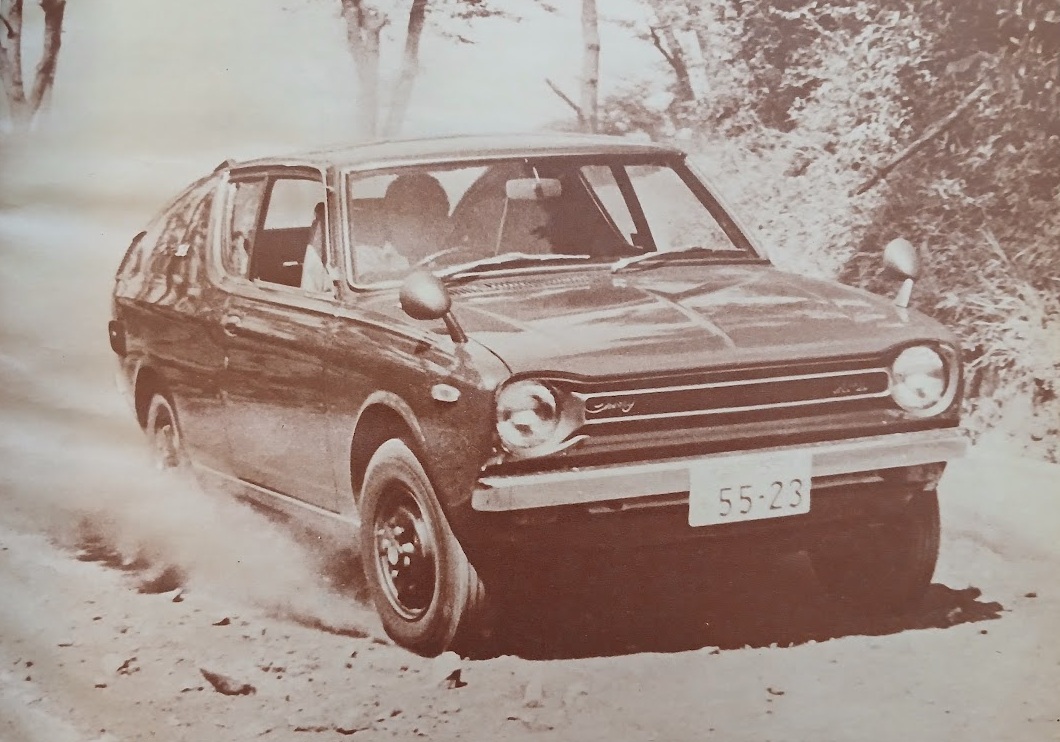
Publication: Motor Fan
Format: Test Drive Report
Date: November 1971
Authors: Eiichi Yamazaki, Motor Fan Editorial Staff (uncredited)
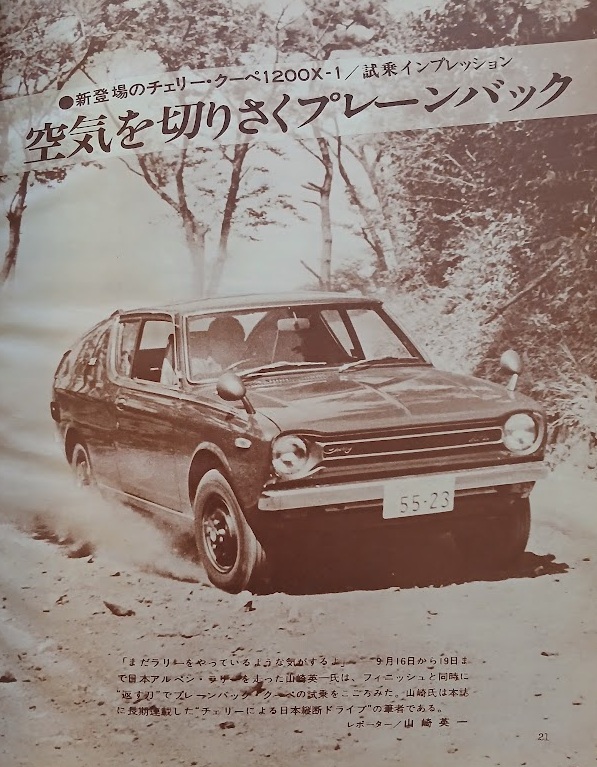
The Planeback Coupe That Slices Through the Air
“It still feels like I’m driving in a rally.”
Having competed in the Japan Alpine Rally from September 16th through the 19th, Eiichi Yamazaki swept directly from the finish line to a test drive of the new Planeback Coupe, almost in one continuous motion.
Yamazaki is also the author of this magazine’s long-running series, A Cross-Japan Drive in the Cherry.
Staking Everything on the Engineers’ Dreams and Convictions
There is said to be a confidential strategic directive within Chrysler that states: “Never stray from the car in the lead.” In other words, when designing a new model, do not take unnecessary risks.
Lately, an endless stream of new cars has appeared on the market, each promoted with flamboyant slogans about this or that “line” or “shape.” Yet no matter which one you look at, they all seem to resemble something seen before somewhere else. More often than not, one comes away disappointed by the lack of genuine novelty.
It is, in every sense, the Chrysler method carried through to the letter.
And yet, the debut of the Cherry sedan–and now this coupe–feels like a true breath of fresh air to enthusiasts, regardless of whether it is commercially successful or not.
There are surely many executives who believe that a product which does not sell is worthless. But if, as a result, one simply conducts “safe business” by producing cars that merely cater to prevailing consumer tastes, there can be no real progress.
One imagines that, before the Cherry series reached production, there must have been considerable disagreement within Nissan’s management between the sales and engineering sides. In the end, it would seem that the engineers won out. Nissan has long promoted itself under the slogan “Nissan–the company of technology,” emphasizing engineering content above all else. But this time, they have made a bold wager not only in substance, but in styling as well.
There are many examples among European manufacturers of companies that stake everything on a fiercely individual character, born from the passion and dreams of their engineers–cars that seem to declare, “This is what an automobile truly is. If you cannot appreciate it, then do not drive it.”
Supported by European temperament and by a longer history of motorization, many such companies have achieved considerable commercial success. There is something of that same spirit running through the Cherry series.
The fundamental difference, of course, lies in user temperament and the differing stages of motorization between Japan and Europe.
In any case, I am wholeheartedly in favor of Nissan’s release of this new model–a move that could almost be called a tremendous gamble.
Cooling Fan Relocated
Last year, I wrote a serialized story for this magazine describing a drive across Japan in the Cherry sedan, and perhaps because of that connection, I was assigned the responsibility of testing the new coupe.
Its official unveiling on September 16 happened to coincide with the start of the Japan Alpine Rally, in which I myself was entered. Through a bit of selfish insistence on my part, arrangements were made for the test drive to take place only after the rally had finished. Until then, I had not seen the actual car, or even photographs of it.
And so, only moments before the test drive was finally to begin, I came face-to-face with the real thing for the first time. Speaking honestly, I was completely dumbfounded, and for a moment found myself literally speechless.
There is a well-known line in one of Sagami Taro’s famous rokyoku performances about the Jirocho of Shimizu gang: “They are not all tough fellows. Among them are a few rather odd ones as well…”
For some reason, that line came immediately to mind.
I walked around the car again and again, studying it from every angle–at moments astonished, at others deeply impressed. One almost had the feeling that the person who drew these lines–the stylist responsible for the shape–was somewhere nearby, grinning quietly to himself.
Seen directly from the side, the silhouette calls to mind the Lotus Europa. The front half, however, makes clever use of the sedan’s existing pressings. The joint along the roof is concealed beneath a rubber molding, which itself serves as a styling accent.
The longer I looked at it, the lower the car began to seem. From directly behind, in particular, it appears strikingly low. Even the vertical height of the side windows looks narrower than on the sedan. Later, I confirmed that the overall height had in fact been reduced by as much as 65mm, while the rear portion of the body had been extended by 80mm.
Nissan refers to this styling theme as a “planeback.” As the name suggests, it refers to the flat rear treatment, which is said to offer excellent aerodynamic characteristics. That claim is certainly believable. More importantly, however, when combined with the folding rear seat and flat load floor, it creates an extremely large luggage space–surely one of the car’s greatest practical advantages.
Of course, less charitable observers may simply call it a light van…
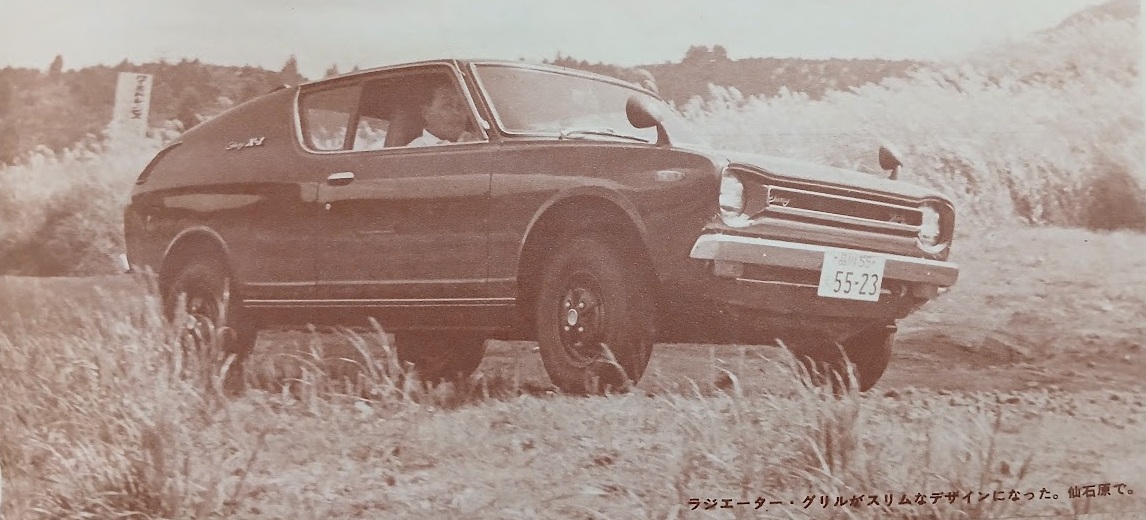
From the front, the coupe appears considerably smarter than the sedan, thanks to its slim radiator grille. The rear view, meanwhile, appears somewhat narrow due to the shallow angle of the large rear window, giving it a faintly top-heavy impression.
The taillamps combine rectangular turn signals within circular brake and running lamp elements, almost as though symbolizing Nissan’s corporate emblem.
The real point of controversy, however, is surely the side view–particularly the enormous rear quarter panel. One could interpret it as dynamic, or simply as a great slab of steel. Still, there is no doubt that it contributes both to increased body rigidity and reduced production costs. Silly though the thought may be, one finds oneself imagining how convenient it would be, in rally competition, to have so much space available for sponsor decals.
Tow hooks have been fitted both front and rear. On independently suspended cars, it is often surprisingly difficult to find suitable places for attaching a tow rope–whether towing or being towed. This is a welcome touch.
The car provided for the test was an X-1 finished in a shade called Ivy Green, a color quite close to Nissan’s familiar Royal Green. As with the sedan, the X-1 uses the 1200cc twin-carburetor engine. (At the same time as the coupe’s introduction, a single-carburetor version of the 1200cc engine was also added to the range.)
The twin-carburetor power unit itself is unchanged from the sedan, but the radiator has now been relocated to a conventional forward-mounted position, with approximately half its surface area cooled by an electric fan. This was most likely done in an effort to reduce noise.
The electric fan switches on and off automatically by means of a thermo-switch mounted midway along the radiator hose, operating via the vapor pressure of ethyl alcohol.
15.5km/l at Highway Speeds
With that, it was finally time to set off.
The interior is finished in a bright orange color extending all the way into the luggage compartment. The dashboard moldings have been revised, and padding has been added. The instrument panel, too, differs considerably from that of the sedan, with round gauges set into a silver-colored plastic fascia. Overall, the impression is somewhat more luxurious.
In general, Japanese cars today tend to spend unnecessarily large amounts of money on decorative treatment around areas such as the instrument cluster. Kei cars in particular, driven by excessive competition within the segment, have become almost textbook examples of over-decoration. Manufacturers ought to reflect seriously on the extent to which such things stray from a car’s original purpose.
If part of the reason for the Cherry sedan’s disappointing sales lay in an interior that was simply too austere, then perhaps this coupe represents a fairly reasonable compromise.
I pressed the clutch pedal. Thunk–solid resistance. Looking down, I realize I had stepped on the brake instead.
In other words, the pedals are offset to the left by roughly the spacing between the clutch and brake, compared with what one would ordinarily expect.
During my drive across Japan in the Cherry, I experienced exactly the same thing at the start of every monthly leg of the trip. Once accustomed to it, it causes no particular difficulty. But while on the subject, I would like to say this to all car manufacturers: I do not want to hear automakers use the phrase “once you get used to it…”
In my view, a proper car is one that can be operated naturally and without resistance from the very first moment one gets behind the wheel.
The engine starts readily, and as with the sedan, the water temperature rises quickly. Avoiding the congested streets of central Tokyo, we headed toward the Tomei Expressway.
Then the water temperature began rising abnormally.
Stopping at a service station near the Tomei entrance–partly to refuel for fuel-consumption measurements–we inspected the cause. The electric fan is not operating.
When the terminal connection at the thermo-switch was pressed into place, the fan began turning immediately. The temperature rise had simply been caused by poor contact at the terminal, preventing the fan from operating.
Generally speaking, Japanese cars still suffer from a high rate of wiring-harness troubles. I have more than once been tormented during rallies by poor contact either within crimped terminals themselves or between the terminals and their wires. Once calmly investigated, they invariably turn out to be utterly trivial faults.
Wiring harnesses are assembled by hand by factory workers, but I would very much like manufacturers to exercise greater care in quality control. Is it not wasteful to lower the reputation of an entire automobile over something so insignificant?
We were soon back onto the Tomei Expressway. In terms of the way the coupe drives, there is little difference from the sedan. It goes well–remarkably well, in fact. It will comfortably exceed the catalog top speed. The characteristic FF reverse-steer behavior is also the same as in the sedan.
Perhaps because of the body shape, wind noise is extremely low. There is no shimmy, and the lack of sensation of speed is almost unbelievable for a car in this class.
That is, aside from the prominent engine noise…
Before long we had arrived at Gotemba. Fuel consumption measured there came out to 15.5km/l—a respectable enough result.
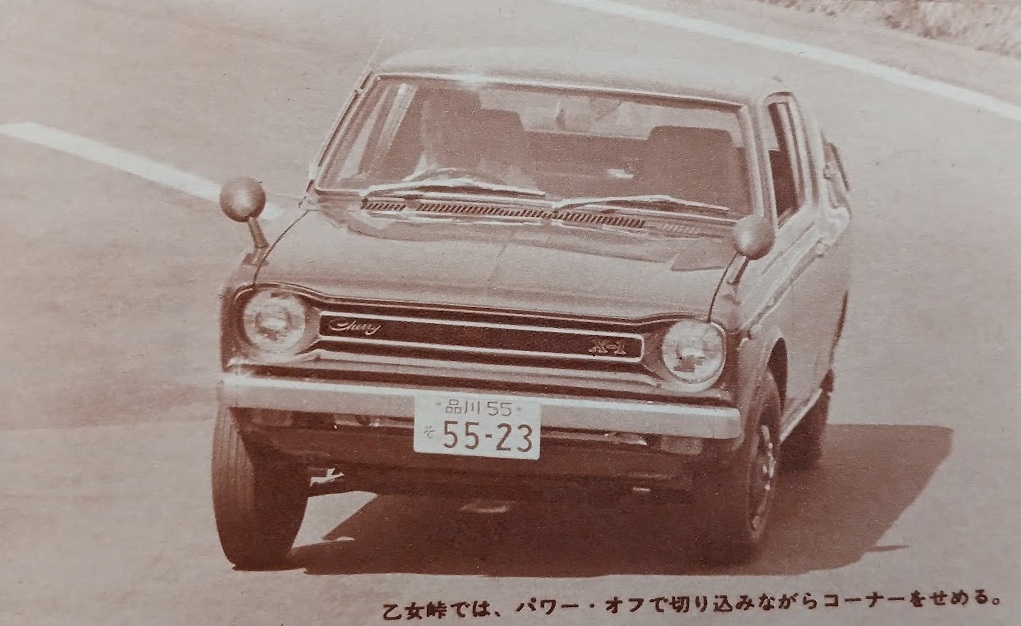
From there it was straight into a hillclimb attack on Otome Pass. The car delivers enjoyable performance in these conditions, tucking in nicely when the throttle is lifted in corners. However, once engine speed falls below 3000rpm, there is a sudden and noticeable drop-off in torque.
Considering that peak torque comes at 4400rpm–and also taking into account the engine noise–one cannot help wondering whether ordinary users, as opposed to those involved in motorsport, will really be able to make effective use of this engine’s performance.
Although the suspension gives the impression of being relatively firm, body roll is still fairly pronounced in large-radius corners. One wonders whether the spring rates may be slightly soft relative to the damping force.
That said, I should add that only a short while earlier I had been driving a fully tuned rally car as unyielding as a tank, so my impressions here may not necessarily be entirely objective.
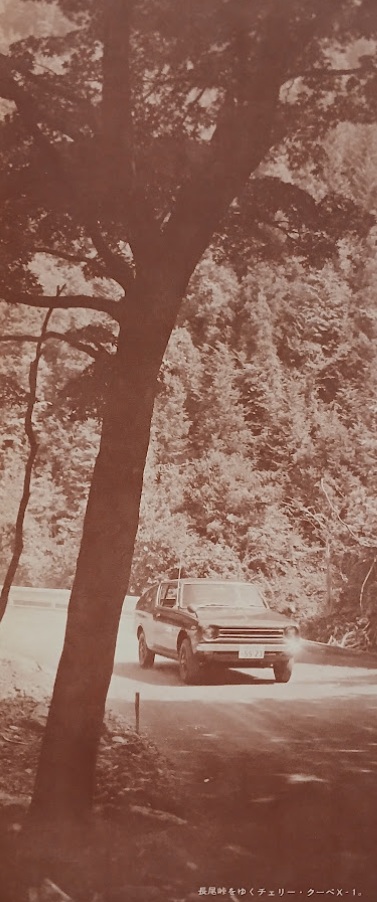
Descending into Sengokuhara, we drove along dirt roads lined with beautiful pampas grass. There still seems to be a slight amount of engine movement under hard acceleration in first and second gear on loose surfaces.
What proved more troublesome was the poor rearward visibility directly behind the car. Reversing to avoid holes and ruts is difficult. Likewise, at diagonally merging intersections, the large rear side panels obstruct visibility and make things quite awkward.
After descending Nagao Pass, we tried some high-speed running on the wide dirt roads around Takigahara. On roads like these, FF cars are unquestionably strong. The feeling of the car clinging tightly to the road surface is irresistible. Even spin turns can be executed at will.
Average fuel consumption over roughly 100km of dirt-road driving came out to 10.3km/l.
And so, while cruising back along the Tomei, I found myself thinking how nice it would be to load up the rear compartment with camping and leisure gear and set off on a vacation trip in this car.
Postscript: Story Photos