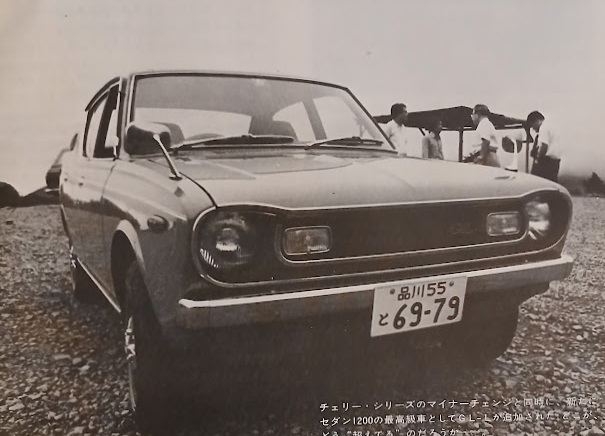
Nissan Cherry Four-Door 1200 GL-L (1972)
Publication: Motor Fan
Format: “Bubble Index” Road Test
Date: October 1972
Authors: Osamu Mochizuki, Katsuzo Kageyama, Shigeki Asaoka, Yasuhei Oguchi, Reiko Ikuuchi, Kensuke Ishizu
Luxury with Approachability
At the same time that the Cherry series received its minor model change, the GL-L was added as the new top model in the 1200 sedan range. Just where, and in what way, does it “go one better”?
Aiming for a Larger Market Share
“Catch Toyota—and overtake them!”
With these words, one Nissan executive is said to be spurring on the sales organization. Nissan has been left particularly far behind in its share of the mass-market car field, so it has little choice but to concentrate its efforts there.
On June 12, Nissan Motor carried out a minor model change to the Cherry series (sedan and van), while at the same time adding the GL-L tested here to the 1200 sedan range.
Needless to say, the aim is for the Cherry, together with the Sunny, to take on Toyota’s Publica and Corolla and increase Nissan’s share of the mass-market car field.
The newly added GL-L is based on the GL, previously the top sedan model. Changes to its exterior and interior—including a new front grille incorporating fog lamps, larger taillamps and a completely redesigned instrument panel—have made it both more luxurious and more approachable. It is, of course, now the top model in the sedan range.
Since we featured the Cherry Coupe 1200 X-1 in a Bubble Index comprehensive road test in our December issue last year, each of our specialists has already experienced the character of its powertrain—the A12 engine and front-wheel-drive layout, with a water-cooled, inline four-cylinder OHV engine mounted transversely.
As usual, the specialists gathered at the drive-in “Fantasy,” which serves as the starting and finishing base for our tests. This time, their discussion centered mainly on the car’s styling and handling in sedan form.
On August 10, the day of our test, strong winds were blowing along the Tomei Expressway.
“The wind was about 10m/s, coming from between 45° to the left and directly ahead, and the car’s handling and stability were not necessarily of a high standard.”
By chance, we had also brought along a Cherry 1000 2-Door Sport DX as a support car, and the specialists divided themselves between the two cars as we drove. In terms of the instability caused by the wind, there was little difference between them.
After leaving the Gotemba Interchange and reaching the Otome Pass, another comment was heard:
“At this point, we sound like young drivers showing off and tearing around. It’s unusual to find a car with this much tire squeal.”
Even though we were not driving particularly hard, the tires shrieked repeatedly—kiiiii, kiiiii.
“Since this is the ‘top model,’ costing 20,000 yen more than the GL, I would like to see it fitted with rather better-performing tires.”
The skies had been clear in Tokyo, but around Hakone we encountered rain and fog. We promptly switched on the standard-equipment fog lamps and continued without incident.
“With the addition of another ‘L’ to the GL-L, we need to find out just how much equipment is actually included, and compare the price with what it would be if those items were added as options.”
With that, each of the specialists examined the car according to his or her own assigned subject, formed an impression of its character, and returned to our base at Fantasy.
As usual, we gathered around the table for our Bubble Session, examining the GL-L critically from every angle and exchanging opinions. Each specialist’s evaluation and impressions are presented in detail in the reports and comments that follow.
Performance: Power and Performance Characteristics That “Go One Better” (Osamu Mochizuki)
With its 1200cc engine, the Cherry shows excellent performance and characteristics over a wide range of speeds. A high-output engine, light vehicle weight and a body with low aerodynamic drag—these three factors combine to give it a high standard of performance for a family sedan.
Looking at the specifications of the 1200 4-door GL-L, vehicle weight is 685kg, engine output is 68ps/6000rpm, and maximum torque is 9.7kgm/3600rpm, giving a power-to-weight ratio of 10.1kg/ps. With this kind of loading, there is no noticeable deterioration in performance even with a full load of passengers on board. All of our test runs were conducted with three people in the car, but it was difficult to detect any difference in acceleration or other aspects of performance compared with only the driver being on board.
The A12 engine, already well-proven from its use in the Sunny, is once again outstanding. It pulls tenaciously at low rpm and spins up freely to high revs.
There is little vibration, and it is an exceptionally easy engine to use.
Driving in top gear at 25km/h presents no particular difficulty. In other words, virtually any situation encountered in city driving can be managed in top gear alone. By 40km/h, throttle response is quite sharp, while pulling power from 60km/h to around 130km/h remains remarkably consistent.
Second can be taken effortlessly to 70km/h, while third covers speeds up to 100km/h. In each gear, it delivers acceleration that is difficult to imagine coming from a 1200cc sedan. With skillful use of the gears, it can provide the same kind of lively driving as a sports sedan.
In addition to the light body, the flat torque curve is a major reason for the characteristics described above. Yet because the engine’s power delivery is fairly mild, even the average owner-driver will find its performance easy to control. In this sense, whether in city or highway driving, it is a car that minimizes driver fatigue.
In high-speed driving at 100km/h, the engine is turning at 3700rpm in top gear, which is close to the peak torque speed.
The response around this speed provides a substantial active safety margin, so there is little cause for concern on the highway. Taking into account the resistance to crosswinds characteristic of front-wheel-drive cars, its safety at high speeds may be considered to be at an extremely high level.
Acceleration from 120km/h to around 140km/h ranks with cars from the next class above. The rate at which the speedometer needle continues to rise can be taken as visual evidence of the car’s low aerodynamic drag.
To sum up, the Cherry 1200 4-door GL-L has reached an ideal level of overall performance for a family sedan, and one may conclude that its performance characteristics are capable of satisfying a broad range of users.
“Thoroughly practical performance that never feels strained.” — Kageyama
“Both its low- and medium-speed pulling power and its high-speed performance are more than sufficient.” — Oguchi
Handling & Stability: Heavy Effort to Turn and Hold the Steering (Katsuzo Kageyama)
My first impression was that the wooden steering wheel rim felt unusually thick. I soon got used to this, however. The next thing that bothered me was the intrusion of the wheelhouse: when I pressed the accelerator fully, the sole of my shoe contacted it. I tried to avoid this by holding my right foot toward the left side of the accelerator pedal, but then I became uncomfortably aware that my shoe was underneath the brake pedal.
In a small car, perhaps a certain amount of compromise in such areas is unavoidable, but even after a full day at the wheel, I never got used to it. The cramped footwell is made to feel even more so by the center console. Although it has been made possible for the left foot to fit beneath it, this console is something the car would be better off without.
Once underway, both the effort required to turn the steering wheel and to hold it in a turn are fairly heavy for such a small car. When I previously drove the Cherry Coupe 1200 X-1, I remember there being quite a lot of friction in the steering system, which made the steering return in a jerky manner. There was no trace of that this time, however, suggesting that careful attention has been paid to adjustment during assembly. In a car like this, having the steering build reassuring weight as lateral acceleration increases is highly desirable from the standpoint of control.
When I tried changing lanes somewhat abruptly, body roll seemed quite pronounced. More troublesome, though, was the way roll and yaw interacted, giving the car an unsettled character. I also had the impression that the steering system might lack rigidity. Somehow, the whole car feels overly soft and yielding, and not very reassuring.
This becomes even clearer when testing hands-off stability. Steering-system rigidity is no longer a factor in this case, but at high speeds the car does not settle readily, and the way it is tossed about is unpleasant. In terms of feel, all I can say is that there is something “not quite right” about it, and I cannot identify the cause. I would like to investigate the phase relationships among steering angle, roll angle and yaw angle through instrumented testing.
When cornering at high speed, the degree of understeer feels quite strong. Lifting off the throttle mid-corner produces clearly noticeable “tuck-in.” In the end, however, these are simply characteristics of front-wheel drive, and the car can be said to display very typical front-wheel-drive characteristics.
That in itself is fine. What does bother me, however, is the squealing of the front tires. Even in ordinary, everyday cornering that is by no means severe, the front tires let out a “kiiii." Try accelerating through a corner, and the squealing becomes tremendous. There may be young drivers who delight in this as evidence of vigorous, spirited performance, but generally speaking it is hardly desirable. To some extent, this should be preventable through a better choice of tires.
Speaking of tire squeal, although this too is characteristic of a front-wheel-drive car, the front tires squealed quite severely with wheelspin from a standing start. This may have something to do with the characteristics of the clutch as well.
“There is a peak in the noise level just above 110km/h.” — Mochizuki
“Perhaps the thickness of the steering wheel puts the car at a disadvantage in terms of handling…” — Oguchi
“Somehow, it lacks a feeling of confidence.” — Asaoka
Interior & Comfort: Dissatisfied with the Overall Balance (Shigeki Asaoka)
When I heard this was a new series, I thought it might really be “new,” but it still has the same old body and hardly deserves to be called a new model. Only the taillamps, radiator grille and rear fenders have been changed, to an extent that one would hardly notice unless they were pointed out.
As a result, there is none of the fresh feeling that comes with driving a new car, and perhaps for that reason I found myself noticing one flaw after another. To begin with, I do not care for the fact that Nissan, while advertising itself as “Nissan of Technology,” can still say with a straight face that “a car is more stable when pulled than when pushed,” an old piece of salesmanship from the distant past. Anyone who remembers even junior-high-school physics will know that a front-wheel-drive (FF) car is inherently unbalanced and unstable.
That does not mean I am against front-wheel drive. As I have said at every opportunity, FF offers enough potential advantages in “rationality” to compensate for that instability, and only a car which makes full use of those advantages can be considered a successful FF design.
The exterior is rather dumpy and not very stylish, but this does allow for plenty of interior height, which is to the user’s benefit. I only wish it were a little wider as well…
The GL-L is the most “deluxe” model in the Cherry series, but I simply cannot understand why Japanese manufacturers, whenever they produce a deluxe model, feel compelled to clutter it up with so many things. As noted above, the greatest advantage of FF is the ability to obtain an exceptionally large passenger compartment in relation to the car’s exterior dimensions. Yet here, on what should be a flat, spacious floor, they have fitted a console that serves no apparent purpose and just gets in the way—and then attached a voltmeter to it. An ammeter in a modern car is still understandable, but a voltmeter is really something else.
The instrument panel is easy to read, which is good, but the absence of a tachometer leaves it incomplete, and the place where one naturally expects to find one is occupied by a conspicuously large clock. This test took place in midsummer, and one thing that deserves special mention is the excellent ventilation. It is probably among the best-performing systems in any car, whether Japanese or foreign.
The interior appointments are decent enough, and given the car’s low price, it would probably be unreasonable to expect much more. Where the engineering is concerned, however, there are things I would like to see improved, particularly since doing so would require only a little more thought, not any great increase in cost. The suspension, for example, is quite firm, yet the car somehow rolls far too much, while the poor stability typical of front-wheel drive has not been adequately overcome through development.
Aside from these points, the front wheelhouses intrude considerably into the cabin, seriously compromising the relationship between the steering wheel, seat and pedals. This is another area I very much hope will be improved at the next opportunity. The price of this car is quite low, but regrettably, there are engineering shortcomings that one cannot simply dismiss by saying, “Well, at this price, that’s only to be expected.” Above all, however, I hope they do not give it any more power. Excess power is the most dangerous thing of all in a front-wheel-drive car…
“The tires are underperforming.” — Mochizuki
“Manufacturers try to add on this and that, and the result is a loss of individuality that ultimately reduces the car’s value as a product.” — Ishizu
“Despite this being called the top model, there are no fewer than three blanking plugs on the instrument panel and console. The manufacturer says this is a convenience provided to make it easier to add accessories, but…” — Ikuuchi
Safety: Psychological Disturbances Remain (Yasuhei Oguchi)
Even when one tries to drive calmly, looking well ahead and anticipating what may come next, there are times when, without a moment to spare, the steering wheel must be turned sharply to avoid an obstacle. Of course, getting into such situations in the first place is the real problem—but that is human nature.
We may know the established rules for driving safely, and yet… That, perhaps, is how accidents happen. When we consider the safety of the car itself, therefore, the question becomes how to keep these inconsistent human behaviors within a stable range. With today’s cars already incorporating increasingly advanced safety measures, there are no longer any features that act like a miracle cure. Instead, I believe the question is becoming how to build in qualities more like those of a refreshing drink—in other words, how to reduce psychological and physiological disturbances.
Viewed in this light, I came away with the impression that there are still aspects of this car that create psychological disturbance. One of these is the body’s lingering sway after a sharp steering maneuver. Even when changing lanes at 100km/h by turning the steering through an angle of about 20° at roughly 1Hz, I was bothered by the delay in yaw response and the way the yaw motion settled afterward. This may not necessarily amount to a psychological disturbance in itself, but I think it would be preferable if it were better controlled.
I drove the Cherry Coupe 1200 X-1 in a previous Bubble Index road test, and my recollection of that car is quite different. Since this test car is the GL-L sedan, from the standpoint of providing an even higher degree of safety, I would like to see less phase lag in yaw response and a greater degree of convergence than in the coupe.
The previous sedan had fairly small taillights, but they have now been made much larger. The brake lights themselves are large, with amber turn signals below them on the outside and reverse lights on the inside, all combined into a single assembly. This arrangement was probably dictated partly by the shape of the trunk, but as an integrated unit it seems to provide good visibility and clear differentiation between the various lamps.
Those were the two points that particularly stood out to me, but in terms of the overall driving experience, there was still a general feeling that things were not quite right.
It was not anything definite that I could identify in a specific area; perhaps a number of small details were combining to produce the effect. For example, the driving position somehow never felt completely natural. If the seat is positioned to suit the pedals, the steering wheel sits at such an angle—the steering shaft being relatively upright—that the elbows tend to be held rather high.
As a result, the hips are drawn back, placing the various levers and switches farther away. If one reaches around the steering wheel, the toes of one’s shoes tend to rub against the steering shaft. Apparently I was not the only one to notice this.
“Overall, it gave me an impression of rather cheap construction.” — Asaoka
“The extra 20,000 yen for the ‘L’ in GL-L is good value, but I would have liked to see better-performing tires fitted.” — Ikuuchi
Economy: The Challenge of Establishing a Top-of-the-Line Model (Reiko Ikuuchi)
The standard Tokyo cash price for the Cherry 1200 four-door GL-L we tested is 560,000 yen. It is the top model in the Cherry sedan series. For another 5,000 yen one can buy a Sunny 1200GL, while even a Bluebird 1400 four-door Standard costs 6,000 yen less. This makes it easy to appreciate the effort that has gone into equipping the GL-L with features befitting the top model in the series.
Before getting to the main subject, however, a word about the way this car’s price is quoted. The manufacturer lists two different prices: the standard Tokyo cash price is 560,000 yen, while the cash price for showroom delivery is 568,000 yen (including 8,000 yen for accessories). We are told that this method of displaying prices has recently been adopted to eliminate the dissatisfaction caused by differences between the manufacturer’s price and the showroom price when items such as a “car-care kit” are added.
Out of curiosity, I checked the contents of the 8,000-yen car-care kit. It includes the following: feather duster, car polish, chamois, car-washing brush, mop, sponge, work gloves, red flag, jumper cables, wheel chock, Tire Pando puncture repair compound, tire pressure gauge, anti-fogging agent and a Cherry bag (according to Cherry Tokyo).
The GL-L takes the GL sedan—the mainstay of the Cherry range—makes it even more luxurious, and adds another “L.” There is no difference in performance; it is essentially a version with what amounts to an optional-equipment package fitted as standard. Perhaps surprisingly, however, there is no GL-L emblem, and the car is marked simply “GL”—a point that may leave owners somewhat dissatisfied. After all, they have paid an additional 20,000 yen for that extra “L” (the GL costs 540,000 yen).
So what does that 20,000 yen actually buy? I checked what the additional “L” equipment would cost if fitted individually as options: muffler tip, 900 yen; fog lamps, 4,600 yen each; voltmeter, 3,500 yen; console, 6,000 yen; wood steering wheel, 10,500 yen; wood gearshift knob, 950 yen; accent tape stripes, 1,060 yen (according to Nissan Motor’s Public Relations Department). These items alone come to 32,100 yen. Replacing the grille as well would cost around another 10,000 yen (though it is not offered separately as an option), and the GL-L also receives a higher-quality floor mat than the GL. So the extra 20,000 yen for the “L” represents exceptionally good value.
Of course, there will undoubtedly be buyers who, rather than such decorative items, would prefer a heated rear window (17,500 yen including installation) or a tachometer (12,000 yen, installation extra).
At the same time as the GL-L was introduced, the entire Cherry series underwent a minor change. In addition to changes to the exterior and interior, a tandem master cylinder and front-passenger seat belt have been fitted to all models as safety measures, with prices remaining unchanged.
At a time when costs seem to be rising everywhere, that is welcome news.
I have ended up talking almost entirely about price this time, but the fuel economy of 18.2km/l recorded on the Tomei Expressway on the return journey is an excellent result, even allowing for the tailwind and downhill gradient.
“The voltmeter on the center console is nothing more than an affectation.” — Asaoka
Product Appeal: Going Against an Age of “Wearing” Individuality (Kensuke Ishizu)
One cannot help wondering whether car manufacturers have any policy at all of emphasizing “individuality.” The styling of the sedans in the Cherry series seems to be growing progressively more uninteresting.
In our December issue, we featured the Cherry Coupe 1200 X-1 in this Bubble Index comprehensive road test series. At the time, I was impressed by the uniqueness of its fastback styling and rated it quite highly. I felt that the thinking behind it was quite fresh.
But I cannot say the same for the styling of this GL-L. It is simply too lacking in distinction. Japanese cars undergo one minor change and full model change after another, but why must they all be given much the same styling, killing off their “individuality” in the process?
The same phenomenon can be found in the world of fashion.
A product appears and, once it begins to sell well, everyone jumps in after it until they ruin it completely.
Looking at recent cars, they seem increasingly prone to the same tendency, and I cannot say that it is a particularly clever way of doing business. It is all too obvious that manufacturers feel compelled to produce “lowest-common-denominator” cars in the hope of selling as many as possible.
But this is an age of such wide variation. If the coupe can be something unique, surely there is room for one or two series that place greater emphasis on the individuality of the manufacturer.
Unfortunately, I see no such attitude in the GL-L.
They advertise it with the line, “It’s a car that goes one better—because it’s FF,” but if front-wheel drive offers such worthwhile advantages, why squander them by fitting something like a center console? Because a car must have a console, apparently. That is no different from putting a cheap chandelier in a 2DK apartment, and makes very little sense. It is the sort of mindset one associates with a developing country, and one has to wonder whether manufacturers are taking consumers for fools.
The interior, too, has improved somewhat, but still lacks distinction. Since my own work is in clothing, let me explain by drawing an analogy with clothes. In the coming age, people will prefer to spend money on what is “inside.” The idea of using fine clothes to display one’s wealth to others is a hundred years out of date. Modern living environments are equipped with heating and air conditioning, so clothing is no longer something that must protect us from heat and cold as it once did. We are entering an age in which people use clothing to express their ideas, their own outlook, their tastes and preferences.
The same should naturally be true of cars: people will want something fashionable. Yet there are still so many lowest-common-denominator cars, and to “wear” one of them is almost like announcing for oneself that its owner has no individuality and no particular distinguishing qualities.
The Cherry series should undergo a further “change of clothes” so that the characteristics and advantages of front-wheel drive can be emphasized more strongly as selling points. If it does, its appeal as a product should naturally increase as well.
“The ventilation is outstanding, with a superb cooling effect.” — Oguchi
“The interior finish is ordinary, but it is well coordinated overall.” — Mochizuki
How to Read the Bubble Index
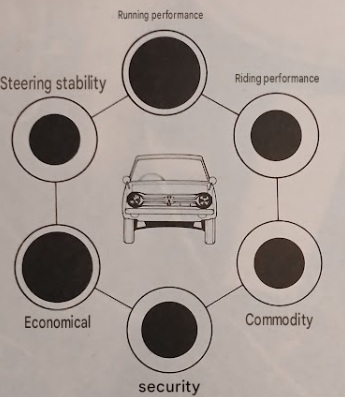
The aim of this comprehensive test series is to evaluate a car’s overall performance by using six key pillars as reference points: power performance, handling and stability, comfort and usability, safety, economy, and product appeal. The evaluation method is what we call a “bubble session:” a systems-engineering approach in which six specialists from different fields gather around a hexagonal table (the “bubble,” like a honeycomb) and exchange their views.
Each category is represented by a circle, with the shaded (black) portion indicating the evaluation score. When the size of these filled circles is roughly equal, the car can be said to be well balanced across all areas. When they vary significantly, the result is a car with a more distinctive, individual character.