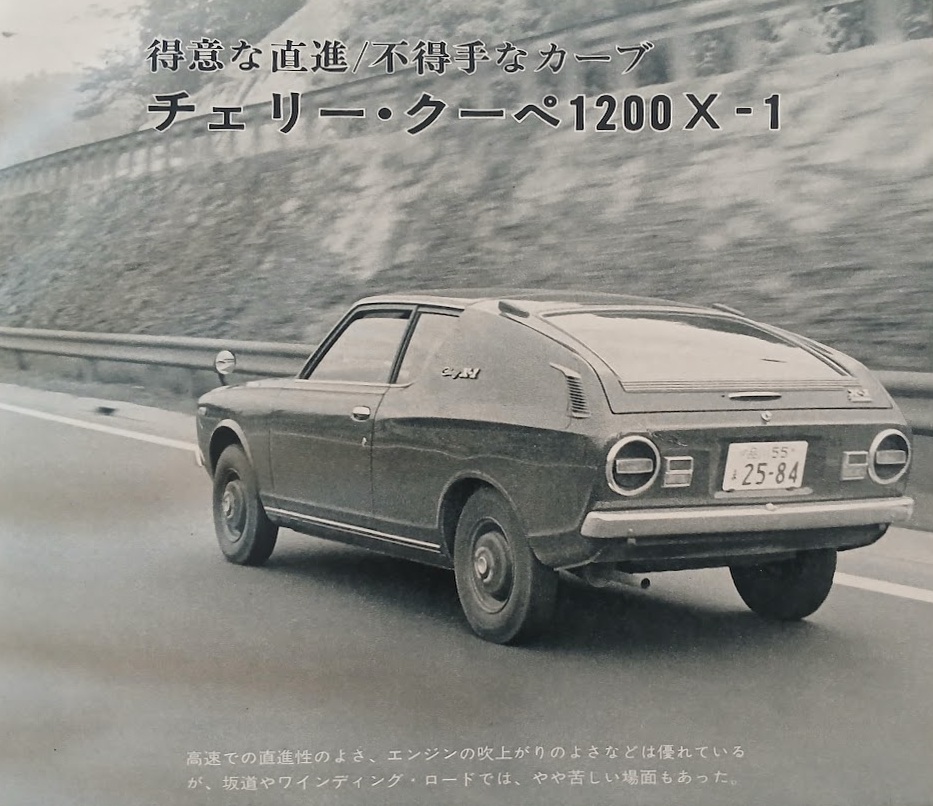
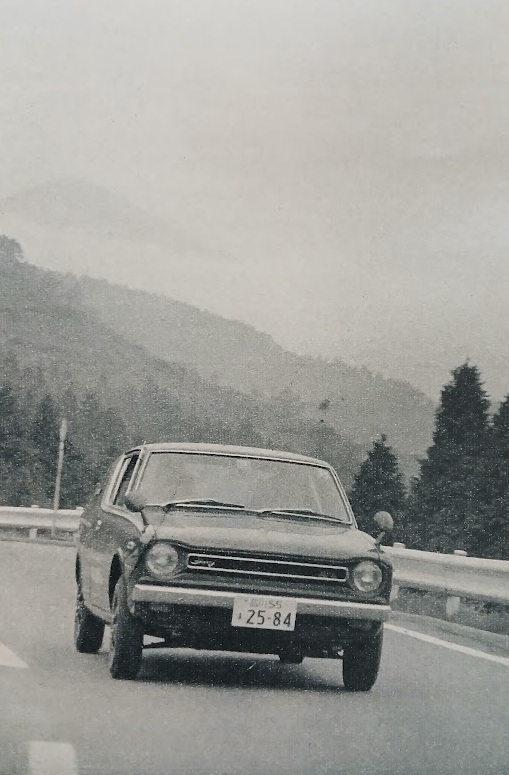
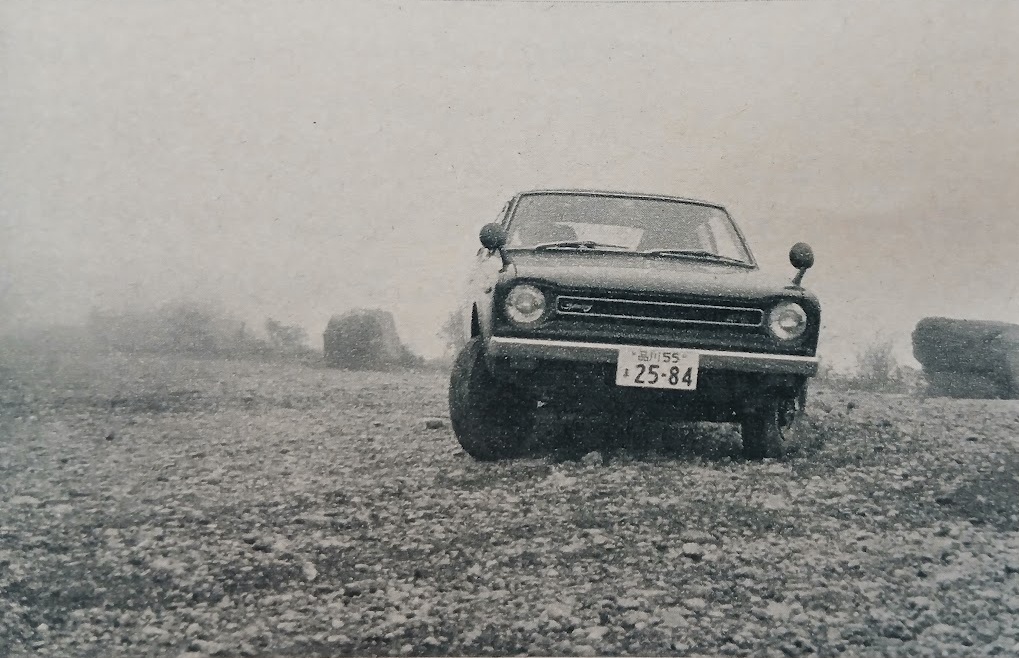
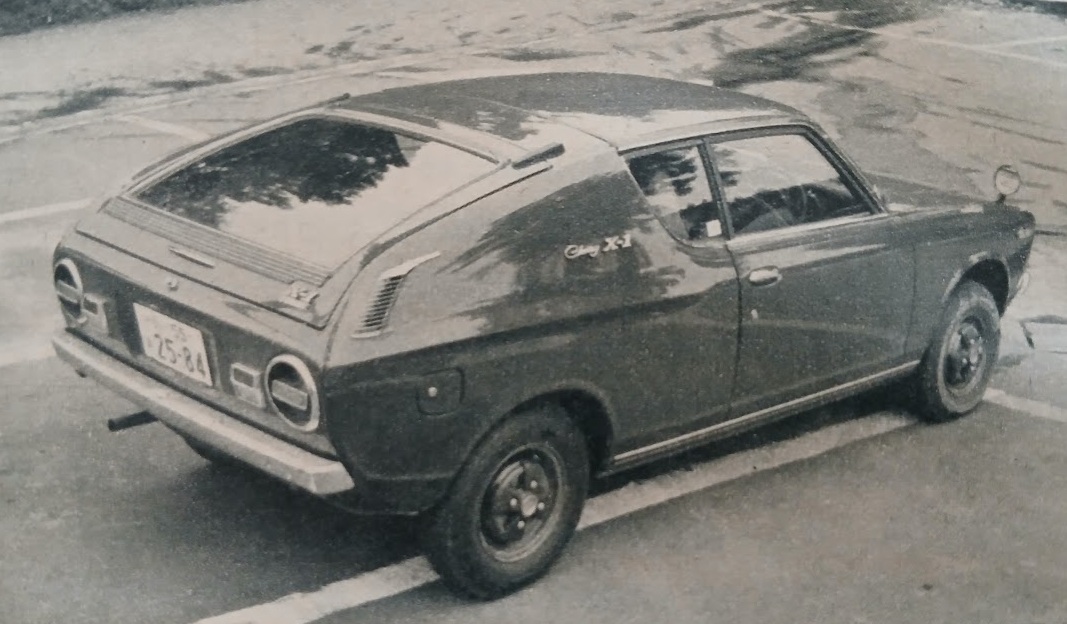
Nissan Cherry Coupe 1200 X-1 (1971)
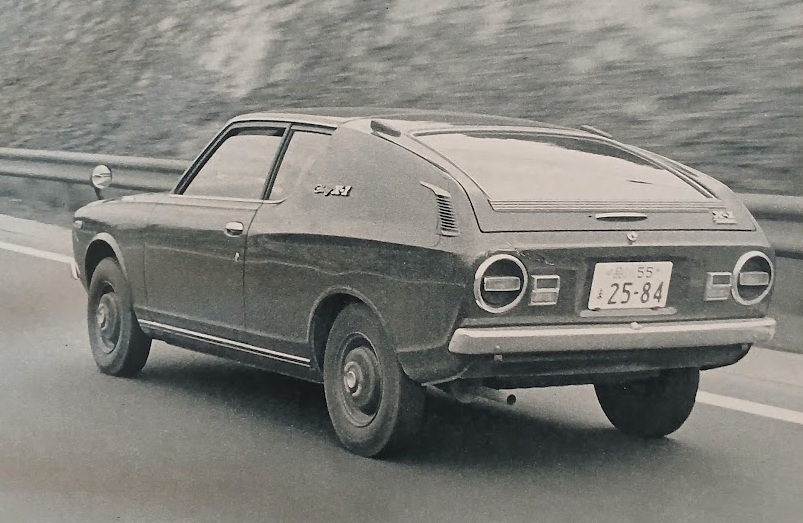
Publication: Motor Fan
Format: “Bubble Index” Road Test
Date: December 1971
Authors: Osamu Mochizuki, Katsuzo Kageyama, Shigeki Asaoka, Yasuhei Oguchi, Reiko Ikuuchi, Kensuke Ishizu
Confident on the Straight, Hesitant in the Curves
On the open road, the Cherry Coupe 1200 X-1 impresses with its composure: high-speed straight-line stability is excellent, and the lively engine spins up eagerly when asked. Yet, when the route tightens into steeply inclined, winding mountain passes, the car shows subtle signs of strain–its poise slightly compromised under more demanding conditions.
Well-Suited to Leisure Use
Nissan has now introduced the Cherry Coupe to the market. The lineup consists of six variations: the Deluxe (1000cc), 1200 Deluxe, 1200GL, 1200GL-L, and at the top, the 1200 X-1 and 1200 X-1L, both equipped with SU-type twin carburetors.
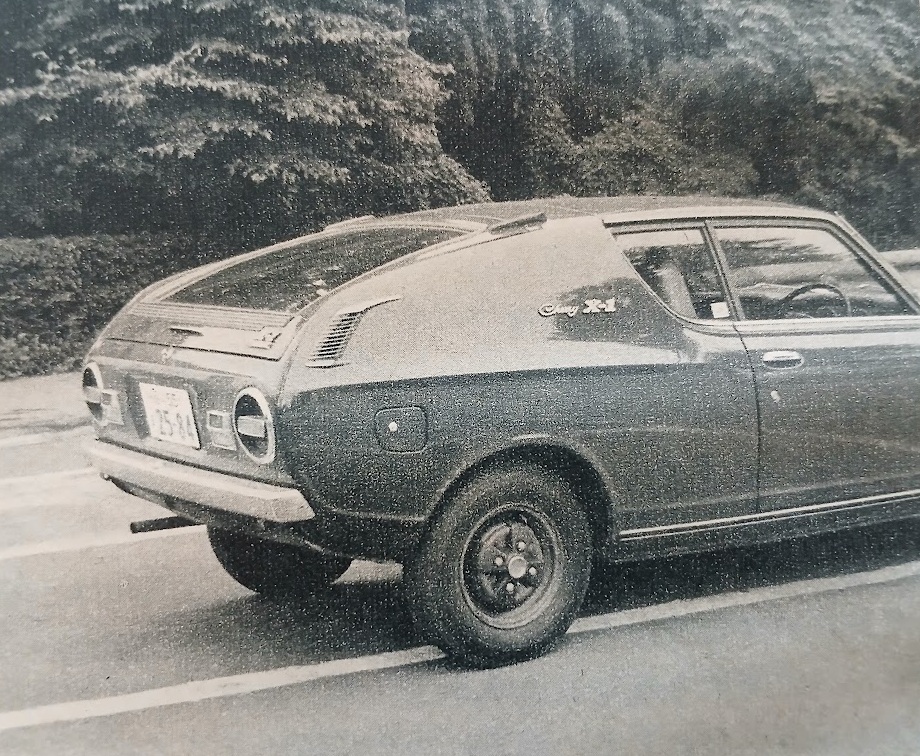
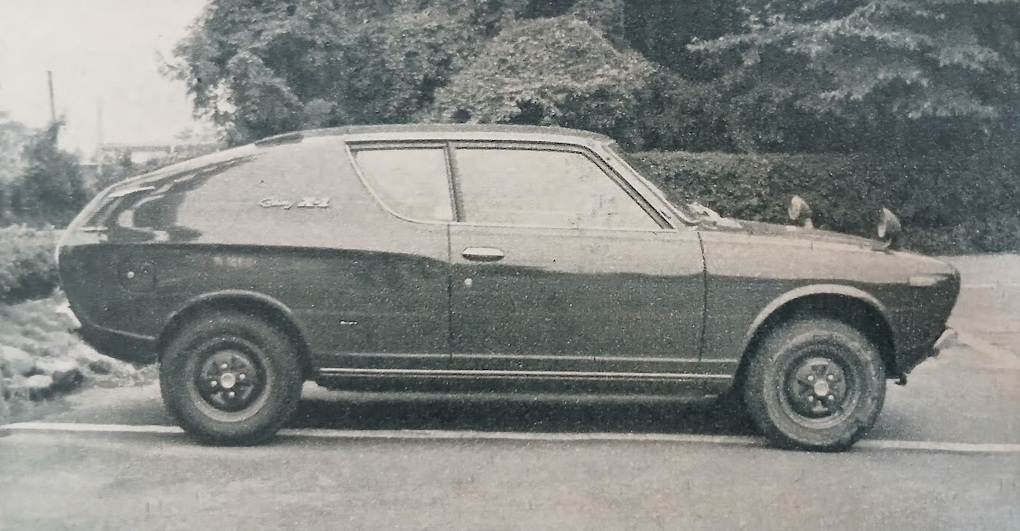
In terms of styling, the car is characterized by a gently flowing flat-back profile, with a smooth curve extending from the roofline to the rear end. This is complemented by large rear quarter panels, which give the coupe a distinctive and somewhat unconventional appearance.
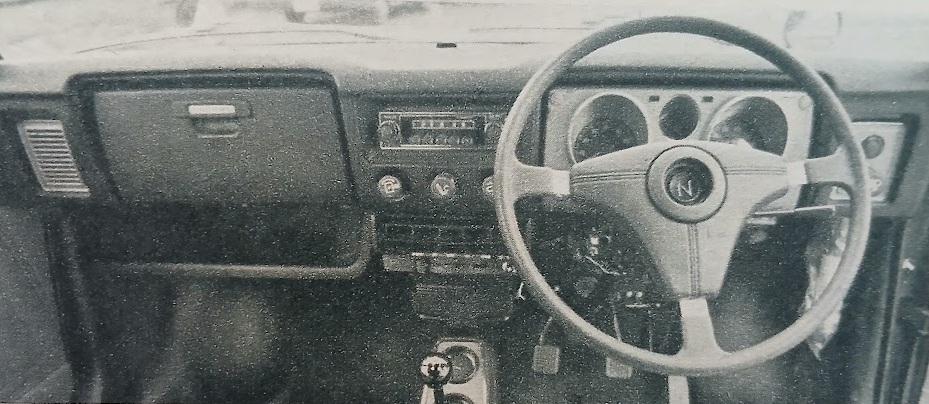
Inside, the dashboard area has been completely redesigned, creating a richer and more substantial impression. However, the layout of the instruments and switches remains largely the same as that of the sedan models.
As for the power unit, in addition to the 58ps and 80ps engines already familiar from the sedan range, a new 68ps version has been introduced, bringing the total to three available configurations:
First is the A10-type 998cc unit, with a maximum output of 58ps/6000rpm and maximum torque of 8.0kgm/4000rpm, which powers the 1000 Deluxe. Its compression ratio of 9.0 is common to all Cherry engines.
Second is the A12-type 1171cc unit (compression ratio 9.0), with a maximum output of 68ps/6000rpm and maximum torque of 9.7kgm/3600rpm, which powers the 1200 Deluxe, GL, and GL-L. This is the same unit currently used in the Sunny 1200.
Last is the A12-type 1171cc with SU twin carburetors, a maximum output of 80ps/6000rpm, and maximum torque of 9.8kgm/4400rpm, which powers the 1200 X-1 and X-1L.
Dimensionally, the coupe remains similar to the sedan, though overall height has been reduced by 65mm, while overall length has increased by 80mm. This added length is entirely in the rear overhang.
One notable mechanical difference lies in the cooling system. In the sedan models, the cooling fan is mounted directly to the engine and driven by a belt from the crank pulley, meaning it rotates continuously whenever the engine is running. In contrast, the coupe adopts an electric fan mounted to the radiator itself. Its operation is controlled by a thermostat positioned midway along the lower radiator hose, switching the fan on and off as needed.
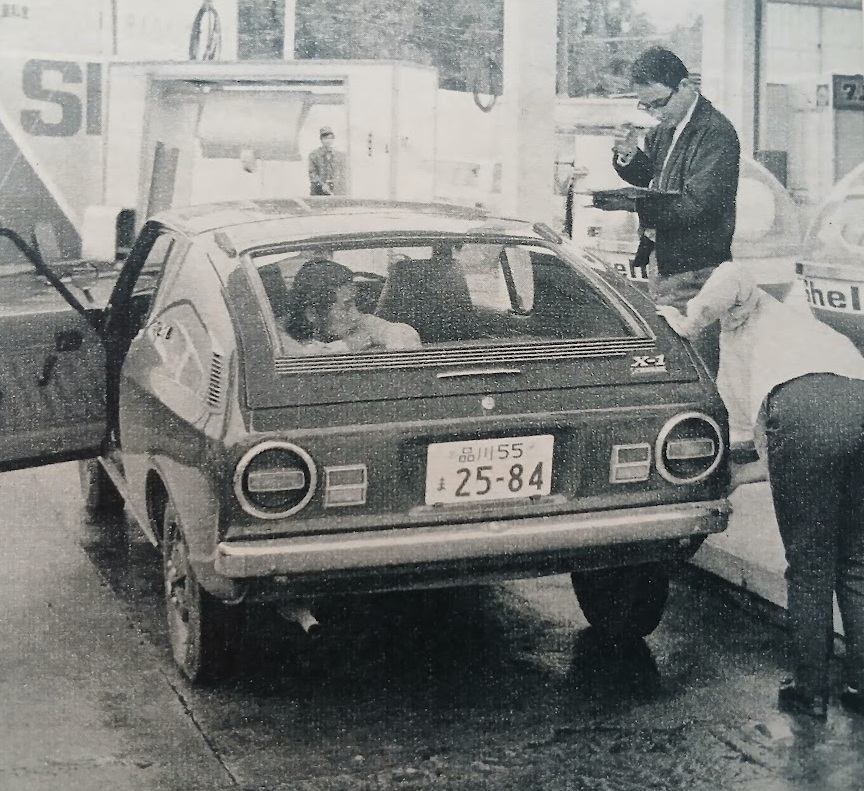
The test car on this occasion was the 80ps Cherry Coupe 1200 X-1. As usual, the group of specialists gathered at our familiar base, the Fantasy Drive-In near the Tomei Expressway entrance on Tamagawa-dori. Their first reaction was one of curiosity at the car’s unusual styling. Conversations quickly turned to its aerodynamic properties and luggage capacity, and before long, with only a brief discussion, the group set off on the test course.
The route followed our standard pattern: onto the Tomei Expressway from Tokyo IC to Gotemba IC, over Otome Pass, up the Hakone Turnpike, back again via Otome Pass, and finally returning to Tokyo on the Tomei.
At the post-drive meeting back at the Fantasy Drive-In, several points were raised. While the car was praised for its high-speed cruising ability and straight-line stability, there were also remarks that “on climbs and descents, as well as through corners, some of the less favorable traits of the front-wheel-drive layout are apparent.” Others noted the presence of a “booming resonance around 90km/h,” while concerns were also expressed about “an imbalance between the steering wheel position and angle and the relationship of the pedals and running gear.” Rearward visibility, too, became a topic of discussion.
On the other hand, more favorable opinions included remarks such as “it represents good value for the price,” and “it’s an ideal car for leisure use.”
For a more detailed account, we invite readers to turn to the individual reports from each of our specialists.
Power Performance: Strong at Speed, Tenacious at Low Revs (Osamu Mochizuki)
With its combination of light weight (690kg) and relatively high output (80ps), the Cherry Coupe 1200 X-1 delivers notably lively performance on the road.
The catalog lists a top speed of 160km/h, but in practice the speedometer needle reaches that mark with little hesitation—and given a bit more time, it will edge toward 170km/h. Even allowing for speedometer error, an actual maximum of around 160km/h seems entirely realistic.
The A12 engine, already well proven in the Sunny Coupe, is above all a light, willing revver. With bore and stroke dimensions of 73 × 70mm, its slightly short-stroke design contributes to an exceptionally smooth character. Even beyond 6000rpm, there is little sense of the power tapering off, and its extension at high revs is genuinely impressive.
At the other end of the scale, the engine also displays notable tenacity at low speeds, likely aided by the car’s low weight. In top gear, 1000rpm at 25km/h is comfortably within the usable range, and even 700rpm at around 20km/h can be managed with a bit of care. In third gear, the car will pull from as low as 15km/h.
However, this inherent flexibility is somewhat undermined by the difficulty of throttle control. The issue lies in the relatively large throttle opening angle for very small movements of the accelerator pedal.
As a result, the car’s naturally sharp response becomes exaggerated: slight pressure on the pedal causes the car to lurch forward abruptly, while lifting off produces an equally sudden onset of engine braking.
This characteristic makes smooth low-speed driving more difficult than it should be, requiring the driver to pay close attention to pedal modulation.
Engine noise itself is at an ordinary level, and with the adoption of an electric cooling fan, fan noise is no longer a concern. Up to around 100km/h, overall noise levels remain within what might be considered typical for this class.
Beyond that point, however, a booming resonance from the exhaust system becomes noticeable. It begins to emerge at around 90km/h, and reaches a peak between 120-125km/h, where it becomes quite intrusive.
Wind noise, on the other hand, is kept to a remarkably low level–something that deserves particular mention.
The transmission’s gear ratios are well chosen, leaning toward a close-ratio setup. In any gear, there is ample reserve of driving force, allowing the driver to enjoy a genuinely sporty style of motoring.
Steering response is fundamentally quite sharp. However, around the center position, the initial reaction is somewhat dull. While overall body roll is not excessive, there is a noticeable amount of roll as the steering is pointed away from the straight-ahead, which appears to contribute to this slight lack of immediacy on-center.
“Power performance is truly excellent.” —Kageyama
“The engine picks up smoothly, and the sense of acceleration is light and brisk.” —Oguchi
Handling and Stability: A Trace of Friction in the Steering System? (Katsuzo Kageyama)
Behind the wheel, the first thing one notices is the upright angle of the steering column. Adjusting the seat position to suit the length of one’s legs to the pedals, the steering wheel somehow ends up in a position that feels slightly unnatural. The clutch pedal is tucked in somewhat behind the center console, with the result that the side of the driver’s left foot is constantly brushing against it. At first this is rather distracting, though in practice it does not interfere with pedal operation.
With the adoption of the coupe body style, the cabin has been extended rearward, increasing overall interior space. However, the front seat area remains unchanged. As a result, the driver’s position feels somewhat pushed forward when viewed in relation to the cabin as a whole, making the footwell slightly cramped.
Rearward visibility, particularly to the rear quarters, is inevitably compromised by the coupe styling. That said, the large fender-mounted mirrors on both sides provide an excellent field of view, helping to offset this inherent weakness. The gently sloping rear glass, a defining feature of the car’s design, is likely to further reduce visibility in wet conditions. It is worth noting, too, that the rear window is not equipped with a heating element.
Once underway, the first impression is of rather heavy steering. In recent years, there has been a general trend toward slightly heavier steering effort compared with earlier cars, and from a safety standpoint this is by no means unwelcome. With that in mind, I initially took it as a positive sign.
However, with this heaviness there seems to be a trace of friction. The steering does not return as smoothly as one might expect, feeling somewhat notchy, and after a lane change the car does not settle as cleanly as it should.
Being a front-wheel-drive car, certain characteristics are naturally present–and here, they appear quite strongly. Understeer is pronounced, and while the effects of throttle-on and lift-off are not abrupt, they are clearly noticeable. In other words, the typical traits of an FF layout are clearly evident, and the driver must understand them and adapt accordingly.
On the expressway, however, the car’s excellent power performance makes for an entirely comfortable experience. Straight-line stability is outstanding, leaving little to criticize. In fact, one might even wonder whether there is another car in this class that performs so well in this respect.
Yet when executing high-speed lane changes, the aforementioned peculiarity in the steering system again makes itself felt, introducing a slight lack of composure in the body’s settling motion.
On tighter, more demanding mountain roads, body roll becomes more noticeable, and at the same time the characteristic front-wheel drive traits come more sharply into focus. That said, these traits cannot simply be labeled as “good” or “bad.” Depending on the driver’s familiarity and personal preference, they may be perceived either as drawbacks or as part of the car’s character. My own evaluation, needless to say, is influenced to a considerable degree by personal taste.
“Steering response is fundamentally quite sharp.” —Mochizuki
“The transverse engine layout follows the BLMC approach. Mounting the radiator facing forward helps keep the engine bay cleaner in wet conditions and prevents water from directly affecting electrical components.” —Asaoka
Ride and Comfort: What Is the Underlying Design Philosophy? (Shigeki Asaoka)
When the Cherry first debuted as an economical mass-market car, it attracted considerable attention for its unique concept. Yet despite the anticipation surrounding it prior to launch, its sales performance has fallen well short of the manufacturer’s expectations.
Against this backdrop, the sudden introduction of the coupe series comes as something of a surprise. The body itself, with its unusual shape, raises the question of whether it should truly be called a “coupe.” Viewed less charitably, it resembles a light van; more generously, it might be described as a kind of sporting wagon, in line with trends currently seen in America and Europe. In any case, it departs significantly from the traditional image suggested by the word “coupe.”
This unconventional rear body does not sit entirely comfortably with the conservative front-end design carried over from the sedan. Inside, the reduced overall height results in noticeably limited headroom. Furthermore, the adoption of a transverse engine layout has shortened the front end, and the steering wheel is consequently set at a fairly upward angle. The driver is therefore obliged to sit more upright, which only serves to accentuate the sense of confinement beneath the low roof.
That said, the overall atmosphere of the cabin is quite refined. The seats and instrument panel are well designed, and the interior leaves a pleasant, inoffensive impression. There are, however, some practical shortcomings. The ashtray, for instance, is both too small and positioned too far away to use easily. Attempting to extinguish a cigarette without taking one’s eyes off the road risks missing it entirely and tapping ash onto the dashboard.
The shelf slung under the instrument panel appears to be almost an afterthought. It is difficult to see its necessity; in fact, it seems to undermine one of the inherent advantages of a front-wheel-drive layout.
Folding the rear seatback forward reveals a surprisingly large luggage area. Combined with the wide-opening rear gate, this should make loading and unloading cargo quite convenient.
Although the car is nominally a five-seater, it would be optimistic to seriously consider carrying three passengers in the rear. The seating area is narrow, and with only small, fixed side windows, occupants are deprived of any meaningful view out. It is a space that can feel cramped and isolating for passengers.
These large side panels also deprive the driver of rear three-quarter visibility. Extra caution is required when reversing or being overtaken.
In short, while the decision to treat the entire body as a single cabin space has yielded generous overall volume, the way that space has been arranged leaves room for improvement. The fact that only the two front windows can be opened while driving is also likely to become a problem in hot weather.
Taken as a whole, the car possesses fundamentally strong performance. Yet one cannot help feeling that it lacks a single, clearly defined design philosophy tying all of its elements together.
“The clutch engagement has something of a motorcycle-like feel.” —Kageyama
“The ventilation intake effect is quite strong, but the outlet capacity seems comparatively insufficient.” —Oguchi
“When you press the accelerator, your foot ends up pressing against the protruding wheel housing as well. The gauge markings are small and difficult to read, and the deep hood over the instruments dims the dial faces.” —Mochizuki
Safety: Blind Spot Over the Left Rear Quarter (Yasuhei Oguchi)
The first impression when driving at highway speeds is the car’s excellent straight-line stability. While the handling retains the characteristic traits of a front-wheel-drive layout, it may well be that these same traits contribute to the calm, settled feel of the steering when traveling in a straight line at high speed.
With small rear-wheel-drive cars, crosswinds often make one feel as though the car is wandering slightly, even when attempting to hold a straight course–an effect that can lead to a certain psychological fatigue. Of course, once one becomes accustomed to such behavior it is manageable, but there is no question that a more stable steering feel is preferable.
In this respect, the Cherry Coupe’s composure is likely aided by its body shape and favorable aerodynamic characteristics. In any case, it proves to be an easy and reassuring car to drive on the expressway.
On winding mountain roads, however, the situation is rather different. Strong understeer, combined with variations in behavior depending on whether the throttle is pressed or lifted, makes the car somewhat tiring to drive over extended stretches of twisting terrain.
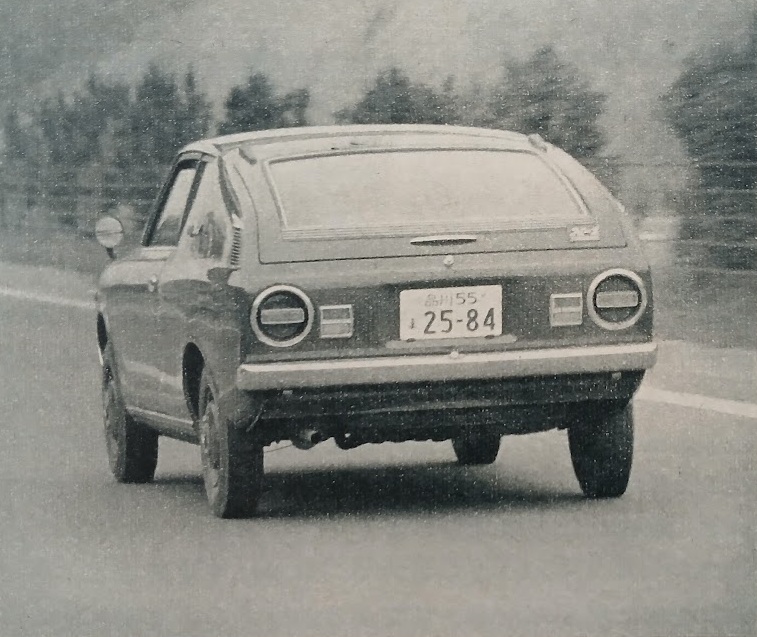
One point that stood out throughout the test was the lack of visibility to the left rear quarter, as well as directly behind the car. When parking in tight spaces, for example, it becomes difficult to judge how far one can safely reverse, as the distance to obstacles at the rear is not obvious. While it is possible to estimate distance by observing the intensity of reflections in the tail lamps, this is hardly a convenient solution.
Similarly, when returning from the passing lane to the driving lane on the expressway, a significant blind spot appears over the left rear quarter. Given the high speeds involved, this demands particular caution.
Even in city driving, when making a right turn, it is difficult to see vehicles approaching from the left. The car effectively reminds the driver not to make hurried maneuvers without checking carefully. That said, the large fender-mounted mirrors do provide a clear and useful field of view.
The tail lamp design follows a recent trend toward clearly separating the turn signals from the brake lamps for improved functional distinction. Regardless of styling considerations, this arrangement is likely more effective from the standpoint of visibility than combining the two.
Beyond this, a seat belt is provided only for the driver. Even when seat belts are standard equipment, they are of little value if occupants do not use them. From the standpoint of encouraging their use, manufacturers should consider whether the design makes drivers more inclined to wear them. Here, the belt lies loose on the floor when unfastened and is easily soiled, which is hardly ideal. A system that restrains effectively when needed, yet stays out of the way in daily use, would be preferable.
In practical terms, the full benefits of seat belts are only realized when designs are developed that minimize the sense of restriction when used.
“Despite the coupe styling, rearward visibility while driving is actually quite good.” —Mochizuki
“I would like to see a seat belt provided as standard for the passenger seat as well. Even higher-grade light cars offer this, so for a car at this price level to only just meet the minimum safety standards is somewhat disappointing…” —Ikuuchi
Economy: A Good Buy as a Leisure Car (Reiko Ikuuchi)
The Cherry Coupe 1200 X-1 tested here carries a Tokyo showroom price of 573,000 yen. Within the Cherry lineup, that makes it the second most expensive model, just below the Coupe L (593,000 yen). Until now, the most expensive version of the Cherry 1200 had been the four-door X-1 at 570,000 yen.
Looking across the same 1200cc class, most cars are priced lower. The top-grade Toyota Publica tops out at 495,000 yen for the SL, while the Hino Contessa 1300 S1200 comes in at 493,000 yen–both under the 500,000 yen mark. The Mitsubishi Colt 1200 Custom lists for 555,000 yen.
Move up a class, however, and prices climb quickly. Models like the Toyota Sprinter, Toyota Corolla, and Nissan Sunny can exceed 600,000 yen even in 1200cc form. Their top 1200cc variants include the Sprinter 4-door SL at 609,000 yen, the Corolla 1200 Coupe Hi-Deluxe (2-speed automatic) at 603,000 yen, and the Sunny Coupe 1200GL (3-speed automatic) at 640,000 yen.
At around the X-1’s price point (plus or minus 10,000 yen), there are also larger or more powerful alternatives: the Toyota Celica 1400ET (572,000 yen), the Toyota Carina 1400 2-door Deluxe (579,000 yen), the Toyota Corona Mark II 1700 Standard (582,000 yen), and the Nissan Skyline 1500 Standard (582,000 yen).
In other words, this is a price range where one could easily step into a higher class of conventional sedan. But in the case of the X-1, the emphasis isn’t purely on practicality–it’s been deliberately styled and equipped to satisfy the more personal, lifestyle-oriented appeal of a leisure car. Seen in that light, the price doesn’t feel excessive.
Speaking with a few salespeople about this car, a common pattern emerges. Buyers are first drawn in by the styling and quickly decide they want one–especially knowing that a coupe can be had for under 500,000 yen (in Deluxe form).
But once they see the actual car and begin considering the available features and accessories, their expectations rise. In the end, many settle on something like the X-1.
As for running costs, the difference between the 1000cc and 1200cc Cherry models is fairly small. Official fuel economy figures are 24km/l for the 1000 and 22 km/l for the 1200, a gap of just 2km/l.
Annual road tax is 18,000 yen for the 1000cc and 21,000 yen for the 1200cc, a difference of 3,000 yen. All models run on regular fuel, which is reassuring not only from a cost standpoint but also in terms of emissions considerations.
Finally, a word on pricing for coupes in general. Taking the Sunny as an example, coupe versions typically cost about 20,000 yen more than their four-door counterparts. In the case of the Cherry Coupe 1200 X-1, however, the difference is only 3,000 yen, which leaves a favorable impression.
Of course, as a two-door, it shares the same wide doors common to coupes, and in everyday use it’s less convenient than a four-door sedan. That’s part of the appeal–a kind of personal-car indulgence. Still, there’s a tendency to accept paying extra simply for style, and it’s worth noting when a car avoids that trap.
“At this price, the performance is very appealing. Naturally, you have to accept a few compromises.” —Kageyama
Product Appeal: Blending into Life (Kensuke Ishizu)
This month’s test car is the Cherry Coupe 1200–but lately, it seems the market’s attention has shifted all at once from 1200cc models to 1400s. With so many cars appearing in the same class, it’s no surprise that buyers find themselves unsure which to choose.
That’s where product appeal comes into play. What matters is the “deciding factor” a car offers within its segment–what makes it stand out, what kind of uniqueness it brings.
From a mechanical standpoint, the Cherry’s defining feature is its front-wheel-drive layout. But that alone is no longer new. Some drivers enjoy it, others don’t. It has its strengths and weaknesses, and it’s hard to call it an outright advantage.
So what, then, defines the Cherry Coupe’s character?
In a word: its styling.
In the fashion world today, the phrase “below the belt” has become something of a theme, with emphasis shifting to how the lower half is dressed. Blue jeans are a good example, as are bell-bottom slacks with their flared hems.
A similar trend can be seen in car design–and the Cherry reflects it clearly. Back when the Ford Mustang debuted, attention was focused heavily on nose design. Now, it feels as though the emphasis has moved toward the rear of the car.
The Cherry Coupe’s folding rear seatback, the generous cargo space it creates, and the way the rear gate opens–all of this shows a kind of thoughtful cleverness. One could say that “fashion” is one of its key themes.
That distinctive rear quarter panel, combined with the wide, open luggage area–how you use the Cherry Coupe is entirely up to you.
Cars have always had their own personalities, but today, it’s the owner’s personality that brings those traits to life.
Once you’ve bought the car, where do you go, and what do you do with it? Load up skis for a winter trip to the mountains, bicycles for a run out to the highlands, a barbecue set for a riverside outing, or even a canoe strapped to the roof for the coast–the possibilities spread in every direction.
In other words, a car is no longer just something for the enjoyment of driving. It’s becoming something that blends more deeply into daily life–into the way people live and the environments they move through.
The Cherry Coupe offers that kind of open-ended space–not something imposed, but something the owner can shape.
“It gives a sense of youthful, lively enjoyment behind the wheel.” —Oguchi
“The slightly purplish body color they offer on the van would suit this coupe perfectly. Why don’t they try it?” —Ikuuchi
How to Read the Bubble Index
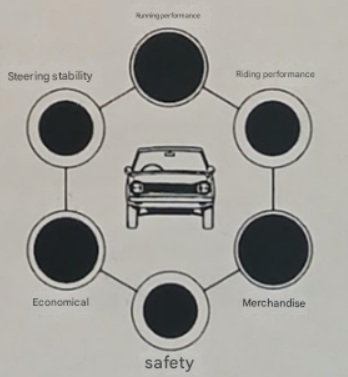
The aim of this comprehensive test series is to evaluate a car’s overall performance by using six key pillars as reference points: power performance, handling and stability, comfort and usability, safety, economy, and product appeal. The evaluation method is what we call a “bubble session:” a systems-engineering approach in which six specialists from different fields gather around a hexagonal table (the “bubble,” like a honeycomb) and exchange their views.
Each category is represented by a circle, with the shaded (black) portion indicating the evaluation score. When the size of these filled circles is roughly equal, the car can be said to be well balanced across all areas. When they vary significantly, the result is a car with a more distinctive, individual character.
Postscript: Story Photos