Nissan Cherry Coupe 1200 X-1 (1971)
Publication: Car Graphic
Format: Road Test
Date: December 1971
Author: “C/G Test Group” (uncredited)
Summary: Three-door coupe version of the Cherry X-1. Rear hatch opens wide, giving it much of the practicality of a sport wagon. Rear visibility is compromised. Performance matches that of the X-1 sedan. Electric cooling fan greatly reduces noise levels. Handling surpasses the usual front-wheel-drive standard, even on cross-ply tires. Disc brakes are prone to fade under sustained hard use. Road noise and vibration are the car’s only significant shortcomings.
Road testing the Cherry Coupe X-1
Contrary to what its sales performance among the general public may suggest, C/G holds the Nissan Cherry in quite high regard. Although its basic layout undeniably takes the ADO15 as its starting point, the Cherry nevertheless deserves recognition for an approach that, among the generally unimaginative designs of Japanese cars, is willing to take risks for the sake of functionality.
As noted in our monthly reports, C/G purchased a Cherry Van as a long-term test vehicle, and it has now served us faithfully for more than 20,000km. We deliberately chose the van rather than the sedan because its front-wheel-drive layout provides a low, flat load space and a tailgate that opens all the way to the floor, making it ideally suited to carrying our fifth-wheel tester, heavy camera equipment, and the like.
Naturally, we anticipated from the start that the van would have certain disadvantages compared with the sedan, and our experience confirmed those expectations. We therefore made a number of significant modifications. The 58ps 1000cc engine, despite the taller overall gearing compared with the sedan, proved entirely adequate for our purposes. The four-wheel drum brakes and commercial-vehicle tires, however, were simply intolerable, and were soon replaced with the sedan’s front disc brakes and the X-1’s S-rated tires.
The rear suspension, with its leaf springs and live axle, likewise produced a ride that was too stiff for the lightly loaded conditions under which we most often drove the car, while its directional stability over uneven surfaces was naturally inferior. Although we considered transplanting the sedan’s entire independent rear suspension—coil springs, trailing arms and all—legal restrictions ultimately forced us to abandon the idea, regardless of its technical feasibility. In the end, we settled for reducing the camber of the leaf springs, while retaining the original spring rate, so that the body would sit level even when unladen.
The results of these modifications exceeded our expectations, and our Cherry Van has since become the most useful vehicle in the C/G fleet.
Even so, what we had really hoped for was a sport wagon that combined the Cherry Van’s practicality with the X-1 sedan’s performance and handling. (Indeed, even now that the coupe has appeared, we still find the van the best-looking of the Cherry variants.) So when we first heard that a Cherry Coupe was being introduced, our immediate thought was that it might make our dream of a sport wagon come true. As it turned out, however, the Cherry Coupe did not entirely live up to our expectations.
Unlike the sedan, the coupe is offered with three different engines: a twin-SU 1200cc unit with 80ps, a single-carburetor 1200cc producing 68ps, and the 1000cc 58ps engine. Combined with differences in trim, equipment, and appointments, these are offered in six model variations, with prices ranging from 593,000 yen for the X-1 L to 493,000 yen for the 1000 Deluxe. The car tested here was the 80ps X-1 (573,000 yen), finished in dark green, one of the four available body colors.
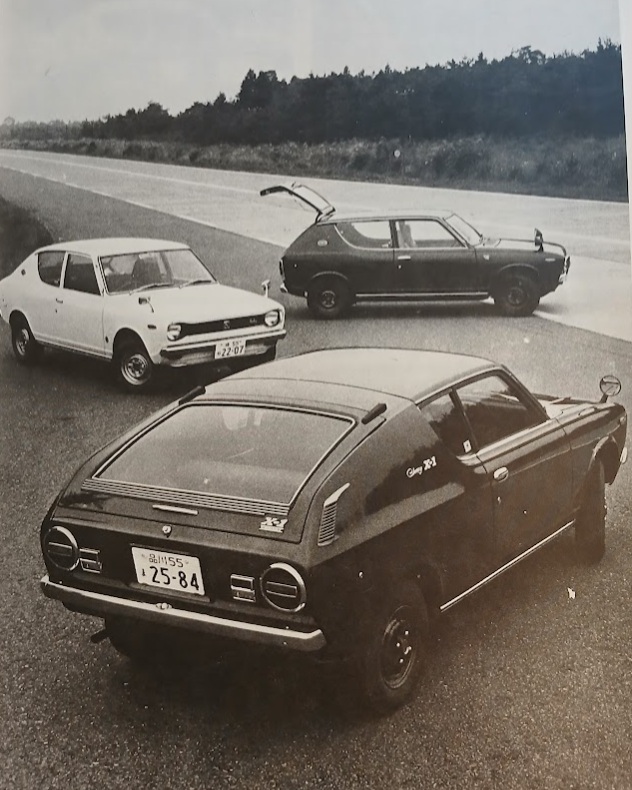
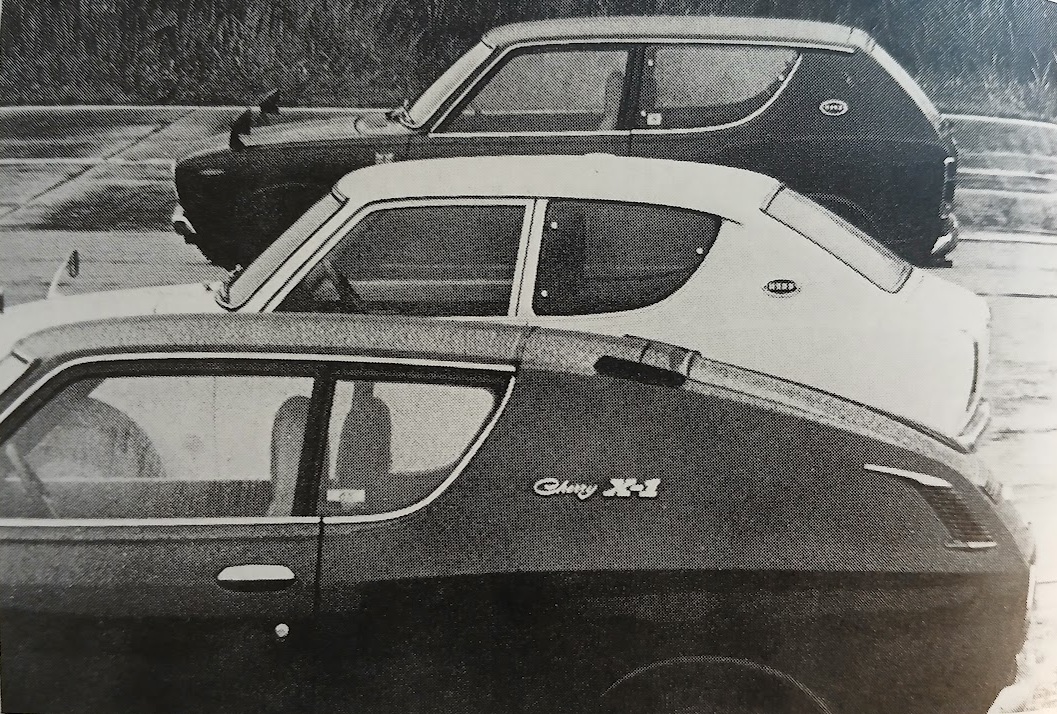
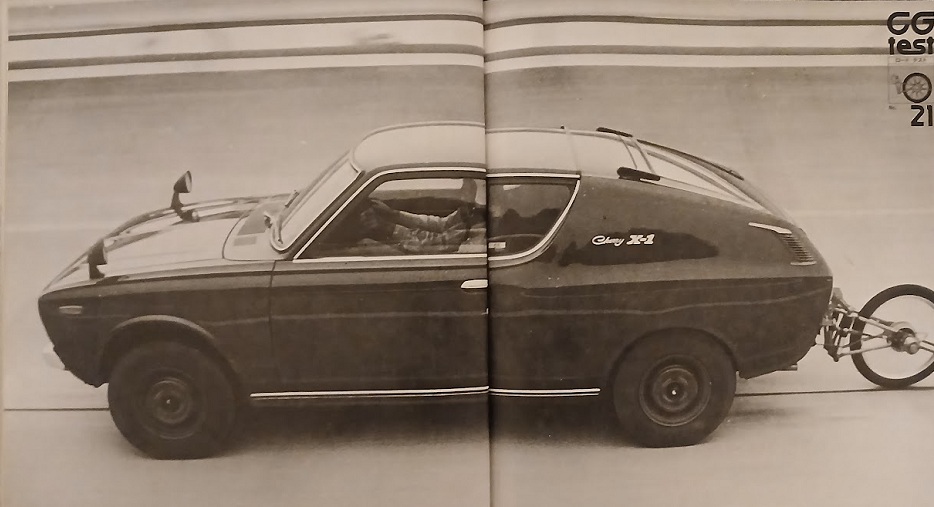
The coupe’s styling is decidedly bold. The windshield flows in a gentle curve into the sloping fastback roofline, while the rear hatch extends almost to the trailing edge of the roof, with the large rear window set into it. In profile, its most striking feature is the unusually large rear-quarter mass. If the roofline were lower, it might almost pass for a mid-engined GT. (The manufacturer was evidently well aware of the resemblance: among the optional accessories are Venetian blinds in the style of the Miura S, along with decorative “hot-air extractor” stripes for the rear quarters.) One detail that bothers us a little is the strip of vinyl applied to conceal the joint between the roof and the rear body panel.
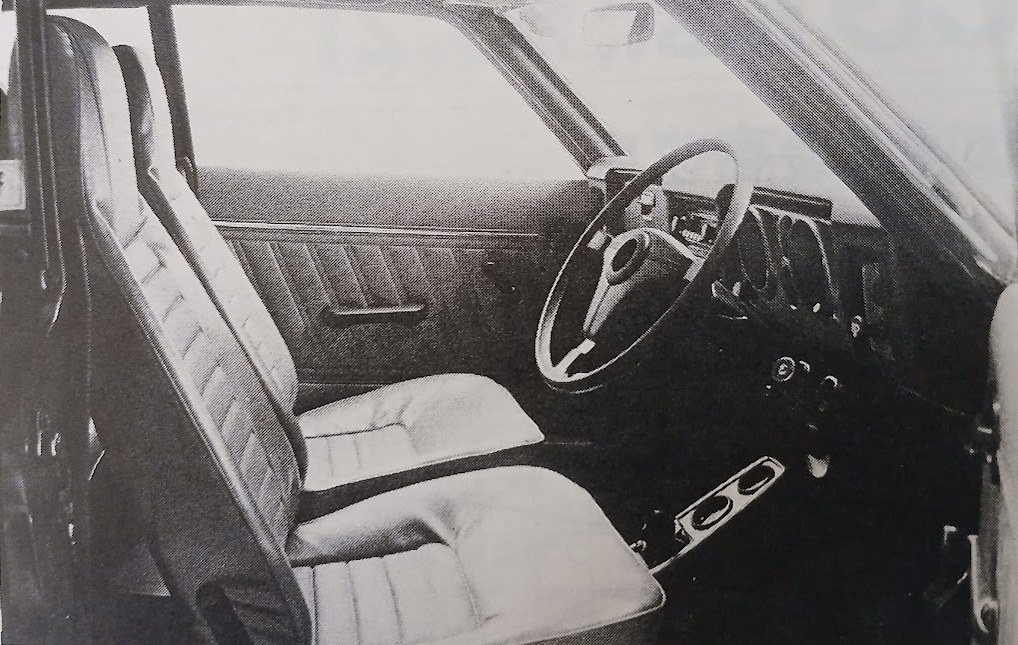
From the driver’s seat, the seating position and controls are unchanged from those of the sedan. The seat, however, now slides an additional 20mm rearward, allowing tall drivers to adopt a thoroughly natural driving position. Because the steering wheel is mounted relatively high and far away, the Cherry can almost be said to suit taller drivers better than shorter ones.
The roof has been lowered by 65mm, leaving only the minimum necessary headroom even in the front seats. At Yatabe, wearing helmets, our heads occasionally brushed the headliner. The standard two-point seat belt is disappointing, considering the character of the car.
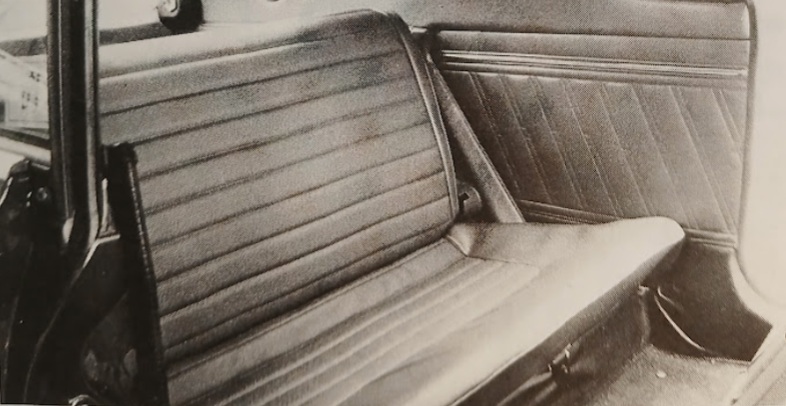
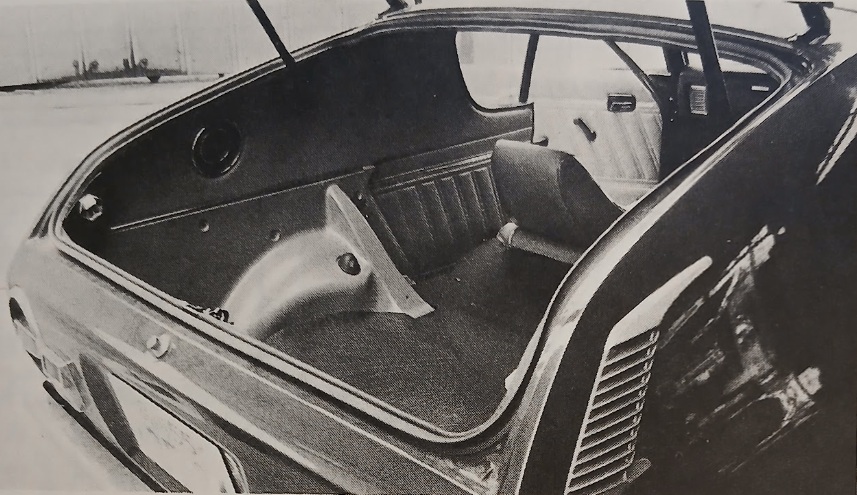
The rear seat can legally accommodate three passengers. Its cushion is nothing more than a thin slab of urethane foam set low into the floor, made possible only by the combination of front-wheel drive, a long wheelbase, and independent rear suspension. This arrangement at least provides the minimum necessary headroom. However, the backrest is nearly vertical, though not as upright as that of the van, while legroom is also insufficient. Rear-seat passengers are therefore forced into a knees-up posture. In truth, it cannot be called a genuine four-seater.
By releasing a simple locking mechanism, the rear seat backrest folds flat (where it automatically locks into position), creating a broad, carpeted load floor continuous with the rear luggage compartment. Unfortunately, unlike the van, the rear hatch does not extend all the way down to the floor. Although the tailgate opening itself is a generous 810mm wide, loading or unloading luggage still requires lifting it up to waist height. In practice, this proves more inconvenient than one might expect. At the very least, the Cherry Coupe failed to meet our own requirement for easy loading and unloading of the approximately 25kg fifth-wheel tester.
As cars are increasingly used for leisure purposes, there are more and more occasions to carry heavy recreational equipment—marine engines, folding motorcycles, portable generators, and the like. From our own experience with the Mini Traveller, we know that a sport wagon capable of serving as a sporting car during the week and an “estate car” on weekends holds tremendous appeal for younger drivers. The popularity of the Traveller versions of the ADO15 and ADO16 suggests that a Cherry sport wagon—not a coupe, but a van body fitted with the X-1’s engine and running gear—could surely find a ready market overseas.
Returning to the Cherry Coupe itself, the dashboard differs slightly from that of the sedan. The crash padding has been made thicker throughout, with the result that the instruments—unchanged in size and location—are now recessed deeply within the panel. The large glovebox lid, which previously had a simple rectangular cutout in place of a handle—a pleasing expression of the Cherry’s functional design philosophy—has been given a normal pull handle. (It still cannot be locked.) The rear-quarter panels, previously left as exposed painted metal, are now trimmed for the first time, removing the cold, unfinished visual impression.
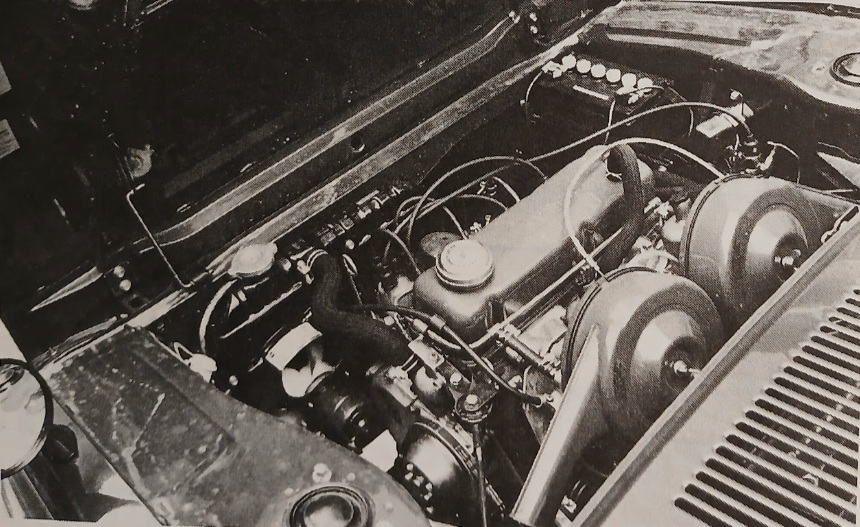
The most significant mechanical improvement in the coupe is the elimination of the engine-driven cooling fan in favor of a compact electric fan mounted behind the radiator. On earlier Cherrys, a plastic duct connected the front-mounted radiator to the engine-driven fan, which faced toward the left side of the car, directing hot air into the left front wheelhouse. Functionally, this arrangement posed no problems, but above 3000rpm both fan noise and the sound of rushing air through the duct increased dramatically, becoming extremely irritating to the ear.
The new 70-watt electric fan has six blades and a diameter of 190.6mm (the previous engine-driven fan measured 290mm). Mounted directly to the radiator, it is automatically switched on and off by an ethyl alcohol-filled thermostatic switch located in the coolant pipe between the radiator outlet and the engine. It is set to engage at 92°C and switch off again when the coolant temperature falls to approximately 87°C.
The first thing one notices after starting the engine is the marked reduction in noise made possible by eliminating the engine-driven fan. In October temperatures, the electric fan never operates while the car is moving, whether at highway speeds or even in slow city traffic. Only while waiting at traffic lights for some time, or when creeping through a traffic jam, does the temperature gauge climb slightly above the midpoint, at which point the fan begins turning with a faint hum. Even then, it is only audible in quiet surroundings; normally it is completely masked by ambient noise.
The system is very effective. At this time of year, it lowers the coolant temperature within a matter of minutes before switching itself off automatically. For now, this electric fan is fitted only to the coupe, but it will no doubt find its way into the rest of the Cherry range soon.
It is only regrettable that it was not used from the outset. Now that the Cherry has already acquired a reputation for being noisy, one might say that the improvement has come too late.
The elimination of the engine-driven fan offers several advantages beyond reducing noise. Any gain from negating the power loss it imposed is unlikely to become apparent except near maximum speed, but engine warm-up is certainly quicker. Cold starts invariably require the choke, and for the first few minutes it must be kept about halfway out. Once under way, though, the engine reaches normal temperature in no more than a couple of minutes.
Based on the engine used in the Sunny 1200 GX, the transversely mounted OHV 1171cc engine, producing 80ps/6400rpm, has earned a reputation for revving freely and smoothly. Our test car, despite having covered only about 600km, was no exception. From its rather fast idle of around 900rpm, it would spin instantly to 7000rpm in the lower gears. The tachometer’s yellow zone extends from 6500 to 6800rpm, but it is well known that a properly run-in engine will easily reach nearly 8000rpm.
Although the coupe weighs 35kg more than the sedan, at 690kg it is still very light for a car of this size. Since its aerodynamic drag should also be slightly lower, we expected virtually identical performance, and our testing confirmed it. At Yatabe, the coupe recorded an average of 157.5km/h over the flying kilometer and 157.2km/h over the 5.5km circuit. Conditions that day were almost perfectly calm, and at one point on the circuit the exceptionally accurate tachometer indicated 6400rpm. This corresponds to approximately 162km/h. (For maximum-speed testing, the fifth wheel is removed. On small-displacement cars of around 1200cc, its weight and rolling resistance are known to reduce maximum speed by 2-3km/h.) It is therefore fair to say that the catalog figure of 160km/h is entirely attainable. Incidentally, an accompanying staff member’s Cherry 1000 GL sedan averaged 140.7km/h over the flying kilometer.
One of the main advantages of front-wheel drive is apparent in the Cherry’s outstanding directional stability at maximum speed. It tracks as straight as an arrow with only the lightest touch on the steering wheel, to a degree one would hardly expect from such a light car. Powertrain vibration is remarkably well suppressed, the engine’s mechanical noise never becomes intrusive, and wind noise from the body is low. If the law permitted, 150km/h would make an effortless cruising speed. The all-indirect gearbox produces a light but constant gear whine, though it is never objectionable. More noticeable is the road noise transmitted from the tires into the body, a subject we will return to later.
The gearing is well matched to the car’s weight and power. Running the engine to the beginning of the yellow zone at 6500rpm yields 58km/h, 90km/h, and 133km/h in first, second, and third gears respectively. The catalog maximum speed of 160km/h corresponds to approximately 6200rpm, a comfortable 300rpm margin below the yellow zone. By international standards, acceleration is outstanding for a car of this class. With two occupants aboard, the Cherry covered 0-400m in 17.8 seconds (though this still fell short of the 17.3 seconds recorded by the X-1 sedan we tested last year). This is exactly the same figure C/G recorded for the Sunny 1200 GX Coupe, which uses essentially the same engine. For comparison, here are the C/G test results for several other 1200-1300cc cars: Publica 1200 SL, 18.4 seconds; Honda 1300 Coupe 9, 17.5 seconds; Subaru 1300 G, 18.0 seconds; and MG 1300, 19.6 seconds.
The clutch, unusually for a Japanese car, has a moderately short pedal travel, making quick starts easy. On a dry surface, the fastest launches were achieved by engaging the clutch at around 4000rpm, allowing just the slightest amount of wheelspin. Gear changes with the long, sturdy shift lever are light and positive—far superior to those of transverse front-wheel-drive cars such as the BLMC models and the Fiat 128.
The engine has excellent torque characteristics, responding crisply throughout a broad range from 2500-6000rpm. High-speed acceleration is especially impressive for a car of this size. Even at 120km/h, pressing the accelerator produces immediate response, and only beyond 140km/h does acceleration begin to taper off.
At very low speeds, however, the behavior of our test car seemed abnormal compared with the X-1 sedan we remembered. The sedan would pull away smoothly in top gear from as little as 25km/h (approximately 1000rpm), whereas this coupe could barely maintain 40km/h in top gear. This impression was reinforced by the fuel-consumption figures, which were markedly poorer at a constant 40km/h than at 60km/h, and also by the fact that in heavy traffic, when we were forced to creep along just above a walking pace, even first gear was often too high and it was often necessary to disengage the clutch. One can only hope this was an isolated fault peculiar to our test car.
The Sunny 1200 GX, which shares the same engine, has earned an excellent reputation for fuel economy, and the Cherry X-1 proves equally commendable. Our overall average for the test was 9.12km/l, but under normal conditions it would be unusual for consumption to fall below 10km/l, regardless of circumstances. It is especially economical when cruising on the expressway at 80-120km/h, where 15km/l can be considered a reasonable expectation. Although the compression ratio is 9.0:1, we detected no trace of knocking even on regular-grade gasoline.
The disc/drum braking system presents no practical shortcomings. Although it is unassisted, pedal effort is light, requiring only 30kg to produce deceleration of 0.80g. Under hard braking, however, the lightly loaded rear wheels have a tendency to lock prematurely.
In our 0-100-0 fade test, the smell of overheated brake linings became noticeable by about the fourth stop, and by the sixth, fade was unmistakeable. Pedal effort increased from an initial 23kg to 42kg by the seventh stop. The coupe’s taillights are large circular units, but the brake lamps themselves are partially obscured by the surrounding bezels, making them difficult to see from an angle even when illuminated.
The coupe’s handling is almost identical to that of the X-1 sedan. Weight distribution with the car unladen is 62.3/37.7 (the sedan is 65.6/34.4), yet the adverse effects normally associated with a nose-heavy layout are very slight. Assisted by its wide track and standard tires with excellent grip—at least on dry pavement (the test car was fitted with Toyo E-31 6.00S-12 4PR tires)—the Cherry achieves remarkably high cornering speeds.
The rack-and-pinion steering, with 3.2 turns from lock to lock, is unusual among Japanese cars in having virtually no free play around the straight-ahead position. It is appropriately quick and consistently light, and the 4.6m turning radius (5.0m overall) is exceptionally small for a front-wheel-drive car.
If the throttle is lifted in mid-corner, the front tires recover cornering grip and the car tightens its line toward the inside—a characteristic known as tuck-in. The effect is considerably stronger than in, for example, the Cherry 1000 GL sedan, and any driver accustomed to front-wheel-drive cars will make instinctive use of it.
Body roll is generally well controlled, but under full throttle in second gear through a tight corner, the inside front wheel tends to spin violently for a moment. This tendency is especially pronounced on wet roads. In the interests of wet-weather safety, one begins to wish for the optional 155SR-12 tires, but as we will discuss later, even the standard cross-ply tires transmit a great deal of road noise into the body, and under these circumstances we cannot recommend fitting radials.
Turning now to ride quality and noise, the Cherry’s long wheelbase and fully independent suspension generally provide an admirably level ride. It is particularly impressive when crossing long, gently undulating stretches of road at speed, where the body remains remarkably flat, like that of a much larger and heavier car.
The suspension travel is rather short, however, and even without a particularly heavy load the suspension bottoms easily—especially at the front—when driven briskly over rough pavement. Another concern is the inadequate isolation of road noise, together with fine vibrations caused by insufficient rigidity in the body panels. As noted earlier, the X-1’s standard tires are stiff cross-plies, which contribute greatly to its handling. The drawback is that they faithfully transmit every irregularity in the road surface, setting up fine vibrations in the relatively thin body panels.
We have experience with three different tire types fitted to the Cherry X-1—the Yokohama Y-205, Bridgestone Skyway H, and Toyo E-31. Of these, the Toyos fitted to our coupe were the stiffest and also the loudest. Sitting in the passenger seat with one’s left foot resting against the wheelhouse, the shocks from pavement joints can be felt clearly through the sole of one’s shoe. Overall body rigidity is also lacking, and over uneven roads the scuttle area vibrates noticeably. Consequently, unless the road surface is mirror-smooth, the resulting road noise and vibration largely cancel out the welcome reduction in engine noise from the new electric cooling fan.
To sacrifice the Cherry’s greatest virtue—its light weight—in order to reduce noise and vibration would, however, defeat the whole purpose. We would much rather see the problem addressed by giving the suspension greater compliance, or by applying effective vibration-damping material to the body panels.
Another drawback shared by many of these increasingly popular coupes is restricted rear visibility, and the Cherry Coupe is particularly affected. Because of its distinctive, broad rear-quarter panels, vehicles approaching from behind at an angle can easily disappear from both the fender-mounted mirrors—which are bullet-shaped and provide an extremely narrow field of view—and the interior mirror, only to appear suddenly alongside unless the driver is paying especially close attention. Also, when backing into a tight parking space, the high-back front seats further obstruct the view to the rear. One saving grace is that, although the rear overhang has been extended by 80mm, it is actually much shorter than it appears from the driver’s seat.
The interior equipment presents another curious contradiction. The car is generously provided with superfluous accessories, yet several items of genuine practical value remain extra-cost options. A heated rear window, intermittent windshield wipers, and three-point seat belts are all optional even on the highest-grade model. In our view, these three items above all others should be standard equipment.
Postscript: Story Photos