Nissan Cherry 1200 X-1R vs. Mitsubishi Colt Galant GTO 2000GSR (1973)
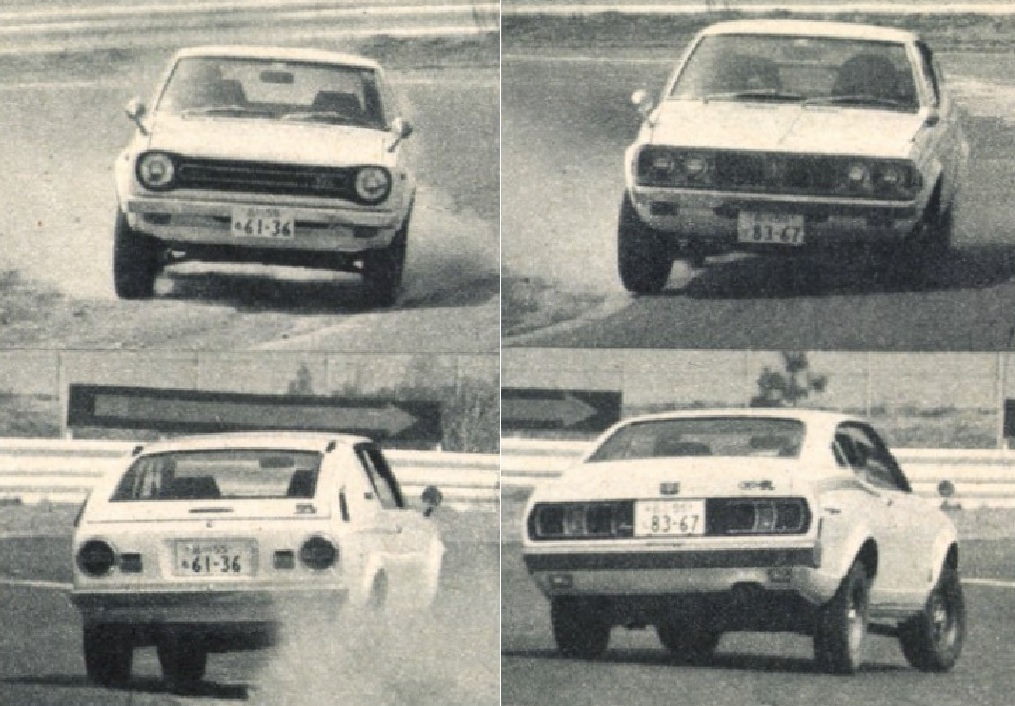
Publication: Car Graphic
Format: Group Test
Date: May 1973
Author: Auto Test Editorial Staff (uncredited)
Our editorial staff swapped their pens for steering wheels, and set out to experience—and verify firsthand—the sporting character of the Cherry X-1R and the Galant GTO 2000GSR.
Two machines, both wearing boldly aggressive overfenders and looking very much the part of modern sport models, were taken to Tsukuba Circuit and driven to their limits. Making full use of whatever driving technique (!?) we could muster, we threw them onto the course and attacked corner after corner… and the result, well…
Editors’ Comprehensive (?) Test Drive: Cherry X-1R vs. Galant GTO 2000GSR
Lately, many newly announced domestic models have been arriving under the looming specter of tightening emissions regulations. Even so, manufacturers continue to include sporty versions in their lineups—models clearly aimed at younger drivers with an interest in motorsports.
At the Auto Sport editorial department, we decided to put these sport-oriented machines to a more serious test than usual. Our goal: to explore their inherent potential–not just as road cars, but as bases for racing and rally competition–through comprehensive evaluation on the track.
For this test, we selected two cars: the Galant GTO 2000GSR and the Cherry Coupe X-1R. On paper, they belong to entirely different classes. What they do share, however, is a common visual statement–both wear overfenders, giving them a distinctly sporting appearance. One is a high-grade grand tourer; the other, a lightweight coupe built with performance as its singular focus. The question, then, is simple: how do they perform on the circuit?
Before getting into that, let’s briefly outline the profiles of each car.
Released nationwide on March 9, the Cherry Coupe X-1R is based on the Coupe X-1. It retains the well-regarded A12-type OHV engine in completely stock form, an engine already known for its willingness to rev. Instead, the focus has been on reducing weight by stripping away non-essential equipment, while significantly strengthening the chassis–particularly the suspension–to create a more purpose-built sporting model.
That suspension development has been carried out with considerable thoroughness. In addition to adopting 13-inch low-profile radial tires, the spring rates and damper settings have been substantially increased. A stabilizer bar has been added, brake disc size enlarged, driveshaft diameter increased, and even the wheel bearings upgraded to angular ball types. Attention has clearly been paid to small details throughout.
Vehicle weight is listed at 645kg, which–on paper–makes it 45kg lighter than the 690kg X-1L. However, this figure represents the homologated weight, achieved under specific conditions: 12-inch standard tires fitted, and with all non-essential equipment such as the heater removed. In reality, the car is likely 10-15kg heavier. The fact that homologation was obtained in this stripped-down form–while production is said to be limited to around 100 units per month–invites speculation. Could this be a homologation special, developed with an eye toward Nissan’s rumored entry into the European touring car racing series? If that rumor proves true, it would certainly be welcome news for enthusiasts. But even if not, it’s an interesting line of thought.
Taking a slightly more skeptical view, one might also question the overfenders—arguably the X-1R’s most distinctive visual feature (officially referred to as “soft guards” by the manufacturer, and indeed made from a pliable urethane material). In reality, the wheel arches themselves have not been cut, meaning that wider wheels cannot actually be fitted. According to catalog data, the tread width remains unchanged, with overall width increased by 60mm solely due to these overfenders. This, too, could be interpreted as a provisional measure for homologation purposes. Then again, it may simply reflect the current trend toward overfenders, and nothing more…
Turning to the GTO, this series has been upgraded to the 2-liter class, and the twin-cam GTO MR has been discontinued. Taking its place as the new top-of-the-line model is the Galant GTO 2000GSR.
Even though it shares an overfender treatment similar to the X-1R, the Galant GTO 2000GSR feels quite different in character. In terms of class positioning and equipment level, it comes across less as a pure sports model and more as a high-speed cruising coupe for highway use. That said, in the broadest sense, it still falls within the category of a “sport-oriented” machine.
Compared to the 2-liter DOHC 4-valve GTO R73X displayed as a concept car at last year’s Tokyo Motor Show, the production GSR is noticeably more restrained. Even so, with its revised front grille, bolt-on overfenders, and 70-profile radial tires, its stance remains quite aggressive and purposeful.
The newly developed Astron engine incorporates an MCA emissions control system, yet still uses twin two-barrel downdraft carburetors. It produces an output of 125ps/6200rpm and torque of 17.5kgm/4200rpm. In terms of weight, the mechanically similar GS-5 model–sharing engine, transmission, and suspension specifications–comes in at 1000kg. The GSR, due to additional equipment, is slightly heavier at 1015kg.
Perhaps because we had behaved ourselves, the test day greeted us with clear skies. At Tsukuba Circuit, where the atmosphere already felt like early summer rather than spring, the editorial test team gathered and immediately began preparations for track running. “Preparations,” in truth, amounted to little more than checking tire pressures and removing unnecessary items from the cars—hardly strenuous work.
With that done, it was time to head out onto the circuit.
This time, however, the objective was not strict testing. The aim was simply to get a feel for the sporting character of the Cherry and the Galant through a more impression-based evaluation. As such, no acceleration figures, sectional times, or braking distance measurements were taken. Only lap times were recorded, and even those were for reference purposes only.
“Go Ahead, You First.” “No, After You…”
Despite frequent opportunities to observe professional drivers up close at the circuit, and despite being rather talkative when it comes to driving technique, the editorial staff found itself in a somewhat different position once actually behind the wheel. Lap times hovered stubbornly around the 1 minute 30 second mark. Easier said than done, as the saying goes.
Even so, the editors, now fully focused and pushing toward their limits, continued to observe with a journalistic eye, carefully extracting the feel of the car even while grappling with it themselves.
With that, let’s begin the report with the Cherry.
The Cherry has been regarded as a capable performer since the appearance of the X-1. Yet when it came time for this circuit impression test, even the more experienced members of the editorial team hesitated. Unfamiliar with front-wheel-drive behavior, they found themselves unusually hesitant–“You go first.” “No, you go ahead.” An unexpected display of politeness ensued.
Following Editor-in-Chief Usui’s instruction–“This is not a time attack, only a circuit impression. Do not push beyond your limits”–everyone complied faithfully, resulting in what looked almost like a driving school session.
The only exception was photographer Yokomachi, a veteran Subaru FF-1 user. “I don’t really feel any FF traits here,” he remarked casually. “It doesn’t have that strong tuck-in like the Subaru. It feels just like an FR car.” He then proceeded to record a best lap of 1 minute 26.8 seconds.
In absolute terms, this is far slower than production racing times in the same class, and roughly comparable to 360cc-category cars. Even so, the fact that he achieved a 26-second lap on only his second flying lap suggests that the Cherry is by no means difficult to drive. The slower times recorded by others likely reflect an overly cautious approach–drivers too conscious of the FF layout, braking conservatively into corners and failing to carry sufficient speed.
On the road to the circuit, city driving impressions had already suggested a firmly set-up chassis. Veteran rally reporter Inoue even commented, “I was surprised by how stiff it is. You could almost take this straight into rallying as-is.” That impression proved accurate on track as well.
Ride height remains unchanged from standard, and with a relatively high seating position, body roll seems more pronounced than it actually is, occasionally creating a slight sense of unease on turn-in.
The A12 OHV engine, already known for being unusually strong-revving for a mass-produced unit, exhibits the same characteristics here. The tachometer needle sweeps easily past the 6800rpm redline and will happily continue toward 8000rpm if allowed to. As noted in the profile, the engine itself is untouched in X-1R specification. However, with further weight reduction over the X-1, the car has more than enough performance for spirited driving.
The combination of light body weight and sharp steering response, along with 4.5J steel wheels and 165/70HR13 tires, further defines the car’s character–light, alert, and distinctly reactive.
The front disc brakes, now increased in both size and capacity, withstand repeated hard braking on circuit without complaint. With no servo assistance, pedal response is linear and easy to modulate. However, under heavy braking, weight transfer toward the front driving wheels tends to unsettle the chassis slightly, making stability somewhat difficult to maintain.
As is typical for FF layouts, the transmission does not offer especially refined shift quality. That said, the synchros are strong enough that downshifts can be executed without using the heel-and-toe technique. The close-ratio 5-speed’s gear ratios remain unchanged from the X-1: 3.014 / 1.973 / 1.384 / 1.000 / 0.858, with a final drive of 3.358.
The reduced weight again proves advantageous here. Compared to rivals in the same class, the gearing feels relatively tall, yet the close spacing ensures that even on a technical circuit like Tsukuba–where second and third gears are used frequently–the car never feels sluggish.
One drawback is gear noise. The aluminum casing transmits a fairly high level of mechanical sound. However, this too may come down to personal taste; for drivers drawn to this kind of enthusiast-oriented machine, it is unlikely to be a serious issue.
In summary, the Cherry Coupe X-1R–equipped with a suspension specification comparable to rally or race kits–delivers exactly what one would expect. Combined with its excellent engine and extremely low weight, it proves to be a lively and capable machine, fully in line with its intentions.
“Flat-Out in 4th—You Can Just Go Straight In!”
Switching from the Cherry to the Galant, the first thing that stands out is the level of equipment. Compared to the Cherry’s sparsely appointed dashboard—lacking even a radio—the top-grade Galant GTO 2000GSR clearly reflects its position in the lineup. The cabin, unified in black with a strong GT atmosphere, is matched with a low seating position that provides ample headroom. By contrast, the Cherry’s more upright driving position means that your helmet often contacts the roof–making the difference in class immediately apparent.
To be honest, the editorial staff did not have particularly high expectations for the Galant. Although it has been given a 2-liter engine in what was originally a 1.6-liter body, this was assumed to be nothing more than a necessary displacement increase to compensate for power losses caused by emissions regulations. The catalog itself explicitly described it as an emissions-controlled model. On paper, we thought it would handle steady high-speed cruising on expressways without issue—but there seemed little chance it would withstand repeated circuit abuse. That was the assumption.
However, that prediction was quickly overturned once driving began.
“This thing runs better than expected.”
That was the unanimous reaction from the entire test team.
The power of a 125ps 2-liter is, after all, no small thing. Combined with a suspension strengthened to match the increased weight, 185/70HR13 radial tires on 5J rims, a 5-speed transmission, and servo-assisted disc brakes, the Galant demonstrates a surprisingly sporty character.
The newly developed Astron engine–carrying on the lineage of the Saturn unit–is a long-stroke design, yet it revs far more freely than expected. The increase in displacement also brings a useful gain in torque, allowing for smooth, progressive response from low- to mid-range speeds.
For a sport-oriented model equipped with overfenders, one might wish for twin Solex carburetors. Still, even with twin two-barrel downdraft carburetors, throttle response is by no means poor. Above 6000rpm there is a noticeable tapering-off in torque, but even so, there is no sign of valve float, and the engine continues to climb willingly if the throttle is held open.
Furthermore, the Galant’s traditionally neutral handling character remains intact. It is a car that allows even inexperienced drivers to record reasonably quick lap times without much difficulty. In fact, most of the team–excluding a few who limited themselves to impression runs–were able to immediately record laps in the 1 minute 23 second range.
“One of the biggest differences is psychological comfort at the final corner. With the Cherry, I’d have to lift slightly before turn-in. But with the Galant, I could stay flat-out in 4th and just charge right in.”
That comment captures the car’s nature perfectly.
Even drivers with no prior circuit experience could confidently commit to full-throttle entry into the 100R corner at around 120km/h. This stability is likely the result of the long wheelbase, wide track, and above all, the inherent controllability of the GTO chassis.
The front disc brakes–now increased from 4.5 inches to 6 inches and equipped with a master-back servo–deliver braking force that feels almost too strong. Yet even when diving into corners, full braking can be applied without any sense of unease.
The transmission offers a good shift feel, and although the overall gearing is relatively tall, the strong torque makes it perfectly manageable in city driving. On the circuit, the longer ratio spacing allows effective extension in each gear, which becomes another advantage.
Steering response is sharp, with well-judged effort. It is the overall balance of these elements that turns the seemingly street-oriented Galant GTO 2000GSR into a far more capable performer on the circuit than expected.