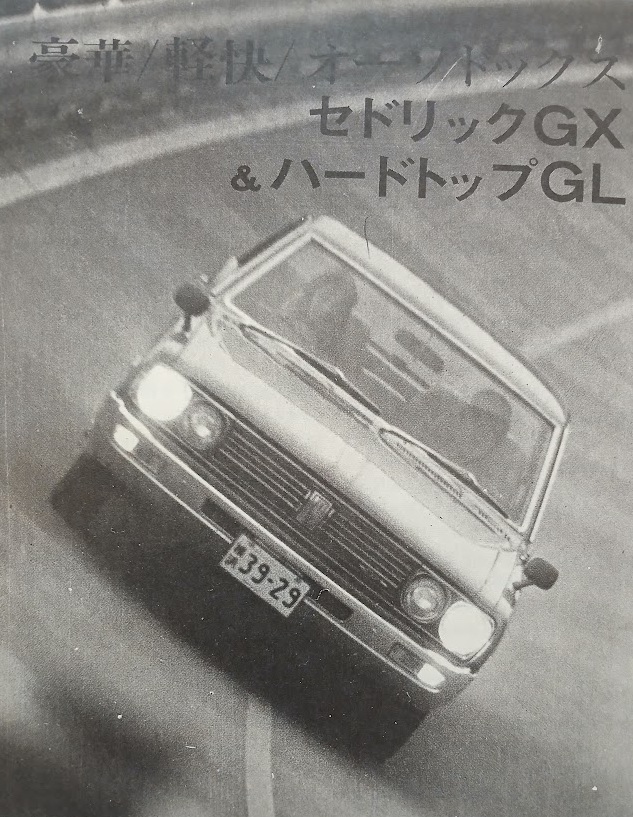
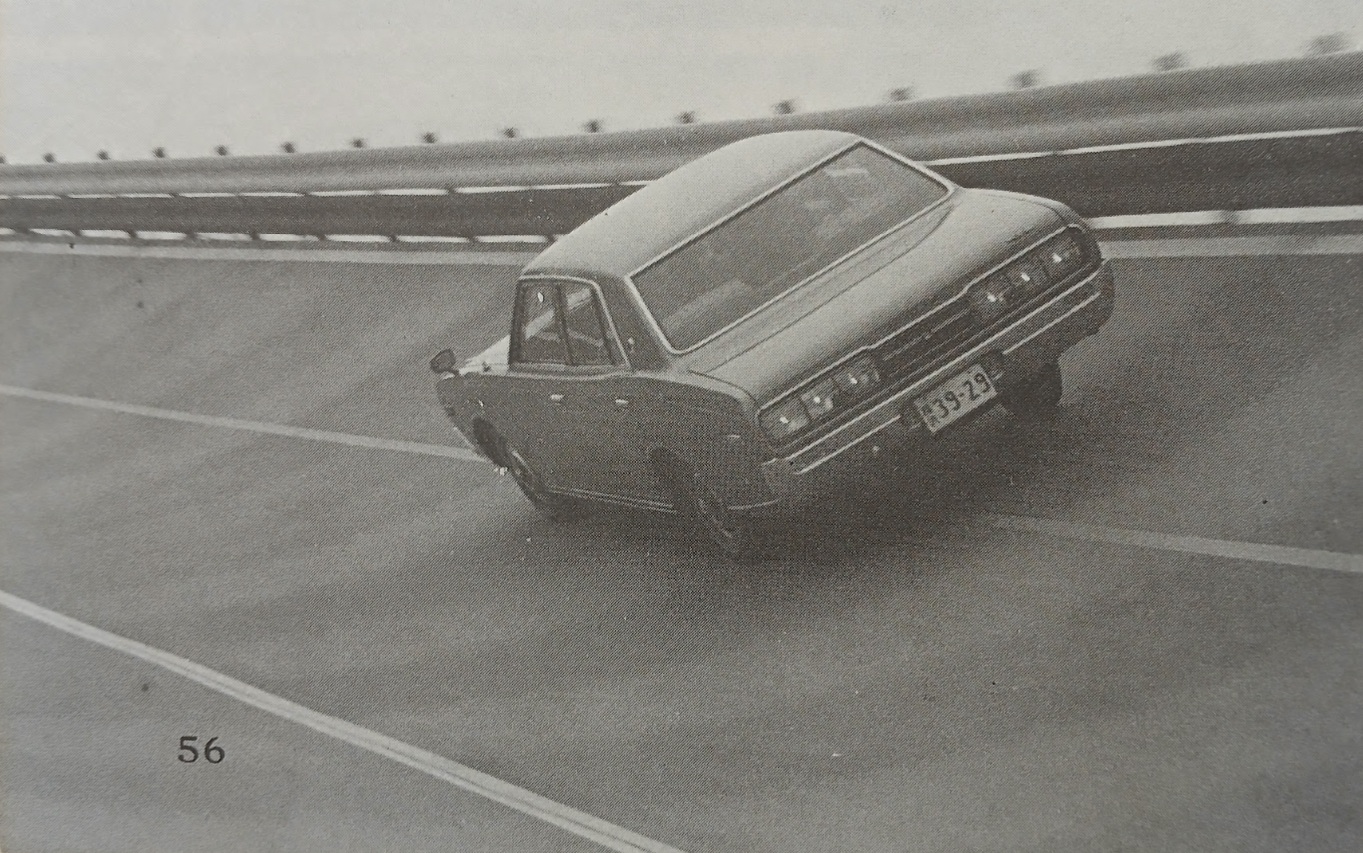
Nissan Cedric GX and Hardtop GL (1971)
Publication: Motor Fan
Format: Road Test
Date: June 1971
Authors (roundtable): Hiroshi Takahashi, Hajime Mizutsu, Kazumi Yotsumoto, Osamu Hirao, Atsushi Watari, Kenji Higuchi, Yasuo Ishikawa, Katsuzo Kageyama, Kunitaka Furutani, Hiroshi Okazaki, Taizo Tateishi, Toshio Omura, Yasuhei Oguchi, Takeshi Toba, Akira Yamamoto, Masahide Sano, Minoru Onda, Yasunobu Tomizuka, Motor Fan Editorial Staff (uncredited)
Meeting Diversified Demand
Magazine: First, we’d like to begin with the design objectives.
Takahashi: The Cedric underwent its first full model change in the autumn of 1965, and was revised again in the autumn of 1968. The previous Gloria, meanwhile, was released in the spring of 1965, so it had been about five and a half years since either car’s last major change. Market research over that period showed that this class had been primarily for business and corporate use–what you might call formal use–but more recently, private owners have begun using these cars as well. Even in corporate use, about 80% are now driven by the owners themselves.
Our research also found that within any given model series, the higher-grade variations tend to sell better. Taking all this into account, we retained the essentially formal character, but added other elements on top of it. In particular, this class increasingly demands a sense of luxury, so we aimed to create something that responds to a more diversified range of needs. At the same time, we made a concerted effort to further improve safety.
Another point is that we unified the Cedric and Gloria model lines. The sales channels remain separate as before, and of course customer preferences differ, but…
Magazine: Both the Gloria and Cedric have a very wide range of variations, so in the end it becomes a case of many models produced in small numbers, doesn’t it?
Takahashi: Demand is diversifying in this so-called information age, and to respond to that, we have to offer a wide range of models. However, it’s not feasible from a cost standpoint to increase the number of completely different vehicles. To that end, we unified the Cedric and Gloria, and then created variety within that shared framework.
Magazine: Could you outline the car overall?
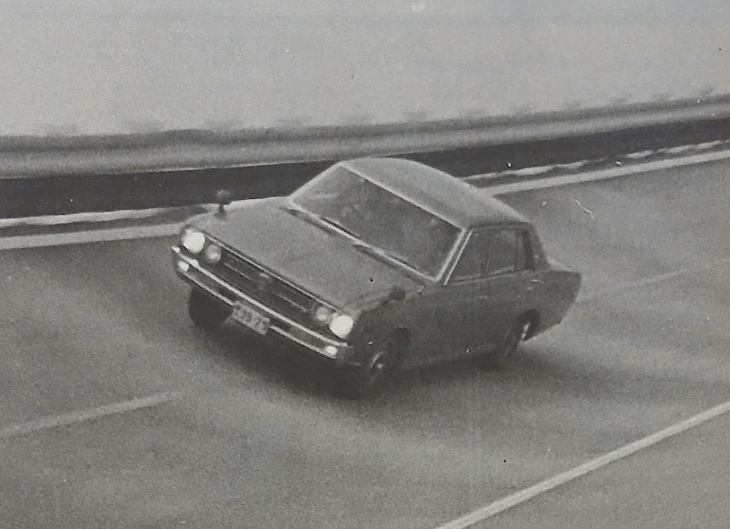
Mizutsu: We aimed the new model more toward private use, with the intention of appealing to a relatively younger demographic. In terms of styling, the basic idea was to keep it fairly orthodox, while introducing a measure of freshness–that was the primary goal.
Secondly, in terms of the model lineup, we’ve added a hardtop variant. Then, through different combinations of specifications, we’ve created a model range: below one million yen there are Standard and Deluxe models, while above that, in increments of 50,000 to 100,000 yen, there are Custom Deluxe, Super Deluxe, GL, and GX variants. In other words, we’re targeting a broad spectrum of demand.
As for the specification-level objectives, the key point was to clearly emphasize a user-oriented approach–to provide refinement in the details. In that regard, there are five areas we focused on in particular:
-
Measures against vibration and noise. We aimed to improve this significantly over previous models. Specifically, we increased the number of crankshaft balance weights to eight, adopted a three-joint propeller shaft, and improved both engine and exhaust mountings. In addition, we worked extensively on sound insulation. Taken together, these measures have raised the overall level of ride comfort considerably.
-
Improved usability for the driver. For example, a remote-control mechanism allows adjustment of the fender mirror’s field of view, a remote trunk release has been added, and there’s a tail-lamp monitor, intermittent wipers, a heated rear defogger, and centralized door locking. In short, we put quite a lot of thought into all the points the driver interacts with directly.
-
Increased trunk capacity. This had not been particularly well received in the past, so we’ve made this area larger.
-
Improved climate control performance. With residential air conditioning becoming something of a trend, there is now an expectation for similar comfort in automobiles. The system combines a centrally directed forced ventilation outlet with a heater and side vents to achieve a “cool head, warm feet” effect. There are also ducts to extend heating to the rear. In addition, a thermostatically controlled air-conditioning system is available, allowing for a more ideal cabin environment.
-
Safety measures. On the braking side, we’ve adopted a larger vacuum booster, front disc brakes, and a tandem master cylinder, along with a brake fluid level warning lamp. We’ve also incorporated a steering lock, headrests, and seatbelts, and added warning markings to the speedometer. Overall, we’ve made a substantial effort to improve safety.
Orthodox Styling
Magazine: The styling is the main highlight—what was the thinking behind it?
Yotsumoto: The big issue was responding to diversification, and bringing in a more personal element. At the same time, we were working under fixed dimensional constraints–wheelbase, overall length, width–all of it was already set. Within those limits, we had to find a way to express something new, which made it quite difficult.
Looking ahead, we felt this car would inevitably be influenced by the youth market as well. So we considered various directions–something more eye-catching, something more in line with the traditional corporate image, and something in between. We built models along each of those lines and carried them through to full-size proposals. From those, we eventually settled on the present form.
In terms of philosophy, there were two opposing views: one was to aim for something bold and unconventional; the other was that, now that domestic cars have reached their current level, we should concentrate on the fundamentals of good design. In the end, given the dimensional constraints, we decided the latter was the right approach. I think that also reflects Nissan’s general character.
As for what we mean by something “fundamental”–design is ultimately about feeling, so there’s no need to make it overly theoretical–but first comes proportion, and then movement, or a sense of flow. In that respect, we asked a great deal of the styling team, but we were able to bring it into line with the intended image.
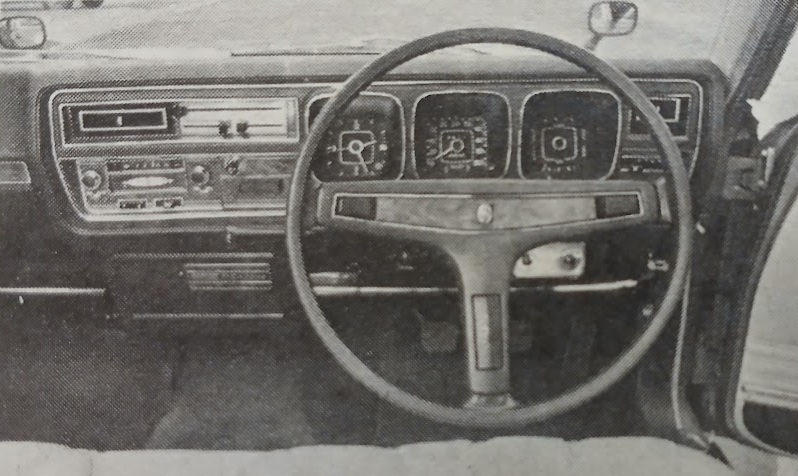
For the interior as well, we avoided anything showy or excessive, and instead aimed for a more mature, genuine kind of luxury. The instruments are the same rounded-off square type as used in the Laurel, although in fact this design was originally developed for this car.
Magazine: So the idea is a more restrained, composed kind of styling?
Yotsumoto: I believe the basic proportions are quite sporty. Within the fixed dimensional limits–and without sacrificing interior space–to achieve those proportions gives it something close to a kind of fully resolved form. If we were to go further, it would mean adding something more flamboyant, but that wasn’t our intention. If dimensional restrictions are relaxed in the future, that may be another matter. Also, we had to keep in mind the relationship with the Laurel as an existing model line.
Magazine: If this is the “ultimate” form, does that mean no further model changes are needed for the 2-liter class? (laughs)
Takahashi: Not quite–but we are certainly reaching a difficult point.
Hirao: It’s becoming a kind of formula, isn’t it. The same goes for kei cars. I do think styling has improved since that earlier “Italian design” influence faded.
Watari: These days, everything is starting to look the same. You can’t tell which car is which.
Higuchi: It does resemble something like an Opel in shape. Though I think something a bit more “overdone,” like the old Gloria’s front grille, might have more appeal. (laughs)
Watari: When you’re actually driving, it’s the rear design that tends to stand out more.
Higuchi: The rear is quite good, I think, but the front feels a little plain.
Yotsumoto: As for the front, we actually wanted to give the grille a bit more depth. But due to dimensional constraints…
Watari: The dashboard feels a bit too high. You can see it clearly even from the rear seat. I think it would look better if it were lower.
Ishikawa: Around the instrument panel, we’ve added new elements like air conditioning and a stereo system, so from a packaging standpoint, a higher layout is preferable. From a styling standpoint, it’s the opposite–so what you see is the result of that compromise.
Higuchi: One thing I noticed was that the glovebox seems to protrude slightly. I wondered whether it might be an issue if the front passenger’s head is thrown forward.
Ishikawa: In that regard, we’ve taken measures such as increasing the thickness of the padding. However, the relationship between the windshield angle and the top surface of the panel is also constrained–for example, by reflections of sunlight–so there isn’t much freedom in that area.
Yotsumoto: Also, regarding the issue of the top of the instrument panel reflecting in the windshield, we put a great deal of effort into the grain of the padding–the pattern, depth, and color–to find what works best.
Magazine: The hardtop seems aimed more at private owners, but its styling doesn’t differ greatly from the sedan’s.
Yotsumoto: With a hardtop, you can go either toward a fastback or a landau-style treatment, and for the Cedric we chose the latter. It was a difficult decision. A fastback raises visibility concerns, which perhaps younger drivers are willing to accept, but many Cedric buyers are older, so that becomes a consideration. There’s also the issue of trunk capacity; with a fastback, it’s difficult to achieve a large trunk lid. In the end, it’s a matter of priorities.
Convenience Features Abound
Magazine: There are quite a number of convenience features fitted–could you comment on that aspect?
Kageyama: It’s a bit of a paradox: “convenience features can be inconvenient.” Take the remote trunk opener, for example–it uses vacuum assist, but in practice there may be situations where it’s actually less convenient.
Watari: Well, you can still open it with the key, so that’s fine, isn’t it?
Hirao: But if you open it from inside, you still have to get out to close it.
Higuchi: If it could be closed from inside, like a taxi door, that would solve it. (laughs)
Takahashi: We’ve had all sorts of ideas internally, but when it comes to the actual equipment, we’ve selected only what we felt was appropriate.
Hirao: Another useful feature is the intermittent wiper.
Magazine: In this class, it seems cars are increasingly competing on equipment and features. In that case, what happens to performance?
Hirao: Well, if someone’s particular about performance, they probably shouldn’t be buying a car in this class to begin with.
Takahashi: That’s right. Buyers in this class are looking for other kinds of appeal rather than outright performance.
Magazine: Still, if you aim for luxury and add too many features, doesn’t the weight increase?
Mizutsu: We’ve kept the vehicle weight about the same as before.
0–400m in 18.4 Seconds (GX)
Magazine: Now, let’s have the performance results.
Furutani: For standing-start acceleration, the GX (with 3-speed plus overdrive, column shift) recorded 0-50m in 4.7 seconds, 0-100m in 7.4 seconds, 0-200m in 11.6 seconds, and 0-400m in 18.4 seconds.
The hardtop GL (with 4-speed floor shift) did 0-50m in 4.8 seconds, 0-100m in 7.5 seconds, 0-200m in 11.9 seconds, and 0-400m in 18.8 seconds. As you’d expect, the difference in power shows up in the acceleration times.
Watari: With figures like these, there’s not much to worry about.
Takahashi: At the GX level, I don’t think it gives anything away to cars in the lower classes.
Magazine: Yes, if anything, it feels rather quick.
The GX we tested was fitted with the optional air conditioner–how much power does that consume when in operation?
Ishikawa: At full capacity, about 5ps.
Magazine: It’s the thermostatically controlled type, is that right?
Ishikawa: Yes, it’s a full air-conditioning system. It maintains around 23°C, so you can keep the interior comfortable at all times.
Okazaki: Compared with the usual feel of 2-liter cars, this one feels very light and responsive. I wonder where that comes from–it doesn’t feel heavy at all.
Higuchi: I’d say that’s due to the clutch.
Hirao: Perhaps it’s more to do with carburetor response. And possibly the ratio used in the accelerator linkage as well.
Furutani: The g-force during initial acceleration is quite strong, too.
Magazine: Could it also be related to the gear ratios?
Mizutsu: The GX’s 3-speed plus overdrive has a final drive of 4.625, so you’re seeing the benefit of that over-top gear.
Okazaki: It’s different from the “lightness” you get from simply having low gear ratios, though. It doesn’t feel short-winded–it has a more relaxed, free-revving character.
Ishikawa: We’ve reduced friction in the accelerator linkage as much as possible, and also refined the pedal angle and stroke. Normally, shortening the pedal stroke can make it feel a bit abrupt, but we’ve smoothed that out and improved overall engine response.
Okazaki: I wondered if it might be because the engine itself revs so smoothly. Previously, above about 5000rpm there was a certain roughness to the way it spun, but that’s been eliminated.
Higuchi: Maybe it’s because the engine no longer sounds like a typical Nissan unit. (laughs)
Watari: Just making the engine quieter makes quite a difference.
Mizutsu: Increasing the number of crankshaft counterweights and adopting a three-joint propeller shaft have contributed as well.
Yamamoto: Engine noise is greatly affected by sound insulation, of course. As countermeasures, we reduced the area of openings in the firewall, paid close attention to the brackets, and used thicker rubber. In particular, in the area where the steering column passes through it, we increased the amount of steel paneling and minimized the use of rubber in moving sections–so we were quite careful in how we treated those openings.
The upper part of the dashboard is also difficult from a sound-insulation standpoint, but we made a point of selecting appropriate materials for the insulation there as well.
Exceptionally Quiet Interior Noise Level
Magazine: Let’s hear the results for vibration and noise.
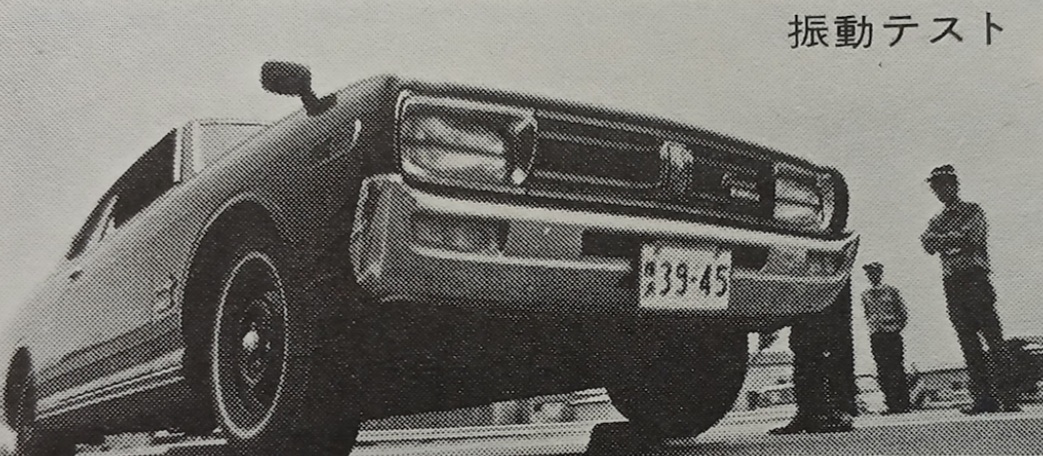
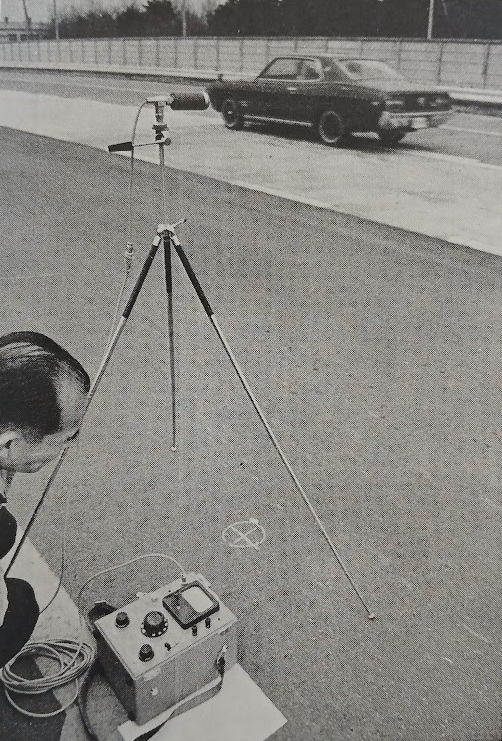
Tateishi: We took measurements on the hardtop GL. For suspension vibration, the sprung mass frequency came in at 1.35cps, and the unsprung mass at 13.5cps. Interior noise measured 59 phons at 40km/h, 64 at 60km/h, 68 at 80km/h, 70 at 100km/h, 74 at 120km/h, and 76 phons at 140km/h.
Up to now, it’s been common for readings to exceed 90 phons at higher speeds, but in this car the curve flattens out from about 80km/h upward, staying below 90 phons, so it remains quiet even at speed.
Watari: A lot of that comes from suppressing engine-related noise, along with measures like the three-joint propeller shaft, an extra rubber insert at the eye of the rear leaf springs, and offset mounting of the shock absorbers on the axle. All of that adds up to a very quiet car.
On the Mechanical Engineering Laboratory course, the noise-level figures would likely come out a bit higher than these, but even so, I’d say this is one of the quietest cars Nissan has produced so far. If I had to be critical, the absolute values are fine, but there’s a bit of a swell in the mid-speed range. If that could be smoothed out, it would be quieter still.
Ride comfort is about average for this class. You might consider lowering the natural frequency a bit more, but that depends on what kind of road conditions you’re designing for.
Higuchi: Lately, we’ve seen cases where the data says a car is quiet, but subjectively it still feels a bit unsettled to the ear. That’s something we’ll need to consider going forward. In that sense as well, this car does feel genuinely quiet.
Watari: In the end, what matters most is whether people in the front and rear seats can talk without raising their voices, regardless of speed. There’s a limit to judging it on dBA readings alone.
Hirao: I had the impression that wind noise was relatively subdued–perhaps that’s because the door seals are doing a good job.
Omura: We put quite a bit of effort into that. The lip pressure of the weatherstripping and the closing force of the door are opposing requirements, so we paid close attention to shape and material. We’ve also increased the contact area.
Oguchi: At higher speeds, I noticed wind noise starting to come from around the front pillars. At first I thought it might be due to the windshield angle, but it seems more likely it’s coming from the air outlets in the front pillars.
Ishikawa: On the sedan, air is extracted through the front pillars, while on the hardtop it’s taken out from the rear. In terms of airflow noise, it’s actually quieter when the outlet is farther from the occupants, so ideally you’d exhaust at the rear while drawing air in from the front pillars.
That said, the position of the outlets in the front pillars—higher or lower—makes a considerable difference, so we’ve selected what we believe is the best location. Since the air travels through the body structure from rear to front, any leakage along the way will naturally increase noise, so the tolerances are controlled quite strictly on the production line.
Oguchi: Also, at around 100km/h, there seems to be a slight body vibration. I’d prefer to see that shifted to a higher speed range.
Hirao: The kind you can just feel through the steering wheel and accelerator, right?
Oguchi: Most people probably wouldn’t notice it, but if you pay close attention, it’s there.
Takahashi: Is that a vertical vibration?
Mizutsu: If I had to guess, it might be tire tramp.
Watari: Once the car gets this quiet, you start to notice things like the air conditioner fan noise. On the low-speed setting, it’s fine, but on high…
Hirao: Even on low, I’d like it a bit quieter.
Omura: We have to deliver airflow to the rear seats as well, so there are limits…
Watari: In that case, the hardtop could blow from the front, and the sedan from the rear.
Hirao: But blowing directly at the back of your head from the rear isn’t ideal either.
Higuchi: Or mount it in the ceiling–like an airplane.
Okazaki: Speaking of noise, you can actually hear the ticking of the clock. At first I thought, “this car must be incredibly quiet,” but then I realized the clock itself is quite loud. (laughs)
Kageyama: I also noticed the sound of the turn signal–that stood out a bit.
Takahashi: It may be a little on the loud side.
How Does the Power Steering Feel?
Magazine: Let’s move on to the results for handling and stability.
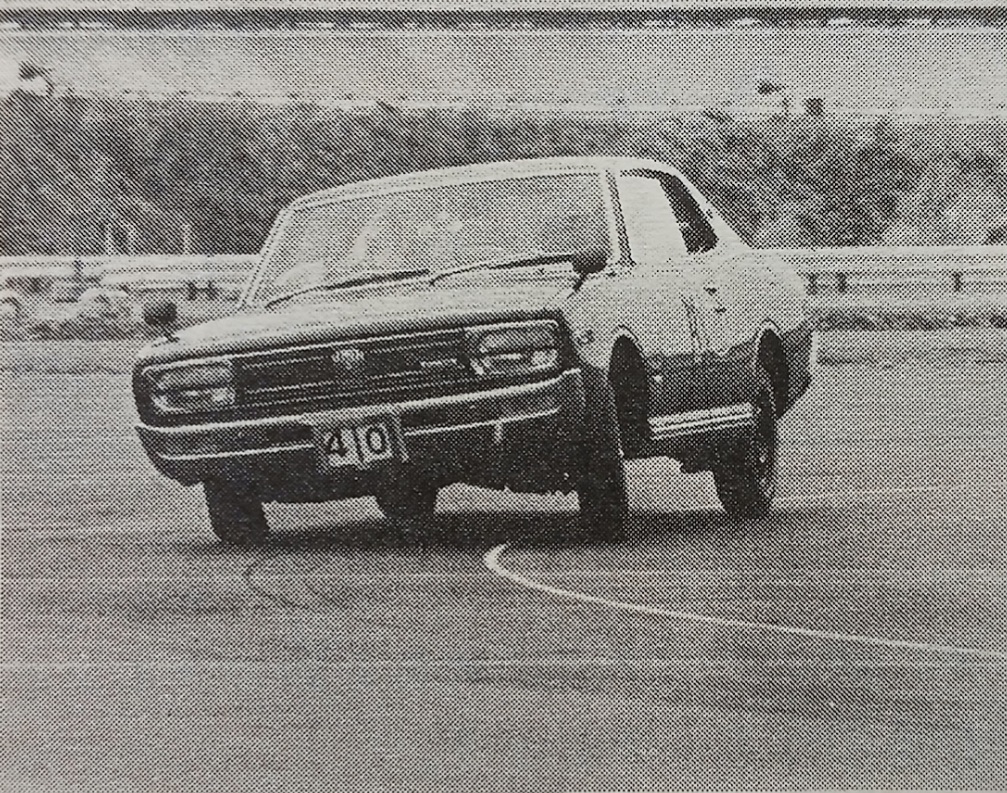
Toba: The tests were carried out with the hardtop GL. First, the practical minimum turning radius was 5.94m on the outside and 3.23m on the inside, which are typical figures for this class.
The steering gear ratio measured 24.0. At a standstill, with the power assist operating, steering effort was about 3.0-3.5kg; without assist, it increased to around 16-17kg to turn the wheel roughly 180°.
As for understeer/oversteer characteristics, the car shows relatively strong understeer. We tested up to about 0.5g of lateral acceleration at a constant steering angle, and it remained in understeer throughout. Even in power-on cornering, there was no tendency toward oversteer.
The roll rate is 5.4°, which is a relatively small value for this class. Steering effort in this test increases smoothly up to around 0.3g, but beyond that it levels off, settling at about 1.2kg.
For straight-line stability with hands off the wheel, we conducted testing up to 130km/h. Convergence was very good, and the subjective feel matched the measured data.
Kageyama: The catalog lists the steering gear ratio as 19.8, but in the test it measured 24.0…
Mizutsu: The catalog figure is based on the steering gear itself. The measured value includes the linkage–an overall ratio. The corresponding design figure is 24.6.
Kageyama: The effect of the power steering shows up clearly in the low stationary steering effort, but what stands out is how gentle the buildup of steering effort is. Compared with something like the Crown, where the effort rises more quickly, this feels different. When making small corrections in a straight line, it gives a softer impression, and I think that comes from that characteristic.
Hirao: Why was lock-to-lock set at 4.4 turns?
Mizutsu: Because the manual and power systems share the same steering gear, it’s a compromise between the two.
With a manual setup alone, it might be better to increase the lock-to-lock turns a bit more to reduce effort. But if you make the gear ratio too large, the steering becomes dull, so we settled on this ratio as a balance with steering weight.
Hirao: From an American point of view, you’d go with more turns.
Kageyama: Standstill effort is fine, but at speed–perhaps because I’m not used to it–it feels rather unsettling. The steering effort curve rises up to about 0.3g, but then it flattens out, so beyond that there’s very little change in feel as lateral g increases. I suspect that’s what makes me feel uneasy.
Hirao: Even so, it’s still heavier than an American car. I suppose the idea is simply, “you’ll get used to it.”
Watari: I think that kind of steering would become tiring at high speeds. It might be better to move it a bit more in the “European” direction.
Kageyama: If it’s light, that’s fine–but it should at least respond to lateral g. What bothers me is that the effort buildup just goes flat.
Higuchi: That’s because we steer not by angle, but by the reaction force at the wheel.
Mizutsu: From a design standpoint, we had both the “American-type” light feel and the “European-type” feel in mind.
With the previous Cedric’s manual steering, we had aimed to make it as light as possible, and I think we were fairly successful. When you add power assist, it naturally becomes lighter still, which gives it a certain appeal. But we wanted to avoid the kind of wandering feel you get in some American cars, so we aimed for something in between the two. We paid particular attention to straight-line convergence at high speed, to ensure stable running.
As for steering feedback, it’s designed so that about 20% comes back through the wheel. Up to around 0.5-1.0kg, the effort is essentially the same as the manual system.
Oguchi: I’ve always had the impression that power steering can feel a bit unnerving–especially in American cars, with their lightness and lack of high-speed stability, where you can get a kind of self-excited oscillation from the weight of your own arms. I really dislike that.
But in this car, you can drive without being overly aware of the power assist. It made me think again that power steering, done properly, is a good thing…
Hirao: After driving an American car, this one feels very natural.
Oguchi: European-type power steering can feel a bit heavy, and for present-day Japan, this balance might be just about right.
Hirao: Since it’s power-assisted anyway, you could go with a smaller gear ratio–something like the Bluebird–and make the steering wheel diameter smaller as well. That would make it easier to use. A more horizontal steering column angle would help, too.
I once heard someone say that with a near-vertical steering column, like in a truck, it feels like you’re working–there’s a certain sense of satisfaction in it. But when the column is horizontal and you’re driving with the seat reclined, it feels more like “play.” (laughs)
Watari: With power steering, it might be worth reconsidering the shape of the wheel itself. It doesn’t necessarily have to be round.
Hirao: You could even go to a smaller gear ratio and use something like an aircraft control yoke. Maybe with a variable gear ratio.
Stable, Well-Balanced Braking
Magazine: Let’s have the results from the Traffic Research Institute tests.
Yamamoto: The test car was a GX sedan. Weight distribution was 55:45 front to rear; with six passengers on board, it shifted to 51:49.
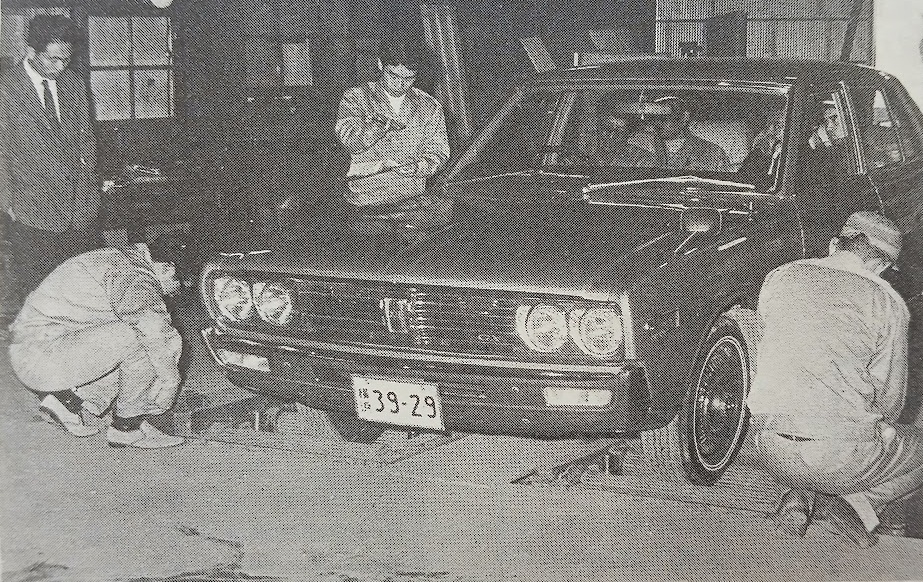
Wheel alignment shows fairly large toe-in and camber at the front, and even with a full load the camber doesn’t decrease very much. At the rear, both camber and toe are set to zero.
The brakes are discs at the front with leading/trailing drums at the rear, assisted by a vacuum servo. The rear wheels are fitted with a “G valve,” which appears to be the same type used on the Austin 1800.
At 0.6g, measured pedal effort was light at 14kg, but the front/rear distribution at that point was 44:56. What is the design target?
Tsuchida: In design terms, it’s around 55:45. It was raining on the day, so I think that may have had some influence.
Yamamoto: There did seem to be a slight imbalance toward the rear. In the road test, however, pedal effort for 0.6g deceleration was the same 14kg at both 50km/h and 100km/h, and 15kg at 130km/h, so it was quite consistent.
For the fade test, we applied the brakes from 100km/h at 0.5g deceleration, repeated at 35-second intervals. The first run averaged 11kg, and the tenth was 14kg, so there was no significant increase in pedal effort.
Magazine: The fade results are quite good.
Tsuchida: Well, they’re discs, after all… (laughs)
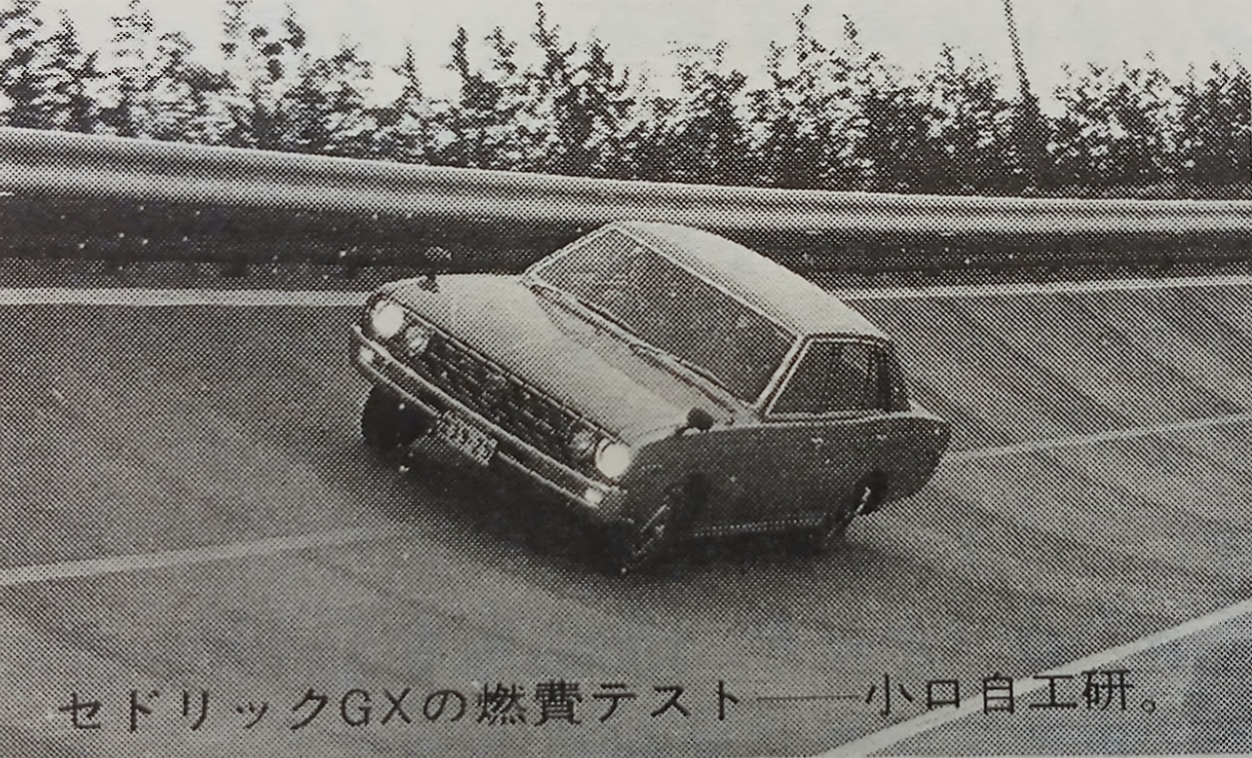
Magazine: Let’s move on to fuel economy results.
Sano: At steady speeds, we recorded 13.8km/l at 40km/h, 12.8km/l at 60km/h, 11.5km/l at 80km/h, 9.8km/l at 100km/h, and 8.1km/l at 120km/h.
For the model driving cycle, the figures were 7.6km/l at a 40km/h target speed, and 6.3km/l at 60km/h.
Magazine: The constant-speed results don’t seem especially strong.
Tsuchida: Compared with our in-house test figures, there’s about a 0.5km/l difference around 60km/h, and a roughly 1km/l difference at 40 and 80km/h.
Watari: In city driving, it can vary by as much as 50% depending on the driver. (laughs)
Oguchi: Have you measured how much fuel consumption changes when the air conditioner is running?
Hirao: That system uses a magnetic clutch and raises the idle speed, doesn’t it?
Tsuchida: Yes, it raises the idle by about 150rpm. We don’t do much testing at idle, but in ambient temperatures around 30-33°C, the difference is roughly 1km/l. That said, the compressor pressure varies with temperature, so it’s difficult to generalize.
Magazine: In this class, I would think most cars are fitted with air conditioning.
Ishikawa: The fitment rate is about 40% overall–around 60% for private owners.
Magazine: Is it a factory option?
Ishikawa: It’s both factory and dealer installation.
Magazine: And the price?
Takahashi: 155,000 yen.
Hirao: Since taxis already have it, I imagine everyone will be ordering it this summer.
Yellow and Red Gauge Lines
Magazine: Let’s have the results on dimensions.
Onda: In this class there are fairly strict dimensional constraints, so the external dimensions all end up essentially the same. However, the roof height comes out slightly higher than the Crown. That is likely a result of the roof treatment and the effort to secure interior space.
The triangular vent window has been eliminated, and the hardtop uses very large doors. Even with someone seated in the front, rear-seat entry and exit is still possible.
The driver’s seat in the hardtop can be adjusted vertically in four steps. There is also a slightly greater distance between the steering wheel and the instrument panel, and as a result the rear legroom is a bit tighter than in the sedan. However, given the character of the hardtop, I don’t think it presents a problem.
Inside, there are many convenience features. Among the more unusual ones are intermittent wipers and a timer for the rear demister. The remote trunk opener is also mounted separately so that it won’t be operated accidentally.
One thing that caught my attention while driving is that the hood lock lever and the side vent knob are located very close to each other. The shapes are clearly different, but for someone not used to it, it could be a little hazardous.
The speedometer is marked with yellow and red lines.
There is also a tail-lamp monitor, which is a new feature.
Magazine: What do you think about putting yellow and red lines on the speedometer?
Takahashi: There’s no particular policy on it, and it’s not something required by regulation…
Hirao: I think the red zone should be set based on the tires. Considering tire reliability, around 100mph–about 160km/h–would be a reasonable point.
Takahashi: For now, we’re placing the red line either at the catalog top speed, or about 5-10km/h below that.
Magazine: But do yellow and red lines really contribute to safety?
Hirao: It’s not really about “safety” in that sense. It’s more a zone that indicates the car is approaching the limit.
Watari: You could even have a car where 60km/h is the yellow zone and 80km/h is the red zone. (laughs) But for this class, perhaps yellow from 120km/h and red from 150km/h would make sense.
Takahashi: From a legal standpoint, 100km/h is the limit, so the yellow zone is set from 100km/h as a warning.
Hirao: German cars even mark 50km/h. It’s as if to say, “don’t get caught exceeding 50 in town.” Following that logic, in Japan maybe anything above 40km/h would be yellow, and above 100km/h red. (laughs)
Magazine: The fender mirror is remote-controlled. That’s quite convenient.
Hirao: But when it’s placed there, you can’t help wanting to adjust it all the time. (laughs)
Magazine: How about safety?
Higuchi: If we score it out of 100, it’s 95 points. There’s really nothing more to add. From here on, real safety needs to be confirmed through actual crash testing–but we can’t exactly go around destroying cars every time. (laughs)
Hirao: Modern cars are all “crushable” now. I saw a rear-end collision the other day, and it deformed quite dramatically.
Magazine: Finally, what about production plans?
Takahashi: The plan was 8,000 units in total, but depending on demand, we’re prepared to go up to around 10,000.
Magazine: What about the ratio of hardtops?
Takahashi: About 30%.
Tomizuka: Until now, this class has averaged around 12,000 units per month, but to be honest it’s been difficult to forecast clearly. Now that the new Crown has come out, that may stimulate the market further.
In March, actual sales of the class rose sharply, reaching 17,690 units in total, surpassing the previous record of 13,018 units set in 1968. We’ll need to see April and May before we know for sure, but there does seem to be a change in the market.
At present, in March alone this new model has already exceeded 8,000 units, so we’ve already reached the initial target. However, hardtop registrations are still limited to display and demonstration vehicles.
Production will be handled at the Tochigi plant, which has a capacity of 10,000 units per month. We’re also currently using the Oppama line as well.
Magazine: That’s all for now…
Postscript: Story Photos