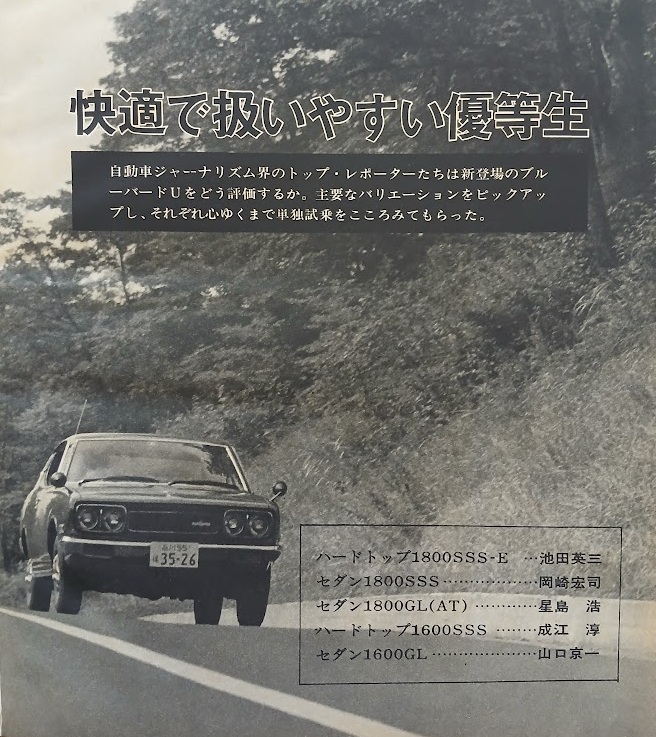
Nissan Bluebird U 1800SSS-E Hardtop (1971)
Publication: Motor Fan
Format: Test Drive Report
Date: October 1971
Author: Eizo Ikeda
Sharp Response and Good Fuel Economy
Contrary to the rather intimidating image suggested by its fuel-injection mechanism, this is a “Super Sport” model that is easy for anyone to handle.
The Elevated Image of the Bluebird
When I discovered that the new Bluebird U lineup included both a hardtop coupe and a model equipped with electronically controlled fuel injection, these two new elements immediately captured my interest.
Naturally, for the Bluebird series–long regarded as a representative family car–it is the more conventional models, both mechanically and in body style, that will attract the greatest interest from buyers. However, for those who harbor even a slight admiration for sporting cars, yet still require the practicality demanded by everyday use, the 1800SSS-E is certainly worthy of attention. With such users in mind, not to mention my own personal curiosity, I set out on a 300km test drive.
My first impression of the “U” Bluebird was that it had altered the familiar image of the Bluebird as a compact, maneuverable car–an image established since the old 210 and 310 series. Perhaps this was partly because I myself owned a 210, 310, and even a 410, and still retained memories of the days when the Bluebird was small yet notably quick on its feet. Then again, even after the Sunny effectively inherited that size category, the lingering impression over the past several years had been that the 510 Bluebird looked comparatively small among contemporary cars. That preconception may also have shaped my reaction.
In any case, there is no doubt that the U series represents a class above the traditional concept of the Bluebird.
And now, this “senior” Bluebird–or perhaps one should say new-generation Bluebird–has finally gained a hardtop coupe model, albeit somewhat belatedly. This follows a worldwide trend, of course, but because the previous 510 series never received such a body style, this is surely a model Bluebird enthusiasts have long waited for. Even as rival manufacturers steadily introduced hardtops, the previous Bluebird coupe retained what was, in effect, two-door sedan styling. For that reason, this “late arrival of spring” will likely create an even greater response than the appearance of the hardtop Cedric and Gloria. After all, many Bluebird buyers had been seeking a car with a greater sense of openness than a two-door sedan could provide…
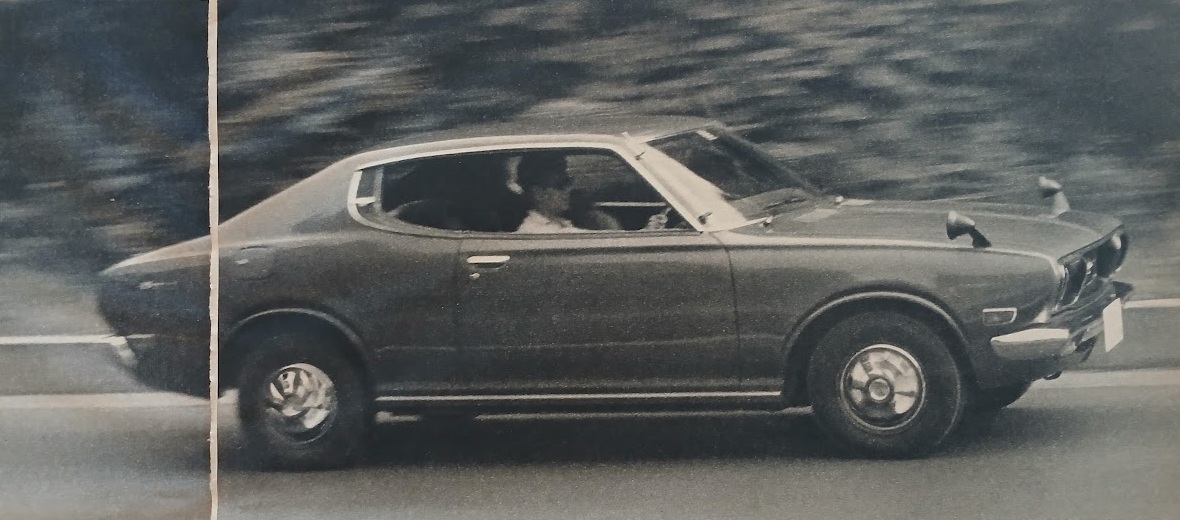
The U series has grown in size compared with the previous Bluebird, with the wheelbase extended by 80mm and the body lengthened by roughly 10cm. Yet both changes seem almost entirely directed toward accommodating the hardtop styling.
By moving the front wheels 30mm farther forward, Nissan adopted the fashionable long-nose proportion, while shifting the cabin rearward to create an overall short-deck appearance.
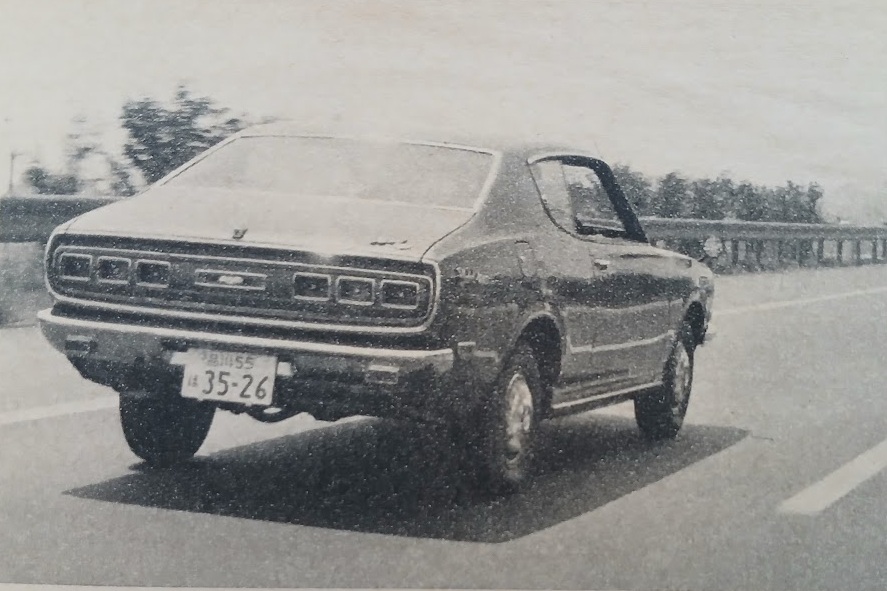
As can be seen in the photographs, when the old and new models are lined up side-by-side, the driving position in the new car sits noticeably farther rearward. The tail also appears slightly raised, although in reality the overall height remains essentially unchanged. This impression is probably created by the higher bumper position together with the prominent J-shaped trim applied to the “eye”-like window line reminiscent of the Fairlady Z, both of which visually emphasize the raised rear stance.
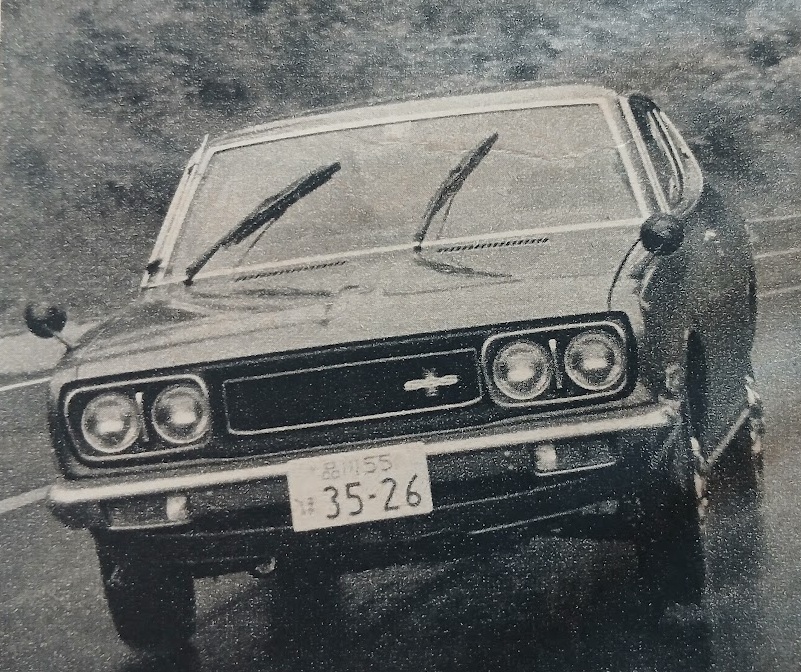
During the test drive, I found that people generally did not notice this newly released car–introduced only two days earlier–until they were fairly close to it. On the black-finished SSS model, in particular, the J-line trim was not especially conspicuous. This styling, then, seems to be something the general public will accept quite naturally. In fact, when I happened to encounter another example of the same model during the drive, the most noticeable feature was precisely that chrome J-line trim.
In other words, there are no eccentric styling elements likely to trouble prospective buyers, making this a car that people will probably feel comfortable deciding upon quickly. At the same time, it is not as restrained or understated as previous Bluebirds tended to be.
Essential Requirements for a Hardtop
As for the question of cabin accommodation in the hardtop, it is about what one would expect for this class in practical terms, with no need to dwell on specific dimensions. However, as a result of the long-nose layout, the driver is now able to stretch out his legs more fully, something younger drivers will likely appreciate.
Another welcome improvement, particularly for taller drivers, is the addition of height adjustment for the driver’s seat.
In addition, the steering wheel–now given a leather-wrapped appearance–has had both its height and angle revised, allowing for a more relaxed driving position. Thus, as with other hardtops, there is no question that priority has been given to the front seats, but one especially senses a considerable degree of attention devoted to the driver–presumably the owner.
Because this was the top-grade model, the test car came almost fully equipped with accessories. Among the smaller details, what left the strongest impression was the arrangement of the power-window switches and the fact that the driver’s-side switch was noticeably longer than the others. Since this is naturally the window operated most often, being able to identify and use it by feel alone–such as at expressway toll booths–is genuinely convenient. It was one of those ideas that makes one wonder why nobody had thought of it before; only after trying it did I fully appreciate how clever it was.
Another point worth mentioning is the airtightness of the windows, an important consideration in a hardtop. Perhaps partly because of the power windows, a faint whistling noise from the gaps around the frameless glass became noticeable from around 80km/h upward with the windows fully closed. Closing the vents and lowering cabin pressure eliminated the sound. That said, even at 100km/h on the highway, the curved side glass (200R) could still be raised and lowered freely, without any tendency to be pulled outward by airflow and refuse to shut.
Particularly noteworthy was the fact that even with all four windows fully open, there was remarkably little unpleasant pressure pulsation or buffeting inside the cabin.
For anyone wishing to enjoy the open, airy feeling that is a key attraction of a hardtop–without relying on air conditioning–this is an extremely important quality. Thanks to that, even in oppressive 34°C heat, I was able to switch off the forced ventilation and enjoy fresh air with all the windows open.
Good visibility is one of the essential qualities of a safe car, and despite the adoption of the long-nose styling, forward visibility has hardly suffered. However, because of the rounded quarter pillars, rear three-quarter visibility is somewhat less easy to judge than in the previous coupe.
Electronically Controlled Fuel Injection
Rumors had circulated even before the car’s announcement that fuel injection would be fitted to the Bluebird. What ultimately appeared, however, was not the sort of experimental technology often discussed at the Tokyo Motor Show, but an actual Bosch system from West Germany. Moreover, it was introduced not as an optional extra, but as a distinct model in its own right: the 1800SSS-E (“Electronic Controlled Fuel Injection”).
This system had already entered production use on cars from Volkswagen, Porsche, Volvo, and Mercedes-Benz. In place of the SU-type twin carburetors fitted to previous SSS models, fuel is injected directly into the manifold in order to improve performance.
Like mechanical injection systems, this one benefits from the absence of the airflow restrictions inherent in carburetors, allowing intake resistance to be reduced. With electronic control in particular, however, various sensors convert engine load (intake manifold pressure), engine speed, coolant temperature, intake-air temperature, throttle opening, and other conditions into electrical signals, enabling the precise amount of fuel to be injected at all times. This precision surpasses the transient characteristics of a carburetor, improving output from low to high speeds while also reducing waste, with corresponding benefits for fuel economy. In actual testing during this drive–including second-gear climbing on the ascent of Mount Fuji–the car recorded 10.3km/l.
As for the system itself, in addition to the sensors already mentioned, there is a control box beneath the passenger seat–a simple form of computer. Since such equipment is vulnerable to heat and humidity, the engine compartment is an unsuitable location; placing it beneath the seat is a rather ingenious use of space. Signals from this unit control injectors mounted on the manifold, which spray gasoline supplied by a pump.
Fuel therefore circulates continuously through a valve regulated to maintain pressure at 2kg/cm², with the quantity controlled by injecting it at the appropriate timing and for the appropriate duration.
Apart from its principles or construction, electronic fuel injection has generally been regarded as difficult to make fully reliable as a commercial product. In the case of the Bluebird U, however, the German-made components have been adopted essentially as-is, though some local production has already begun under partnership arrangements.
Speaking for myself, I currently drive a car equipped with mechanical fuel injection, so based on my previous experience with imported cars, I was particularly interested to see how different this system would feel compared with the SU-carbureted SSS.
A casual test drive would not be enough to reveal the car’s character, so I set out from Tokyo in stifling 34°C heat and drove all the way to the fifth station of Mount Fuji on the Omote-Fuji route, at an elevation of 2,450m and a temperature of 18°C , attempting to expose the system to as many natural conditions as possible. I hoped this might reveal how effectively the electronic controls responded regardless of ambient temperature, coolant temperature, climbing load, or engine speed. (With carburetors, output generally falls off at higher elevations because of reduced atmospheric pressure.)
To begin with starting performance: provided idle airflow has been properly adjusted, the cold-start valve–which serves the role of a choke–allows the engine to start without any throttle input. However, as with mechanical injection systems, there is a slight delay before ignition, since the system must first draw in air and calculate the required fuel quantity. The same tendency was observed both after the car had been left sitting under the blazing sun and in the cold air at Fuji’s fifth station. It is said, however, that even at -20°C , starting performance remains excellent.
The next trait worth noting is the response of the accelerator pedal, which is markedly quicker not only than with the SU setup, but even compared with Weber-equipped systems. Rather than the sort of follow-up response associated with an accelerator pump, the impression is that the moment the pedal is moved, acceleration is felt immediately. This characteristic reveals itself not only in sporting driving, but in everyday use as well, once the driver becomes accustomed to the feel.
However, due to the nature of the engine, on steep climbs under heavy load, excessive throttle input can have the opposite effect. Although the correct mixture is presumably being maintained, there is a sense of having to wait for acceleration to arrive. Even so, the car will continue to pick up speed gradually even below 1500rpm. In keeping with the engine’s natural character, though, it is around 3000rpm that its hidden strength seems to comes most vividly to life.
Beyond these points, there is little else that especially needs to be said about the injection system.
In other words, the fact that no particular abnormal behavior appeared under a wide range of conditions (including heavy traffic) simply means that the computer system was functioning exactly as intended.
There were no instances of abnormal stalling or the like, although compared with German systems there was a slightly “stepped” feel when cruising in first gear during light throttle modulation. This may have been due to slack in the throttle linkage. (The linkage in this particular test car had a somewhat sluggish return action…)
With that, the impressions from this test drive–focused as they were on the two points of the hardtop and fuel injection–are essentially complete. However, another factor in the car’s altered character is its handling.
In general terms, the extended wheelbase aids straight-line stability, resulting in a car that requires more deliberate steering input in corners. Even with the suspension itself unchanged, this is a direction that is safer for the average driver, and the pronounced understeer means the steering always maintains a steady, predictable feel.
In this respect, it does feel different from the traditional “Super Sport” character of the SSS. However, since its absolute cornering ability is high, it seems that the tires (BS20 radial 165S13) are being outmatched by the engine’s performance.
As an overall impression after the test drive, the price of 944,000 yen (Tokyo showroom price) for this “Super Sports” model can be considered justified. For users expecting a sporting character, it delivers performance that is above standard for the 1.8-liter class.
On the other hand, if the car is purchased as an everyday vehicle, it is worth emphasizing that, contrary to the rather imposing image of electronic fuel injection, it offers fewer internal losses and better fuel economy than the SU system, as well as easier day-to-day operation. A sports car with “10km/l” economy would more than make up for the 60,000-yen premium over the SSS-L. In this sense, the SSS-E is a car that offers a higher degree of practicality than previous versions.
Postscript: Story Photos