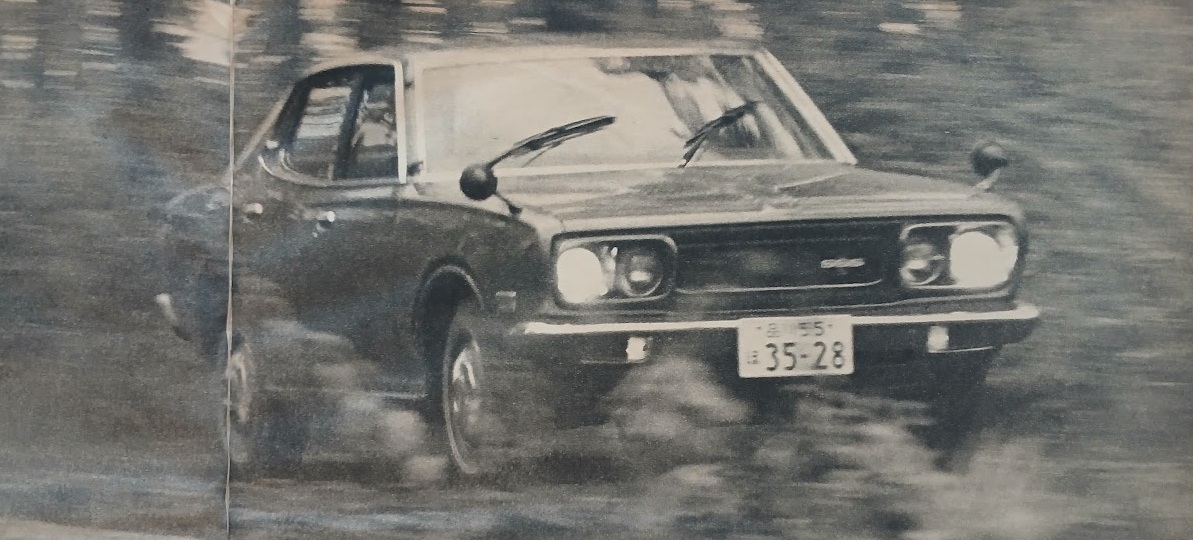
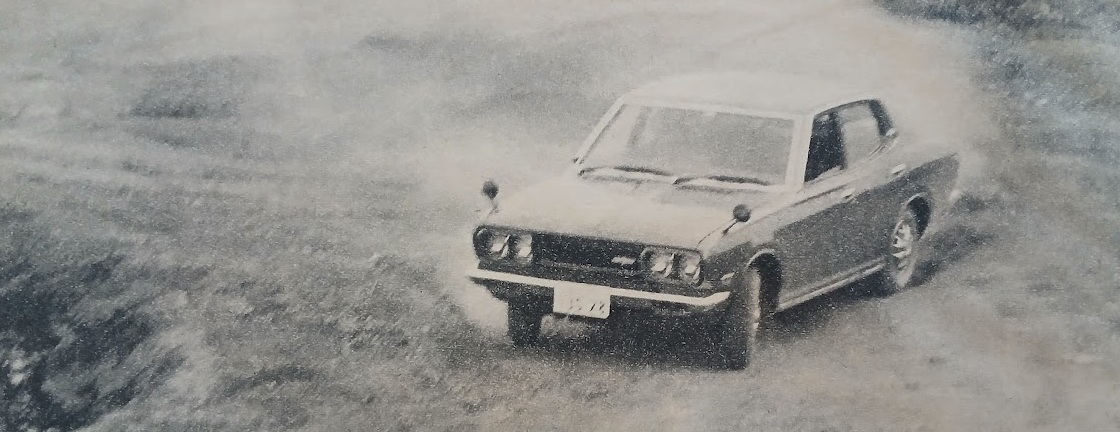
Nissan Bluebird U 1800SSS (1971)
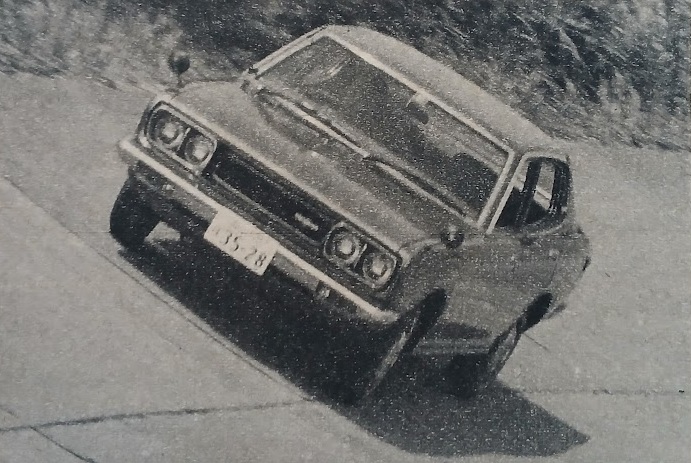
Publication: Motor Fan
Format: Test Drive Report
Date: October 1971
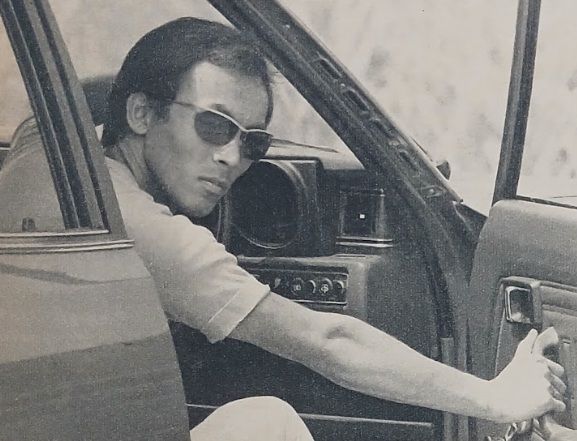
Author: Hiroshi Okazaki
Feeling Closer to the Mid-Size Class
There are shortcomings in brake fade resistance and general quietness, but overall this is a car with few vices or peculiarities. In terms of presence and character, it feels a considerable step above the 510 series.
A Broadly Targeted “Flavor”
Before getting into the actual test drive report, I will first share my own attempt at an analysis of this car from external, visible factors. In doing so, I will outline what I would call the “panel characteristics” of the Sedan 1800SSS’s intended audience. In deriving these characteristics, I have naturally also taken economic considerations into account.
-
The target user group is centered on the age range from the thirties through the early forties, while also extending fairly broadly on either side of that bracket. Within that range, particular attention is given to younger users who, while requiring parental financial support and effectively sharing the car within the household, in practice use it almost entirely on their own.
-
The intended user’s personality can be described as one with broadly average tastes and sensibilities. They are, to a degree, enthusiastic about cars–but are certainly not the specialist or “fan” type–and at the same time have a mildly self-conscious, moderately stylish disposition.
-
Although it carries the SSS name, which suggests a “hot” or sporty character, the actual positioning is one of broad general usability. It is aimed at the family car segment for households consisting of three to four adults plus children.
This is a very rough categorization, but the rest of this report is written with these characteristics in mind, and will describe impressions of the Sedan 1800SSS accordingly.
Rather than attempting to evaluate the visual design aspects–which I will leave to the reader’s own judgment–I would like to begin with the functional qualities of the interior.
The instrument panel is one aspect that is sure to satisfy the user both in terms of visual richness and functionality.
Gauge visibility is good, with thorough anti-glare measures. The reach to the various switches is also well-judged. In addition, their layout reflects careful consideration not only of frequency of use, but also of the degree to which each control is related to driving safety.
The individual front seats are, of course, fully reclining, with ample fore-and-aft slide adjustment. There is even a mechanism that allows the cushion angle to be adjusted in four stages.
Unfortunately, however, for drivers of average build (particularly those in the 30-40 age group), even when the cushion is set to its flattest angle, noticeable pressure is felt under the thighs while pressing the clutch.
Only drivers of around 170cm or taller, or those who sit with the seat adjusted further forward, can maintain a driving position with their legs and arms extended without experiencing undue pressure under the thighs.
Given constraints such as forward visibility, it would likely be difficult to lower the seat cushion any further. As such, the problem seems better addressed through a redesign of the front edge of the cushion itself.
Aside from this point, there are no particular shortcomings to note in either the seat construction or the driving position.
Rear-seat comfort is also good. There is ample space, and the seat itself is well designed. If there is one request, it would be a slightly greater sense of support when reclining against the seatback–but that is a minor point of refinement.
In many small cars, the shape of the front seats or headrests can significantly reduce rear passengers’ perception of comfort, but in this respect as well, there is nothing to criticize.
Forward visibility presents no problems, but rearward visibility is a concern. The vertical height of the rear window is not entirely sufficient for good visibility, and combined with the wide rear pillars, this creates significant blind spots and makes reversing quite difficult.
When children are playing behind the car, there is a relatively large area in which they cannot be seen, so considerable caution is required. The interior layout does at least make it reasonably easy for the driver to turn around and look backward—but that alone is not enough to offset the limited rear visibility…
Engine Is Mid– to Low-Speed Oriented
The engine in this model is the same L18 unit used in the earlier 510 Bluebird. It is fitted with twin SU carburetors, and produces a maximum output of 115ps/6000rpm and a peak torque of 15.5kgm/4000rpm.
This engine has good low- to mid-speed characteristics, but its performance is not very impressive at high engine speeds. It takes on a rough character from around 4500rpm upward, with a noticeable increase in vibration and noise, while throttle response also loses its sharpness.
Although the redline is marked at 7000rpm, it requires a fair amount of determination to actually push it that far, given the noise and vibration.
The range in which it can be revved without undue strain is up to around 5000rpm. One wonders whether the issue lies in crankshaft balancing or perhaps in engine mounting.
Another source of discomfort is the vibration and sound that occur when the accelerator is lifted at high rpm (possibly residual pressure pulsation in the exhaust system). Some low-frequency resonance is also noticeable in the cabin, and it feels as though improvements in the rigidity of the floorpan and overall body structure could have raised the refinement level further.
The transmission, like the engine, is carried over from the 510 series. However, the extension housing has been lengthened, and the shift lever position moved significantly rearward. This has allowed the lever itself to be shortened, and the throw length reduced, lending a sportier and more direct feel to shifting. Engagements have also become more positive. On the other hand, shift effort is somewhat on the heavy side.
The relatively high overall gear ratios remain unchanged.
As noted earlier, the engine is not particularly willing to be revved beyond 5000rpm, but this disadvantage is largely offset by the tall gearing and the engine’s strong low- and mid-range torque characteristics.
At 5000rpm, vehicle speed is approximately 42km/h in first gear, 72km/h in second, and around 110km/h in third. So, even without exceeding this engine speed, acceleration is more than adequate.
Furthermore, in highway cruising between 100-120km/h–the most common speeds in general traffic–fourth gear corresponds to only 3300-4000rpm, meaning there is still a comfortable margin before reaching the range where vibration and noise become intrusive.
In that sense, there will likely be few occasions in everyday use where this characteristic becomes seriously dissatisfying. Still, it is clearly an area that calls for improvement.
Neutral Handling Characteristics with Few Quirks
The suspension uses a front strut and rear semi-trailing arm layout. Its basic architecture follows that of the 510 series, but most of the individual components have been revised. As a result, there is relatively little parts interchangeability with the 510. In addition, due to the increased track width, a front stabilizer bar has been fitted.
On the road, the first clearly noticeable difference from the 510 is the improved noise and vibration isolation from the suspension and wheel assemblies. The test car was fitted with Yokohama 6.45S-13 tubeless tires, and at the city driving recommended pressure of 1.6kg/cm², noise and vibration from minor surface irregularities and road joints are almost entirely absorbed. On typical paved roads, the ride quality is very comfortable.
Ride comfort over larger surface undulations has also improved. Taking into account the longer wheelbase and track, as well as the improved seat comfort, one could say that the already well-regarded ride of the 510 series has been further refined.
Stability has, as expected, also improved over the 510.
The handling shows a mild but definite tendency toward understeer, while beyond the so-called reverse point it transitions into oversteer, exhibiting what can be described as reverse-steer characteristics. However, this transition into oversteer is relatively gradual, and even up to the point of approaching a spin there remains a reasonable margin of control.
Accordingly, on high-friction surfaces, the car is unlikely to enter a spin unless driven with extreme carelessness. On low-friction surfaces, however, the reverse-steer behavior becomes more pronounced, so caution is required. That said, countersteer response is not poor, and for a skilled driver the car remains controllable even in such conditions.
Yaw response (the tendency of the car to rotate into a corner) is also good. In situations such as entering a corner at excessive speed and suddenly lifting off the throttle, the car seems to maintain a relatively high level of stability.
Changes in steering effort, including the effort required to maintain steering angle through a corner, are stable and predictable.
Overall, it is fair to describe the car’s handling character as easy to manage, with few quirks.
Stability is also at a solid level. The pronounced side-to-side oscillation that could be felt in the 510 series when making high-speed steering inputs has been almost entirely eliminated.
High-speed slalom behavior is likewise good. Changes in trajectory in response to steering inputs is natural and predictable, with little sense of unease.
Compared with the 510 series, both front-end response and rear-end tracking behavior have clearly been improved.
The 6.45S-13 tubeless tires provide cornering performance that, within a normal speed range, is generally more than adequate. However, with the tire pressures set to the city-driving specification of 1.6kg/cm² (front and rear), a certain degree of sidewall softness or “squirm” becomes noticeable.
For users who regularly maintain higher cruising speeds, it is recommended to use the high-speed setting of 2kg/cm² even in everyday driving. Even at 2kg/cm², there is very little concern that ride comfort or noise levels will deteriorate significantly.
Rough-road capability is also improved. However, one wonders whether there may be some minor shortcoming in damping control or rigidity, as the rear wheels exhibited a slight hopping similar to axle tramp (a kind of foot-stamping sensation) several times during the test drive.
Steering system friction appears to be slightly higher than that of the 510 series. This has the effect of giving the steering somewhat more weight at higher speeds, which can be considered beneficial in terms of feel. At the same time, no particular negative effect could be felt in terms of steering return or self-centering behavior.
The brakes are a servo-assisted disc/drum setup with a PCV system.
In normal driving, the servo assistance is well judged and the brakes are easy to use. However, for reasons that are not entirely clear, fade resistance is unusually poor. Under full deceleration from 100km/h, brake fade sets in immediately, accompanied by heavy smoke from the linings. Even on mountain descents, relatively light repeated use quickly leads to fade.
Since the braking system itself is said to be the same as that of the 510 series, it is possible that the addition of PCV, improvements in tire performance, and changes in load transfer characteristics have all combined to reduce the effective safety margin compared with the 510. Whatever the cause, this is clearly an area requiring prompt attention.
The test covered approximately 350km altogether, and the conclusion reached through this evaluation is that the “panel characteristics” of the car, as assessed from its outward appearance, are largely consistent with its actual behavior.
In terms of perceived size and overall presence, the car is clearly a step above the 510 series, and in many respects it gives an impression closer to that of a mid-size vehicle.
However, as has been mentioned repeatedly, quietness is one area where it fails to reach this level. Part of this may be a perceptual effect caused by the car’s more upscale visual presence, but in absolute terms it cannot be said to offer above-average levels of noise suppression. Sound transmission from the rear of the car, particularly through the trunk area, is relatively pronounced.
While there are several points of dissatisfaction, fundamentally this is a vehicle with strong product merit, and it has more than enough appeal to attract a wide range of users.
Postscript: Story Photos