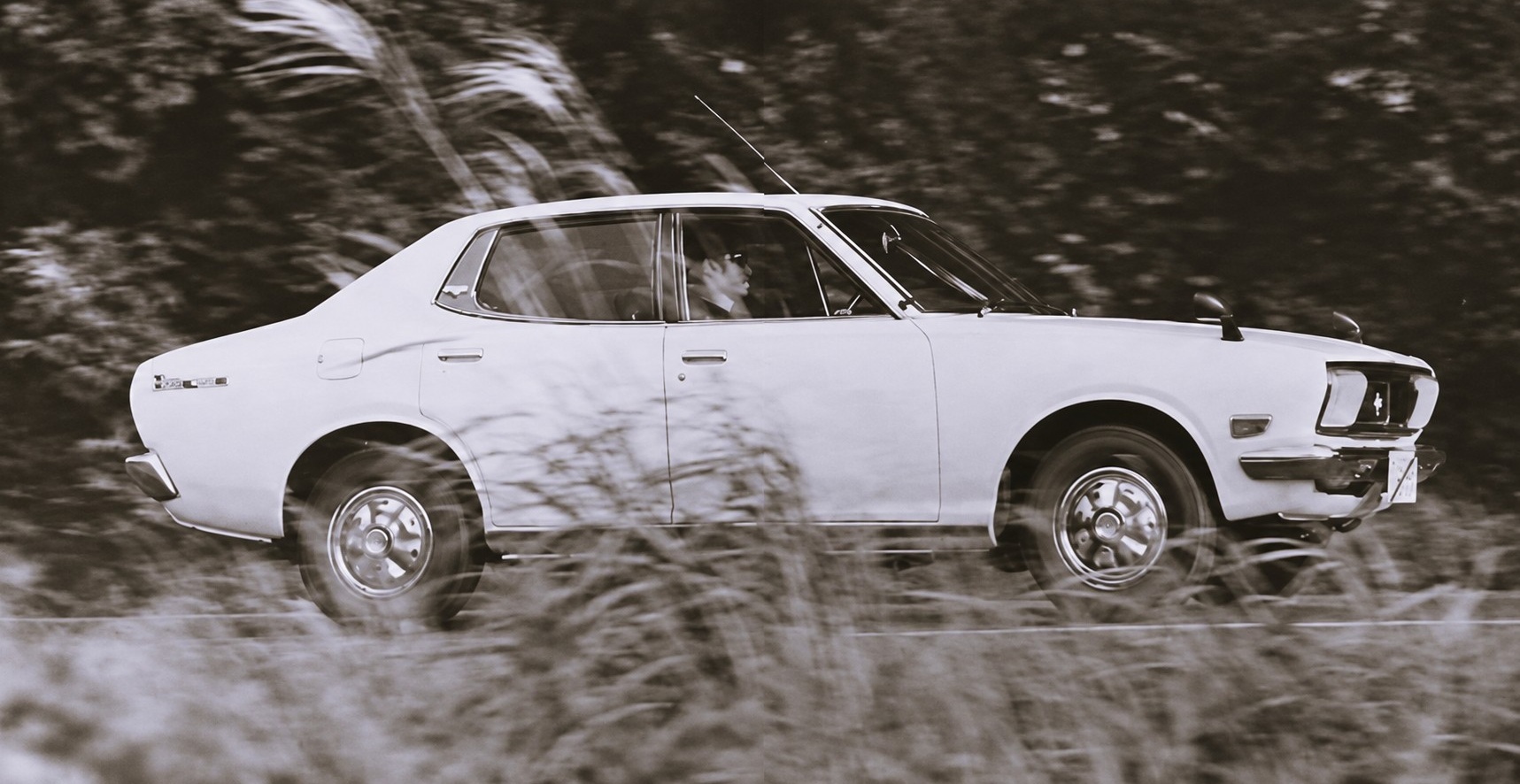
Nissan Bluebird U 1600SSS-E (1972)
Publication: Motor Fan
Format: Test Drive Report
Date: November 1972
Author: Kyoichi Yamaguchi
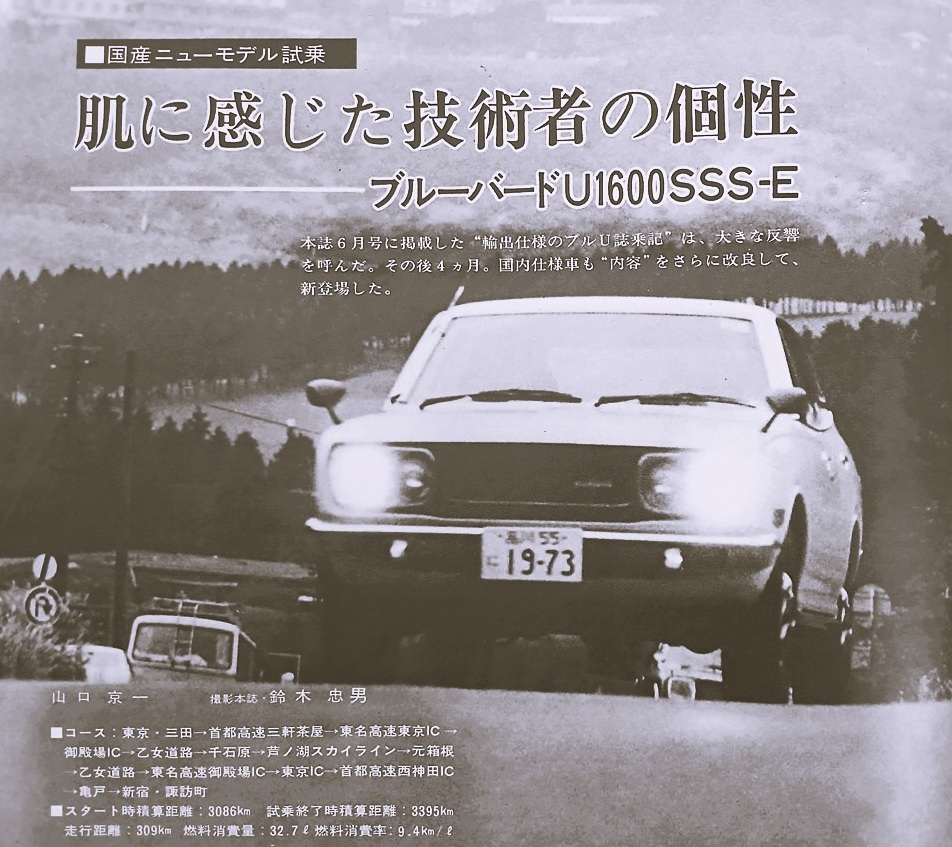
The Engineers’ Individuality Is Clearly Felt
Our road impression of the “export-spec Bluebird U,” published in the June issue, drew quite a response. Four months have passed since then. Now the domestic model has appeared with further improvements where they really count.
Firmly Tuned Suspension
“Shouldn’t we Japanese owners also demand a car that we can confidently take into the high-speed lane of the Autobahn…?”
That was how I concluded my road impression of the Bluebird U 1600SSS with export-specification suspension in the June issue of Motor Fan, and this report might well be regarded as a continuation of that one.
To begin with, I am told that a number of Japanese owners did, in fact, ask Nissan for a Bluebird U with such a suspension. Their requests apparently made their way through Nissan’s Service Department to Noboru Ota, Deputy General Manager of the No. 1 Vehicle Design Department, who “owned” the car I had driven. Perhaps, even when he kindly allowed me to test that car, Mr. Ota already had it in the back of his mind that a U with the same suspension specification would soon be offered on the domestic market. But I would like to think that the voices of the owners who use and appreciate the Bluebird U reached the designers who created it, and helped, to some degree, to move a major manufacturer to act.
A little more than a year after its introduction, the Bluebird U has received several functionally significant improvements, while new models have also been added to the range. This so-called “minor change”—a completely inappropriate expression, I think—was of particular interest to me. The “heavy-duty suspension” now standard on SSS models equipped with the 5-speed gearbox is nothing less than the suspension used on the European-market Datsun 160/180B. The addition of an E version of the 1600SSS, fitted with Bosch electronically controlled fuel injection, and the appearance of E-specification sedans in both 1800 and 1600 form, are also very welcome additions to the range.
In discussing the export-specification car in the June issue, I explained the degree of suspension stiffening using a ratio relative to the standard domestic model. I have since obtained the actual figures for the spring rates and damper forces, so I shall give them here:
| Specification | Standard suspension | Heavy-duty suspension | (Increase) |
|---|---|---|---|
| Front wheel spring rate kg/mm | 1.4 | 2.08 | ~1.4× |
| Damping force (rebound) @0.3m/sec | 40 | 80 | ~2× |
| Damping force (compression) @0.3m/sec | 25 | 40 | |
| Rear wheel spring constant kg/mm | 6.56 | 7.82 | ~1.2× |
| Damping force (rebound) @0.3m/sec | 45 | 66 | ~1.5× |
| Damping force (compression) @0.3m/sec | 28 | 42 |
14-inch wheels have also been adopted throughout the Bluebird U range. Even in terms of appearance, these are an improvement. Rim width remains 4.5J. This time I drove three cars: two 5-speed 1600SSS-Es, a hardtop and a sedan, along with an automatic 1800SSS for comparison. The first car was the 1600SSS-E hardtop, fitted with the standard 6.45S-14 cross-ply tires, Toyos in this case. The only model fitted with radials as standard is the 1800SSS-E, and since these are 165/SR-14s, their width is unchanged.
I drove the 1600SSS-E on ordinary city streets and in a deserted parking area with a fairly rough paved surface to check the handling, covering the low- to medium-speed range. The tire pressures, as the car was delivered to us, were rather high at 2.2kg/cm². For normal use, they should probably be reduced to below 2kg/cm². Even so, driving in Tokyo confirmed once again that this European-specification suspension is by no means too firm for Japan. When I first drove it this spring on the rough roads of the industrial area around Nissan’s No. 1 Vehicle Design Department, I was similarly surprised that it was not as hard as I had expected from the increases in spring rate and damper force.
Of course, a damper’s characteristics cannot be expressed by a single figure such as its damping force at 0.3m/sec, and I suspect that this is where much of the development team’s painstaking work is hidden. The Bluebird U’s heavy-duty suspension is firm—or “well controlled,” to put it another way—but it is not hard. It may carry the SSS name, but the Bluebird U should not be the sort of “boy racer” that bounces around on rock-hard suspension.
What the engineers who developed the European specification were aiming for, I think, was a car capable of covering long distances—including expressways and twisting mountain roads—comfortably, safely, and quickly: in BMW or Alfa terminology, a “TI”, or Turismo Internazionale.
The Bluebird U with standard suspension displays fairly pronounced understeer. With the heavy-duty suspension, this is brought to a very agreeable, near-neutral balance. I am told that the steering mechanism itself is completely unchanged, but the heavy-duty suspension has markedly improved the steering response. This was a second pleasant surprise. With its tires inflated to 2.2kg/cm², the handling of the 1600SSS-E was such that, through a series of tight bends, this car—with its none-too-generous sideways visibility and relatively low seating position—almost gives the illusion of having shrunk by one size.
I switched directly from the 1600SSS-E into the 1800SSS-L automatic provided for comparison, and the contrast in ride and handling was stark. I was pulled straight back into the world of the luxury hardtop, where everything in the original car feels soft and indirect. Certainly, the ride is markedly softer. Perhaps because I had just experienced the excellent settling characteristics of the heavy-duty suspension, the tail showed a pronounced residual oscillation through S-bends. And the steering still had that play around the straight-ahead so often described as “Japanese vagueness.”
Thus, the heavy-duty suspension has succeeded in achieving an excellent balance between handling and ride comfort. I do not think it would be wise to pursue even higher performance by making the mechanical components any stiffer. Rather, I felt that attention should now be turned to the advances made in tires. The S-rated tires, which gave precise response at the high pressure of 2.2kg/cm², began to reveal the limitations of their bias-ply construction when lowered to less than 2.0kg/cm².
A Second 1600SSS-E
I therefore asked the manufacturer to prepare another 1600SSS-E. I myself have a rather conservative (?) preference for sedans, and since the sedan was also a new addition to the U series, I went so far as to specify a four-door sedan with an engine that was thoroughly run in for expressway and mountain-road driving.
A few days later, a Cherry White sedan arrived exactly as requested. The odometer showed 3,086km. I fitted this car with Bridgestone RD102 Wide 185/70HR-14s. Naturally, these are not listed in the catalog even as an option, but they can be fitted without interfering with the bodywork at all. One word of caution, however: tire chains will not fit. The wheels were the standard 4.5J rims, though ideally a 5J rim would be preferable. On the round trip from Tokyo to Gotemba on the Tomei Expressway, I tried pressures of 1.8kg/cm² and 2.0kg/cm², in both cases measured with the tires cold, but could detect no great difference.
These wide radials give a very comfortable ride. I did notice a certain dullness in the steering response just away from the straight-ahead, but, like the softness of the ride, might this not be influenced by the rim width?
I should make it clear that I am no fan of wide tires. I believe that choosing tires appropriate to the car’s power is what produces the best handling and roadholding. For a car of the 1600SSS-E’s size and power, the catalog-specified 165/SR-14 should be quite sufficient, as far as size is concerned. I must add that qualification—“as far as size is concerned”—because most of the 165-width “standard” radials fitted to Japanese cars do not offer particularly remarkable capabilities. That is why I made the leap directly to the newer, and naturally better, 185/70 profile.
Even at parking speeds, the steering did not become as heavy as I expected. On a winding hillclimb with one hairpin after another, however, there was a sense of resistance, as though dragging enormous blocks of rubber along the road. The grip of the wide radials absorbs the driving force. The actual climbing speed is relatively high, and the cornering power is considerable, but there is a certain ponderousness about it. Looked at another way, however, the fact that the tires can absorb power that, depending on the driver’s skill, may be somewhat excessive could also contribute to safety.
During the test, at the photographer’s request, I drove back and forth through the same corner five or six times. To build up cornering speed in the short stretch available, I repeatedly made high-rpm standing starts. Under these hard starts, the grip of the tires placed a severe load on the clutch, which then slipped quite badly for some time.
Medium-speed corners, with the car already carrying some speed, are where the neutral handling and high cornering power of the tires really come into their own. Stability through gentle bends like those on expressways is also extremely good. With the wide 70-series tires fitted, the 1600SSS-E is more “TI” than hill-climber.
It should also be noted that, compared with the 6.45S-14 tires, the speedometer becomes much more optimistic. At a true 125km/h on the test course, it read 140km/h.
As for my own conclusions on the best match between the Bluebird U’s heavy-duty suspension and its tires, I would ask you to wait another two or three months. The next time I go to Europe, I plan to get a set of the quite “ordinary” radials worn by the genuine TIs there—for example, Uniroyal 180s, Metzeler Monzas, Continentals, or Pirelli CN36s—and then try the SSS-E again.
Another important improvement to the U’s chassis concerns the brakes. After driving an early GL, I came away feeling that brake fade was the car’s Achilles’ heel. With this latest “substantial” minor change, pads with greater fade resistance have been adopted, and the servo has been increased in size from 4.5 to 6 inches—probably in part to offset the resulting increase in effort. I tried repeated hard stops from high speed in the 1800SSS-L, as well as a mountain descent in the 1600SSS-E, and neither produced any noticeable fade.
The brakes of the 1800 and the 1600 hardtop, however—both of which had only two-digit odometer readings when we started—felt quite spongy and indirect. Those of the 1600 sedan were not nearly so bad, so this may have been a matter of adjustment, or simply of the brakes having had time to bed in. The 1600 sedan did, however, show a tendency for the right rear wheel to lock prematurely under hard braking.
About the L16 Engine…
The L-series is one of the world’s major mass-produced engine families.
Four-cylinder versions are used in the Bluebird 510 and U, the Sunny Excellent, and the US-specification Datsun pickup, while the six-cylinder engine in the 240Z is essentially the 1.6-liter four with two cylinders added. The 2600 used in the Cedric/Gloria also “borrows” a great many components from the L-series four-cylinder parts bin. It performs well, and its greatest virtue is its robust, no-nonsense construction.
Of the two sizes used in the U, 1.6 and 1.8 liters, I personally would choose the 1.8 and its extra torque for an automatic, but the 1.6 for an SSS with manual transmission, where the engine can be used at higher revs. I therefore very much welcome the arrival of the 1600SSS-E and the Porsche-synchro 5-speed gearbox. With the lower mass of its pistons and connecting rods, the 1600 is one of the more pleasant-feeling units in the L family. The 5-speed makes effective use of its 115ps/6200rpm and 14.6kgm/4400rpm. The electronically controlled fuel-injection system should also improve low- and medium-speed torque while reducing fuel consumption.
Unfortunately, even in 1.6-liter form, the L can hardly be called an engine of outstanding quietness and smoothness. In the 1600SSS-E sedan, a resonance from the exhaust system appears at around 4000rpm and persists for some 500-600rpm. Beyond that, however, the engine can be taken to 6000rpm without concern. Grit your teeth and put in a pair of earplugs, and it would probably be physically possible to take it up to 7000rpm, where the red zone begins, but the torque characteristics of the fuel-injected engine make this unnecessary. In the 1800SSS-L automatic, this resonance appeared at around 3000rpm, and the noise level seemed higher as well. The 1600SSS-E sedan tested here had already received the measures intended to suppress body and chassis noise, and in this respect it was indeed very quiet.
The low level of noise from the transmission and driveline deserves particular praise.
The Bluebird U has made remarkable progress in its suspension and noise suppression. Next, I would like to see Nissan refine the feel of the engine. When that has been achieved, the Bluebird U will be a car with the legs and heart of a TI.
Fuel consumption was 9.1km/l over the 192.3km of expressway and mountain-road driving, and 10.1km/l over the 116.8km return journey on the Tomei and through Tokyo, for an average of 9.45km/l. Since this was hardly what one could call economy-run driving, I suspect that figure must be close to the worst one is likely to see.
The synchromesh of the 5-speed gearbox is very effective, and the gear spacing has been chosen appropriately. The spring resistance going into fifth is rather strong, however, and a deliberate effort is required to push the lever across the gate.
In its performance, handling, and passenger comfort, the 5-speed 1600SSS-E sedan is an exceptionally well-balanced car, and at 100,000 yen less than the equivalent 1800 model, it must be regarded as good value. Luxury equipment such as the cassette stereo and overhead console has been omitted, but of the features fitted to the 1800, the only one I missed was the height adjustment for the front edge of the seat.
What pleased me more than anything about the 1600SSS-E was that I could sense an “engineering personality” in the car.
Postscript: Story Photos