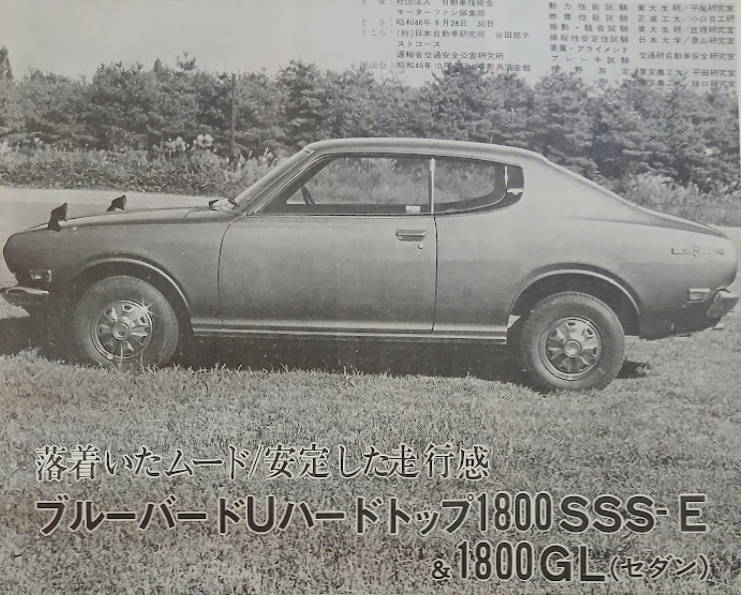
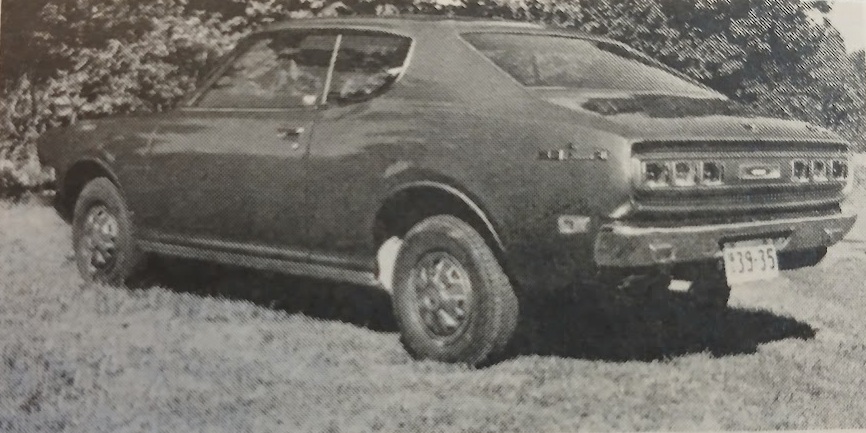
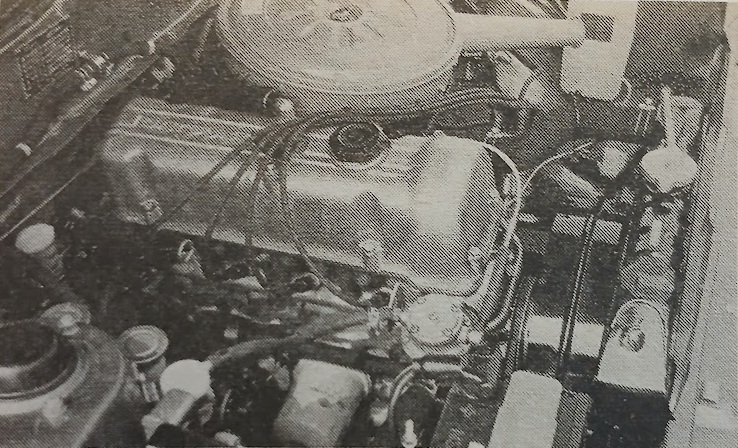
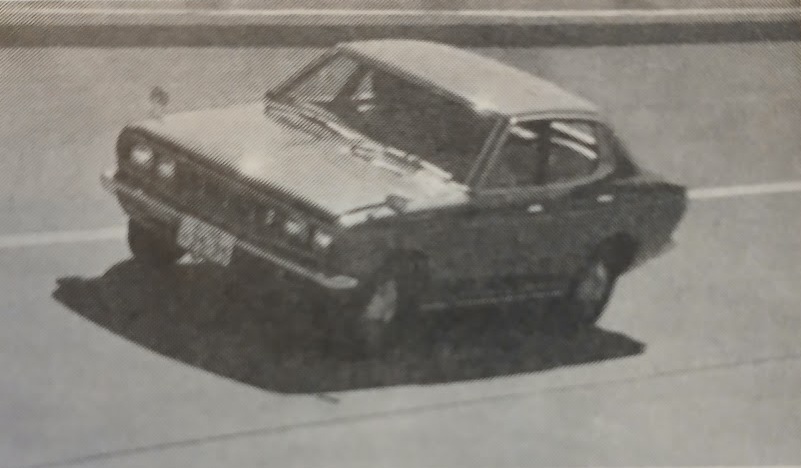
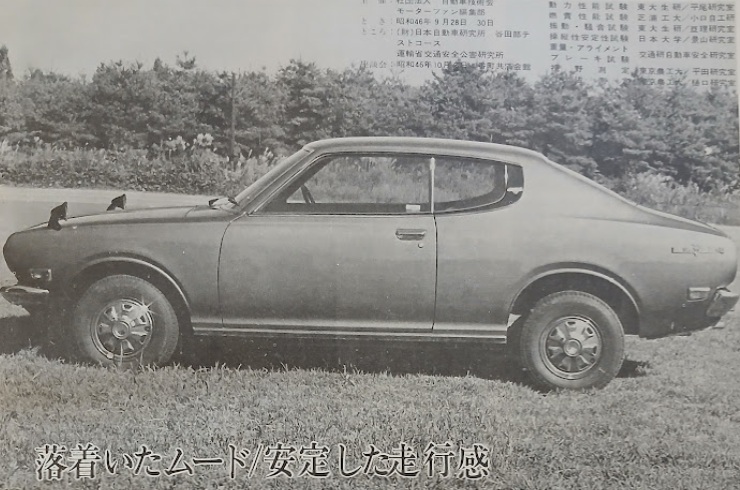
Nissan Bluebird U 1800SSS-E Hardtop and 1800GL (1971)
Publication: Motor Fan
Format: Road Test
Date: December 1971
Authors (Roundtable): Hajime Mizutsu, Osamu Hirao, Kenji Higuchi, Yasuhei Oguchi, Noboru Ohta, Hiroshi Hoshijima, Hiroshi Shimizu, Kenichi Otani, Kunitaka Furutani, Masahide Sano, Atsushi Watari, Taizo Tateishi, Katsuzo Kageyama, Kenzaburo Ishikawa, Yukio Miyamori, Toshihide Hirata, Minoru Onda, Yasunobu Tomizuka
Soft in Image, 510 at Heart
Magazine: Could you begin by giving us an overview of the Bluebird U?
Mizutsu: Recently, compact cars have become increasingly diverse in both specification and level of luxury. Our goal was to respond to that trend by establishing a broad model lineup with distinct individual character.
With the addition of the new “U” series to the existing Bluebird range, we’ve created a structure capable of covering a much wider span of market demand.
Since its launch in August 1959, the Bluebird has sold around two million units. Among them, the current 510 series–introduced in August 1967–has been very well received both in Japan and overseas.
Building on the proven reliability of the 510, we developed the U series with greater diversification and a more upmarket orientation in mind.
Our key development targets were:
- To build on functionality while pursuing greater appeal and richness in quality
- To meet market demand with a wide range of variants
- To further improve reliability
- To ensure safety
- To thoroughly pursue labor-saving design in production
In terms of size, the U is one class up from the 510. Overall length is 4215mm, 95mm longer; the wheelbase is 2500mm, 80mm longer; and width is 1600mm, 40mm wider. Height, however, is slightly lower at 1405mm. Vehicle weight has increased by about 30kg.
Stylistically, it adopts long-nose, short-deck proportions.
On the technical side, we’ve further improved performance, including upgrades to the 1.6-liter engine. In addition, we offer a 1.8-liter engine with electronic fuel injection, as well as a carbureted version of the same displacement.
The lineup is split so that the 510 continues with 1.4- and 1.6-liter engines, while the U series uses 1.6- and 1.8-liter units.
As for comfort, interior length has increased by about 80mm over the 510, and width by 45mm. Seat dimensions have also been expanded, with taller seatbacks and longer cushions, improving overall cabin comfort.
We’ve also improved the heater and air conditioning capacity, and some models are equipped with accessories such as an overhead console and a cassette-type car stereo.
Ride quality has benefited from the longer wheelbase, reducing pitching and improving overall comfort.
For driving performance, we placed particular emphasis on improving straight-line stability to make the car easier to drive. This was achieved through revisions to front suspension geometry and careful tuning of front-to-rear roll stiffness distribution.
In terms of production efficiency, we’ve reduced assembly labor by roughly 25-30% compared to the 510. As for safety, we’ve followed essentially the same philosophy as the 510.
Magazine: Compared to the current 510, the image of this “U” feels quite different. If the 510 is “hard-edged,” this one feels more “soft.” Yet they share the same Bluebird name–is that a branding decision?
Mizutsu: To be honest, abandoning the Bluebird name altogether would have been a major risk…
When we began planning, we studied how the 510 was perceived. One aim was to move away from its somewhat plain character, and also to create something that felt a bit more youthful, in line with current trends.
There’s also a price range aspect, and in terms of image, we felt we could cover a broader spectrum this way.
Hirao: You could think of “Bluebird” as the name of the class, and “U” as the actual name of the car. (laughs)
Higuchi: Looking at the history of the Bluebird, it tends to change drastically with each new model. But this time, the 510 is still being kept–that’s reassuring.
Mizutsu: Yes, when we spoke with dealers, there was still strong attachment–and demand–for the 510, so I think it was the right decision to keep it.
Higuchi: Nissan cars have generally had a sharp, crisp character. Meanwhile, other manufacturers tend toward softness. This U feels soft in appearance, but somewhat sharp in how it drives.
Hirao: In the past, Nissan cars didn’t seem to attract many female buyers. But I get the feeling this one might.
Oguchi: Looking at the Bluebird, you almost get a sense of the broader evolution of Japanese cars. Right now we’re in an era of image–of fashion, even–and this feels like quite a bold shift in that sense. It’s like part of a larger swing in direction. Though mechanically, the basic design still carries over.
Mizutsu: That’s exactly right. Functionally, it’s essentially the 510 underneath. We’ve simply changed the outer image.
The Inevitability of the “J-Line”
Magazine: When it comes to the styling, was the hardtop the primary design focus? Or was it more a case of turning the sedan into a hardtop?
Mizutsu: In fact, the design started with the hardtop. We created the hardtop first, and then developed the sedan from that. The overall front-to-rear balance was established with the hardtop, and the sedan was derived by changing the roof and rear sections.
Hirao: That’s really how it should be done. Buyers of hardtops tend to be more particular about styling. With sedans, you’re carrying passengers in the rear, so utility naturally takes priority.
Magazine: These days, most cars seem to follow that pattern. But in the past, it was often the other way around–start with a sedan, then create a hardtop as a variation.
Hirao: Which is why those hardtops sometimes felt a bit lacking as hardtops.
Ohta: Ideally, both the four-door sedan and the hardtop should be fully realized in their own right. But from a development standpoint, you inevitably get pulled toward one or the other. The question becomes: which direction should you start from to minimize compromise? In this case, we felt it was better to begin with the hardtop.
Magazine: The U’s design gives the impression of a somewhat darker cabin, as if the glass area has been reduced quite a bit.
Ohta: That’s partly a global trend—window areas have been getting smaller overall. But particularly for the rear seats, there’s also the idea that a more “enclosed” feeling reduces fatigue, provides a sense of security, and even conveys a sense of luxury.
Magazine: What about the rear quarter area on the hardtop? There’s quite a lot of sheet metal there.
Hirao: That’s a trend too, isn’t it? Though that area does seem quite large.
Oguchi: It certainly gives a sense of mass.
Higuchi: If you covered that rear quarter area in black vinyl right up to the edge, it might start to resemble an old carriage. Like what you see on some Lincolns… with a crest or emblem added on top…
Magazine: We understand that a “fashion scarf” can be attached to the J-line area. So you could choose one to your taste…
Higuchi: Change it like a necktie, to match your suit… that’s not a bad idea.
Hoshijima: The wide rear quarter pillars might help in a rollover from a safety standpoint. But from a driving perspective, I’m not entirely in favor of it. On a larger car it’s less of an issue, but on a compact car, it hurts visibility–especially rear three-quarter visibility. It might be fine in a wide-open place like America, but in Japan’s tighter conditions, it could be a drawback.
Oguchi: From the driver’s seat, I’d agree. Especially when parking.
Hoshijima: And to be a bit critical… without that J-line, the car’s shape might look incomplete. Which, in a way, suggests that it needs that element to look good.
Oguchi: But if adding it improves the look, that’s better than leaving it plain and unresolved. That area is quite flat otherwise—the accent changes the impression significantly. I imagine it wasn’t easy to resolve.
Hoshijima: Still, you don’t often see this kind of technique used on foreign cars to improve the styling.
Hirao: We once had a discussion about what a car body really is. Some said it’s information. Others said it’s armor, or a capsule. One woman said something interesting–she called it a costume.
And if you think of it as clothing, then of course you need accessories–a tie, a brooch. If you took away the accessories from what someone’s wearing, it would feel incomplete. In that sense, I think it’s perfectly fine if the car only “comes together” once the J-line is there.
Hoshijima: I see…
Hirao: If you start calling it sculpture, though, that invites a different kind of resistance.
Hoshijima: The hardtop does look visually larger, though.
Oguchi: The 510, by contrast, looks smaller than its actual dimensions.
Magazine: The wheel arch area curves slightly inward…
Mizutsu: That’s actually a first for us. The rear fender rises in a kind of Coke-bottle shape, which can make the rear look heavy. So we recessed that area to visually lighten it.
Magazine: The styling of the U feels quite similar to the Cedric/Gloria. Were they designed by the same person?
Mizutsu: The designers were different. But the timing was only about six months apart, so it’s difficult to completely separate the influence of what came before.
Ohta: It’s also a matter of the times. Designers are responding to the same environment and trends.
Hirao: And people around them probably end up saying similar things, too.
Cheap(?) Electronic Fuel Injection
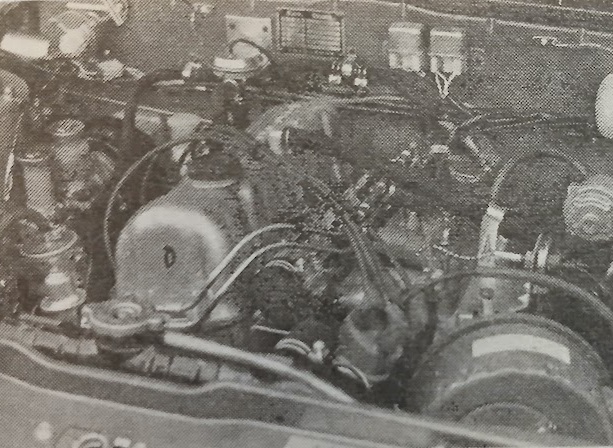
Magazine: The engine is shared with the 510 series, but now you’ve added an electronically controlled fuel-injection version.
Shimizu: From the customer’s point of view, power is something people are reluctant to give up. At the same time, we’re under pressure to address exhaust emissions. That’s the challenge we faced.
This was one way of reconciling those two requirements. With fuel injection, we can deliver the correct amount of fuel evenly to each cylinder under all operating conditions. As a result, not only does peak output improve, but low-speed torque as well–we’ve seen gains of about 5-10% in both.
At the same time, emissions are roughly 30-35% cleaner compared to a carbureted setup. And cleaner combustion translates directly into better efficiency. We’ve seen about a 5% improvement in fuel economy in normal driving, and around 10% at highway speeds.
What you notice most in actual use is how easily the engine starts, regardless of weather conditions. Even immediately after startup, sensors monitor intake air temperature and coolant temperature, adjusting fuel delivery accordingly, so drivability is extremely good.
Fuel pressure is set at 2kg/cm², so there’s no concern about vapor lock.
This Bosch-type injection system is already widely used. Volkswagen alone fitted it to about 270,000 cars in 1970, and Mercedes-Benz to around 16,000 units, which is about 5-6% of their production. So we believe its reliability is well proven.
Magazine: When adding the injection system, were any changes made outside the intake system?
Shimizu: The injection system itself consists of about 15 specialized components. Beyond that, there are a few related parts, like the air cleaner, intake manifold, and something equivalent to the carburetor’s throttle valve. Otherwise, nothing significant was changed outside the intake system.
Magazine: So just by adding fuel injection, you gain about 10ps over the carbureted version?
Shimizu: Yes, that’s right. Normally, to increase power, you try to reduce intake resistance, making passages larger or straighter. But then you run into issues like poor fuel atomization or uneven distribution at low airflow. With fuel injection, those concerns essentially disappear.
Hirao: In other words, intake efficiency improves. There’s no carburetor choke–or more precisely, no venturi. At high engine speeds, the venturi becomes a major restriction.
Shimizu: Exactly. With SU twin carburetors, intake vacuum at peak output is around 30-40mmHg at 6000rpm. With fuel injection, it drops to about 10–15mmHg.
Magazine: And that’s why the engine’s peak power rpm increases by about 200rpm?
Shimizu: Right. Previously, the intake system limited the engine speed at which maximum power could be produced. With that restriction gone, it can rev a bit higher.
Magazine: What about the mechanical limits–valves, bearings, and so on?
Shimizu: Around 7000rpm. It can go higher briefly without issue, but that’s the general limit.
Magazine: How does the “bento box” control unit hold up in Japan’s climate?
Shimizu: Japan’s high humidity does raise concerns about corrosion protection. But under current road conditions, there’s no exposure to salt, and the unit is mounted inside the cabin, so it’s not really an issue. As for water, even if it enters through the doors, the unit is positioned above floor level, so there’s little risk.
Magazine: And dust?
Shimizu: It’s completely sealed.
Higuchi: If anything, durability of the mechanical parts, like the electromagnetic valves, seems more of a concern.
Shimizu: We’ve conducted durability testing on both components and complete vehicles. And based on results from other manufacturers, we don’t see any major issues.
Hirao: It’s great that the engine is treated so carefully. But I’d like to see the same consideration for people. Why not use electronic control for the cabin environment as well?
Magazine: There’s a 60,000 yen price difference between the SSS-L and SSS-E. Is that essentially the cost of the fuel-injection system?
Mizutsu: That’s a fair way to think about it.
Magazine: 60,000 yen seems rather inexpensive.
Mizutsu: It’s practically a service item. (laughs)
Hirao: Maybe it would sell even better if you priced it higher. (laughs)
Higuchi: It’s like EE cameras–there’s potential for explosive demand. High-end mechanisms like this really appeal to Japanese buyers.
Mizutsu: To be honest, we didn’t expect it to sell this well.
Hoshijima: When you factor in fuel savings and resale value, that 60,000 yen difference probably doesn’t feel like much to buyers.
177.89km/h Top Speed for SSS-E
Magazine: Let’s take a look at the data, starting with the power performance results.
Furutani: In standing-start acceleration, the GL records 0-50m in 5.0 seconds, 0-100m in 7.4 seconds, 0-200m in 11.4 seconds, and 0-400m in 17.9 seconds.
For the SSS-E, the figures are 0-50m in 4.7 seconds, 0-100m in 7.1 seconds, 0-200m in 11.1 seconds, and 0-400m in 17.4 seconds.
Top speed was measured using lap times on the test course. The GL reached 169.09km/h, while the SSS-E recorded 177.89km/h.
Magazine: Does the SSS-E feel more responsive, as you’d expect?
Furutani: In the overtaking acceleration tests, pulling from 30km/h in third gear or 40km/h in top gear is a bit of a strain. But once you’re at around 60km/h in third or 80km/h in top, the response is quite good–subjectively, as well.
Magazine: The top speed is about the same as the earlier 510 1800 SSS, isn’t it? The catalog listed 175km/h…
Hirao: Pushing beyond 175km/h doesn’t really mean much in practical terms. Rather than chasing a higher top speed, improving acceleration in the 130-140km/h range would make the car far more usable. With this much power available, that kind of real-world performance is what really matters.
Ohta: Exactly. There’s not much point in forcing it to hit some headline number like 200km/h.
Magazine: How does aerodynamic drag compare to the 510?
Otani: Officially, there’s no change.
Magazine: But the frontal area is larger, isn’t it?
Ohta: Yes, about 7% larger.
Surprisingly Good Fuel Economy from the GL
Magazine: Let’s hear the fuel economy results.
Sano: For the GL, constant-speed fuel economy was 20.6km/l at 40km/h, 19.1km/l at 60km/h, 16.7km/l at 80km/h, 14.3km/l at 100km/h, and 11.8km/l at 120km/h.
In the model driving cycle simulating real-world conditions, it returned 12.0km/l at a target speed of 40km/h, and 10.3km/l at a target speed of 60km/h.
For the SSS-E, constant-speed figures were 16.8km/l at both 40km/h and 60km/h, 15.6km/l at 80km/h, 14.0km/l at 100km/h, and 12.3km/l at 120km/h.
Under model driving conditions, it recorded 9.2km/l at 40km/h and 7.2km/l at 60km/h.
Compared with the GL, the SSS-E gives poorer results in both constant-speed and model driving tests, although at higher speeds, above around 110km/h, it performs slightly better.
Magazine: Injection is supposed to give better fuel economy, isn’t it…?
Higuchi: Compared with the twin-SU SSS, it does use less fuel.
Shimizu: Yes, that’s right.
Watari: What kind of fuel economy do you see on the Tomei Expressway?
Otani: On the Tomei, it averages around 13-14km/l.
Watari: At what sort of speed?
Otani: About 100km/h.
Hoshijima: In my own experience, I drove about 300km in the SSS-E, including both highway and ordinary roads, and averaged 11.4km/l overall.
Higuchi: That’s fairly typical.
Oguchi: The GL’s numbers are quite good. It can be driven while keeping engine speeds low, and perhaps because of the gear ratios, it has a fair amount of surplus driving force. That gives it an advantage. Even so, the results are better than we expected.
Magazine: So it’s not necessarily true that fuel injection automatically means better fuel economy…
Oguchi: In practice, driving style makes a big difference. Still, if the same person were to drive both cars under identical conditions, then in theory the fuel-injected one should come out ahead.
Somewhat Noisy at High Speed
Magazine: Let’s move on to the results for vibration and noise.
Tateishi: For suspension vibration frequencies, the sprung mass frequency is 1.3Hz at both the front and rear, while the unsprung mass frequency comes in at 12.5Hz for the front wheels and 13.0Hz for the rear. Measurements were taken on the Hardtop SSS-E.
As for noise, the SSS-E recorded 61 phons at 40km/h, 65 at 60km/h, 71 at 80km/h, 77 at 100km/h, and 80 at 120km/h. The GL measured 60 phons at 40km/h, 68 at 60km/h, 72 at 80km/h, 76 at 100km/h, and 79 at 120km/h.
Overall, interior noise levels are very slightly better in the GL.
Watari: With this new Bluebird, I think in some respects–especially in suspension vibration and ride comfort–it’s really turned over a new leaf compared to previous models. Ride quality over rough roads, for example, has improved considerably.
But when it comes to noise, I’m not quite sure what’s been done, but overall, the level has crept up. Unless it’s reduced by another 5dB or so, it becomes difficult to listen to the radio in the rear seat on something like the Tomei Expressway. Among cars in this class, being about 5dB quieter has already become the norm.
Magazine: We wonder about the SSS-E being slightly noisier than the GL…
Watari: Looking at past trends, sedans and hardtops tend to show similar figures at higher speeds, around 120km/h, but at lower speeds, the hardtop is usually noisier. I think that comes down to interior sound absorption, as well as differences in body rigidity. So when comparing hardtop and sedan versions of the same car, the hardtop’s sound level generally comes out higher in the low-speed range.
Higuchi: In the 510, you start to hear that “roaring along” kind of sound from about 80km/h. In this U, it comes in closer to 90km/h. It feels like the threshold has shifted slightly upward.
Watari: I wonder if fitting an overdrive might help quiet it down…
Oguchi: You can see it in the numbers, but even subjectively, it starts to feel a bit loud from around 90-100km/h. Whether that’s due to the mountings or some kind of resonance between the suspension and the body, I’m not sure–but you do feel a sort of vibration coming up through the floor.
Watari: So maybe a full 5dB reduction is difficult, but even 3dB less would make it a much better car.
Hoshijima: One noise that stood out to me was when I rode in a car equipped with air conditioning–there was a rattling sound. It happened when the compressor stopped and only the fan was running.
Ohta: We noticed that just before the car went on sale and have been looking into it. It seems to be caused by vibration of the gas inside. We’re currently studying ways to eliminate it.
Mizutsu: Some cars produce that sound, and some don’t…
Hoshijima: Still, looking at these figures, it makes me feel my ears can’t quite be trusted. I thought it was genuinely quiet up to about 100km/h…
Watari: It definitely rises quite sharply above 100km/h.
Kageyama: I usually drive a fairly rough, noisy car myself, but even so, my impression was that this one became noisy at around 100km/h.
Oguchi: The whole car has a softer, more refined character, so perhaps you go in expecting it to be quieter than it actually is.
That said, wind noise seems relatively low. And the sound from the air-conditioning fan is also quieter than I expected.
Tateishi: At around 100km/h, tire noise–particularly with radials–has a relatively low frequency, but high energy, so it tends to stand out to the ear.
Stable, Straight-Tracking Handling
Magazine: We don’t yet have complete data on handling, so let’s go by driving impressions for now…
Kageyama: My first impression was of strong straight-line stability–a very planted, solid feel. At the same time, I felt there was quite pronounced understeer.
In that sense, compared with earlier Bluebirds, which had something of a “driver’s car” character, it now feels more stable and composed, closer to a family car in nature.
Also, this may have been specific to the particular car I drove, but I did notice a bit of friction in the steering system.
Hoshijima: I agree. When you come up behind another car on the Tomei and observe how it behaves, this one seems to move around less than others in its class. In that sense, it’s a very reassuring car to drive. And yes, the understeer does feel stronger.
Watari: That may also be why it’s become more resistant to crosswinds.
Kageyama: There was one point about usability that bothered me, though. The wiper switch and light switch are the same shape and mounted side by side on the right. I made a mistake almost immediately after getting in, and even after telling myself to be careful, I did it again. Having identical controls so close together just invites confusion.
Hoshijima: They are definitely too close. Once you get used to the general control layout, you tend to just reach toward that area and grab whatever’s there without looking, so in that sense as well, it would have been better to space them farther apart.
And on a smaller note, the ashtray knob is quite small, which makes it a bit fiddly to use.
Watari: Nissan’s cars have always had small ashtrays. They’re never in a very good location either. (laughs)
Higuchi: They might as well just put one big one on top of the console. Even a tin can would do. (laughs)
Kageyama: The position of the shift lever is much improved, though. It’s easier to reach first gear now…
Ohta: We moved the lever closer to the driver.
Magazine: There was a comment about slightly increased friction in the steering–what do you think about that?
Ohta: We do hear that from time to time, but it’s not something we’ve intentionally built in to a noticeable degree. We’ve paid quite a bit of attention to the bearings throughout the system.
Hirao: It did feel a bit like rack-and-pinion steering. Not that it’s “heavy,” exactly, but there’s a certain firmness to it. Perhaps it’s just part of that overall sense of stability.
Higuchi: Still, it doesn’t feel like there’s any artificial friction added, even if it were rack-and-pinion. The impression I get is that, compared with the 510, the target driver has aged by about ten years. That’s what this steering feels like.
A Carefully Designed Brake System
Magazine: Let’s hear the test data from the Ship Research Institute.
Ishikawa: We conducted measuremnts on the SSS-E, and the vehicle weight came to 1056kg, compared with the catalog figure of 1010kg. Weight distribution was 54:46 front to rear. With five occupants aboard, this shifts to roughly 49:51.
In terms of alignment, the front shows a relatively strong toe-in setting, with camber at a moderate level. With five passengers on board, front toe-in is reduced, while camber remains largely unchanged. At the rear, toe-in becomes almost neutral, and the camber tends to move slightly into the negative.
As for the braking system, it uses a disc/leading-trailing drum arrangement, with a tandem master cylinder, servo assistance, and a proportioning valve at the rear. The proportioning valve itself incorporates a thoughtful feature: in the event of a failure in the front brake line, the valve’s operating point shifts upward, increasing braking force as a safeguard.
Brake force distribution is approximately 60:40 at the point where the proportioning valve begins to operate–around 15kg of pedal effort, corresponding to about 0.45g deceleration. At 0.6g, pedal effort is about 28kg, and the distribution shifts to roughly 70:30.
The servo’s rest point appears to coincide with the operating point of the proportioning valve.
In on-road testing at 50km/h, achieving 0.6g required around 23-24kg of pedal effort, slightly lower than the bench measurements.
Otani: Regarding vehicle weight, the test car was equipped with items such as power windows and an overhead console as part of its standard specification. If these accessories are excluded, the calculated weight comes to approximately 1009kg.
Brake Fade Isn’t Entirely Absent
Magazine: We also carried out a fade test–could you present that data?
Sano: We conducted the test in accordance with the JASO code. On the first run, pedal effort was 18kg, and the second was the same. The third rose slightly to 18.5kg, the fourth to 20.5kg, and the fifth to 21.5kg. After that, however, it actually began to trend downward a bit. That said, since the target deceleration was 0.45g and the actual figures fell just slightly short of that, it’s difficult to say definitively that pedal effort increased without applying some correction…
Magazine: Looking at the data as it stands, there’s almost no fade evident.
Oguchi: Up to about the fifth run, pedal effort does increase, but beyond that it doesn’t continue rising. In that sense, even under repeated heavy braking, the data doesn’t show a clear tendency toward fade.
Ishikawa: In the October issue, there was a suggestion that it might fade a bit. So I was actually expecting to see that here (laughs).
Still, if you were to apply very hard braking continuously, it feels like some degree of fade tendency might appear.
As for braking feel, when you repeat heavy braking, it’s not exactly fade, but you can sense a slight change in pedal effort. On the other hand, within normal use, the brakes are extremely smooth and reassuring. There’s none of that drawn-out, elastic feel you sometimes get with discs.
I’ve also heard there are alternative Ferodo pads available. Those would likely provide even stronger braking, though they might introduce some noise…
Mizutsu: Yes, that’s right. Ferodo-type pads do tend to squeal. In Japan, there’s a very low tolerance for brake noise, whereas in Europe the priority is often placed on fade resistance, even if it means some noise. So the two are used differently depending on the market.
Hoshijima: In my experience, when I repeatedly applied hard braking on a downhill, pedal effort increased quite dramatically.
Hirao: In Japan, speeds tend to be relatively low, and the driving pattern is brake, turn, accelerate, brake again, turn again…
Hoshijima: Probably the worst possible conditions.
Oguchi: If you’re running up to 100km/h, there’s quite a bit of cooling effect. But if you were to descend somewhere like Otome Pass using only the brakes, then yes, pedal effort would definitely rise.
Hirao: The speeds at which brakes are used repeatedly probably differ quite a bit between Japan and Europe as well.
Oguchi: Under severe use, this brake system does seem to lean toward increasing pedal effort somewhat. That said, when you actually step on the brakes, the feel is genuinely good–that was my honest impression.
Ishikawa: Evaluating “feel” is always difficult. Everyone on our team drove it, and everyone commented that the braking feel was good. I found myself wondering exactly what they were responding to…
Hirao: I think “feel” really comes down to how controllable it is around 0.1g or so.
Oguchi: That initial moment when you first press the pedal and begin to modulate speed…
Hirao: Exactly–that’s where the difference shows up.
Higuchi: And that has nothing to do with whether it’s discs or drums. It’s purely a matter of servo system design.
Oguchi: Once you’re at 0.5g or 0.6g, “feel” isn’t really part of the equation anymore. It’s all about how easy it is to control braking at lower deceleration levels.
Higuchi: And if the brakes are too light, that actually makes them harder to control.
Magazine: These are the same brakes as the 510, correct?
Miyamori: Yes. For domestic use, we placed a strong emphasis on braking feel, as well as noise. Squeal was something we struggled with quite a bit. We ultimately adopted the same setup as the 510, and it’s true that fade isn’t entirely absent. For that reason, we’ve also prepared optional pads with better fade resistance for drivers who intend to push the car harder.
Since this U model was introduced, we’ve heard a few comments like Mr. Hoshijima’s, and I’ve driven it myself to evaluate it further. Frankly, I’m impressed that those characteristics were noticed at all (laughs).
Higuchi: At that point, it’s less a test of the car and more a test of the driver (laughs).
Is the Auto Compass Accurate?
Magazine: Let’s hear the results of the visibility measurements.
Hirata: For both the SSS-E and the GL, the figures are very close to the averages we’ve recorded up to now.
The overall visible field for the vehicle as a whole comes out to about 2.5 steradians. The GL is just slightly below that, but still within the typical range.
For the windshield, the visible area is 0.6 steradians for the hardtop and 0.7 steradians for the GL. The rear window averages around 0.2 steradians, and both cars fall just a bit below that.
As for the wiper sweep, the average is about 0.4 steradians. The hardtop is slightly below that figure, while the GL is just a little higher.
Magazine: Now, let’s have the data from the Higuchi Laboratory, please.
Onda: Dimensionally, it’s quite close to the Toyota Corona Mark II. It seems the exterior size was set so as not to exceed the Skyline or Laurel.
From a styling standpoint, the key feature is the adoption of the “J-line,” along with the elimination of the rear door’s triangular window–those are defining elements both visually and dimensionally.
Inside, there’s a new feature for this class: the driver’s seat can be adjusted vertically. This also allows the angle of the seat rails to be varied in four stages, from 8° up to the low teens.
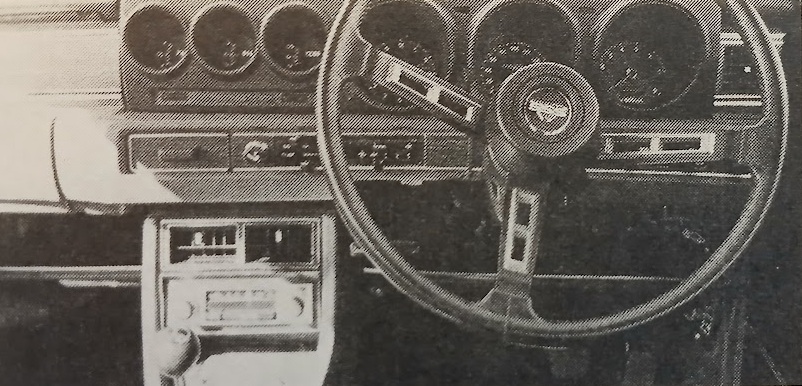
The interior is quite different from the 510, with a softer overall atmosphere. In the GL, the instrument panel is organized around a squared-off design theme. It also comes with a cassette stereo, which is something of a highlight, and gives an overall sense of luxury. In smaller details, there’s even a coin pocket, which seems quite practical.
In the hardtop, on the other hand, all the gauges are round, forming a more traditional “cockpit-style” instrument panel. There’s also an optional overhead console, which includes an auto compass.
The gearshift stroke has been reduced by about 20mm overall compared to what we’ve measured previously.
Switchgear in the hardtop is illuminated using a fiber-optic system.
Hirao: You can’t really see the auto compass while driving. You have to lean in and look at it.
Kageyama: I once went through quite a bit of trouble trying to fit a compass to my own car, and that position they’ve chosen is actually one of the better ones. So I thought, “Ah, they settled on the same spot.” But still, it’s not easy for the driver to see.
So if you’re unsure of your direction, you stop the car and take a look.
Hirao: You mean you actually stop to check it? (laughs)
Watari: I’ve got a small one mounted with a suction cup down in the lower-right corner of the windshield…
Kageyama: The problem is, positions that are easy to see tend to throw off accuracy. Anywhere around the dashboard is generally no good.
Mizutsu: We struggled with that quite a bit in the beginning. Using magnets in the press process can leave residual magnetism in the body. And we were also finishing parts of the console’s internal frame with a magnetic chuck, so we had to stop doing that…
Magazine: So is it actually accurate?
Ohta: Well, it’s described as indicating the general direction. If you start asking for accuracy within six or seven degrees, that becomes a bit difficult… (laughs)
Sales Target Reached in September
Magazine: Finally, could you tell us about the sales plan?
Tomizuka: For the time being, the U series is being sold only in the domestic market. Our initial target was 14,000 passenger cars per month and 3,000 vans, for a combined total of 17,000 units.
In addition, with the 510 series still in the lineup, we were aiming for around 25,000 Bluebirds in total.
Since actual sales only began in the latter half of August, registration numbers for that month were relatively low. For the U series alone, passenger cars and vans combined, we recorded 6,284 units.
In September, however, full-scale sales got underway, and the results have been very strong. Registrations for the U series reached 15,187 passenger cars, including 6,298 units of the 1800, along with 2,368 vans. That brings the total to 17,555 units, so we’ve essentially met our target.
As for the 510, it underwent a minor change in September, so numbers were lower in August. But in September, it still posted 3,931 passenger cars and 1,331 vans, so demand remains quite steady.
Higuchi: Are the U and 510 sold through the same dealerships?
Tomizuka: Yes, exactly the same outlets. From the dealers’ perspective, the U series sells well, but the 510 continues to move too.
Hirao: That works because the customer bases are slightly different.
Tomizuka: Right. Since the 510 no longer has an 1800 model, the lineup connects quite neatly. Going forward, the 510 will likely center on the 1400.
Magazine: Are there plans to export the U series in the future?
Tomizuka: That would require considerable preparation, so it’s not something we can do immediately. At present, the 510 is our main export model, with about 20,000 units shipped overseas each month on average. Transitioning that role to the U would take a great deal of work–not only in production, but also in reorganizing overseas sales networks.
So for the time being, the U will remain focused on the domestic market, while exports will continue to rely on the 510.
Magazine: Thank you all very much.
Postscript: Story Photos