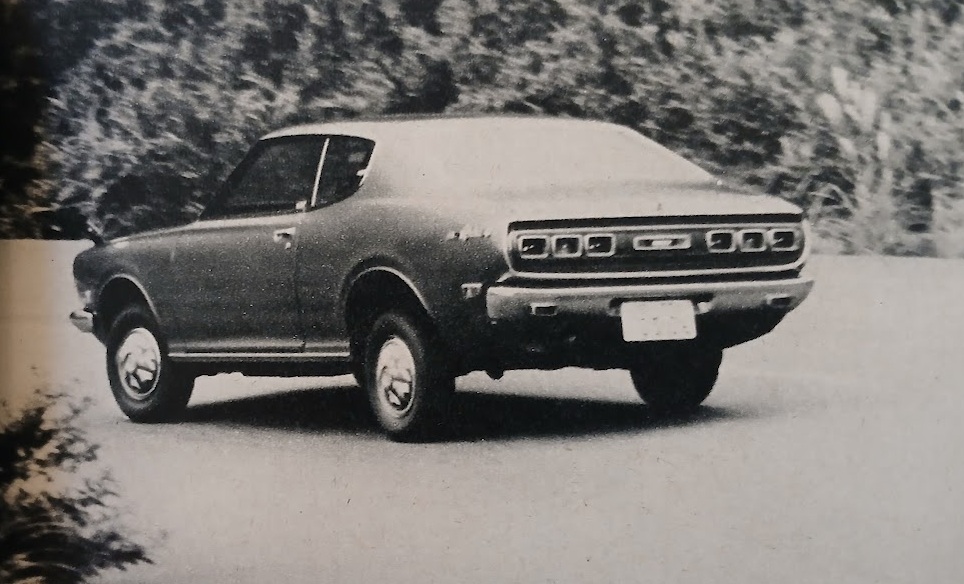
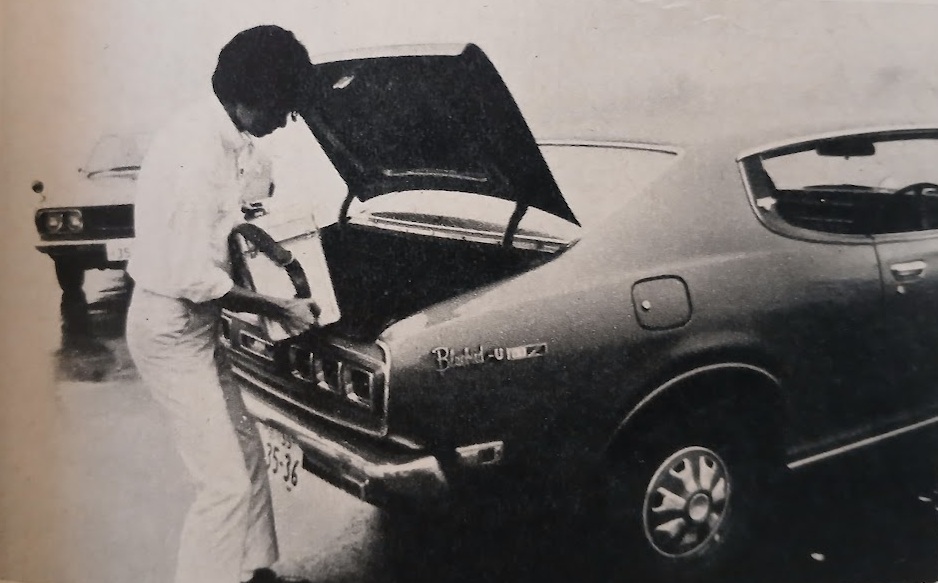
Nissan Bluebird U 1800SSS-E and 1800SSS-L Hardtops (1971)
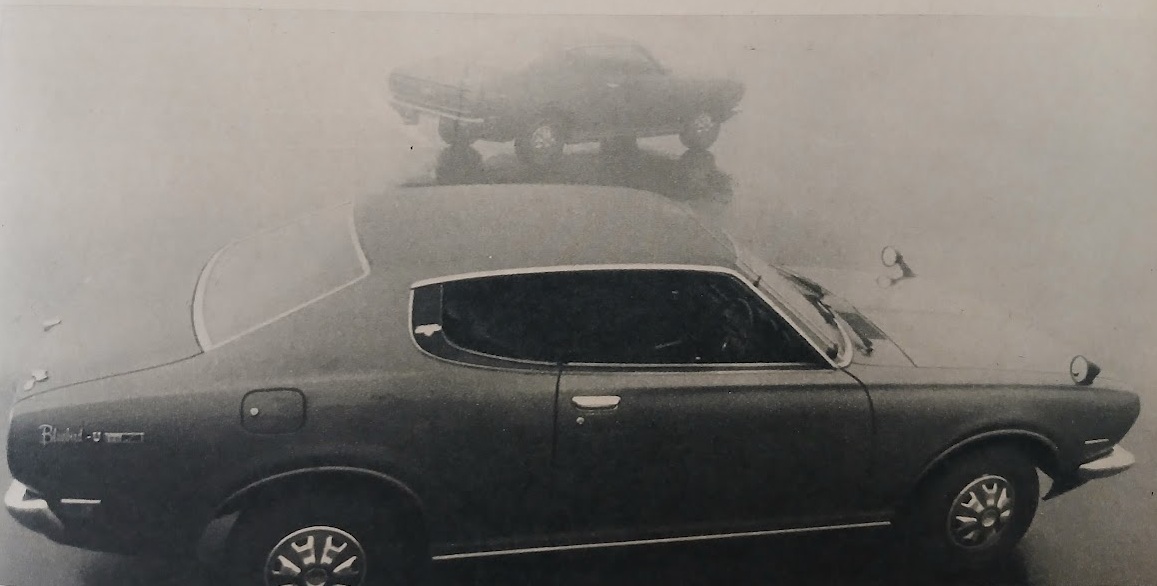
Publication: Car Graphic
Format: Road Impression
Date: November 1971
Author: Shotaro Kobayashi
Road testing the Bluebird U 1800SSS-E and 1800SSS-L Hardtops
The Bluebird U (610 series), which was announced and released on August 10th, is positioned as a premium model above the existing 510 series (the coupe has been discontinued; only the sedan remains). In other words, its relationship to the 510 is similar to that between the Mark II and the Corona. The powertrain and other mechanical components are largely carried over from the 510 series, with minor improvements; it is in the body that the 610 has been completely redesigned.
The lineup consists of a four-door sedan, two-door hardtop, wagon, and van, and the hardtop alone can be divided into six different variations depending on engine, interior, and exterior trim choices. Mechanically, the most noteworthy addition is the 1800 SSS-E, which is the first model to feature Bosch-built electronically controlled fuel injection. The 1800 SSS-E comes exclusively with the most luxurious trim package. For this test, we evaluated two models: the fuel-injected 1800 SSS-E hardtop (944,000 yen) and the carbureted 1800 SSS equipped with an automatic transmission (951,000 yen).
The U-series hardtop has grown compared to the 510, with its wheelbase stretched 80mm, overall length increased by 95mm, and width increased by 40mm, and it follows current trends with its long-nose, short-tail styling. In both dimensions and appearance, it makes an impression very similar to the Laurel and Mark II hardtops. This impression continues when you sit in the driver’s seat. Traditionally, Nissan’s design philosophy has prioritized functional engineering, and it has been well-known that interior finish and equipment were inferior to those of rival Toyota models. Recently, however, Nissan has adopted a new approach and has begun placing as much emphasis on interior fittings as on mechanical components. The results of this policy first became apparent in the Sunny 1400 Excellent and Cedric Hardtop, and it can be said that the new Bluebird U has taken it a step further.
The interior of the 1800 SSS-E is especially luxurious, reaching the highest standards in its price class. The seats are generously sized, comparable to those in the Corona Mark II, and their well-shaped, foam-padded leather cushions offer excellent comfort. The front seats not only provide ample fore-and-aft adjustment but also adjust easily for height, allowing drivers of any build to find a natural driving position. The steering wheel, which was previously too large, is now a more appropriate diameter; in the SSS, it is a leather-wrapped, three-spoke type.
The rear seats, which were somewhat cramped in the previous coupe, now approach the comfort of the U series sedan. The front and rear quarter windows on the top-trim SSS-E and SSS-L are power-operated.
The center console neatly houses the standard FM radio (automatic tuning is optional) and a cassette stereo player. Behind the gear lever are two storage areas: a small tray (convenient for coins) and a covered compartment large enough to hold a camera.
The instruments, lined up under a deep anti-glare hood, are easy to read both day and night. A large, circular tachometer, speedometer, and three-hand clock are placed directly in front of the driver, with smaller gauges for fuel, water temperature, and oil pressure off to the left. There is also an overhead console mounted on the ceiling behind the interior mirror, housing a seatbelt warning light that encourages use of the belts (a timer turns it off about 15 seconds after closing the door), a red lamp that illuminates when a door is only partially closed, and even a magnetic compass (which is gratuitous enough to be almost annoying).
There is a large lockable glovebox and a shelf across the underside of the dashboard, so storage space is plentiful. The dashboard switches and cigarette lighter are illuminated in pale green at night (using a fiberscope). The switch for the lights simply turns them on and off, while the other functions—flashing, switching between parking lights, high beams and low beams, and operating the turn signals—are all conveniently controlled by the lever on the right side of the steering column.
Now, let’s get to what it’s like on the road. The fuel-injected 1800 SSS-E produces 125ps at 6000rpm–10ps more than the twin-SU version–and its peak torque of 16.0kgm (an increase of 0.5kgm) arrives 400rpm earlier, at 3600rpm. The engine always started on the first try during the test, and ran smoothly under all driving conditions. Previous SSS engines were never particularly smooth or quiet, and the engine itself remains basically unchanged in the U series, but detail improvements have been made to the engine mounts. The results are so striking that it’s hard to believe it is the same engine. Barely any engine vibration reaches the body up to the practical rev limit of 6000rpm. The entire drivetrain also feels smoother throughout the rev range, a major improvement over the old SSS.
It is unfortunate, however, that the exhaust system suddenly becomes noisy around 4000rpm, with a peak at 4500rpm, especially when lifting off the throttle. Because of this sharp, harsh resonance, which seems to originate from the connection between the manifold and the exhaust pipe, the Bluebird is by no means quiet at high speed; it remains relatively quiet only up to 100km/h (approximately 3000rpm). Noise aside, however, the Bluebird U produces far less vibration than the previous SSS, allowing it to maintain high speeds without psychological stress. The speedometer easily reaches 180km/h, and 140–150km/h is a natural cruising speed. While this is unrealistic and even illegal in Japan, it will be able to comfortably hold its own with other cars in its class on foreign highways. Even in third gear, it easily reaches about 140km/h at 6000rpm, the practical maximum. The tachometer optimistically shows 6500–7000rpm as the yellow zone and 7000–8000 rpm as the red, but realistically, anything above 6000rpm should be considered yellow.
This engine has very good low- and medium-speed torque characteristics, and both the clutch and gearshift are light, so there is no difficulty driving in city traffic. However, on the high-speed hill climb through Hakone, we discovered one drawback: when climbing in a low gear, if you ease off the throttle just before a hairpin turn, and then apply power again, its response lacks the expected “punch.” In this regard, a carbureted engine with an accelerator pump offers better response (the old SSS used twin SUs without an accelerator pump, but had a damper that enriched the mixture during sudden acceleration). The Bosch fuel-injection system’s electronic “brain” is almost too clever, always providing an air-fuel mixture optimized to prevent the tailpipe from emitting black smoke.
Of course, this is beneficial from the perspective of preventing air pollution, and it is also good for fuel economy. Despite our fast driving, fuel consumption on our round trip from Tokyo to Hakone plus city driving was not excessive, averaging 8.24km/l over the roughly 100km trip. Since the fuel-injected model has a compression ratio of 9.5 (there is no low-compression version), it requires high-octane fuel. The fuel tank holds 55 liters, so in normal conditions you can expect a long cruising range of 500km. We appreciated the red warning lamp in the fuel gauge that comes on when the fuel level drops to 8.5 liters.
The suspension is basically the same as that of the 510 series, but the wheelbase is 80mm longer, the track is slightly wider, and the front end now has a stabilizer separate from the tension rods. The ride is on the soft side, with generous suspension travel, and is exceptionally comfortable over all types of road surfaces. The biggest difference from the previous model is that, despite being a hardtop with no center pillar, the body exhibits much higher rigidity and a solid, substantial feel. The test car was fitted with radial tires, but road noise was fairly well suppressed. As a result, the somewhat tinny, lightly built feel of the old Bluebird’s body has been completely eliminated, replaced by a much more composed, upmarket sense of weight.
The handling is characterized by consistently strong understeer, the type that feels the most familiar and manageable to the average driver. Steering rigidity is higher than before, and the smaller-diameter steering wheel helps make the steering feel more precise and responsive to small inputs, such as lane changes. Directional stability at high speeds is also excellent. For fast drivers, however, the understeer is rather excessive. Because the suspension is soft and has a long travel, if you lift off the throttle in mid-corner at high speeds, the resulting weight transfer causes the front wheels to cut strongly towards the inside of the turn. In this sense, its behavior is almost like that of a front-wheel-drive car. Experienced drivers will instinctively learn to use this trait to their advantage in high-speed cornering.
The test car was fitted with 165SR-13 Bridgestone Radial 20 tires on 4.5J rims. Among domestically produced radials, these rank with the best, offering good grip even on wet pavement. On the broad test area with pooled water that we used as a skid pad, both front and rear tires showed well-balanced cornering power. The rear tires in particular held on strongly, and although the front end eventually began to wash out gradually, the limit speed was high. In other words, the chassis is stronger than the engine, making it a safe design.
Later in the day, heavy rain forced us to drive with all the windows closed, giving us an opportunity to appreciate the excellence of the ventilation system. At speeds above 50km/h, a strong breeze blows from both ends of the dash, and of course, the three-speed fan allows for forced ventilation when the car is stopped. There is also an air-mix door ahead of the heater core, allowing fine adjustment of the outlet temperature, and it can direct warm air to the footwell while sending cooler air at face level, creating the ideal condition of a cool face and warm feet.
Up to now, heaters on domestic cars have tended to be difficult to use because they exhibited extreme on/off behavior or distributed heat unevenly, but the Bluebird U’s heater and ventilation system compare well with the best foreign designs. We were also able to confirm the effectiveness of the 1800 SSS-E’s standard rear-window defogger, and the high-speed wipers with fins functioned perfectly even at 120km/h. One unfortunate point, however, is that at speeds above 100km/h, there is a very annoying whistling noise from around the front pillars. This, strangely, is where the cabin air inlets are located (it is said to be the most efficient location), which seem to be where the noise comes from. The sound disappears if the window is opened even slightly.
Next, let’s turn to the 1800 SSS-L with automatic transmission. The body is identical to that of the 1800 SSS-E, so we’ll focus solely on its driving performance. This torque converter is the 3N71B model built by Nippon Automatic Transmission, and the gear ratios of the 3-speed planetary gearbox are 2.458, 1.458, and 1.000. The final drive ratio is 3.90, slightly shorter than the 3.70 used with the manual gearbox. The engine is the twin-SU version producing 115ps at 6000rpm (the regular-fuel version is rated at 110ps at 6000rpm).
This automatic is highly efficient. Even when accelerating quickly from low speeds in a higher gear, there is very little slippage, and the transmission reaches the coupling point (lock-up) quickly. In first and second gears, the response is almost comparable to that of a standard clutch. When you press the accelerator gently, upshifts occur at around 2500rpm. Full-throttle acceleration pulls the engine up to about 5000rpm before upshifting, and in first and second gears, the car will reach about 60 and 90km/h, respectively. In all cases, the shifts are extremely smooth.
Kickdown response is quite sensitive, with virtually no time lag, and second gear can be held to about 120km/h at the engine’s practical maximum of 6000rpm. Engine noise is slightly better suppressed than in the 1800 SSS-E, but there is still a sharp, resonant peak in the exhaust sound just above 4000 rpm. The natural highway cruising speed is only slightly lower than in the SSS-E, and if you don’t mind the noise, you can easily maintain 135-140km/h. This goes to show that, even when fitted with an automatic transmission–originally designed for easy, foolproof driving–the 1800 SSS can be safe and enjoyable to drive at high speeds, if its torque converter is efficient and its power-to-weight ratio remains favorable.
On the other hand, mountain driving in places like Hakone generally tends to expose automatics’ weaknesses, but in the case of this 1800 SSS, the handicap is surprisingly small. By using the second-gear hold feature on both ascents and descents, you can utilize the adequate driving force and engine braking to keep up with the manual-gearbox model. The second-gear hold is also extremely convenient in heavy city traffic. When you take your foot off the brake, the car creeps forward slowly; when you step on the throttle it accelerates fairly quickly, and when you release it again, strong engine braking comes into play.
The test car was equipped with optional radial tires, 165SR-13 Yokohama GT Specials. These have a softer tread compared with the Bridgestone Radial 20s on the 1800 SSS-E, soaking up minor surface irregularities better and producing less noise. This makes them well-suited to the driving patterns typical of someone likely to buy the automatic SSS. But in terms of handling, they are vastly inferior to the Bridgestone Radial 20s. Understeer is significantly stronger, and the front tires squeal even at relatively modest cornering speeds. Comparing the handling of both cars on the same skid-pad under identical conditions, the difference between the tires was unmistakable. The Yokohama GT Specials caused the front end to break away earlier, sending the car sliding straight ahead with large steering angles. Of course, this occurs only in extreme situations, and under normal conditions on public roads it is not a problem.
Finally, when driven under nearly the same conditions as the SSS-E, the SSS-L’s fuel economy was slightly better, returning an average of 8.64km/l. For a 1.8-liter car with an automatic transmission, this can be considered quite economical.
Postscript: Story Photos