Nissan Bluebird U 1600SSS-E vs Toyota Celica 1600GTV (1972)
Publication: Car Graphic
Format: Group Test
Date: November 1972
Author: “C/G Test Group” (uncredited)
Comparison Test: Nissan Bluebird U 1600SSS-E vs. Toyota Celica 1600GTV
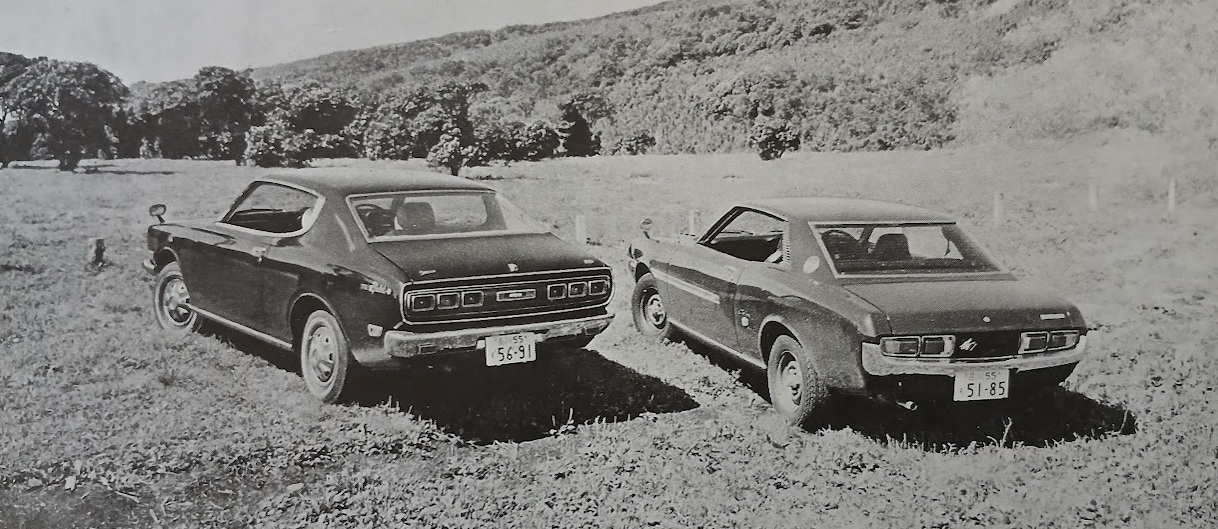
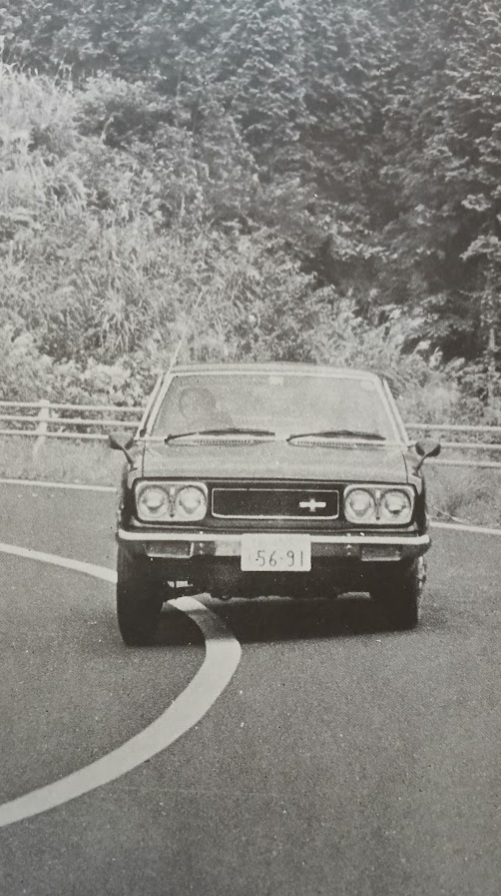
The Toyota Celica GT and Nissan Bluebird U 1600SSS occupy much the same market, both in character and in price class. Recently, noteworthy variations aimed at enthusiasts have been added to each range. These are the Celica GTV and the Bluebird U Hardtop 1600SSS-E, the two models examined in this comparison test.
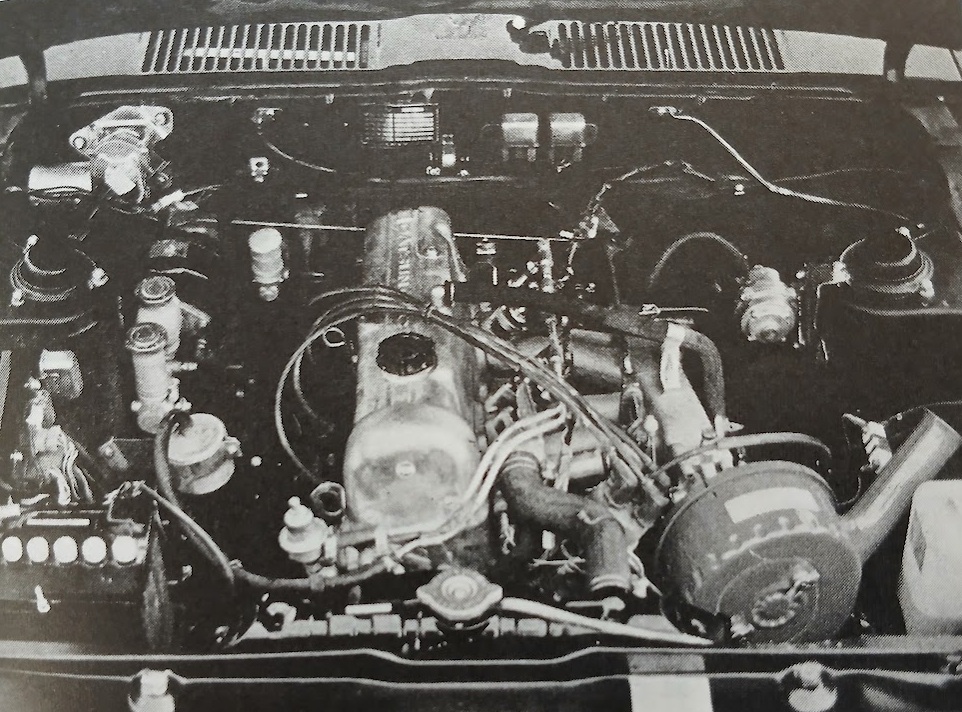
Both are equipped with 115ps engines and 5-speed gearboxes, though the Bluebird’s two-door hardtop body is somewhat larger and weighs roughly 60kg more. Needless to say, the Celica GTV employs a DOHC 1588cc engine breathing through twin Mikuni-Solex 40PHH twin-choke carburetors, whereas the Bluebird U 1600SSS-E uses the same Bosch electronic fuel-injection system found in its big brother, the 1800SSS-E.
As noted above, maximum output is identical at 115ps, but the Celica reaches its power peak at 6400rpm, compared with 6200rpm for the Bluebird. Maximum torque figures are 14.5kgm/5200rpm and 14.6kgm/4400rpm respectively. As these figures suggest, the DOHC-powered Celica is the more high-revving of the two.
The most significant changes distinguishing these new models concern suspension and tires. Toyota and Nissan have very different ideas when it comes to suspension. To achieve sporting handling, Toyota begins with a conventional suspension design, stiffens it considerably, and compensates with generous tire specifications. Nissan, by contrast, places greater emphasis on suspension design itself while fitting comparatively ordinary tires.
The Celica GTV’s suspension has been substantially stiffened compared with that of the GT, and ride height has been lowered by 10mm. Front spring rates have been increased from 1.7kg/mm to 2.3kg/mm, while rear rates rise from 1.7kg/mm to 2.2kg/mm. Rear damping force has likewise been strengthened by about 30-40%.
Wheels and tires have also been upgraded. The GT’s 4.5J rims and 165HR-13 tires have been replaced by a much wider combination of 5J wheels and 185/70HR-13 tires.
The Bluebird U has undergone a similar transformation with the 1600 and 1800 SSS/SSS-E models, though only those equipped with the 5-speed gearbox. Here too, the suspension has been substantially reinforced. Front spring rates have increased from 1.45kg/mm to 2.08kg/mm, while rear rates have risen from 6.56kg/mm to 7.82kg/mm. Damper forces have likewise been increased front and rear, from 40/25kg to 80/40kg at the front and from 45/28kg to 66/42kg at the rear. This strengthened suspension specification was already standard on export-market models.
Another important change accompanying this revised specification is the adoption of 14-inch wheels. All passenger-car models in the range (excluding the van) now use 4.5Jx14 rims in place of the previous 13-inch wheels. Here again, the specification has been borrowed from the export-market hardtop, where it was already standard.
In terms of price, the two cars are evenly matched. The Celica GTV sells for 863,000 yen, while the Bluebird U is priced at 864,000 yen.
Compared with the GT, the GTV is somewhat more sparsely equipped. The radio is AM-only, and features such as power windows and wheel covers have been omitted. In return, however, it gains an oil-temperature gauge together with the wider wheels and 70-series tires already mentioned. Since it is also 12,000 yen less expensive than the GT, buyers interested primarily in performance will likely find this specification more attractive.
The 1600SSS-E’s equipment specification is the same as that of the existing 1600SSS 5-speed model (priced at 814,000 yen). It is naturally less lavishly equipped than the 1800SSS-E (964,000 yen), but among the items sacrificed for the 100,000-yen price difference, the only ones of real significance are the radial tires and the driver’s seat height adjustment mechanism.
Performance
Celica GTV: The 2T-G engine, producing 115ps at 6400rpm, behaves exactly as one would expect of a twin-cam unit. It revs effortlessly beyond the 7000rpm red zone and invites full use of the upper reaches of the rev range without the slightest sense of psychological hesitation. From its smooth 800rpm idle to maximum engine speed, very little vibration is transmitted to the body, while mechanical noise is remarkably subdued for a DOHC engine.
At Yatabe, the GTV recorded a maximum speed of 175.43km/h (average over the 1km straight), corresponding to 5850rpm in fifth gear. The inclusion of an oil-temperature gauge as standard equipment is reassuring during sustained high-speed running. At a steady 100km/h cruise, oil temperature remained entirely normal, and it rose to 110°C on only two occasions: after five or six consecutive laps of Yatabe at maximum speed, and during more than thirty minutes of hillclimbing with the engine held continuously between 5000-6500rpm in second and third gear.
The 5-speed gearbox is very well matched to both the engine’s characteristics and the car’s weight. Extended to 7000rpm, first, second, and third gear will reach 51km/h, 91km/h, and 132km/h respectively. The fact that even direct fourth gear is capable of 172km/h (6600rpm) demonstrates that power reserves are more than adequate.
At the same time, the engine displays impressive flexibility at low and medium speeds. If desired, the overdrive fifth gear can be used at speeds below 60km/h. Its intended role, of course, is as an economical cruising gear for expressway travel at speeds above 100km/h. For example, 100km/h corresponds to approximately 3800rpm in fourth gear, but selecting fifth drops engine speed to 3300rpm, reducing noise levels noticeably.
Transmission noise is essentially unchanged between fourth and fifth gear. The shift pattern follows the arrangement used by the Fiat 124 Sport Coupe, with fifth gear located above and to the right of fourth. Reverse is directly below fifth, but can only be engaged by lifting the gear lever, eliminating any concern about accidental selection. Shift action is light and positive, with relatively short lever travel and a satisfying feel.
The one area in which this car proved somewhat disappointing was acceleration performance. 0-400m required 17.45 seconds, while 0-1000m took 32.25 seconds. These figures fall well short of the 16.8 and 32.0 seconds recorded by the GT we tested last year, and the deficiency was even more apparent in passing acceleration.
On the other hand, maximum speed differed little between the two cars: 176.78km/h for the GT and 175.43km/h for the GTV. It therefore seems unlikely that the engine in the test car was particularly out of tune. The only plausible explanation is that, although official output remains unchanged at 115ps, the current engine is tuned far more conservatively than the 1971 specification in order to meet emissions regulations. One suspects, in particular, that the discharge volume of the accelerator pumps has been reduced.
This engine also exhibits a tendency toward what is commonly known as “dieseling”–continuing to run after the ignition has been switched off. We encountered the phenomenon several times during this test, particularly following sustained high-speed driving.
Bluebird U 1600SSS-E: The fuel-injected 1600SSS-E develops 115ps at 6200rpm, only 10ps more than the twin-SU-carbureted 1600SSS. Needless to say, this is not a difference one can readily detect from behind the wheel. The real advantages of fuel injection lie elsewhere: reliable cold starting and a service-free nature that maintains consistent running under all conditions. Much of what was said when we previously tested the 1800SSS-E applies equally to this slightly smaller 1600SSS-E.
By modern standards, this SOHC engine is somewhat rough. Noise levels are high, and it can hardly be described as free-revving. Under acceleration, intake roar, fan noise, and valvegear noise all become markedly more pronounced. Perhaps because the 1600SSS-E employs the “wildest” camshaft specification in the Bluebird range–10.9mm valve lift (compared with 10.5mm for the 1600SSS) and 38 degrees of overlap (versus 30 degrees)–it is generally noisier than the previous SSS models. The car is comparatively quiet only up to about 100km/h, which corresponds to approximately 3300rpm in fifth gear.
The tachometer marks 6500-7000rpm as the yellow zone and 7000-8000rpm as the red zone, but this is wholly unrealistic. In practice, the yellow zone should begin around 6000rpm and end at 6500rpm. The psychologically tolerable rev limit lies considerably lower still, at roughly 5500rpm.
Fortunately, the engine possesses strong low- and mid-range torque characteristics, making it possible to maintain a brisk pace without exceeding 5000rpm.
The 5-speed gearbox now fitted to the 1600SSS-E is the same Porsche-type servo-synchromesh unit used in the Skyline and Laurel. At the same time, the final-drive ratio has been shortened from the 4-speed model’s 4.111 to 4.375.
This gearbox features pleasingly close ratios in its upper three gears and, like most Porsche-synchronized transmissions, operates with exceptional lightness. Extended to 7000rpm–effectively the practical maximum–first, second, and third gear will reach 56km/h, 91km/h, and 146km/h respectively.
In direct fourth gear, the Bluebird achieved exactly the same 172km/h as the Celica GTV, while requiring 400rpm less engine speed to do so, at 6300rpm. Maximum speed averaged 172.41km/h over the 1km straight, corresponding to 5450rpm in fifth gear. As usual, the speedometer proved spectacularly inaccurate, indicating 191km/h at this speed.
The best 0-400m time was 17.50 seconds, achieved when shifting at 6500rpm. Extending the engine to 7000rpm produced a best of only 17.60 seconds, demonstrating that there is nothing to be gained by revving beyond 6500rpm.
Comparing the two cars in terms of performance, it is only natural that the GTV should hold the advantage. Its power-to-weight ratio is slightly superior, and its frontal area is somewhat smaller. Accordingly, both maximum speed and acceleration favor the Celica. Its engine also spins more willingly at high rpm.
The Bluebird’s strength, on the other hand, lies in the flexibility of its top gear. In every top-gear acceleration test from 40km/h through 120km/h, it proved slightly quicker than the Celica GTV.
The reason is that the Celica’s DOHC engine has a range around 3000-4000rpm where the rise of the torque curve becomes less pronounced, whereas the torque curve of the fuel-injected engine in the 1600SSS-E is largely flat. As a result, fifth gear covers a wider operating range, allowing a more relaxed driving style if one is so inclined.
Fuel Economy
In the steady-speed fuel-consumption tests conducted at Yatabe, the Celica–somewhat unexpectedly–returned better figures than the Bosch fuel-injected Bluebird at both 60km/h and 100km/h, despite its twin Mikuni-Solex twin-choke carburetors.
In fifth gear, the overall gearing of the two cars is identical, corresponding to 30.4km/h per 1000rpm. In fourth gear, the figures are 26.2km/h and 27.3km/h respectively, making the Celica the lower-geared of the two. Its more favorable power-to-weight ratio likely explains the difference.
When the two cars were driven in convoy over approximately 600km of ordinary roads, however, the situation was completely reversed. Under real-world conditions, the Bluebird returned better fuel economy over every section of the route, recording an overall average of 9.07km/l against the Celica’s 8.38km/l (with odometer error corrected in both cases).
For example, on the 80km journey from Yatabe back to Tokyo along a typically congested national highway–a trip that required three hours–the Celica averaged 9.65km/l, while the Bluebird returned 10.41km/l. On the approximately 250km of mountain roads around Hakone and the Omote-Fuji area, the respective figures were 7.33km/l and 7.78km/l.
One possible explanation for the Bluebird’s superior real-world economy relative to its steady-speed figures lies in a characteristic of the fuel-injection system itself: fuel delivery is shut off when the throttle is closed.
Both cars require premium gasoline, although a lower-compression version of the GTV capable of using regular fuel is also available.
For the 1973 model year, the Celica’s fuel tank was relocated from beneath the floor to a position behind the rear seat in the interest of improved rear-impact safety, though capacity remains unchanged at 50 liters. The Bluebird holds 55 liters.
Handling, Ride, and Braking
Celica GTV: With its substantially stiffened suspension, wider Bridgestone Radial RD-102 185/70HR-13 tires, and newly adopted variable-ratio steering (18.0–20.5:1), the GTV’s road holding and handling are markedly superior to those of the previous GT.
Most noticeable is the improvement in steering response. Turn-in is far more precise, and at high speeds the car now responds faithfully to even very small steering inputs. Steering effort has increased only slightly and remains well within acceptable limits.
The degree of understeer, which had been somewhat excessive in the GT, now seems almost ideally suited to the preferences of the fast driver. At least on medium-speed uphill bends taken at around 80-90km/h, the full power available in third gear is very well matched to the tires’ grip, allowing the car to corner in a stable, composed attitude.
The grip afforded by the wider tires is naturally excellent, and because body roll has been reduced dramatically compared with the GT, even applying full power in second gear through tight corners does not induce wheelspin from the inside rear wheel.
That the tires’ reserves are well beyond the engine’s output is further demonstrated when easing the throttle in mid-corner, which produces almost no change in the car’s attitude.
The wider tires have, however, necessitated a slight reduction in maximum steering lock. As a result, the minimum turning radius has increased from 4.8m in the Celica GT to 5.2m in the GTV.
Ride quality is generally firmer than that of the GT. At lower speeds it exhibits a distinctly choppy character, comparable to that of an Alfa Romeo 1750, though at higher speeds it becomes notably flatter and more comfortable. Clearly, the well-shaped seats and their carefully judged firmness contribute greatly to this impression.
Recent design revisions to the Celica have added further sound-deadening and vibration-insulating material to both the dashboard panel and floorpan. Perhaps as a result, road noise remains well suppressed despite the wider radial tires, while vibration from the suspension is also absorbed effectively.
Braking performance is well matched to the car’s performance potential. Servo assistance is powerful, requiring only 15kg of pedal effort to achieve 0.5g deceleration from 100km/h. The pronounced nose-dive that characterized the GT under hard braking has been reduced considerably in the stiffer-sprung GTV.
In the 0–100–0 fade test, pedal effort rose gradually from an initial 15kg to 29kg by the tenth stop, but this remains comfortably within normal limits.
In the 0-100-0 fade test, pedal effort increased gradually from an initial 15kg to 29kg by the tenth stop. Even so, this remains entirely within the normal range.
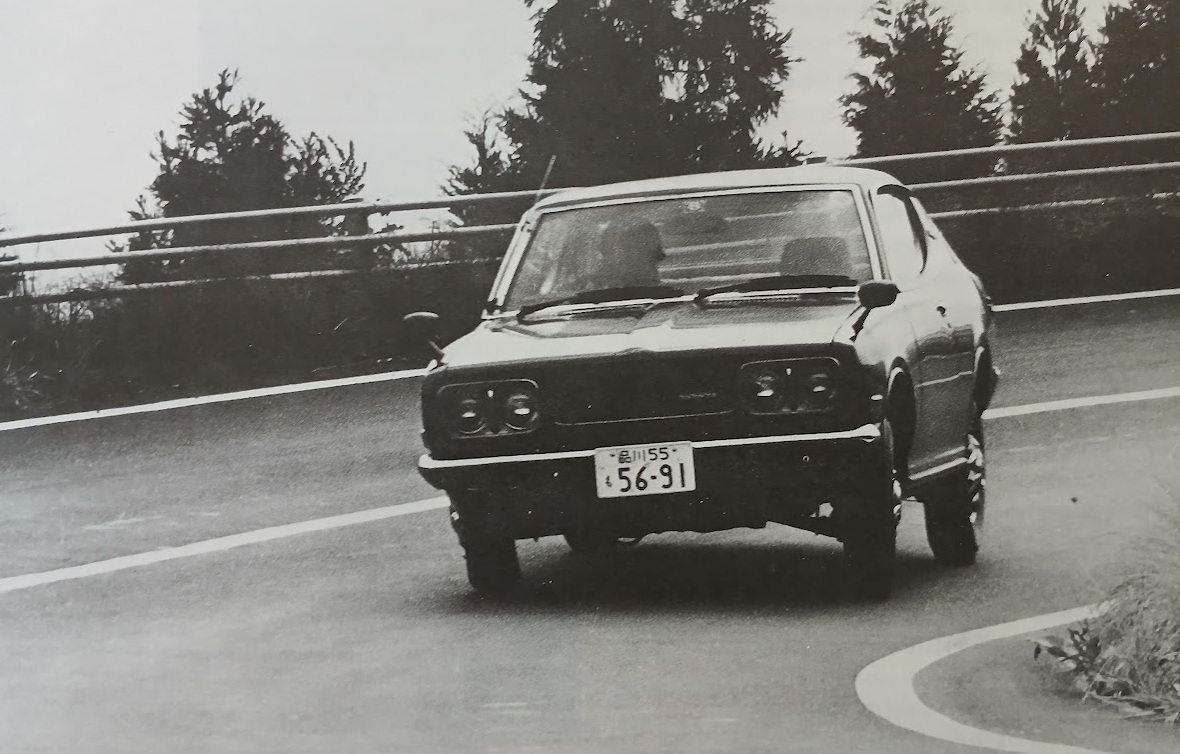
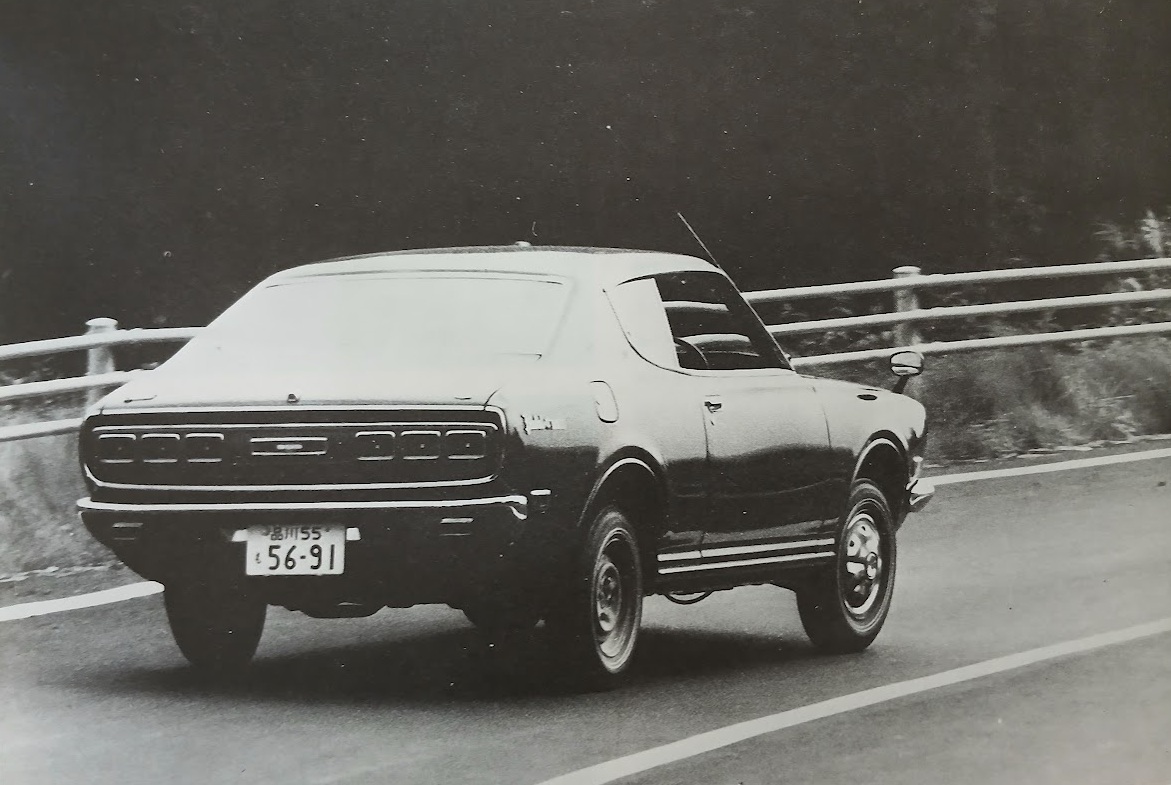
Bluebird U 1600SSS-E: The most impressive aspect of this car was the dramatic improvement in handling compared with the 1800SSS-E we tested last year.
That earlier car was fitted with Bridgestone Radial 20 165SR-13 tires, yet this 1600SSS-E, despite riding on ordinary Toyo E-31 6.45S-14 cross-ply tires, demonstrated substantially greater cornering power and road holding.
Understeer remains pronounced, but it is no longer excessive. Likewise, lifting the throttle in mid-corner no longer produces the strong tendency exhibited by the earlier car for the front end to tuck sharply toward the inside of the bend–though in reality, this was merely a reduction in understeer.
On uphill bends that can be taken at 80-90km/h, applying full power in third gear initially produces some understeer. As the corner progresses, however, the steering wheel can be gradually unwound. This allows the car to maintain both speed and smoothness through the bend without scrubbing away momentum through excessive front-tire slip.
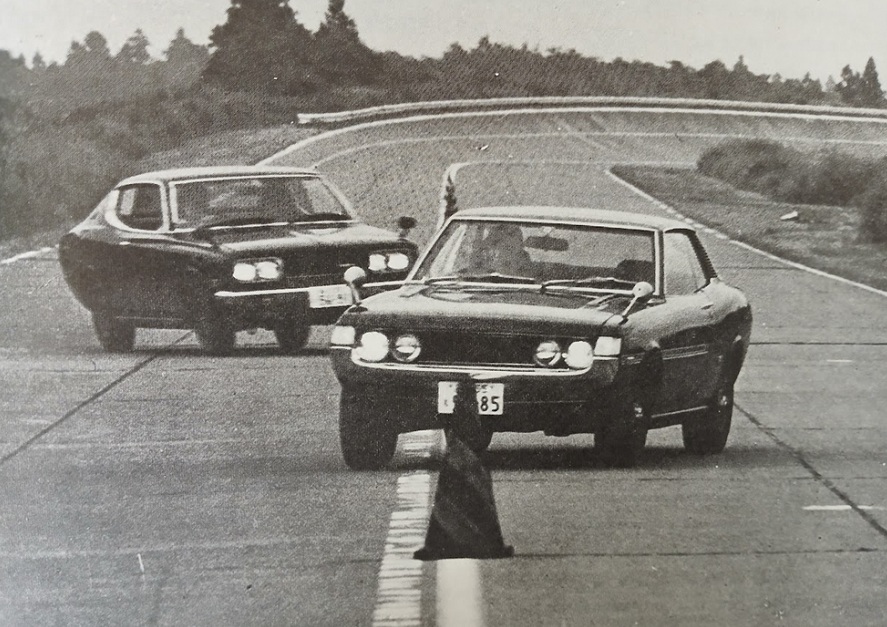
The limitations of the narrow cross-ply tires did become apparent during slalom testing at Yatabe. We set pylons at 30-meter intervals and threaded through the course at speeds of 80-90km/h. Under these conditions, the car gradually transitioned into excessive, throttle-controlled power oversteer. If the throttle was eased to reduce understeer, the tail would step out abruptly, the yaw angle would continue to increase, and recovery would become progressively more difficult.
The Celica GTV proved considerably stronger in this test, threading through the pylons on a more direct line and with greater composure. It should be remembered, however, that this sort of slalom test is extremely severe. On ordinary public roads, opportunities to generate such high cornering forces are exceedingly rare.
For the purposes of this comparison, the Celica GTV emerged as the winner in outright handling. Yet if the question is which car would be easier for the average driver to enjoy, the answer may well be the 1600SSS-E. Its tail can be induced to slide quite readily through throttle control, making the car easy to balance and place.
The Celica GTV, by contrast, has an unusually high level of tire grip for a standard production car. As a result, its cornering limits are more difficult to sense, and once those limits are exceeded both ends of the car tend to break away at once.
Returning to the Bluebird U, it would be most interesting to see what results might be obtained by combining its already-impressive handling on cross-ply tires with a set of high-quality radials.
Although the recommended pressures for the standard cross-ply tires are 1.6kg/cm² front and rear, we obtained markedly better handling using 1.9kg/cm² at both ends throughout our testing. Perhaps as a consequence, however, the car reacted rather sharply to pavement joints and similar surface irregularities, and road-noise isolation still seemed to fall somewhat short of the ideal.
This was less noticeable in the 1800SSS-E tested previously, but the 1600SSS-E constantly conveyed the sensation of substantial unsprung masses working beneath the floor, transmitted as vibration through the body structure. The test car had covered less than 2000km, yet it already felt like a car that had traveled considerably farther.
The brakes have also been revised. The pads have been changed to the more fade-resistant S21B material, while the vacuum servo has been enlarged from 4.5 inches to 6 inches in diameter. At the same time, however, the pedal ratio has been reduced from 5.0 to 4.2, offsetting some of the reduction in pedal effort that might otherwise have resulted.
Pedal effort was never particularly heavy to begin with, so this presents no problem. More important is the fact that the excessive pedal travel of earlier models has finally been reduced to a more appropriate range.
Fade resistance is likewise entirely satisfactory. In the 0-100-0 fade test, pedal effort initially measured 18kg, then actually decreased slightly during the first three stops—evidence that the pads achieve their highest coefficient of friction once somewhat warmed. Thereafter pedal effort increased gradually, reaching 25kg by the tenth stop.
Fade resistance must therefore be judged exceptionally good.
The handbrake, however, remains the under-dash umbrella type. It is inconvenient in use, and Nissan would do well to reconsider it.
Interior and Accessories
The interiors of the two cars present sharply contrasting atmospheres.
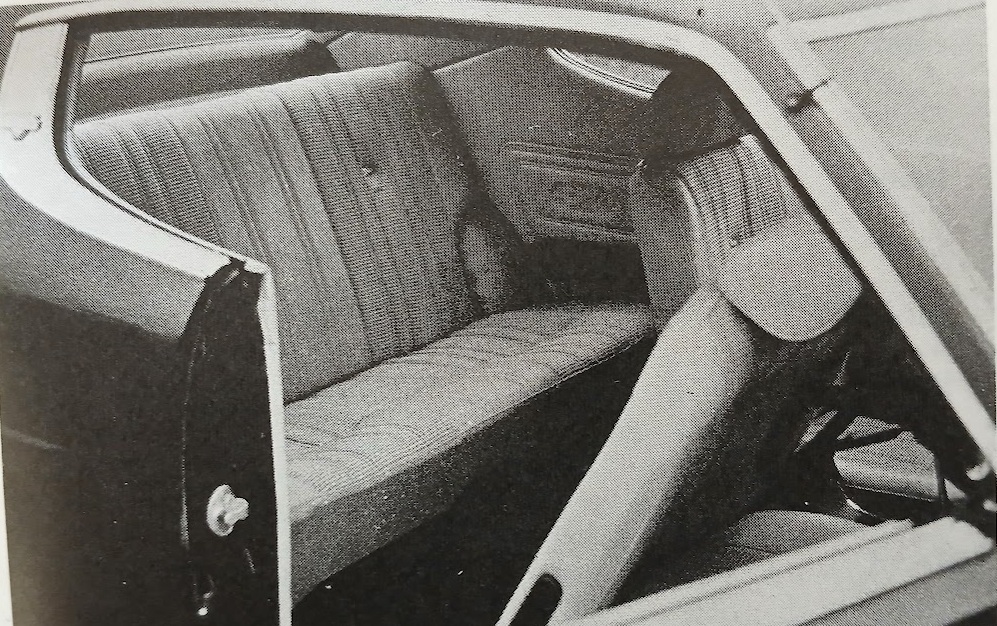
The Bluebird uses light-colored beige trim and houndstooth-pattern tricot cloth upholstery to create a bright, sedan-like environment–one that also has the effect of making the cabin appear more spacious than it really is.
The Celica, by contrast, adopts the low seating position expected of a sports coupe and surrounds its occupants almost entirely in black, with knit vinyl-leather seat upholstery.
In terms of dimensions, there is little to choose between them. If anything, the Bluebird is slightly longer fore-and-aft, while the Celica is marginally wider.
Most of those who drove both cars preferred the Celica’s driving position. The reason is straightforward. With the introduction of the U-series, Nissan abandoned the traditionally high seating position long associated with the Bluebird in favor of a lower one. As a result, the dashboard and steering wheel now seem disproportionately high relative to the driver. (Only the 1800 model offers seat-height adjustment.)
The basic shape of the Bluebird’s seats is generally good, but several details drew criticism. Both the cushion and backrest are somewhat too narrow where they wrap around the body, creating uncomfortable pressure from either side. In addition, the forward-projecting headrest presses awkwardly against the back of the head. If anything, the seats are more comfortable to ride in than to drive from.
The orange houndstooth upholstery looks somewhat inexpensive, but cloth trim does offer the advantage of remaining cooler and less prone to inducing perspiration during the summer months.
The Celica’s seats, by contrast, are relatively thinly padded but generously sized and very well shaped. The relationship between the seat, steering wheel, and controls is particularly well judged, allowing the driver to adopt a thoroughly natural position with both arms and legs comfortably extended.
Recent Japanese cars seem almost to have conspired to adopt unnecessarily wide rear quarters and steeply raked rear windows. The result is a serious and widespread deficiency in rearward and rear three-quarter visibility.
Of the two cars tested here, this criticism applies most strongly to the Bluebird. Its broad rear quarter panels–whose lower sections are particularly thick–create large blind spots, while the rear side windows taper noticeably toward the rear. In addition, the excessively steep rake of the rear window tends to distort the image seen in the rearview mirror.
The contrast with the Fiat 124 Sport Coupe accompanying us during this test could hardly have been greater. The Fiat offered a bright, airy interior and visibility almost entirely free of blind spots.
These criticisms apply equally well to rear-seat accommodation. The broad blind sections of the rear quarters and the large front headrests restrict visibility, while the rear window extending overhead exposes rear-seat passengers directly to sunlight.
In both cars, rear-seat occupants may experience sensations approaching claustrophobia, though the Bluebird’s lighter interior trim makes it somewhat less oppressive in this respect.
Dimensionally, there is little difference between the two. A passenger approximately 178cm tall, however, will find his head resting directly against the hard rear-window frame in the Bluebird. In the Celica, the rear seat cushion is set lower, providing appreciably more headroom.
The Celica’s deeply recessed rear seat comes at a price, however. While two passengers can ride comfortably, accommodating a third would be difficult. The Bluebird’s flatter rear seat makes three-across seating at least feasible.
In either car, if the front seats are adjusted fully rearward, rear passengers will find their knees pressed against the seatbacks.
Seatbelts for both front occupants are standard equipment in both cars. The Bluebird uses two-point belts, whereas the Celica is more thoughtfully equipped with three-point belts. Unfortunately, the retractor spring constantly applies pressure across the abdomen, which can become uncomfortable. (Retractable seatbelts are fitted to the Bluebird only in 1800-series models.)
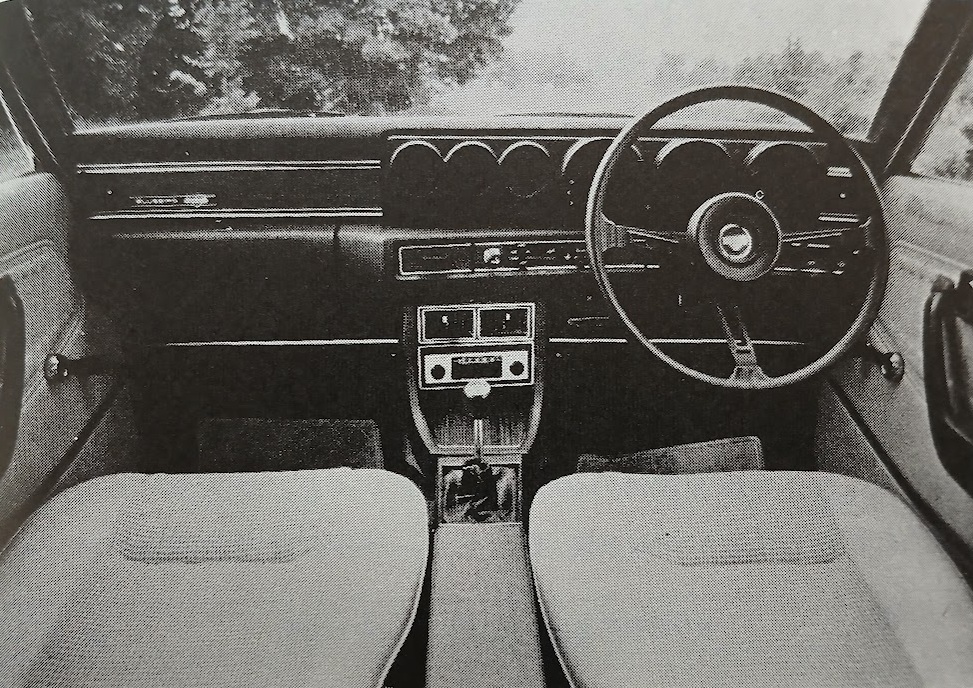
Both cars feature lavishly equipped instrument panels. In addition to the obligatory tachometer, each provides gauges for fuel level, coolant temperature, oil pressure, and a clock. The Celica goes a step further by including both an ammeter and an oil-temperature gauge. Visibility of the instruments presents no particular problems, either by day or by night.
Visually, the Celica’s instrumentation is the more attractive of the two, but from a functional standpoint the Bluebird’s lighting controls are superior. A pull switch located beneath the right side of the dashboard serves only to switch the lights on and off; thereafter, sidelights, dipped beam, main beam, and headlamp flashing are all controlled by moving the turn-signal stalk for and aft. The ability to operate these functions with one’s fingertips while keeping both hands on the steering wheel is admirably convenient.
The Celica, by contrast, continues to place its lighting and wiper switches on the instrument panel beneath the deep hood over the gauges, in a position that requires the driver to reach behind the steering wheel. Operation remains awkward even without the seatbelt fastened.
One redeeming feature is that the Celica’s main switch knobs are internally illuminated, with brightness adjustable together with the panel lighting, making them easy to locate at night.
Both cars are fitted with leather-grip steering wheels. In the Celica’s case the rim is genuinely leather-covered, while the Bluebird merely employs a one-piece molded imitation.
Both cars are fitted with leather-grip steering wheels. The Celica uses a genuine leather covering, whereas the Bluebird’s is a one-piece molded imitation.
As noted previously, the Bluebird’s steering wheel is positioned too high and is also somewhat too large in diameter. The Celica’s wheel, by contrast, is well judged in both respects.
The Bluebird’s horn button remains solely in the center of the steering wheel. Horn buttons mounted on the spokes and operable without removing one’s hands from the rim, as in the Celica, would be preferable.
Both cars are equipped with steering-column locks as standard equipment, though the Celica employs a safer two-stage arrangement in which a lock button must first be pressed before the key can be removed.
The Bluebird’s handbrake remains the umbrella type mounted beneath the dashboard. We would like to see it relocated to the floor, at least on the hardtop models, where it would be considerably easier to use.
Among the smaller details is the Celica’s newly introduced speed-warning device. Once the car exceeds 100km/h—110km/h in the case of our test car—it begins to emit a “ding-dong” chime. Fortunately, it is rather less objectionable than the buzzer-type systems used previously.
Compared with the standard GT, the GTV dispenses with power windows. In our view, this is no great loss. For their speed of operation and, above all, their superior reliability, manual windows are probably better in any case.
Both cars are equipped with conventional AM radios as standard. On the top-line models, however, equipment levels rise considerably. The Celica GT receives an AM/FM radio, while the Bluebird 1800SSS-E (and SSS-E L) comes standard with not only an automatic-tuning AM radio but even a cassette stereo system.
In recent years, the ventilation systems of Japanese cars have improved noticeably with each new generation of design, and these two cars are particularly good examples.
Both feature face-level vents at the either end of the dashboard directing fresh air toward the occupants. In addition, forced-ventilation outlets linked to the heater blower are mounted above the center console. The dashboard vents introduce outside air effectively even with the windows fully closed and at speeds below 50km/h, while the console vents deliver surprisingly strong airflow even with the blower set to its lowest speed.
The dashboard vents introduce outside air effectively even with the windows fully closed, becoming useful at speeds below 50km/h. The console vents, meanwhile, deliver a surprisingly strong airflow even with the blower set to its lowest speed.
Creating the ideal winter environment–cool air to the head and warm air to the feet–is easily accomplished. It is also welcome that electrically heated rear windows have now become virtually standard.
The Bluebird provides more interior space for small personal items. Both cars offer locking gloveboxes of average capacity. Beyond that, however, the Celica provides only a single under-dash tray on the passenger side and a shallow coin tray on the console. The Bluebird, by contrast, includes under-dash trays on both sides, a console storage compartment, and a deep lidded box that also serves as an armrest.
There is little difference in luggage capacity between the two cars. Because both locate their fuel tanks behind the rear seat, trunk depth is limited. As is often the case with short-tail body styles, the trunk lids are small and the loading sills relatively high, making heavy luggage awkward to load and unload.
Earlier Celicas placed the fuel tank beneath the floor and stored the spare tire upright, providing a more spacious luggage compartment. In the latest model, however, the fuel tank has been relocated to the forward end of the trunk in the interest of rear-impact safety, while the spare tire has been recessed beneath the floor. The result is a reduction in usable luggage space.
There is a far greater difference in the tool kits supplied with the cars. Toyota has long provided an unusually generous set of tools regardless of vehicle class, including an adjustable wrench, a six-piece spanner set, and two screwdrivers. The Bluebird’s kit, by comparison, is decidedly meager and does not include even a spark-plug wrench.
In conclusion, these two cars are closely matched in performance, and both offer handling of a high standard. More importantly, and rather unusually for Japanese cars in this class, both are genuinely enjoyable to drive.
At present, the Celica GTV holds a slight advantage in handling, but much of that superiority can be attributed to its 5J wheels and 185/70HR13 radial tires. If the Bluebird were fitted with tires of comparable size and specification, the contest would become even more interesting.
Finally, while Nissan has traditionally trailed Toyota by a considerable margin in interior finish and equipment, the arrival of the Bluebird U has narrowed that gap significantly.
Postscript: Story Photos