Nissan Bluebird U 1800SSS-E Hardtop (1971)
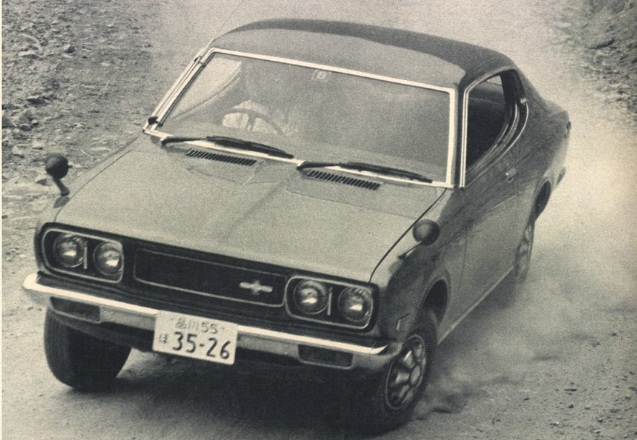
Publication: Auto Sport
Format: Auto Sport Test
Date: December 1971
Author: Juichi Kanmoto
1,000 Kilometers on an Alpine Rally Route in the Fuel-Injected “U”
A new model, the “U,” has now joined the Bluebird line, which has already established an unshakable reputation in rally competition.
Larger in every dimension than the 510-series car, and equipped with fuel injection, what sort of potential might this new Bluebird U possess as a rally machine?
To find out, we drove it over a 1,000km route made up of roads actually used in competition events. And the results were…
Can the 1800SSS-E Be Used for Rallying?
The long-awaited new Bluebird was unveiled on August 10, drawing considerable attention from motorsport enthusiasts. Known as the “Bluebird U,” the new model will be sold alongside the existing 510 series. The “U,” we are told, stands for “You”–a reflection of Nissan’s intention to give the Bluebird a greater sense of individuality and refinement, rather than pursuing pure functionality as in the past.
In terms of size, the new car has grown substantially: overall length has increased by 120mm, width by 40mm, and wheelbase by 80mm, while the track is 40mm wider at the front and 50mm at the rear. In effect, the Bluebird U now approaches the dimensions of the Corona Mark II class.
The lineup itself is also changed considerably. Replacing the former coupe is a newly introduced hardtop model, while the sedan offers four engine variations: 1600cc and 1800cc units, each available in both single-carburetor and twin-carburetor form.
Most noteworthy of all, however, is the new 1800cc hardtop equipped with electronic fuel injection–the 125ps 1800SSS-E.
The defining feature of this engine is its electronically controlled fuel-injection system supplied by Bosch of West Germany. Because the system can deliver precisely the appropriate amount of fuel for virtually any driving condition, exhaust emissions are cleaner, fuel consumption is reduced, and power delivery is improved throughout the rev range. Response is said to be particularly sharp, promising excellent acceleration performance.
Given all these characteristics, one naturally begins to wonder: how would the “Bluebird U 1800SSS-E” perform as a rally machine?
With that question in mind, we decided to take the car straight onto actual rally roads for a thorough evaluation.
The planned route would cover roughly 1,000 kilometers: starting from Tokyo, then on to Hakone, Lake Kawaguchi, Kofu, Yachiho, Yatsugatake, Chino, Matsumoto, Kamikochi, Takayama, Mt. Ontake, Nomugi Pass, Shiojiri, and finally back to Tokyo.
At 5:30pm, a metallic-blue “U Hardtop” arrived at this author’s residence. Within moments, it was surrounded by a crowd of curious onlookers.
The styling represents a complete departure from the angular forms of the 510 series, replacing them with flowing curves throughout. In many respects, it feels unlike any previous Nissan. Particularly striking is the distinctive “J-line” treatment of the side windows, which lends the car an unmistakably sporty elegance.
Inside, the cabin is finished entirely in black. The cockpit-style instrument panel–sure to appeal to enthusiasts–uses a two-tier layout, with the gauges grouped in the upper section and the controls arranged below.
Integrated into the center console is a cassette stereo fitted as standard equipment, while the newly adopted overhead console houses warning lamps for the doors and seatbelts, together with a magnetic compass.
The seats themselves are tastefully designed, and thanks to the 160mm of fore-aft adjustment combined with height adjustment, even someone of relatively large build by Japanese standards–such as the author (176cm tall, 72kg)–could settle into an exceptionally relaxed driving position.
In terms of driving position, the Bluebird U shows a marked improvement over the 510 series. Most notably, the shift lever–previously positioned awkwardly far away–now falls naturally to hand from the steering wheel, while the accelerator pedal has been moved slightly farther forward, allowing the driver’s leg to extend far more naturally.
Hesitation When Accelerating Out of Coasting
The engine fired immediately and settled into a pleasant idle. Since the car had covered barely more than 1,000 kilometers, the engine still felt slightly tight, but even at an idle speed of 500rpm it remained perfectly stable.
Leaving the Yokohama Bypass at dusk, we joined the Shonan coastal road. From the cars overtaking us came one curious glance after another, drivers turning to stare as they passed.
Our group consisted of the author together with Mr. U and Mr. I from the editorial staff. At this point, we left public roads and headed onto a test course in order to conduct some high-speed evaluations.
First came an abrupt lane-change maneuver at 120km/h.
In the case of the 510, tire grip itself is excellent, but body roll is fairly pronounced, and one cannot help feeling a slight uneasiness as the suspension and body seem to momentarily fall out of sync. The U, however, rolls far less and responds smoothly and naturally to the driver’s inputs.
Next came a hands-off straight-line stability test, again at 120km/h. In this test, the steering wheel is turned sharply and then released entirely in order to observe how quickly the car settles from its ensuing oscillation.
The result was impressive: the steering required only one and a half cycles before the movement fully converged. Presumably the increased wheelbase and track dimensions, together with the greater damping force of the front shock absorbers, are contributing significantly here.
The final-drive ratio is 3.70–exactly the same tall gearing used in the 510-series 1800SSS. As a result, even at 120km/h the engine is turning only about 4000rpm, making the cabin remarkably quiet.
There was, however, a pronounced resonance somewhere around 4200-4500rpm where mechanical noise suddenly increased quite sharply. Perhaps this was simply due to some component still not fully settled on such a new car.
Shortly before 8:00pm, we entered Odawara. Traffic was heavy, making it impossible to proceed without constantly modulating the throttle in small increments.
It was here that a troubling characteristic emerged.
Whenever transitioning from “coasting”–that is, engine braking–back onto the throttle, the engine would momentarily stumble no matter how carefully the accelerator was applied. It felt almost as though the engine had to briefly catch its breath before responding. Perhaps the accelerator sensor was improperly adjusted, but lacking the necessary testing equipment, there was no way to diagnose it on the spot.
There was little choice but to continue the drive as it was.
By the time we began climbing the Hakone Turnpike–the paved toll road ascending into the mountains–night had fallen. From Odawara toward Hiratsuka and Fujisawa, the lights of the towns traced a beautiful outline along the shore of Sagami Bay.
The fuel-injected Bluebird U climbed steadily up the Turnpike’s 7%-average gradients. Yet because of the tall gearing, even with a powerplant producing 125ps/6200rpm and 16kgm/3600rpm, climbing in top gear proved somewhat demanding.
At this point, it seems worthwhile to compare the “acceleration capability index” (introduced by Hajime Hiratsuka in the July issue) of the 510-series 1800SSS equipped with SU twin carburetors against the new model.
Taking into consideration torque, transmission gear ratio, differential gear ratio, vehicle weight, and effective tire radius, the formula results in a value of 0.213 for the 510 SSS, and 0.206 for the U SSS-E.
Performance is almost identical between the two cars, though in terms of outright index figures in top gear, the 510-type 1800SSS records a slightly superior value. This is probably due to the fact that the Bluebird U’s increase in vehicle weight exceeds the gain achieved in torque output.
Minimal Roll, No Apparent Effect from Altitude
After climbing nearly all the way to the summit through repeated use of third and fourth gears, we turned around and began a downhill evaluation run. Here, we specifically wanted to examine the car’s reactions when abruptly lifting off the throttle under acceleration and transitioning into coasting.
In this respect, the system felt little different from the familiar SU-carburetor setup.
After repeating hill climbs and descents three or four times, the brakes began to show slight signs of fade. Up to around 80km/h, braking feel is exceptionally good, particularly at low and medium speeds, but once speeds exceed 100km/h the system appears somewhat prone to fading.
Still, since rallies rarely involve sustained running above 80km/h, this is unlikely to pose any serious problem in ordinary competition. In high-average-speed rallies, however–where special stages often determine the final result–it might be wise to substitute a more competition-oriented brake pad better suited to high-speed use.
From Kojiri we entered Nagao Pass. Until two or three years ago, nearly all of this road had remained gravel and it was frequently used for rally events, but unfortunately only about 3km on the Gotemba side still survive as dirt road today.
Because the surface remains relatively smooth and the road itself quite wide, we attempted a high-speed downhill run here. With three occupants aboard and no seatbelts in the rear seats, we naturally had no intention of driving recklessly, but average speed still worked out to roughly 48km/h.
Compared with the 510 SSS, body roll has been strikingly reduced, making the car far easier to control. Suspension stiffness is well judged, and there is no sign whatsoever of bottoming.
While the body has in fact grown considerably larger overall, the car never feels cumbersome. This is surely a reflection of how composed the handling has become.
Descending from Hakone, we stopped near the Gotemba interchange on the Tomei Expressway to refill the fuel tank and set tire pressures to exactly 2.0kg/cm².
After a short rest, we resumed the drive at 10:00pm. One welcome improvement was the trip counter reset, now operated by a simple pushbutton mechanism.
Passing through Kagosaka Pass and Misaka Pass, we arrived in Kofu just after midnight. For some time now, however, one small irritation had continued to bother us: the illumination of the water-temperature gauge was inexplicably dim.
From Nirasaki we joined the Saku-Koshu Highway and, beyond Yachiho Village, finally reached the long-awaited Yatsugatake Transverse Road.
Although some parts are paved, most of this route remains broad gravel road, and in many rallies it is regarded as one of the highest-average-speed sections on the course. At its summit lies Mugikusa Pass, at an elevation of 2,185m–high enough that the effects of altitude on engine performance become immediately apparent.
It is precisely here that rally cars fitted with poorly adjusted Solex carburetors often begin losing power and suffer time penalties as engine response deteriorates.
The U Injection uses an intake-pressure sensor in its control unit to regulate fuel delivery and maintain the proper air-fuel mixture. The question was whether altitude would have any noticeable effect on its performance.
Beyond the sign marking 1,400m elevation, the route became a true gravel hill climb. We left the gearbox in second gear throughout. Engine speed fluctuated between roughly 3500-4500rpm–a range in which the engine felt particularly flexible and easy to use.
In places the road surface became badly broken, and whenever the body was thrown violently upward and downward, the auto-retracting seatbelts gradually tightened around us. Unless loosened periodically, they became uncomfortably restrictive.
Still, the Bluebird continued climbing steadily upward.
Soon we approached the 2,000m mark, where rallies often place a checkpoint. The section immediately beforehand consists of a succession of relatively large hairpins demanding considerable engine power.
Yet engine response remained entirely unchanged. It appeared that the system was genuinely unaffected by altitude differences.
Even at the summit itself–2,185m above sea level–that impression remained exactly the same.
Completely at Ease Even on Rough Downhill Roads
The descent from the pass toward Chino becomes narrower, and the road surface deteriorates considerably.
Ordinarily, the faster one attempts to drive on roads like these, the more advantageous greater ground clearance becomes in avoiding strikes to the car’s underside. Under such conditions, it seemed possible that the Bluebird U might prove more difficult to drive than the 510.
Yet this expectation was overturned completely.
Because the damping is so well judged, the underside almost never strikes the surface at all. In addition, since the braking system is fitted with an N-P valve, even under fairly severe braking the rear wheels resist locking unexpectedly.
In the case of the 510-series SSS, pressing the brakes only slightly too hard would often lock the rear wheels immediately, demanding constant concentration to correct the car’s attitude.
Even on the descent from Mugikusa Pass, the Bluebird swept downhill toward Chino at what felt like an extraordinarily rapid pace for a completely standard-production car–yet without the slightest sense of strain.
By now, it was past 2:30am, and we had already covered approximately 360km from Tokyo.
Mr. U, who was experiencing rally-style driving for the first time, must have been deeply impressed by the crossing of the Yatsugatake range earlier. The moment we returned to paved roads, he fell fast asleep, snoring loudly beside us.
Mr. I, too, began nodding off.
Even the author–who during actual rallies rarely feels the slightest trace of drowsiness–found himself gradually succumbing to fatigue in sympathy with the others. Climbing Shiojiri Pass beyond Kami-Suwa, I finally handed the wheel over to Mr. I.
Feeling somewhat hungry, we stopped at Matsumoto Station, only to discover that not a single restaurant remained open in front of the station at that late hour. With little alternative, we decided to simply continue toward Kamikochi.
The road from Shimashima to Kamikochi has now largely disappeared beneath the waters of the newly constructed Nagawado Dam, but before that it was notorious as one of the worst roads imaginable.
Anyone who had driven it once probably swore never to return a second time.
Today, however, paving work has advanced steadily, and only a few gravel sections remain.
The final obstacle before entering Kamikochi is the infamous Kama Tunnel. Because of its steep gradient and sharp dogleg bend midway through, before traffic signals were installed it was common for vehicles entering and leaving Kamikochi to meet head-on inside the tunnel itself, often creating tremendous traffic jams.
Naturally, the installation of signals has eliminated that problem. Even so, holiday traffic remains as severe as ever.
Emerging from the tunnel, we arrived at Taisho Pond. Here and there, pale birch trunks rose eerily from the water’s surface.
By this point, the mountain air had become bitterly cold. Without switching on the heater, it would have been almost unbearable.
We parked beside the banks of the Azusa River and slept until dawn.
We were awakened by the voices of campers preparing breakfast nearby, and eventually made our own way to a mountain lodge for a meal. Washing our faces in the clear current of the Azusa River finally brought us fully awake again.
From Kamikochi we continued through Abo Pass–now substantially paved–then past the busy resort town of Hirayu Onsen, crowded with summer visitors, before finally reaching Takayama in Hida Province.
Takayama, often called “Little Kyoto,” possesses a deeply atmospheric character, with its old lattice-fronted houses and the many bridges crossing the Miyagawa River. Against this traditional townscape, the Bluebird U’s modern styling stood out especially vividly.
Our final challenge would be the demanding mountain roads around Mt. Ontake.
Before setting off, we checked water and oil levels and refueled the car. Since filling the tank completely at Gotemba, we had covered 380.4km (550km from Tokyo overall), and the car accepted 44.1 liters of fuel.
That works out to fuel consumption of approximately 8.6km/l–a respectable figure considering the repeated hard hill climbs and demanding driving conditions.
Drifting on the Mt. Ontake Climb
From Kosaka Town we entered the Mt. Ontake mountain road. By the time this issue reaches print, the results will likely already have been decided, but this route was also expected to appear in this year’s Japanese Alpine Rally. On the evening of the second day of the four-day event, the first stage was scheduled to finish at Nigorigawa Onsen on the sixth station of Mt. Ontake. This was the same route used for last year’s climb up the mountain.
Following last year’s Alpine Rally maps and route instructions, we climbed the road, barely wide enough for two cars to pass. About 6km beyond the end of the pavement lay Norikoshi Pass. The designated average speed for this section had been 36.1km/h. At that pace, it felt almost like a relaxed mountain drive.
But as the climb continued, the valley to the right dropped away ever more steeply.
“Many sheer cliffs. If you make even a small mistake and go over the edge, not even a parachute will save you. Exercise extreme caution.”
The warning from the route book came vividly back to mind.
Rounding a cliff face on the left, we caught sight of a cut through the mountain. That appeared to be the checkpoint at Norikoshi Pass. From there to the summit section beyond was another 5.1km, with a designated average of 29.4km/h. The valley on the right grew deeper still. One false move here and, with no trees to catch you, a car would tumble hundreds of meters down the mountainside.
At this point Mr. I was driving, but even from the passenger seat, the view out was enough to unsettle anyone. What would happen if another car suddenly appeared around one of these corners? Swerve to avoid it and one of the cars would surely go over the edge–but a head-on collision would be disastrous as well.
Occupied with thoughts like these, we eventually arrived at the summit of Norikoshi Pass.
I took the wheel from there to Nigorigawa Onsen, a distance of 15.5km.
The road was roughly a lane and a half wide, littered with loose stones, and we climbed at an average speed of around 40km/h. Gravel thrown up by the front tires rattled noisily against the floorpan. Slowing for corners, dropping a gear, then letting the car drift through, our speed reached roughly 50km/h. On corner exit I would use just a trace of opposite lock, but the Bluebird U Injection, with its near-neutral steering balance, followed my intentions faithfully and precisely.
We arrived at Nigorigawa Onsen on the sixth station at around 1:00pm and took lunch at the lodge. Fatigue was beginning to creep in, but just as the old song says, Mt. Ontake is “cold even in summer,” and the crisp mountain air sharpened our senses again.
The owner of the lodge proved extremely talkative, and when he learned we had come all the way from Tokyo to test the car, he peppered us with questions: “Are you entering this year’s Alpine Rally?” and so on.
Wanting to descend the mountain before dark, we set off again without lingering long.
There were two possible routes back toward Tokyo: descend through Kaida Village and continue via Kiso-Fukushima to Shiojiri, or cross Nomugi Pass and head for Shiojiri via Yabuhara. We chose the latter, taking the Nomugi Pass road that had only opened the previous year.
On the Senmadaru Highlands descent from Ontake, cattle grazed freely, and several gates had been installed along the route to keep them from wandering off. The road surface here resembled a quarry track covered in freshly scattered crushed stone, the rocks still sharp-edged and jagged. Radial tires in particular would be vulnerable to punctures in such conditions.
This is a good opportunity to mention the radial tires fitted as standard equipment on this car: Bridgestone Super Speed Radial 20s.
Their tread pattern closely resembles that of the earlier Radial 10, though the rubber compound itself appears to have advanced considerably.
In feel, they are close to the SP44, with strong grip on dirt surfaces that makes them well suited to rally use. Muddy sections are another matter, of course, but on gravel and loose stone the tread pattern itself matters surprisingly little, and the likelihood of punctures also seems low. Naturally, there is still some of the characteristic harshness peculiar to radial tires–that slightly coarse, choppy feel–but it is by no means excessive.
With most of the journey now behind us, all that remained was to cross Nomugi Pass on the return leg. The Gifu side of the road is not especially wide, but the surface is good and progress is comfortable. On the Nagano side, however, the first 500m or so of the descent are extremely rough and very narrow. It looked as if the whole section could be washed away by even a moderately heavy rain, and would demand considerable caution under poor conditions.
We reached Shiojiri at 8:00pm, and from there followed National Route 20 back toward Tokyo, arriving shortly after 1:00am.
The total distance covered was slightly over 1,000km. Naturally, the car completed the trip without a single mechanical problem.
Fuel consumption for the Tokyo return leg came to 9.07km/l, while the overall average for the entire trip was 8.9km/l. Considering the amount of hard driving involved, this was a thoroughly respectable figure.
From the results of this test, it seems clear that the Bluebird U 1800SSS-E combines a well-judged suspension setup with excellent drivability, while the fuel-injected engine offers strong flexibility and ease of use. In extreme cases, one suspects the car possesses enough inherent capability to complete quite demanding rally events with little more than the addition of an underguard.
That said, it should also be noted that driving a completely standard production car properly demands considerably more technique than a machine already modified for rally use…