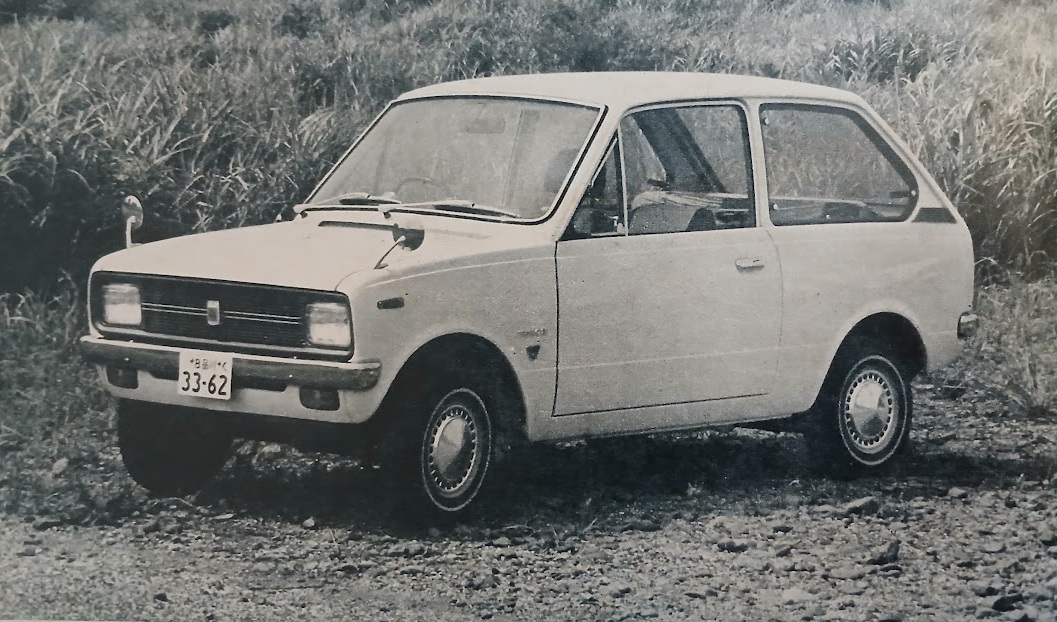
Mitsubishi Minica 70 (1969)
Publication: Motor Fan
Format: Road Test
Date: October 1969
Author (Roundtable): Yukichi Mochida, Hiroshi Hoshijima, Isao Imai, Akio Miyamoto, Osamu Wake, Kenji Higuchi, Atsushi Watari, Katsuhiko Makino, Hajime Hattori, Taizo Tateishi, Kasuo Kumabe, Kunitaka Furutani, Kenzaburo Ishikawa, Masahide Sano, Toshihide Hirata, Minoru Onda, Jiro Takahashi, Motor Fan Editorial Staff (uncredited)
Aiming for a Small Passenger Car
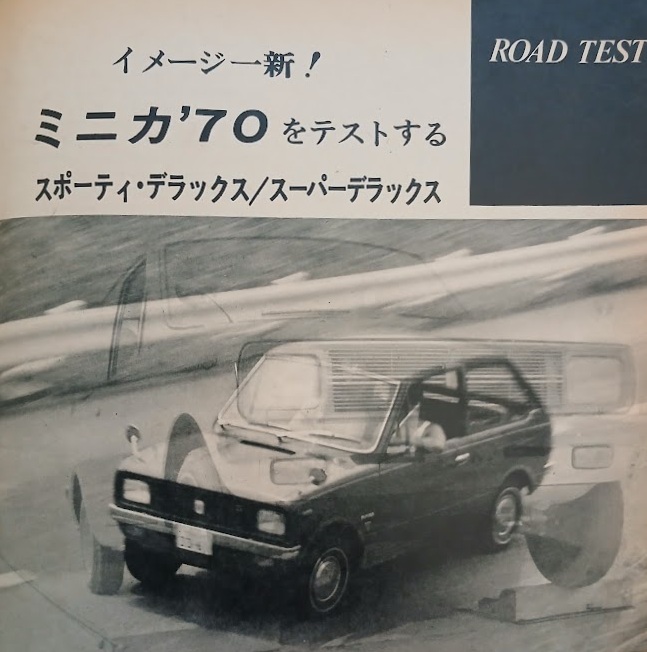
Magazine: The Mitsubishi Minica 70 has been introduced with completely new styling for the first time in seven years. Mr. Mochida, perhaps you could begin by telling us about its key features.
Mochida: Today, there are 3.7 million kei 4-wheelers among the 14 million vehicles in use in Japan. In other words, kei vehicles account for about 25% of the total. I think these kei 4-wheelers have played an important part in supporting Japanese industry and, indeed, every aspect of our way of life. We ourselves built a passenger car within these regulations in 1961, about eight years ago, and together with Suzuki, Mazda, and Fuji Heavy Industries, we worked hard to develop this field. Then, several years ago, Honda and Daihatsu entered the market, and we felt we could hardly stand still. The Minica 70 is the result of our determined efforts to come up with our response.
Within this class, which also receives preferential treatment under the tax laws, we wanted to make a car that would be as practical as possible and make a real contribution to people’s everyday lives. As a result, our first objective was to make the interior as spacious as possible. In order to provide fore-and-aft room approaching that of a 1000cc “popular” car, we adopted the familiar link-type rear suspension with a Panhard rod, allowing the rear suspension to be moved farther back. We also gave a great deal of thought to the rest of the layout, trying to provide as much fore-and-aft legroom as possible and improve passenger accommodation.
The SS, our sports sedan, can produce about 36hp from 360cc. We have announced it already, although it has not yet gone on sale. But horsepower alone is not enough. We also wanted as much torque as possible, so that the car would have plenty of pulling power and hill-climbing ability. We consequently pursued both objectives, with particular emphasis on increasing low-speed engine torque, so that in pulling power and acceleration the car could keep pace with traffic in Tokyo and elsewhere.
As for the styling, because we are working within these dimensional regulations, if we were to make the car overly streamlined it would end up looking like a child’s toy. So we based the design on practicality, while at the same time trying to give it a pleasing form. That is how we arrived at this shape.
The engine layout, moreover, is neither FF nor RR, but FR. FF is certainly very attractive, but it presents some difficulties when the car is made into a van or pickup. We have a very strong track record with vans and pickups, and we did not want to abandon that established field, so we decided against FF. With RR, on the other hand, there is less room for luggage. These days there are also people who want to carry things such as beach umbrellas and guitars for leisure use, so we wanted to provide plenty of luggage space. That is why we also decided against RR.
In the end, then, we chose the orthodox FR layout, which also allowed us to provide a good-sized trunk. This autumn we will add a van version and aim to increase sales, and that is another reason we settled on the orthodox FR arrangement. In other respects as well—the use of a 2-stroke engine, for example, and making the car lightweight but still sturdy—we gave consideration to reliability and also to maintaining its value when it eventually reaches the used-car market.
Then there are the seats. Foamed polyurethane is widely used in beds and chairs, but when it is used in a car, its very strong damping generates heat, and this eventually causes the material to deteriorate. For that reason it had not been suitable for automotive use. The French company Bertrand Faure, however, developed a material in which the composition of the polyurethane, along with such factors as temperature and pressure, has been carefully worked out. It provides strong damping while generating very little heat, so that there is no deterioration through heat-induced adhesion. Taking the opportunity presented by a technical tie-up involving our cooperating supplier, Namba Press, we have adopted these seats. Their damping is very strong in both the fore-and-aft and lateral directions, and I certainly think they make the car less tiring to ride in.
I’ve gone into rather more detail than I intended, but in short, although it may be small, we wanted a car with good passenger accommodation and high practicality—one that would not break down and would require little attention. Until now, people driving a kei car have sometimes felt a little self-conscious about it, and there have been aspects of these cars that left something to be desired. With this car, however, rather than thinking of it as a kei car or anything like that, we approached it simply as a small passenger car. That is the thinking behind the finished Minica 70.
We hope our concept will find favor with a great many people and contribute to Japan’s motoring culture. Today we also have with us the department manager and assistant manager responsible for the design and testing of the car, as well as the product-planning section manager, so we would very much like to hear your honest opinions.
Styling That Makes It Look Larger
Magazine: As you were saying, the car combines practicality with a number of other appealing qualities. In particular, its styling makes it look quite large for a kei car. Perhaps we could begin with the styling.
Hoshijima: The first thing that surprised me about the styling was the steep rake of the windshield. Together with the fastback treatment of the rear, it is very hard to believe that this Mitsubishi Minica is only 3m long. And besides the styling itself, once you get inside, it is remarkably spacious. The driver’s seat in particular gives you such a smart driving position that I doubt there is anything else quite like it.
Magazine: Was making the car look larger one of the objectives from the outset?
Imai: One of our main objectives was to make it look as large as possible within the dimensions prescribed by the regulations. We also tried to incorporate flowing lines and the fastback concept we have used in our other cars as effectively as possible.
Miyamoto: Having the rear window open like that is certainly very convenient.
Imai: We had a great deal of discussion over whether the usual arrangement would be better, or whether we should use this kind of rear-flap arrangement. In the end, we decided to take the plunge and use it in order to increase the car’s utility as much as possible.
Mochida: Driving is of course the primary purpose of a car, but a car is also a tool for everyday life, so we wanted to make it something that could be enjoyed as much as possible. If you look at the catalogs for cars such as the French Renault R16 and Simca 1100, there are pictures showing the rear door open with a large potted plant being loaded, or an accordion placed inside. They give you a sense of people enjoying their lives, with the car at the center of them. We wanted to try something like that ourselves, and decided to pursue the opening rear panel as a central feature. That’s why we gave it the name “rear flap.”
Wake: Then there was the question of what form it should take. Among the various possibilities considered during product planning were whether to give the rear a more formal shape, or to go all the way and make the rear flap open. We also conducted market research. In the end, because the dimensions of a kei car are fixed, providing a separate trunk inevitably makes the shape awkward and reduces the available space.
So instead of a trunk, we provided what we call a “rear shelf,” which covers the luggage and effectively brings the trunk into the passenger compartment. We then decided to go all the way and make the rear panel open, so that things could be loaded and unloaded through it freely.
We gave it the new name “rear flap.” A door normally carries the image of something through which people enter and leave the car, and in that sense I think describing a car with a door at the rear as a “3-door” would give the wrong impression. Rather than having people think of it as a door, we thought it would be better for them to think of the rear flap as a glass panel in place of a trunk lid, opening from the rear.
We also have the 3-door Colt 11-F, but this particular type is a first in Japan, so we listened to a variety of opinions from users as well. In the end, we concluded that it would be a good idea as a new type of car, and decided to go ahead with it. We ourselves are convinced that it is extremely convenient, but we intend to watch how people respond to this styling and learn from the results. In the end, I think it will be the users who give the final verdict.
Hoshijima: It certainly is convenient. Cars of this type have tended to be disliked in the past because they give the impression of a light van, but this one doesn’t really have that image, does it?
Higuchi: I enjoy leisure activities myself, so I’d like to have a light van, but the trouble is that everything you’re carrying is completely exposed. You see people putting a cloth over their luggage for that reason, but this car has a cover neatly fitted over the top. And then there’s the idea of “It’s not a door, it’s a flap.” You’ve really paid attention to the details.
Watari: I think this is almost too luxurious for a kei car. Well, I understand the desire to make it as luxurious as possible, since that’s what Japanese buyers like, but….
A Choice of Air-Cooled or Water-Cooled Engines
Magazine: You’ve also increased the power of the engine….
Imai: We’ve been producing air-cooled two-stroke engines for about eight years now, and have built roughly 700,000 of them. Since the end of last year, we’ve also been producing a water-cooled two-stroke. With the Minica 70, both water-cooled and air-cooled engines are available. Previously, the water-cooled engine produced 23hp and the air-cooled engine 21hp, but with various improvements this time, we’ve increased the output of each by 5hp.
The main changes were improvements to the exhaust system, reduced friction and intake resistance, and changes to the port timing. The most effective measure, though, was the use of a diffuser-type layout to improve charging efficiency. We conducted a great deal of testing on all these points, but if you concentrate too heavily on horsepower alone, low-speed performance inevitably suffers. So we approached the problem from both ends—low-speed performance and maximum output—and aimed for a balance that would present no problems for anyone using the car as an everyday vehicle.
We had already been using a reed valve in the engine to prevent low-speed torque from falling off too much, and we’ve made further improvements in that area as well, so there is now very little loss of torque at low speeds.
Mochida: I’d also like to explain our thinking behind offering both water-cooled and air-cooled engines. Basically, the virtues of a kei car like this are that it is inexpensive and simple. Looked at from the ideal standpoint, air cooling is obviously preferable. If only because there is no water tank or radiator, air cooling is clearly the simpler solution, and that’s why we’ve built air-cooled engines up to now. We intend to continue doing so.
On the other hand, since the car is both a tool for everyday life and something to be used for leisure, there are many customers who, while still wanting the various advantages of a kei car, would also like something a little quieter and more substantial-feeling. There are enough customers like that that we decided to produce the water-cooled version as well.
The water-cooled engine has no forced-air cooling fan, and its cylinder block is thicker, so it is certainly quieter. The intake air can also be warmed by the cooling water, which improves distribution and allows more power to be produced, and of course a hot-water heater can be used as well. It has a number of advantages. It costs a little more as a result, but there are customers who prefer those qualities, so in the interests of giving the customer a choice, we decided to offer both types.
We’ve nicknamed the air-cooled version the “Yellow Engine” and the water-cooled version the “Red Engine,” so customers can simply choose whichever they prefer. Here too, our thinking was that a car like this should be made as approachable and familiar as possible. In the past, engines tended to be given rather difficult, highly mechanical names, but we wanted something people could readily identify with, so we decided to distinguish these engines by color.
The engines themselves are actually color-coded. On the Red Engine, the air cleaner and other components are all red, and the cylinder block is red as well. The moment a customer opens the hood, they can immediately recognize, “Mine has the Yellow Engine,” or “Mine has the Red Engine.” We’re making use of color in that way. The engine compartment inevitably tends to be rather drab, so we’ve taken a completely different approach from the past.
Higuchi: What has the sales ratio been between the air-cooled and water-cooled engines so far?
Wake: Among the passenger cars, it’s about 40% water-cooled and 60% air-cooled. There are various opinions on the subject, and as Mochida was saying earlier, air cooling does have some very real strengths. Some customers recognize advantages such as the engine starting immediately even in winter, and choose the air-cooled version for that reason. With water cooling, on the other hand, there are advantages such as quieter operation and more effective heating.
Watari: Are the prices the same? How much of a difference is there?
Makino: There are four models: Super Deluxe, Sporty Deluxe, Deluxe, and Standard. The upper two are water-cooled and the lower two air-cooled. The Super Deluxe is 388,000 yen and the Sporty Deluxe 368,000 yen. Then the price comes down another 20,000 yen to 348,000 yen for the Deluxe, while the Standard is 318,000 yen. Those are all Tokyo delivery prices.
Watari: I’m not so sure about there being that much difference in price between the air-cooled and water-cooled models.
Mochida: The differences aren’t simply a matter of water cooling versus air cooling. The instrument panel is more attractively finished, for example, and there are differences in other areas as well.
Link-Type Suspension
Magazine: Perhaps you could tell us about the chassis next.
Imai: Previously, we used leaf springs for the rear suspension, but this time we have adopted a layout with four links, upper and lower, and a Panhard rod providing lateral location. With that arrangement, of course, the leaf springs have been replaced by coil springs. With leaf springs, their required length is determined by such factors as stress, so on the previous Minica, there was simply no way we could move the rear wheels any farther back.
By adopting this link-type arrangement, we were able to move the rear wheels about 100mm farther back. The wheelbase was previously 1.90m, whereas it is now 2.00m, and the entire additional 100mm has been devoted to improving passenger accommodation. There are already a few link-type suspensions in Japan, but after experimenting with various ideas, we settled on the Panhard-rod arrangement. I think it is probably the most orthodox form of link-type suspension.
As for the front, previously that also used a transverse leaf spring suspension. This time, particularly because the car is so small, and with production efficiency in mind as well, we adopted a MacPherson-strut layout with a stabilizer. So, whereas the previous car used leaf springs at both front and rear, this one uses coil springs at both ends, each with hydraulic dampers. At the front, because it is a MacPherson-strut layout, the spring and damper are integrated into a single unit.
Watari: Judging from the design of the front suspension, it’s a fairly substantial arrangement, the sort you might expect to find on a 1500cc-class car. So I do wonder just how much benefit there is in fitting something that elaborate to such a small car.
Hattori: Imai has explained the suspension layout itself, but one consideration behind the design was that even kei cars are now being driven at higher speeds, so their stability has to be good. Another requirement is the maneuverability that comes from being able to turn in a very small space. You pointed out that the suspension seems rather extravagant, but that is how we came to use a construction comparable to that of an ordinary compact car.
Then there is ride comfort. Although it is a small car, we placed a great deal of emphasis on the ride, and we aimed to improve it with the adoption of the MacPherson-strut arrangement at the front and the link-type suspension with a Panhard rod at the rear. Despite the car’s very small size, this gives it stability and ride comfort comparable to those of a compact passenger car.
Watari: There is certainly a considerable improvement in running stability. Even with the same rigid axle, a trailing-link arrangement with a Panhard rod gives much greater stability than leaf springs. But I would think that the difference really begins to show only when this car is traveling at more than 100km/h. In that case, wouldn’t fitting radial tires, for example, improve things even further? I think that’s the kind of solution that is usually used instead.
Hattori: In Japan, though, radial tires are still a little too harsh in terms of ride comfort for general everyday use.
Watari: That’s what you’ve mentioned, and so what I wanted to ask was whether, despite that, you deliberately chose fairly high spring rates all around.
Magazine: On that subject, then, could we have the vibration and noise data?
Tateishi: Here are the results of the vibration tests. The sprung-mass frequency was 1.75cps at the front and 1.65cps at the rear, while the unsprung frequency was 16.0cps at both front and rear.
As for noise, these are the results recorded at Murayama. The measurements were made on the A scale. Interior noise was measured at 10km/h intervals from 40-100km/h: 74 phons at 40km/h, 75 phons at 50km/h, 78 phons at 60km/h, 79 phons at 70km/h, 81 phons at 80km/h, 81 phons at 90km/h, and 83 phons at 100km/h.
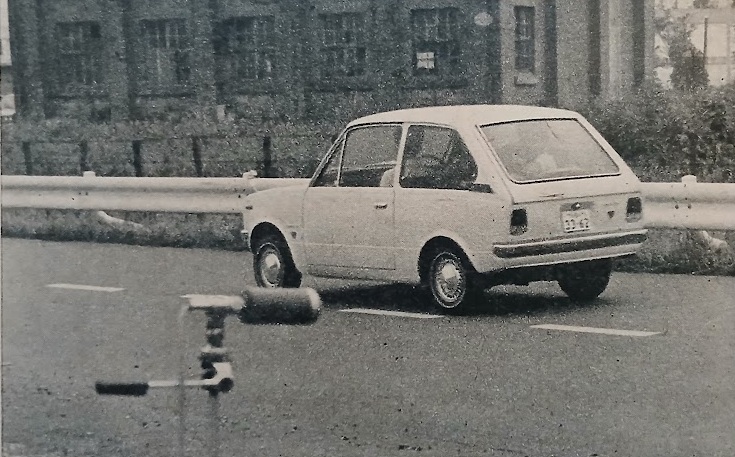
Exterior noise was measured by the ISO method. With a normal passenger car, we measure the noise at a steady 50km/h in second gear, but since this car cannot run at 50km/h in second, we made the measurement at 3000rpm. The corresponding speed was 32km/h. Exterior noise was 69 phons at a steady speed and 81 phons under acceleration.
Watari: Once you get up around 1.7cps, the ride may be good on a smooth road, but the car tends to bounce on a rough one, doesn’t it? I think it would have been better to lower the frequency a little more. The shock absorbers may be helping, of course. What is the damping like?
Tateishi: The damping is about average.
Watari: There will be some variation depending on how the measurements are made, but if those are the figures obtained by the method we’ve been using up to now, the conclusion is that the car will bounce on a rough road. In the end, I suppose there must have been a compromise with roll stiffness, from the standpoint of running stability.
But in that case, I think the roll stiffness should be provided by the stabilizer or something else, while the pure pitching and bouncing characteristics should be made a little softer. Otherwise, I think the car will be rather uncomfortable on rough roads.
Imai: We tested about three different spring rates at the front and made the final choice after considering the overall results, but the figure you’ve measured does seem a little higher than we expected.
22.4 Seconds for 0-400m
Hattori: There’s something I’d like to ask you. The noise level seems to decrease gradually as the car accumulates mileage. What is the reason for that? It becomes quieter as the car is run in.
Watari: Wouldn’t that be because the engine and its related parts are bedding in? If it’s the engine, that is. If it were the body, you’d expect it to get worse rather than better. How much difference is there between the figures you measured and these?
Hattori: Ours are lower at the lower speeds and higher at the upper end. In absolute terms, there’s a difference of about 3 phons.
Watari: That’s an honest answer. The surface at the Murayama course has deteriorated lately, and our readings there come out about 3-4 phons higher than they do on the manufacturers’ test courses, so I think that accounts for it. All the figures we give here are measured at Murayama, and they therefore come out higher than they would on a good road surface such as the Third Keihin Expressway. So when comparing these figures with those of other cars, you have to bear in mind that they were all measured at Murayama.
Hoshijima: I didn’t drive the air-cooled version, so I can’t comment on that, but the previous car certainly wasn’t quiet. Even with the water-cooled version, from inside the car, I didn’t think, “This is water-cooled, so it’s quiet.”
Watari: Then again, there’s a certain manufacturer that tells us, “It’s quiet because it’s air-cooled,” so who knows?
Hattori: In the range normally used on ordinary roads, around 60-70km/h, there doesn’t seem to be much difference between the two. At higher speeds, the air-cooled version is somewhat noisier than the water-cooled one.
Kumabe: It is a little noisy. (laughs) But perhaps it’s wrong to expect too much from a car of this size.
And if you ask how you would make it quieter, perhaps the only answer is to make the car larger.
Watari: The real problem is the displacement limit. It affects everything. So if, in connection with the pollution problem, the displacement limit were to be removed, I imagine an engine of around 500-600cc would be put in the car. Personally, I’d like to see about 800cc. I think that’s what the car really ought to be.
Magazine: Then could we have the results of the performance tests?
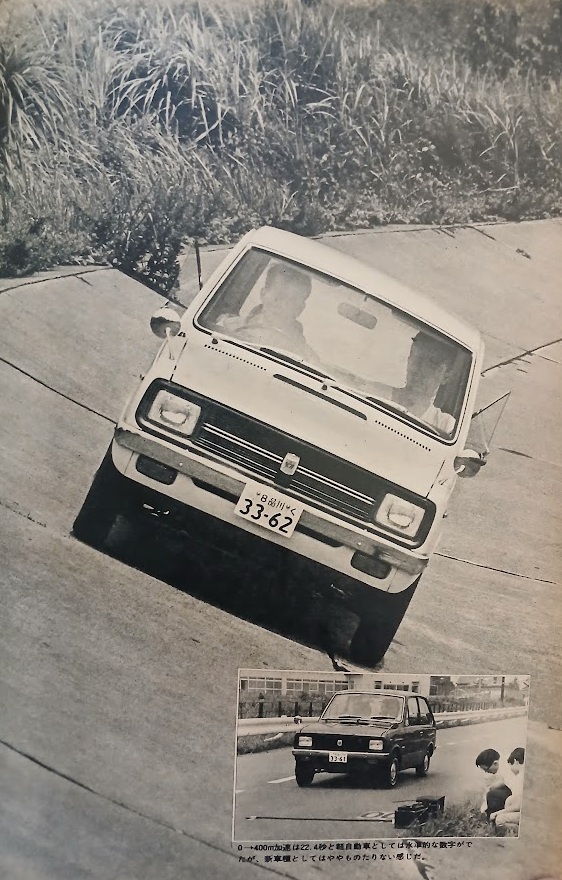
Furutani: The catalog curb weight is 450kg. Three people and the instruments added another 179.5kg, for a total of 629.5kg. From a standing start, it covered 0-50m in 5.7 seconds, 0-100m in 8.7 seconds, 0-200m in 13.8 seconds, and 0-400m in 22.4 seconds.
In terms of speed against time, it accelerated from 0-20km/h in 1.6 seconds, 0-40km/h in 4.6 seconds, 0-60km/h in 8.9 seconds, and 0-80km/h in 16.5 seconds.
Next, in acceleration from 30km/h in third gear, it reached 40km/h in 3.1 seconds, 60km/h in 8.0 seconds, and 70km/h in 10.9 seconds.
In top-gear acceleration from 40km/h, it reached 50km/h in 5.0 seconds, 60km/h in 10.1 seconds, 80km/h in 20.1 seconds, and 90km/h in 26.6 seconds. During the standing-start acceleration test, there was a wind of 2-3m/sec from about 40° to the right. It seemed to drop off a little at higher speeds, but the 0-200m time was 13.8 seconds, exactly the same as the catalog figure.
Magazine: How was the acceleration in terms of feel?
Furutani: From the initial pickup, the acceleration was strong enough that you could feel it in your back.
Magazine: The gearing seems a little too low, doesn’t it?
Furutani: We also tested the maximum speed on the test course. Even when the engine entered the red zone, it still had power, but it felt as though the revs were being held back.
Hoshijima: Leaving first gear aside, it’s rather restrictive not to be able to reach 50km/h in second. Even in third, I certainly wouldn’t have the nerve to rev it all the way to 80km/h. It seems to me that the gear ratios could be made a little taller. Or perhaps simply making the final drive taller would make things easier. What do you think?
Wake: What you’re pointing out was one of the issues we considered in product planning. Ultimately, it was a question of whether to bias the characteristics toward the low-speed or high-speed side, and for the high-speed side we will have the SS.
So we chose gearing that we thought would be most suitable for customers in areas with hills and mountain roads, as well as those who use expressways. As you mentioned, it is true that we have biased the characteristics somewhat toward the lower-speed side. In other words, although the engine has the power, we tried to make as much of it as possible available at lower speeds. Our thinking is that the SS will adequately cover the high-speed side.
Ishikawa: Once you’re running at 105-110km/h, there’s no acceleration left, is there?
Higuchi: Doesn’t it become tiring once you’re over 100km/h?
Ishikawa: I didn’t find it particularly tiring.
Hoshijima: The driving position itself is comfortable. This hasn’t been mentioned yet, but the gear lever has a very short movement. It goes into gear with a nice, positive click, and has very good feel.
Effective Brakes
Magazine: Next let’s have the fuel-consumption figures from the Oguchi laboratory.
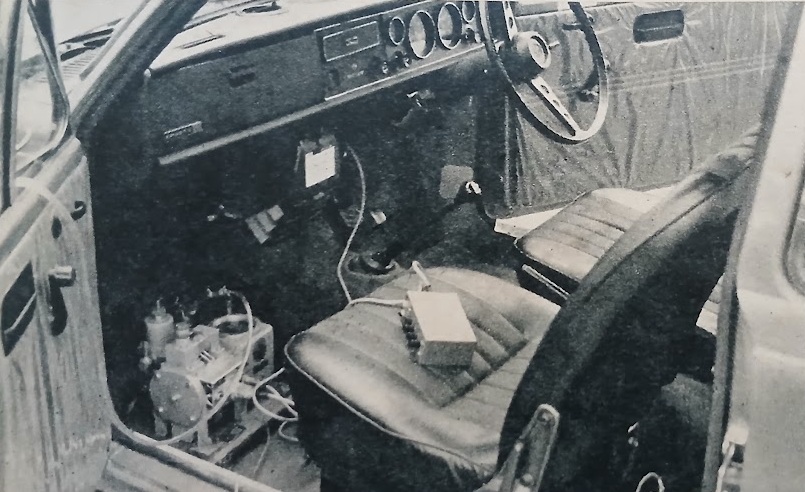
Sano: Beginning with steady-speed fuel consumption, it was 27km/l at 40km/h, 23.6km/l at 60kmh, 18.6km/l at 80km/h, and 11.4km/l at 100km/h. The best figure was 27km/l at 40km/h.
Then, in the simulated urban driving test intended to represent conditions in Tokyo, fuel consumption was 14.5km/l at a maximum speed of 40km/h, and an average speed of 22.5km/h. At a maximum of 60km/h and an average speed of 25.4km/h, it was 10.3km/l.
Actually, this was the first time we’d conducted this test on a kei car. The test conditions call for starting in first gear, reaching a maximum acceleration of 0.3g, and then continuing at 0.2g. It also requires starting from idle, and in this car 0.3g felt close to full acceleration. In ordinary city driving, of course, you raise the engine speed before engaging the clutch, so that may not present a problem. But particularly in the 60km/h cycle, the fact that the test procedure demands something close to full acceleration results in the rather unfavorable figure of 10.3km/l.
Magazine: Next, could we have the results of the measurements at the Ship Research Institute—the weight, alignment, and brake tests?
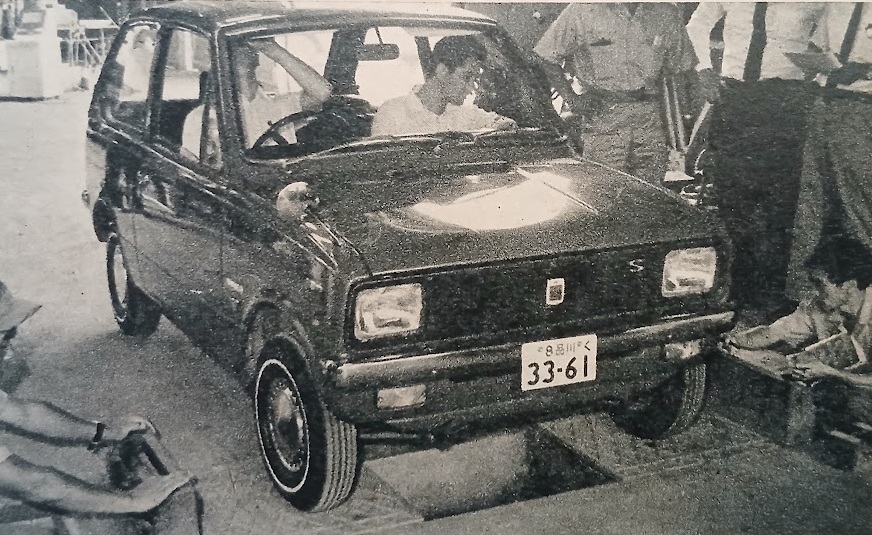
Ishikawa: Here are the test results. Against the catalog weight of 450kg, the test car weighed 471kg, including the spare tire and tools. The model tested was the Sporty Deluxe. Of that 471kg, 247kg was on the front wheels and 222kg on the rear, giving a distribution of 53:47. With one or two occupants in the front seats, the distribution changed very little, although there was a slight increase at the rear. With four people on board, total weight was 670kg and the distribution was approximately 45:55, so the rear load increased somewhat.
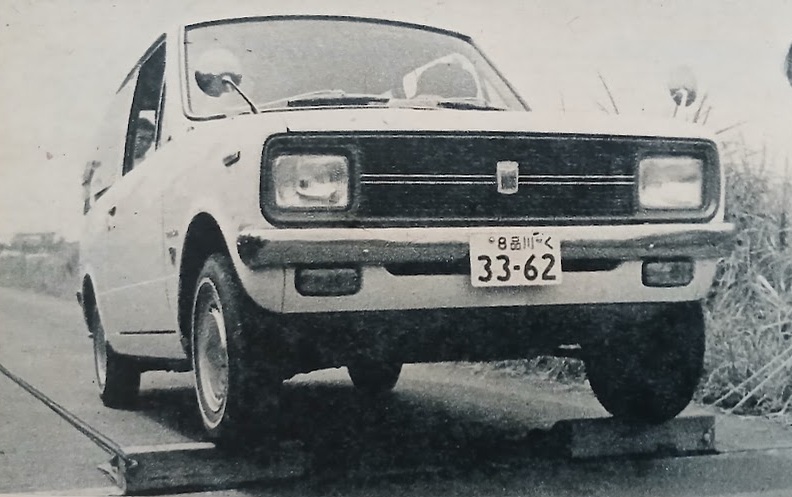
Next, wheel alignment. On the side-slip tester, both the front and rear wheels showed zero side slip in the forward direction. Looking at the individual contributions of toe-in and camber, each amounted to about five divisions on the side-slip scale, so both camber and toe-in are set somewhat stronger than average.
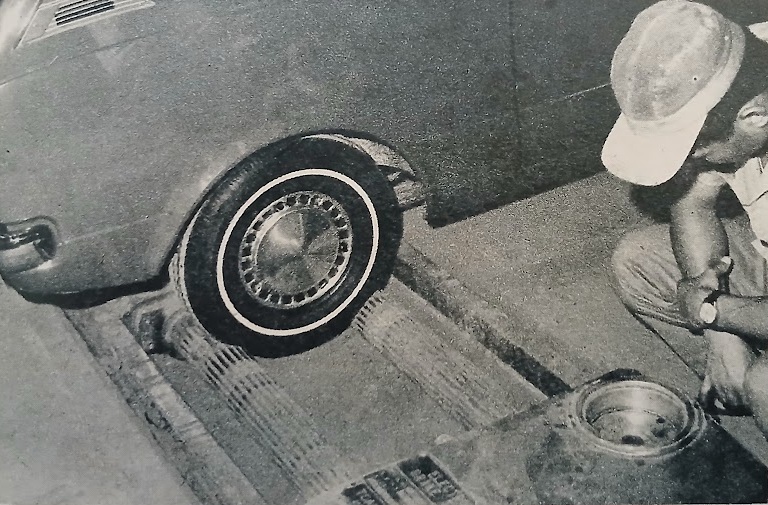
As for the brakes, the front drums are twin-leading and the rears leading-trailing, which is a somewhat elaborate arrangement by the usual standards of a kei car. As a result, braking effectiveness is quite good: 0.6g deceleration requires pedal effort of about 22kg. The braking force is also quite evenly balanced from left to right. Front-to-rear distribution is 2:1.
As for pedal travel, the front brakes begin to take at a pedal effort of about 3kg and the rears at around 5kg. Once both have begun to operate, the pedal rate remains almost constant at about 1.3kg/mm. That’s about an average figure for conventional hydraulic drum brakes. The parking brake operates mechanically on the two rear wheels and uses a floor-mounted lever. Its effectiveness is very good.
Magazine: What did you think of the pedal layout and driving position?
Higuchi: I consider the noise level and the way it drives as about what you would expect from a car like this, so viewed in the sense of a second car, I think it’s very well done.
Magazine: We’re told these are the first polyurethane-foam seats used in a Japanese car. They feel rather different, don’t they?
Hoshijima: I found them soft, and as I sat in them I began to wonder whether they might lose their shape with use. How durable are they?
Imai: In our fatigue test, we repeatedly compressed the material from 50mm to 5mm about 250,000 times, and I believe the permanent set was around 3%.
With ordinary urethane foam, it is around 40%. Ours shows surprisingly little permanent set.
Magazine: What about moisture absorption?
Hoshijima: In hot weather, I suppose there’s only so much you can do. I certainly found myself sweating.
Magazine: And what did you think of the steering?
Hoshijima: The first thing that surprised me about the steering was how tightly the car could turn. In fact, that same day I took out some other kei cars as well and drove them one after another, and this unquestionably had the tightest turning circle. The steering also feels lighter than before. I thought that might have something to do with the new front suspension.
Cornering has improved over the previous car, particularly at higher speeds. On the other hand, when driving over surfaces such as streetcar tracks, quite a lot of kickback comes through the steering wheel.
Magazine: Is the steering mechanism the same as on the previous Minica?
Imai: Previously we used a worm-type steering gear, but this time it is a recirculating-ball type, so it is certainly a more sophisticated mechanism. Although this is a kei car, structurally it may now differ very little from an ordinary compact passenger car.
A Wide Field of Vision
Magazine: Professor Hirata, could we have the visibility measurements?
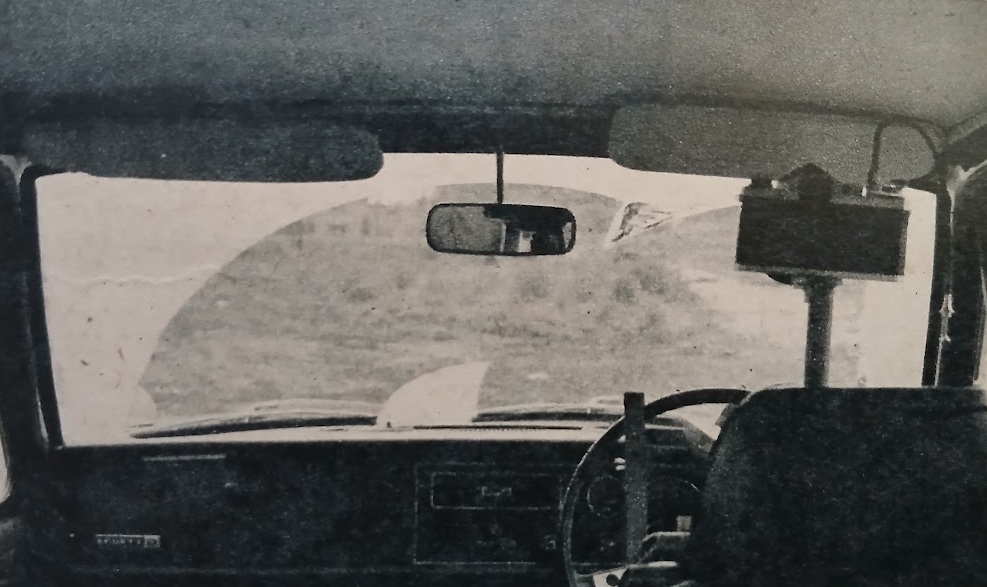
Hirata: These are the results measured from the center of the seat. The eye point is 127cm above the ground, 48cm from the windshield, and 45cm from the inside rear-view mirror. The visible range through the windshield is 29.5° to the right and 62° to the left, for a total of 91.5°. Vertically, it is 13° upward and 14° downward, for a total of 27.5°. Through the rear window, the visible range is 9° to the right and 33.5° to the left, totaling 42.5°. Vertically, it is 5° upward and 11° downward, for a total of 16°.
In the horizontal plane through the eye point, the area swept by the wipers extends 20° to the right and 46° to the left, for a total of 66°. The resulting blind angle is 47.5° overall. This is quite large because the rear-view mirror lies in the horizontal plane through the eye point.
The forward field of view is 19.5°. Expressed as a solid angle, the total field ahead of the eyes is 1.56 steradians, of which the windshield accounts for 0.625 steradians. The area swept by the wipers is 0.37 steradians, or about 59.2 percent—roughly 60 percent of the windshield area. The rearward visible range is 1.42 steradians. Small cars generally provide good visibility, but compared with an ordinary passenger car, this one is exceptionally good. Through the inside rear-view mirror, the rearward field is 28 degrees, and roughly 52–69 percent of the rear window can be seen.
Magazine: The glass area certainly is very large. Was that a concern from the standpoint of styling? I imagine you gave it some thought.
Imai: We deliberately lowered the beltline somewhat. There are structural and weight considerations involved, but one of our aims was also to make it easy to rest your elbow on the window sill while driving. And since the car is small in terms of overall volume, enlarging the windows helps give the interior at least a little more of a spacious feeling.
Hoshijima: With the steeply raked windshield and the large window in the rear flap, the interior feels tremendously spacious and bright. That’s one of the car’s major features.
Magazine: As for the view to the side, wouldn’t it have looked even more open without the vent windows? (laughs)
Imai: Actually, we put a good deal of effort into the ventilation system on this car. Fresh air is taken entirely through the scoop on top of the hood, and that air can be used both for heating and for ventilating the interior. We had some discussion about it, but since we expect a car like this to spend much of its time in city driving, we decided to retain the vent windows as well. For export markets, too, it seems that having vent windows is sometimes considered a requirement. From the standpoint of visibility, however, I agree that it would be better without them.
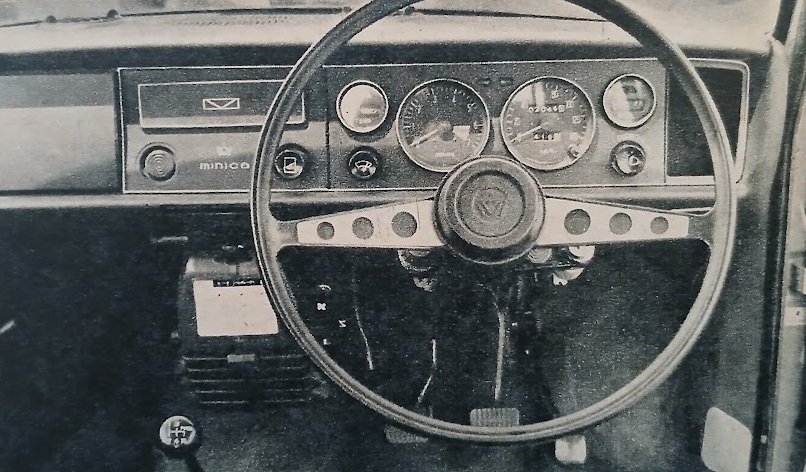
Magazine: The way the fresh air enters is a little unusual as well. It comes out from the top of the instrument panel.
Imai: When you want to defrost the windshield, you can rotate the outlet into position and use it as a defroster. Turn it the other way and the air can be directed toward your face, so it serves both purposes.
Magazine: Could we have the results from Higuchi’s laboratory?
Onda: I’ll begin with the dimensions. Since this is a kei car, its width and length are fixed by the regulations, so there is nothing particularly noteworthy there. But the wheelbase, which you went to considerable trouble to obtain through the suspension design and other measures, has been put to very effective use in the dimensions around the rear seat and luggage area. And with such features as the rear flap, you’ve boldly adopted an approach that is quite new for a passenger car.
As for the interior dimensions, to put it briefly, you’ve made extensive use of ideas that we have long known would be functionally desirable in a passenger car, but which for one reason or another have not been adopted. From the standpoint of actual use, I think that’s very good.
To give a specific example, the spare tire is suspended externally beneath the car. That has been done on light vans, but here it allows the rear seat to be set very low, along with the arrangement of the fuel tank and other components. For a kei car, I think that’s a very valuable use of the available space. The rear flap, too, is commonplace on light vans, but using it on a passenger car is quite novel—even from Motor Fan’s point of view. And as has already been mentioned, I think you’ve also achieved a driving position that doesn’t make you feel you’re in a kei car.
Since you went so far in pursuing function by putting the spare tire underneath, though, I wonder why its retaining screw isn’t placed outside as well. Having gone that far, it seems to me you might just as well carry the idea through completely and put the screw outside. It would only mean changing the angle of the screw. Suspending the spare outside was already quite a bold step, so I can’t help feeling you might as well have gone all the way.
Magazine: As it is now, you still have to take all the luggage out before you can release the spare tire, just as before.
Improved Safety Equipment
Higuchi: Finally, I’ll talk about safety and maintenance. What gave me a different impression of this car is that the things that really matter have been properly taken care of. For example, the brake adjustment is quite elaborate, with the same automatic adjustment used on 1200cc and 1500cc cars. The seats also look considerably more robust.
As usual, I checked 30 items on a five-point scale. Cars in the 360cc class generally score around 70 points, but recently many of them have acquired all sorts of equipment that looks safety-related at a glance, and on that basis this car’s score comes out around average for its class. The numerical score may be much the same, but what strikes me as different here is that the important safety equipment has been provided where it really matters. For example, it doesn’t have an armrest simply for the sake of appearance, and it loses points for omissions of that sort. That’s why its score ends up about the same as the other cars.
As for maintenance, a 2-stroke is actually extremely easy to look after. There are no engine-oil changes, which is the most bothersome job of all, and the suspension and other parts require virtually no greasing either. For what remains, it should be enough to have a service station look the car over every 5,000km. If it were mine, I’d probably do nothing at all for 40,000km. For a kei car, a 40,000km interval really does amount to maintenance-free motoring.
Ishikawa: The warranty of two years or 50,000km is excellent.
Magazine: Finally, could you tell us about the production plans and sales?
Takahashi: Our initial sales plan called for 6,200 units as production got under way, followed by 7,000 and then 8,000. But sales have been unexpectedly strong, reaching 10,000 units, so we’ve instructed the factory to move quickly to a production rate of 10,000 units. Perhaps our forecast was too conservative, but in any case, sales have exceeded our expectations.
Magazine: Thank you all very much.
Postscript: Story Photos