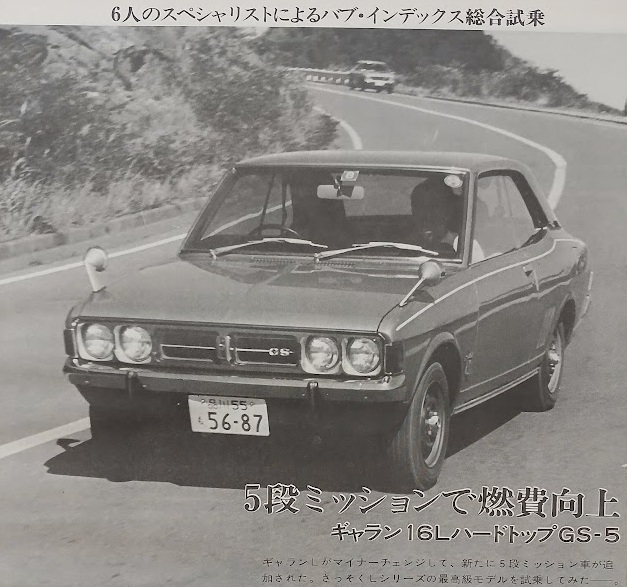
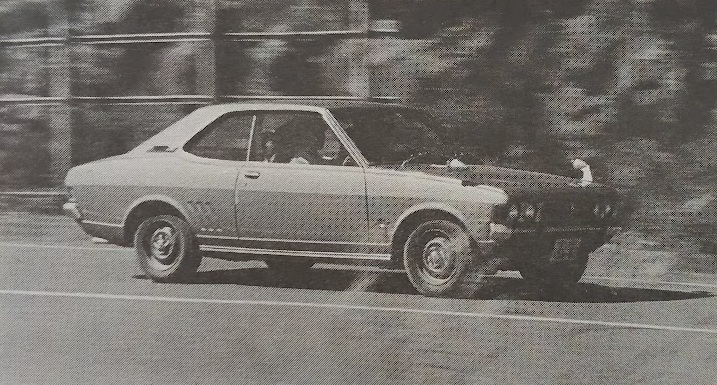
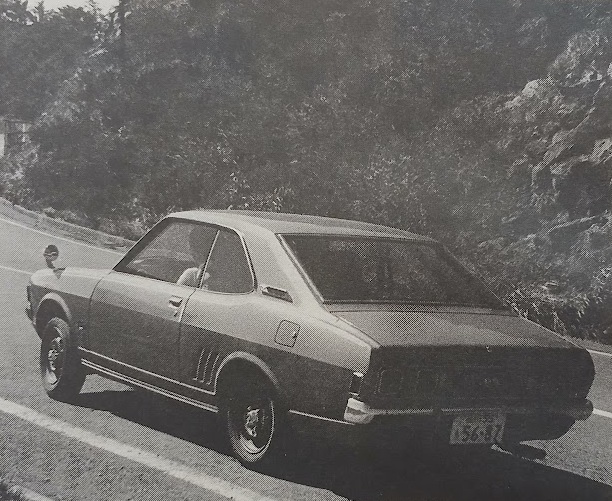
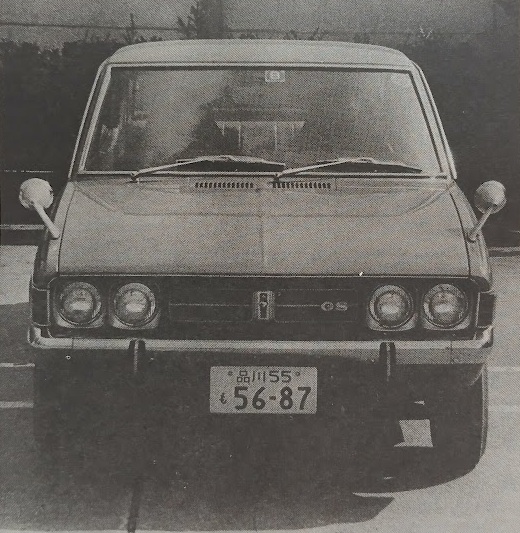
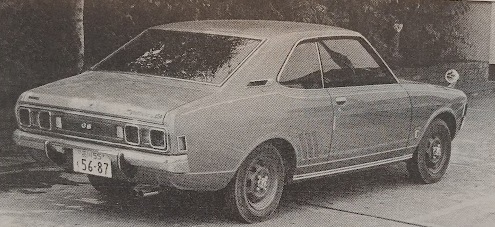
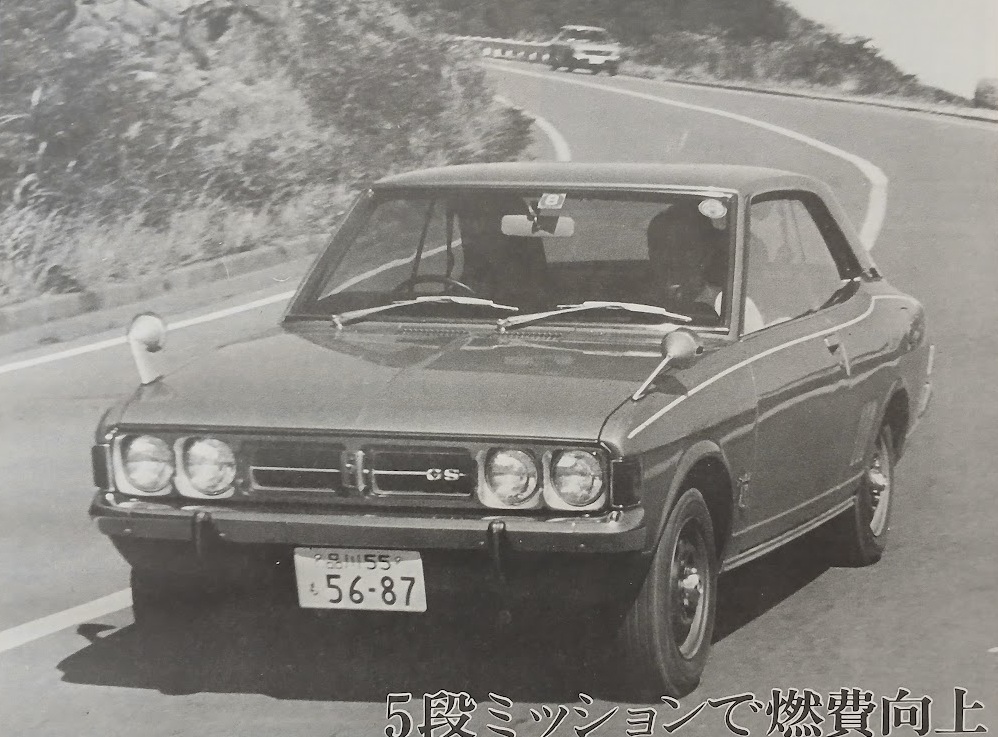
Mitsubishi Colt Galant 16L Hardtop GS-5 (1972)
Publication: Motor Fan
Format: “Bubble Index” Road Test
Date: November 1972
Author: Osamu Mochizuki, Katsuzo Kageyama, Tadao Suzuki, Yasuhei Oguchi, Reiko Ikuuchi, Kensuke Ishizu
Improved Fuel Economy with a 5-Speed
The Galant has undergone a minor update, highlighted by the addition of a new 5-speed transmission model. We wasted no time in putting the top-of-the-line L-Series version through its paces.
Expanding the Wide-Selection Lineup
Autumn is new-car season. Every year, right up until the opening of the Tokyo Motor Show, the industry is flooded with full model changes and minor updates.
The 1973-model Galant L was announced on August 23. For the automotive press, Mitsubishi chose simply to distribute technical materials rather than hold a formal presentation.
Perhaps the changes were judged too modest to justify gathering the press for a detailed briefing.
In any case, the most noteworthy development was the addition of 5-speed transmission models. Beyond that, the revisions amounted mainly to refreshed front-end styling and changes to various badges and emblems.
The positioning of the 5-speed models within the lineup is as follows: the 14L series has gained the SL-5, while the 16L series received the GS-5 sedan and the GL-5 and GS-5 hardtops. All went on sale September 1.
These additions further strengthened the breadth of the Galant range. With 14L and 16L sedans and hardtops, plus the GTO, FTO, and Estate V, Mitsubishi now offered a complete model line, and cumulative sales have reportedly surpassed 300,000 units.
This is the second time the Bubble Index comprehensive test series has featured the Galant. In the November issue of last year, we tested the Galant 14L SL. Looking back at the fuel-economy figures from that test, the results over the test route were 10.5km/l for the first section, 9.3km/l for the second, and 11.8km/l for the third. The SL was equipped with a 1439cc, 92ps engine and a 4-speed transmission.
The Galant 16L Hardtop GS-5 tested this month uses a 1597cc, 110ps engine and a 5-speed gearbox. Over the same test route, its fuel-consumption figures were 12.6km/l in the first section, 10.3km/l in the second, and 14.1km/l in the third–a dramatic improvement over the SL.
For reference, our support car on this test was a Galant 14L SL-5 (1439cc, 92ps, 5-speed). Its figures were 12.2km/l, 10.6km/l, and 14.2km/l respectively. This confirmed that the 5-speed transmission improved fuel economy compared with the 4-speed SL, but even so, the GS-5’s results were remarkably good. The overdrive fifth gear (0.854:1) clearly deserves much of the credit.
At the same time, the 5-speed gearbox proves useful in city driving as well.
“You can practically leave it in fifth all the time.” — Mochizuki
Professor Kageyama, who evaluated handling and stability, also remarked:
“At first the steering felt surprisingly light, and I worried the car might wander at high speed. In fact, its hands-off stability was excellent. In corners, the steering loaded up reassuringly in your hands, making the car easy to place.”
Associate Professor Oguchi, responsible for the safety evaluation, was equally complimentary:
“Above all, the car combines a natural, honest driving feel with a welcome sense of strength. These qualities may not contribute directly to safety, but they certainly encourage safe driving in a subtle and reassuring way.”
The details of those impressions are best explored in the reports from each of our specialists that follow.
One final note: because Shigeki Asaoka, our regular contributor for the Ride and Comfort category, was once again traveling overseas, his place was taken by Motor Fan staff writer Tadao Suzuki for this test.
Performance: A 5-Speed You Can Use Around Town (Osamu Mochizuki)
Mitsubishi unveiled the 1973-model Galant on August 23, adding a new range of 5-speed transmission models. The facelifted front-end styling was the most obvious change, but there were significant functional revisions as well, including the adoption of the MCA clean-engine system and the new 5-speed gearbox.
From a performance standpoint, the 5-speed transmission naturally attracts the most attention. It is available throughout the L-Series lineup, including the 14L and 16L four-door sedans as well as the hardtops.
By now, most manufacturers seem to have completed the transition to offering 5-speed transmissions within their passenger-car ranges. The advantages generally fall into three categories: reduced noise while cruising in top gear, improved fuel economy at high speeds, and enhanced acceleration performance. Yet a closer examination of the various gear ratios reveals that each manufacturer has pursued these goals somewhat differently.
Broadly speaking, current 5-speed transmissions fall into three types. Some retain the existing 4-speed ratios and simply add an overdrive fifth gear. Others leave the former top-gear ratio unchanged and insert an additional ratio below it. Still others adopt an entirely new set of gear ratios from top to bottom, creating a fundamentally new transmission.
The Galant L’s 5-speed gearbox belongs to the third category, although its ratios suggest a compromise between the latter two approaches. To compare the new gearbox accurately with the old 4-speed, it is useful to normalize the ratios by treating 5th gear in the new transmission as 1.000 and expressing the remaining gears relative to it. On that basis, the new gearbox becomes: 1.000 in fifth, 1.171 in fourth, 2.289 in third; and 3.791 in first. Expressed on the same scale, the old 4-speed’s top gear would be 1.078, followed by 1.555 in third, 2.365 in second, and 3.802 in first. Viewed this way, the 5-speed’s ratios provide closer spacing and should offer both better acceleration and improved ability to maintain speed through the gears.
The 4G32 1600cc engine has long enjoyed a reputation for excellent responsiveness, and the addition of a fifth gear makes its performance all the more impressive. The car delivers acceleration comparable to that of sports sedans two classes above it. In particular, the overall ratio of 4.222 in fourth gear is exceptionally well judged. It provides strong response across a remarkably broad speed range, from 20km/h all the way to 160km/h. It feels very much like a dedicated gear for the enthusiast driver.
Fifth gear, with its overall ratio of 3.606, has a more relaxed character. At 1500rpm the car is already traveling at 40km/h, yet the engine remains perfectly smooth. It is entirely possible to leave the car in fifth while driving around town, enjoying a level of refinement comparable to that of an ordinary family sedan.
The Galant’s quick steering and sharp responses make it fully capable of genuinely sporting driving. At the same time, its broad torque curve and suspension tuning–which sacrifices little in ride comfort–allow it to serve equally well as a family car. That breadth of capability may well be this car’s defining virtue.
“It’s a 5-speed you can actually use in city driving. On the highway, I almost found myself wishing for a sixth gear.” — Kageyama
“The acceleration in fifth gear around 100km/h is outstanding.” — Oguchi
“The engine’s responses have become more relaxed.” — Suzuki
Handling and Stability: Excellent Directional Stability and Straight-Line Tracking (Katsuzo Kageyama)
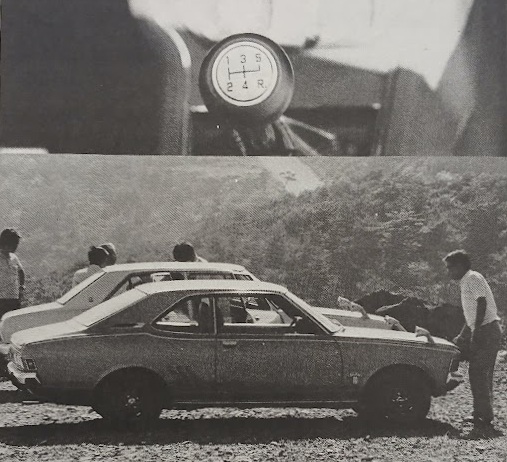
The 5-speed transmission is the headline feature of this model, but one detail immediately stands out when compared with the existing 4-speed version. Although both belong to the 16L series, the shift pattern places reverse gear in the complete opposite position. One can understand that this was dictated by the internal design of the transmission, but from the driver’s perspective it is something that ought to be standardized as soon as possible.
The reverse-lockout mechanism, which requires the shift lever to be pushed down before engaging reverse, also proved troublesome. Perhaps the transmission was simply too new to have loosened up, but selecting reverse required an inordinate amount of effort every time.
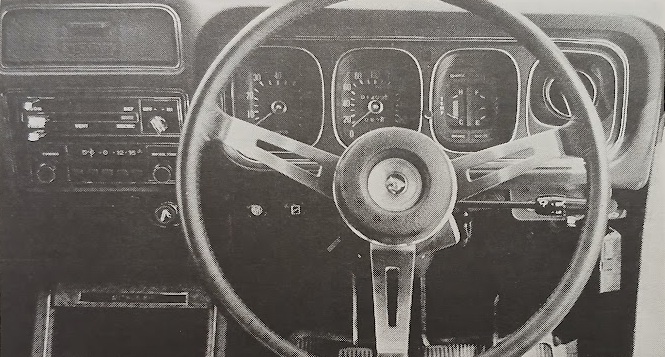
I have commented on the tilt steering wheel before, but its greatest virtue seems to be that, once the seat position has been set, the steering wheel can be adjusted so that it neither obstructs the forward view nor blocks the instruments.
The various switches and controls are thoughtfully arranged and easy to operate. My only complaints concern the somewhat heavy window regulators and the fact that both the speedometer and tachometer are rectangular rather than round. From a functional standpoint, this is difficult to rationalize.
The steering initially feels surprisingly light, enough to raise doubts about high-speed stability. Yet once out on the expressway and changing lanes at speed, it inspires complete confidence. On the winding roads around Hakone, the steering builds reassuring weight as cornering forces build, making the car exceptionally easy to place. Steering effort and self-centering characteristics are excellent at both low and high speeds, while friction in the steering is minimal.
Hands-off stability at high speed is superb, and the car settles cleanly without any tendency to wander. Body roll is relatively well controlled, and the Galant feels remarkably well-developed and easy to drive overall.
The hardtop body style itself gives a clue to this car’s intended character. Surrounded by a richly appointed interior, it is designed for drivers who want to enjoy a luxurious mood, with an added touch of style and just a hint of sporting flavor.
Its pronounced understeer, excellent directional stability, strong straight-line tracking, and light steering around the straight-ahead all suit that mission perfectly. Judged against what the car appears to be trying to achieve, there is very little to criticize.
If one were determined to find fault, it would be that the front tires squeal too easily in corners. This is related to the car’s strong understeer, and anyone intending to drive more aggressively would naturally want to pay careful attention to tire selection.
With that in mind, I was pleased to find a chart affixed inside the door listing approved tire sizes and recommended inflation pressures. It is a small detail, but one that demonstrates commendable thoughtfulness on the manufacturer’s part.
“The suspension tuning should do more to bring out the car’s performance.” — Suzuki
Ride and Comfort: A Refined Balance (Tadao Suzuki)
A 5-speed craze is sweeping through the Japanese auto industry, and the Galant has not escaped its influence.
The Galant, powered by Mitsubishi’s free-revving Saturn engine, has long ranked among the easiest domestic cars to drive. The GS-5 pairs that familiar hardtop GS package with a newly introduced 5-speed transmission.
This gearbox uses closely spaced third, fourth, and fifth gears, combined with a final-drive ratio of 4.222. As a result, it offers more finely graduated gearing at higher speeds than the previous 4-speed unit. Fifth gear is an overdrive ratio (0.854:1), which should bring benefits in both cruising refinement and fuel economy.
Even so, the appeal of the 5-speed seems to be as much a matter of atmosphere as of function.
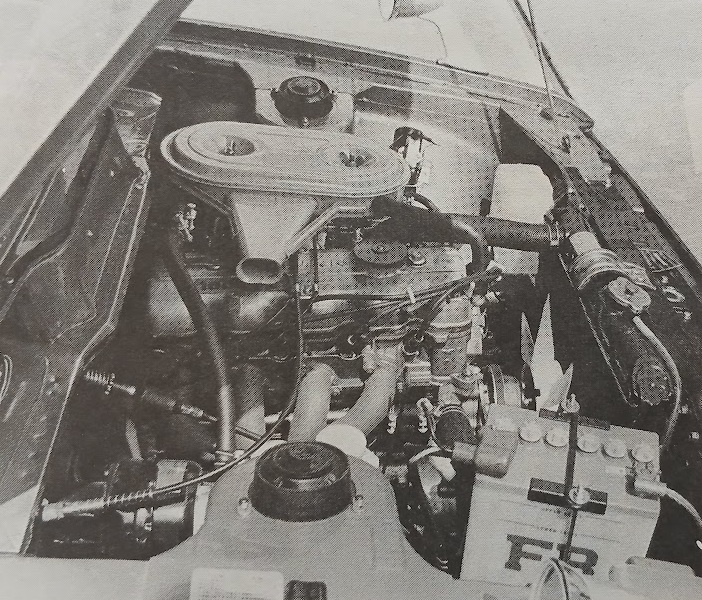
Previous GS models used twin SU carburetors, but the GS-5 uses twin Stromberg carburetors instead. The change was presumably made in the interest of reducing exhaust emissions. If cleaner emissions can be achieved without sacrificing output, so much the better. Still, I could not help feeling that a degree of sharpness had been lost. Even so, the engine remains as eager to rev as always, and whether it is paired with a 4-speed or a 5-speed transmission hardly seems to matter.
Nor has it become any quieter.
From around 3500rpm onward, it takes on a distinct high-pitched note. It is a sound with plenty of character–perhaps rather more character than necessary.
Even with the accompanying noise, the GS-5 comes alive on winding roads, where its ease of control and well-judged balance are immediately apparent. Yet one wonders whether the chassis is a little too soft for a car bearing the name “Grand Sport.”
Comfort is certainly good, but a car of this type ought to inspire confidence through a firmer suspension setup. If it could achieve that without sacrificing ride quality, so much the better.
The sleek hardtop profile inevitably places limits on interior space. Yet given Japanese traffic conditions and the average physique of Japanese drivers, this size is probably a reasonable compromise. Indeed, its manageable dimensions undoubtedly contribute to the car’s ease of use.
That said, rear-seat headroom remains insufficient. At a time when newer hardtops and coupes are showing considerable ingenuity in accommodating rear passengers, one would like to see the Galant do the same.
There is one additional request regarding the rear seat: assist grips should be fitted as standard.
As for the front seats, the Galant remains one of the few domestic cars to offer a genuinely excellent driving position. The high-back seats offer good support, and while opinions differ on the styling of the interior appointments, their execution leaves little to criticize.
One frustration extends beyond this particular model. With every minor model update, manufacturers seem compelled to redesign the instrument panel for no apparent reason. It is a trend I find exasperating.
“The debris that comes in through the ventilators is annoying. It’s unlikely to get in your eyes, but it still bothers me.” — Oguchi
“I experimented with the tilt steering wheel in search of a better driving position, but in my case it always made the left fender mirror difficult to see.” — Ikuuchi
Safety: Straightforward Handling with an Added Measure of Strength (Yasuhei Oguchi)
The combination of a favorable power-to-weight ratio and well-matched transmission gearing appears to be the key to this car’s ease of use, whether in city traffic or on the expressway. Together they reduce the driver’s workload and make the car’s power remarkably easy to exploit.
The handling, too, feels close to neutral, and its controllability leaves a strong impression. If there is one criticism, it is that the chassis could use a little more lateral rigidity during abrupt steering inputs, such as emergency avoidance maneuvers. For a model called “GS,” one expects slightly firmer underpinnings.
The steering wheel itself is relatively thin-rimmed, evidently to reduce rotational inertia within the steering system and thereby sharpen response while enhancing steering feel. If that was truly the intention, then all the more reason to give the suspension slightly firmer tuning.
That reservation aside, the steering system is admirable in the way it incorporates a variable-ratio mechanism without introducing any sense of artificiality. Steering effort while stationary may seem a little heavy for a variable-ratio setup, but if the goal was to optimize steering feel while underway, then perhaps this is the ideal compromise.
In any case, the car combines a natural, honest driving character with a reassuring sense of strength. While these qualities do not contribute directly to safety, they nevertheless promote safe driving in a subtle but meaningful way.
Another aspect of the car’s ease of operation is the quality of its braking performance.
More specifically, the brakes are exceptionally easy to modulate up to around 0.3g of deceleration, particularly in the 0.1-0.2g range drivers use most often. Some may argue that this is only to be expected in a car equipped with disc brakes rather than duo-servo drums, but the matter is not quite so simple.
While disc brakes do make it easier to achieve a smooth onset of deceleration, they can also bring disadvantages, including increased pedal travel and poor feel through the pedal as braking force builds. Power assistance can alleviate some of these issues, but the elasticity of the pedal mechanism itself also influences braking feel.
The impression left by the Galant is that its brakes are the result of careful attention to many small details. Each issue has been addressed individually, resulting in a thoroughly refined system.
Safety is not the only area where this principle applies. The same could be said of emissions control. The reality is that, however important it may be, low emissions are not a feature that captures the imagination of most buyers. Yet from the manufacturer’s standpoint it has become an unavoidable requirement–a true must-have characteristic.
In that respect, the Saturn engine deserves recognition for the number of measures incorporated to reduce emissions. Among conventional reciprocating engines, it stands out as a particularly earnest attempt to address the problem.
“Ease of driving is worth more than any safety device.” — Suzuki
Economy: The Extra 15,000 Yen Pays for Itself (Reiko Ikuuchi)
The Tokyo standard cash price of the Galant 16L Hardtop GS-5 we tested is 795,000 yen. As for the actual showroom-delivery price, another 10,000 yen must typically be added for accessories.
At 795,000 yen, the first thing one notices is that this car starts to overlap with the Galant GTO in price.
Traditionally, the Galant had been regarded as a practical family car, while the GTO occupied the specialty-car niche. But in March of this year Mitsubishi introduced the GTO XI, essentially a more accessible version of the GTO, priced at 794,000 yen. Now the flagship Galant L model has appeared at a price just 1,000 yen higher.
The two cars, however, appeal in rather different ways. The XI, with its sporty ducktail rear end and long-nose styling, offers 105ps from a single-carburetor 1700cc engine–something of a sheep in wolf’s clothing. The GS-5, by contrast, combines a 1600cc twin-carb engine producing 110ps with relatively restrained styling, making it closer to a wolf in sheep’s clothing. In an age increasingly defined by market diversification, maybe there is room for both.
At nearly 800,000 yen, the GS-5 sits in the price range of many 2-liter cars. A Mark II 2000 Hardtop Deluxe costs 787,000 yen, while a Laurel 2000 Custom lists at 800,000 yen. Standard versions of the Crown and Cedric are cheaper still. Yet the Galant’s direct rivals–1600cc twin-carburetor models–are priced similarly. A Celica 1600ST with 5-speed floor shift and a full complement of accessories costs about 770,000 yen, while the Bluebird U 1600 SSS Hardtop is priced at 794,000 yen. The Carina 1600ST 5-speed, however, remains something of a bargain at 700,000 yen, albeit only as a two-door sedan.
Compared with the standard GS, the GS-5 costs 15,000 yen more, the transmission being the only significant difference between the two. It is therefore fair to regard that amount as the price of the 5-speed gearbox itself.
Those who choose the 5-speed will likely do so because they enjoy shifting gears, but used properly it can also deliver tangible savings in fuel consumption. The official 60km/h fuel-economy figures are identical for both the GS and GS-5 at 19km/l, yet Mitsubishi’s own testing reportedly showed that at 100km/h the GS-5 traveled approximately 1km farther per liter.
As for our testing, the GS-5 returned impressively strong results over the three sections of our test route: 12.6km/l, 10.3km/l, and 14.1km/l respectively. Compared with the Galant 14L tested in this Bubble Index series last September–which recorded 10.5km/l, 9.3km/l, and 11.8km/l over the same three sections—the improvement is remarkable.
Of course, the gain cannot be credited solely to the 5-speed transmission. The 1973-model Galant also adopts the MCA (Mitsubishi Clean Air) emissions-control system, designed to promote more complete combustion. It seems likely that the resulting improvement in efficiency has contributed to the better fuel economy as well.
One final consideration concerns ownership costs. Because the 1600cc engine falls into the 1500-2000cc tax category, annual road tax rises to 24,000 yen–3,000 yen more per year than the 1400cc Galant. In addition, the car’s overall length is 4.08m. That extra 8cm is enough to place it in the higher fare category on car ferries, which begin at vehicles over 4m in length.
Product Appeal: I Cannot Agree with the Philosophy of the 5-Speed (Kensuke Ishizu)
I own and regularly drive a Mercedes-Benz 250CE. Naturally, it is equipped with an automatic transmission. My long-held belief is that cars ought to be automatic.
That is not to say I fail to understand the appeal of shifting gears for one’s own enjoyment. Recently, however, Japanese manufacturers have been adding 5-speed transmissions to their lineups almost indiscriminately.
The Galant has now joined the trend.
After driving it, I found myself thinking about the purpose and rationale behind the move to 5-speeds, but I remain unconvinced.
Mitsubishi promotes the advantages of the 5-speed by claiming that it lowers engine speed during high-speed driving, improves fuel economy, and is quieter.
To my mind, however, this amounts to little more than a deception of the customer.
Manufacturers speak of “high-speed driving” and “expressway cruising,” but does Japan truly have highways worthy of the name?
Even on the Tomei or Meishin Expressways, the legal speed limit remains 100km/h. As I mentioned in the September issue of this magazine, I myself was caught speeding by an unmarked police car on the Tomei. At 100km/h, can one honestly speak of “high speed?” To me, the term does not truly begin to apply until somewhere around 200km/h.
I recently returned from driving on Germany’s Autobahn and Italy’s Autostrada del Sole. Traffic there flowed comfortably at 130-150km/h. On the Autobahn, I cruised at 200km/h in a Mercedes-Benz 280. That was possible because three conditions existed: first, the cars themselves had the necessary performance; second, the roads were smooth and free of significant irregularities; and third, driver discipline was rigorously observed.
Unfortunately, Japan still lacks all three of those conditions, and is likely to continue lacking them for some time. Several of my reservations regarding the very existence of 5-speed passenger cars stem from precisely these domestic realities.
Aside from the addition of the 5-speed transmission, Mitsubishi describes this minor model change in terms of revised front-end styling and updated badges and emblems.
But this sort of cosmetic touch-up is little more than applying false eyelashes. It is unlikely to fool anyone.
Too often today, excessive attention is devoted to outward appearance while the substance underneath remains unchanged.
Nor do I find the idea very appealing that an owner should derive a sense of superiority merely from being able to say, “Mine is the newest.” Such satisfaction strikes me as quite petty.
We often hear that consumer power is becoming increasingly influential, and that manufacturers must build products according to consumer preferences. I disagree. If companies wait for consumers to tell them what they want before creating products, genuine progress becomes impossible.
What matters is that manufacturers approach their work seriously, honestly, and thoughtfully. When they do so, the resulting products will naturally align with the needs of consumers. In that sense, leadership should come from the producer rather than from the marketplace.
In conclusion, I believe the GS-5 is, as a sporting sedan, a fundamentally well-developed automobile.
The one question that remained with me throughout the test was the value of the 5-speed transmission itself. Given the convictions I expressed at the outset, I simply cannot endorse the philosophy behind the 5-speed passenger car. For that reason, I was rather strict in my assessment of the car’s product appeal.
“An honor student lacking a distinct personality—though, if one point deserves recognition, it is the serious commitment to emissions reduction in the engine.” — Oguchi
How to Read the Bubble Index
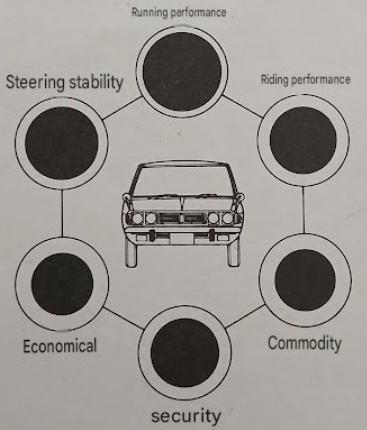
The purpose of this comprehensive road test is to evaluate a car’s overall capabilities through six principal categories: performance, handling and stability, comfort and accommodation, safety, economy, and product appeal.
The evaluation method is what we call the “Bubble Session.” Borrowing an approach from systems engineering, six specialists from different fields gather around a hexagonal table–the “bubble” referring to a honeycomb cell–and discuss the car from their respective viewpoints.
The black circles shown within the six evaluation fields indicate the rating assigned in each category. A car whose circles are relatively equal in size may be regarded as a well-balanced design, whereas one with larger disparities can be said to have a stronger individual character.
Postscript: Story Photos