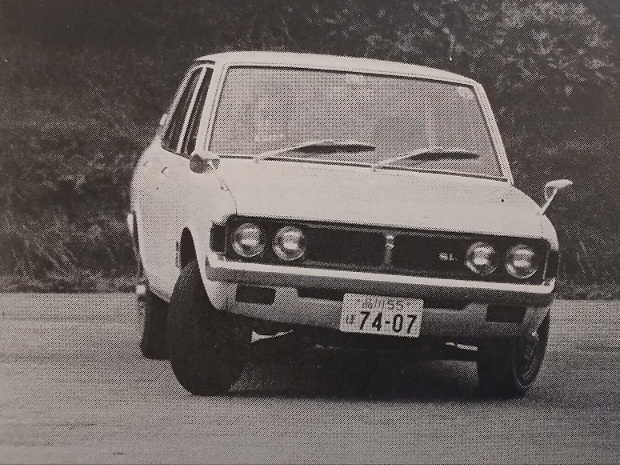
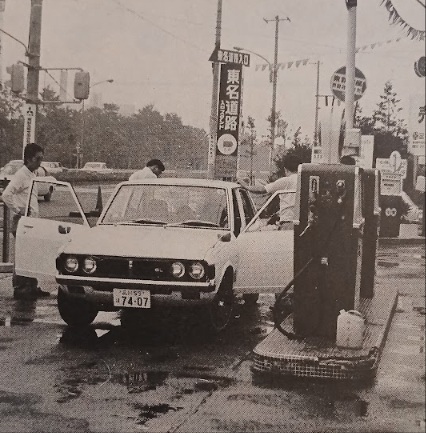
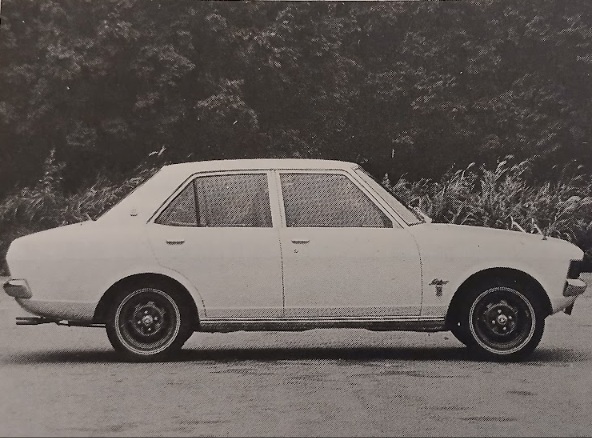
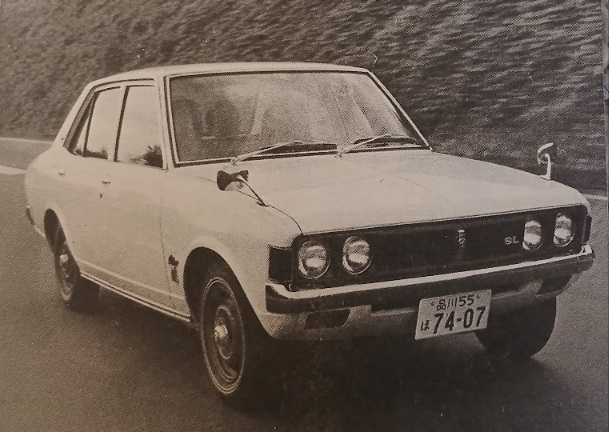
Mitsubishi Colt Galant 14L SL (1971)
Publication: Motor Fan
Format: “Bubble Index” Road Test
Date: November 1971
Author: Osamu Mochizuki, Katsuzo Kageyama, Tadao Suzuki, Yasuhei Oguchi, Reiko Ikuuchi, Kensuke Ishizu
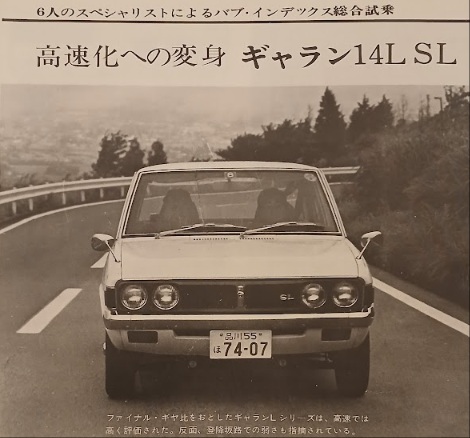
Transformed for Higher Speeds
The Galant L series, with its taller final-drive gearing, earned high marks at higher speeds. On the other hand, its weaknesses on uphill and downhill roads were also pointed out.
Smooth, Progressive Pickup
Ahead of the autumn Tokyo Motor Show, Mitsubishi Motors upgraded the power units throughout the Galant series and completely redesigned the instrument panel.
The Galant first appeared in October 1969, in two versions: the AI (1300cc) and AII (1500cc). The AI was equipped with the 4G30 engine, developing 87ps/6000rpm and 11.0kgm/4000rpm, while the AII had the 4G31 unit, producing 95ps/6300rpm and 13.2kgm/4000rpm. The AII GS was fitted with a 105ps version of the 1500cc engine, its compression ratio raised by 1.0.
The Hardtop series was added in May of the following year, 1970, but at that time the AII engine was carried over unchanged.
This latest engine transplant has been carried out across the entire Galant sedan and hardtop range, with two engine capacities now offered: 1600cc and 1400cc. The 1600cc model uses the engine from the Galant GTO MII, while the 1400cc model chosen for our test is fitted with a longer-stroke version of the 4G30 engine previously used in the AI.
As for the transmission and final-drive ratios, only the final-drive ratio has been changed, to a taller 3.889 in both the 1400cc and 1600cc models. Previously, the AI had a ratio of 4.222 and the AII 3.889.
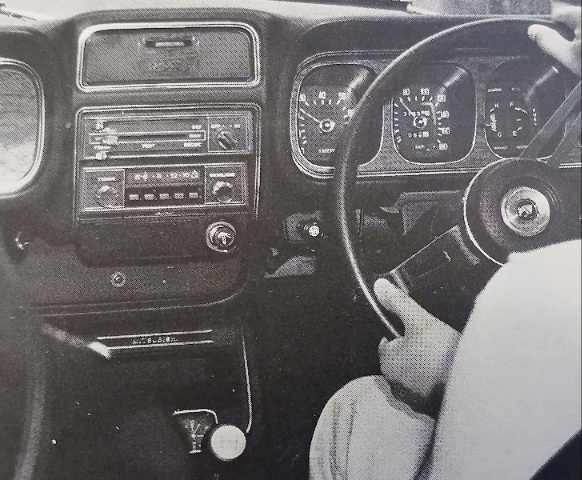
The dashboard now features the currently fashionable rectangular instruments, with a woodgrain finish for the panel.
Our test group—some of whose members drove the car that evening—then took the Galant over our customary route: from the Tokyo Interchange of the Tomei Expressway to the Gotemba Interchange, over the Otome Pass, along the Hakone Turnpike, back over the Otome Pass, and finally from the Gotemba Interchange to Tokyo.
Returning to our base at “Fantasy,” the drive-in on Tamagawa-dori near the entrance to the Tomei Expressway, the specialists exchanged their impressions of the car.
Their overall assessment could be summed up in comments such as these: “It’s become much more of a high-speed car.” “The engine runs smoothly, with natural, progressive pickup.” “It’s so quiet that I wondered whether the instrument readings might be inaccurate.” And: “There’s no resonance at 100-120km/h, so it isn’t tiring to drive.”
On the other hand, certain shortcomings were also noted: “With the final-drive ratio now at 3.889, it struggles a little on Hakone’s mountain roads.” And: “Perhaps because the cabin is so quiet, gear noise is rather noticeable.”
For further details, we invite readers to turn to the individual reports from our specialists on the following pages. We should add that the hill-climbing performance test was canceled because of dense fog at the test location.
Performance: A Strong Performer in the 1400 Class (Osamu Mochizuki)
With its facelifted exterior and interior, the Galant 1400L has moved up a notch in stature compared with the previous 1300, and it has been given the performance appropriate to its higher standing.
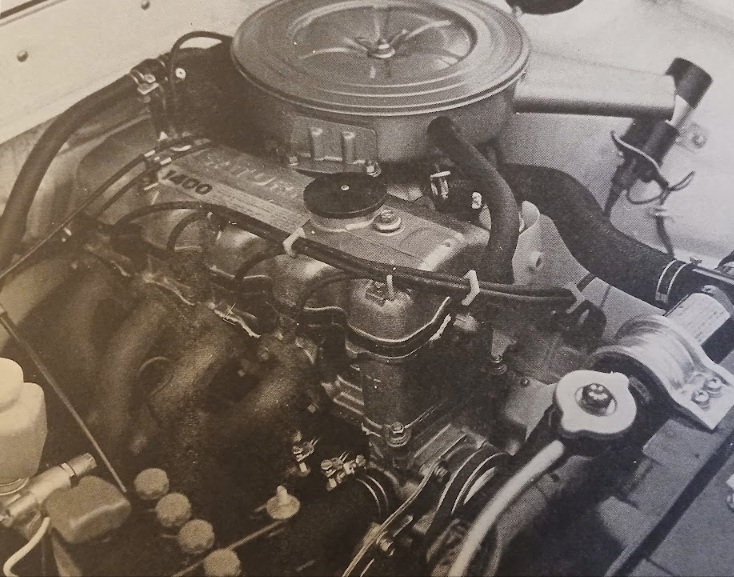
At the heart of the car is the 4G33 Saturn engine, developing 92ps/6300rpm. Maximum torque of 12.5kgm is produced at 4000rpm, but its outstanding characteristic is the strong torque available over a wide range of engine speeds.
Bore and stroke are 73×86mm, giving a total displacement of 1439cc, the largest in the 1400cc class. Thanks in part to this generous displacement, the car’s performance is exceptionally smooth as well as powerful.
One of the distinctive features of its quiet performance is the final-drive ratio of 3.889, which can be considered relatively high-speed gearing for this class. This is a substantial change from the 4.222 ratio of the previous 1300, and has markedly improved the car’s ability to stretch its legs at higher speeds.
At the same time, the lower engine speeds have brought a noticeable reduction in noise. The body styling was already relatively free of wind noise, but with the engine turning only around 3500rpm at 100km/h—a speed more typical of a larger-engined car—running noise at high speeds is kept to a satisfactory level.
The test car had covered just under 2,000km, so the engine was not fully run in. There was a tendency for it to become less eager to gain revs at higher engine speeds, but it nevertheless provided the enjoyable driving performance one would expect of a strong contender in the 1400cc class.
In city driving, engine speeds down to around 1000-1500rpm are used frequently, but there was no shortage of throttle response in either third or top gear. This is only to be expected from the long 86mm stroke, but the engine also offers excellent response over a broad range from medium to high speeds. The feeling that the car surges forward the moment the accelerator is pressed, whatever the road speed, can be regarded as a distinctive Galant characteristic.
Looking at the average power outputs in the 1400cc class, standard models generally develop around 87ps, while twin-carburetor sporting versions produce about 95ps. The Galant 14L, however, has the same 92ps engine throughout the range, from the basic Standard to the SL. In that respect, it is closer to the sporting versions of its competitors. Although its power output is relatively high, the strong, flat torque characteristics leave the impression of an unfussy car that anyone can drive easily. The design philosophy of using plenty of displacement and a single carburetor seems to have paid off in this respect.
The precise, smooth gearshift, easy-to-operate pedals and steering that maintains an appropriate degree of effort at both low and high speeds all contribute to making the car easy and pleasant to drive. These qualities undoubtedly play a part in the favorable impression of its performance.
“The engine runs so smoothly that you can accelerate in a relaxed frame of mind.” — Oguchi
“It’s a docile engine that makes the car easy to drive.” — Kageyama
Handling & Stability: Agile Handling (Katsuzo Kageyama)
Since the tilt steering wheel is one of the car’s distinctive features, I expected it to be easier than usual to find a driving position that suited me exactly. I tried various combinations of steering-wheel angle and fore-and-aft seat adjustment, but was surprised at how much difficulty I had finding the best position.
Eventually, I discovered that moving the seat slightly rearward and tilting the steering wheel down gave me a position that suited my build perfectly. Unfortunately, once I had adjusted everything to suit my arms and legs, the left fender mirror was almost completely hidden by the windshield wiper.
Moreover, the upper edge of the dashboard is high, and the raised portion in the center particularly obstructs the view ahead. Looking into the reasons for these difficulties, I concluded that the seat is simply too low. The roof is quite high, with plenty of headroom, so raising the seat a little should solve these problems. For better or worse, my bodily proportions are rather far removed from those of the average Japanese person, and perhaps that made these shortcomings especially noticeable to me. In any event, I was reminded just how difficult it is to achieve a proper dimensional relationship between the human driver and the car.
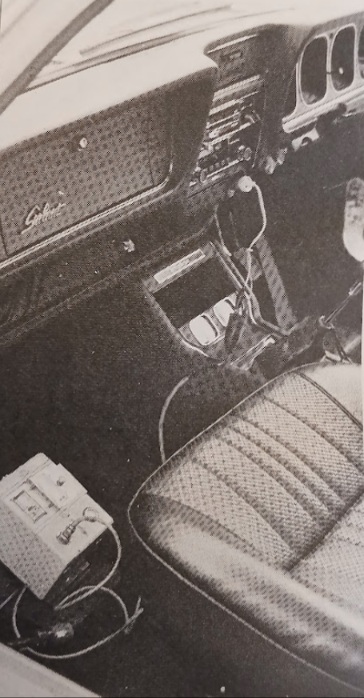
The interior design has a decidedly luxurious appearance, and there is no denying that it looks impressive. But there are too many shiny surfaces around the center console, giving the whole area a rather cluttered and distracting appearance. From the driver’s point of view, it is better not to have too many bright or reflective surfaces directly ahead. While I am on the subject, I cannot quite understand the reason for adopting rectangular gauges.
Once underway, I found that the pedals, various switches and parking-brake lever were all well-positioned and easy to operate. I was slightly bothered by the gearshift, which tended to catch rather than move smoothly, but its position and travel were beyond criticism.
I did not have an opportunity for high-speed driving this time, but in ordinary city driving the steering effort was just right and the wheel returned easily. With the help of the excellent engine and brakes, I found that, when called upon, the car could execute remarkably quick, almost darting maneuvers with ease.
Even reversing the steering direction when nearly stopped could be done quickly and with relatively little effort. I was left with a strong impression that much thought had gone into making this a car that could be driven easily and without strain.
Considered purely as a machine, this car is exceptionally well made, with hardly anything to criticize. Both in its mechanical design and in its operating characteristics, a great deal of thought has clearly gone into making it easy to use, and one finds oneself admiring one detail after another. It is difficult not to acknowledge how well executed it is. But when considered as a vehicle for people to actually travel in, there are still a few things that give cause for concern.
“The steering effort remains appropriate at both low and medium speeds, making it easy to handle.” — Mochizuki
Interior & Comfort: A Glittering Interior (Shigeki Asaoka)
With its separation from Mitsubishi Heavy Industries, the rapid realization of its tie-up with Chrysler, and the success of the Galant, Mitsubishi Motors has recently been growing at a brisk pace. Now it has made a number of revisions to the existing Galant series, introducing the result as the new “L Series.”
Although described as new, these models retain the same body design. No doubt Mitsubishi felt the need to keep the Galant in the public eye amid the succession of new-model announcements from other manufacturers. But with the company placing high hopes on large-scale exports, it must also have been very conscious of the strict regulations in America, one of its main markets.
The coupe series has been left untouched this time, but improvements have been made to the sedans and hardtops, with a new 1400cc model added only to the sedan range. In that sense, the real newcomer in this latest announcement is the 1400.
This engine uses the block from the previous 1300, and Mitsubishi appears to have made every effort to retain common components, probably including the crankshaft and other parts. The bore remains unchanged at 73mm, but the stroke has been increased from 77 to 86mm, making this an unusually long-stroke engine by today’s standards.
Nevertheless, an engine that develops its maximum output of 92ps at a high 6300rpm, while also producing its peak torque of 12.5kgm at a relatively high 4000rpm, must be regarded as an exceptionally high-performance unit—if the catalog figures are to be believed. Its mechanical noise is somewhat on the high side, but there is nothing to complain about for a 1400cc engine, and it runs smoothly.
The interior fairly glitters, and is generously equipped. The tilt steering wheel, a distinctive feature dating back to the Colt, has also been carried over to this series. By adjusting it in conjunction with the high-back reclining seat, the driver can find a position that suits a wide variety of conditions, whether high-speed driving, city traffic or rough mountain roads.
On the standard model, a small covered storage compartment is provided at the top center of the dashboard, separate from the glovebox. This is an excellent and very convenient feature, allowing things one might use while driving, such as sunglasses or a window-cleaning cloth, to be stored within easy reach.
Unfortunately, the compartment is actually intended to accommodate the air outlets of the optional air conditioner. Fit the air conditioner, and all those small articles will presumably end up scattered around the cabin again.
Another thing I do not particularly like is the lighting switch, which is positioned oddly far away and has a rather small lever. As circumstances dictated that I test-drive the car at night, I spent quite some time trying to find the light switch before I could even drive away. Surely it would be better to design frequently used switches like this so that they are close at hand and easy to operate.
“The car has been made to feel quiet, at least subjectively. Maybe it has something to do with the character of the sound…” — Oguchi
“The driver’s seat has been improved.” — Mochizuki
Safety: The Subconscious Mind and Safety (Yasuhei Oguchi)
A car from which any peculiar characteristics have been consistently eliminated. That seems to be the distinguishing feature of the Galant 14L series. It might be described as a car with an unusually good overall balance, in which ease of driving and comfort stand on an equal footing with performance.
My strongest first impression during this test was of the quietness of the cabin. Even when cruising on the Tomei Expressway, the sound-pressure level was relatively low, there were no noticeable peaks in the noise, and the character of the sound itself was psychologically reassuring.
I suspect this is the result of careful attention to details such as body rigidity, reduced transmission of vibration, and improved sound insulation.
The reason I bring up these matters in a discussion of safety is that I consider comfort, ease of driving and a reserve of acceleration to be subconscious factors contributing to safety, in contrast to more tangible, physical items of safety equipment.
Just as a person has a personality, a car has its own individual character. By this I do not mean the class or standing determined by its specifications, but rather the car’s “personality in relation to the driver.” Judged from this standpoint, I felt that the test car was of a very high standard.
Turning to specific safety features, the front wheels are equipped with disc brakes and a Master-Vac servo, providing dependable braking even at high speeds, and giving a reassuring feeling of braking capacity in reserve. The hydraulic system also uses a tandem master cylinder to provide protection in case of emergencies.
The steering column is collapsible, designed to absorb impact forces and reduce intrusion into the cabin. The car also has the tilt steering wheel that has already become one of the distinctive features of the Colt series.
When driving on the Tomei, I lowered the steering wheel to adopt a “passive” position—a relaxed driving posture appropriate when relatively little information must be processed for safe driving. In city traffic and on the mountain roads of Hakone, I raised the wheel to adopt an “active” position, suited to conditions in which more information must be taken in and quicker judgments and actions are required. There may have been a psychological element to it, but I found this arrangement extremely comfortable.
I have no way of knowing the actual strength of the body, but according to the catalog and other materials, the basic cabin structure that protects the occupants in a collision or rollover appears to be strong. The clean, straight lines of the body somehow give a delicate impression, but this is misleading. The area around the quarter pillars, in particular, is said to be especially strong.
Among other details, the rear combination lamps are of a modular type that makes their functions easy to tell apart, with amber turn signals separated from the brake lamps. Measures to control exhaust emissions also appear to have been thoroughly considered.
“The seat belts have become easier to use.” — Mochizuki
“It’s a small thing, and other cars have it too, but the belt console is a good idea. Without it, the belts tend to get dirty, and people eventually stop using them.” — Ikuuchi
Economy: Better Value Than the 1300 (Reiko Ikuuchi)
The Galant 14L SL we tested has a standard cash price of 660,000 yen for delivery to Tokyo. It is the most luxurious model in the 14L series.
The 1400cc engine is an enlarged version of the previous 1300, but since there was no SL model in the 1300 series, a direct price comparison is difficult.
However, compared with the previous Custom Sports, the most expensive model in the 1300 (AI) range at 636,000 yen, the difference is 24,000 yen. For that amount, in addition to the extra 100cc of engine capacity, the following equipment is included (the items in parentheses are those fitted to the Custom Sports):
Electronic clock (electric clock), leather-touch steering wheel (standard steering wheel), high-back seats with integral head restraints (seats with recessed head restraints), disc brakes (drum brakes), Master-Vac brake servo, belt storage console, and sports-type tires (whitewall tires).
So, reflecting the current trend toward luxury, quite a number of features have been added, and they seem to go a fair way toward making up the difference in price.
With so many cars in this class, judging their relative value is difficult. The 1400cc class did not exist until recently, but over the past year or two, manufacturers have rushed into it in large numbers.
Even a quick glance reveals the Carina, Celica, Corolla, Sprinter, Sunny Excellent and Bluebird, all competing in the same class. The recently introduced rotary-engined Savanna is also considered part of the 1400cc class in terms of its market position.
And since each of these models is offered in numerous variations, each with its own price, it is extremely difficult to judge whether the 14L SL is inexpensive or expensive for what it offers.
Looking at the prices of 1400cc-class cars from the various manufacturers, they range from 509,000 to 695,000 yen. I have left the Savanna out because of its rotary engine; its most expensive model costs 750,000 yen. Still, among cars in the 1400cc class, there is a price spread of nearly 200,000 yen.
That is how broad the range of variations has become. As a result, the combinations of accessories and equipment have grown so complicated that making a clear-cut judgment based on economics is near-impossible. In other words, this car’s appeal from a purely economic standpoint is rather weak.
Nevertheless, it is certainly an economical car considering how luxurious it is. For the 660,000 yen asked for the 14L SL, one could also buy a 1700cc model in Deluxe trim. Whether to choose a car with a larger engine from the next class up, or one with sporting and luxurious accessories but a smaller engine and better fuel economy, is a matter of personal preference.
Finally, there is after-sales service, which has a great deal to do with economy. The manufacturer’s public relations department had this to say: “We used to be criticized for poor service, but we are now doing our best to improve our service organization.”
Product Appeal: What Was the Point of the Model Change? (Kensuke Ishizu)
Along with adopting a new engine, Mitsubishi has made substantial changes to the Galant’s instrument panel and other interior details.
I am not quite sure why it was necessary to go beyond replacing the engine and make changes to the interior as well. Just what aspect of consumer attitudes toward products was Mitsubishi trying to appeal to?
Cars are outside my field of expertise, so I cannot claim to know much about this, but it seems to me that people who wanted to buy a Galant were attracted by a certain air of refinement about the car.
I think this character was something intangible, an added quality over and above the Galant’s actual value as a product. There have been a number of examples in other fields where this “extra something” became the main selling point.
This approach to selling, in which consumers are attracted less by the product itself than by the feelings surrounding it, or by fashion in the broadest sense, stems from the idea of “moving away from the product.” And it has proved quite successful commercially.
But as consumer society develops, consumers themselves become more discerning. They are growing increasingly exacting in their judgments of a product’s intrinsic value. As a result, they are no longer satisfied with the products of an earlier, image-conscious age, in which a product’s actual value was never clearly established.
This has given rise to the idea of a “return to the product.” Rather than relying on some intangible extra quality, the idea is to compete on the merits of the product itself. Instead of appealing through “mood” or feeling, the aim is to convince consumers of just how good the product itself is, and attract them on that basis.
Seen in this light, the Galant’s model change seems to have been guided by a rather outdated attitude toward consumers. I cannot see how changing the appearance of the instrument panel has improved its functionality. Nor can I say that it has increased the car’s value as a product.
On the contrary, I feel that the Galant has lost something of the air of refinement that had appealed to a certain sense of superiority among its buyers.
Rectangular instruments and woodgrain panels are things that everyone else is doing. Is the idea simply that because other cars have them, the Galant must have them too?
Although Japanese consumers have become increasingly discerning when it comes to products, their attitudes are still in many respects those of a developing country. It is dangerous to conduct business without regard for consumers, but an approach that kneels before them is no more desirable. Mitsubishi should have preserved the Galant’s existing virtues and quietly changed nothing but the engine. I would give the approach taken to changing the car’s image a score of 70 points.
“One might call it the definitive Mitsubishi-style practical car. The improvement in taste is remarkable.” — Asaoka
“There seems to be an empty space visible behind the speedometer and tachometer. What’s going on there?” — Oguchi
“When I ask myself what compelling reason there is to choose this car among all the others in the 1400cc class, well…” — Ikuuchi
How to Read the Bubble Index
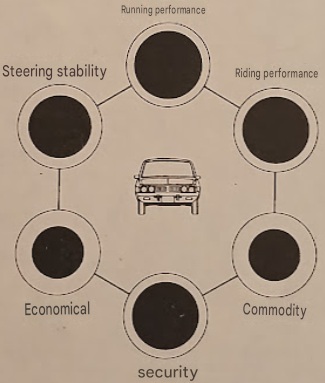
The purpose of this comprehensive road test is to evaluate a car’s overall capabilities through six principal categories: performance, handling and stability, comfort and accommodation, safety, economy, and product appeal.
The evaluation method is what we call the “Bubble Session.” Borrowing an approach from systems engineering, six specialists from different fields gather around a hexagonal table–the “bubble” referring to a honeycomb cell–and discuss the car from their respective viewpoints.
The black circles shown within the six evaluation fields indicate the rating assigned in each category. A car whose circles are relatively equal in size may be regarded as a well-balanced design, whereas one with larger disparities can be said to have a stronger individual character.
Postscript: Story Photos