Mitsubishi Colt Galant AI Custom (1970)
Publication: Car Graphic
Format: Road Test
Date: March 1970
Author: “C/G Test Group” (uncredited)
Summary: Exceptionally easy-to-use five-seat sedan. Outstanding performance for its class. Extremely smooth and well balanced powertrain, though somewhat low-geared. Exhaust-system resonance becomes pronounced at medium engine speeds. Drum brakes prone to fade in repeated use. Very good interior accommodation.
Road testing the Mitsubishi Colt Galant AI Custom
The 1289cc Galant AI is offered in four variations: the lowest-priced Standard (518,000 yen), the Deluxe (568,000 yen), the Custom (596,000 yen), which adds heat-absorbing glass and reclining seats, and the Sport (636,000 yen), equipped with front disc brakes, a wood-rim steering wheel and round gauges. The car tested here was the Custom, purchased by C/G for long-term testing and still virtually new, with only about 2,000km on the odometer. We were not particularly happy about taking a car whose various components were not yet fully run-in to Yatabe, even subjecting it to a maximum-speed test (the tight schedules of magazine publishing often force us into such unreasonable measures), but to our surprise, this AI once again proved that the manufacturer’s claimed performance figures were entirely without exaggeration. Its maximum speed over the measured 1km section reached 146.95km/h (against a catalog figure of 145km/h), while its 0-400m acceleration was 18.6 seconds (catalog: 18.3 seconds). For a pure family sedan in the 1300cc class, this is outstanding performance.
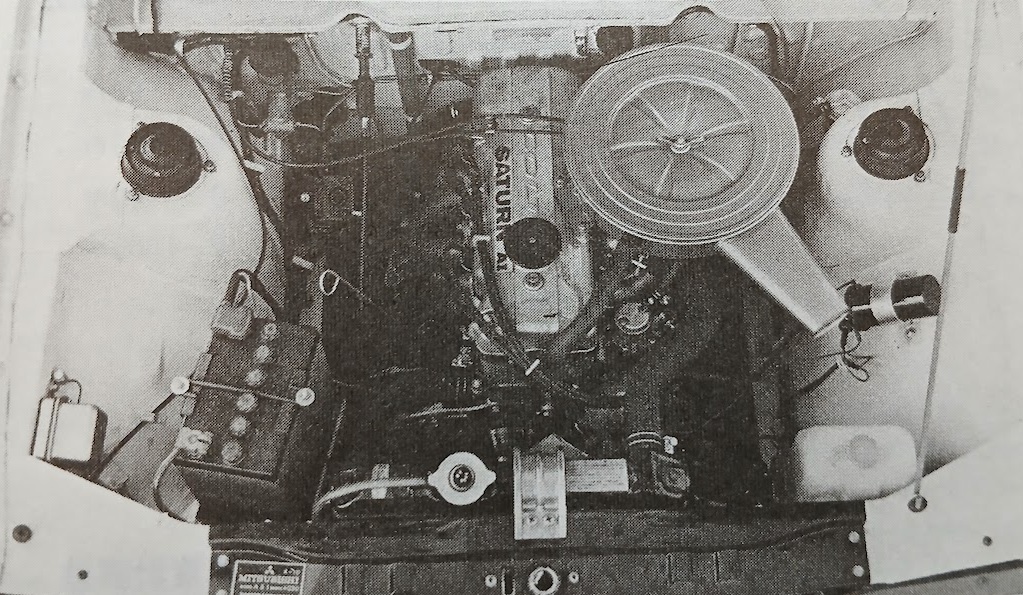
The SOHC 1289cc engine (long-stroke, at 73mm × 77mm) has a compression ratio of 9.0 and, with a single twin-barrel Stromberg carburetor, produces a substantial 87ps/6300rpm. The secret of the AI’s excellent performance lies in its good aerodynamic characteristics and favorable power-to-weight ratio (9.5kg/ps, compared with 12.5kg/ps for the Bluebird 1300). We described in detail how smoothly the Galant engine runs, and how willingly it revs to high speeds, in our report on the AII GS, and this single-carburetor AI is hardly inferior in this respect. The only real difference is that where the AII GS will rev easily beyond 7000rpm, the AI’s induction system suddenly loses efficiency at around 6500rpm, and the revs level off. However, its extremely flexible power characteristics mean that in ordinary use there is no need to take the engine beyond 4000rpm in any gear. Its ability to pull at low speeds is remarkable: even in top gear it will accelerate smoothly from 30km/h (1300rpm), without the slightest sign of knocking. And since it uses regular gasoline, this gives some indication of how high the engine’s mechanical octane rating must be.
The AI Custom is available with either a 3-speed column shift or a 4-speed floor shift, and C/G’s AI is, of course, the latter. The gearbox is so pleasant to use that one finds oneself wanting to shift often, although the reserve of power means there is no real need to do so. We have not yet had a chance to test the 3-speed column-shift model, but for someone with no particular interest in fast driving, we imagine that three speeds would be entirely adequate.
Compared with the 1.5-liter AII, the AI has a lower final drive ratio of 4.222 (3.889 for the AII), giving 24.0km/h per 1000rpm in top gear against the AII’s 27.1km/h. Its excellent acceleration and flexibility at low speeds can probably be attributed in part to this low gearing. In our view, however, the AI’s gearing seems a little too low for its power and character. This makes the car particularly easy to use around town, but when the gears are held to higher revs for fast driving, the engine becomes rather busy and the noise somewhat restless. Mechanical noise is always low; the main source of noise is resonance from the exhaust system. At the relatively modest, practical speeds of 45-50km/h in second and 60-70km/h in third—the middle-speed range centered around 3500rpm—the exhaust note booms inside the cabin. Since the AI will pull away smoothly even in second gear on level roads, a somewhat higher final drive ratio would hardly make it difficult to use.
As we noted in our report on the AII GS, the constant-speed fuel-consumption tests produced the curious result that the 1.5-liter AII GS was more economical than this 1.3-liter AI. We believe this is due not only to the fact that C/G’s AI has not yet been fully run in, but also to its generally lower gearing compared with the AII. The load and weather conditions, incidentally, were exactly the same. As for fuel consumption in actual use, the AI averaged 9.21km/l over approximately 440km driven in the same pattern as the AII GS during this test, while its overall average for the 2,500km since we purchased it has been 8.35km/l. The former figure includes some 200km of testing at the Yatabe test course, while the latter consists almost entirely of stop-and-go city driving. The Galant AI is quite economical, but fuel consumption could probably be improved still further with a slightly higher final drive ratio.
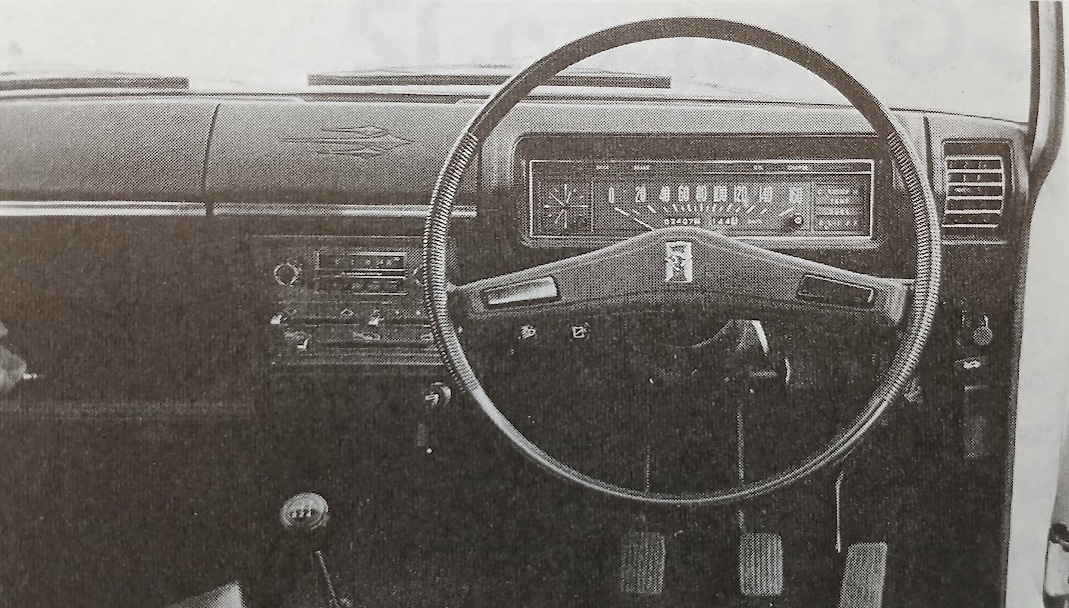
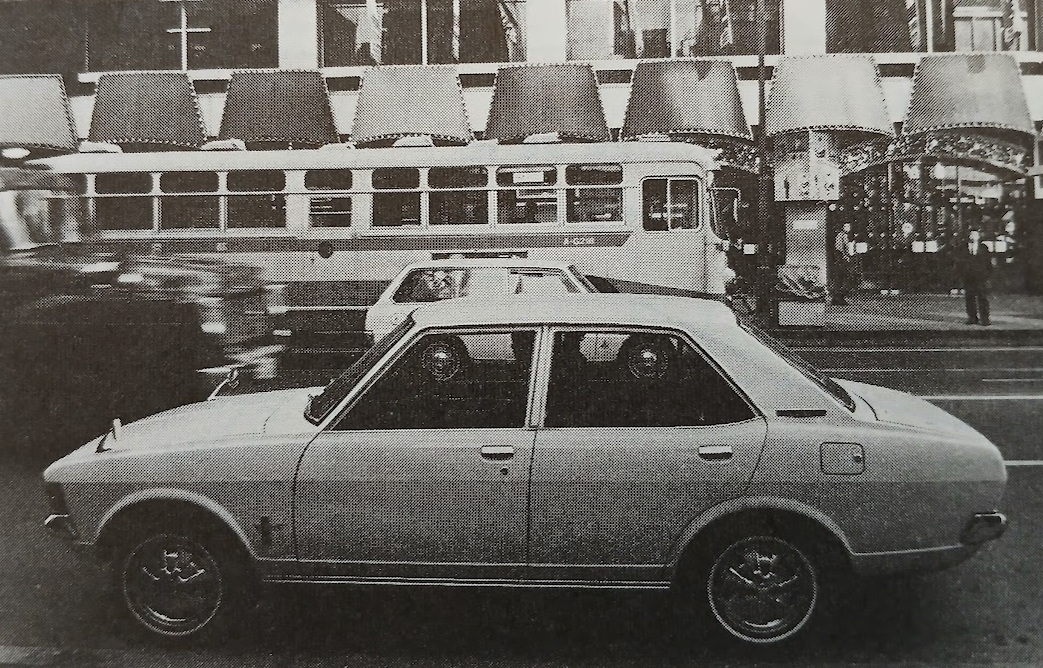
We have already mentioned that the Galant’s greatest virtue is that it is exceptionally easy to drive: from the first moment behind the wheel, anyone can drive it with the same confidence as a car they are already used to. One reason is the excellent visibility from the driver’s seat, along with controls that are light yet positive in operation. The steering takes approximately 3.3 turns from lock to lock, but the turning radius is only 4.6m, making the car particularly convenient in crowded city streets. The hood slopes down toward the front, giving a clear view of the road immediately ahead, and with short overhangs at both ends, there are few cars that are easier for a novice to park.
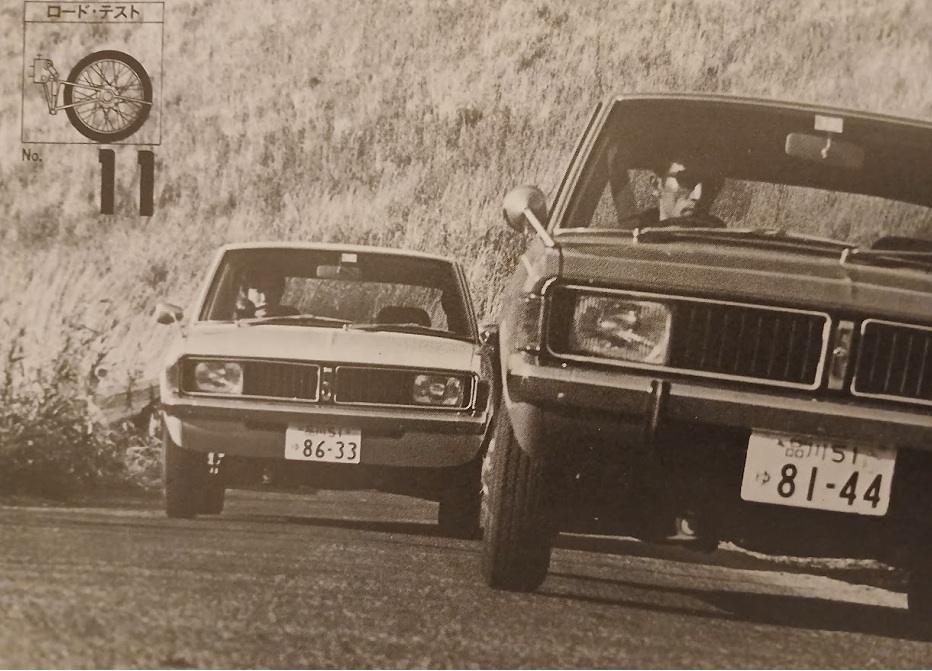
Straight-line stability at high speed is also excellent. The steering has a variable ratio, with sharp response around the straight-ahead position and just the right amount of weight, giving the car a well-settled feel at speed. The handling is characterized by a degree of understeer appropriate to a family car. The test car was fitted with Yokohama 6.15-13 tires, and when we drove hard over winding roads following the AII GS, the understeer admittedly became rather excessive. Nevertheless, for a pure family car (one with a live rear axle, at that) the Galant’s handling is well above average. Despite its soft suspension, there is little change in attitude during cornering, acceleration or braking, so passengers can ride without anxiety.
Of the AI series, only the Sport model has front disc brakes; the others have self-adjusting drums both front and rear. Pedal effort is light and the brakes work reliably even at high speeds, so in ordinary use there are no problems. When driven “rally-style” over mountain roads, however, they gradually began to fade, to the point where we no longer felt confident maintaining high speed until just before corner entry. In the 0–100–0 fade test, pedal effort rose from an initial 24kg to 36kg by the fifth stop, showing signs of fade, and the tenth stop required nearly twice the original effort—47kg—by which point the brakes had faded completely. This is, after all, the limitation of drum brakes.
For a car with a conventional suspension layout, the ride is comfortable over all kinds of surfaces and comes close to the ideal for a family car. It is soft, but even when going over undulating surfaces at high speeds, the car is not tossed about; small irregularities are well absorbed by the suspension and are not transmitted to the body. Road noise is also well isolated, so it should remain satisfactory even with radial tires. Where the car is less satisfactory is on rough roads (fortunately becoming less common around Tokyo); on one occasion, we managed to strike the oil pan even though we weren’t going all that fast.
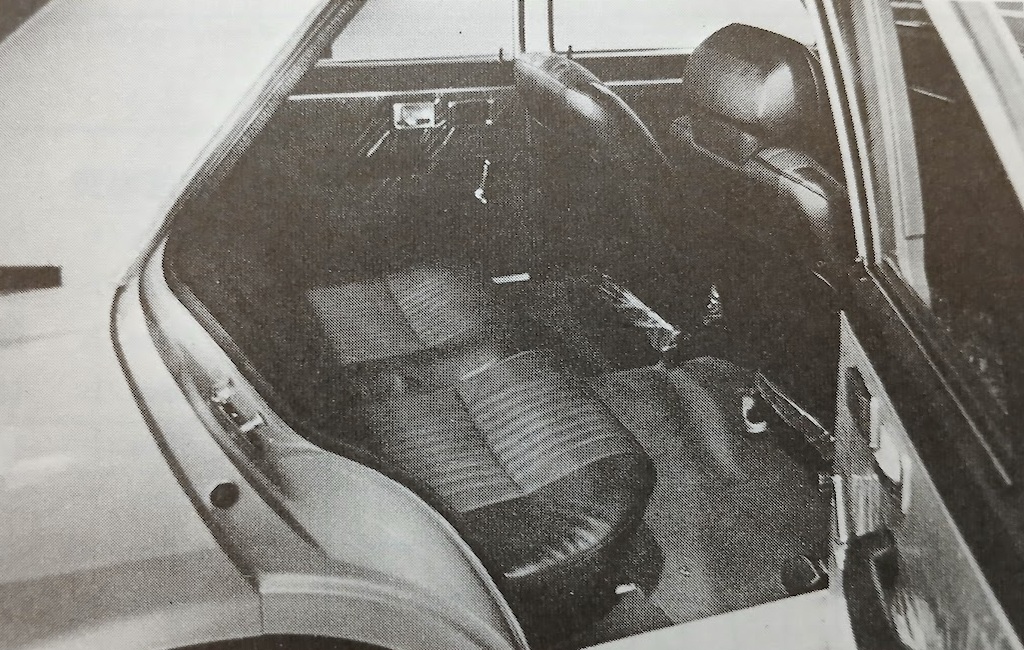
One of the Galant’s attractions is the interior, which is of unusually high quality and finish for a car in this price class. At 178cm, this editor has to slide the separate front seat all the way back, but even then there is still adequate foot room for rear-seat passengers. The urethane-foam cushions are suitably soft yet resilient, and rank among the best in Japanese cars.
The rear-seat cushion is low in relation to the floor, allowing the backrest to be generously sized, so rear-seat accommodation is very good. Five adults can be carried without difficulty.
One particularly good feature is the heater/ventilator system. In addition to the usual choice between fresh-air intake and recirculation, warm air can also be delivered through the fresh-air vents at either end of the dashboard using the booster fan (which has three speeds and is quiet in operation). The engine warms up quickly, so the heater begins working within about five minutes of driving away. The ventilation is also effective. We tried smoking with two occupants while driving at 50km/h, and the smoke did not linger inside the car but was drawn out through the outlets behind the rear seat (without using the blower, relying only on the airflow). However, because these air outlets connect directly with the outside (rather than passing through the trunk or some other intermediate space), noise from following cars, the voices of people standing and talking just behind the Galant when it is parked, and even sounds from within the trunk can be heard surprisingly loudly inside the car.
Storage space inside the car is limited to the large locking glovebox in the dashboard (big enough to hold something like a handbag), and a shelf underneath it (with a lip so low that objects tend to slide off when accelerating). A deep console compartment like that in the AII GS and AI Sport would be welcome.
The trunk is quite deep from front to rear, but relatively shallow vertically, and its opening is rather narrow. Incidentally, the trunk lid itself serves as the radio antenna, so one can forget about the presence of an antenna altogether.
The body is solidly constructed, and even on rough roads we noticed no abnormal vibration or creaking whatsoever. Despite the body’s light weight, the doors close with an “expensive” sound.
Postscript: Story Photos