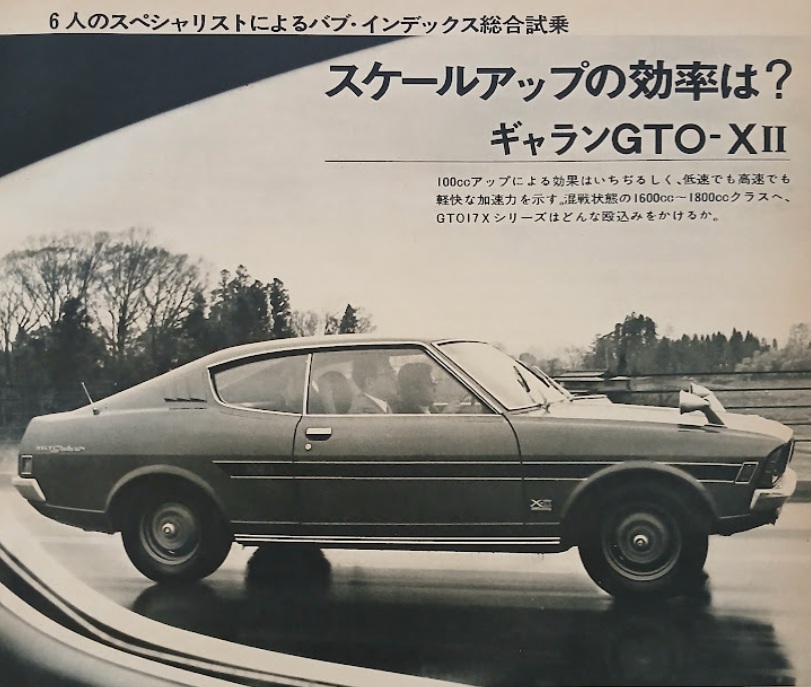
Mitsubishi Colt Galant GTO 17X-II (1972)
Publication: Motor Fan
Format: “Bubble Index” Road Test
Date: June 1972
Authors: Osamu Mochizuki, Katsuzo Kageyama, Shigeki Asaoka, Yasuhei Oguchi, Reiko Ikuuchi, Kensuke Ishizu
Does the Larger Engine Deliver?
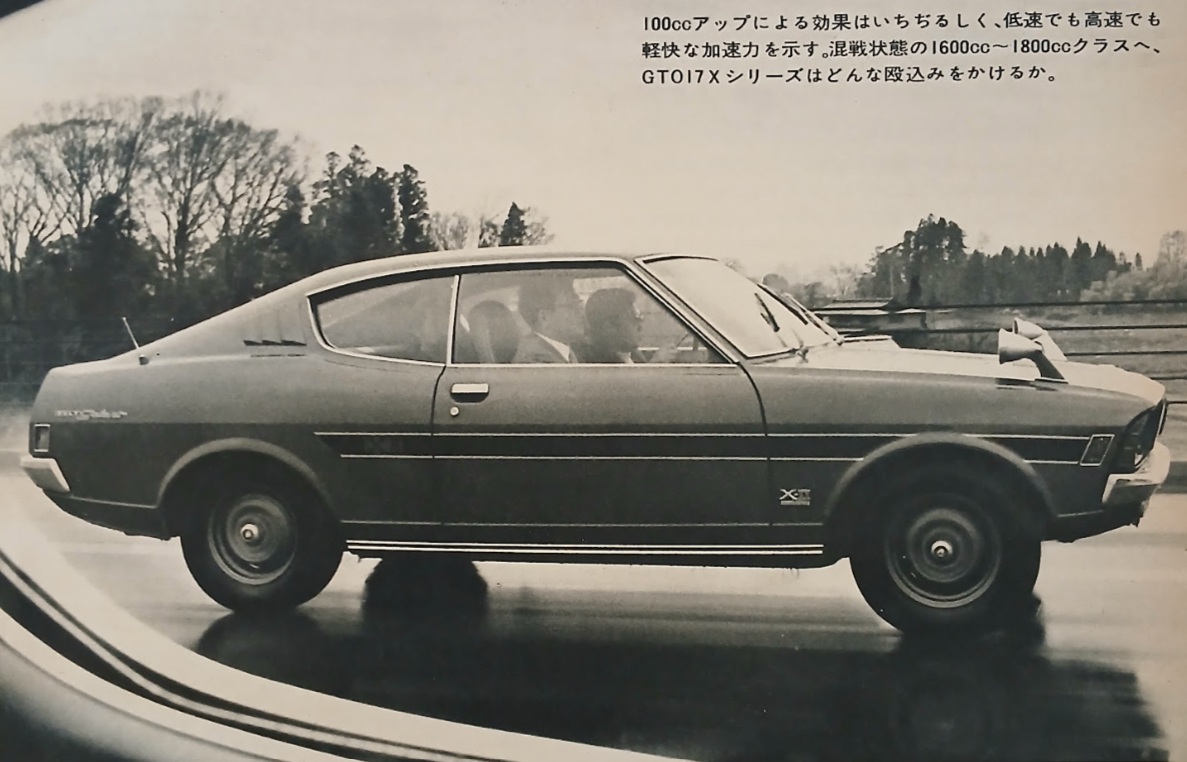
The extra 100cc has brought a noticeable improvement. Whether at low or high speeds, the GTO 17X-II delivers brisk, effortless acceleration. But in the fiercely contested 1600-1800cc class, what sort of challenge will Mitsubishi’s new GTO 17X series pose to the established competition?
Smooth-Revving and Surprisingly Economical
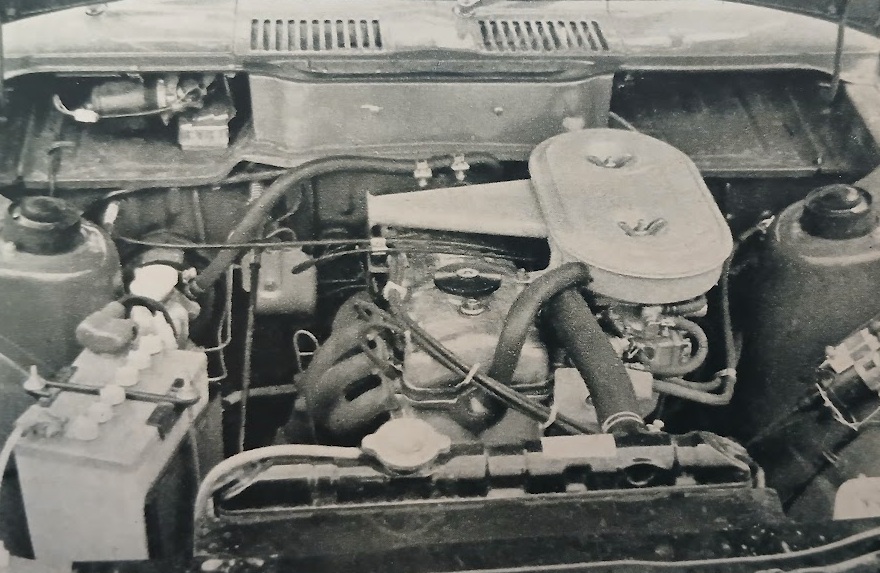
The 1600cc Galant GTO lineup has now been joined by the new 17X series, powered by Mitsubishi’s 1700cc engine. This new unit, designated the 4G35, is a bored-out version of the familiar 1600cc 4G32 engine.
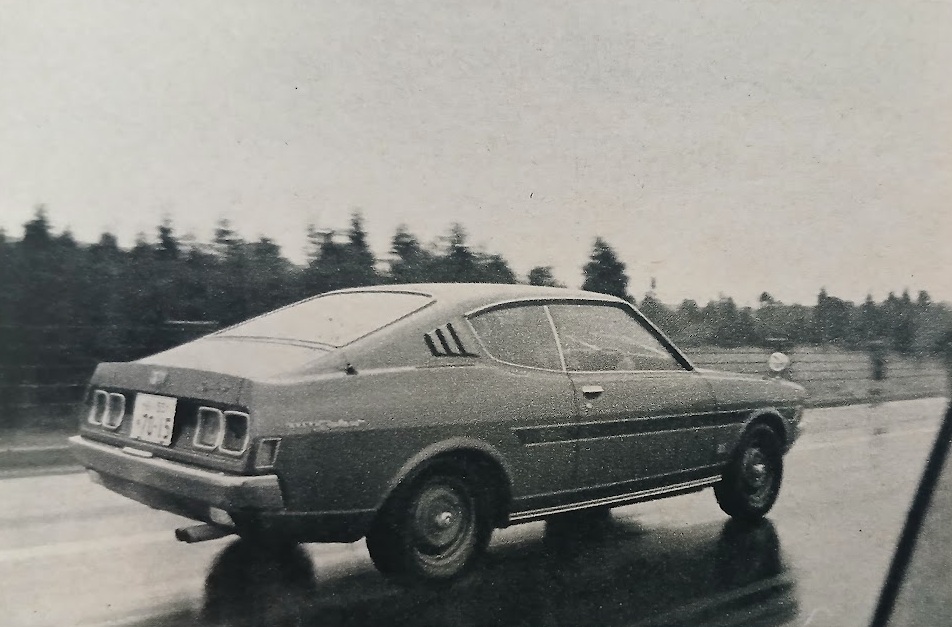
The Galant GTO series first appeared in November 1970. Its dramatic styling–highlighted by its ducktail rear treatment and 50-inch-radius curved side glass—generated considerable attention at the time, and it still remains fresh.
The newly introduced 17X Series consists of three basic models: the X-I (single carburetor, 105ps), the X-II (twin carburetors, 115ps), and the X-II Automatic (twin carburetors, 115ps). In addition, a regular-fuel version of the X-II is offered as an optional specification.
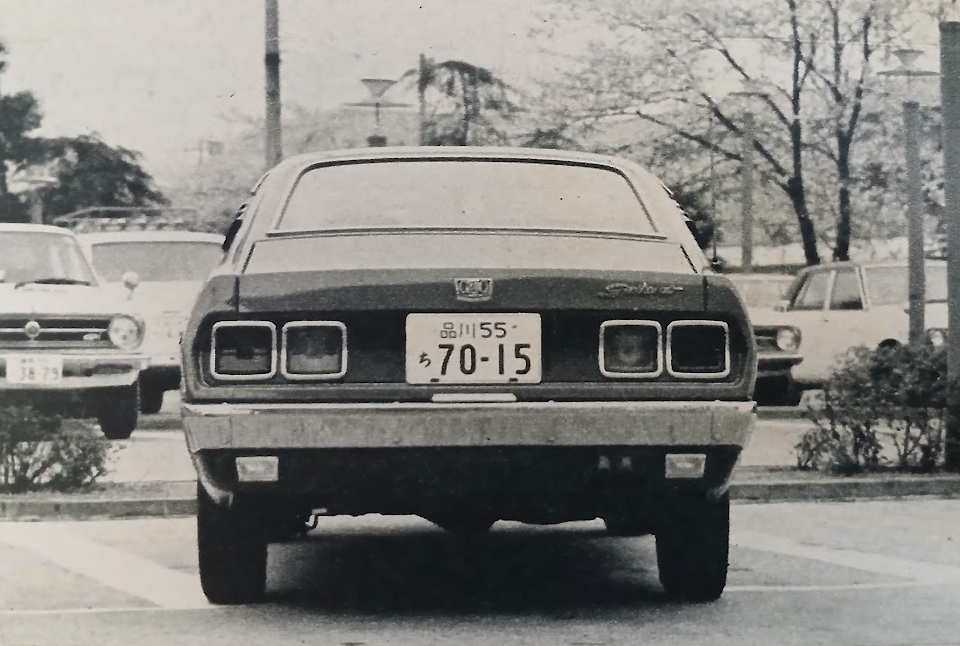
Inside and out, these models differ little from the existing GTO 1600 range. One visible change appears at the rear, where the combination lamps have been revised: on the 1600 all four lenses are red, while on the 1700 the inner pair are amber.
For this month’s test, we selected two examples of the X-II–a 4-speed and an automatic–with performance measurements taken mostly with the former. (Hill-climb testing was cancelled due to heavy fog at the test site.)
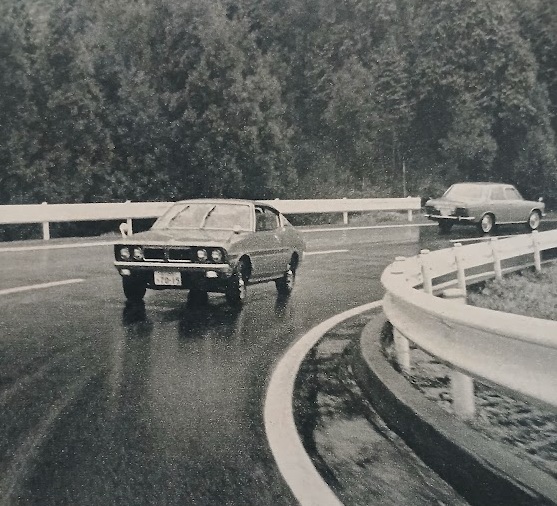
As usual, the test group assembled at our base, the Fantasy Drive-In near the Tokyo IC on the Tomei Expressway, before setting off on the familiar route: Tomei Tokyo IC to Gotemba IC, over Otome Pass, up the Hakone Turnpike, back via Otome Pass, and then returning to Tokyo on the Tomei.
At the post-drive meeting, the group’s assessment of the car’s overall character was generally favorable. Among the more representative comments were:
“The engine is exceptionally smooth. It responds eagerly whether at low or high speeds.”
“Once you’re beyond 100km/h in top gear, engine noise becomes somewhat pronounced. You find yourself wanting a fifth gear.”
“The rear seat becomes tiring after a certain distance. That’s probably inevitable, since this is essentially a two-seat coupe with occasional rear seating. The front seats, however, are excellent in both shape and materials.”
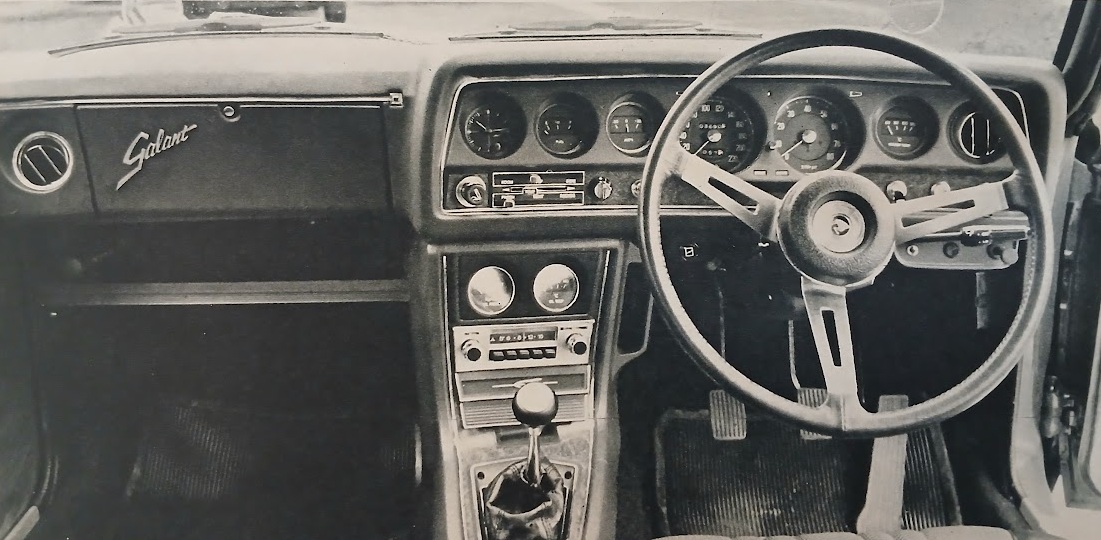
“The round gauges are easier to read than the old rectangular style, and the numerals themselves are very legible.”
One other subject became a recurring topic of conversation during the drive: fuel economy.
At the first fuel-consumption check in Gotemba, the specialists calculated a figure of 16.0km/l for the initial section. That corresponds to roughly 86% of the official fuel-economy rating—an unusually strong result for a 1700cc car and well above what would normally be expected under real-world driving conditions.
Since the car was running on the specified premium gasoline, and the test route and speeds were nearly identical to those used in previous evaluations, the figure was difficult to dismiss. Suspecting a measurement error, the group repeated the calculation on the return leg (Section Three), only to record another impressive result: 14.1km/l.
For more detailed impressions of the GTO 17X-II, we invite readers to continue with the reports from each of our specialists in the following pages.
Power Performance: Broader Capability (Osamu Mochizuki)
Already the flagship of the Galant range, the GTO has now received a larger-displacement version of the Saturn engine. The new 4G35 increases displacement from 1597cc to 1686cc by enlarging the bore from 76.9mm to 79mm while retaining the 86mm stroke.
As a result, the X-II model’s output rises from 110ps/6700rpm to 115ps/ 6500rpm, while maximum torque increases from 14.2kgm/4800rpm to 15.2kgm/4500rpm.
A number of other improvements have been incorporated as well. In an effort to reduce exhaust emissions, the SU twin carburetors have been replaced by a pair of Strombergs. Durability has also been enhanced through revisions including new piston-ring materials, oil-control rings with coil expanders, and the addition of flywheel locating dowels to increase fastening strength.
The new 4G35 retains all of the Saturn engine’s established virtues, including its crossflow hemispherical combustion chambers and five-bearing support for both the camshaft and crankshaft. As a result, the additional 100cc has been translated into usable performance with impressive efficiency, bringing meaningful gains in both power and torque. This makes the X-II a genuinely muscular machine.
Since both the final-drive ratio (3.889:1) and the transmission ratios remain unchanged, the improvement in response is immediately apparent from behind the wheel.
The 1600 GTO was already known for the crisp response typical of a long-stroke engine. With the arrival of the 1700, that character has been refined still further. The difference is subtle, but the engine now spins up with noticeably greater smoothness.
The result is a car that is exceptionally easy to control, whether accelerating or decelerating, qualities entirely in keeping with the GTO’s grand-touring ambitions.
Catalog top speed remains unchanged at 185km/h. A gain of only 5ps would not be expected to produce a meaningful increase in outright maximum speed. What it does improve, however, is the time required to reach it.
At 100km/h in fourth gear, the engine speed is approximately 3200rpm. At that point it is producing around 14.5kgm of torque, making expressway driving particularly relaxed and secure. With such generous reserve power available, overtaking can be accomplished quickly and safely–a clear example of what might be termed active safety. Engine braking is also reassuringly effective when the throttle is closed.
At lower speeds, the engine’s smoothness becomes particularly notable. In third gear, 30km/h corresponds to roughly 1300rpm, yet response remains entirely adequate for everyday driving and there is no trace of knock. A gentle step on the accelerator is enough to send the car surging effortlessly to around 60km/h.
Shift action is exceptionally smooth, and the rest of the controls are equally easy to operate. For enthusiastic drivers, the GTO offers enough performance to be satisfying in spirited driving. For the more relaxed, its flexible torque characteristics make it equally rewarding.
With the arrival of the 17X Series, it is fair to say that the breadth of the GTO’s capabilities has been expanded considerably.
“The engine is smooth all the way from low to high speeds.” —Kageyama
“What makes the Saturn engine so appealing is the way it springs to life the instant you ask for power.” —Oguchi
Handling and Stability: An Admirably Well-Balanced Package (Katsuzo Kageyama)
The Galant GTO’s greatest appeal is in its bold styling and richly appointed interior. Derived from aerodynamic principles, its shape is attractive not merely because it is dramatic or unconventional, but because it serves a purpose. The design contributes not only to the car’s performance, but also to its handling and stability.
The same philosophy is evident in the driving environment. The dashboard layout is clearly the product of careful functional study, and its attractive appearance is largely a result of that effort. The decision to use round instruments throughout is particularly welcome, as they are both highly legible and inherently functional.
If there is one criticism, it concerns the placement of the oil-pressure and oil-temperature gauges. For those who drive enthusiastically, these are among the most important instruments, but here they have been relegated to the center console. Unless they are intended merely as decoration, the clock and ammeter could be moved to the console, while the oil gauges ought to be mounted in the main instrument panel.
The adjustable steering column, one of the car’s selling points, is certainly a worthwhile feature. Its greatest advantage, however, seems to be that it allows the driver to choose a position where the rim does not block the view of the speedometer or tachometer. It is somewhat less successful in helping drivers achieve an ideal seating position. One cannot help thinking that if it could be quickly tilted upward when getting in or out, it would offer an even greater advantage in a compact coupe such as this.
All of the switchgear is easy to operate. The only minor complaints concern the rather heavy window regulators and the awkwardly placed door-lock knobs.
Once underway, the steering immediately impresses with its well-judged weight. It inspires confidence at speed. The car feels planted and secure, with excellent straight-line stability. Even at high speeds there is no sensation of the body becoming light or unsettled. One comes away genuinely impressed by the effectiveness of the aerodynamic design.
Naturally, public roads are no place for reckless driving, but during overtaking maneuvers on the expressway the car’s responses proved pleasantly sharp. It reacts eagerly to steering inputs and shows a distinctly sporting character. Much of the credit must go to the tires’ cornering ability and to the quality of the suspension design.
Steering self-centering is excellent, and hands-off stability at speed leaves little to be desired.
It is easy enough to find faults with any car if one is inclined to dwell on minor details. The GTO is no exception. But a fair assessment requires looking beyond matters of personal taste and focusing on the car’s essential qualities.
Judged on the fundamentals of handling and stability, this is a thoroughly well-balanced car. Indeed, it left me with the satisfying feeling that I had encountered a genuinely good car–something that does not happen nearly often enough.
“Considering the balance it strikes with ride comfort, I would say its control of lateral movement ranks among its strongest points.” —Oguchi
Ride and Comfort: Questions About the Instrument Layout (Shigeki Asaoka)
This was my first opportunity to drive the Galant GTO in any form, so despite the fact that the model has already been on the market for a year and a half, I was able to approach it with relatively fresh eyes.
I know the styling was widely praised when the car was introduced, yet sales have not grown to the extent one might have expected. Perhaps this reflects Mitsubishi’s comparatively limited sales network compared to the two largest manufacturers.
The interior atmosphere is very much to my liking. The dashboard design is elegant and neatly arranged, with all the instruments in matching round dials that are easy to read and attractively lettered. The row of toggle switches across the panel is both functional and pleasantly traditional in character.
One aspect does trouble me, however. Given the importance of the instruments themselves, the layout raises certain questions. The GTO is unusual among recent cars in being equipped with both an ammeter and an oil-temperature gauge. Yet the ammeter is positioned to the left of the speedometer, while the oil-temperature gauge is relegated to the center console next to the oil-pressure gauge.
Aside from the speedometer and tachometer, the three most important instruments for assessing a car’s condition–and for detecting mechanical trouble–are the water-temperature, oil-temperature, and oil-pressure gauges. In racing cars, these are invariably placed in the most visible positions available. Yet even the owner’s handbook offers little explanation of the oil-temperature gauge’s significance, stating only that temperatures up to 120°C are within the safe range.
For modern drivers unfamiliar with oil-temperature gauges, this hardly seems helpful. Indeed, by the time oil temperature reaches 120°C, even a racing car running on the best lubricants may be approaching danger, or even retirement in some cases. To describe this figure as safe for an ordinary road car seems questionable.
I would strongly recommend switching the positions of the ammeter and fuel gauge on the main instrument panel with the oil-pressure and oil-temperature gauges currently mounted in the console.
Above the occupants is an overhead console incorporating three red warning lamps that illuminate for approximately fifteen seconds at start-up. They may be somewhat theatrical, but the reminders for seatbelt use and door-lock engagement are nevertheless a thoughtful touch. The center lamp warns of brake-system trouble. Its practical value may be limited, but it certainly contributes to the car’s atmosphere.
The leather-wrapped steering wheel is pleasantly soft to the touch, although it is somewhat thin-rimmed and lacks the feeling of substance one might expect in a sporting coupe.
The seats themselves are not especially luxurious, but I prefer them to the overstuffed designs that have become fashionable of late.
The rear seat, however, is another matter entirely.
Engine noise is also somewhat pronounced.
“The generous rear legroom is welcome, but once you settle fully into the seat, the combination of low cushion and upright backrest leaves you in a crouched, distinctly Rodin-like pose.” —Oguchi
“Above 80km/h, driveline noise becomes intrusive. The rear seat is a fairly severe place to spend time, and long journeys would be tiring.” —Kageyama
“The absence of assist grips in the rear is disappointing. In a high-performance car like this, rear-seat passengers ought to have something to hold on to.” —Ikuuchi
“The instrument layout is fundamentally sound, though the gauge markings could stand to be larger and bolder.” —Mochizuki
Safety: A Strong Protective Cell (Yasuhei Oguchi)
Ease of control is one of the fundamental pillars of active safety. This has two aspects. First, the car should have a broad stability envelope and be easy to recover when pushed beyond the driver’s intentions. Second, it should demand as little psychological and physical effort from the driver as possible.
The difficulty, of course, is that these are questions of the interaction between man and machine. Because this territory remains dominated by human perception, any rigorous evaluation ultimately depends upon subjective judgment. For the time being, it remains something of a black box. Put simply, there is no entirely objective way to measure such qualities.
That lengthy preamble aside, the first impression of the GTO is that all of its controls behave with admirable honesty. Acceleration, braking, and steering inputs are met with predictable and natural responses.
To give one example, I simulated overtaking maneuvers and obstacle-avoidance lane changes, generating lateral acceleration of roughly 0.6g at moderate-to-high speeds. Steering inputs measured up to approximately 1Hz. Throughout these tests, the car responded crisply, with a suitably high gain and very little phase lag.
As a result, even when steering inputs became somewhat excessive, it was easy to gather the car up and place it back on the intended line. The driver never felt burdened by unnecessary tension.
Cars designed primarily for ultimate cornering performance often feel nervous and overly rigid in ordinary driving. The GTO avoids this trap. It remains a genuinely sporting coupe, yet one that even inexperienced drivers should find easy to handle.
That said, it is worth repeating a familiar point. On public roads–and especially on expressways–drivers should avoid abrupt steering inputs that generate more than about 0.3g of lateral acceleration, roughly the point at which a book resting on the seat beside you would begin to slide sideways. Maintaining a margin of reserve is one of the keys to safe motoring.
The brake system has also been thoughtfully engineered. A power-assisted master cylinder reduces pedal effort, while a pressure-control valve (PCV) in the rear circuit helps maintain directional stability during hard braking. The dual-circuit hydraulic system incorporates a fail-safe warning feature as well: if a fault occurs, a lamp in the overhead console illuminates to alert the driver. Though not unique to the GTO, it is nevertheless a valuable contribution to active safety.
As for passive safety–the protection afforded after an accident has occurred–the two principal requirements are a strong occupant compartment and a body structure capable of absorbing impact energy.
In the GTO, the front and rear sections of the unit body are designed to deform progressively and dissipate collision forces, while the stronger structural members preserve the integrity of the passenger compartment. Particularly impressive is the apparent strength of the side members.
Since side impacts are said to occur more frequently in real-world accidents than purely frontal collisions, this aspect of the design could prove especially valuable in worst-case situations.
“The rear lamps are surprisingly difficult to see in fog, which strikes me as a safety concern.” —Kageyama
“The factory literature claims that the amber rear lamps improve visibility, but in dense fog they actually seemed less visible.” —Ikuuchi
Economy: Exceptional Expressway Fuel Consumption (Reiko Ikuuchi)
First, let’s take a look at the fuel-economy figures obtained on our test route. The GTO 17X-II returned 16.0km/l in Section One, 8.3km/l in Section Two, and 14.1km/l in Section Three. The highway portions of the test produced particularly outstanding results.
Since the measurements were taken at the usual locations and by the same methods used throughout this series, there is little choice but to accept them as accurate. Yet it is difficult not to be surprised. A car with an official fuel-consumption figure of 18.5km/l recording 16.0km/l under actual test conditions seems almost too good to be true.
Equally puzzling is the fact that Section One returned a better figure than Section Three. The first section runs uphill overall from Tokyo toward Gotemba and includes several performance measurements along the way. Section Three covers the same route in the opposite direction, and has almost always produced superior fuel economy in previous tests.
There is another curious point. In our November 1971 test of the Galant 14L SL, fuel consumption figures were 10.5km/l, 9.3km/l, and 11.8km/l for the three sections respectively. Yet here we have a 1700cc car delivering substantially better results. Admittedly, the catalog fuel-consumption figures for both the 14L SL and the 17X-II are identical at 18.5km/l, but even so, the evidence suggests that this is a remarkably economical car for its size and performance.
The Galant GTO 17X-II tested here, in premium-fuel specification, carries a Tokyo price of 853,000 yen. The regular-fuel version costs exactly the same.
By comparison, the equivalent 1600cc GTO MII sells for 843,000 yen. In other words, the larger engine commands a premium of just 10,000 yen.
What does that additional 10,000 yen buy?
On paper, output rises by 5ps to 115ps. (The regular-fuel version remains at 110ps, the same as before.) Yet top speed remains 185km/h, and the 0-400m acceleration figure is likewise unchanged at 16.7 seconds.
The gains are found elsewhere. The extra displacement provides a useful increase in mid-range torque, improving flexibility and making highway overtaking noticeably easier. One could argue that the additional 10,000 yen buys something more valuable than outright performance: the reserve power and safety margins increasingly demanded by the modern expressway era.
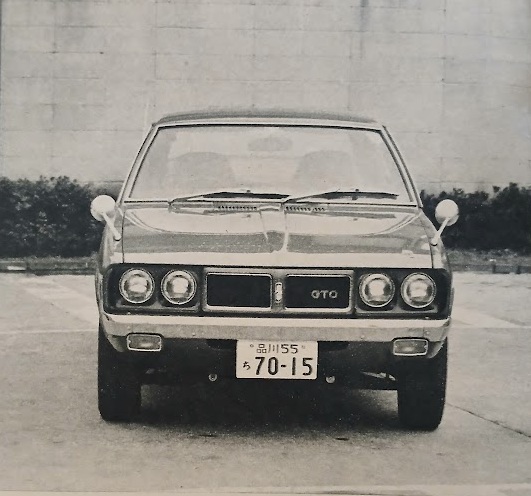
The body shell itself is unchanged, but the front grille and rear trim have been revised, an indicator light for the rear window defogger has been added, and improvements have reportedly been made to the cooling system, including a higher-capacity fan. Taken together, these changes more than justify the modest price increase.
Comparisons with 1700cc rivals are limited, since the only other cars in the displacement class are the Toyota Corona and Mark II. A Corona Hardtop SL sells for 768,000 yen, while the Mark II Hardtop Deluxe is 757,000 yen, placing the GTO X-II nearly 100,000 yen higher.
On the other hand, both Toyota models sit below larger 1900cc and 2000cc variants within their respective ranges. The GTO X-II, by contrast, is effectively at the top of the Galant GTO lineup, excluding the special MR model. Viewed in that light, its higher price becomes easier to understand.
One final point is worth mentioning. With labor costs on the rise, ease of servicing and repair has become an increasingly important aspect of automotive economy. Unfortunately, that is not the sort of question that can be answered from a brief road test.
“The differences in performance and economy among domestic cars have become smaller, but this car strikes a particularly good balance between capability and price.” —Ishizu
Product Appeal: A Car That Will Sell (Kensuke Ishizu)
Not long ago it was Pierre Cardin; more recently it has been Yves Saint Laurent. Clothing designed by such figures inevitably attracts the attention of those with an interest in fashion.
To the average person, however, their creations often seem less like everyday garments than works of art. Wearing them well requires a certain degree of taste and confidence.
Couldn’t something similar also be said of cars?
A striking silhouette alone is not enough. Without performance to match the appearance, much of a car’s appeal is lost. Nor is performance by itself sufficient; the asking price must also be appropriate to the package. Styling, power, and price–these three elements, I believe, are the essential criteria by which a car’s commercial value should be judged.
Viewed in that light, the Galant is one of the more successful domestic cars. Its proportions are simply “right.” The relationship between its length and height is well balanced.
In this respect, cars are the opposite of people.
With people, a tall and slender eight-head-tall figure is generally considered ideal, and fashion illustrators often exaggerate the effect further, drawing figures ten or even twelve heads tall. With cars, however, a lower overall height tends to produce more pleasing proportions.
From the standpoint of design and proportion, then, it is easy to understand why the Galant has found favor among younger buyers.
I have written before that the era of selling cars primarily on atmosphere and vague impressions is coming to an end. We have entered an age in which substance matters once again.
From now on, the true selling points will be the balance between engine and body, and the practical ease of use that results from that balance.
The Galant’s success has probably owed much to two factors: its handsome proportions and the long-established confidence many buyers place in Mitsubishi engines.
Now the displacement has grown from 1600cc to 1700cc. Admittedly, this is not a revolutionary strategy; it is one of the oldest tricks in the book. Nevertheless, it is an effective one.
A recent example can be found in Toyota’s decision to install the Crown’s engine in the Mark II. The principle is simple. Fit a more powerful engine to an existing body and the result is bound to be a more capable and responsive car.
The car I drove was equipped with the 4-speed, but with this much power available, I suspect the automatic version would be equally pleasant to drive.
Today there is little to separate most Japanese cars in terms of outright performance or economy. The differences have become increasingly small.
What distinguishes the Galant, in my view, is the balance it achieves between proportion, power, and price. Judged as a product, that balance gives it considerable appeal.
“Doesn’t the interior use too many different colors? The instrument panel, door trim, headliner, and other surfaces all seem to be finished in different tones, which is somewhat distracting.” —Ikuuchi
How to Read the Bubble Index
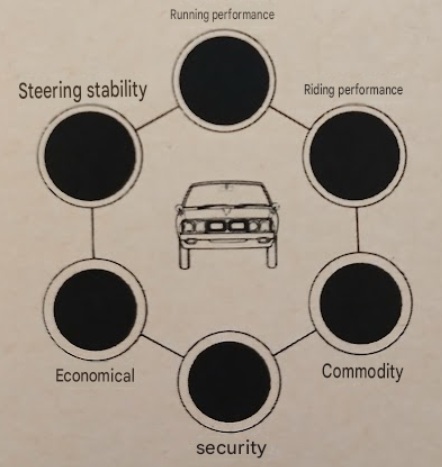
The purpose of this comprehensive road test is to evaluate a car’s overall capabilities through six principal categories: performance, handling and stability, comfort and accommodation, safety, economy, and product appeal.
The evaluation method is what we call the “Bubble Session.” Borrowing an approach from systems engineering, six specialists from different fields gather around a hexagonal table–the “bubble” referring to a honeycomb cell–and discuss the car from their respective viewpoints.
The black circles shown within the six evaluation fields indicate the rating assigned in each category. A car whose circles are relatively equal in size may be regarded as a well-balanced design, whereas one with larger disparities can be said to have a stronger individual character.
Postscript: Story Photos