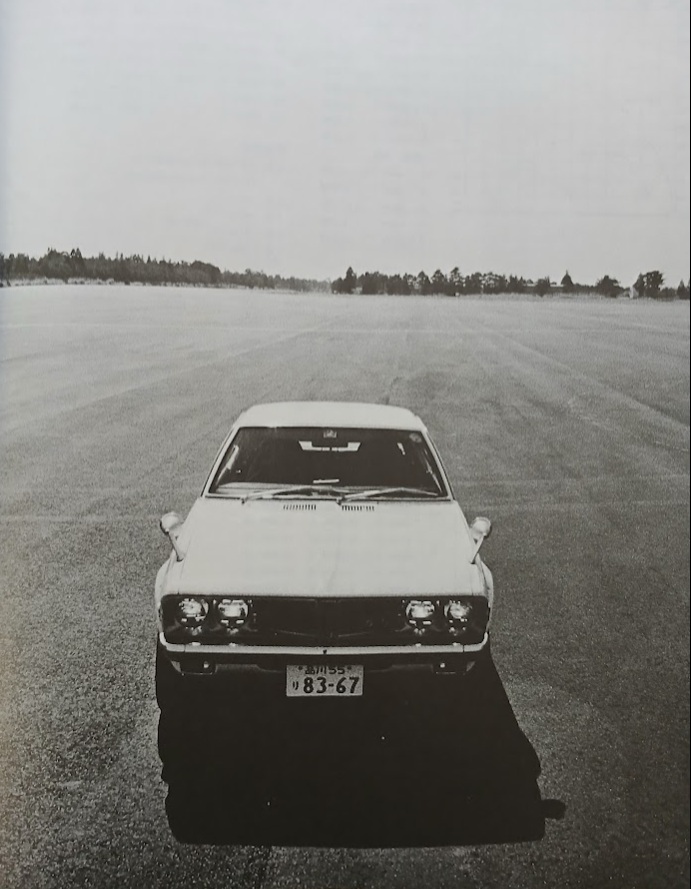
Mitsubishi Colt Galant GTO 2000GSR (1973)
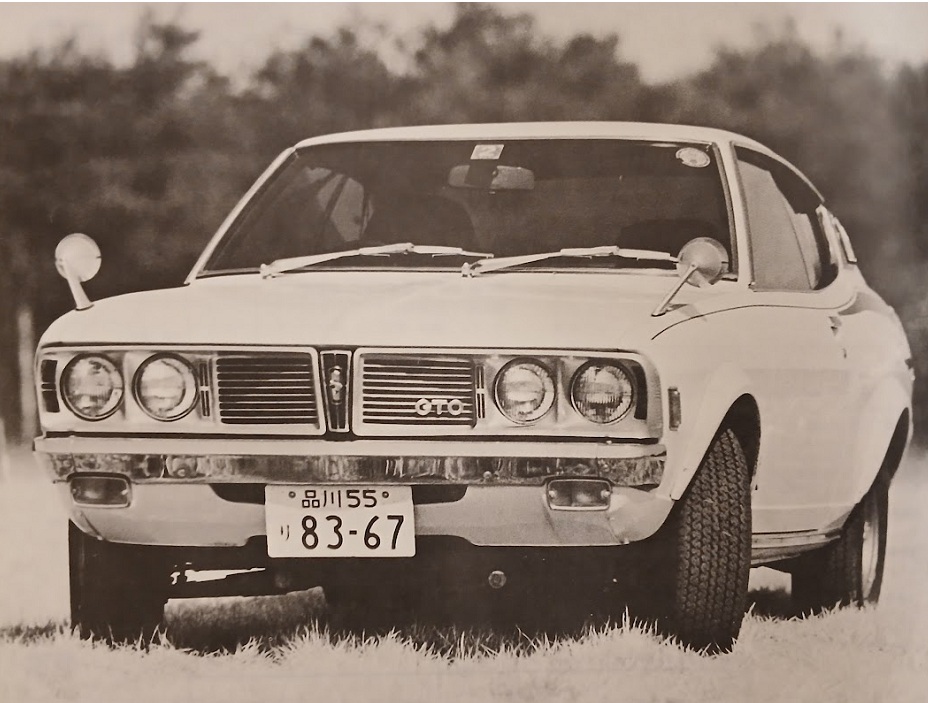
Publication: Car Graphic
Format: Road Test
Date: May 1973
Author: “C/G Test Group” (uncredited)
Summary: Engine enlarged to 2 liters and 125ps, good low- and mid-range torque, tractable in city driving, acceleration performance surpasses that of DOHC 1.6-liter MR except at high speeds. Excellent 5-speed gearbox. Fifth gear can be used often, good fuel economy on the highway, average handling despite 5J rims and 185/70R-13 radials, brake pedal effort greatly reduced, excellent seats.
Road testing the Mitsubishi Galant GTO 2000GSR
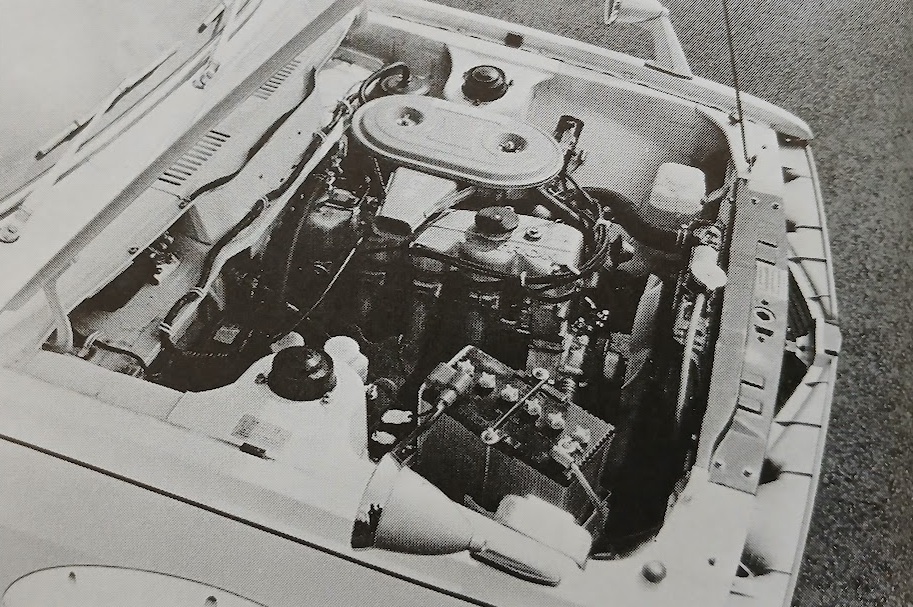
The Galant GTO, whose styling skillfully scales down the themes of the Ford Mustang, was enlarged and strengthened to 2 liters for 1973, and is now known as the GTO 2000. The new 2-liter “Astron” engine retains fundamentally the same design as the previous 1.7-liter “Saturn” unit: a long-stroke 1995cc SOHC engine with hemispherical combustion chambers, measuring 84x90mm. Two states of tune are offered, differing in compression ratio and carburetion.
The range consists of five models. The GSR and 2000GS-5 receive the 125ps engine developing maximum output at 6200rpm, while the 2000SL-5, 2000SL Automatic, and 2000SL use the 115ps/6000rpm version. Three transmissions are available: 5-speed, 4-speed, and Borg-Warner 3-speed automatic, although the 125ps GSR and GS-5 are offered exclusively with the 5-speed gearbox.
Of the previous 1.7-liter XI/XII models, only the single-carburetor 105ps version remains in production, revised in minor details and renamed the 1700SL and 1700SL-5, the latter newly equipped with a 5-speed gearbox.
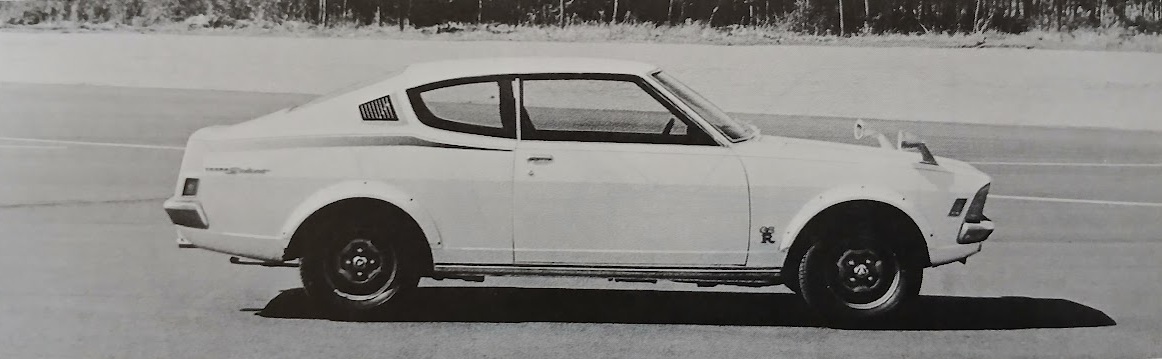
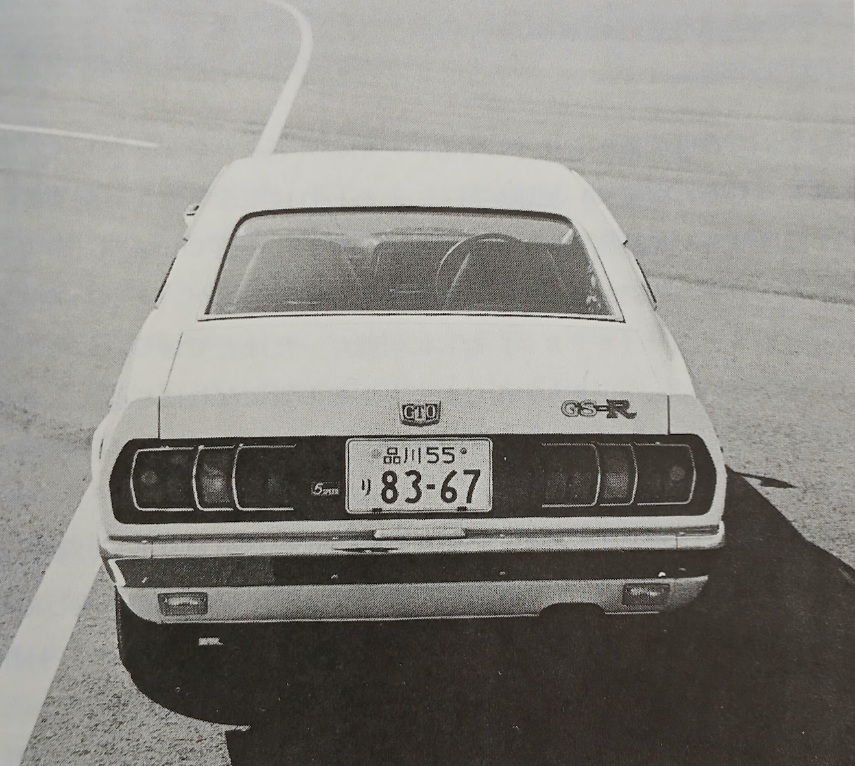
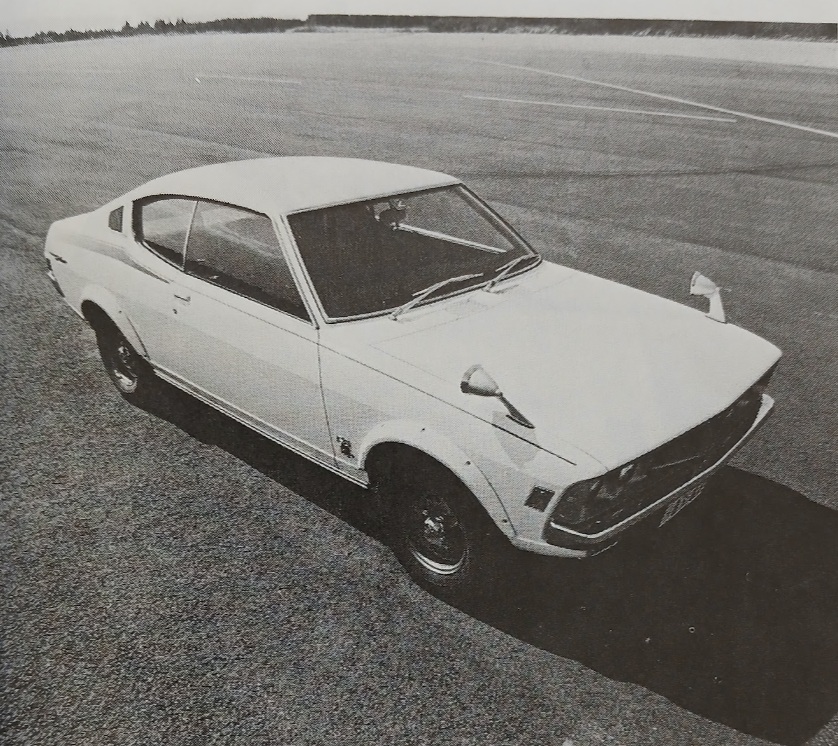
The car tested was the most sporting model in the GTO 2000 range, the GSR, priced at 943,000 yen. Aside from the engine revisions, the principal improvements common to all 1973 GTO models are wider wheel rims–increased from 4.5J to 5J–and more powerful brake servo assistance. The GSR alone is equipped as standard with 185/70HR13 tires, and to accommodate still wider rubber, FRP overfenders are fitted front and rear.
Now that production of the 1.6-liter DOHC GTO MR has ceased since last year, this SOHC 2-liter GSR has become the most powerful model in the range. Accordingly, it is best evaluated primarily in comparison with the MR. Let us first compare the specifications of the two cars.
The body is entirely identical apart from minor details, though the new GSR is heavier by 35kg, bringing curb weight to 1015kg. The MR used a DOHC 1597cc engine producing 125ps/6800rpm, while the GSR employs a SOHC 1995cc unit producing the same 125ps, but at 6200rpm. Consequently, the GSR is at a slight disadvantage in terms of power-to-weight ratio, at 8.12kg/ps compared with the MR’s 7.84kg/ps.
What has increased substantially, however, is torque. The MR developed 14.5kgm/5000rpm, whereas the 2-liter GSR produces no less than 17.5kgm/4200rpm. In determining acceleration performance, torque is often more important than peak output, and the test results confirmed that the 2-liter GSR surpassed the 1.6-liter MR quite noticeably in acceleration throughout most of the range.
At maximum speed, however, outright high-rpm power still proved decisive, and here the advantage remained with the MR. Although the GSR recorded the quicker 0–400m acceleration time–16.1 seconds against the MR’s 16.3–the MR ultimately achieved the higher maximum speed, reaching 182km/h at 6050rpm compared with 178km/h at 5400rpm for the GSR.
The SOHC engines used throughout the Galant range have long enjoyed a reputation for their willingness to rev smoothly and freely even in single-carburetor form, and the enlarged 2-liter “Astron” is no exception. The tachometer marks the red zone from 6000 to 8000rpm, yet the engine will pull cleanly to 7000rpm without strain. Beyond 6500rpm, however, power falls away rapidly, and during acceleration testing it became clear that the best results came from shifting up at 6500rpm.
In the DOHC-powered MR, by contrast, the red zone extended from 7200 to 8000rpm, and in practice engine speeds beyond 7000rpm could be used routinely. Compared with the MR, the GSR engine thus operates within a somewhat lower effective speed range, though this is offset to some extent by the adoption of a higher final-drive ratio, changed from 4.222 to 3.889.
In other words, once tire diameter is also taken into account, the GSR is higher-geared overall. The speed per 1000rpm in fourth gear is 27.6km/h for the GSR, compared with 25.6km/h for the MR. Given that the two cars produce identical power, while the GSR carries slightly greater weight and somewhat taller gearing, it is hardly surprising that its maximum speed fell short of the MR’s. Even so, maximum speed in direct fourth gear was essentially identical: 165.74km/h at 6500rpm for the MR, and 166km/h at 6000rpm for the GSR.
When the MR first appeared, it was the only Galant-series model equipped with a 5-speed gearbox, and its ratios were correspondingly chosen to suit the characteristics of the DOHC engine, resulting in a fairly close-ratio arrangement. Later, however, as the 5-speed transmission spread even to the 1400 models, the ratios were revised to better suit more modest power units, particularly by increasing the gap between third and fourth gears.
At present, all Galant models equipped with 5-speed gearboxes–from the Galant 14L SL-5 through to the GTO 2-liter GSR–use the same ratios. Those ratios are 3.238 / 1.955 / 1.341 / 1.000 / 0.854, compared to the MR’s 3.197 / 2.043 / 1.273 / 1.000 / 0.845.
The revised gearbox is very well matched to both the output and the broad, flat power characteristics of this 2-liter engine. Accelerating to 6000rpm in second before shifting up drops engine speed to 4200rpm; the shift from third to fourth brings it to 4500rpm, while fourth to fifth leaves the tachometer at 5000rpm. In every case, the engine remains squarely within the power band where maximum torque is available, allowing acceleration to pick up strongly in the next gear.
Compared with the MR’s 5-speed gearbox, however, the extension of third gear is curtailed rather noticeably, both by the ratio itself and by the lower usable engine-speed range. The MR would pull to 145km/h at 7200rpm, whereas the GSR reaches only 122km/h when using 6000rpm as the practical limit, and no more than 132km/h even when extended to the absolute limit of 6500rpm.
Apart from this point, though, the 5-speed gearbox must be considered one of the best of its kind even by international standards.
Shifter movement is short, positive, and light in effort, making the gearbox exceptionally pleasant to use.
The torque rod fitted to the MR’s rear axle has been omitted on the GSR, yet rear axle tramp under hard starts–the phenomenon of violent wheel-hop–rarely occurred except when the clutch was released extremely abruptly, in which case acceleration times naturally deteriorated owing to excessive wheelspin.
Power reserves are more than sufficient under virtually all conditions. On expressways such as the Tomei, the car can remain in fifth gear at nearly all times, whether climbing grades or overtaking. When forced to slow down behind slower-moving trucks, the preferred technique was often to shift directly from fifth down to third and complete the overtaking maneuver in one decisive sweep.
Despite its relatively high 9.5 compression ratio, this engine displays almost uncanny flexibility at low speeds. In direct top gear, 30km/h corresponds to approximately 1000rpm, yet the engine will not only run perfectly smoothly at this speed, but will also accelerate cleanly away from it–slowly, of course, but with complete smoothness and without the slightest trace of pinking.
Our steady-speed fuel-consumption tests are conducted over a measured 1km section while maintaining a constant speed, and during these tests it proved possible to run at the almost absurdly low speed of 30km/h in fifth gear–barely above the idle speed of roughly 850rpm–without any transmission snatch or driveline shudder.
Accordingly, even in city traffic where speeds seldom exceed 60km/h, fifth gear can be used whenever desired, making the car remarkably easy to handle in urban driving for such a sporting machine.
As the figures show, standing-start acceleration was consistently quicker than that of the 1.6-liter DOHC GTO MR. Curiously, however, the situation was often reversed in passing acceleration tests measured from constant speeds, where the MR generally proved faster.
Accelerating from 60-100km/h in third, fourth, and fifth gear, the respective figures for the GSR and MR (in parentheses) were 6.7 seconds (6.2), 9.5 seconds (8.6), and 11.0 seconds (11.5). From 80-120km/h, the times were 8.0 seconds (6.5), 10.2 seconds (8.9), and 12.2 seconds (13.2).
The reason appears to lie largely in the gearbox ratios. In the MR, the 60-100km/h and 80-120km/h tests in both third and fourth gear showed little difference between ratios, whereas the GSR displayed a much larger spread in times. This can reasonably be attributed to the MR’s closer-ratio gearbox.
Conversely, the GSR’s superiority in fifth-gear acceleration is likely the result of its greater absolute torque output. Why this torque advantage failed to appear in third and fourth gear–and in some cases even reversed itself–is more difficult to explain, though the most plausible reason would seem to be differences in carburetor characteristics. The MR employed sharp-throttled Mikuni-Solex carburetors, responsive but correspondingly “dirty” in emissions terms, whereas the GSR used twin Stromberg two-barrel carburetors set deliberately lean in order to reduce exhaust emissions. This may well account for the discrepancy.
As for fuel economy, the advantages of the two-barrel carburetor system are quite evident. At steady speeds up to roughly 80km/h–where only the primary side operates–fuel consumption is exceptionally good for a 2-liter twin-carburetor engine. The best figures in both fourth and fifth gear were recorded at 50km/h, returning 15.87km/l and 18.18km/l respectively.
Particularly noteworthy is the fact that fuel consumption changes very little between 30 and 60km/h. Comparing economy at 100km/h, the GSR recorded 11.76km/l (12.35km/l in fifth), against the MR’s 11.3km/l (12.3km/l in fifth). In other words, the larger 2-liter model was actually marginally more economical.
Real-world fuel consumption during this test averaged 7.50km/l, though the test distance was unusually short at only 369km, with much of that mileage consisting of testing at Yatabe. Since the MR previously averaged 7.7km/l across a wide variety of road conditions, the GSR should in practice prove at least slightly better than that.
Compression ratio is 9.5, requiring premium gasoline. Curiously, however, the fuel tank has been reduced slightly in capacity, from the MR’s 55 liters to 52 liters.
As for the chassis, one of the improvements common to the entire 1973 GTO range was the enlargement of the brake servo from 4.5 inches to 6 inches in diameter in an effort to reduce pedal effort. The effect is immediately noticeable. Previous GTOs required surprisingly heavy pedal pressure for servo-assisted brakes–to the point that one could barely believe a servo was fitted without opening the hood to confirm it.
In numerical terms, the MR produced 0.5g deceleration with a pedal effort of 20kg, whereas the GSR achieved 0.77g. Under full panic braking (approximately 25kg pedal effort), the proportioning valve prevents the rear wheels from locking, though the front wheels will lock for roughly 5 meters. Even so, directional stability is not disturbed.
In the 0-100-0 fade test, pedal effort increased substantially as the repetitions progressed. The initial figure of 12kg rose to 18kg by the fifth run and 28kg by the tenth. From around the sixth cycle onward, smoke and odor became evident, and although some degree of fade was clearly present, braking effectiveness itself remained reliable, with only pedal effort increasing.
This test is an extremely severe one, and opportunities to subject a car to such punishment under real road conditions are exceedingly rare. Nevertheless, we continue to regard it as an important part of the C/G road test because, regrettably, the braking performance of Japanese cars still falls well short of international standards, and we wish to see them reach an acceptable average level as quickly as possible.
When first introduced in the autumn of 1970, the original GTO rode on narrow 4Jx13 rims fitted with 155SR-13 tires. Car Graphic has criticized such narrow rims and inadequate tires–common shortcomings among Japanese cars–for more than ten years. With the arrival of the MR, the specification was widened to 4.5J rims with 165SR-13 tires, and from 1973 onward all GTO models adopted 5J rims.
The high-performance GSR alone receives 185/70HR-13 radial tires as standard equipment, together with FRP overfenders to clear the wider rubber. Our test car was fitted with Yokohama GT Special Super 70 tires.
Candidly, however, handling did not seem to improve dramatically. It was by no means poor, but neither was it notably better or worse than the average Japanese sporting car. At the very least, one could not genuinely feel the expected benefits of widening the rims to 5J and fitting 185/70 tires.
Indeed, the more noticeable changes were negative ones: steering effort increased overall, while at lower urban speeds the car became more susceptible to road-surface irregularities and tramlining–the tendency for the steering to fidget and wander over grooves and ridges in the pavement.
All GTO models employ a variable-ratio ball-nut steering system, with ratios ranging from 15.5 around center to 18.1 near full lock. In the earlier MR, steering response had been sharp by Japanese standards, with understeer restrained within agreeable limits. In this GSR, however, one must regrettably conclude that the car has taken a slight step backward, with stronger understeer and a generally duller overall character.
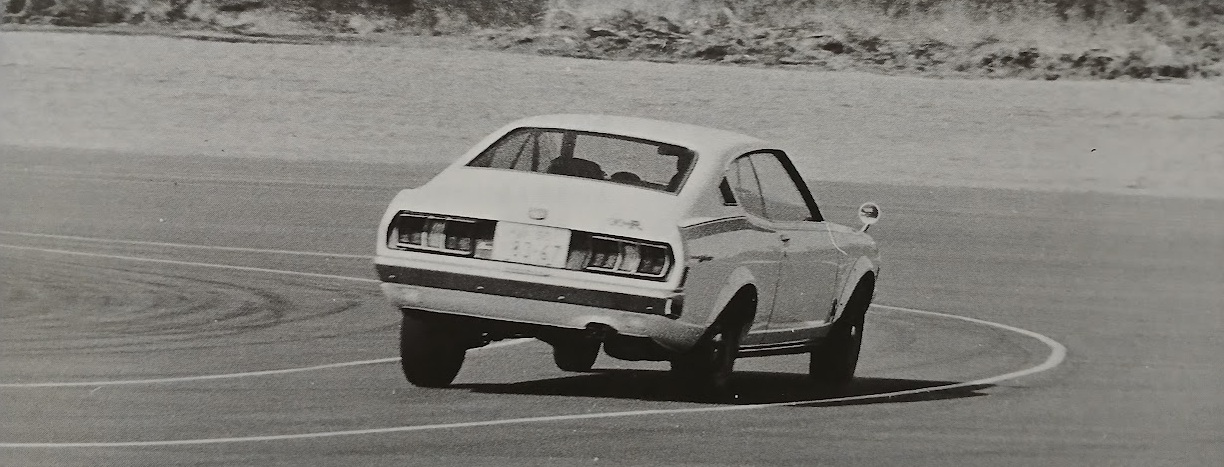
At ordinary cornering speeds, understeer remains within reasonable limits, body roll is modest, and aside from the steering effort–which is generally on the heavy side–the car follows steering inputs fairly naturally. Under more extreme conditions, however, such as slalom testing, the limitations of the tires become much more apparent.
To begin with, grip levels are simply too low for a tire carrying a 185/70HR designation. The tires squeal readily, and understeer quickly becomes excessive. Even within the Yokohama range, the recently introduced steel-belted radials display considerably higher grip, closer in character to the Michelin ZX, and one cannot help feeling that such tires would allow the 5J rims to demonstrate their full potential.
The present 185/70HR tire is, comparatively speaking, a rather “soft” radial, and is consequently relatively insensitive to small surface irregularities. The suspension itself is clearly tuned with high-speed driving in mind, yet even at lower speeds the car delivers a notably flat and comfortable ride, due perhaps in part to these softer radials. In absolute terms the ride is certainly firm, but while it may be described as “firm,” it is by no means “harsh.”
Body rigidity in the hardtop coupe structure is high, and even on rough roads the body exhibits very little creaking. Overall, the car gives the impression of being solidly constructed.
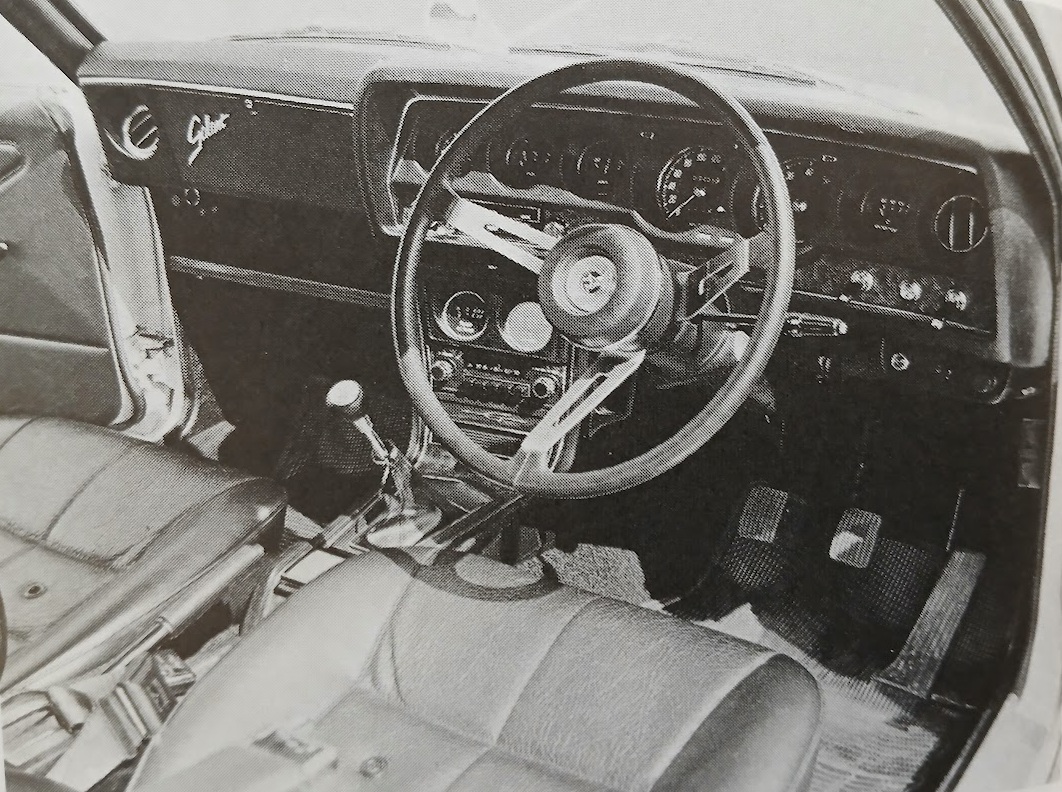
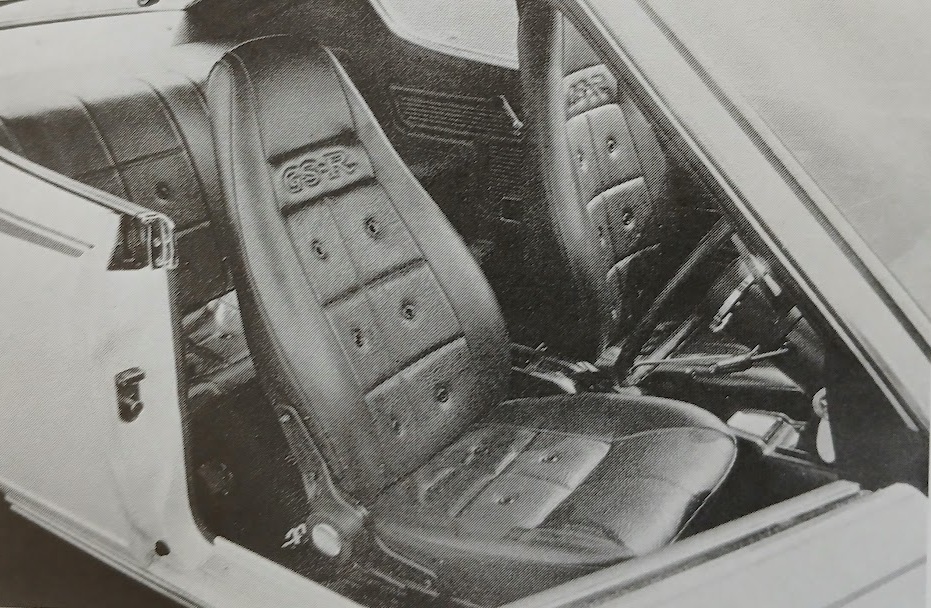
The biggest change to the interior concerns the seat upholstery. Previously, only the central sections supporting the body had been trimmed in fabric, but the seats are now finished entirely in vinyl leather. These integrated-headrest high-back seats are excellent: generous in size, supportive laterally, and well shaped to support the body at all the proper points. On the GSR alone, both the cushion and backrest are perforated for ventilation.
Seat adjustment range is generous both fore and aft, and together with the tilt steering wheel–a hallmark of the Galant range, best positioned at its lowest setting–it becomes possible to adopt a relaxed driving posture with both arms and legs properly extended.
The steering wheel rim, however, is too thin for convincing control of a sporting car of this kind, and becomes tiring to the fingers. A thicker leather-covered rim is available as an option.
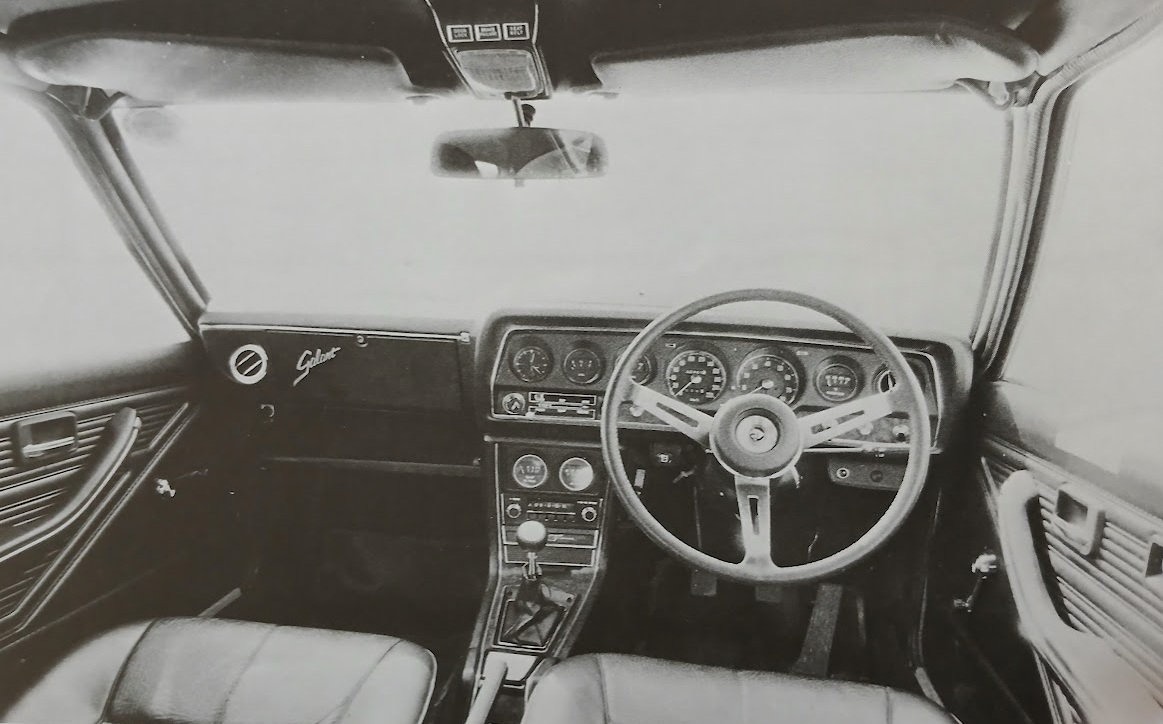
The dashboard itself is exceptionally complete, containing virtually every conceivable instrument. Alongside the speedometer and tachometer are gauges for water temperature, ammeter, fuel level, and a clock, while the center console even carries oil-pressure and oil-temperature gauges. During our testing, oil temperature reached 100°C only during maximum-speed running at Yatabe.
Instrument design is clean and pleasing, though the graduations on the speedometer and tachometer are somewhat too fine. Increasing their diameter slightly, or painting the needle tips red, would improve legibility considerably.
With the exception of the headlight on/off switch, all of the most frequently used controls are conveniently operated by a single stalk on the right of the steering column. Headlight dimming and flashing, turn signals, and the wiper/washer functions are all incorporated into this one lever, an arrangement that works very well.
It is somewhat unusual nowadays, however, that the horn button remains in the center of the steering wheel. It would be preferable to relocate it to the spokes.
The GTO was also the first Japanese car to adopt what is called an overhead console. This incorporates an extraordinarily bright interior lamp together with warning lights for seatbelts, brake-system failure, and door locking.
Equipment levels are notably generous even by Japanese standards. A heated rear window, heated glass, and finned wipers are all standard equipment, though rather surprisingly the radio remains AM-only. From the 1973 model year onward, the antenna has also been redesigned: instead of a conventional aerial, the trunk lid itself now serves as the antenna element.
The rear seats are set low into the body in the manner of an Alfa Romeo GTV. In terms of space, two passengers can sit comfortably, while three can be accommodated if necessary. The backrest angle is more upright than that of a sedan, however, and in this respect the Celica GT offers greater comfort.
In practical terms, it is difficult to think of anything that truly needs to be added to the already comprehensive equipment list, though options include items such as air conditioning, power windows, stereo audio equipment, and rear seatbelts.
Interior and exterior finish quality is particularly good, even among Japanese cars, which in general already exceed international standards in this respect by a considerable margin.
The price is 943,000 yen, substantially less expensive than the former DOHC 1.6-liter MR, which cost 1,125,000 yen. This makes the relationship between the GSR and the MR rather similar to that between the Porsche 914/2.0S and the discontinued six-cylinder 914/6.
Without hearing the engine, the two Porsches are almost impossible to distinguish externally, and in standing-start acceleration the 914/2.0S was actually quicker than the 914/6. Only in maximum speed and high-speed acceleration did the 914/6 hold a clear advantage, despite costing nearly 50% more.
Much the same may be said of the GSR and MR, though the performance gap in Mitsubishi’s case is even smaller than it was with the two Porsches. In that sense, the GSR may fairly be considered an excellent value.
Postscript: Story Photos