Mitsubishi Colt Galant GTO MR vs. Toyota Celica 1600GT (1971)
Publication: Car Graphic
Format: Group Test
Date: April 1971
Author: “C/G Test Group” (Shotaro Kobayashi, uncredited)
Comparison test: Mitsubishi Galant GTO MR vs. Toyota Celica 1600GT
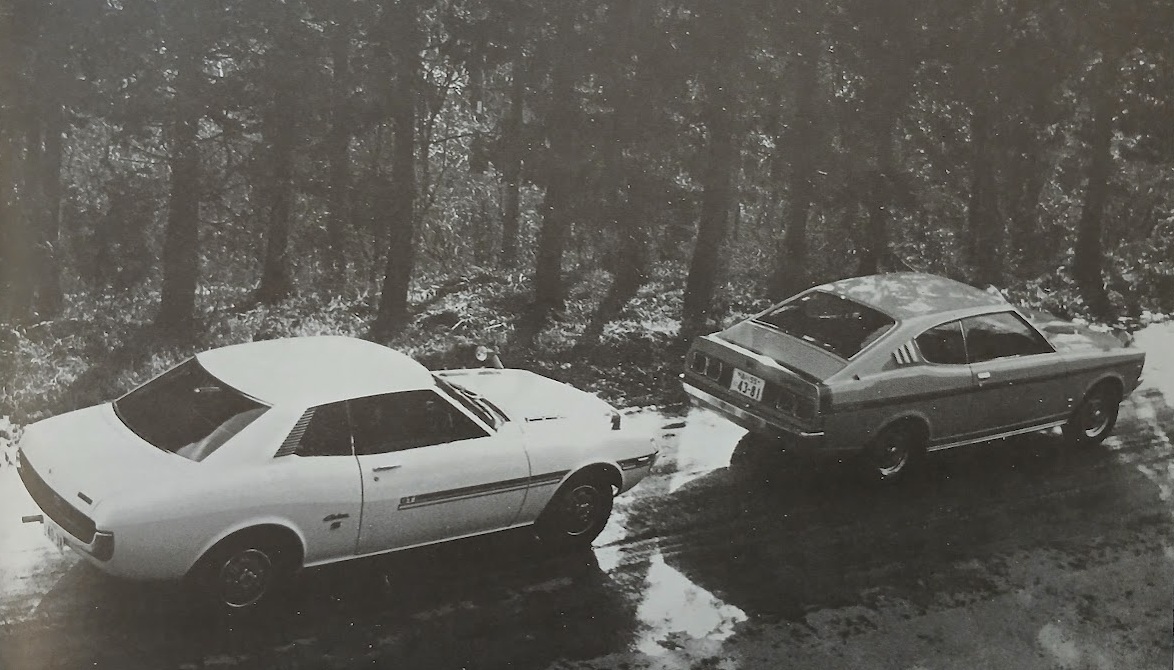
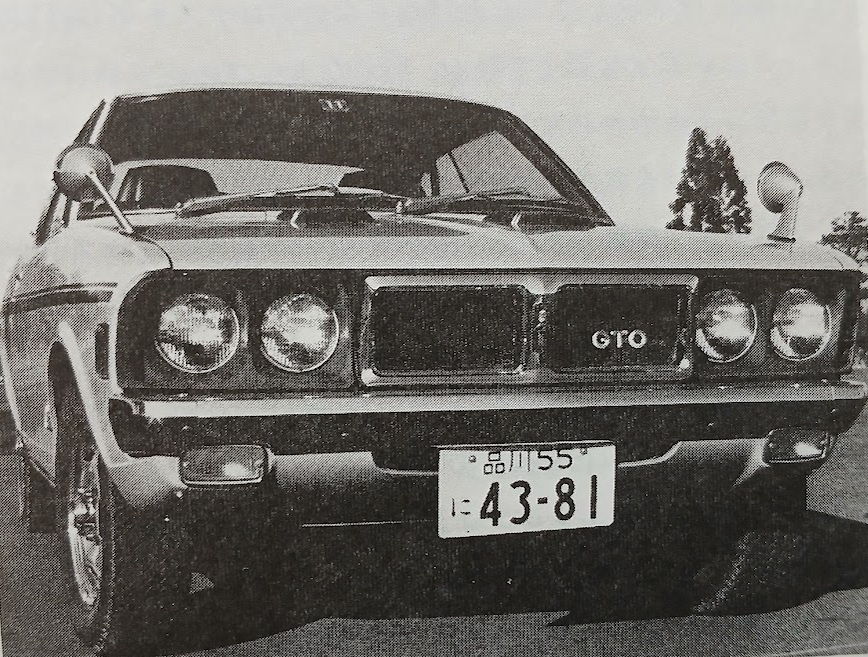
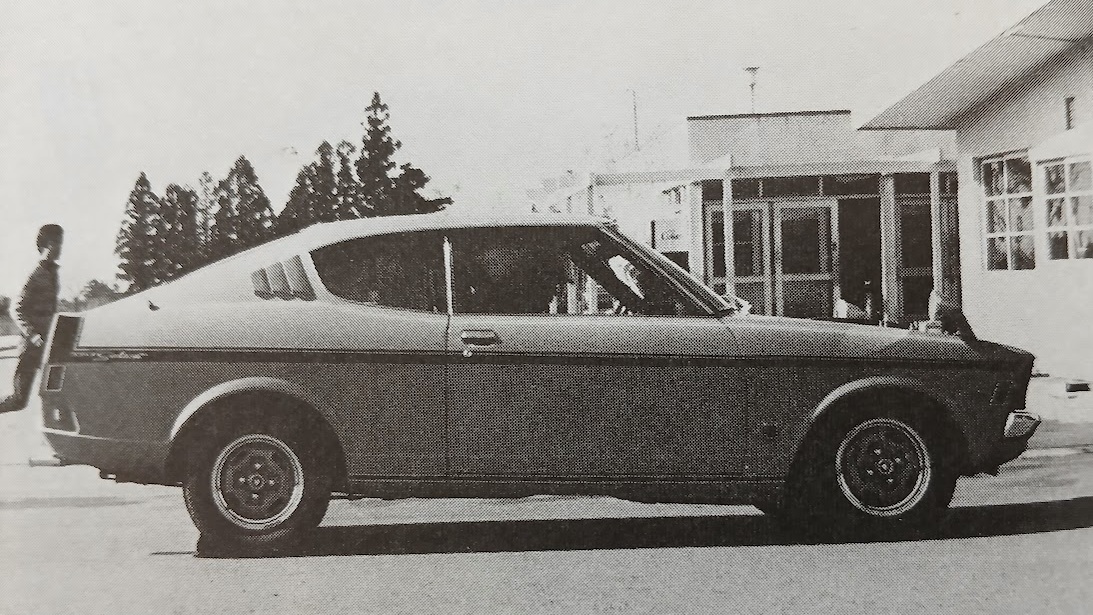
The Mitsubishi Galant GTO MR and Toyota Celica GT are remarkably similar cars, both in specification and character. Each is a five-seat sporting coupe aimed at essentially the same market, and both appeared at roughly the same time. Both are equipped with 1.6-liter DOHC engines and 5-speed gearboxes, while differences in external dimensions and weight are negligible.
Structurally, both are thoroughly conventional designs. Each is a hardtop coupe with monocoque construction, based on the chassis of an existing mass-production sedan–the Galant AI/AII in the GTO’s case, and the Carina in that of the Celica.
The front suspension of both follows the familiar MacPherson strut layout, while at the rear each uses a live axle. Their methods of axle location, however, differ considerably. The GTO series uses semi-elliptic leaf springs, with a torque rod added only on the high-performance MR. The Celica, by contrast, uses coil springs, with the axle located longitudinally by a four-link arrangement and laterally by a Panhard rod.
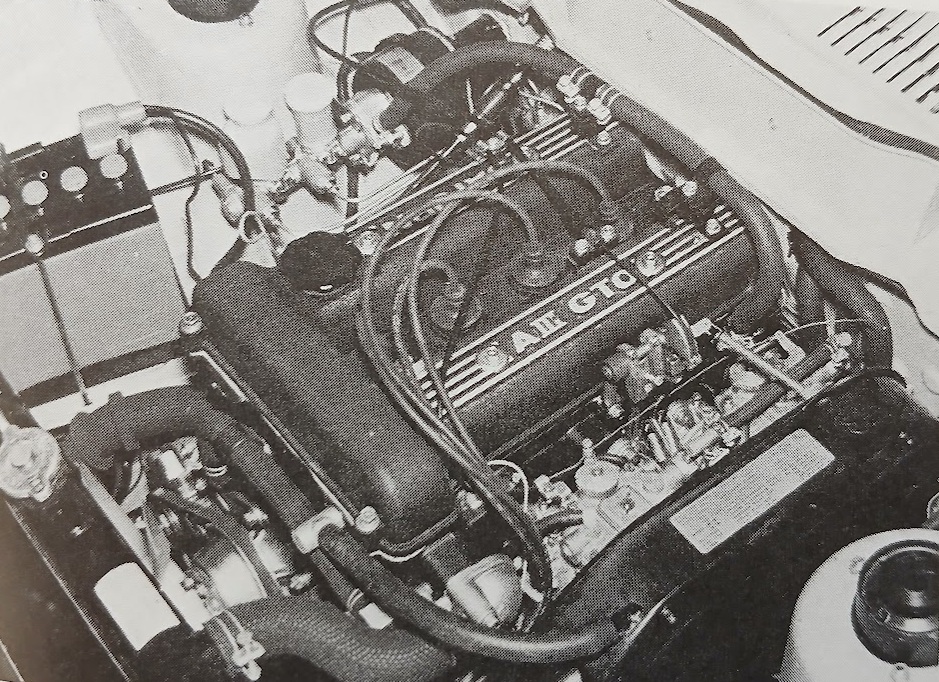
The two DOHC engines make an interesting contrast. The Celica’s unit is an oversquare design with bore and stroke dimensions of 85x70mm, while the GTO’s engine, at 76.9x86mm, is a decidedly long-stroke design of a type that is now rarely seen. Compression ratios are 9.8:1 for the Celica and 9.5:1 for the GTO. Both engines use twin Mikuni-Solex twin-choke carburetors and require premium gasoline.
Maximum output favors the GTO slightly, at 125ps/6800rpm versus the Celica’s 115ps/6400rpm, though peak torque is identical at 14.5kgm. Power-to-weight ratio likewise gives the advantage to the Mitsubishi, at 7.84kg/ps compared with the Toyota’s 8.17kg/ps.
Wheel and tire dimensions are identical on the two cars, both using 4.5J rims and 165-section tires. The test Celica was fitted with Bridgestone Radial 20 165HR-13 tires, while the GTO wore Yokohama GT Special High Block 165SR-13s. In this respect, the Toyota comes standard with what is effectively a higher-speed-rated tire specification.
There is, however, a substantial difference in price. The GTO MR costs 1.125 million yen, while the Celica GT is priced at only 875,000 yen. This disparity presumably reflects the difference in production volume and sales strength between the two manufacturers.
Performance
Celica GT: Among Toyota’s engines, this 115ps DOHC unit is truly outstanding. From a smooth idle of roughly 800rpm to the beginning of the red zone at 7000rpm, it revs with exceptional smoothness, and even at high engine speeds very little vibration is transmitted to the body.
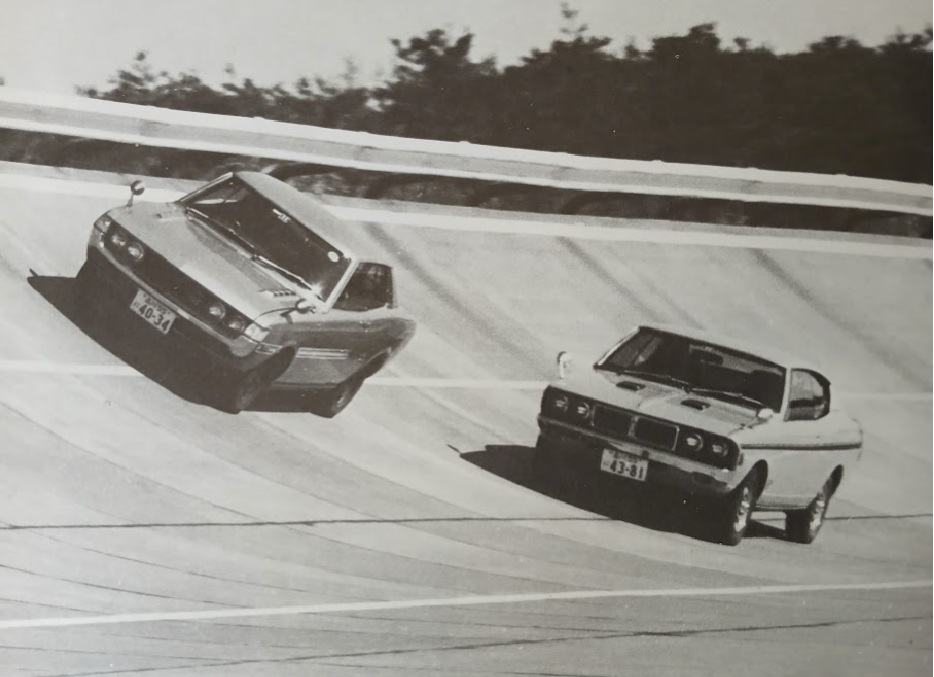
Around 4000rpm, some exhaust resonance becomes noticeable inside the cabin, but mechanical noise is remarkably subdued for a twin-cam engine. At Yatabe, the Celica recorded a maximum speed of 176.78km/h over the measured 1km straight, corresponding to 5900rpm in fifth gear.
Evidence of the engine’s ample power relative to the car’s weight is provided by the fact that it was able to reach 173.81km/h even in direct fourth gear. At that speed the engine was turning 6750rpm, slightly above its 6400rpm power peak but still comfortably within the yellow zone.
The ratios of the 5-speed gearbox are very well matched to both the engine’s characteristics and the car’s weight. Extended to 7000rpm, the top speeds in first, second, and third gear are 51km/h, 91km/h, and 134km/h respectively.
At the same time, the engine displays impressive flexibility at low and medium speeds. It will pull a gentle incline in top gear while maintaining only 2000rpm. Surprisingly, the overdrive fifth gear can be used from as low as 60km/h if desired, though its intended role is naturally that of an economical cruising gear for expressway travel at speeds above 100km/h.
For example, 100km/h corresponds to approximately 3800rpm in fourth gear, but selecting fifth drops engine speed to about 3100rpm, reducing noise levels noticeably. Gear noise in fifth is virtually inaudible.
The shift pattern follows the arrangement used by cars such as the Fiat 124 Coupe, with fifth gear located to the upper right of fourth. Shift feel is positive and precise, and there is little danger of accidentally selecting fifth when upshifting from second to third.
Acceleration is unquestionably rapid for a practical 1.6-liter car. The Celica covered 0-400m in 16.8 seconds and 0-1000m in 32.0 seconds. This represents a dramatic improvement over the SOHC 105ps, 5-speed Carina 1600ST sedan tested previously, which required 17.9 seconds for the standing 400m, and serves as a clear demonstration of the advantages offered by the DOHC engine. (It should be noted, however, that the Carina tested earlier was brand new, whereas this Celica had already covered approximately 2,100km.)
GTO MR: The first point that must be noted is that the test car’s engine (having covered approximately 11,000km) was not in perfect condition. In the area that mattered most–top-end power–it appeared to be performing somewhat below standard. In the lower gears it would rev easily beyond 7000rpm, but in fourth and fifth it would go no further than 6500rpm and 6050rpm respectively, and beyond those speeds it felt as though the ignition were beginning to cut out.
As a result, the average speed recorded over Yatabe’s measured 1km straight was only 182.02km/h, well below the catalog figure of 200km/h. Even so, this remains exceptionally impressive performance for a practical 1.6-liter car. It exceeds the 180km/h achieved by the Fiat 124 Coupe (1608cc) and comes very close to the Alfa Romeo GTV’s 185km/h (1570cc).
Despite its long-stroke dimensions, the engine revs very freely, and in the lower gears the needle climbs to the 7200-8000rpm red zone without the slightest hesitation.
Compared with the Celica, however, mechanical noise is generally more pronounced, while exhaust-system resonance centered around 4000rpm is also rather intrusive.
The 5-speed gearbox is even better than the Celica’s. Shift travel is shorter and the action exceptionally satisfying. The shift pattern is the same, with fifth gear located forward to the right of third. The upper three ratios are spaced even more closely than those of the Celica, and third gear in particular is considerably nearer to fourth (1.273 versus the Celica’s 1.384). At the beginning of the red zone, 7200rpm in third corresponds to no less than 145km/h.
Although maximum torque is identical to the Celica’s at 14.5kgm, the GTO generally produces stronger torque through the middle of the rev range. As the figures demonstrate, fourth-gear acceleration from 80-120km/h requires only 8.9 seconds, compared with 10.4 seconds for the Celica.
Standing-start acceleration is likewise superior. The GTO covered 0-400m in 16.3 seconds, half a second quicker than the Celica. The 0-1000m time, however, was 31.2 seconds, and the margin proved smaller than expected. This is probably attributable to the slight top-end weakness noted in the test car’s engine.
Overall, power reserves are entirely adequate. For example, even on the long gradients near Matsuda on the Tomei Expressway, the GTO could maintain 80km/h in fifth gear with complete ease. Third gear, spanning approximately 30-145km/h, is extraordinarily versatile. When stuck behind slower traffic on the expressway, the usual procedure was to downshift directly from fifth to third and overtake in one decisive surge.
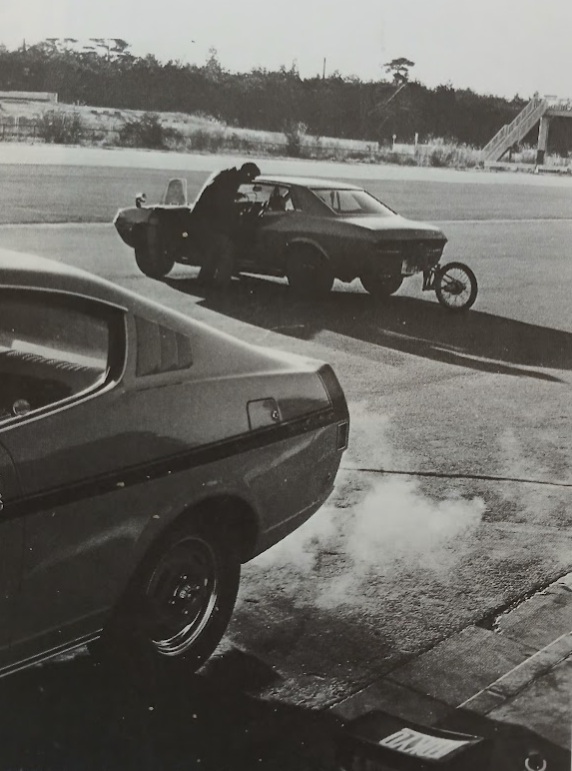
The strength of third gear was demonstrated rather vividly by an incident during the test. While running at Yatabe, the Celica suffered a clutch failure–fortunately only after all testing had been completed. The GTO then towed the disabled Celica all the way back to Tokyo, a distance of approximately 80km, with most of the driving in third gear at 50-60km/h. Even under this heavy load, the water-temperature gauge remained entirely normal.
Comparing the two cars overall, the figures suggest a slight advantage for the GTO, but from behind the wheel the difference is barely perceptible. If we were pressed to identify a distinction, it would be that the Celica’s torque curve exhibits a slight dip in the 3000-4000rpm range, whereas the GTO’s delivery is more uniformly flat. As a result, the GTO enjoys a small advantage when accelerating out of corners.
Incidentally, if these two Japanese coupes are compared with the mechanically similar Fiat 124 Coupe 1600 and Alfa Romeo Giulia GTV, the respective maximum speeds are 180km/h for the Fiat and 185km/h for the Alfa, while quarter-mile times are 17.8 and 17.7 seconds. Whatever the case may be regarding maximum speed, in terms of acceleration the two Japanese cars are decidedly quicker.
Fuel Consumption
In the steady-speed fuel-consumption tests conducted at Yatabe over a level 1km section, the Celica proved more economical. At a constant 100km/h it returned 13.1km/l in fourth gear and 13.9km/l in fifth. This is understandable given its 10ps lower output, 40kg lower weight, and slightly taller overall gearing.
Under the same conditions, the GTO recorded figures of 11.3km/l in fourth and 12.3km/l in fifth.
When the two cars were driven together in convoy over approximately 550km of ordinary roads, however, the situation was reversed. The overall average was 7.4km/l for the Celica and 7.7km/l for the GTO.
These figures represent the outbound journey to Yatabe (the return trip being excluded because, as already described, the GTO towed the Celica back to Tokyo) together with high-speed running from the Tomei Expressway to Hakone.
It is therefore reasonable to conclude that the GTO does indeed hold a slight advantage in outright performance. In order to maintain the pace set by the faster GTO, the Celica evidently required more frequent use of lower gears and higher engine speeds.
Both cars require premium gasoline. Fuel-tank capacity is 50 liters for the Celica and 55 liters for the GTO, making it reasonable to expect a safe cruising range of approximately 350km in either case.
As an aside, the results of the CO emissions test were far less encouraging. The Celica recorded figures between 5-5.8%, while the GTO produced approximately 8%. By the latest standards, both would have to be judged complete failures.
Handling, Ride, and Braking
Celica GT: When the Celica was first introduced, we had the opportunity to drive one the very next day. At the time, we remarked that its steering response was unusually sharp for a Toyota product–particularly in the sister-model Carina fitted with Bridgestone Radial 10 tires. Having now tested a Celica with about 2,000km on it, however, we feel obliged to revise that opinion somewhat.
Its response remains fairly good, but compared with European cars of the same class–the Fiat 124 and Alfa Romeo among them–it is distinctly less immediate. There is a sensation of twisting perhaps 5cm worth of rubber somewhere in the system before the steering actually begins to take effect.
The test car’s Bridgestone Radial 20 tires have a softer tread than the earlier Radial 10. The advantage is that kickback is almost entirely absent, but steering response is slightly less crisp and the tires squeal more readily.
The rear axle, located by a four-link arrangement, maintains good grip even in tight corners, though body roll is somewhat excessive. The handling is certainly not poor, but neither is it especially outstanding. If anything, the understeer is a little stronger than we prefer.
When we first drove the model as a brand-new car, ride quality struck us as unusually firm for a Toyota. It now appears that this impression was due in large part to the friction present in a new chassis and suspension. On this occasion, the car displayed entirely appropriate ride comfort over all types of road surfaces.
The servo-assisted disc/drum brakes are quite powerful. A pedal effort of only 20kg produced 0.78g deceleration, while 40kg yielded nearly the maximum attainable figure of 0.95g. Nose dive under hard braking is rather pronounced, however.
In the 0-100-0 fade test, pedal effort increased from an initial 16kg to 26kg by the tenth stop. An increase of 60% remains well within the normal range.
GTO MR: Fitted with 165SR-13 Yokohama GT Special tires on 4.5J rims, the MR’s steering is vastly more secure and responsive than that of the GTO MII riding on 4J wheels. Although the MII used the same tires, they squealed excessively in corners and tended to collapse onto their sidewalls, making the car difficult to control. The MR, by contrast, feels far more firmly planted, with noticeably less body roll.
Understeer is held to moderate levels, and the car responds eagerly to even small steering inputs. The penalty is that steering effort during low-speed maneuvers–parking, for example–is disproportionately heavy for a car of this weight.
The effect of the torque rod added to the rear axle is unmistakable. On the Galant AII GS, severe rear-axle tramp during hard starts was a persistent problem, but on the GTO MR it is entirely absent. Instead, the car launches with only slight wheelspin before surging forward vigorously.
The same advantage is apparent when accelerating hard out of tight corners on uneven surfaces. Power is transmitted to the road with little waste, and the rear axle remains well controlled. Cornering stability is excellent. Even if the throttle is lifted in a fast bend, the car’s overall attitude changes very little, the only effect being a slight reduction in understeer.
It is the sort of handling that inspires confidence when pressing on along a winding road.
The steering-wheel rim, however, would benefit from being somewhat thicker.
When we tested the MII, its ride quality struck us as rather harsh, particularly at lower speeds. Curiously, the same criticism does not apply to the MR. It is certainly firm in absolute terms, but it is “firm” rather than “harsh.”
The servo-assisted disc/drum brakes require considerably more pedal effort than those of the Celica. For example, 20kg of pedal effort produces only 0.5g deceleration, while maximum braking force requires nearly 50kg of pressure.
Fade resistance is also inferior to the Celica’s. In the 0-100-0 test, pedal effort had doubled by the tenth stop, rising to 40kg.
Comparing the two cars as a whole, the GTO’s handling is unquestionably closer to that of a true sports car. To keep pace with a GTO driven hard along a winding road, the driver of the Celica must work considerably harder.
On the other hand, the Celica’s ride comfort is superior, and as an overall driving experience it feels the more refined of the two.
Interior and Equipment
The front seats in both cars are fully reclining with integrated headrests, and comfort in both is excellent. Driving position differs little between them, though the Celica gives the driver a noticeably more sporting feeling, either because the cowl is higher or the seating position lower.
The central sections of the seat upholstery–the areas that actually support the body–are trimmed in knitted vinyl leather in the Celica and fabric in the GTO.
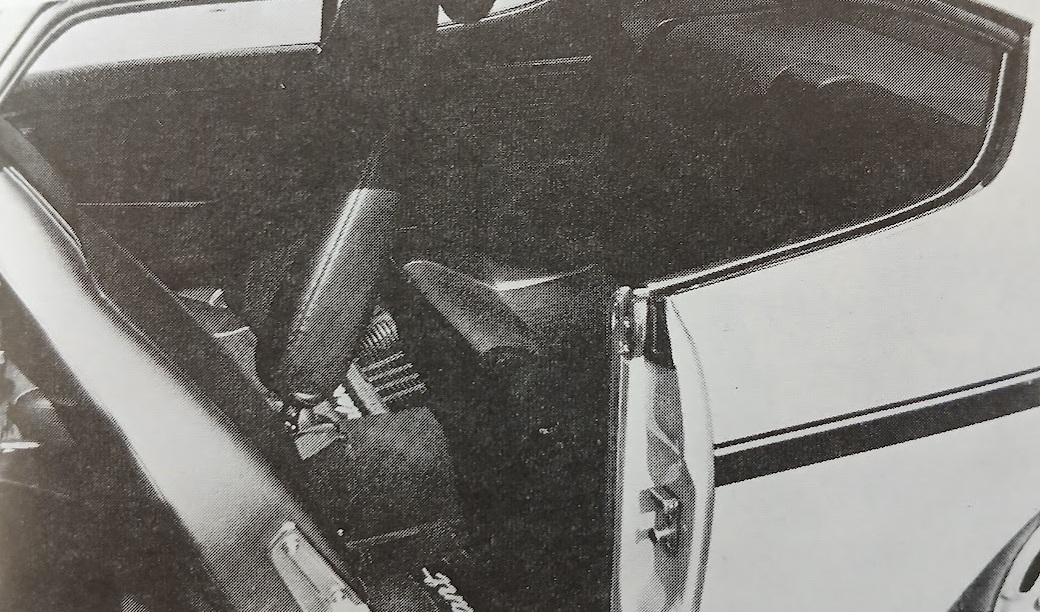
The rear-seat cushions, like those of an Alfa Romeo, are deeply recessed in both cars. Even so, the Celica provides the more comfortable seating position. The reason is simple: the backrest is reclined at a more relaxed angle, allowing occupants to sit in a more natural posture. In either case, however, four adults can be accommodated without too much difficulty.
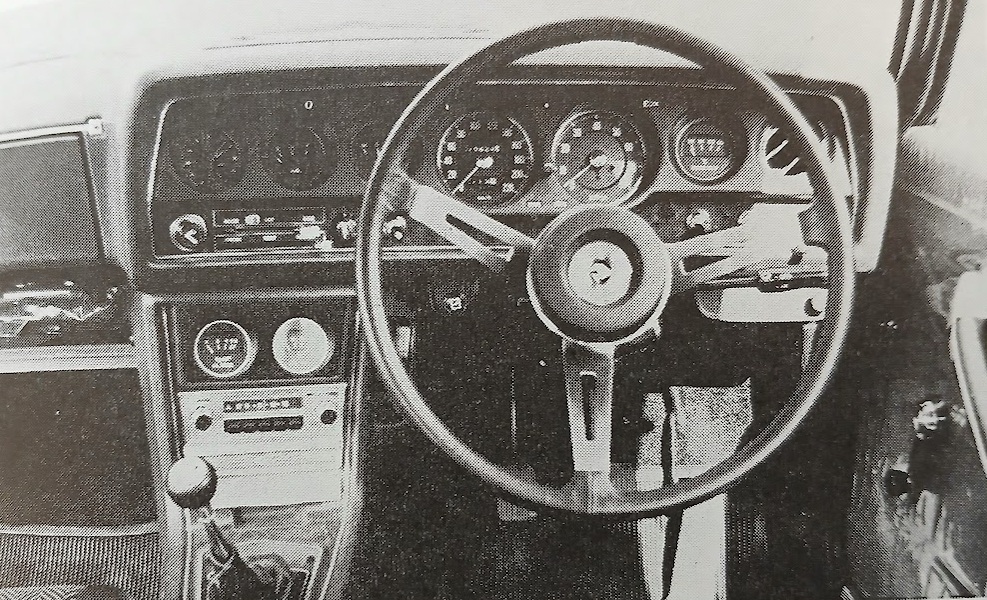
Instrumentation is comprehensive in both cars, and the GTO even includes an oil-temperature gauge. Overall, though, the Celica’s dashboard is more attractive and better organized. The Galant’s instrument panel is somewhat busy, making it harder to take in at a glance.
From a functional standpoint, the main weakness of the GTO is its horn button, which is located in the center of the steering wheel. The Celica’s arrangement, with horn buttons positioned at the bases of the three T-shaped spokes and operable without removing one’s hands from the wheel, is decidedly preferable.
The GTO does have the advantage when it comes to the headlamp and wiper controls, both of which are conveniently close to hand. In the Celica, they are mounted farther away on the dashboard.
The Celica is equipped with an AM/FM radio as standard equipment, whereas the GTO offers only AM reception.
Generally speaking, the Celica has the more attractive interior design and more complete equipment specification.
In conclusion, these two cars are so similar in performance and design that it is difficult to identify a truly decisive factor in choosing between them.
If forced to draw a distinction, we would say that the GTO holds the advantage in both handling and performance, making it the more natural choice for “drivers.” The Celica, on the other hand, combines elegant styling with a fully equipped interior, qualities likely to appeal more strongly to “cruisers.”
In the end, the difference in price–875,000 yen for the Celica versus 1,125,000 yen for the GTO–remains difficult to ignore.
Postscript: Story Photos