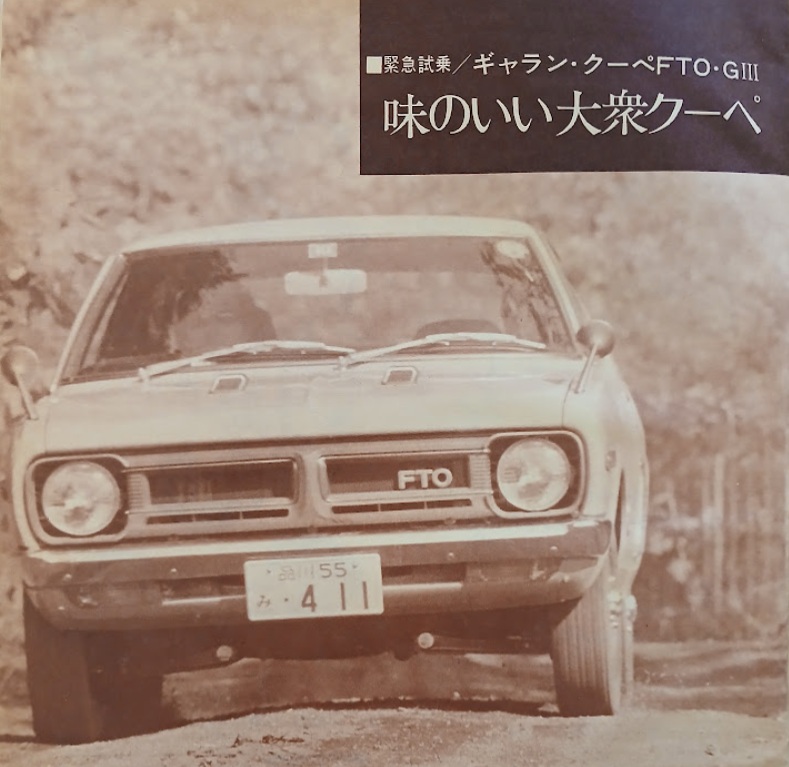
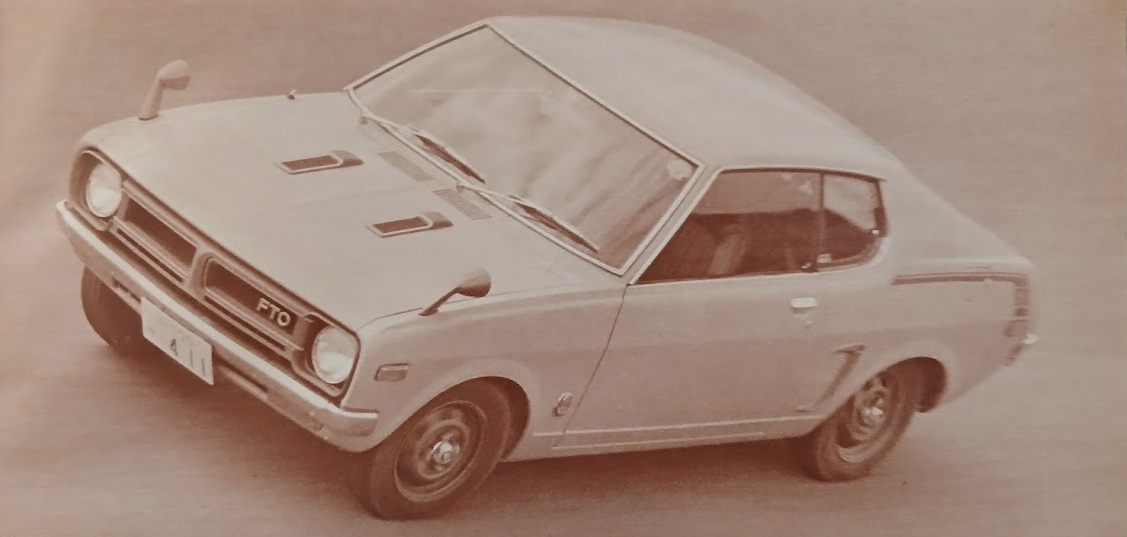
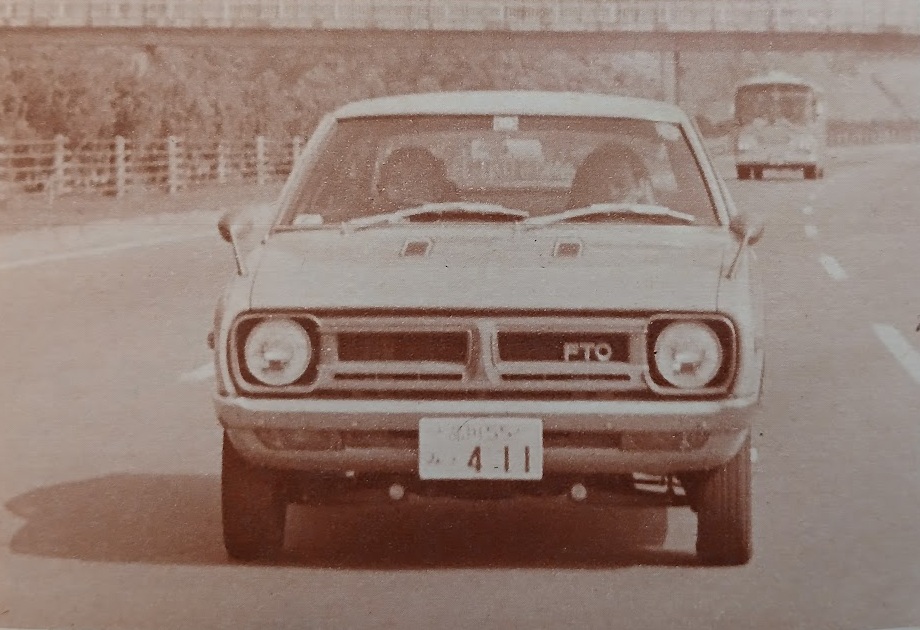
Mitsubishi Colt Galant FTO GIII (1971)
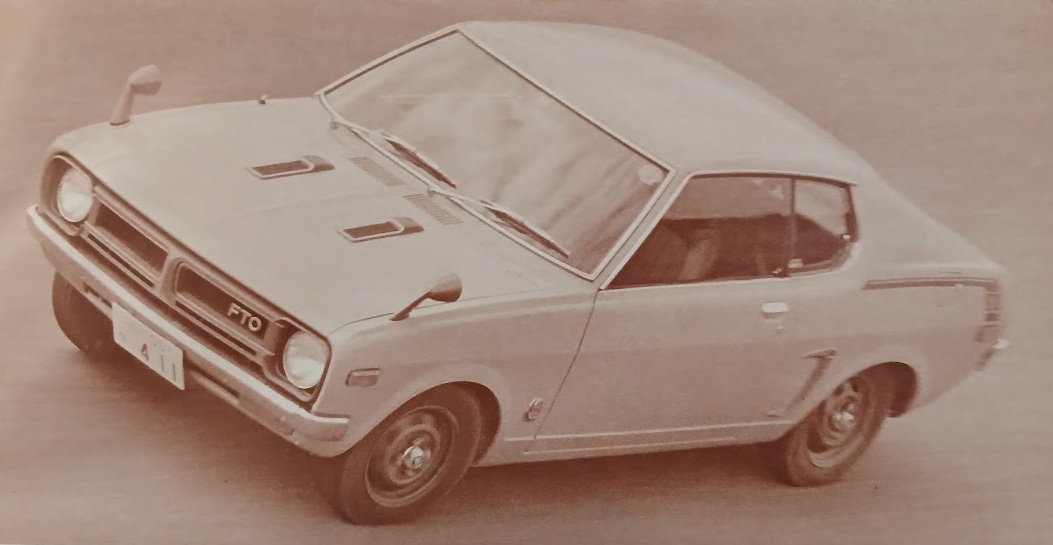
Publication: Motor Fan
Format: Test Drive Report
Date: December 1971
Author: Hiroshi Okazaki
A Well-Judged Mass-Market Coupe
On the eve of the Tokyo Motor Show, Mitsubishi Motors has announced a new 1400cc coupe. We promptly took it to Fuji Speedway to assess its performance—and this is what we found…
A Nicely Settled Driving Position
A stylish compact coupe has now joined the Galant series.
Its name is the Galant FTO. The initials “FTO” are said to derive from the Italian Fresco Turismo Omologare—or, in English terms, “Fresh Touring Homologated.”
At 3765mm in overall length, it is in fact shorter than rivals such as the Sprinter and Sunny Coupe. Yet its width, at 1580mm, is comparable to cars in the 1.5-1.6-liter class.
Because Japanese tax regulations classify vehicles under 1.7m wide as “compact cars,” the upper edge of that limit in the 2-liter class has tended to define the benchmark, with smaller classes scaled downward from that. As a result, by international standards, many domestic cars have ended up relatively narrow in proportion to their length. It has not been uncommon to see cars that look attractive in profile, but somehow less convincing when viewed head-on or from the rear.
The Galant FTO clearly breaks away from that tendency. From any angle, it presents a well-proportioned, balanced shape.
At first glance, the side windows appear to be a fully open, pillarless design. In reality, however, there is a very thin center pillar styled to resemble a window frame, and the rear side windows are hinged at the front and open outward.
This slender pillar is unlikely to contribute meaningful structural strength in the event of a rollover. Even so, it succeeds in eliminating the somewhat elastic, “springy” feel that is typical when closing the doors of a full hardtop. In that sense, its presence is quite effective.
Inside, the overall impression carries over the Galant family image, but with a clear emphasis on youthfulness.
The steering wheel, in particular, is unlike anything seen before–a strikingly modern design.
The front seats are high-backed units with integrated headrests. Comfort is quite satisfactory.
The seating position is low, as expected. Drivers who prefer to stretch out their arms and legs in a relaxed posture will find that the hood is barely visible. The steering column is, of course, tilt-adjustable.
This tilt mechanism, together with generous seat travel and a finely stepped recline adjustment, should allow a satisfactory driving position for all but the most unusually proportioned drivers.
The relative positioning of pedals, steering wheel, and shift lever is also well judged.
What stands out most when sitting in the front seats is the sense of cabin width. This width has a strong influence on psychological comfort, and in the FTO it is immediately noticeable. It lends the interior an easy sense of composure.
The rear seats cannot be called sufficient in terms of absolute dimensions, but for a car of this type, their practicality is at an acceptable level.
It is clear that the design priority has been placed firmly on the front seats. As a compromise, it is entirely reasonable. In a car of this size, it is unrealistic to expect both the front and rear occupants to be fully satisfied. Given that, it is more rational to secure a tolerable amount of usability in the rear, and devote the remaining space to the front. In a sedan, of course, this kind of thinking would not apply.
The FTO’s sporty yet comfortable front-seat arrangement owes much to this clearly defined, front-seat-first design philosophy.
As for visibility, there are no major concerns apart from the rear three-quarter view, which is obstructed by the thick rear pillars.
One point worth noting, however, is the limited field of view provided by the bullet-type fender mirrors.
In addition, these mirrors make it difficult to judge distance accurately. As this directly affects safety, it is an area that warrants reconsideration.
Easy to Handle at Low Speeds
The engine is a high-camshaft OHV unit. In the GI and GII models, it is paired with a single carburetor and a compression ratio of 9.0, producing 86ps at 6,000rpm and 11.7kgm of torque at 4,000rpm. In the top-spec GIII, however, the compression ratio is raised to 9.5, twin (two-barrel) carburetors are fitted, and revisions to the cam profile and other tuning details bring output up to 95ps at 6,300rpm and 12.3kgm at 4,500rpm.
This engine revs willingly, and its response is quite acceptable.
In terms of high-speed performance, there is nothing in particular to fault.
Low-speed performance, on the other hand, feels slightly less satisfying than with the OHC Saturn engine. That is not to say it is difficult to handle. 40km/h is comfortably within the range of top gear, and with a sensitive touch, even 30km/h can be managed in top. Still, the low-speed tractability of this Neptune engine owes more to its smoothness than its torque. In that sense, it lacks a certain sense of strength compared to the Saturn engine.
Engine quietness is neither particularly good nor bad, and can simply be called average for the class.
Initial acceleration is excellent. This is helped in part by an overall gear ratio set somewhat low for the available power. A 0-400m time of 17.2 seconds, or 16.4 seconds with only two occupants, places it less in the “sporty car” category and closer to the realm of true sports cars.
However, in hard launches, unless the clutch is handled carefully, axle tramp at the rear will cause some loss of time. Even so, traction loss does not seem severe enough to require adding a torque rod or other such measures.
High-speed testing was carried out on the 4.3km short course at Fuji Speedway. Going by the speedometer, the car reached an indicated top speed of 165km/h–more precisely, around 168km/h.
As the car was still new, we drove with a certain amount of restraint. Sill, we recorded a lap time of 2 minutes 7 seconds (an average of 121.89km/h). For a completely stock 1.4-liter car, this is a very respectable figure. Pushed to the limit, it would no doubt be capable of lap times around 2 minutes 5 seconds (an average of 123.84km/h).
The Merits of the RD201
The suspension is essentially carried over from the Galant series. Up front, it uses a double-support twin-strut layout, while the rear is a rigid axle with semi-elliptic leaf springs.
The test car was fitted with Bridgestone RD201 tires, in size 155SR-13.
In terms of steering characteristics, within the normal range of lateral g, the car shows a very agreeable light understeer. However, once pushed beyond that range into higher lateral loads, understeer becomes noticeably more pronounced. In testing at Fuji Speedway, a strong tendency to push wide was felt in the hairpin and in the final 50R corner.
That said, through the high-speed section from Turn 1 down to the hairpin, the car behaved in a near-neutral manner, allowing it to hold a tight inside line all the way through.
In this steering behavior, I felt it had something of an FF-like character. Of course, this is not to suggest that it is equivalent to a front-wheel-drive car–but its stability on gravel roads and its composed feel at high speed give the impression that the engineers may have deliberately aimed to emulate some of the better aspects of FF behavior in an FR package.
On the mountain roads around Hakone, even if the tires are made to squeal, up to around 0.5g the car will still follow the driver’s intended line with ease. In that sense, the steering setup can be regarded as well judged. It is generally said that everyday driving rarely exceeds about 0.5g, and by that measure the FTO’s handling balance is quite sound.
Its behavior on rough roads is also impressive. Suspension travel appears to be slightly greater than that of the Galant, and its ability to absorb bumps and uneven surfaces is superior. Ride comfort is likewise good.
Overall, both in ride quality and in steering feel, the FTO gives a somewhat softer impression than the Galant, yet its underlying response feels sharper and more precise. It is difficult to express this contradiction in simple terms, but that is the impression it leaves.
This may be a result of the design advantage gained from a relatively wide tread in relation to the wheelbase.
On dry pavement, the rear end is reluctant to break loose, but on rough surfaces, depending on throttle application, it is quite easy to provoke power slides and controlled drifts. The breakaway behavior is predictable and easy to catch, and response to countersteer is also good, allowing the driver a considerable degree of freedom. If only it had the same kind of torque characteristics as the Saturn engine, there would be little left to criticize.
However, as with the Galant, the FTO shows a pronounced tendency to “tuck in” when the throttle is lifted mid-corner, tightening its line toward the inside.
Because of this, if one enters a corner too fast and then suddenly lifts off the accelerator–or applies the brakes abruptly–the car reacts quite sharply. In other words, it is sensitive to driver error in such situations. For skilled drivers, this trait can be useful–even welcome–as it can be exploited to allow faster cornering speeds. But for the average driver, the degree of lift-off oversteer is a little too strong, and should probably be moderated.
Another point is that the steering wheel’s inertia also feels a little heavy. While the wheel’s styling is certainly attractive, its rotational mass should ideally be reduced slightly.
The transmission is the same unit used in the Galant, with identical gear ratios of 3.525 / 2.193 / 1.442 / 1.000. Only the final drive is set lower, at 4.222 compared with the Galant’s 3.889 (for the 14L/16L versions).
As readers will already know, this transmission’s shift operation is quite good. Lever throws are short, engagements are well defined, and the overall feel is crisp and satisfying.
It is the kind of transmission that makes the driver want to shift more than is strictly necessary.
The brakes are disc at the front and leading-trailing drums at the rear, with servo assistance.
Pedal effort is appropriately light, and the brakes can be applied naturally without conscious effort. Stopping power and stability are both excellent, with no complaints.
As mentioned earlier, the tires are Bridgestone RD201s, and these appear to contribute a great deal to the FTO GIII’s overall performance.
A previous test of this tire was carried out in the rain at Fuji Speedway, where it demonstrated strong cornering grip and very good braking performance. Ride comfort is also quite acceptable for a radial tire, and it shows notable strength on wet surfaces.
For the GIII, buyers can choose between 6.15-13 cross-ply tires and the RD201 radials at the time of purchase. In this case, the RD201 is clearly the better choice.
The Galant FTO can be fairly summarized as possessing a range of qualities that will appeal strongly to the sensibilities of today’s younger drivers.
Postscript: Story Photos