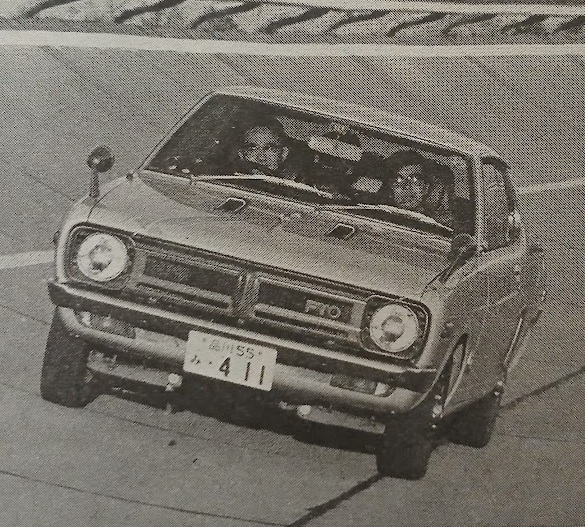
Mitsubishi Colt Galant FTO GIII (1972)
Publication: Motor Fan
Format: Road Test
Date: March 1972
Authors (roundtable): Shinji Seki, Yasuhiko Yashiro, Osamu Hirao, Kenji Higuchi, Hiroshi Hoshijima, Motoo Suzuki, Kunitaka Furutani, Kunihiro Yoneyama, Hiroshi Okazaki, Masahide Sano, Taizo Tateishi, Yasuhei Oguchi, Katsuzo Kageyama, Chiaki Moritani, Kenzaburo Ishikawa, Toshihide Hirata, Minoru Onda, Motor Fan Editorial Staff (uncredited)
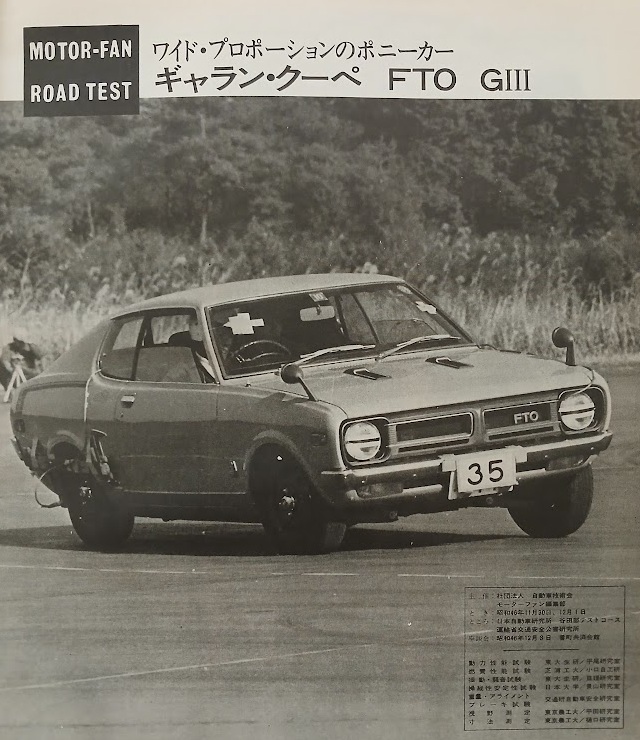
Fast-Notch Styling and a Wide Body
Magazine: First, could you give us an overview of the Galant FTO?
Seki: The Galant line has been introduced in stages–the sedan first, followed by the hardtop and then the GTO–and all have been well received. However, there remained a gap between those models and the kei-car class.
We felt it was necessary to fill that gap, and at the same time demand for coupes in the 1400cc class was growing. So we decided to develop a genuine coupe.
Our objective was to create a car that was sporty and stylish, with a distinctly luxurious feel, yet priced within reach of the mass market.
Its principal features are:
- A wide-bodied proportion, with a 1285mm tread and an interior width of 1300mm;
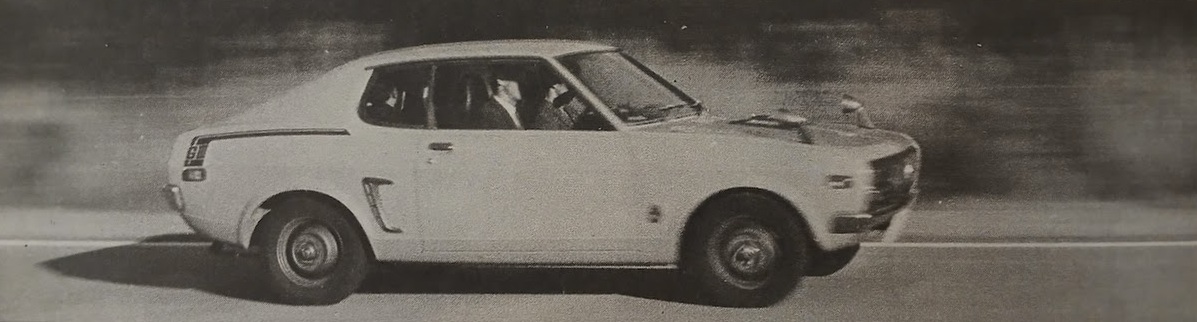
- A new styling theme we call the “fast-notch style;”
- Excellent high-speed stability and cornering performance, influenced in part by that styling;
- A sporty atmosphere in the interior;
- The adoption of a coordinated options program allowing customers to tailor the car to their tastes, choosing items such as the console, stripes, radio, and even tires; and
- Extracting strong performance from a 1400cc engine.
Those six items represent the car’s main selling points–or, if you like, the goals behind its development.
The lineup itself consists of three versions. The GI is positioned as a personal car, the GII as a more luxurious model, and the GIII as the sporting version equipped with twin carburetors.
Magazine: The wide tread is certainly noticeable. Could you tell us why you chose that approach?
Yashiro: Generally, when people think about making a smaller car, they assume that means a reduction in width. But if you design the car around the driver, it becomes clear that what people really want is a sense of roominess at their sides.
In a personal car, much of the space behind the occupants is essentially surplus. So we decided to retain a certain amount of width while shortening the overall length. In practice, that meant leaving the area ahead of the driver largely unchanged and reducing dimensions at the rear.
As a result, compared with the Galant sedan, we shortened the wheelbase by 120mm and reduced the rear overhang to the minimum necessary. Overall length was cut by roughly 300mm, while the existing body width was retained.
That proportion emerged from considerations of occupant space centered around the driver’s seat. From a styling standpoint, however, the broad proportions also allowed us to create what might be called an American-car sense of glamour.
At the same time, the wide tread contributes to greater stability and provides tangible performance benefits as well.
Magazine: The suspension is the same as the Galant’s, isn’t it?
Yashiro: That’s right. A mass-market car has to appeal to a very broad range of users, so we chose to use the proven suspension from the existing Galant–something with a solid track record that customers could trust.
In a sense, we kept the underlying structure exactly as it was and simply changed the outer “costume.” If you think of the car’s body as a garment, we merely changed the clothes.
We felt it was the responsibility of a manufacturer building mass-market cars to create something that customers could drive with complete confidence from the very first day.
Hirao: That wide body certainly gives the car an appealing presence.
Magazine: One advantage of shortening the Galant’s wheelbase is lower cost, and we’ve heard it also helped shorten the development time. In those respects it’s clearly beneficial.
However, you’ve said the car offers excellent high-speed stability. Wouldn’t a shorter wheelbase normally work against that?
Yashiro: It would become a problem if the wheelbase were made extremely short, but even after shortening it, the FTO still has a wheelbase of 2300mm, which is about standard for the mass-market class. On the other hand, the tread is relatively wide.
From the standpoint of development, you could say we took an existing car and shortened it. But looking at the finished product itself, it might be more accurate to say that we gave it a typical wheelbase and widened the tread.
Higuchi: My immediate impression when I drove it was that it recaptured, in a different form, the feeling I had when the Sunny 1000 first appeared.
Magazine: There are cars with this fast-notch style in Europe as well, aren’t there?
Yashiro: In terms of its proportions, it’s an American car. The costume it wears, however, is European fashion.
It’s not that we set out to imitate a European car. When you shorten the rear of the body, you inevitably run into difficulties with the trunk opening. We solved that problem while also creating a fastback-like profile when viewed from the side.
The term “fast-notch style” is actually a new expression we coined by combining “fastback” and “notchback.”
Magazine: So the technique is European, but the mood is American.
Hirao: And the soul is Japanese. (laughs)
Yashiro: The designers are all Japanese.
Hoshijima: Personally, I like the styling very much. To me it feels more American than European.
American cars have recently begun shedding some of their excess ornamentation, and in that sense the FTO has the clean, uncluttered image of a modern American car.
You describe it as a purely Japanese design, and I think that was true of the Galant as well–including the GTO. Those cars never struck me as being strongly influenced by Mitsubishi’s relationship with Chrysler.
With the FTO, however, it feels as though that partnership has finally borne fruit–if I may put it in a positive sense.
Hirao: I don’t think it’s been influenced nearly as much as people say. Still, it’s advantageous for people to believe it has, so perhaps it ends up being presented that way whether it was intended or not.
Hoshijima: At the very least, I think the rear styling is outstanding by domestic standards.
Hirao: It’s certainly true that it doesn’t look like a purely Japanese product.
Higuchi: Put slightly wider tires on it and it would look exactly like an American car.
Yashiro: I think your observation is quite correct. The American flavor is certainly stronger than any European influence.
What has happened, however, is that American cars themselves have become cleaner and have moved somewhat closer to European tastes. So perhaps the best description would be American-car proportions clothed in the cleaner styling of contemporary European cars.
The coordinated-options program is another of the car’s distinguishing features. It’s aimed particularly at GIII buyers.
The basic car is intentionally simple and uncluttered. From there, customers can add the details that suit their own tastes.
It’s our response to what might be called the age of individualization.
A Tappet-in-Head OHV Engine
Magazine: The car uses Mitsubishi’s “Neptune” engine. Could you tell us a little about it?
Suzuki: Both OHV and OHC layouts have their advantages and disadvantages. If the objective is simply to raise engine speed, OHC naturally has the advantage.
However, when displacement is relatively small, it is inherently easier to achieve high engine speeds regardless of valve-train layout. We therefore regard roughly 1400cc as the dividing line: above that, OHC becomes advantageous, while below it an OHV design is entirely practical.
For this reason, our OHV engine employs what we call a high-camshaft, or tappet-in-head, arrangement.
In this design the pushrods are extremely short and therefore very light, which gives the valve train a high degree of rigidity.
Speaking in broad terms, one way of judging an engine’s ability to sustain high rpm is to divide the stiffness of the valve train by its mass and then take the square root of the result–a vibration-frequency relationship we express as K/M. The larger that figure, the easier it is for the engine to operate at high speed.
If a conventional OHV engine is assigned a value of 100, an OHC engine would be around 200. This tappet-in-head OHV design falls at approximately 150.
In other words, it was conceived to occupy the middle ground between OHV and OHC. Since it can deliver performance approaching that of an OHC engine, we felt it was a worthwhile solution.
Magazine: If 1400cc is your dividing line, though, the Galant itself is also available with an OHC 1400cc engine.
Suzuki: Engine production requires enormous investment in manufacturing equipment, so we have to think in terms of engine families.
One family covers the kei-car range and the vicinity of 1000cc. That’s where the Neptune engine fits.
Above that, from roughly 1500-1600cc upward, we intend to cover the range with the Saturn engine series.
Naturally, there will be some overlap between the two.
Magazine: From a cost standpoint, isn’t there very little difference between enlarging the smaller engine to 1400cc and simply using the larger engine?
Suzuki: It depends on the circumstances.
Simply comparing OHC and OHV doesn’t tell the whole story. You also have to consider factors such as whether the intake and exhaust layout is crossflow or turn-flow, and whether the combustion chamber is hemispherical or wedge-shaped.
Because of those variables, it’s difficult to make comparisons based solely on camshaft arrangement. In this particular case, though, there is some difference.
Magazine: Was this engine originally a 1000cc unit?
Suzuki: In a sense, yes. The production facilities are shared, but the parts themselves are almost entirely different.
There are, of course, some small components in common, but what is shared is really the basic architecture.
When we introduced the original 1000cc version, racing at Suzuka was in full swing. The Formula III engines were based on this design, and we had already developed OHV engines with high-mounted camshafts up to 1600cc.
As a result, we gained considerable experience in extracting performance through high engine speeds, and I believe that experience has proven very useful in the development of this engine.
Gear Ratios Geared Toward City Driving
Magazine: Let’s move on to the performance figures.
Furutani: The standing-start acceleration times were 0-50m in 4.9 seconds, 0-100m in 7.4 seconds, 0-200m in 11.5 seconds, and 0-400m in 18.1 seconds.
In terms of time to speed, the results were 0-20km/h in 1.3 seconds, 0-40km/h in 3.0 seconds, 0-60km/h in 5.4 seconds, 0-80km/h in 8.3 seconds, and 0-100km/h in 12.1 seconds.
Perhaps because the test car was not in the best condition, the engine occasionally bogged down at launch, and power in the medium- and high-speed ranges seemed somewhat lacking. That also showed up in the passing-acceleration results, which were slightly disappointing.
Top speed averaged 159.5km/h over the measured 400m section.
Magazine: Those acceleration figures are noticeably slower than the catalog claims.
Yoneyama: I suspect the problem was with the test car itself. Our internal data shows a 0-50m time of around 4.6 seconds, so I think that accounts for much of the difference.
Passing acceleration also seems to be about one or two seconds slower than expected.
Magazine: The catalog top speed is 165km/h as well. The test was conducted in rather severe conditions, with a crosswind of 8-11m/s…
Yoneyama: Under normal conditions we’ve consistently recorded figures slightly better than the catalog value, so I believe the poor results this time were largely due to the testing conditions.
Magazine: What about the gear ratios? They felt a little on the low side.
Furutani: For a 4-speed transmission, the ratios are relatively short. In fact, they’re quite close to those of the Sprinter 1400SR’s 5-speed gearbox.
Magazine: Is that because of the final-drive ratio?
Suzuki: Yes. Taking the differential ratio into account, I’d say the gearing was chosen primarily with urban driving in mind.
Magazine: In third gear, the car reaches about 110km/h at the 6500rpm redline. How high will the engine actually rev?
Suzuki: Maximum power is produced at 6500rpm, but we’ve built in a margin of a little over ten percent beyond that.
So the practical limit is around 7100-7200rpm.
As a matter of fact, when we were selecting the final-drive ratio, we spent quite a bit of time debating whether to use a 4.22 or a 3.89 ratio.
Yashiro: In the end, we concluded that if the car was to be driven primarily in city traffic, the 4.22 ratio would be preferable because it made the car easier to drive at low speeds. That’s why we settled on it.
Hirao: Is a 3.89 ratio available as an option?
Yashiro: We’ve maintained compatibility, so it can be fitted.
Higuchi: Personally, I prefer the shorter gearing. It may not look particularly impressive in a Motor Fan test, but I think most owners would actually prefer it.
Suzuki: The dilemma with a car like the GIII lies in low-speed performance.
In other words, even though it’s a sporting model, most owners spend the majority of their time driving around town. Quite often the complaint is that top gear feels a little sluggish at low speeds.
Okazaki: At first I also thought the gearing was a bit on the low side, but in the end I came away feeling it was probably the right choice.
The reason is that, consciously or not, I kept comparing it with the Saturn engine. Against that benchmark, the Neptune feels a little short on torque, and that made me think this final-drive ratio was justified.
For the average owner, I think the car will be quite enjoyable with the gearing as it stands.
Hoshijima: I felt that something around a 4.11 final drive might have made the car a little easier to handle. At the same time, I suspect the present gearing may also be contributing somewhat to the noise level.
Magazine: Let’s move on to the fuel-economy results.
Sano: Constant-speed fuel consumption was 20.6km/l at 40km/h, 19.8km/l at 60km/h, 17.5km/l at 80km/h, 14.3km/l at 100km/h, 11.2km/l at 120km/h, and 9.4km/l at 140km/h.
Unlike the performance figures, these results were actually a little better than the catalog values.
The peak appears to occur somewhere between 40-50km/h, and the rate of decline becomes somewhat more gradual above 100km/h.
Practical model-route fuel economy was 11.4km/l at the 40km/h indicated-speed setting and 9.3km/l at the 60km/h setting.
Yoneyama: The model-route figures are about 10% worse than our internal data.
That may be due to differences in driving technique, as well as the strong winds during testing. Our own figures are approximately 12.5km/l at the 40km/h setting and around 10.8 to 11km/l at the 60km/h setting.
Oguchi: Model-route testing inevitably includes the human element, so it’s quite common for the results to differ from a manufacturer’s figures.
That said, we control the acceleration and deceleration rates, as well as the time spent in each phase, and we always use the same driver. As a result, we believe the test has excellent repeatability.
Higuchi: Fuel economy is something that naturally varies quite a bit.
It would be more useful to owners if manufacturers indicated not only the best figure achieved, but also the likely range of variation and the extent to which results can change with driving technique.
When manufacturers publish only their most favorable numbers, ordinary drivers inevitably begin to lose confidence in them.
Subjective Noisiness
Magazine: Let’s move on to the vibration and noise results.
Tateishi: The suspension’s natural sprung-mass frequency is 1.4Hz at both the front and rear, while the unsprung-mass frequency is 11.5Hz front and rear.
Interior noise measured 63.5 phons at 40km/h, 68 phons at 60km/h, 71 phons at 80km/h, 76 phons at 100km/h, and 81 phons at 120km/h. Exterior noise measured 75 phons at a steady 50km/h and 83.5 phons during acceleration.
I think it’s fair to say that both the sprung- and unsprung-mass frequencies are comparatively low.
In a sense, this may be a car suited to the tastes of a more comfort-oriented owner.
The interior-noise figures are about the same as those of the Galant sedan. The GTO produced considerably better numbers, so in that respect it feels as though it’s moved back in the noisier direction.
Oguchi: Actually, the thing that struck me most strongly about this car was the noise.
The next thing was the handling, but noise came first.
We say the figures are about the same as the Galant’s, yet subjectively it seemed noisier to me than the Galant. Perhaps it’s a matter of sound quality, or the distribution of the frequency components, but there was a kind of busy, rustling quality to the noise.
Magazine: Mechanical noise?
Oguchi: Yes, though more the lower-frequency components of the mechanical noise.
On the other hand, when listening from outside the car, the higher-frequency sounds are more noticeable.
Hoshijima: Around town at 40km/h or so, it actually feels fairly quiet.
Once you reach about 80km/h, however, it suddenly becomes much noisier. By around 120km/h, I got the impression that it was one of the noisiest cars in its class.
Higuchi: If the noise rises in a smooth, linear fashion with speed, your ears become accustomed to it and it doesn’t seem particularly loud, even if the absolute level is high.
When there’s a peak somewhere, that’s when it strikes you as noisy.
Kageyama: I normally drive an outrageously noisy car myself, so I rarely complain about noise levels.
But in this case, when I looked back at the notes I made at Yatabe, I found that I’d written: “Engine noise becomes intrusive at 100km/h.”
Tateishi: From a data standpoint, the car falls within the comparative evaluation zone, though there is a peak around 110km/h.
On the C scale there are some irregularities around 70-80km/h, but the various noise sources appear to be fairly well separated, and the data suggests that the higher-frequency sounds are not being transmitted strongly to the occupants.
For this class, I’d say it’s roughly average.
Oguchi: So the data suggests it isn’t actually a noisy car.
In that case, considering that the engine is turning relatively high rpm and still produces these figures, perhaps it shouldn’t be regarded as especially noisy at all. One could argue that it deserves an average–or perhaps even better-than-average–evaluation.
Even so, my impression is that the sound has the kind of quality that drowns out conversation between occupants.
That aspect of the sound quality itself may be what influences our subjective impressions.
Moritani: Within the speed range most people use every day, we’ve worked to eliminate any pronounced peaks by carefully balancing driveline vibration, body vibration, rear-suspension vibration, and so forth. Looking at these test results as well, there don’t appear to be any significant peaks; the noise level simply rises steadily all the way up.
It’s possible, however, that the test car was allowing a bit more engine noise into the cabin than intended. And since the GIII is equipped with radial tires, that may also have had some influence.
Tateishi: Based on our experience to date, there’s usually a difference of about 8 to 10 phons between exterior and interior noise measurements. In this case, however, the interior-noise figure is somewhat higher relative to the exterior figure than we’d normally expect, so there may indeed be a place where noise is finding its way into the cabin.
Moritani: As far as noise is concerned, we’d like to make one more determined effort and achieve an even quieter result.
Magazine: The ride quality is said to be quite good, but doesn’t the car exhibit a certain amount of pitching?
Oguchi: When braking, I did have the impression that the nose dived a little.
Rather than being purely a suspension issue, the initial build-up of deceleration is fairly abrupt. Even when you think you’re applying only light brake pressure, the brakes bite rather sharply. The nose drops more than expected, which made me wonder whether that might contribute to a pitching motion.
Hoshijima: From the way it behaved over rough surfaces, I’d say it has the best ride quality in its class. Tire contact over uneven pavement is excellent as well.
There is a bit of pitching, but if you learn to work with it, it can actually be enjoyable on long undulating stretches of road. (laughs)
Oguchi: When Mr. Hoshijima was driving at Yatabe and took the curve at the base of the banking at quite a high speed, I remember thinking from the passenger seat how remarkably stable the car felt.
At first I wondered whether that was simply because of his driving skill…
Hoshijima: The suspension tuning is excellent.
It gives up nothing to an independent-rear-suspension layout. As far as rigid axles go, I’d say it’s among the very best.
Magazine: For a car equipped with radial tires, the ride isn’t particularly harsh.
Hoshijima: Around town I wouldn’t necessarily describe the ride as exceptionally comfortable, but compared with most other cars it belongs on the softer side of the spectrum.
It certainly doesn’t have that choppy, jarring feel.
Oguchi: Nor did I notice much tire noise. And wind noise was almost nonexistent as well.
High-Gain Steering
Magazine: Let’s hear the results for handling and stability.
Kageyama: The practical minimum turning radius is 4.85m, the smallest figure we’ve seen in the 1400cc class. At the same time, because the car is relatively wide, the inside turning radius is also small, at 2.49m.
The overall steering ratio is 18.7, which is quite a large figure. In this class, the Sunny Excellent is almost identical at 18.8. The Subaru Leone is something of an exception at over 20, but among 1400cc cars I’d say this is on the high side.
The catalog also describes it as having a variable-ratio steering gear. However, when we measured the steering ratio, we obtained a rather curious result: the relationship between steering-wheel angle and actual wheel angle was perfectly linear.
In other words, even if the steering box itself is variable-ratio, the overall system behaves linearly. That came as something of a surprise.
Looking at it another way, however, perhaps if it weren’t a variable-ratio system, the curve would rise even more steeply–that is, the steering would become heavier. One could argue that the variable ratio has been used to reduce steering effort.
Stationary steering effort measured 12kg at 360° and 15kg at 500° of wheel angle. Those are entirely normal figures for a car of this type.
The roll rate was 5° by photographic measurement and 4.9° when calculated from lateral acceleration. The two figures corresponded closely, but for this type of car I think the value is on the high side.
That may, however, have been influenced by the unusually heavy test condition: two occupants plus instrumentation, for a total vehicle weight of 1032kg.
The measured roll rate was quite different from what we’d been led to expect. Even after removing the instruments and judging by feel while driving the car, it still seemed to exhibit a fairly large amount of body roll.
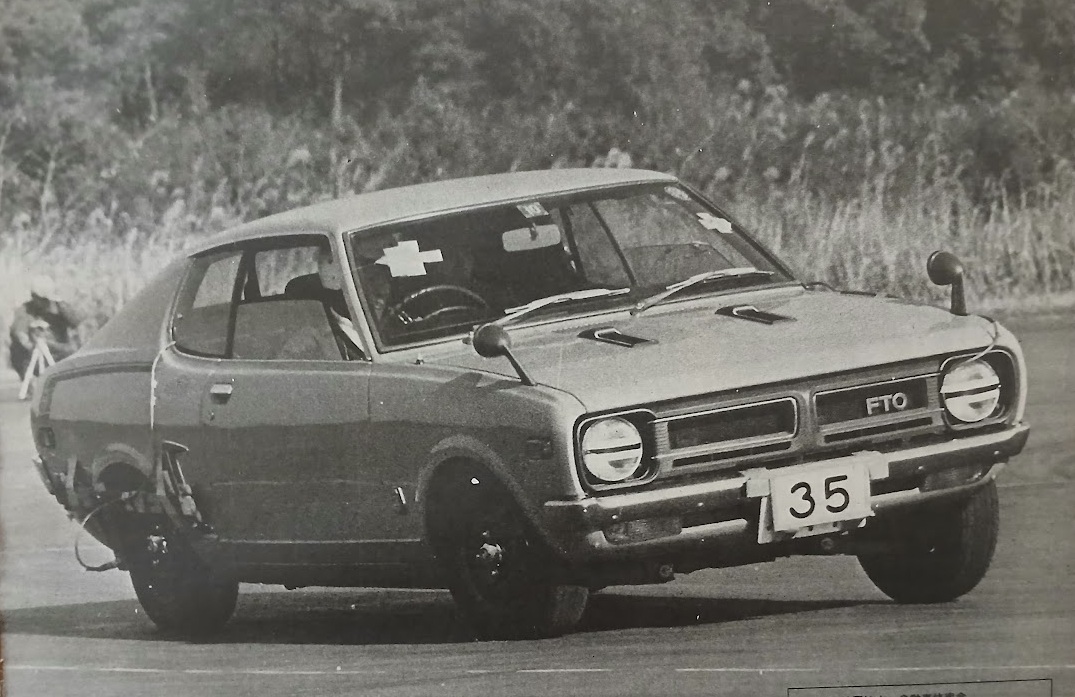
As for the understeer/oversteer characteristics, we pushed it to about 0.55g of lateral acceleration and found a consistently mild understeer throughout.
Numerically, the R/R₀ value at 0.5g was 1.54. Judging from that figure, the degree of understeer is probably about average by domestic-car standards.
However, because the weight distribution under test load was almost exactly 50:50, I began to wonder whether that really reflected the way the car would ordinarily be used. After removing the instruments and driving it with two people in the front seats, the understeer seemed noticeably stronger.
Steering effort in steady-state cornering is extremely light: 2.2kg at 0.3g of lateral acceleration and 2.7kg at 0.5g.
The increase in steering effort relative to cornering force is also very gradual, making changes somewhat difficult to perceive. Perhaps because of that, the steering felt light and slightly lacking in reassurance at higher speeds.
In the slalom test, steering effort measured 3.1kg at 0.4g lateral acceleration and 3.7kg at 0.6g. These values are markedly lighter than those of most comparable cars.
As for hands-off directional stability, there appears to be a tendency for convergence to be somewhat weak at both medium and high speeds.
Magazine: The variable-ratio steering is listed as ranging from 15.5-18.1. Yet that doesn’t seem to appear in the measurements…
Moritani: According to our own data, the overall ratio varies from roughly 17-19.
Kageyama: So there is some variation, then. The measured figure of 18.8 is based on the average of the inner and outer wheel angles, but when you plot those values, the result falls almost perfectly on a straight line.
Magazine: With a variable-ratio system, you’d expect the line to bend.
Kageyama: Exactly. I would have expected the system to be designed so that as more steering lock is applied, the rate at which the road wheels turn gradually decreases. That’s the usual direction in which variable-ratio steering works…
Moritani: If you’re averaging the inner and outer wheel angles, then I suppose a result like that might be possible.
Kageyama: Then perhaps it’s falling within that range after all…
Come to think of it, if one were to measure very precisely over a very small range of steering input–say, less than about 100° of steering-wheel movement–it might indeed prove to be variable-ratio.
Oguchi: Judging purely by feel, I suspect it’s either a matter of steering gain or perhaps the steering ratio itself, but at high speed, within the range where you’re steering with little more than two fingers and intending to go essentially straight ahead, if your hand tightens slightly and the wheel moves just a little, the car responds immediately, with very little sense of free play.
The steering seems to take a set almost instantly.
Both from that sensitivity to small inputs at high speed and from the way it behaves in corners, I found myself wondering whether it might actually be a variable-ratio steering system.
Hoshijima: It almost feels like free play.
It isn’t free play, but measured around the circumference of the steering wheel there’s a zone perhaps 12-13cm wide–maybe as much as 15cm–where the wheel feels extremely light and somewhat vague, as though it can wander around within that range at any time.
That impression becomes especially pronounced in the GII.
Higuchi: I only drove it at about 50-60km/h, but subjectively it felt as though the steering ratio were around 15.
That’s what led me to conclude that the steering gain was high.
Steering gain isn’t determined solely by steering angle; steering effort plays a part as well. In terms of feel, we’re actually judging steering angle through the effort required.
That’s why the measured result showing light steering effort made perfect sense to me.
Oguchi: In a crosswind, for example, the steering is light, surprisingly sensitive, and almost free of friction.
As a result, the car’s path can wander slightly.
Not that it departs dramatically from its course, but people are remarkably sensitive to small changes.
Under those conditions, you become aware of tiny lateral accelerations and slight deviations in direction. That’s the sort of steering this car has.
In fact, we were discussing whether a steering system with this kind of sensitivity might actually be preferred. Among younger drivers, there seems to be a growing dislike of steering that retains any trace of friction or stickiness.
In that sense, I think this may be a good approach…
Higuchi: It’s an enormously entertaining car. (laughs)
Moritani: The Galant has often been praised for its sharp handling characteristics, and with the FTO we sought to preserve that sharpness while pursuing greater stability.
Part of that comes from aerodynamic considerations and improvements in body torsional rigidity, but we also increased the static margin slightly compared with the Galant, giving the car a stronger understeer tendency.
For those reasons, we believe we’ve produced a car with very good handling and stability.
Oguchi: I wouldn’t describe it as sharp so much as sensitive.
For example, when there’s a crosswind, a driver whose steering inputs are a little slow may not notice anything unusual, but a passenger sitting alongside is liable to think, “Why don’t you hold a straighter line?”
Moritani: The moment generated by crosswinds is also about 20% lower than on an ordinary car.
Higuchi: That’s not really the point.
The engine is fairly powerful, and the steering gain is high.
That means it’s wonderful in the hands of a skilled driver, but with a less experienced driver at the wheel it can feel a little intimidating.
Okazaki: I think it’s a tremendously enjoyable car.
The softness of the suspension and the sensitivity of the steering are matched together in a rather curious way…
At high speed, it’s an exceptionally easy car to drive.
Hoshijima: I felt the car was comparatively unaffected by crosswinds.
Okazaki: My first impression when I grabbed the wheel was that it might not have very good high-speed directional stability.
Then I drove it at FISCO, and it turned out to be better than I’d expected. Its straight-line stability was quite acceptable.
In corners, at high speed and relatively low lateral-g levels, it felt almost neutral, which I thought worked very well. But in slower corners where lateral acceleration builds more heavily, a fairly strong understeer appears.
That said, most drivers will never push the car anywhere near that limit, so I don’t think it’s really a problem.
One thing that did catch my attention, though, was the way the car’s line changes when you lift off the throttle.
The change is rather abrupt.
Because it’s a car that can be driven so effortlessly at high speed, I felt that if you suddenly lifted the throttle or applied the brakes in mid-corner, the resulting change in trajectory could be a little unsettling.
Hoshijima: I imagine that’s because the wheelbase is short and the springs are relatively soft, so weight transfer is fairly pronounced.
Then again, I was driving alone, which may also have contributed.
Okazaki: You can drive this car very quickly.
On a circuit, for example, it’s remarkably fast.
Hoshijima: It’s quick over rough roads as well.
Magazine: The internal data gives a roll rate of 3.5°, whereas the test results came out at 4.9-5.0°…
Moritani: Measurements taken during constant-radius cornering tend to show some variation, so we measure roll rate on a tilt platform, where we obtained a figure of 3.5°.
Hoshijima: Judging from how it feels, I’d side with the test data. (laughs)
Higuchi: I would too.
Okazaki: The way that it rolls is actually quite good, but I do think the amount of roll is a little excessive.
Hoshijima: It has something of a European-car flavor in that respect.
Okazaki: It rolls cleanly and progressively in proportion to lateral acceleration.
Because of that, it never feels unsettling.
Moritani: The suspension and steering have been carried over directly from the Galant.
Since the center of gravity is slightly lower than the Galant’s, I would have expected the amount of roll to be comparatively modest.
Heavy Handbrake
Magazine: Let’s move on to the Traffic Engineering Laboratory results.
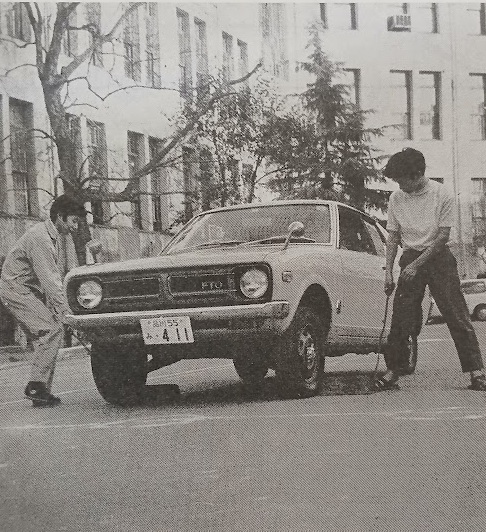
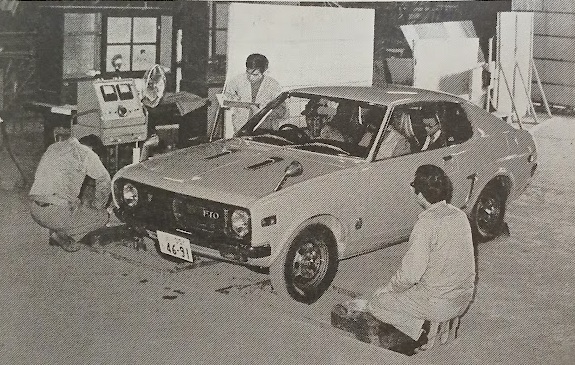
Ishikawa: Vehicle weight came to 868kg, with a front-to-rear distribution of 54:46. That remains roughly the same with one or two occupants in the front seats. With five people aboard, it shifts to 48:52.
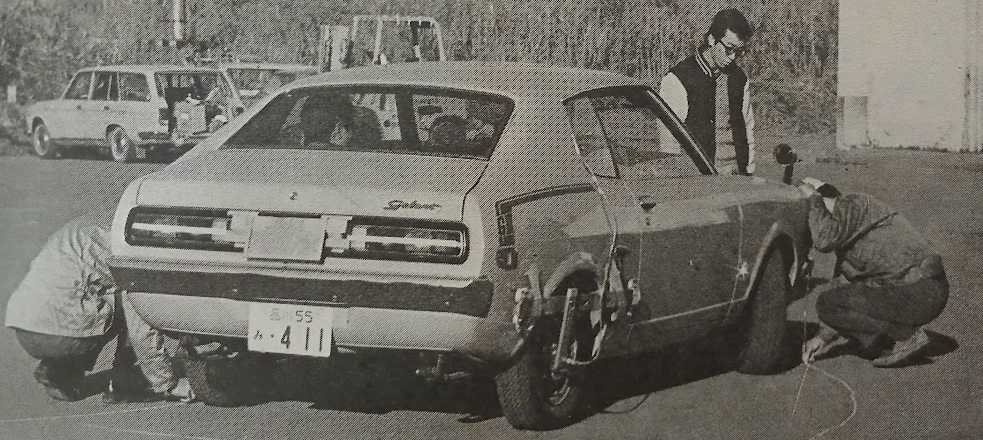
Alignment measurements showed camber and toe-in values both very close to zero, with little variation due to passenger load.
The braking system uses front discs and rear leading-trailing drums, with servo assistance. The servo cut-in point is specified at around 15kg pedal effort, though in practice it seems to come in a little later than that.
The pedal force required to achieve 0.6g deceleration was 20kg on the test bench, but only 13kg in actual road testing. That is probably due to intake vacuum affecting servo operation.
Initial brake engagement begins at about 3kg pedal effort at the front wheels and 5kg at the rear. Pedal spring rate is 0.6kg/mm up to around 20kg pedal effort, increasing to roughly 1.0kg/mm once servo assistance drops out.
These are fairly typical figures. Brake-force distribution at 0.6g was 60:40 front-to-rear.
Magazine: The brakes are said to feel exceptionally light…
Oguchi: Light, and very effective. In that sense they match the light steering quite well.
Ishikawa: The handbrake is a little heavy, though.
Furutani: It feels as though it’s already biting right from the start. That probably makes it seem heavier than it really is.
Ishikawa: Yet it doesn’t actually begin working until about 9kg of effort, so there’s a fair amount of travel before anything happens.
Yoneyama: It’s a reaction-operated design. The right-hand wheel is actuated directly, while the left-hand wheel operates through the reaction force generated by the right side. From a feel standpoint, that may be something of a disadvantage.
Magazine: Next, let’s have the visibility results.
Hirata: Overall driving visibility measures 2.4 steradians. That’s about what you’d expect from a coupe, though it feels slightly restricted by passenger-car standards.
The windshield alone accounts for 0.6 steradians, which is quite generous. The forward blind spot is approximately 9° wide at a 33° angle from straight ahead, so it should rarely interfere with driving visibility.
The wiper results may have been somewhat conservative because the test was conducted under half-wet conditions. Even so, the wiped area covers 57-58% of the windshield, which falls within the normal range.
As viewed through the interior mirror, about 70% of the rear window is visible.
One distinctive feature of this car is that the seating position is approximately 30-50mm lower than in most other cars. That affects some of the measurements, but overall the figures are quite ordinary.
Magazine: Through the interior mirror you can actually see the frame of the rear window.
Higuchi: You can see it, yes–but somehow you still can’t really see anything. (laughs)
Hirata: Reversing isn’t particularly easy. Though I suppose that’s largely a matter of getting used to it.
And the high-back seats do get in the way.
Hoshijima: I also found the fender mirrors a little bothersome. I’d like to see more coverage toward the sides.
Just because a mirror has a bullet shape doesn’t automatically make it a good mirror.
Low Driving Position
Magazine: Now let’s have the dimensional measurements.
Onda: Based on the Galant, the overall length has been shortened somewhat, particularly through a reduction in rear overhang.
As a result, for this class of car it has relatively generous width and proportions that give a strong sense of stability.
The doors are very large, sharing the same dimensions as those of the Galant GTO.
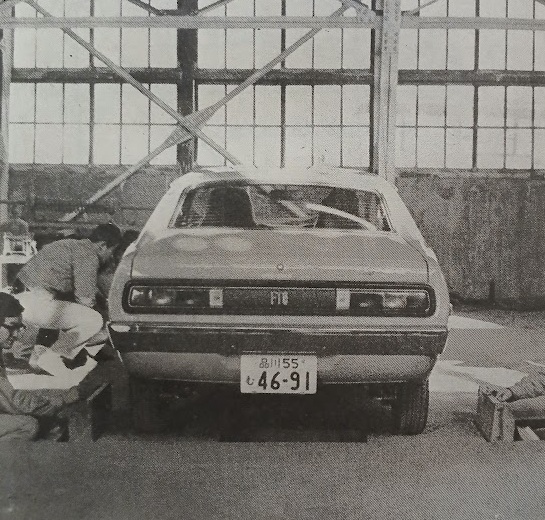
In the details, the rear bumper is comparatively slim and mounted high. Combined with the short rear overhang, this creates what might be called a “miniskirt” effect, making it easier to see beneath the rear of the car. Those are among its more distinctive exterior features.
Inside, the driver’s seat is positioned unusually low.
Consequently, the entire driving position is low. I suspect this was done to recover headroom lost by the car’s reduced overall height.
Because the rear overhang was shortened, the fuel tank has been mounted behind the rear seatback. As a result, the luggage compartment is quite wide but relatively short front-to-back.
In terms of practicality, the jack is exposed at the front of the trunk, making it easy to access. That’s convenient from a service standpoint, but not particularly desirable where luggage is concerned. It would be nice to see a little more consideration given to that.
The handbrake is located very close at hand, and its travel is also extremely short.
That contributes to a distinctly sporting feel, or at least gives the controls a rather different character.
The switches are combined in what Mitsubishi calls a “multi-use lever” arrangement, with everything gathered close to the driver. From an operational standpoint, I don’t think there are any issues of controls being too far away.
One thing I did notice, however, is that the window regulators require about four full turns of the handle. That feels a little tedious.
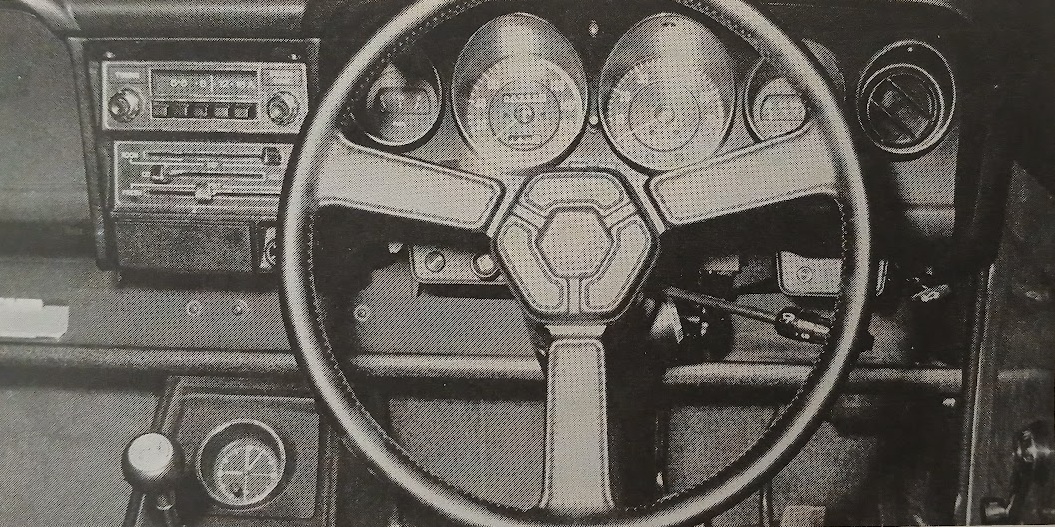
As for the instruments, it has a binnacle of four round gauges, all of them easy to read.
The gearshift pattern belongs to what one might call a particular school of thought, with reverse located on the first-and-second-gear side of the gate.
Tateishi: With the driving position set that low, I would imagine visibility forward and down becomes considerably more restricted.
Yashiro: The driving position was lowered quite deliberately.
The idea was to let drivers enjoy a more sporting atmosphere, so we intentionally set it on the low side. If someone wants it higher, that’s easily accomplished with spacers or similar adjustments.
Hoshijima: Is the difference in seat travel between the driver’s seat and passenger seat intended to preserve rear-seat space?
Yashiro: Exactly.
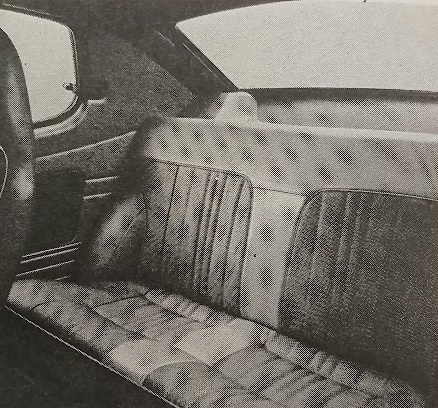
If anyone is riding in the back, the left-hand side is considered the proper seating area. The right-hand side is really intended more as a seat for children.
Magazine: How did you find the seats?
Oguchi: I thought they were excellent.
They provide good support and fit the body very well.
If possible, I’d like to see a little more support around the third or fourth lumbar vertebra. For me, that would make them even better.
Magazine: Production is starting at around 3,000 units, but what is the longer-term target?
Yashiro: Roughly 3,000 to 4,000 units per month.
Magazine: So there is room for further variations in the model range?
Yashiro: We intend for the FTO to remain purely a coupe.
Magazine: And what about export prospects?
Yashiro: At the moment, we have no plans in that direction.
Magazine: On that note, we’ll conclude our discussion.
Postscript: Story Photos