Mitsubishi Colt Galant FTO GIII vs. Toyota Sprinter SR (1972)
Publication: Car Graphic
Format: Group Test
Date: February 1972
Author: “C/G Test Group” (uncredited)
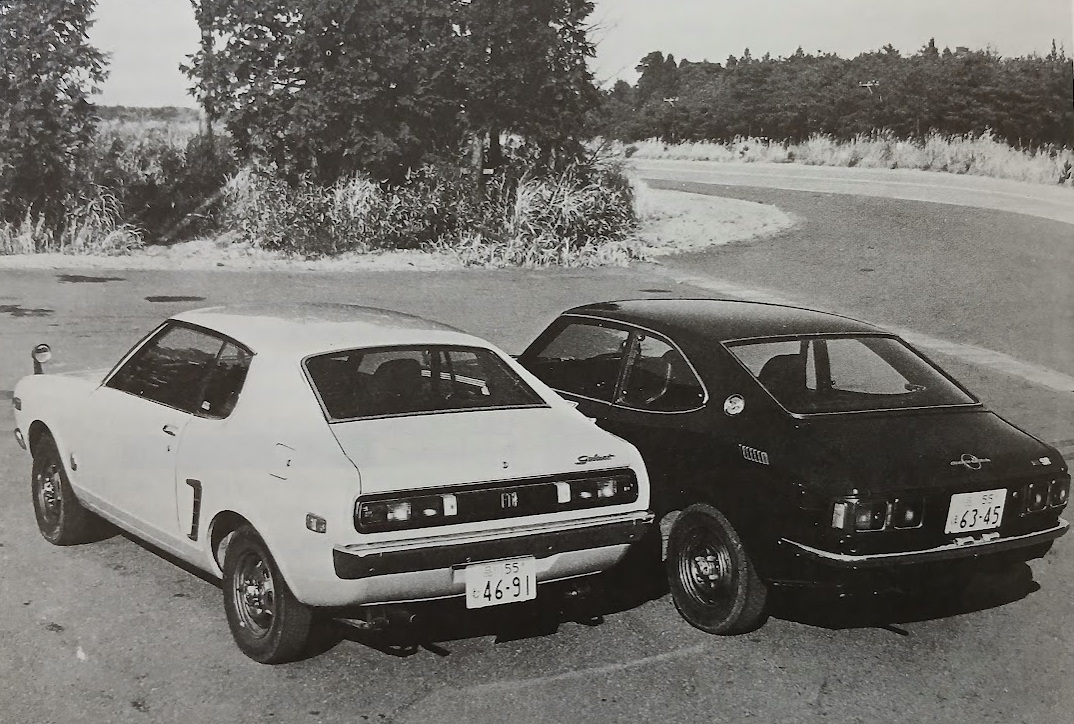
Comparison test: Mitsubishi Galant FTO GIII vs. Toyota Sprinter SR
This month we conducted a comparison test between two 1400cc sporting coupes–the Sprinter SR and the Galant FTO GIII–under a wide variety of conditions, including testing at Yatabe. Before examining the results, however, it is worth explaining why these two were selected from among the many cars in the class.
The Sprinter SR was an obvious choice. On paper it stands at the very top of its category, and for enthusiasts such as ourselves–as, we suspect, many Car Graphic readers are as well–who enjoy driving for its own sake, it represents an ideal specification.
The Galant FTO GIII, meanwhile, has only just gone on sale. Having driven the GII the previous month, and having come away impressed by its handling, we were particularly interested to see how the GIII, with an additional 9ps, would behave by comparison.
Mention the Sprinter and many readers will immediately think of the Sunny GX. In our view, however, the Sunny Coupe is at its best in 1200GX form. The Excellent model, fitted with the SOHC 1400 engine, is a step backward in virtually every respect–the only exception being the addition of servo-assisted brakes–and for that reason we deliberately excluded it from this comparison.
To avoid any misunderstanding, it should be added that a Car Graphic road test is first and foremost an evaluation of a car’s ability to perform on the road. We place particular emphasis on the balance between performance, handling, and braking, and this is especially true of cars that make sporting character one of their main selling points.
The Sprinter SR, introduced in April 1971, is the hottest version of the Corolla yet produced. It is available only as a two-door coupe; unlike the mechanically similar SL, there is no four-door version.
Its crossflow OHV 1407cc engine, with twin carburetors and a compression ratio of 9.6 (an 8.5-compression version is also available), develops 95ps/6000rpm and 12.3kgm/4000rpm. The lower-compression version produces 91ps/6000rpm and 12.0kgm/4000rpm.
Its most notable feature is the standard 5-speed gearbox. In a car of this size and character, a 5-speed transmission remains extremely rare even by international standards; the Alfa Romeo 1300 GT Junior is one of the few comparable examples that comes to mind.
The suspension is conventional–MacPherson struts at the front and semi-elliptic leaf springs at the rear–but is tuned even more firmly than that of the SL, while the anti-roll bar has been increased to a substantial 19mm in diameter. The SR is a car devoted entirely to the business of driving. It comes standard with radial tires, yet dispenses with even such equipment as a radio, which is virtually expected on a Japanese car. Price is 644,000 yen, making it slightly less expensive than the SL.
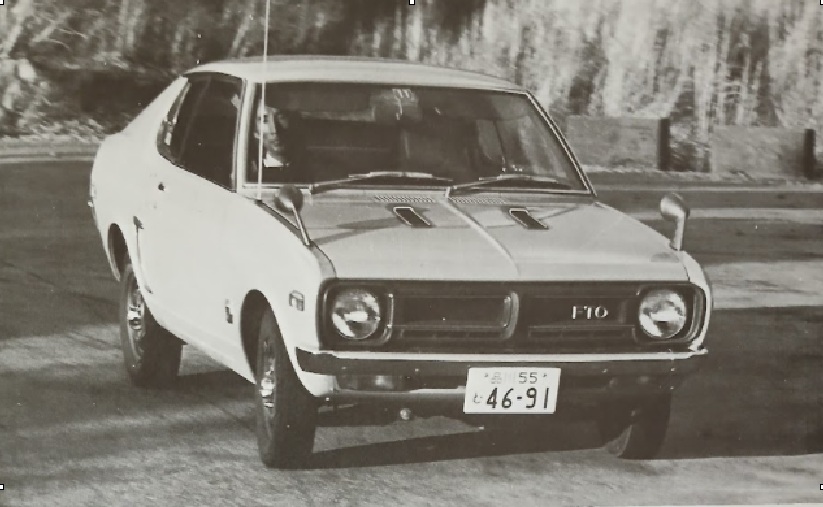
Whereas the Sprinter SR’s basic design can be traced back to the original 1966 Corolla 1100 sedan, the Galant FTO, introduced in October 1971, is a much newer design. In practice, however, nearly all of its running gear and powertrain components apart from the engine are shared with the Galant 14L, 16L, and GTO.
As a result, the FTO inherits the same track dimensions as those larger models, while combining them with a wheelbase 120mm shorter and a body approximately 150kg lighter. From the outset, therefore, it possessed considerable potential for excellent handling through its wide-track layout.
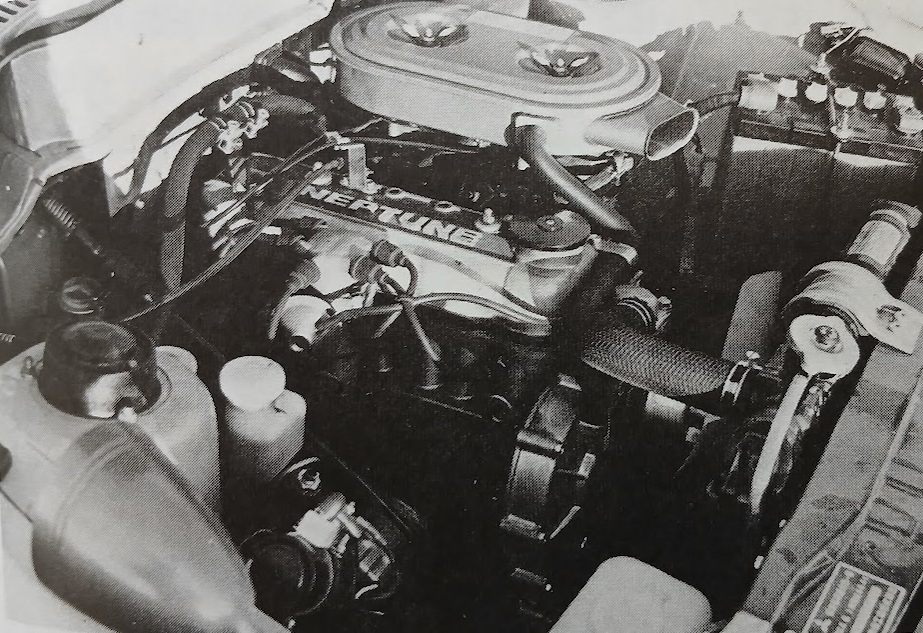
The 1378cc short-pushrod OHV engine is unique to the FTO, though fundamentally it can be considered an enlarged version of the older 11F/Colt 1200 unit. In the sporting GIII model, the most powerful version in the range, a compression ratio of 9.5 and twin Stromberg carburetors raise output to 95ps/6300rpm and 12.3kgm/4500rpm.
Apart from this engine specification and the addition of servo-assisted brakes, the GIII is essentially identical to the GII. Base price is 660,000 yen, but once one adds the “mandatory optional equipment”–a curious term that reminds us of our university days–the figure rises appreciably. Our test car included 155SR-13 radial tires and a heated rear window, bringing the total to 682,000 yen, considerably more expensive than the Sprinter SR.
Comparing the two cars on paper reveals remarkably little difference between them. Engine output and torque are identical, while curb weights are likewise almost the same: 840kg for the SR and 835kg for the GIII. Power-to-weight ratios are therefore virtually equal at 8.84kg/ps and 8.78kg/ps respectively.
Both cars run on 155SR-13 tires, and with final-drive ratios of 4.3 for the SR and 4.222 for the GIII, their overall gearing may also be regarded as effectively identical.
The only significant differences, then, are the Sprinter’s 5-speed gearbox versus the FTO’s 4-speed unit, and the shape of their bodies.
What, then, did the tests reveal?
Performance
Sprinter SR: The Corolla engine, with its hemispherical combustion chambers and V-type valve arrangement, has long enjoyed a reputation for revving freely despite its OHV design. The 95ps unit fitted to the Sprinter SR is no exception. Equipped with twin carburetors, it will happily pull all the way to the 6500rpm redline.
It is neither especially quiet nor particularly smooth, however. Beyond about 3500rpm, noise levels rise sharply, mainly from the cooling fan and exhaust-system resonance.
The SR’s greatest attraction is probably its 5-speed gearbox. Both the gear ratios and final-drive ratio are very well matched to the engine’s characteristics. Since the engine produces strong, relatively flat torque throughout a useful operating range extending from roughly 1500rpm to well beyond 6000rpm, the upper three gears overlap substantially in their usable speed ranges.
Take, for example, the 60-100km/h passing acceleration frequently encountered on expressways. Depending on necessity or the driver’s mood, the maneuver can be accomplished in third, fourth, or fifth gear. In fifth it requires 15.2 seconds; in third, only 7.2 seconds.
The character of this 5-speed gearbox is very much Alfa-like. Fifth gear, with its 0.861 ratio (3.70 overall), is not merely a high-speed cruising gear. Even on Japan’s relatively slow roads, opportunities to use it come frequently. If one wishes, it can be engaged from 60km/h (approximately 2000rpm), and even above 100km/h, a firm step on the throttle produces unmistakable acceleration.
The shift pattern follows the now-standard international arrangement–adopted even by Porsche from 1972 onward–with fifth gear located to the upper right of third. Since the gear lever is spring-loaded toward the third/fourth-gear plane, downshifting from fifth to fourth requires only a light movement to the left followed by a pull rearward, allowing rapid shifts to be made with complete confidence.
Acceleration is exceptionally brisk for a 1.4-liter car. Clutch take-up and throttle response are both smooth, making it easy to achieve quick starts accompanied by only a slight trace of wheelspin. The 0-400m time was 18.2 seconds. This figure was obtained by shifting at the 6500rpm redline; beyond that point torque falls away rapidly, and there is little to be gained by extending the engine further.
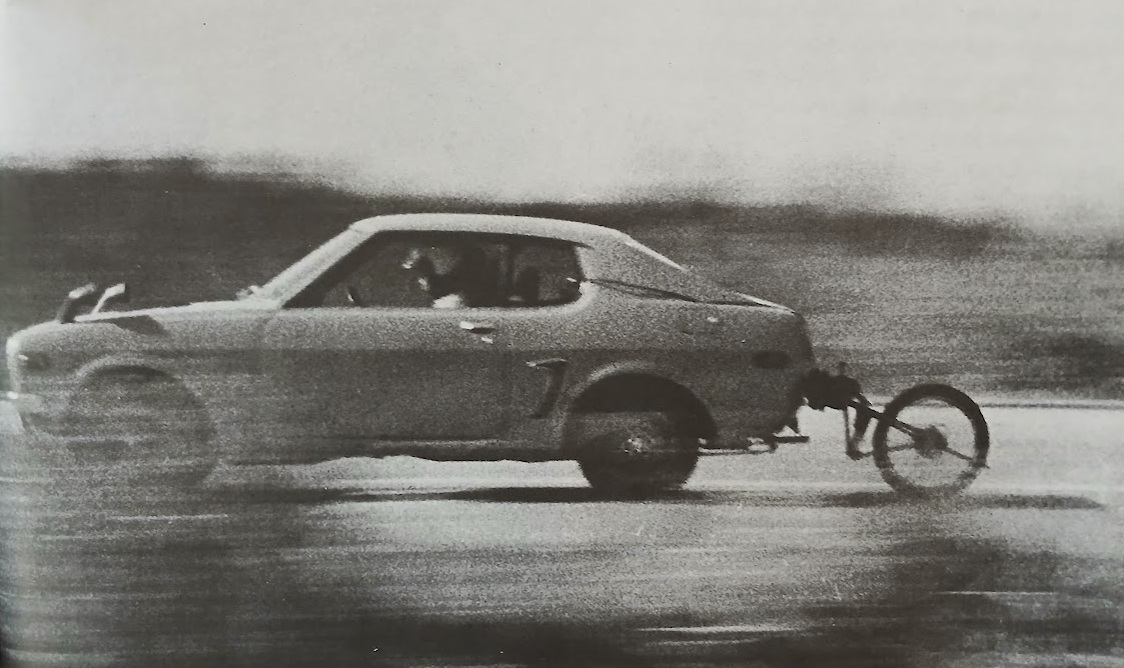
During maximum-speed testing at Yatabe, the SR recorded 163km/h at 5600rpm. In direct fourth gear, maximum speed was 151km/h at 6450rpm.
The speedometer proved unusually accurate. At 100km/h the error was effectively zero, while at maximum speed it was actually pessimistic, indicating 159km/h. The legal expressway cruising speed of 100km/h corresponds to only 3500rpm in fifth gear, and the cabin remains comparatively quiet. Beyond 120km/h, however, wind noise around the window frames increases abruptly.
Speaking of noise, the gearbox itself is not particularly quiet, with noise in second gear being especially noticeable. Furthermore, when one shifts from direct fourth into overdrive fifth, the reduction in engine noise is accompanied by a faint but distinct gear whine.
A minor incident occurred during the Yatabe maximum-speed testing. Power suddenly fell away and the car began to lose speed. Investigation revealed that one spark plug had melted, burning a hole in the No. 3 piston.
From the beginning of the test, the car had displayed a tendency to knock under acceleration from around 3000rpm in the higher gears, and it would also continue running briefly after the ignition was switched off. In retrospect, those were warning signs of the trouble to come.
When the car was retested several days later, both symptoms had disappeared completely. It is therefore reasonable to regard the failure as an isolated incident resulting from improper adjustment rather than any fundamental defect in the design.
FTO GIII: Last month we tested the 86ps Galant FTO GII equipped with a single Stromberg carburetor and came away thoroughly impressed by both its free-revving engine and its excellent handling. Compared with that car, however, this 95ps GIII left a somewhat less favorable impression.
To be sure, it revs smoothly all the way to its 6600rpm redline, but so did the GII. The main culprit is noise.
The engine itself becomes noticeably loud above 5000rpm as fan noise increases sharply, but even more objectionable is the differential. Under heavy load it becomes particularly noisy, most noticeably during hard acceleration in first and second gear. The effect is so pronounced that the car feels much lower-geared than it actually is.
For the Galant series, the differential seems to be something of an Achilles’ heel. Nearly every Galant we have driven has exhibited excessive differential noise. Even Car Graphic’s own older 1300cc AI sedan required two differential replacements during 46,000km of service, almost all of it accumulated in Tokyo traffic.
We mention this specifically in the hope that Mitsubishi will take prompt measures to address the problem.
The GII’s 86ps engine was entirely adequate for everyday use, though when driven enthusiastically on mountain roads it occasionally felt somewhat underpowered. The GIII is unquestionably more powerful.
Most notably, torque in the 3000-5000rpm range–the range of greatest practical importance–is appreciably stronger, something that became particularly evident during hillclimbing. On our usual test hill, the GII spent much of its time at the 6600rpm limit of second gear. The GIII, by contrast, climbed roughly 80 percent of the route comfortably in third gear at only 4500rpm.
The strength of its mid-range torque was demonstrated in another way as well. When the Sprinter suffered its mechanical failure at Yatabe, it became necessary to tow it back to Tokyo with the GIII. Even while towing, the FTO cruised effortlessly at 40-50km/h in third gear (2200-2800rpm), and the temperature gauge never rose above its normal position.
Maximum speed was 154km/h at 6050rpm, a result that was somewhat disappointing in light of the GII’s performance. The GII had managed an actual 150km/h at 6200-6300rpm despite being equipped with 6.15-13 tires, which are slightly larger in diameter than the radial tires fitted to the GIII.
The FTO’s greatest virtue is its ease of operation. Anyone can drive it well.
The reasons are straightforward. First, there is the engine’s flexibility. Second are the light, easy-to-use clutch and gearbox. Pedal placement is virtually ideal, allowing heel-and-toe downshifts to be performed naturally and without conscious effort. Gear changes are light, positive, and satisfying, making rapid shifts both easy and enjoyable.
Standing-start acceleration, however, is compromised somewhat by inadequate rear-axle location. Under normal driving this presents no difficulty, but racing-style starts provoke axle tramp, making a clean launch difficult to achieve.
This is true of every Galant model except the GTO MR, which is equipped with a torque rod.
Partly as a result of this behavior, the FTO recorded a 0-400m time of 18.5 seconds, 0.3 seconds slower than the Sprinter SR.
The 4-speed gearbox represents a definite handicap when it comes to outright performance. The gap between third and top gear is particularly large, and on expressways, where speeds above 100km/h are common, one is reluctant to use third gear for overtaking.
Despite its twin carburetors, this engine’s strength lies more in the low- and mid-range than at the top end. High-rpm power is not especially impressive, and it is not an engine that encourages being extended to its limits. Given these characteristics, the present gearing seems somewhat too short. One cannot help wondering whether a taller final-drive ratio, reducing engine speed, might actually improve not only maximum speed but acceleration as well.
As it stands, the car is relatively undergeared.
Comparing the performance of the two cars, the outcome is perfectly clear. In both outright speed and acceleration, the Sprinter SR enjoys a substantial advantage.
If one assumes that the two engines truly produce identical output–and their published horsepower and torque figures are indeed the same, though intuitively the SR’s 95ps engine feels considerably more powerful–then the difference in maximum speed can largely be attributed to the advantage of the overdrive fifth gear.
That aside, overdrive is beneficial in practical terms as well, reducing fuel consumption, noise, and vibration during high-speed cruising.
At least judging from the test cars, the SR enjoys a considerably broader effective operating range. The FTO GIII begins to run out of breath at the top end. As a result, when cruising at 100-120km/h–a perfectly ordinary expressway speed nowadays, regardless of engine size–the FTO effectively becomes a one-speed car, with only top gear remaining useful. The SR, by contrast, always allows the driver to choose freely between fourth and fifth, making both acceleration and deceleration quicker and more effective.
In standing-start acceleration, the difference is not especially large at first. The SR reaches 100km/h in 13.2 seconds, while the GIII requires 13.9 seconds.
By 120km/h, however–the limit of third gear in both cars–the gap has widened to 1.8 seconds. At 140km/h the difference becomes dramatic: the SR requires 30.5 seconds, the GIII 38.6 seconds, a substantial margin of 8.1 seconds.
Since the 120-140km/h interval is covered in fourth gear, this difference simply reflects the disparity in available driving force between roughly 4800 and 5600rpm.
Passing-acceleration figures demonstrate equally clearly that the SR develops stronger torque throughout the range.
To repeat, both cars use tires of the same diameter, and their final-drive ratios–4.3 for the SR and 4.222 for the GIII–are for practical purposes identical. Looking at top-gear acceleration, the SR covers 40-80km/h in 10.6 seconds, compared with 12.3 seconds for the GIII, a margin of 1.7 seconds. At 60-100km/h the advantage grows to 2.1 seconds, and at 80-120km/h it widens further to 3.4 seconds.
One might assume from this that the SR’s engine is simply tuned for high-speed performance, but that is not the case. At lower engine speeds it is at least as flexible as the FTO’s engine, if not more so, and equally easy to use.
At that point, one is forced to conclude that the difference lies in the relative efficiency of the Corolla’s hemispherical combustion chambers compared with the FTO’s wedge-shaped design.
Fuel Consumption
Both cars use twin two-barrel carburetors and relatively high compression ratios–9.6 for the SR and 9.5 for the GIII–and both require premium gasoline.
Steady-speed fuel-consumption measurements were taken at 60km/h and 100km/h in top gear, with the SR tested in both fourth and fifth.
In fourth gear, the FTO held a slight advantage. At 60km/h the SR returned 14.1km/l against the GIII’s 14.6km/l, while at 100km/h the figures were 11.4km/l and 11.6km/l respectively.
With the SR’s overdrive fifth gear engaged, however, the results improved to an impressive 17.1km/l at 60km/h and 12.5km/l at 100km/h.
Practical fuel consumption was measured over a round trip between Tokyo and Hakone. Since the SR spent much of its time in fifth gear on the Tomei Expressway, we expected it to outperform the FTO. In the event, however, the two cars produced exactly the same average: 10.8km/l.
It is quite clear that the SR is more economical during expressway cruising. The most likely explanation is that, during the hillclimb section at Hakone, we found ourselves enjoying the 5-speed gearbox rather too much and shifting more frequently than necessary, thereby offsetting the advantage gained on the expressway.
Fuel-tank capacity is 45 liters in both cars.
Handling, Ride, and Braking
Sprinter SR: The Sprinter was tested on its standard Bridgestone RD201 tires, inflated to 2.0kg/cm² front and rear.
Steering-system rigidity is high, and the elastic play around the straight-ahead position that has traditionally characterized many Toyota products is absent here. Response to steering inputs is appropriately quick and accurate.
Understeer is pronounced, but by no means excessive. Lift off the throttle in mid-corner and the car tightens its line quite noticeably–to a degree more commonly associated with a front-wheel-drive car, albeit a relatively well-mannered one.
The Bridgestone RD201 develops considerable cornering force, at least on dry pavement, and tire squeal is rarely heard. Away from the smooth surface of a circuit, however, the rear wheels have a tendency to hop. On occasion they momentarily lose contact with the road and step sideways slightly.
In very tight corners, body roll is greater than one might expect given the stiff springing. The inside rear wheel becomes lightly loaded and wheelspin can be quite severe.
The SR is at its best on a succession of medium-speed bends that can be taken at 80-100km/h. In this type of cornering, body roll is minimal, transitions from right to left are crisp and decisive, and the combination of a powerful third gear and responsive handling makes for very rapid and enjoyable progress.
Road noise is well suppressed, and even on coarse surfaces the usual harshness associated with radial tires never becomes objectionable.
Ride quality is undeniably firm. At lower speeds there is a constant degree of pitching, yet the suspension neither bottoms on large undulations nor loses composure over pronounced crests. In short, for the sort of driver likely to buy a car of this kind, it is almost the ideal compromise.
The unassisted disc/drum brake system requires substantial pedal effort regardless of speed, but braking performance itself is dependable and consistent.
The impression is that of a low-friction pad compound intended to be paired with servo assistance, yet used here without it. In practical terms, it is about at the limit of how much pedal effort one would reasonably tolerate in a non-servo system. Personally, this author would prefer to have a servo fitted.
One particularly commendable characteristic is the very small amount of nose-dive under hard braking.
FTO GIII: The FTO was tested on Yokohama GT Special 155SR-13 radials, likewise inflated to 2.0kg/cm² front and rear.
Frankly speaking, this suspension seems better suited to a high-quality cross-ply tire than to a radial.
The principal reason is that isolation from road noise is inadequate for a 1972-model car. The coarseness of the radial tires is transmitted faithfully into the body structure. When we drove the 86ps GII last month on Yokohama Y205 cross-ply tires, the FTO struck us as a remarkably quiet car. With radial tires fitted, however, the impression changes completely.
The same applies to handling. For some reason, the cross-ply-shod GII felt better balanced and easier to drive overall.
To be sure, the radial-equipped GIII displays much sharper steering response–along with noticeably heavier steering effort–and cornering speeds are somewhat higher. Yet it does not seem unfair to ask whether the delicate balance between power and suspension that existed in the GII has been disturbed in the GIII, with its increased output and radial tires.
One cannot help wondering what sort of handling the GIII might display if fitted with a set of excellent cross-ply tires.
It should be emphasized that these observations concern driving right near the limit. Under normal high-speed driving conditions, the GIII’s handling presents no problems whatsoever. Understeer remains moderate, and lifting off the throttle in mid-corner produces only slight changes in attitude.
Ride quality has become considerably firmer with the adoption of radial tires–the suspension itself is unchanged from the GII–but it remains more compliant than that of the Sprinter SR.
There is, however, a pronounced difference between the front and rear seats. Rear-seat occupants are subjected to considerable vertical tossing over bumps and undulations.
The servo-assisted disc/drum brakes are powerful, progressive, and require remarkably little pedal effort.
In this respect they are the complete opposite of the Sprinter SR. The impression is of a high-friction, “soft” pad compound originally intended for use without servo assistance, now combined with a servo system. The result is excellent braking feel and strong stopping power.
We had no opportunity to test them under severe conditions, but it is possible that they might prove susceptible to fade if subjected to prolonged hard use.
The non-servo brakes on the GII were also light and powerful in operation–though naturally fitted with a different master-cylinder bore–which suggests that the same pad material is probably used.
One further point of distinction is that while the Sprinter uses single-piston calipers, the FTO is equipped with opposed-piston calipers.
Interior and Equipment
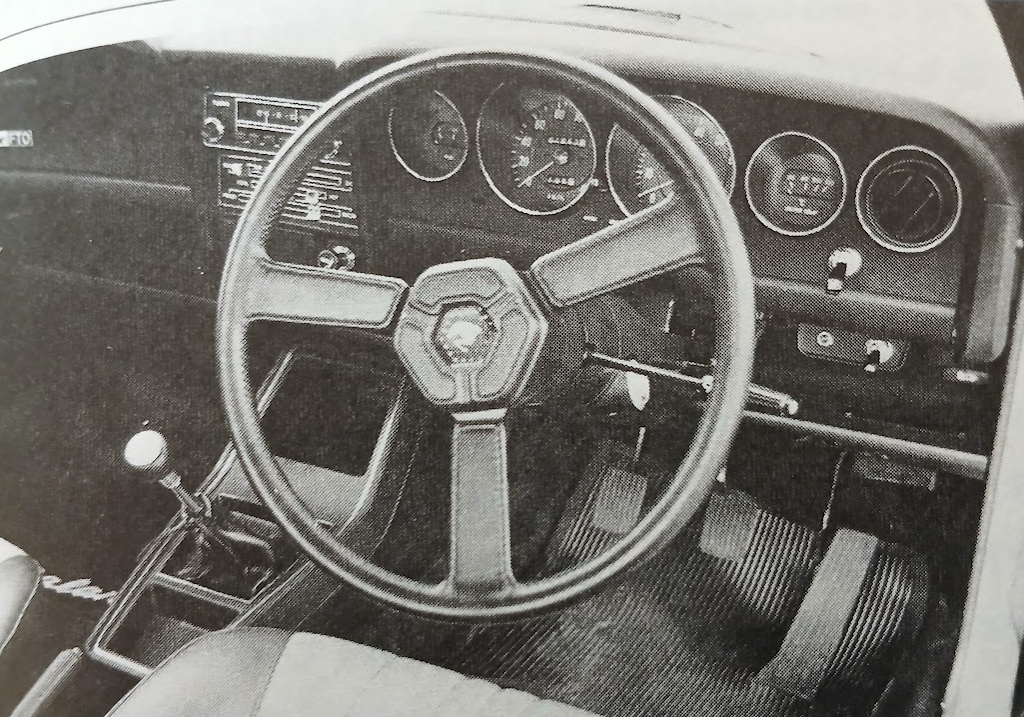
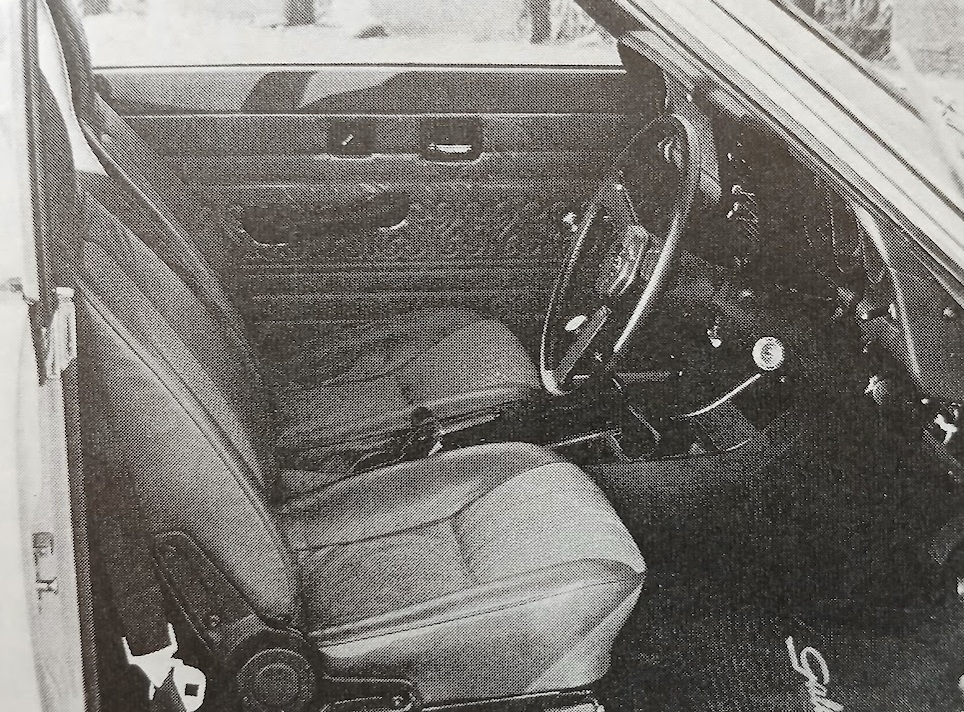
Both cars are fitted with generously proportioned reclining front seats with integrated backrests, and both provide the sort of driving position one hopes to find in a proper sporting car, with arms and legs comfortably extended.
In fact, the driving positions of the two cars are remarkably similar. One can step directly from one into the other without experiencing the slightest sense of unfamiliarity. Both steering wheels are mounted sufficiently low not to obstruct the driver’s view (the FTO’s column is also adjustable for angle), and the instruments are easy to read.
The Sprinter’s steering wheel is covered in genuine leather, whereas the FTO uses an imitation so convincing that one is hard pressed to distinguish it from the real thing.
Looking at the smaller controls, the Sprinter’s horn buttons, mounted in the steering-wheel spokes, deserve praise because they can be operated without removing one’s hands from the wheel. In the FTO, one must press the center of the steering wheel.
The headlight switches, which are used frequently, are dashboard-mounted in both cars. In the Sprinter, particularly when wearing the standard 3-point seatbelt, the switch is placed uncomfortably far away. The FTO’s toggle switch is somewhat better, though ideally all such functions would be operated from a steering-column stalk.
The FTO’s wiper and washer controls are commendably integrated into the turn-signal lever. In the Sprinter, they are located on the dashboard and, to make matters worse, must be operated with the left hand, opposite from the headlight switch. This arrangement is distinctly inconvenient.
Pedal placement is slightly better in the FTO, whose controls are positioned to allow operation while keeping one’s heel on the floor. Both cars, however, are well suited to heel-and-toe downshifting.
Rear-seat accommodation is superior in the Sprinter. Two passengers can sit naturally and comfortably in the SR’s rear seat, whereas in the FTO knee room becomes restricted unless the driver happens to be particularly small in stature.
As for the heater and ventilation systems, the Sprinter is decidedly superior.
Its controls are easy to operate and permit precise adjustment. The FTO, by contrast, seems to offer either excessive heat or none at all, with little fine regulation possible in between. One finds oneself constantly moving the levers back and forth in an effort to achieve a comfortable setting.
The face-level vents at the outer ends of the dashboard are likewise unsatisfactory. Their on/off controls are recessed too deeply and are difficult to reach while driving.
Overall, one must conclude that Toyota has done the better job in interior design.
In terms of equipment, the Sprinter is the more austere of the two. As noted earlier, it omits such items as a radio, cigarette lighter, and center console, but compensates by including radial tires and finned wiper blades as standard equipment.
The FTO, on the other hand, includes an AM radio, cigarette lighter, and center console, but radial tires remain a 16,000-yen option.
The luggage compartments of both cars are deep but somewhat short in length, and the trunk openings are comparatively small. In each case the spare tire is stored flat beneath the trunk floor, meaning that all luggage must be removed before it can be accessed in the event of a flat.
The Toyota is far better equipped when it comes to tools, both in quantity and quality. In addition to a set of spanners, an adjustable wrench, two screwdrivers, a spark-plug wrench, pliers, and a wheel wrench, it even includes wheel chocks. Nowadays, only Toyota and Isuzu seem to provide such comprehensive tool kits as standard equipment.
Rather than attempting a formal conclusion, perhaps it is best to finish with a personal choice.
Of these two cars, we would choose the Sprinter SR without hesitation.
Although both are rated at 95ps, the SR feels–and proves in the test data–to be the far more lively performer. It is also the more rewarding car to drive. The 5-speed gearbox is unquestionably one of its greatest attractions.
Moreover, the SR’s 644,000-yen price includes radial tires as standard equipment, whereas fitting radials to the basic 660,000-yen FTO GIII adds another 16,000 yen.
If choosing an FTO, this author would actually prefer the GII. With its single-carburetor engine and cross-ply tires, it offers a better balance between power and suspension, and at 608,000 yen it is also considerably less expensive.
The SR is, in every respect, a tougher, harder-edged machine. The FTO, by contrast, has a softer and more approachable character that will likely appeal to a broader audience. Its controls are lighter, and its dimensions more compact than those of the SR, making it particularly well suited to urban use. There will also be many who find themselves drawn to the freshness of its Ford Capri-like styling.
Postscript: Story Photos