Mitsubishi Colt Galant FTO GIII (1971)
Publication: Auto Sport
Format: Road Test
Date: December 1971
Author: Hajime Hiratsuka
Driving the Galant Coupe FTO: Hard Cruising on Shinano Roads in Late Autumn
On November 1, Mitsubishi Motors introduced a new model under the catchphrase “a coupe with room to grow”: the Galant Coupe FTO, powered by a 1400cc Neptune engine. The name “FTO,” we’re told, is derived from the Italian Fresco Turismo Omologare—which, loosely interpreted, suggests a car homologated as a “fresh” touring machine.
With this addition, the domestic 1400cc class is now complete. Toyota fields the Corolla Coupe, Sprinter, and Celica; Nissan counters with the Sunny Excellent and Bluebird; Mazda offers the Familia Coupe; and Subaru has the new Leone. With every player now on the board, the natural question is how their performance potential stacks up.
The FTO range itself offers three grades: GI, GII, and GIII. The first two are equipped with the newly developed 1400cc OHV Neptune engine, breathing through a single two-barrel carburetor, and producing 86ps at 6000rpm with 11.7kgm of torque at 4000rpm. The GIII, meanwhile, adopts a twin two-barrel carburetor setup, raising output to 95ps at 6300rpm and torque to 12.3kgm at 4500rpm. In other words, the GIII is the hottest model in the lineup.
As for styling, it follows what might be called a long-nose, short-deck proportion—though whether that label fully applies is questionable. In resolving the practical issues of trunk space and luggage access, Mitsubishi has arrived at what it calls a “fast notchback,” a form that seeks to balance utility with a more refined shape.
Compared with the Mitsubishi Galant GS, overall length is reduced by 315mm, yet the body is 20mm wider and 40mm lower. The resulting stance is compact and well-planted, with a certain charm to it. That is the initial impression of the Galant Coupe FTO–but to move beyond the superficial, we took it out onto an actual rally course to explore its character and underlying potential. The model, of course, was the range-topping GIII.
Suspension Rigidity Leaves Some Concerns
At a little past 7:00pm on October 26, a Mitsubishi Galant Coupe FTO GIII painted in “Olympus Orange” arrived at our meeting point. Accompanying me on this test drive were editor Mr. S and photographer Mr. I.
After a brief inspection of the car, we set off a little after 8:00pm, heading north from Hiratsuka via Route 129 toward the Atsugi interchange on the Tomei Expressway. The cabin is finished entirely in black, giving it a surprisingly restrained, mature atmosphere for this class. As the “super-wide proportion” advertising suggests, interior width is indeed on par with many 1600cc-class cars.
Because the pedal and seat layout have been given a distinctly sporting bias, headroom remains generous despite the relatively low overall height of 1330mm. However, if the seat could slide back just one or two more notches, taller drivers would likely find it close to ideal…
The instrument panel places round gauges for water temperature, tachometer, speedometer, and fuel in a row from right to left. A rather lonely-looking headlamp switch sits separately at the lower right. The heater controls are positioned neatly beneath the center-mounted radio and are easy to operate. On the steering column, a multi-function lever handles wipers, washer, dimmer, and passing functions in one control—an impressively thoughtful setup, though drivers unfamiliar with it will need time to adjust.
Driving through the city, I immediately felt something different from previous Galant models. The ride is notably soft, and road noise is significantly reduced compared with other cars in this class. In particular, the dull thumps from concrete expansion joints are well suppressed, which is most welcome.
Engine response is smooth, and the sound retains the light, lively character that has long been a Galant trademark. The newly developed OHV Neptune engine with twin carburetors produces 95ps at 6300rpm, and its performance is certainly strong—but the body still feels somewhat heavy by comparison.
From Atsugi, we joined the downhill lanes of the Tomei Expressway. Despite it being a weekday, traffic was unusually heavy, with large trucks thundering past and shaking the road surface.
Cruising at around 80km/h while listening carefully to the car’s mechanical sounds, we soon noticed another vehicle shadowing us closely—front, rear, and side—clearly intrigued by this unfamiliar car. The behavior was more annoying than innocent, and frankly, a little risky. I dropped quickly into 3rd gear and gave it full throttle. With a sharp, eager engine note, the GIII pulled away and soon left our pursuer behind.
After passing Matsuda Interchange, we entered one of the most demanding sections of the Tomei, with its tightest curves. The road gradually climbs, but there is no sense of power deficiency. As long as you don’t fixate on the amount of body roll, the suspension and Bridgestone RD201 radial tires combine to offer excellent grip, allowing for confident cornering.
However, when passing over bridge joints or uneven seams mid-corner, the soft springing allows the body to bounce and pitch noticeably. This sudden movement induces a slight change in front toe angle, and the resulting shift in direction can feel unsettling at first.
At 100km/h, the engine is turning exactly 4000rpm, giving a v1000 figure of 25km/h. Incidentally, the Nissan Sunny Coupe 1200 GX records the same value. At this cruising speed, cabin noise remains impressively low.
After exiting at Gotemba Interchange, we carried out lane-change and stability tests behind the Fuji Speedway main stand area.
First, in a rapid lane-change maneuver, the car exhibited mild understeer but no real instability. The only impression was that body roll is somewhat pronounced. The softness of the suspension may be responsible, as the body also feels slightly unsettled at the end of the maneuver.
Next, we applied a slight steering disturbance at 100km/h to observe hands-off directional stability. The car continued to weave for quite some time before settling down. Normally, a vehicle would stabilize within 1.5 to 2 oscillations at this speed, but here convergence was noticeably slow.
That said, in normal, everyday driving, this is unlikely to pose a serious issue. Still, in the event of an abrupt steering correction by an inexperienced driver, the response may require careful attention.
By a little after 10:00pm, we had arrived at a ryokan in Subashiri. At an elevation of 700-800m, the night air was unexpectedly cold. Fortunately, gathering around a heated kotatsu for a hot nabe meal restored both warmth and energy to the group.
Rough Roads Demand Care for Underbody
The next morning, we were up at 3:00 a.m. Still half-asleep, we washed down onigiri prepared the night before with tea while going over the day’s route plan.
At 3:30 a.m., we left the ryokan and headed out into pitch darkness on National Route 138 toward Lake Yamanaka. The road over Kagosaka Pass was completely empty. Climbing steadily up Kagosaka Pass, we downshifted to second gear for the three or so hairpin bends along the way, but otherwise third and top gear provided ample acceleration.
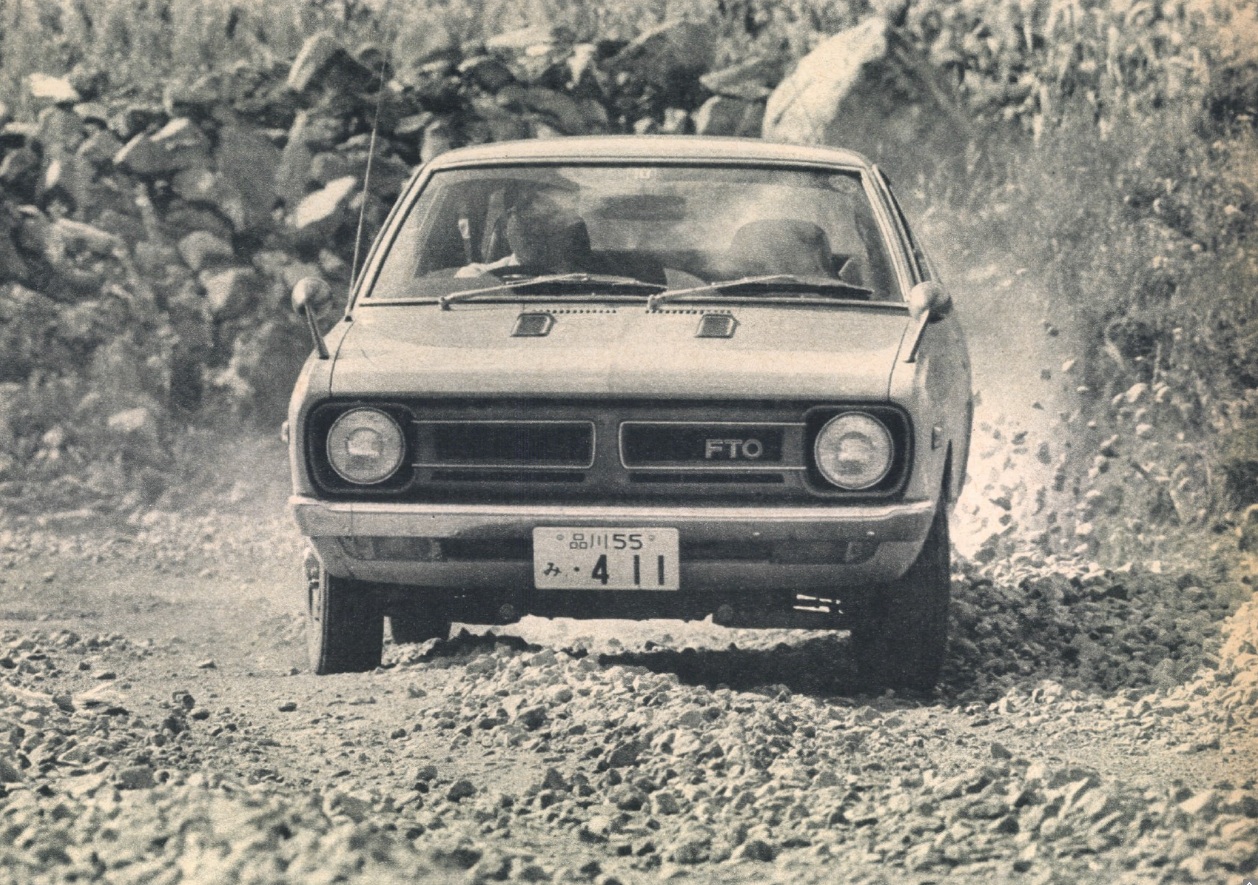
From Lake Yamanaka the route continued past Lake Kawaguchi and Lake Motosu, eventually turning toward Shimobe Onsen. This descent was once used as a special stage in the Tour de Nippon, and even now the gravel surface remains in poor condition. Progress with the GIII becomes somewhat difficult here.
The soft spring rates, combined with slightly inadequate damping, lead to fairly pronounced pitching over uneven surfaces. If the bumps are not carefully avoided, you risk striking the underbody. In fact, the lower arm mounting points scraped the ground twice during this section.
That said, cornering performance itself is quite good. For a rigid-axle suspension, it maintains road contact well and grips better than expected.
Further along, we encountered a section where a landslide had reduced the road to a single-car width, with an idle bulldozer blocking the path. After carefully passing through, we entered Shimobe Onsen and continued on Route 52, then began the climb toward Yashajin Pass.
From there, the road widens and improves in surface quality, and we pushed on at an average of around 60km/h. Passing just beyond the townscape of Nishiyama Onsen, we turned right at a reverse Y-junction and entered Maruyama Forest Road. From Tokyo to this point is roughly 240km.
By now, dawn had fully broken, though a light rain was falling. We had missed the peak of the autumn colors, but the remaining foliage still held striking beauty.
The forest road is about one and a half lanes wide, but well maintained. The GIII flowed easily along the winding, steep uphill sections. Here and there, bumps sent it into full rebound, which in turn brought out more pitching. However, the light early morning rain had left just enough moisture to tighten the road surface, improving grip. Combined with the RD201 radial tires, the car maintained reassuring stability.
That said, when passing over sections where the road is slightly crowned, the limited ground clearance and soft suspension combine to make underbody contact almost unavoidable, no matter how carefully the line is chosen.
For rally use, it is clear that the car cannot be left in standard form.
The climb is continuous and steep, keeping the gearbox almost constantly shifting between first and second gear. The shift action itself is pleasing–throws are short, and it engages with a crisp and well-defined mechanical “click.”
The pedal layout, however, is not ideal. The pedal angle is set fairly horizontally, and for drivers with larger feet (around 26 cm in this case), the toe tends to touch the pedal arm while the heel drags lightly on the floor. Combined with the narrow spacing, operation can feel somewhat cramped.
On narrow mountain roads with tight corners, forward visibility becomes critical. In this respect, the FTO has one clear drawback: in left-hand corners, the interior rearview mirror sits slightly too low and partially obstructs the forward-left field of view (of course, raising it would compromise rear visibility…).
In right-hand corners, however, the absence of quarter windows and the slim A-pillar make things considerably easier.
At the Maruyama Forest Road Y-junction, we turned right and began descending toward Kajikazawa. Here, the braking feel is excellent. Although pedal travel is relatively short, the servo-assisted system provides stable, reliable deceleration with a feather-light touch. It’s the kind of brake feel you wouldn’t trade for anything else.
By the time we passed through the town of Kajikazawa, it coincided with the morning rush of students heading to school. Interest in cars among today’s young people runs remarkably high, and our Galant FTO drew considerable attention. Voices calling “That’s cool” came from all directions, and more than once, we found ourselves smiling with quiet satisfaction.
“Out-of-Breath” Phenomenon at 1,800m Altitude
At Nirasaki, we refueled and checked the tire pressures. The distance traveled up to this point was approximately 294km, with fuel consumption of 30.4l. That works out to about 9.4 km/l, which is roughly acceptable for the 1,400cc class.
From here, we took the Saku-Koshu highway and ran straight toward Uminokuchi Onsen. This route offers a continuous view of the magnificent Yatsugatake range on the left, and it is one of those roads that never grows old no matter how many times one drives it. In particular, the view of Yatsugatake from around Nobeyama–the highest point on the Japanese National Railways system–is outstanding. Snow was already visible on the peaks.
At this stage, I was no longer driving; Mr. S. was at the wheel and I was dozing in the passenger seat. Even so, the morning cold and the scenery eventually brought me back to full alertness. We stopped for breakfast at a roadside drive-in near Ipponmatsu, lingering briefly over simple food while chatting casually with a young woman working there about cars.
After breakfast, we entered the main highlight of the drive: the Kawakami-Makiyoka Forest Road (also known as the Minegoe Forest Road). This route traverses the ridgelines of some of the highest peaks in the Chichibu mountain range, including Mt. Kinpu (2,595m), Mt. Asahi (2,581m), and Mt. Kokushi (2,595m). Its highest point, Odarumi Pass, reaches 2,360m.
Starting the climb from Akiyama in Kawakami Village, Minamisaku, the Galant FTO GIII charged upward powerfully, with the jagged silhouette of Mt. Mizugaki filling the view ahead. The gravel surface was generally in good condition and the road fairly wide, allowing for relatively easy, controlled sliding through corners.
The GIII’s high-backed seats provide good lateral support, and the driver does not shift around unnecessarily. That said, rearward visibility is limited compared with a sedan body, which is both expected and unavoidable. One point of concern is the shift pattern: unlike in most cars, reverse gear is back and to the left, and requires the lever to be pushed downward to engage. Fundamentally, having to reach to the farthest point from the seated position and then push the lever down seems incorrect from an ergonomic standpoint. That said, one would likely become accustomed to it over time.
As the GIII continued its high-speed hill climb and approached around 1,800 m altitude, the engine began to lose some of its willingness to rev. In particular, after stopping and pulling away again, response became noticeably sluggish and power did not build cleanly. We wondered if this is related to the twin carburetor setup–which is not the twin SU-type used on cars such as the Galant GS, but a twin two-barrel downdraft configuration. Even SU systems can exhibit some degree of this behavior, but not usually to this extent.
At this point, the question naturally arises: why was the Neptune engine not equipped with SU-type twin carburetors? There are of course likely reasons related to cost, parts standardization, and production management. However, from a driving perspective, the advantage of the twin two-barrel downdraft setup is not immediately obvious.
Beyond 2,000m, patches of snow began to appear on the road surface. As we approached Odarumi Pass at 2,360m, the amount of snow increased, with occasional icy sections. However, since the road was not fully snow-covered, the RD201 radial tires did not present any particular difficulty.
At these altitudes, the engine hesitation became more pronounced. When starting from rest, even with relatively high revs, the engine would occasionally stumble–briefly feeling as though it might stall. This appears to be the result of an overly rich mixture under reduced air density conditions.
On this issue, we requested an explanation from the manufacturer. In response, Mr. Motoo Suzuki, chief engineer of Mitsubishi Motors’ Engine Design Section 1, provided the following comments:
“1. On engine hesitation: At high altitude, reduced atmospheric pressure results in a richer air-fuel mixture. However, at elevations of around 1,800-2,000m, this should not normally present a serious problem. As a general reference: at sea level (0m), standard pressure is 760mb at 15°C. At 2,000m, this drops to 595mb and around 2°C; and at 6,000m, 335mb and -24°C. Under these conditions, the intake air-fuel ratio shifts such that, taking sea level as 100, it becomes 90.5 at 2,000m and 73 at 6,000m. Correspondingly, engine output is reduced by about 20% at 2,000m and 54% at 6,000m. High-altitude testing of the FTO in the United States showed no major issues except at extreme elevations. However, air-fuel ratio variation is influenced not only by altitude but also by driving speed and terrain gradient. A detailed investigation of the exact driving conditions is necessary. It will also be confirmed whether the test vehicle was in a fully correct state of tune.”
“2. On the decision not to use SU carburetors: Recently, fuel delivery systems and exhaust emissions have become an increasingly important issue across manufacturers. When SU-type carburetors are used in multi-carburetor configurations, imbalance can occur due to wear in the suction piston sliding surfaces and eccentric wear of the metering needles, potentially resulting in emissions exceeding regulatory limits. While this is not a concern under the 1971-72 emissions standards, for future compliance a fixed-venturi downdraft type was selected, as it is less likely to deteriorate emission quality. At the current stage, this two-barrel, two-stage system is considered more effective than SU-type carburetors from an emissions control standpoint.”
Around midday, we arrived at Odarumi Pass. As expected, it was cold–cold enough that it felt as if winter had already started in October. From here, one can look out over both the Shinshu side to the north and the Koshu side to the south, and for those who have made the effort to climb up, the view may feel like a fitting reward.
After a short break, we began the descent toward Makiyoka Village. Up to Yakeyama Pass, the road remains wide and the surface in good condition, much like during the climb. Beyond that point, however, the road narrows and the surface becomes noticeably rougher. In this section, the GIII suddenly began to feel more lively. Engine response became cleaner, and the powertrain picked up revs more willingly on the downhill.
From Makiyoka, we dropped down into Enzan City and joined National Route 20, passing through the Sasago Tunnel before entering the Chuo Expressway at Otsuki. We returned to Tokyo at around 6:00pm. The total distance covered was 526.6km.
From this test, our impression is that the Galant FTO GIII can be seen as a “cute” car with strong appeal–particularly for younger drivers. In terms of performance, its acceleration and deceleration are both satisfactory, ride comfort is good, and noise levels are relatively low. On balance, it is probably best to regard it as a car well-suited to town use.
That said, it is also clear that with some suspension tuning, it has more than enough underlying potential to be developed into a rally version.