Mitsubishi Colt 1100F SS (1969)
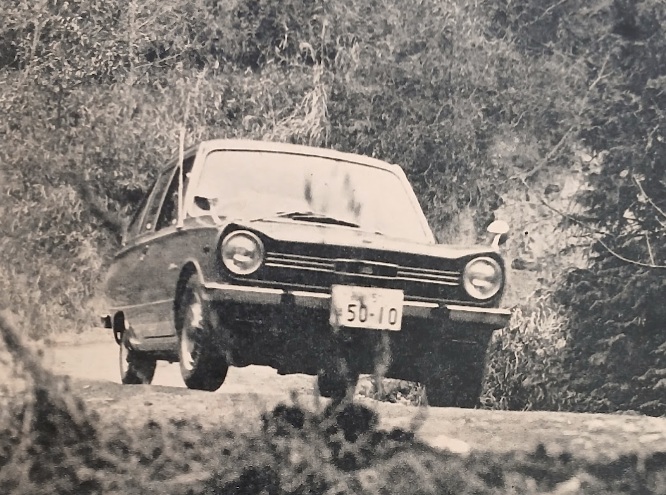
Publication: Motor Fan
Format: Test Drive Report
Date: March 1969
Author: Nobuki Hayama
The Long-Awaited SS Model Finally Appears
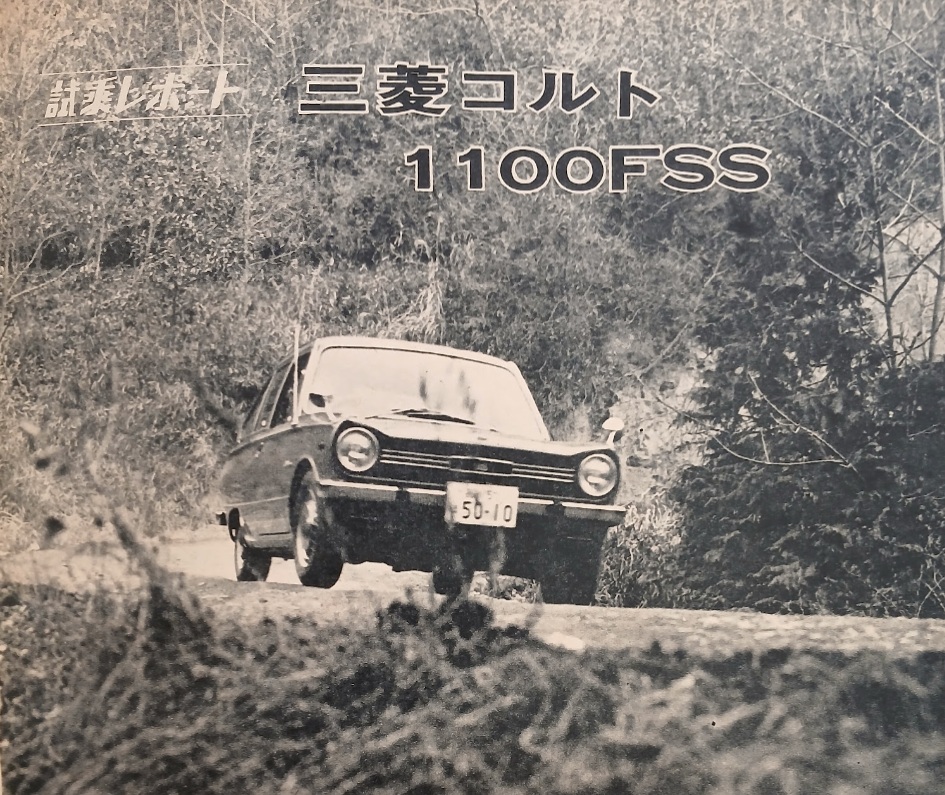
The first time this car–the Colt 1100F SS–appeared before our eyes was at the Tokyo Motor Show the year before last. At the time, detailed specifications were not shared, but the apparent fitment of radial tires, together with a pair of thick exhaust pipes, suggested that it had been tuned to a rather considerable degree.
Yet after that, there was no mention of a production release. Then, in August of last year, the 1100F Sport, fitted with the new 1100cc engine, appeared; and with that development it seemed increasingly likely that the car seen at the show would remain no more than a reference model.
Meanwhile, however, in the world of rallying and other forms of motor sport, factory-tuned versions of the 1100F gradually began to appear following that Motor Show appearance. Last year they turned in remarkable performances, beginning with victory in an international rally in Australia and continuing with strong showings in domestic events. Among a certain circle of enthusiasts, one might say that calls were already growing louder in hopes that the car might be placed on sale in essentially the same form.
Then, last November, under the catchphrase “a car that lets you feel superior on the highway,” the 1100F SS finally made its appearance—almost exactly as it had been prepared for rally use. For fans of motor sport, it must surely have been welcome news.
The Feel of the Brakes–Superb!
For this test drive, we planned a route starting from Mitsubishi’s sales office in Mita, Tokyo, then threading our way through the city center before joining the Chuo Expressway. After running along the newly opened Hachioji-Sagamiko section, we left National Route 20 (the Koshu Kaido) at Uenohara and climbed the Jinba Kaido, crossed Wada Pass, returned to Hachioji, and from there headed back to Tokyo.
Until reaching the expressway we found ourselves squarely in the morning rush, and so–as usual–the driving became a matter of crawling along at a snail’s pace.
The secret to this kind of inch-by-inch progress is simply not to think about it. One must resign oneself completely to the slowness. Whether the engine happens to have twin carburetors or even a DOHC layout makes no difference; the best frame of mind is to imagine that you are driving an old, tired machine that stalls the moment it tries to get moving.
That said, the large, circular gauges—the speedometer on the right reading to 180km/h and the tachometer on the left to 7000rpm (with the yellow band beginning at 6300 and the red zone at 6500), together with the wood-rimmed steering wheel and the pleasantly resonant, low-toned exhaust note–bo-bo-bo…–create an anticipation that pricks at the nerves little by little.
And then there is the body color of this car: a striking, brilliant red (called Lightning Red by the manufacturer). One does not need to be a fighting bull to be stirred on by this hue.
I am fairly sure this is the very same red that was used on the 1100F SS exhibited at the Motor Show. Even then its vivid appearance drew plenty of attention, but seen here in full daylight it glows with an even more intriguing brilliance. Before long, one begins to feel as though one is at the controls of a high-level machine.
It seemed as though the eyes of the surrounding drivers were fixed upon us, and I found myself self-consciously stretching my arms a little farther forward on the wheel, assuming a pose rather like that of a racing driver.
At that very moment, a light van suddenly darted into the lane directly ahead of us.
Watch out!
Instinctively I stamped on the brakes. The car stopped instantly, without the slightest fuss—clamping down as though nailed to the road. The feel of the brakes is excellent. Disc brakes with opposed calipers are fitted at the front, while the rear uses leading-trailing drums. The master cylinder, moreover, is a tandem type—something of a luxury in this class.
When brakes of this sort first began to appear, the pedals were often excessively heavy, or else at low speeds gave a vague feeling that left one unsure whether they were actually working. The latest examples, however, are much improved. I had previously heard favorable reports about Mitsubishi’s disc brakes, and those on this car indeed have a remarkably fine feel. One suspects that experience gained with the Colt Formula has been put to good use here.
“Driving beyond one’s ability invites an accident”–recalling this solemn admonition, I gathered myself again and gripped the steering wheel.
Prior to the appearance of this 1100F SS, the Colt 1500 SS had already been released, and when I drove that car one impression stood out clearly: the response at low speeds was exceptional. Perhaps this is simply a characteristic of Mitsubishi engines. It is also pleasing to find that the twin SU carburetors show none of the unevenness that is sometimes encountered with these units.
The transmission uses the same gear ratios common to this series–3.787 in first, 2.379 in second, 1.535 in third, and 1.000 in fourth, with reverse at 5.243. However, the final reduction ratio has been lowered to 4.22, the same as that used in the 1500 SS. Even so, drawing out the engine’s full performance requires rather careful and technical driving. One cannot help feeling that they may soon begin to wish for a closer-ratio gearbox. Yet in a way, this too seems to form part of the car’s unique character. Certainly, for the enthusiast who enjoys frequent gear changes and the process of extracting the machine’s capabilities, it has its own kind of appeal.
The shift action itself has what might be called a distinctly British-car firmness. The lever slots neatly into place with only small movements—click, click. At a time when more and more gearboxes feature the so-called Porsche-type shift, with its somewhat viscous feel—rather like stirring honey with a pair of chopsticks—this crisp action has a charm that is hard to dismiss.
The shift knob, like the steering wheel, is finished in high-quality wood. One senses here the small touches clearly intended with younger drivers in mind.
Running on the Chuo Expressway
From Hachioji onward, the Chuo Expressway—as readers may already know from newspaper reports—was opened only on one side at first. This has resulted in the rather unusual situation, for Japan, of an expressway with only two lanes. There are sections where overtaking is prohibited and the arrangement is somewhat irregular, but thanks to its completion it is now possible to travel from central Tokyo to Lake Sagami in well under an hour.
In time it will no doubt develop into a major commercial road linking the capital with its satellite cities. For the moment, however, it serves perfectly well as a leisure route. Yet perhaps because it is a weekday, the road is so quiet that it almost feels like our own private highway.
Without delay, we opened the throttle fully and tried some high-speed running. Acceleration from around 60km/h is, as one would expect, quite strong. The engine also spins with remarkable smoothness–hard to believe for a brand-new car with only 800km on the clock.
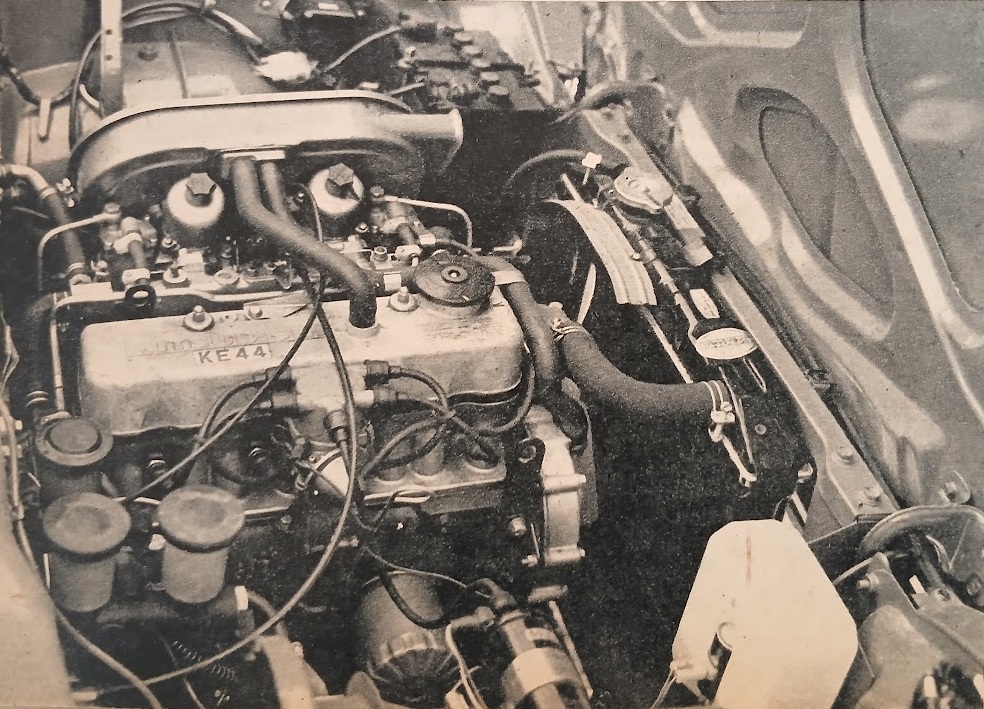
However, the mechanical noise that hardly draws attention when cruising in the 3000-4000rpm range takes on a rather strained note once the engine is pushed past 5000rpm. One must remember that this car’s water-cooled inline-four OHV engine is a small unit, with a total displacement of just 1088cc.
Yet this engine achieves impressive performance for its size. By reshaping the pistons to raise the compression ratio (from 8.5 to 10.0), adopting twin SU carburetors, and fitting a high-speed-type manifold, the engineers have succeeded in extracting a maximum output of 73ps at 6300rpm and a peak torque of 9.0kgm at 4500rpm.
The power that has been extracted from this engine is outstanding for the 1100cc class–so much so that one almost forgets the modest displacement and begins expecting more than is reasonable. Nevertheless, while the twin SU carburetors display excellent stability at low speeds, at higher speeds they leave a sense of being slightly held back. Since the engine has already been tuned this far, one cannot help wondering how it might perform if the designers had taken the bold step of adopting twin Solexes instead.
The steering incorporates the variable-ratio system first introduced on the Colt 1200 and 1500 (with the ratio ranging from 15.6 to 18.2), which improves stability at higher speeds. As mentioned earlier, the brakes are very effective, and they remain so even at high speed; braking force is distributed very evenly across all four wheels. Such is the virtue of disc brakes.
On the other hand, wind noise is quite pronounced. Since the body itself remains that of the Colt 800, this may be unavoidable, but it does mean that in contrast to the car’s excellent performance, perceived refinement suffers somewhat. In addition–and this may have been peculiar to the particular test car–once speeds exceed about 90km/h, a sharp whistling sound, like air passing through a flute, resonates throughout the cabin.
At first we assumed this was wind noise from the quarter windows, but upon inspection we discovered that the sound was actually coming from the ventilation outlet. In other words, if the vent is closed, the noise disappears.
Perfect for Rallying
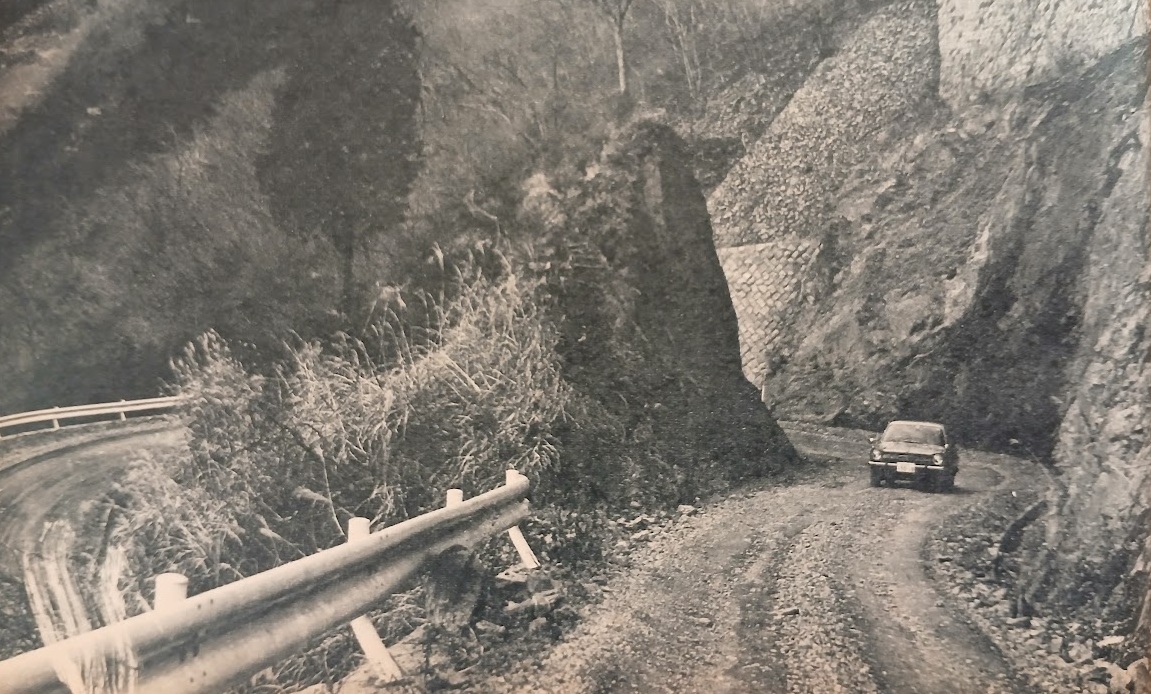
The Jinba Kaido, running from Uenohara Town over Wada Pass and down to Hachioji, is a remarkably scenic drive. Yet, for a road so close to Tokyo, it remains surprisingly little known.
The route winds through the mountains in a series of twists and turns, making it ideal for sports driving.
The Colt 1100F SS is said to be almost identical in specification to the car that entered the Southern Cross Rally in Australia. Its high mechanical specification had already made itself felt during our driving so far, but to really put it to the test, rough roads are best.
To familiarize ourselves with the course, we first ran up to the summit of Mount Jinba. The surface was paved only in a few sections; most of the road was gravel. With ongoing construction in places, it seems likely that eventually the entire route will be paved and become a tourist road.
Along the way, we noted two fairly sharp corners near Wada Pass, and the presence of a small neighborhood at the foot of the road where children were playing. Having made note of these conditions, we finally began our hard drive.
In each gear, we pushed the engine almost to the redline, taking care to never let the revs drop below 4500rpm. This was a lesson learned from previous runs: below 3000rpm, torque drops off sharply.
Shifting up and down repeatedly, we raced to the summit in one continuous burst. Impressive! All four wheels gripped the surface with astonishing strength. The tires are Yokohama radials (GT Special). Suspension is standard for the series: independent with transverse leaf springs at the front, and semi-trailing arms at the rear. However, the spring rates have been increased and the travel significantly reduced.
The characteristics of this suspension, combined with the variable-ratio steering and the radial tires, harmonize perfectly to deliver exceptionally sharp cornering. The steering mechanism itself is a standard ball-and-nut type, yet the feel is surprisingly close to that of a rack-and-pinion system. In fact, it’s more than that: the way the car glides cleanly into a corner the moment you turn the wheel gives it something of the feel of a formula car. This unique sensation is unlike anything you would feel in ordinary cars; I must admit I felt a bit bewildered at first, but once accustomed, it becomes thoroughly enjoyable. Truly, it gives a sense of man and machine as one.
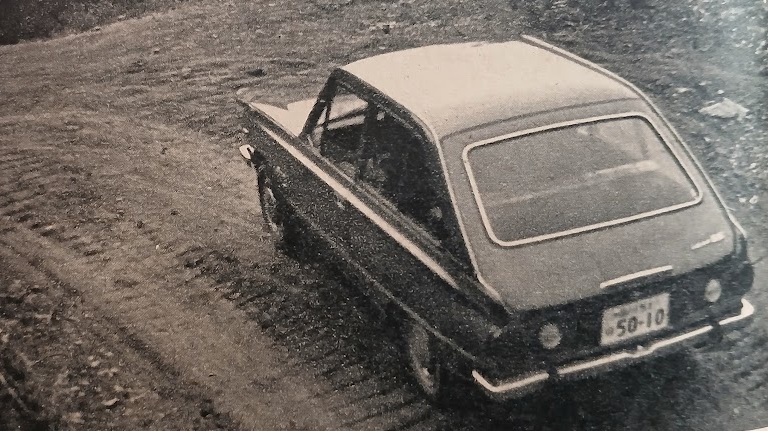
Since the first Colt 800s, this model series has tended toward a cornering characteristic closer to “snap oversteer” than simple oversteer. That, however, could largely be seen as a drawback inherent to fastback cars, where the rear is comparatively light and balancing the body becomes tricky.
In the 1100F SS, that issue has been brilliantly resolved. Road holding from all four wheels is superb, and the roll angles are astonishingly small. This proved immensely advantageous on rough roads.
For roughly two hours, we put the car through several runs on the Jinba Kaido. Our conclusion: for rally use, it performs nearly flawlessly as-is. Making matters better, a thin steel plate–essentially a stone guard–is mounted beneath the oil pan. Before driving the car, I had worried that its 775kg weight might be a disadvantage in this class, but in practice, that weight actually contributes to a sense of stability and confidence. With this car, there is no need to tiptoe over the oil pan at all.
An Un-Mitsubishi-Like Car?
When those who had already driven the Colt 1100F SS were asked for their first impressions, the unanimous response was: “It’s a car that is simply not Mitsubishi-like.”
The phrase “Mitsubishi-like” carries many nuances. Sometimes it conveys reliability, stability, and a sense of refinement–but at other times, it implies a lack of novelty, excessive conventionality, or simply means that the car isn’t exciting.
Mechanically, this car has plenty of admirable qualities, yet until now, Mitsubishi has been frustratingly restrained in making full use of its potential–an ambivalence that many longtime users of the brand would surely recognize. After all, the average driver associates Mitsubishi with its reputation for having produced the Zero fighter, or for possessing the world’s top shipbuilding technology–and expects the same level of engineering brilliance to manifest in their passenger cars.
Seen in that light, the arrival of the 1100F SS is truly groundbreaking. Mitsubishi, a company that had long avoided producing cars with an assertive character, has now brought forth a high-performance car that is stronger and more uncompromising than any they’ve built before.
Passenger cars have recently begun moving away from an era when driving demanded technical skill, toward an age of easy driving. In that context, a car like the Colt 1100F SS–which allows the driver to fully enjoy the act of driving, to transform an ordinary commute into something thrilling with nothing more than subtle inputs–is a delight no car enthusiast could resist.
Watching the tachometer, modulating the throttle and brakes, and repeating shifts with precision–the Colt 1100F SS hides within it a charm sure to win the hearts of young drivers.
Postscript: Story Photos