Mitsubishi Colt 11-F (1969)
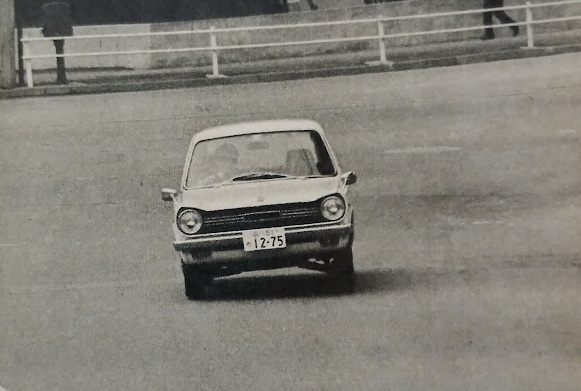
Publication: Car Graphic
Format: Road Impression
Date: September 1969
Author: Nobuyasu Yoshida
Road-testing the Mitsubishi Colt 11-F
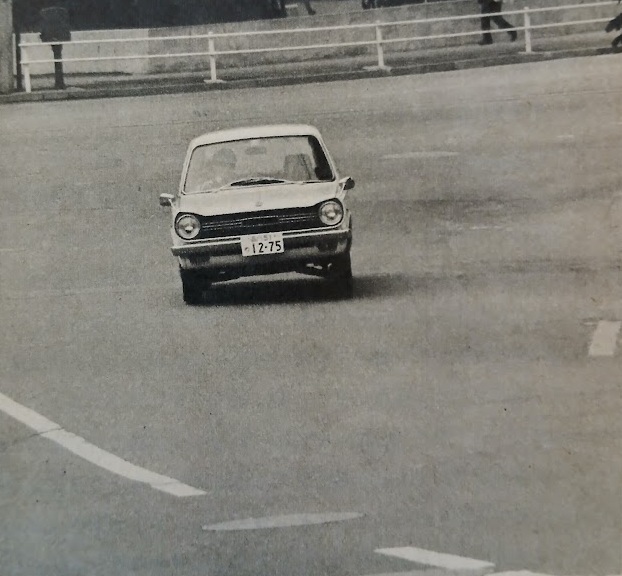
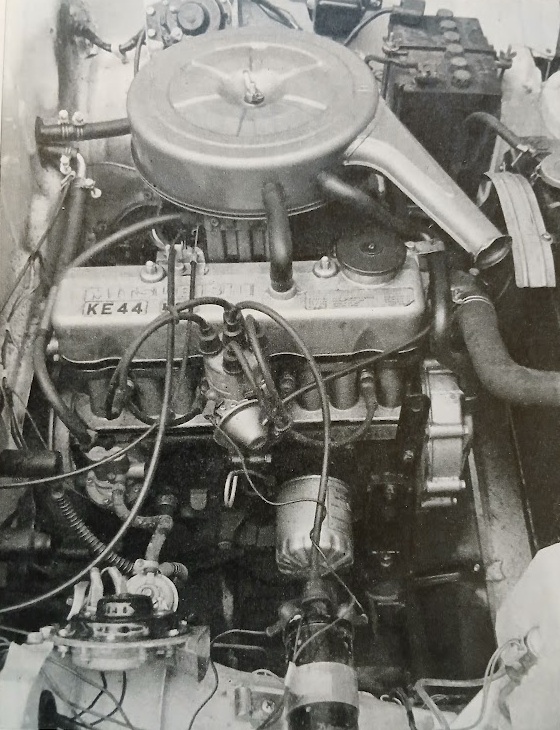
In May of this year, the Colt 1100F underwent a minor change focused mainly on an increase in power, and at the same time its name was changed to Colt 11 (pronounced “eleven”)-F. The uprated KE44 engine is the same unit used in the previous 1100F, but has received a number of modifications: the camshaft profile has been revised and its bearing surfaces strengthened, valve lift has been increased from 7.8 to 8.2mm, and the inlet ports have been polished to improve intake efficiency. As a result, although displacement remains 1088cc and the compression ratio 8.5, output has risen to 62ps/6000rpm and maximum torque to 8.7kgm/3800rpm (from 58ps/6000rpm and 8.2kgm/3800rpm in the 1100F). This increase in performance has brought with it a switch to high-octane gasoline, which means the owner must now pay just under 10 yen per liter more than before. The Super Sports, incidentally, remains unchanged at 73ps.
As an aside, it appears that this autumn the Colt range will adopt SOHC engines, with a new twin-cam 1600GT also joining the lineup. Its engine will be based on that of the Formula Colt F2C. The body shows a strong Giugiaro influence.
Powerful, Free-Revving Engine
The car we borrowed (a 2-door Deluxe with floor shift) had covered only 1,732km and was not yet fully run in. Even so, and despite the modest 7% increase in output, its engine has been transformed into one far easier to use and much more flexible than that of the previous 1100F. Since vehicle weight remains unchanged at 735kg, the effective gain in performance amounts to more than 7%. Even so, the engine retains much the same character as before, with emphasis on the low- and medium-speed ranges. In fourth, for example, the car will keep up comfortably with the flow of traffic at 35km/h (about 1400rpm), and it will even accelerate from 30km/h if desired. One factor in this may well be the use of high-octane gasoline accompanying the increase in power. In top gear, 1000rpm corresponds to 25km/h.
The increased torque is maintained over a broad range from 1600-5450rpm, with more than 8kgm—87.5% of maximum torque—available throughout. As a result, the engine pulls well in every gear, and it is even possible to start off in second gear. On the other hand, its extension at higher speeds is restricted by a gearbox whose ratios are poorly matched to the available power.
The maximum speeds in each gear—the catalog figure for the engine’s limit is 6000rpm, although in practice it will rev to around 6400rpm, by which point valve crash is severe—are 42, 70 and 110km/h at 6200rpm. The practical maximum, however, is still the catalog figure of 6000rpm. Valve crash sets in at 6200rpm, so holding third all the way to 110km/h is not good for the engine, nor is it necessary. An easy 100km/h (about 6000rpm) is available in third, making it safe to merge into the traffic stream on the Tomei Expressway and similar highways.
At 100km/h in fourth (about 4000rpm), the noise level is low and the car is quiet. At 110km/h, however, a booming resonance suddenly becomes much louder, and over a long period it wears on the nerves.
Although cruising at 100km/h is by no means beyond its abilities, the Colt is actually at its best in places such as Tokyo, with frequent stop-and-go driving. Taking advantage of its very low gearing (the ratios for the 11-F series, including the Super Sports, are 3.787, 2.379, 1.535 and 1.000, with a final-drive ratio of 4.222), it can usually get the jump on most cars in a traffic-light grand prix. Even its main rivals, the Sunny Coupe and Corolla, can be outrun by this sprinter (“sprinter” here meaning a short-distance runner, not the Toyota). Yet even compared with these two cars, the 11-F’s gear ratios are rather widely spaced by modern standards. For reference, the Sunny Coupe’s ratios are 3.757, 2.169, 1.404 and 1.000, with a 4.111 final drive; the Corolla’s are 3.684, 2.050, 1.383 and 1.000, with a 4.222 final drive.
Compared with a Sunny Coupe owned by a member of the C/G staff, the Sunny gathers speed more smoothly through each gear, while the Colt has the advantage in instantaneous punch. In terms of building road speed, however, the Colt seems to be handicapped by its gearbox. With a final-drive ratio of 4.111, or perhaps something even slightly taller, its performance should improve considerably. The floor-mounted shift lever has a positive action, and although the synchromesh is not especially powerful, it works well.
The steering uses a variable ratio of 15.58–18.8, sharp at high speeds and light at low speeds. In our earlier test of the Super Sports, we wrote that the car would turn farther into a corner than the steering angle would suggest, but the milder 11-F has none of this peculiar tendency and maintains straightforward understeer right to the limit. The new Yokohama cross-ply tires (5.50-13) also provide good grip, and at the limit the rear tires begin to slide gradually, making corrections easy. The suspension, with wishbones and a transverse leaf spring at the front and a rigid axle at the rear, holds the car well in cornering, and roll angles are not particularly large. By simply changing to radial tires, it should be quite capable of sporting driving as it is.
At 100km/h (with tire pressures set to the high-speed figures of 1.7kg/cm² front and 1.9kg/cm² rear), crosswinds affected the car and disturbed its straight-line stability. Because these high-speed tire pressures were left unchanged when driving in Tokyo, the rear wheels would hop when driving over tram tracks. The suspension itself is relatively firm, but it absorbs small surface irregularities well and the ride is very good. Much of this, however, is probably due to the new seats.
The all-drum brakes are well matched to the car’s performance and provide consistent braking force even from high speeds. On mornings when the drums are still cold, however, care is needed for the first kilometer or so: pedal travel is long, and the brake linings tend to grab the drums suddenly, so that the brakes come in with a jerk.
Improved Seats, But Cramped Rear Cabin
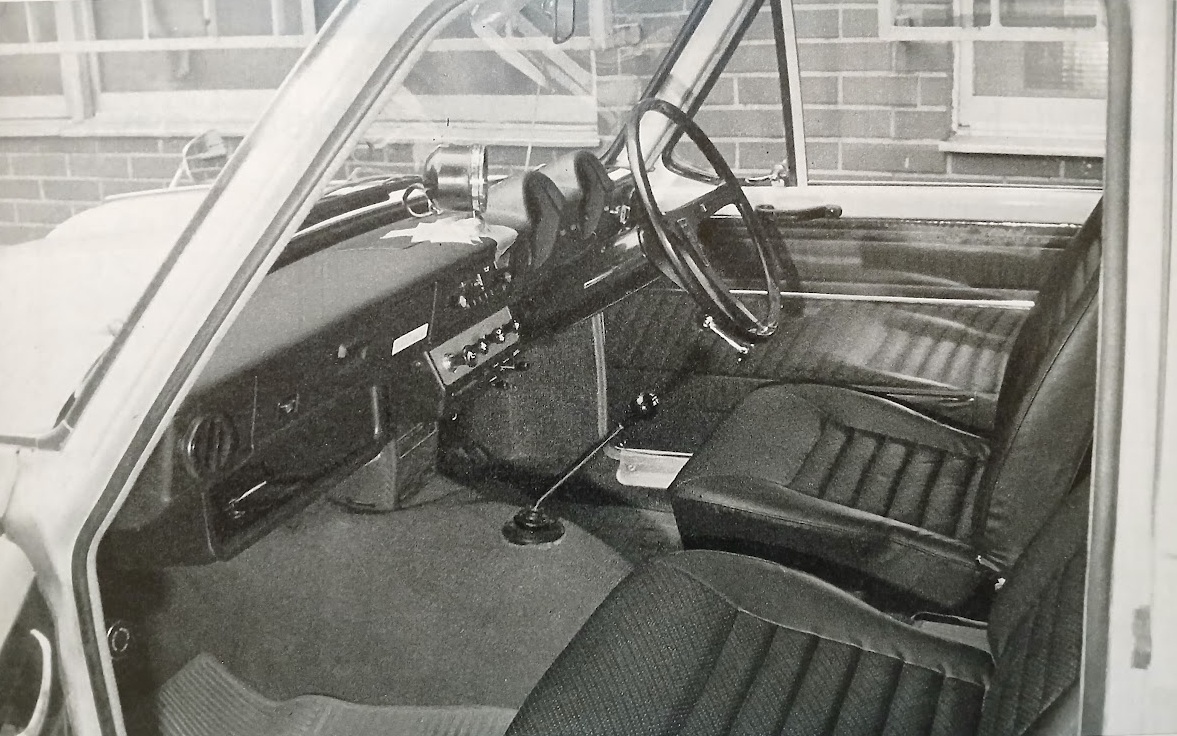
The 11-F is fitted with new seats of which Mitsubishi is particularly proud, making extensive use of polyurethane foam. They were newly developed by Namba Press Industry, a Mitsubishi supplier, under a technical tie-up with the French firm Bertrand Faure. Sitting in them confirms their merits: the areas in contact with the body—particularly beneath the posterior—have just the right degree of resilience while remaining soft, and are extremely comfortable. They provide a quality of seating comfort not previously found in a Japanese car, and fatigue is minimal even on long drives. They are still a step short, however, of the enveloping sensation offered by such cars as Citroëns and Renaults.
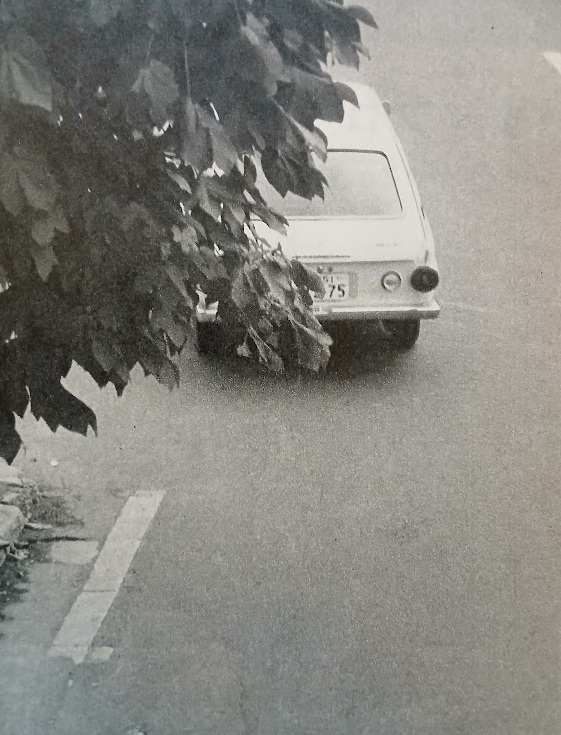
With the driving position adjusted for a 170cm driver (with the seat slide one notch from its rearmost position, and the backrest slightly reclined), a rear-seat passenger’s knees come into contact with the front backrest. It is probably best to think of the rear seat as being for children. There is a door pocket beside the rear seat large enough to hold four or five weekly magazines if they are folded in half.
Considerable thought has clearly gone into the pedal layout. The accelerator pedal in particular is offset quite substantially to clear the protruding wheel housing, but it is not difficult to operate. Perhaps this was peculiar to the test car, but the accelerator was also unusually light. Normally, in a touring car, a pedal this light would probably tire the ankle on a long journey. Fortunately, in our case we were spared that problem.
The area around the dashboard is simple, and the large markings on the instruments are easy to read. At night, however, illumination of the speedometer is uneven: the upper half from the center (the 60, 80 and 100 markings) is bright, while the lower half is dark. The turn signals make a sound rather like drops of water falling on a drum, and perhaps partly because we were not used to it, it was not very well received. The return spring also seemed to have weakened already, and at times the lever had to be returned by hand. Another point that bothered us was the crossed-type windshield wipers. The motor did not operate smoothly, and it was also noisy. The unwiped area was confined to a small section in the center and was not large enough to be particularly troublesome.
Fuel consumption at a steady 100km/h on the Tomei Expressway was 16.9km/l, outstanding among 1-liter-class cars in C/G’s experience to date. In Tokyo driving, on the other hand, it returned 7.8km/l, which was not particularly good for the class. This was because we drove it hard; in the hands of the sort of owner for whom this car is intended, it should certainly manage at least 10km/l. Even so, we were somewhat surprised by the large difference between highway and city fuel consumption.
Postscript: Story Photos