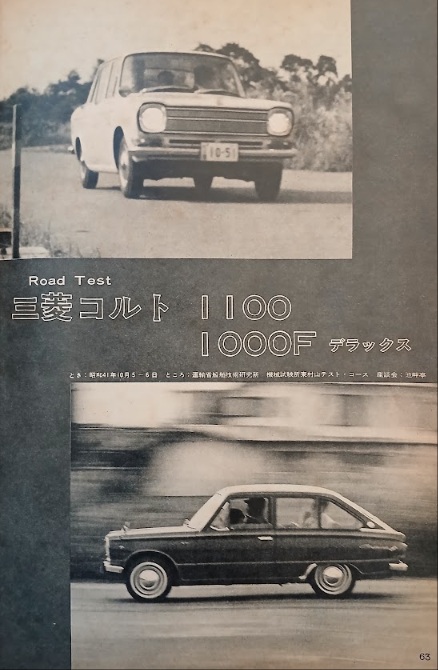
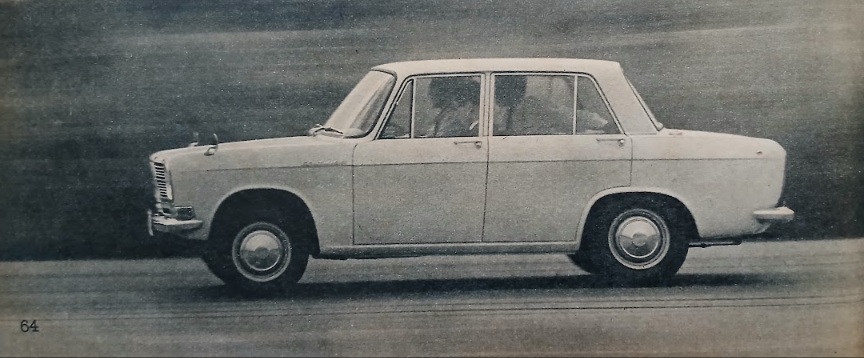
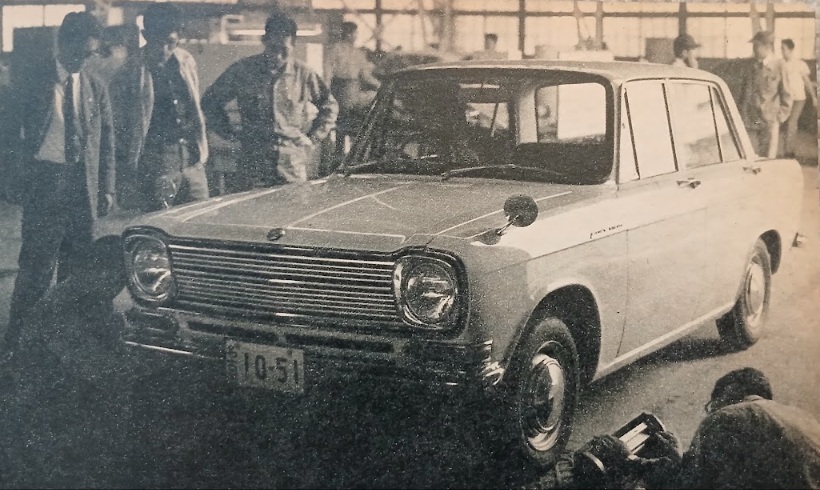
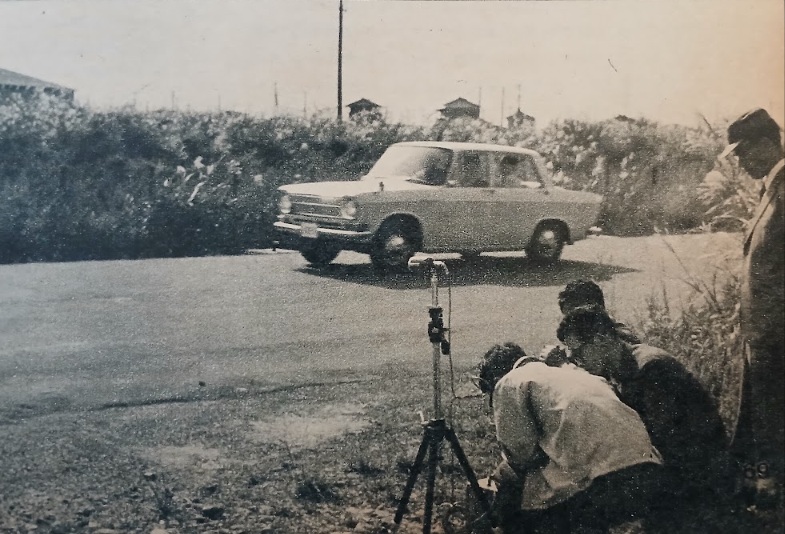
Mitsubishi Colt 1100 and 1000F Deluxe (1966)
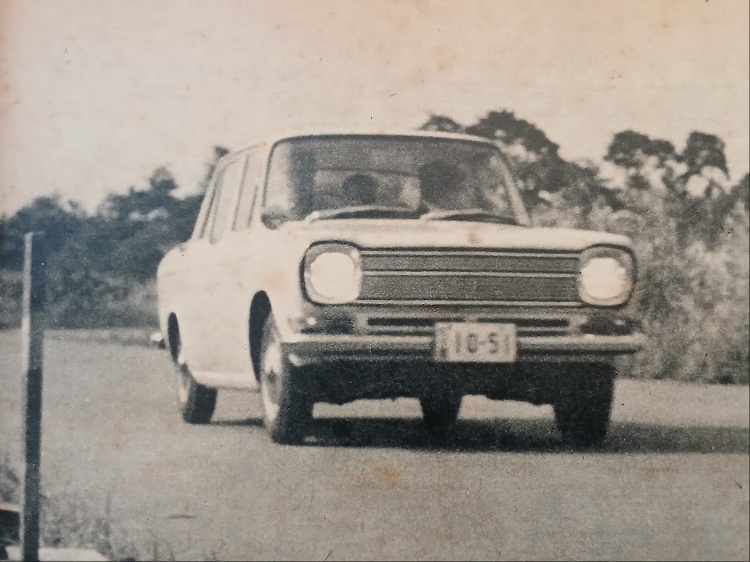
Publication: Motor Fan
Format: Road Test
Date: December 1966
Authors (roundtable): Yukichi Mochida, Sadao Kobayashi, Osamu Hirao, Yasutaka Toyoshima, Hachiro Utsumi, Yasuhei Oguchi, Kazuo Kumabe, Katsuyuki Miura, Taizo Tateishi, Kenji Higuchi, Mineo Yamamoto, Chiaki Moritani, Kenzaburo Ishikawa, Minoru Onda, Isao Imai, Toshihide Hirata, Mitsuo Nakao, Motor Fan Editorial Staff (uncredited)
Mitsubishi’s Vision for the 1000cc Class
Magazine: Mitsubishi Heavy Industries now has a passenger-car range extending from the 360cc minicar class all the way up to 2000cc. Could you begin by telling us about the thinking behind the newly introduced Colt 1100, and how it fits into Mitsubishi’s overall plans?
Mochida: It has only been six years since we began producing passenger cars, so we are still newcomers to the industry and hardly in a position to speak with much authority. We started with the idea of building a “people’s car,” introducing the Mitsubishi 500 and subsequently developing it into the 600.
However, we came to realize that this approach was not necessarily suited to conditions in Japan. We were also not yet fully prepared, either technically or in terms of sales. So we changed our thinking and decided that, if we were going to build a passenger car, it should be a proper passenger car—a simple, conventional model of good quality. That was how the Colt 1000 came about. With its water-cooled engine, front-engine, rear-wheel-drive layout, and four-door body, it was almost a textbook example of a passenger car.
Next, we wanted to try something a little more ambitious, incorporating some new technical ideas. The result was the Colt 800.
We took a more adventurous approach, using a transverse front spring, curved glass, and a two-door fastback body.
Our aim has been to contribute to the motorization of Japan by providing cars for ordinary owner-drivers, and it was with this in mind that we developed the Colt 800 and 1000. We then decided to expand this part of our range further. With the arrival of the high-speed era, there has been an increasing demand for more powerful engines, so the aim with the new Colt 1100 was to increase engine capacity to 1100cc, reduce weight, and lower noise levels.
At the same time, we wanted to make use of the ambitious body design of the Colt 800, fitting it with a four-stroke 1000cc engine to appeal to the growing market for cars of that displacement. This became the Colt 1000F. So we now have three models in what might be called the “popular car” category, and that is something we at Mitsubishi are rather proud of.
Of course, producing a small number of models in large quantities is the accepted practice in car manufacturing. But that requires a strong organization extending all the way from production to sales. As a result, for the time being, we are combining two body types with three engines, with the aim of keeping costs from rising.
Magazine: Turning to the particular features of the Colt 1100…
Kobayashi: If you look at the previous Colt 1000 as a car in the 1000cc class, I think everything about it, starting with the body, places it toward the more luxurious end of the range. So we set out to give it performance worthy of that body. There had been comments that the existing 1000cc model felt a little underpowered, and we wanted to make up for that and produce a car that would be easier to drive.
Naturally, we also wanted to give it a fresh appearance, so we redesigned the front grille and adopted a console-type instrument panel, among other changes.
There is also considerable demand for a sportier car, so we added a version with revised gauges, a tachometer, and a floor-mounted gearshift. At the same time, we made sure to retain one of the strong points of the previous Colt 1000—its good fuel economy.
We also paid attention to noise and ride comfort, particularly reducing noise at higher speeds, so that even at 100km/h the car would not feel unpleasantly noisy.
Magazine: Well then, perhaps we could hear everyone’s impressions after driving the cars…
The Extra 100cc Makes a Noticeable Difference
Hirao: Having driven it, I can certainly say that the throttle response is markedly better than in the 1000cc model. The extra 100cc makes quite a difference. Suppose, for example, that only 200cc of the engine’s capacity is needed to maintain a steady speed of around 20-40km/h. In that case, the additional 100cc is effectively being added to the remaining 800cc. So in terms of high-speed performance, the increase has a much greater effect than simply adding 100cc to a 1000cc engine might suggest.
And when people start wanting things like air conditioning, for example, a generous reserve of power becomes necessary.
The top speed is 135km/h, but what was the maximum speed of the previous Colt 1000?
Toyoshima: It was 130km/h.
Kobayashi: Before we increased the power in July of this year, it was 125km/h.
Hirao: With expressways being built at such a rapid pace, I can certainly understand why more power has become necessary.
Magazine: The engine’s output has increased by 3ps over the previous 1000. Although capacity has gone up by 100cc, the increase in power isn’t particularly large. I imagine this has something to do with the kind of engine characteristics you wanted, perhaps placing greater emphasis on ease of use. Could you explain the thinking behind it?
Utsumi: In designing the 1100 engine, we increased the bore by only 1mm over that of the 1000. Our basic thinking was to obtain as much of the additional capacity as possible by increasing the stroke. We also wanted to move the bore-to-stroke ratio in a direction that would give us cleaner exhaust emissions.
So we changed the bore and stroke from 72 × 60mm to 73 × 65mm, increasing displacement from 977cc to 1088cc, or about 12%. To achieve cleaner exhaust and make the engine easier to use, we kept the increase in power somewhat modest, at approximately 6%, bringing output to 55ps. Torque has risen from 7.5kgm to 8.2kgm.
As for production considerations, we wanted to keep costs down, so although the bore has been increased by 1mm, we arranged for the cylinder block casting to be common with that of the 1000F engine. The crankshaft, however, is different in both its raw forging and machining because of the change in stroke.
In developing the 1100, we also made improvements to the cylinder-head ports, manifolds, and other areas, paying attention to the accuracy and shape of the castings.
As for weight reduction, we managed to save 5kg on the engine, mainly through changes to electrical equipment and other auxiliary components. We also revised the tooth profile of the transmission gears and improved manufacturing precision to reduce gear noise.
To improve durability, we increased the diameter of the water-pump bearings and adopted a raw-edge V-belt. The same improvements have also been incorporated into the 1000F engine.
With the 1100, we didn’t want the additional 100cc to result in poorer fuel economy, so we devoted a great deal of effort to the carburetor and distributor. I think we’ve achieved quite satisfactory results in that respect.
Hirao: Have you changed the final-drive ratio?
Utsumi: No, we haven’t.
Magazine: What measures have you taken to deal with exhaust emissions?
Utsumi: As far as exhaust emissions are concerned, our first consideration was to achieve the best possible combustion.
We developed the carburetor with the ideal of obtaining, at every engine speed, the leanest possible mixture that would still produce the required torque. In conjunction with improvements to the distributor, we settled on specifications that would allow the engine to run at the very limit of how lean the mixture could be.
The result is that these improvements also serve as measures to reduce exhaust emissions.
More Power, Less Weight
Magazine: Could you tell us a little more about the improvements made apart from the engine?
Toyoshima: As far as the car itself is concerned, our first objective was to improve performance, achieving a top speed of 135km/h and a 0-400m time of 20 seconds. To make the most of the increase in engine power, we aimed to keep the weight down to around 800kg. We also designed the car to maintain the same fuel economy as the previous Colt 1000, at 19.5km/l overall and 20.2km/l at a steady 40km/h. We have also retained the Colt 1000’s particularly small turning radius of 4.1m.
The second area was the exterior appearance, particularly the front grille and the instrument panel, as you’ve all seen for yourselves.
Third, we have made a great many practical improvements. We’ve devoted considerable effort to safety, comfort, and maintenance, particularly in areas that aren’t immediately apparent, and made substantial improvements in these respects.
Noise levels have been reduced throughout the speed range, but particularly between 100-110km/h, where they are some 12-13 phons lower than in the previous Colt 1000. That’s quite a substantial reduction.
To achieve this, we reinforced the engine and transmission assembly, revised the rigidity of the driveline, improved the suspension characteristics, and increased the accuracy of gear meshing.
We have also greatly improved the feel of the gear change. The gearshift mechanism has been redesigned to reduce mechanical losses, while changes to the transmission’s internal construction have given the shift a lighter, more pleasant feel.
We have made further improvements to engine cooling as well, increasing the airflow entering from the front of the car and improving the radiator’s cooling efficiency. Air conditioners are likely to become more common from now on, but even with one fitted, there should be no concern about the cooling system’s capacity.
Magazine: We understand you’ve also made significant improvements to the interior…
Toyoshima: We’ve increased the seat width from 440mm to 460mm, and extended the fore-and-aft adjustment range from 100mm to 140mm, so that drivers of different builds can find a suitable driving position.
We’ve also substantially revised the seat construction, including the frame, springs, and padding, to improve its support characteristics.
The reclining-seat adjustment previously had seven positions at intervals of 10°, but now has 26 positions at intervals of 2°30′.
As for safety, we’ve adopted an anti-burst door latch to prevent the doors from opening accidentally in a collision. There’s also a double-supported door catch designed to prevent the doors from sagging or becoming loose, even after prolonged use on rough roads. In addition, we’ve fitted childproof locks to prevent children from opening the doors themselves.
We’ve paid close attention to safety in the instrument panel, too. Apart from changing its appearance, we’ve redesigned the control knobs so that no sharp projections extend from the front surface.
As for maintenance, we’ve gone further toward eliminating the need for servicing the running gear, with a maintenance-free interval of 18,000km or one year. We’ve also arranged the radiator so that an auxiliary tank can be fitted easily.
Advances in Manufacturing Methods That Shouldn’t Be Overlooked
Magazine: We understand the body is lighter than that of the previous Colt 1000. How did you manage to achieve that?
Toyoshima: I think the main reason is advances in manufacturing methods. For example, parts that were previously made by welding two sheet-metal components together can now be formed as a single pressing. In other cases, where we used to weld forged and machined metal pieces to sheet-metal parts, we’ve adopted more advanced forming methods, such as the pearling process, to eliminate unnecessary material…
Also, quite a long time has passed since the Colt 1000 first went on sale, and various improvements have been made during that period. As a result, there were some extra parts that were no longer functionally necessary—rather like an appendix—and other areas where we had more strength than we needed. We went through these and eliminated the excess weight.
We also reduced unnecessary weight in the electrical equipment and adopted a lighter construction for the front grille. All these changes together have brought about a weight reduction of approximately 25kg.
Magazine: Now, we’d like to ask Mr. Oguchi to present the performance figures measured by the Hirao laboratory.
Oguchi: For the Colt 1100’s standing-start acceleration, we recorded 0-50m in 5.0 seconds, 0-100m in 7.8 seconds, 0-200m in 12.3 seconds, and 0-400m in 19.7 seconds.
Looking at the relationship between speed and elapsed time, again starting from rest, the car recorded 0-60km/h in 5.4 seconds, 0-80km/h in 9.6 seconds, 0-100km/h in 15.4 seconds, and 0-110km/h in 20.0 seconds. So it was doing about 110km/h just as it completed the 400m run.
Next, for overtaking acceleration, we measured the acceleration times starting from 30km/h in third gear. The results were 6.0 seconds to reach 60km/h, 10.2 seconds to 80km/h, and 16.8 seconds to 100km/h. Around that speed, the engine is almost at its rev limit.
In top gear, we measured overtaking acceleration from 40km/h. It took 6.0 seconds to reach 60km/h, 12.8 seconds to 80km/h, 21.0 seconds to 100km/h, and 26.2 seconds to 110km/h.
Kumabe: What was the test weight?
Oguchi: We had three people on board, plus the test instruments. Some of us are a little heavier than average, so if we take 55kg as the standard weight per person, the load was equivalent to four occupants.
Kumabe: This car is rated for five passengers, isn’t it?
Toyoshima: Yes, that’s right.
Oguchi: Your company’s own figure for 0-400m is around 20.5 seconds, is that right?
Miura: That figure was taken in the rain. Under normal conditions, this particular test car recorded 20.0 seconds in our own testing. That was with five people on board, so we think today’s result of just under 20 seconds is quite reasonable.
Oguchi: The test conditions today were extremely good. There was no wind, and everything was favorable.
Toyoshima: That earlier figure of 20.5 seconds was recorded during the Ministry of Transport’s approval testing. It was raining quite heavily, and even watching from the side, you could see the wheels spinning badly for about the first 10m after the start.
Magazine: Regarding fuel economy, was the 19.5km/l you mentioned earlier measured at a steady speed?
Toyoshima: No, that’s the figure for ordinary driving. In steady-speed tests, we’ve recorded 21.2km/l at 40km/h and 19.2km/l at 60km/h.
Oguchi: When Motor Fan previously road-tested the Colt 1000, we recorded a 0-400m time of 23.3 seconds, so it’s fair to say the acceleration figures have improved quite a bit.
On that earlier test, I felt that the car could have pulled a little more strongly around 40-50km/h. This time, though, I thought it kept building speed quite well.
Magazine: And what did you think of the overtaking acceleration?
Oguchi: I felt that had improved in much the same way.
Quieter at High Speeds
Magazine: From what you’ve told us so far, it sounds as though you’ve put a great deal of effort into reducing noise. What sort of figures did the Watari laboratory obtain?
Tateishi: I’ll present the vibration and noise measurements from the Watari laboratory. As the manufacturer’s representatives have said, there are certainly clear improvements in both noise and vibration.
Using the A-scale, which corresponds most closely to human hearing, we measured interior noise levels of 67 phons at 40km/h, 70 at 50km/h, 71 at 60km/h, 73 at 70km/h, 75 at 80km/h, 76 at 90km/h, 78 at 100km/h, 78 at 110km/h, and 81 at 120km/h.
For exterior noise, we measured noise levels during acceleration at engine speeds corresponding to 50% and 75% of the maximum-power rpm. In third gear, the readings were 80 phons at 50% and 83 phons at 75%. In top gear, they were 75 phons at 50% and 81 phons at 75%.
If I remember correctly, exterior noise on the previous Colt 1000 was somewhat high, but this time the figures appear to be lower.
As for suspension vibration measurements, when the front wheels passed over an obstacle, the sprung-mass frequency was 1.3cps, or 78 cycles per minute. At the rear, it was 1.4-1.5cps. The unsprung-mass frequencies were 13cps at the front and 14-15cps at the rear.
Hirao: I see. Judging by those phon readings, it certainly has become quieter. But when I drove it around town, I thought it sounded a little noisy. That may simply have been because I’d been comparing it with the 1000F.
The 1000F had a very subdued, muffled sort of sound. In the 1100, though, I thought I could make out something like a mixture of engine knock and gear noise. Even in second, third, and top gears, there seemed to be a slight rattling, knocking sound, whereas I didn’t notice that in the 1000F.
The phon readings are accurate as a measure of sound energy, of course, but I think there’s also the question of sound quality. Even when the energy level is low, certain sounds can still be bothersome.
Tateishi: We use the A-scale because it is considered the closest to human hearing, but when we measure on the C-scale, the energy levels are relatively high. Perhaps that has something to do with what you noticed.
Miura: How did you find the acceleration at low speeds?
Hirao: Very good.
Miura: I think the engine knock on this particular test car is rather more noticeable than usual.
Hirao: I had the impression there was something else mixed in with the knocking sound. In the 1000F, all those noises seemed to be muffled, and it had what I’d call the sound of a proper passenger car.
Higuchi: I drove both the 1100 and the 1000F. When I first drove the 1100, I could hear a little engine and transmission noise, but on the other hand, I thought its acceleration was very good.
When I got into the 1000F, the sound was much quieter—or rather, it was like listening to a radio with the treble turned down. That’s the muffled quality Professor Hirao was talking about.
I could certainly feel the difference the extra 100cc made to the engine. In fact, the difference between the 1000 and 1100 was more than I’d imagined from the additional 100cc before driving them.
Hirao: In the 1000F, if you open the window just a little, you hear the engine noise coming from somewhere behind you. But in the 1100, it comes from in front…
The Pleasant Sound of the 1000F
Tateishi: Comparing the noise levels of the 1000F and the 1100, the 1000F is quieter overall. Compared with the 800, the figures are about the same up to around 80km/h, but at higher speeds the 1000F is much quieter.
Higuchi: I think part of the reason the 1000F seemed so quiet and subdued was that we still had the sound of the previous two-stroke engine in our minds. (laughs)
Kumabe: There may be circumstances within Mitsubishi that account for it, but I think you have to consider whether having both two-stroke and four-stroke engines will really be advantageous in the future. Having the 800 as the only two-stroke model does seem to present something of a problem, particularly in light of what we’ve just been discussing. I rather feel that the time has come to standardize the range along one general line.
Mochida: At first glance, offering three rather similar cars side by side may certainly seem a little strange. But from the standpoint of our sales policy, we want to increase our total sales volume as much as possible. We’ve studied the matter quite extensively, and the current arrangement is the conclusion we’ve reached.
One thing we’ve come to appreciate since we started mass production of passenger cars is that nothing really works unless the sales organization and its selling capacity can grow along with production. From the design standpoint, of course, we have to consider both mechanical engineering and human factors. But we’ve also learned very clearly that we must keep the ultimate sale of the car firmly in mind at the same time.
Hirao: Well, I imagine that if you could see that standardizing the range would increase your total sales, you’d naturally move in that direction.
Magazine: Returning to the 1100, what were your impressions of the ride comfort? And how did you find the feel of the transmission and the seats?
Difficult Subtleties of Steering Feel
Hirao: I thought it was quite good. In the previous Colt 1000, the seats were a little hard and tended to become tiring, but I think the 1100 has improved considerably in that respect. The transmission is very good, too, although I found the steering of the 1100 a little reluctant to turn, or perhaps rather heavy when you first begin turning the wheel. I imagine the steering wheel is the same as the 1000F, but I didn’t get that impression in the 1000F.
The steering on the 1100 is very light, certainly, but its moment of inertia bothers me a little. It has something of the feel of turning a flywheel.
Toyoshima: That’s a difficult one. The steering wheel fitted to the Sporty Deluxe version of the 1000F doesn’t have a horn ring, so it is lighter by the weight of the ring and its supports, at least.
Hirao: The rim feels a little thick compared with what’s fashionable these days.
Miura: The 1000F’s wheel may feel a little thick to begin with, but we think the one on the 1100 is about right.
Higuchi: I thought the thicker steering wheel on the 1100 was quite suitable, and since it’s a fairly substantial car for its class, I found the steering feel agreeable as well. There was a slight sense of heaviness, but it didn’t bother me particularly.
The gearshift has certainly improved over the previous model. In the old Colt 1000, it had a rather clunky, “katan-katan” sort of action, whereas now the gears slip in smoothly and quickly. That’s a very good improvement.
On the other hand, I couldn’t quite get used to the gearshift in the 1000F. Lightness alone isn’t enough; there has to be some positive feel to the action. Especially in a sporty car, I would rather have a slightly heavier shift that engages with a definite click. Reverse seemed especially difficult to engage.
Hirao: When I tried it, I couldn’t get it into reverse at first either. It went in on the second try, though.
Higuchi: The shift pattern itself is very well laid out, so maybe it was just a matter of some minor adjustment.
Hirao: When I described the steering as having a feel rather like a flywheel, I was thinking that, apart from its weight, there might also be a lack of rigidity. Is there a rubber coupling or something like that in the steering system?
Toyoshima: There is one fitted, but I don’t think its effect on the overall rigidity is significant.
Yamamoto: I wonder whether there’s a difference in rigidity somewhere between the steering wheel and the steering gear. Also, the effort needed to hold the wheel in a turn seems greater in the 1100. The 1000F is relatively firm, too, but I had the impression that the moment of inertia was smaller in the 1000F.
Moritani: We use the same steering gearbox in both cars, so I think the difference must come down to the steering wheels themselves.
Yamamoto: Yes, and presumably whether or not they have a horn ring.
Magazine: The Kondo laboratory has also taken measurements, which you can refer to in the data accompanying this article. As for the steering characteristics, the results indicated fairly pronounced understeer.
Hirao: Oddly, I had the opposite impression from Professor Yamamoto regarding the effort needed to hold the steering wheel in a turn. But that’s only a subjective impression, so I could be mistaken. I imagine some people might even say the steering is too light.
Yamamoto: I’d be quite surprised to hear anyone describe it as too light.
Magazine: What about the weight and braking measurements carried out by the Ship Research Institute?
Ishikawa: For the Colt 1100, we measured a curb weight of 816kg, including the spare tire and tools. According to the catalog figures, the 1100 Deluxe is 25kg lighter than the Colt 1000.
The Colt 1100’s weight distribution was 449kg on the front wheels and 367kg on the rear, giving a front-to-rear ratio of 55:45. That distribution remains unchanged with either one or two occupants, but with five on board it becomes 49:51.
As for the 1000F, we measured 765kg. When we previously tested the Colt 800, it weighed 789kg, so the 1000F is approximately 25kg lighter.
Its weight distribution was 424kg at the front and 341kg at the rear, again giving a ratio of 55:45, the same as the 1100. With five occupants, the distribution becomes 48:52. So the two cars appear to follow much the same pattern in their weight distribution.
Light Operating Efforts Are Welcome
Ishikawa: Aside from the weight measurements, we tested only the 1100. The alignment measurements taken with a sideslip meter showed zero sideslip at the front wheels when moving forward, and -14mm/m when moving backward. This suggests that the car has fairly pronounced toe-in and camber settings. With five people on board, the front wheels tend slightly toward toe-out. At the rear, both toe-in and camber are practically zero, with no change under different loads.
The brakes are of the duo-servo drum type at both front and rear. The pedal travels about 30mm before the brakes begin to take effect. Looking at the relationship between pedal effort and travel, the pedal spring rate is 1.8kg/mm, giving a somewhat firm feel.
The pedal effort required to achieve 0.6g deceleration is 22kg, which is quite a light figure. The brake-force distribution appears to have been designed around a front-to-rear ratio of 2:1, but the rear brakes start working much later than the fronts. This is an estimate, but if the front brakes begin to take effect at a pedal effort of 7kg, the rears do not begin to contribute until about 15kg. So it would seem to be a braking system that places particular emphasis on the front wheels.
As for the parking brake, if we consider the operating effort required to hold the car on a slope of a given gradient, it takes 20kg to hold the car with five occupants when facing downhill. When facing uphill, the required effort is 26kg. These are quite low figures, making the brake easy to operate. The ratchet action is also very good, and holds the brake securely in position.
The operating efforts measured for the various controls were generally quite satisfactory. The gearshift requires between 2-2.5kg, which is fine, although the sideways movement from neutral toward reverse takes 4kg, somewhat more than the other movements. Even so, that is only high by comparison; in absolute terms, it is fairly light.
The clutch requires 9kg to disengage and 5kg when engaging. The accelerator effort is only about 1.5kg when maintaining a steady 50km/h, and 3kg under acceleration.
The windows require 1.5-2kg to raise or lower, while releasing the door locks and seat-slide mechanisms takes 3-3.5kg. Overall, we found no controls that required particularly high operating effort.
Hirao: I understand that the height of the brake pedal on the 1000F can be adjusted, which is a good thing. But on the car I drove, it seemed a little too high relative to the accelerator. When moving my foot from one pedal to the other, my shoe tended to catch.
If you adjust the brake pedal to about the same height as the accelerator, though, I have the impression that the two pedals then end up a little too far apart.
Onda: The distance between the brake and accelerator pedals was 40mm on the 1000F and 30mm on the 1100.
Magazine: Isn’t that about normal?
Higuchi: From my point of view, I didn’t notice much difference in the relative height of the pedals. But on the 1100, the accelerator pedal is positioned closer to the driver, so I think that may give the impression that the distance from the seat to the pedals is different.
Hirao: It’s the 1000F, rather than the 1100, that has the accelerator farther forward, then. So when you’re pressing the accelerator, the clutch pedal feels as though it’s too far back toward you.
Higuchi: That’s right. There isn’t much difference in height, but perhaps the fact that the accelerator is farther forward is what causes your shoe to catch.
Imai: The brake and clutch pedal positions are designed to be adjustable fore and aft.
Magazine: Could we now hear about any points of interest in the interior dimensions measured by the Higuchi laboratory?
Improved Seat Adjustment
Onda: We measured the dimensions of both the 1000F and the 1100, but concentrating on the 1100, its overall length is on the short side for a car in the 1000cc class. Its width, on the other hand, is generous, giving it a spacious feel.
One thing we noticed in the measurements was that the front door openings are narrower than those of the rear doors. This means getting in and out of the front seats is more restricted than in the rear. Since this model is advertised as a car for the owner-driver, I think it might have been better to make the front doors wider.
In terms of width and height, the interior dimensions are generous, but when seated, the headroom feels a little tighter than in the 1000F. That isn’t to say the actual measurement is small compared with other cars in the 1000cc class, but the 1000F somehow feels more comfortable in this respect.
As for the seat adjustment, it has improved so much with this latest change that I would almost call it perfect. Including the full-reclining adjustment, there’s a total adjustment range of 200mm, so the catalog description is actually quite modest.
Regarding the reach to the various controls, nothing is particularly far away. The hood release is some distance from the driver, but since it isn’t something you operate while driving, that presents no real problem.
We’ve already discussed the pedals, but dimensionally I don’t think there’s anything wrong with their arrangement. The instruments are quite conventionally designed, although I do feel that the normal and high-temperature positions on the water-temperature gauge are a little too close together.
Higuchi: The seat adjustment is very good for the method Professor Hirao often talks about—sliding the seat all the way back before getting out, so you can step out easily. It’s too bad the rather narrow door makes it difficult to take full advantage of that.
The point is that the fine adjustment allows you to set the seat to exactly the right position for your body. You can then leave that setting alone and release the coarse adjustment lock, which would give you just about the ideal arrangement for getting in and out.
Hirata: One thing we noticed in our visibility measurements was the unusually large range of seat adjustment. In our test, the horizontal distance between the reference eye positions was 150mm, whereas the catalog gives 140mm, but the seat mechanism certainly allows for that sort of variation.
With the seat moved forward, visibility to either side becomes very good, extending to about 120°. However, the blind spots are relatively large, accounting for approximately 18.6% of the full 360° field of view.
Yamamoto: I had the impression that this car’s windshield wraps around slightly at the sides. Is that the case?
Toyoshima: Yes, just slightly.
The Impression of a Well-Bred Car
Yamamoto: I think that improves visibility considerably, both straight ahead and to either side. Looking at the body overall, I came away with the impression that this is a very well-made car.
We’ve discussed the relative heights of the pedals, but I found them very easy to operate, and the gearshift feel is excellent. If there’s one area that could still be improved, I think it would have to be the weight. If the car could be made a little lighter, I believe it would be even better.
The construction is quite interesting. It incorporates a strong reinforcing member high up at the front, which does a good job of preventing localized distortion. The challenge for the future will be to further refine this arrangement, reducing weight while retaining or even improving its strength.
Japanese cars in the 1000cc class have become very light in recent years. Of course, lightness isn’t everything, but I think there’s still some room for improvement in the Colt 1100.
Kobayashi: It’s certainly not impossible. Even from my own point of view, I can see that there’s still scope for reducing weight. But there are various constraints to work within, and we’re considering how we can make further reductions within those limits.
Higuchi: From the user’s standpoint, it’s a problem when you wash your car after driving along a muddy road and find exposed screws or sharp sheet-metal edges.
From an automotive engineering standpoint, it’s clear that a great deal of thought has gone into cars like the 1000F. But I think it’s important to go one step further and consider how the owner actually uses the car in everyday life.
Toyoshima: We’ve removed the burrs around the wheels so that people won’t injure themselves when changing a tire. But we’d also like to make further improvements to things like screws and welded joints in less accessible areas.
Ishikawa: This is Mitsubishi’s first car to incorporate measures for controlling exhaust emissions, isn’t it? What percentage of CO does it produce?
Mochida: 1.53%.
Ishikawa: That’s extremely good.
Hirao: If you produce figures that are too good, you’ll only invite questions about production variations—and maybe even stricter regulations. (laughs)
Mochida: Japan’s 3% limit is rather strange, too. It applies to gasoline-powered vehicles right up to 6-ton trucks, which is something I find a little difficult to understand.
We’ve achieved a figure of 1.53% with this car, but as for what sort of figures trucks might produce, even the manufacturers themselves don’t really know.
The Thinking Behind the 1000F
Magazine: We’ve touched on the Colt 1000F here and there during our discussion, but could you tell us more about what you were aiming for with this model?
Imai: When we introduced the Colt 800, we were already considering the possibility of offering a four-stroke version in the future, either with a 1000cc engine or perhaps even an 800cc one.
We chose a two-stroke engine for the 800 because our experience with light four-wheeled vehicles had shown that two-strokes offered advantages in power and ease of maintenance. On the other hand, there were complaints about fuel economy and various other shortcomings, and quite a few customers wanted a four-stroke engine.
But if we had used a four-stroke engine of 800 or 850cc, it would have been inferior to the two-stroke 800 in terms of power. So we decided on 1000cc instead, and the result was the 1000F, intended for customers who wanted a four-stroke engine in the fastback body.
Magazine: You’ve certainly introduced quite a variety of models. I imagine you must also be considering further variations, perhaps something more sporting. What can you tell us about that?
Mochida: Naturally, we’re considering all sorts of possibilities, but whether we actually put any of them into production depends on various conditions that we’re still examining.
Miyamoto: The 1000F’s fastback body is very distinctive. How does it perform in terms of aerodynamic drag?
Imai: The airflow over the rear of the body is certainly very smooth. In that respect, we’ve fully achieved what we set out to accomplish in the design.
Miyamoto: You specify that the car requires no lubrication for one year or 18,000km. Can we take that as a firm claim?
Imai: Yes, certainly.
Miyamoto: You also specify that the radiator, with its condenser tank, requires no water replenishment for two years or 36,000km. What about water loss?
Imai: So far, under those conditions, we haven’t experienced any loss of water.
As for lubrication of the running gear, when we first introduced the 800, we recommended greasing it as a precaution. But with the 1000F, we’ve eliminated that requirement, and we intend to do the same for the 800 from now on.
Safety Measures Are Thorough
Magazine: Now, could we have the report on the safety checklist?
Higuchi: In assessing safety, we consider such things as the proposed American GSA regulations and our own country’s safety standards. I think the approach taken depends on the circumstances in each country. With that in mind, I’ve prepared a checklist based on my own views, using the five-point rating system we’ve used in previous Motor Fan tests, and conducted the assessment accordingly.
First, the Colt 1100 is fundamentally unchanged from the previous Colt 1000, but I think there have been substantial improvements in safety when we look at the details.
The test car had separate, fully reclining seats, with integral head restraints and seat belts. All the doors have also been improved with anti-burst latches and childproof locks. Together with the sturdy monocoque body and bumpers, there is little left to be desired.
Naturally, there’s also generous safety padding around the dashboard and seats, and the sun visors are of a soft construction.
If I were to make any further requests, they would be to reduce the protrusion of the door and window handles, and to reposition the control knobs under the dashboard and the handbrake so that they cannot strike the driver’s knees. With those changes, I would give the car full marks for safety.
The Colt 1000F is a different matter in this regard. There may be cost considerations, of course, but particularly since our test car was the Sporty Deluxe, I would like to see a little more effort devoted to its safety provisions.
Magazine: And what about maintenance?
Higuchi: Here the situation is the reverse of what we found with safety. The 1000F has a completely sealed cooling system, whereas the 1100 uses a conventional arrangement. However, the manufacturer’s representatives told us that a fully sealed system with a supplementary tank would eventually be offered as an option.
The oil-change interval is 3,000km for both cars, but while the 1000F requires a new oil-filter element every 9,000km, the interval for the 1100 is only 3,000km.
Another thing I noticed was that, although both cars belong to the Colt series, the owner’s manuals for the 1000F and 1100 are written quite differently. I felt that someone changing from a 1000F to a 1100 might find this rather confusing.
And this isn’t a criticism confined to these particular cars; the same applies to the manuals supplied by every manufacturer. Rather than devoting so much space to complicated technical data and detailed servicing procedures, I would like to see more practical guidance on the everyday care an owner should give the car, when it should be taken to a service workshop, how to operate it in extreme cold or heat, and particularly what precautions to take when driving at high speeds.
Instead of giving advice in general terms, the manuals ought to explain specifically what the owner should do in each particular model.
Magazine: Finally, we’d like to ask about Mitsubishi’s sales plans for the 1000cc class. If you don’t mind telling us, what monthly sales figures are you aiming for, and how do you expect those sales to be divided among the 800, 1000F, and 1100?
Nakao: By the end of the year, we’re aiming for monthly sales of 4,000 Colt 1100s, including both sedans and vans, 2,500 Colt 1000Fs, which are offered only as sedans, and 3,000 Colt 800s, including sedans and vans.
Our overall target for the three models in the Colt series is 11,000 vehicles per month.
Magazine: Thank you all very much for your time and contributions.
Postscript: Story Photos