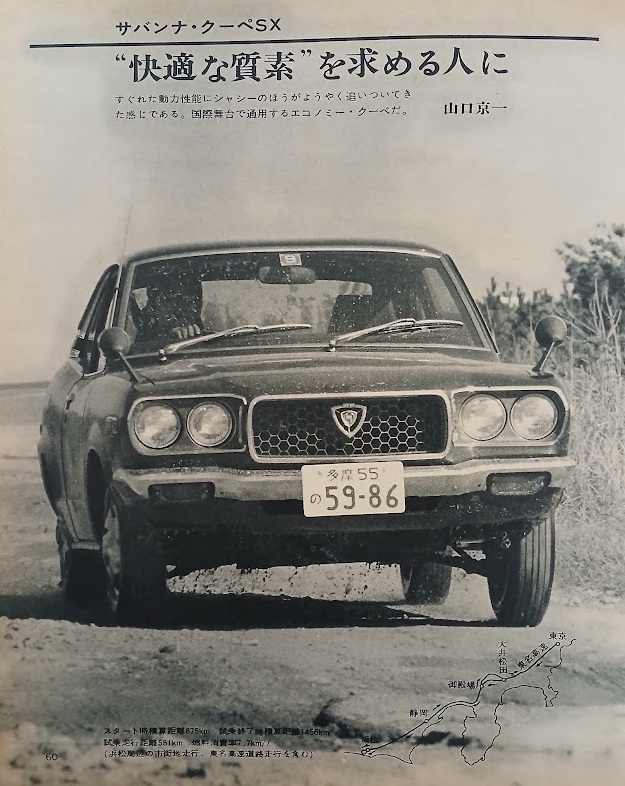
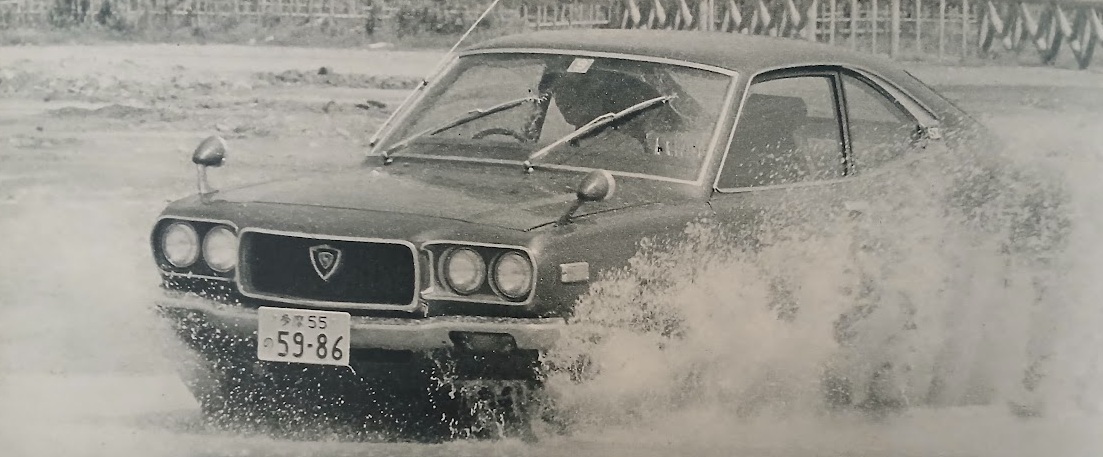
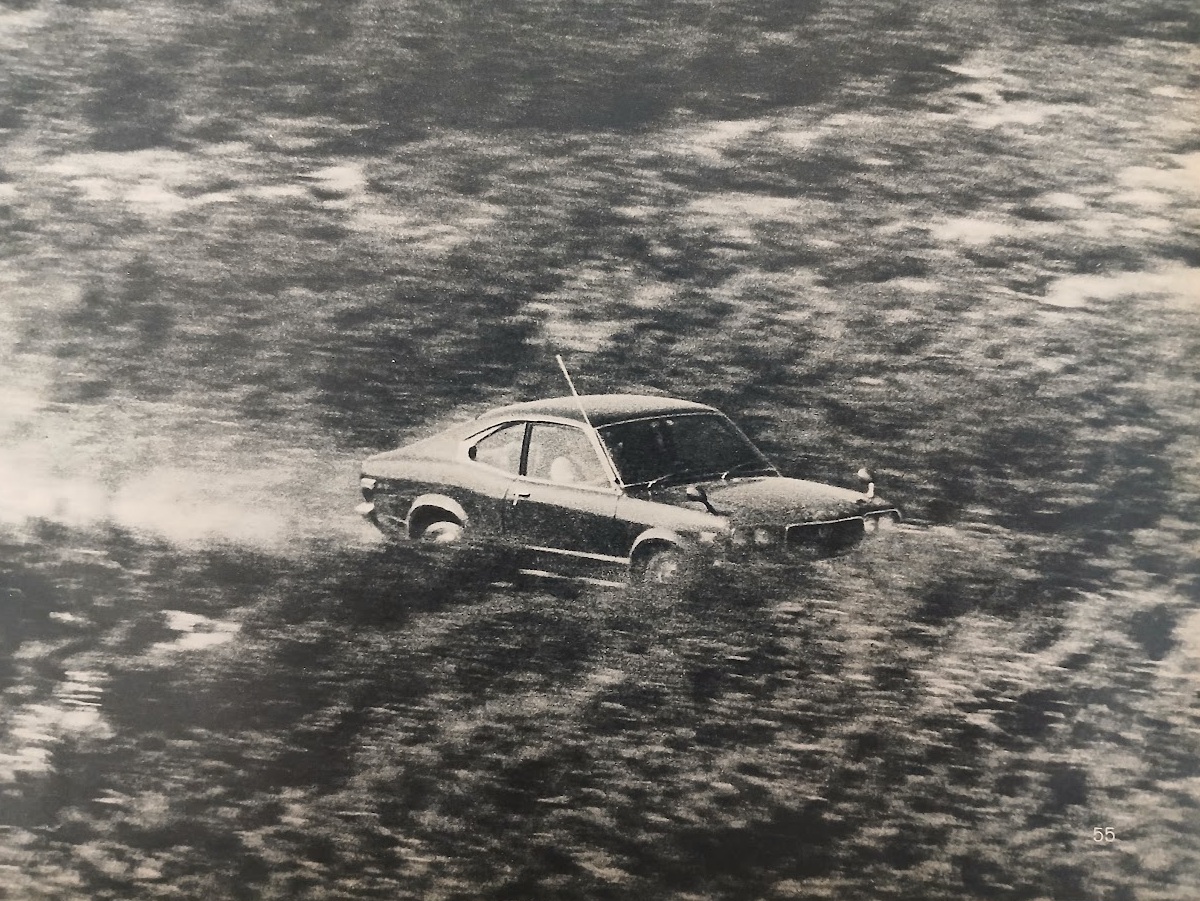
Mazda Savanna SX (1971)
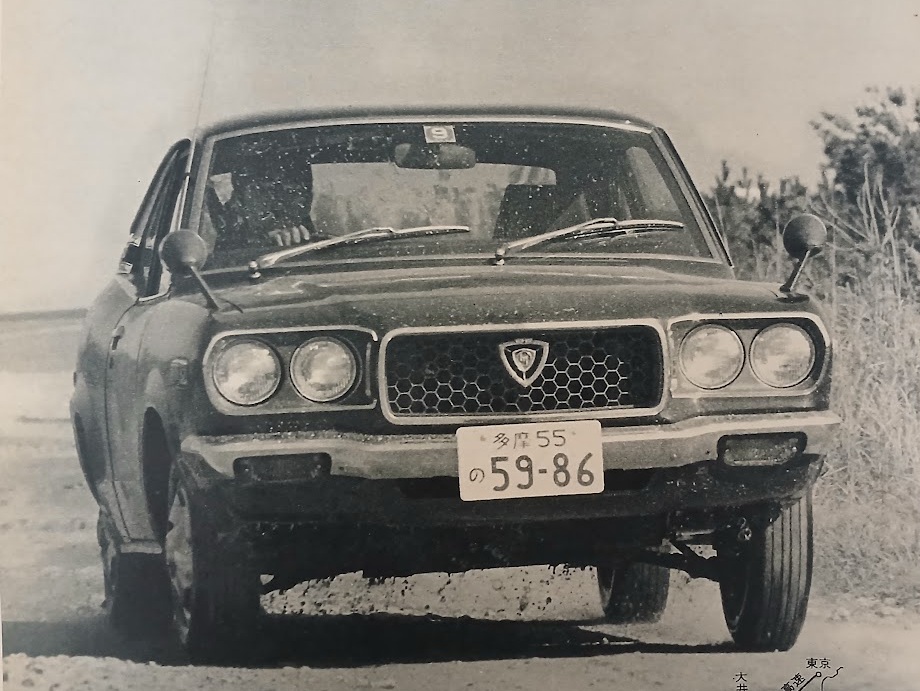
Publication: Motor Fan
Format: Test Drive Report
Date: November 1971
Author: Kyoichi Yamaguchi
For Those Who Appreciate “Unpretentious Comfort”
The chassis has finally caught up with the outstanding performance. An economical coupe fully capable of holding its own on the international stage.
From Domestic Car to International Car
The remarkable success of Mazda’s rotary-powered cars in export markets has prompted Toyo Kogyo’s management to accomplish something of a revolution against an established class system. Somewhere along the way, the Japanese automobile industry had quietly developed a curious hierarchy involving the “compact car” and the “popular car.” Perhaps out of deference to the fact that the larger 2-liter class—the elder brother among Japan’s mass-market passenger cars—was constrained by regulations limiting overall width to 1.7m, compact and popular cars traditionally seemed obliged to make themselves another 10cm or so narrower than their respective bigger brothers.
Among domestic cars, these “popular cars” have always been the most energetic and the most economical. Yet because of their narrow proportions, they appear to have been placed at a considerable disadvantage in overseas markets.
Perhaps it was inevitable that Toyo Kogyo, with its domestic and export sales volumes rapidly approaching parity, should choose the Savanna as the model with which to break through this width barrier. Even so, the courage to adopt chassis dimensions—with both overall width and tread exceeding those of the larger Capella—deserves genuine praise. The Savanna is better regarded not as simply another Japanese popular car, but as a European-sized small car.
I have long been an advocate of what I call “unpretentious comfort.” During the past five or six years, the four popular cars I have owned have all been one grade above the standard model. Although they lacked luxury appointments, they sacrificed little in functional terms while still providing more than adequate comfort. The Savanna Coupe SX falls squarely into this category, costing 80,000 yen less than the range-topping GS II. At 670,000 yen, it commands a premium of only about 25,000 yen over a 1400cc sports coupe from the “popular car” class (a term that, it seems, remains unavoidable).
Of the equipment omitted from the GS II, the only items I genuinely regret giving up are the dual-circuit hydraulic braking system with servo assistance and more fade-resistant pads, the Z78 tires, the steering lock, and the three-point seat belt for the passenger seat.
On the matter of seat belts, I would go so far as to protest to the manufacturer. The explanation will no doubt be that they are offered as an option, but this is precisely the sort of equipment that ought to be standard on every car. Only then should manufacturers begin campaigns encouraging their use. Unless they show at least this degree of initiative, we will ultimately find ourselves rushing headlong toward the airbag—a device that is at once entirely passive and extremely expensive.
There are also areas where omission would actually improve the SX. One is the dummy grille treatment at the front, something I would gladly pay to have removed. There is little about this car’s styling that strikes me as genuinely original. Instead, it seems to have been assembled from fragments of styling ideas that someone, somewhere, had already tried and successfully brought to market.
The basic coupe body is cleanly styled and free from obvious faults, but the collection of chrome and plastic embellishments added afterwards lends it an almost flamboyantly aggressive character. Just when Mazda’s designers seemed finally to have escaped the captivating influence of Giorgetto Giugiaro, they appear instead to have set off in the direction of George Barris.
The other feature I wish Mazda had simplified, along with the dummy grille, is the decorative panel surrounding the taillights. I would prefer either to see it removed altogether or, at the very least, left unpainted. As it is, it calls to mind a lizard that has just lost its tail.
The Coupe SX sells for exactly the same price as the equivalent RX sedan. In a market where a stylish body normally commands a substantial premium, this strikes me as a refreshingly honest approach.
(Note: George Barris is an American custom-car designer based in Hollywood. Known for his extensive use of scoops and ducts, he has exerted considerable influence even on Detroit styling.)
Black is not always beautiful. The interior of our Espas Blue Coupe SX was finished entirely in black, apart from the subdued reddish tone of the thin, semi-carpet material known as “Arachne.” I find the T-shaped dashboard of the Familia Presto Rotary considerably more distinctive.
By comparison, the Savanna’s dashboard has ended up looking rather plain. Removing the chrome-effect surrounds from the two large gauges directly ahead of the driver was undoubtedly the right decision. On the SX, even the eyeball vents are finished in matte black.
On the other hand, chrome-effect trim has descended in force upon the auxiliary gauges, radio, and heater and ventilation controls in the center console, cluttering the otherwise functional design. Personally, I feel the half-console used in the sedan models would have been more appropriate. The unfinished appearance of the stereo mounting panel at the base of the coupe’s center console is particularly disappointing.
Mazda’s arrangement of the lighting controls is one that any road tester, East or West, is sure to praise. The main lighting switch, together with the column-mounted stalk on the right that operates the headlamp dimmer, passing flasher, and wiper and washer functions, is an exceptionally well-judged layout. Designers who insist on scattering switches across the dashboard for appearance’s sake rather than functionality should take note.
The three-spoke plastic steering wheel has a decidedly cheap-looking rim, and I would have preferred it to be somewhat thicker. The horn buttons, recessed into the spokes, are well positioned, but they protrude too far. On several occasions I sounded the horn unintentionally simply through normal hand movements.
Because the front wheel housings do not intrude into the passenger compartment, and because the body itself is relatively wide, there is generous foot room, allowing both legs to be stretched out comfortably. The seats are semi-bucket types with integrated head restraints. Personally, I still prefer adjustable head restraints. (At 176cm tall, an integral design tends either to press against my shoulders or end up serving only as a neck rest.) The seats are upholstered in vinyl, though buyers in this class are unlikely to complain. Even so, it is regrettable that cloth upholstery has disappeared altogether, even on the GS. (It survives only on the sedan GR.)
The Character of a Long-Distance Runner
I’ve gone on at some length about minor complaints, but in truth, our drive began after dark, so the interior barely attracted my attention at all. As a car embodying what I call “unpretentious comfort,” the Savanna satisfies those requirements more than adequately, while the performance of the revised twin-rotor 10A engine completely offsets any dissatisfaction one might feel over its equipment.
As its designation suggests, this engine belongs to the Familia/Presto series, but detail revisions to the intake, exhaust, and ignition systems have raised output to 105ps at 7000rpm and torque to 13.7kgm at 3500rpm.
Like the Capella, it uses Mazda’s honeycomb-shaped exhaust ports. Together with a larger-diameter exhaust system and the replacement of the three-stage silencer with a two-stage design, the high-pitched edge has disappeared from the exhaust note, leaving a far more pleasing sound. The progress Mazda has made with the rotary engine is remarkable. New apex seal materials and chrome-plated corner seals, among other improvements, are said to have further enhanced the durability for which Mazda’s rotary engines have already earned an international reputation.
NSU, the originator of the rotary engine, neglected to carry out what Mazda calls “Doctor’s Mode” testing—that is, repeated cold starts of the kind experienced by a doctor making house calls. As a result, many engines suffered premature seal wear under exactly these demanding real-world conditions. Toyo Kogyo, by contrast, says it has left nothing to chance in conducting this distinctly Japanese sort of “Doctor’s Mode” testing.
The engine performance curves indicate that the engine develops nearly 11kgm of torque at just 1500rpm. However, because the final drive ratio is a relatively tall 3.70, slightly more throttle is required when moving off from rest. Apart from that—and remembering not to over-rev the engine–driving a rotary requires no special technique whatsoever.
With a 0-400m time in the 16-second range, 0-80km/h in under seven seconds, and a claimed top speed of 180km/h, the Savanna Coupe delivers performance comparable with that of 1.8- to 2.0-liter GTs and sporting sedans. Moreover, it cruises at high speed with the quietness and ease of a luxury sedan, completely unstressed. That such performance can be had for 670,000 yen is almost unbelievable.
Its silence at speed proved so deceptive that I found myself doubting the speedometer, rather than my own senses. In fact, its accuracy was quite respectable, recording errors of 4.8% at 80km/h, 4.6% at 100km/h, and 3.3% at 120km/h.
The opening of the four-barrel carburetor’s secondary stage is quite distinct. As the secondary barrels come into operation, the accelerator pedal suddenly stiffens quite a bit—so much so that I wondered whether a mechanical stop had been built into the linkage. Using this step almost as an economy assistant and keeping engine speed below 4000rpm, fuel consumption over a 200km journey from Hamamatsu through the Tomei Expressway to Numazu averaged 8.1km/l.
Over a further 237km run on the Tomei Expressway, with the secondary barrels frequently in use, fuel consumption fell to 7.6km/l. During a final 145km section combining the Tomei with stop-and-go driving in central Tokyo, it dropped again to 7.2km/l. The overall average for the entire 581km test came to 7.7km/l.
Calculating fuel costs on the basis of regular gasoline, and then adjusting for the price difference between regular and premium fuel (58 versus 65 yen per liter), the equivalent fuel economy of a premium-fuel car over the same distance would be 8.8km/l. Viewed as the operating cost of a 1.8- to 2.0-liter sporting sedan, this is by no means excessive and seems quite reasonable considering the level of performance.
Gearbox and Steering Leave Something to Be Desired
Because the engine’s mechanical noise and exhaust noise are at exceptionally low levels, gear whine from the intermediate gears becomes all the more grating. The synchromesh is not especially robust, either, and even when treated carefully, there was resistance and noise during downshifts into third gear. The hydraulically operated clutch is light and showed no tendency to slip, even during hard starts. Mazda says the driven plate uses carefully selected German-made Textar friction material and is even run in before installation.
After using a live axle located by five links on the Capella, Mazda has returned to a conventional live axle on semi-elliptic leaf springs. Fiat made the same apparent step backwards when moving from the 124 to the 125, and even Maserati, after experimenting with every form of rear suspension imaginable, eventually returned to leaf springs. It is a layout in which noise is comparatively easy to control, while excellent ride comfort can still be achieved.
The real challenge lies in controlling the axle itself. On the Savanna, the designers have mounted the dampers diagonally, one ahead of the axle and the other behind, allowing them to perform this function as well. Their claimed benefits in suppressing axle wind-up under hard acceleration and maintaining tire contact on rough roads proved to be exactly as described. During lane changes at high speeds, however, the rear suspension is less settled than one might wish.
After the initial steering input into the new lane, the body rocks once and then continues with a series of small, relatively slow oscillations. Since this is not a panic-avoidance type of maneuver, it never feels dangerous, but the lack of convergence is nonetheless unpleasant.
The steering, meanwhile, still displays the characteristic on-center free play so common to Japanese cars, along with the slightly rubbery feel familiar from the Familia Rotary. Once the steering takes up the slack, response is quite good, but there is an unmistakable delay at first. To match the car’s performance, I would like to see a more precise steering system offered, even if only as an option.
Compared with the persistently understeering Capella, the Savanna exhibits only mild understeer.
Here again, this is exactly as its designers intended, and it makes the car considerably more enjoyable to drive.
The SX’s 6.15-13 tires do not provide very good grip, however, and on slippery surfaces the car becomes distinctly tail-happy. Correcting a slide with steering that requires three turns from lock to lock is by no means effortless, and on unpaved roads careful throttle control is essential. Straight-line stability and resistance to crosswinds, on the other hand, are dramatically improved over those of the Presto.
Braking performance was also impressive. Although it lacks servo assistance and the brake pads are not the more aggressive Ferodo material fitted to the GS II, fade resistance proved entirely satisfactory, while pedal effort remained modest.
As for my final verdict on the Savanna SX, it is, after all, akin to traveling by jet airliner in economy class, enveloped in “unpretentious comfort.” For my own tastes, it is vastly preferable to first class aboard a luxurious but slow, noisy piston-engined airliner.
Postscript: Story Photos