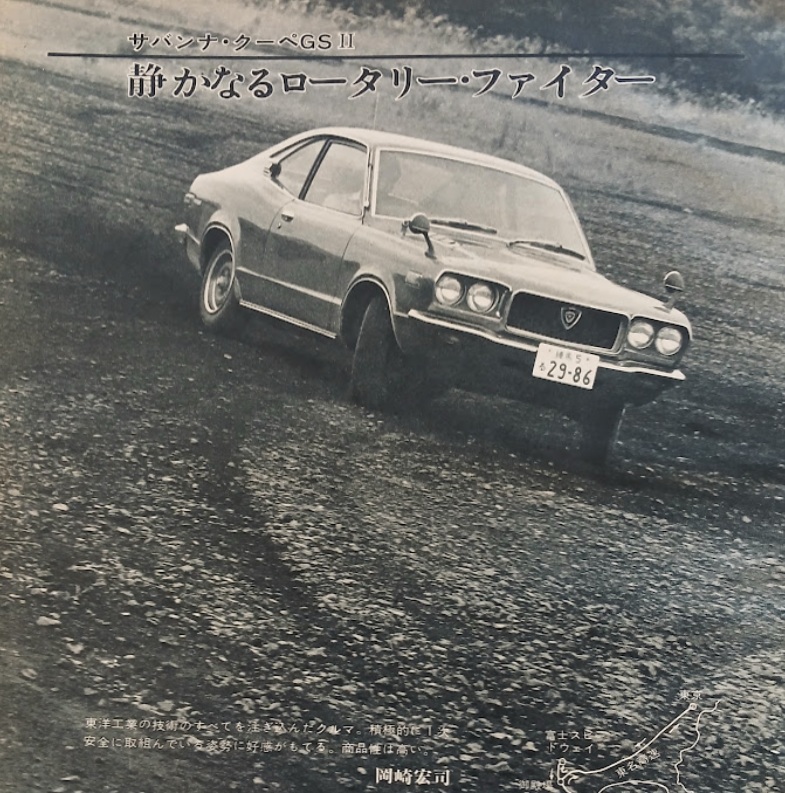
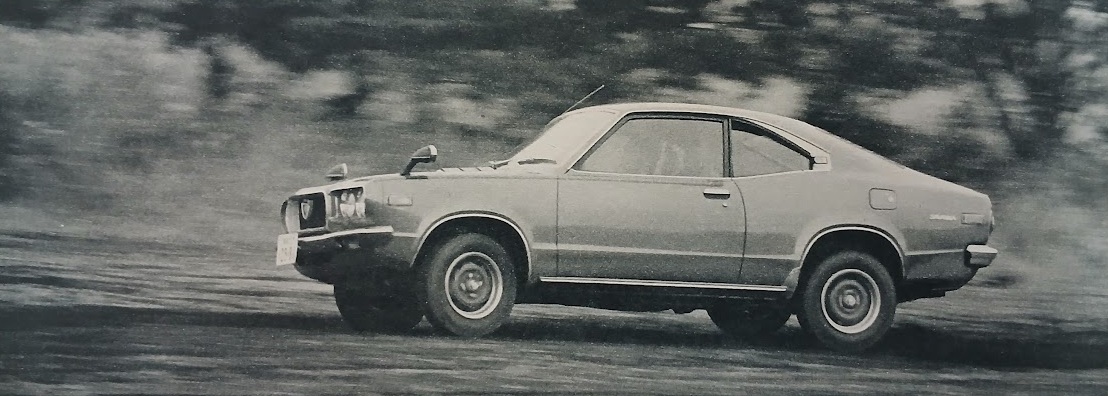
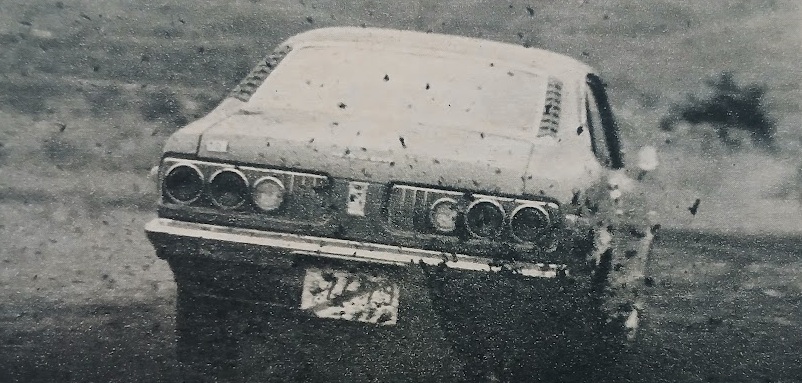
Mazda Savanna GS II (1971)
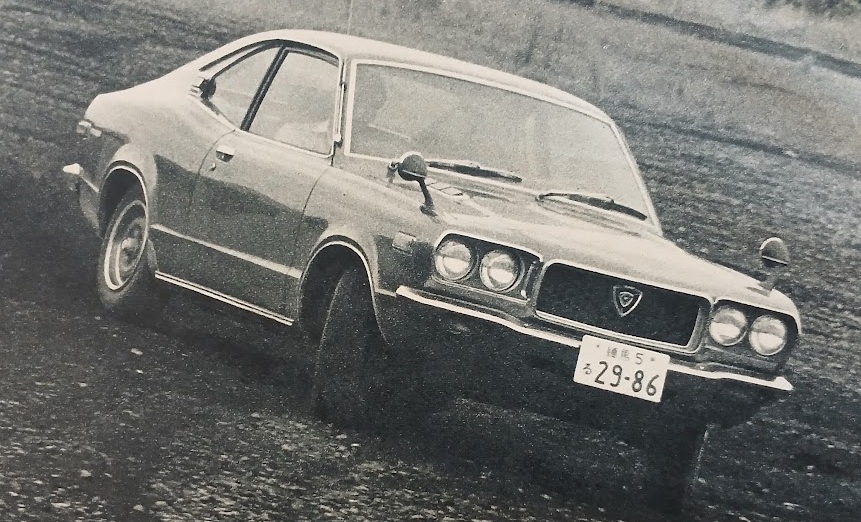
Publication: Motor Fan
Format: Test Drive Report
Date: November 1971
Author: Hiroshi Okazaki
The Quiet Rotary Fighter
A car into which Toyo Kogyo has poured the full extent of its technical capabilities. One cannot help but admire the company’s determined and forward-looking commitment to safety as well. As a product, its overall appeal is undeniably high.
No Functional Shortcomings
The Savanna Coupe—its styling has a substantial, eye-catching presence. Even during this test drive, it drew considerable attention, and we were repeatedly approached with questions.
Mazda’s catchphrase for the Savanna is “Intuition.” At the beginning of the catalog appears the line:
“The encounter between man and automobile is no different from that between human beings themselves. Indeed, there are even those who would say that a car is a living thing. At the very instant of that encounter, here appears a new class of automobile that appeals directly to your intuition.”
The Savanna does seem to be a car that appeals to something instinctive in many people.
The car tested was the Coupe GS II, the highest-grade model in the Savanna series.
Standard equipment includes an energy-absorbing steering column, low-profile tires with an aspect ratio of 78, disc brakes with master-back servo assistance, and even a signal-seeking radio with built-in car stereo–a notably luxurious specification.
Let us begin by stepping into the interior.
The dashboard adopts the three-dimensional styling that has recently become fashionable, with the large-diameter tachometer and speedometer positioned deep within a large cowl directly ahead of the driver.
Until now, Mazda dashboards have often been criticized for being somewhat flat and lacking in visual interest, but it would seem that the Savanna’s designers made a determined effort to address such user complaints.
The use of colors other than black on the dashboard is also a departure for Mazda.
The front seats are high-back units with integrated headrests, trimmed in a sporty design accented by twin stripes. Their dimensions are generous, and in terms of functional design there appears to be little to criticize.
That said, for a truly serious sporting car, the seating position is perhaps slightly too high. Cars of this type now generally favor a lower driving position, and it is unusual to find an example like the Savanna in which the hood remains so fully visible even when one adopts a relaxed driving posture with arms and legs outstretched.
The height of these seats was probably chosen primarily to secure adequate rear-seat space. But considering the character of this car, one cannot help feeling that Mazda might have done better to pursue a more uncompromising, front-seat-focused approach.
Certainly, the elevated eye point is advantageous when driving on narrow roads or through crowded city streets. But it does not particularly suit the kind of high-speed driving in which the Savanna excels, and it also somewhat weakens its character as a serious sporting car.
The steering wheel angle also feels slightly too upward-angled—that is to say, too close to horizontal—which makes it comparatively difficult to adopt the sort of reclined, arms-and-legs-extended driving posture one would ideally like. The long clutch stroke, meanwhile, forces the driver to sit somewhat farther forward than desirable. These points proved difficult to overlook.
This is unfortunate, because the driving position is one of the most important factors in defining both a car’s character and its appeal.
The rear seat, on the other hand, offers generous accommodations for a coupe of this size.
The seat itself is generously sized, and there is no shortage of foot space. In terms of room alone, it comfortably accommodates two adults. Indeed, from the standpoint of space, the Savanna fully qualifies as a family car for a household of four or five people.
Nowadays, even among coupes, the competing alternatives increasingly include sedans as well, and rear-seat space therefore has a major influence on a car’s value as a product. In this respect, the Savanna’s rear accommodations are more than sufficient to withstand such comparisons.
Even so, as mentioned earlier, it is regrettable that securing this degree of rear-seat space has resulted in a somewhat unconventional driving position for a sporting car. If the intention is to create a truly serious sports-oriented machine, then the point of compromise ought to have been shifted somewhat further in favor of the front seats–and it seems there was still ample room to do so.
In addition, it would have been preferable for the shapes of the front seatbacks to do a little more to reduce the sense of confinement felt by rear passengers. The design of the front seatbacks has a considerable influence on rear-seat comfort.
Improved Sound Quality
The engine is a two-rotor unit with a single-chamber displacement of 491cc per rotor. Based on the engine used in the Familia Rotary, it has been further refined, with maximum output increased to 105ps/7000rpm and peak torque to 13.7kgm/3500rpm–gains of 5ps and 0.2kgm, respectively.
Two differences from the Familia became immediately apparent upon setting off: the sound quality and the engine’s improved behavior at low rpm.
The exhaust note is deeper, and its overall sound quality has improved noticeably. This is probably the result of adopting the same honeycomb-port system used in the Capella.
As for improved low-speed behavior, this refers to the reduction of the so-called “bucking” phenomenon–a knocking-like shudder that occurs when the clutch is left engaged while the car is slowed almost to a stop.
From what I hear, this aspect has recently been improved across Mazda’s rotary models generally. Still, there is no question that, at least up through the early Capella rotaries, it remained one of the cars’ more conspicuous shortcomings.
Compared with the Familia Rotary, vehicle weight has increased by roughly 50kg, but it was impossible to detect any disadvantage from that handicap in actual driving. The Savanna remains as powerful as ever, with performance that is truly remarkable.
Compared with a reciprocating engine of roughly equivalent rated horsepower, the Savanna’s power even gives the impression of exceeding it by as much as twenty percent–maybe more.
With its inherent combination of excellent quietness and powerful performance, one’s average speed steadily rises almost unconsciously. Whether on the expressway or in city traffic, one frequently finds oneself far beyond the speed limit before noticing, then hurriedly backing off the throttle. Speaking frankly, in the Savanna–and the same applies to the Familia Rotary and Capella as well–observing urban speed limits of 40 or 50km/h can feel positively painful.
This is not because the car lacks the ability to maintain low speeds mechanically. Rather, unless one is constantly conscious of the speedometer, the speed inevitably tends to creep upward.
I often find myself thinking that, now that the rotary engine has become so widely accepted and its merits so well understood, perhaps it is time for Mazda to introduce models whose performance is more in keeping with the vehicle class itself.
Cars like the GS II, the Capella GS, and the Cosmo Sport quite naturally make their superior performance a key selling point. But in practical sedan models, I would rather see versions with more restrained output–cars offering performance comparable to normal reciprocating-engine sedans of the same class.
For an ordinary four-door family sedan, a maximum speed of 150km/h is entirely sufficient, and 0-400m acceleration in the high-18-second range is more than adequate.
What is really needed is a rotary-powered car with still greater economy–one truly qualified to be called a “popular car.”
Even without emphasizing power and speed, the rotary engine has now reached a stage where its advantages–quietness and smoothness far surpassing conventional reciprocating engines–are alone enough to attract buyers.
There are in fact quite a few users who hesitate, saying, “I’d like to try a rotary, but that kind of performance is a little too much…”
But to return to the subject at hand: in terms of outright speed, there is absolutely nothing to fault in the Savanna.
A Few Traces of Phase Lag
The suspension uses struts at the front and a leaf-sprung rigid axle at the rear.
Until now, many rotary-powered Mazdas have been criticized for chassis performance that failed to keep up with the engine’s capabilities. In the Savanna, however, the wider track and significantly heavier-duty suspension setup have produced a chassis properly matched to its strong performance.
In terms of chassis behavior, within the bounds of ordinary driving the car displays mild understeer, tracing clean and natural cornering lines and responding faithfully to the driver’s intentions. As cornering speeds rise further, the degree of understeer becomes somewhat more pronounced, but by domestic standards it still cannot be considered especially strong.
The car also exhibits characteristic reverse-steer behavior, transitioning to oversteer once the reverse point is exceeded.
The reverse point itself feels higher than on previous Mazda models, though not dramatically so. For a sporting car, it would probably be fair to call it around average, or perhaps slightly above average.
The transition into reverse steer is not abrupt, and from the driver’s standpoint the behavior remains relatively easy to control.
Steering effort has an appropriately weighty feel at medium and high speeds, though at lower speeds it becomes somewhat heavy.
Parking effort, however, is extremely heavy. In very tight spaces requiring repeated lock-to-lock maneuvering, one is almost certain to work up a sweat.
Particularly in the case of women drivers, the prospect of wrestling with this steering while stationary seems rather unfair.
At high speeds, however, the chassis settles well. Its ability to absorb external disturbances is also good. Even so, a certain amount of phase lag in the steering response is somewhat noticeable.
If the wheel is turned left and right repeatedly through an arc of roughly 60 degrees at a rate of about once per second, the steering response falls into opposite phase after only four or five cycles. This suggests that caution is required during high-speed steering inputs–particularly rapid steering motions involving quick transitions and corrective inputs.
The GS II is fitted with Bridgestone Z78 low-profile bias-ply tires, and their capabilities are quite impressive.
Cornering power is high, almost radial-like in character, while ride comfort is considerably better than that of radials. These tires appear to contribute substantially to the Savanna GS II’s overall handling and stability. The choice of 4-inch rims also seems to bring out the tire’s strengths particularly well.
I have long regarded Toyo Kogyo as one of the more demanding manufacturers when it comes to tires, and after experiencing the GS II’s setup, I was once again reminded that this is a company with real expertise in that area.
That said, the strong self-aligning torque does make the steering response feel a little less sharp…
The Savanna is also comparatively capable on rough roads. Its straight-line stability in particular is quite impressive. However, its ultimate cornering behavior cannot necessarily be described as ideal in these conditions.
The transition into oversteer is, if anything, somewhat abrupt, and recovery once the car begins sliding is not especially quick. Of course, within ordinary speed ranges, most drivers are unlikely ever to encounter these limits.
Even so, on rough roads there were moments when the front and rear suspension seemed to move somewhat out of phase with one another, which was slightly concerning.
This is purely my own impression, but in overall balance it feels as though front damping may be a little too soft relative to the rear.
Ride quality is on the stiff side. Perhaps because rebound damping at the rear is quite strong, one feels pronounced vertical kicks from the rear suspension.
This may also be a measure intended to increase rear roll stiffness, but in terms of ride comfort it is not particularly satisfactory. With tire pressures set at the low-speed recommendation of 1.5kg/cm², the ride remains tolerable, but once inflated to the high-speed specification of 1.8kg/cm², it becomes downright harsh.
This feeling is particularly noticeable in the rear seats. One can sense that considerable effort was made to compensate through seat design, but even so…
Given how generously the rear seating has been treated for a coupe, one cannot help feeling that there is something of a contradiction between the accommodation and the ride.
Though its character is not always clear-cut or easy to define, there is no doubt that this car represents Toyo Kogyo placing the full strength of its technical capabilities on display.
In terms of positioning, the overall impression is of a car aimed primarily at buyers in their thirties–people who, despite their age, remain decidedly youthful in spirit.
Postscript: Story Photos