Mazda Savanna GR (1971)
Publication: Motor Fan
Format: Test Drive Report
Date: November 1971
Author: Eizo Ikeda
A Well-Balanced GT Sedan
Those with a discerning eye for cars may well choose this model in preference to the coupe. It strikes a good balance between performance and comfort.
A Wider Body
The catalog for this car appeals to the buyer with the slogan “A Car of Instinct.” There is no doubt that instinct, or one’s first impression, plays an important part in the decision to choose one car from the flood of domestic models now on sale. A good impression at first sight may be enough to make a prospective owner 90% decided.
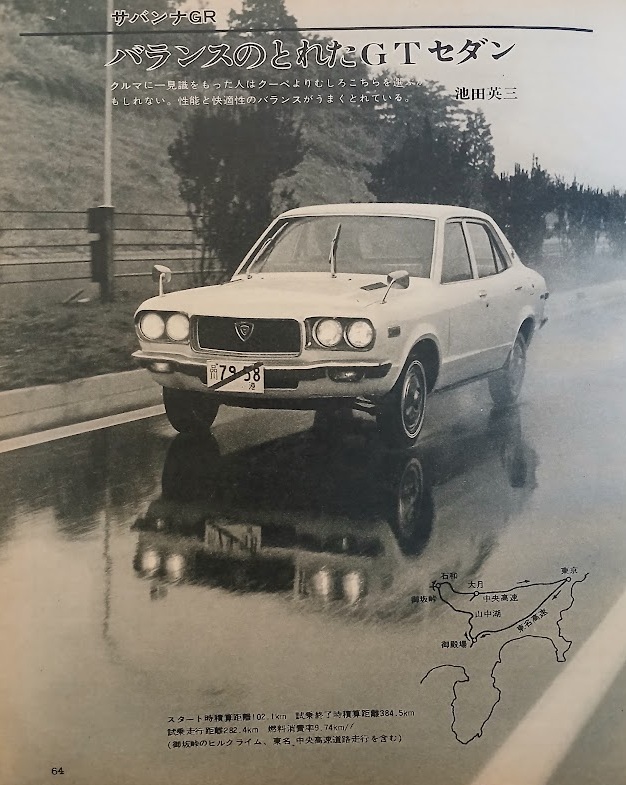
Of the newly announced Savanna series, the car that appealed most to my instincts was not the Savanna coupe with its strong statement of individuality, but rather the four-door sedan, with its “cool” first impression. The coupe, of course, has something of the appeal of a fashion model and should win the hearts of young people. But those who have owned at least a few cars and developed a certain degree of taste in automotive matters will recognize that this four-door sedan has the appeal of the “real thing.”
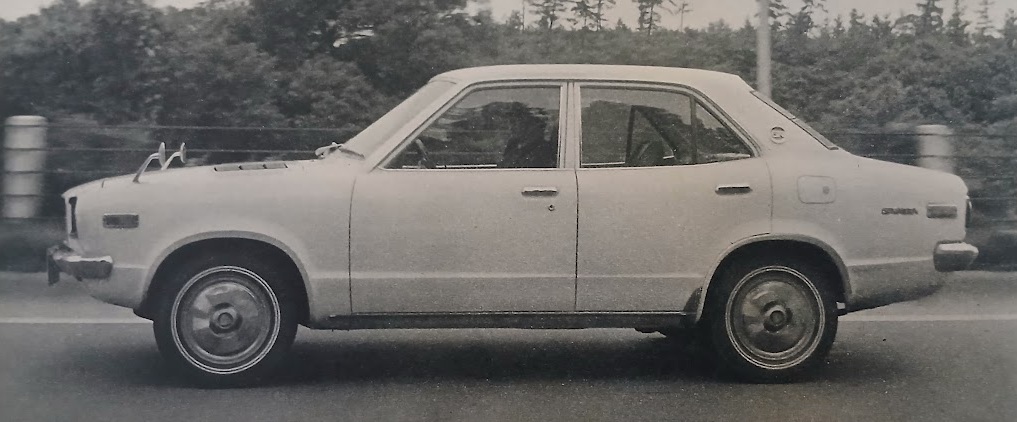
The long nose and short deck have until now been characteristic of sporting cars. Yet the Savanna four-door sedan reveals the same characteristics at a glance. It has a stylishness not found in the previous Presto or Capella. Considering that this car is intended not only for domestic sale but also to play a major role in exports, overseas buyers accustomed to seeing the “real thing” will probably choose the four-door.
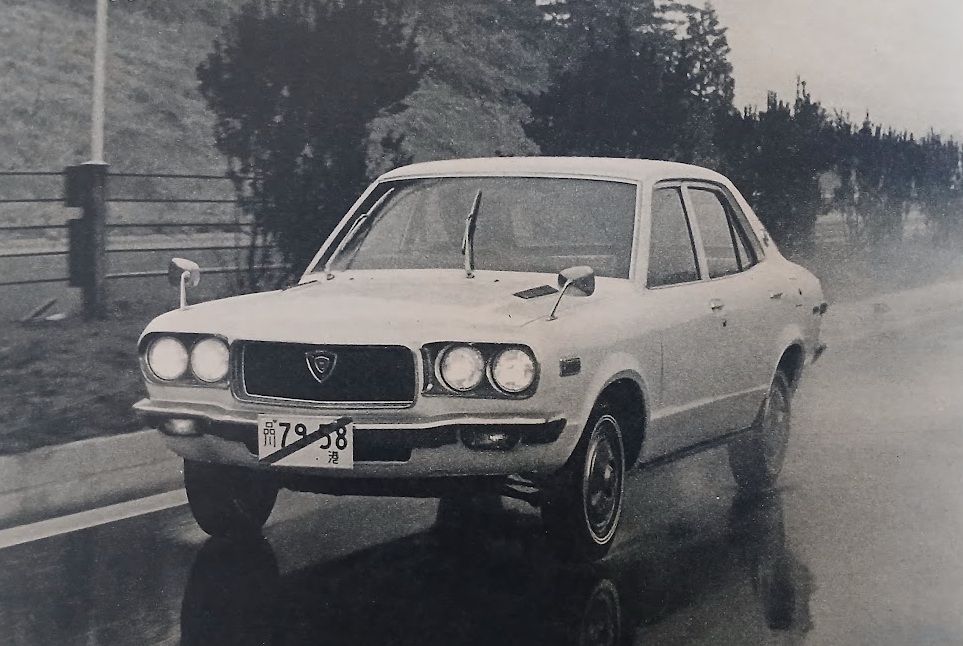
What especially catches the eye in the exterior styling is the nosepiece added to what would otherwise be a conventional front overhang. This treatment, first introduced by Pontiac, makes the entire assembly, including the lights and bumper, a decorative element in its own right. It looks somewhat exaggerated when the car is standing still, but on the move it takes on a dynamic sense of mass as it looms in the rearview mirror of the car ahead.
Similarly, the (dummy) air outlets on the hood serve no practical purpose, but as accessories symbolic of a high-performance car, they are the kind of thing that appeals to Americans.
But speaking from actual experience rather than “instinct,” the position and size of the Savanna’s outside mirrors represent a step backward in practicality for Mazda, which until now has taken considerable care to provide good visibility from its mirrors. With a nose this long, placing the mirrors in this position not only spoils the styling, but from a practical standpoint, one must say that they are little more than ornaments (dummies).
Although the Savanna shares its body shell with the Grand Familia, the bold decision to make the body wider than usual gives it the appearance of a car in a class above the so-called 1300cc class. Moreover, rather than simply widening the body, the pressed sections around the wheel arches have been made to project outward like fender flares, further enhancing the impression of stability. Whereas overall width has traditionally been around 1500mm, even among cars in the 1600cc class, the Savanna measures 1600mm, nearly the same as the Skyline. According to the designers, they deliberately broke away from established ideas in this area. (The Luce, incidentally, had been a pioneer in this respect.)
Naturally, this has enhanced the impression of stability in the styling, and even the width of the windshield lends the car the imposing look of a full-fledged family car. But the real significance of the increased width is the spaciousness of the interior. If one also takes into account the short overall length of the compact rotary engine, it becomes clear that despite a wheelbase of 2300mm, the interior is more spacious than those of the Sunny and Corolla. I should add that the intention to make effective use of the resulting space is clearly evident in this four-door model.
Having formed a favorable opinion of the overall exterior styling, my impression upon driving the car was that it had been designed by someone with a keen eye for detail.
First of all, the seats are generally soft, and when the driver sits in a correct posture, the backrest conforms closely to the shape of the back. If there is a criticism to be made, it is that the upholstery is so smooth and soft that the seats tend to provide insufficient support under strong lateral forces. In terms of the distinction between a “driving seat” and other kinds of seats, I felt that the emphasis was more on comfort.
Fastening the three-point belt makes a significant difference in this respect. One should wear the belt at all times. It is also better not to recline the backrest too far.
The steering wheel is positioned low relative to the seat, encouraging the driver to adopt the correct seating posture. There is certainly no possibility of assuming a position in which one clings to the steering wheel. Both the tachometer and speedometer are fully visible through the openings between the spokes, while the remaining instruments, the fuel gauge, water temperature gauge, and ammeter, are in the console above the radio, where they are easily read whenever one makes a point of looking at them.
The combined control lever on the right for the turn signals, beam selector, headlight flasher, and wipers is easy to use even on first acquaintance. However, the main light switch lever on the left is short and hidden behind a spoke, making it surprisingly awkward to operate for those who habitually switch off their headlights in city traffic, or when driving on roads with many tunnels. It should either be placed in a position where it is easily seen and within reach of the belted driver, or the lever should be lengthened so that it can be operated with the fingertips. An indicator light would also help prevent one from forgetting to switch off the headlights.
An outstanding feature of the Savanna is its powerful cowl ventilation system, which further improves on that of the Capella. Generally, in cars without quarter windows, only a token amount of air enters through the side vents, and the ventilation is not very effective except at fairly high speeds. In the case of the Savanna, however, so much air comes through that it is almost uncomfortable if aimed directly at one’s face. Driving in the rain with the windows closed, the system cleared the mist from the side windows, expelled cigarette smoke, and dried my damp hands, providing ventilation very much as advertised in the catalog. As a result, there was never any need to keep the windows even a crack open.
Easy Handling
The entire automotive world is beginning once again to recognize the suitability of the rotary engine for sporting cars. As a result, the coupe, which seeks to appeal to those with more sporting tastes, can pursue that objective head-on. The question is how well the car fares as a sporting sedan for those users (particularly family-minded ones) who are continually faced with the problem of reconciling performance with practicality. In this sense, the four-door Capella was a high-performance touring car that attracted worldwide attention, ranking alongside certain expensive European sedans that boasted GT performance.
What is particularly noteworthy about the new Savanna is that, having gone to the trouble of adopting a five-link rear axle layout on the Capella, Mazda has reverted to conventional semi-elliptic leaf springs. Despite the universally high regard for the Capella’s performance, the manufacturer explains this decision as a “progressive step backward.” One reason was to take advantage of the leaf-spring layout, the positioning of the fuel tank, and other factors to improve safety in the event of a rear-end collision, particularly with exports to America in mind. The other was that, by making the track wider than that of the Capella and staggering the gas-filled shock absorbers, the designers had become confident that they could bring out the advantages of the rigid axle. This, they say, was the result of a thorough analysis of the shortcomings of the rigid axle with the aid of a computer.
With these points in mind, I set out to test-drive the car. However, we were plagued by rain and fog on the day of the test, and the road surface was slippery throughout. On the other hand, poor road conditions tend to make the characteristics of a suspension more apparent, even at low speeds, so in some respects these conditions actually had their advantages.
Starting with ride comfort, which was naturally a concern, the shocks are surprisingly unobtrusive considering the firmness of the ride, whether on expressways, rough surfaces, or gravel roads.
In this respect, the combination of leaf springs and gas-filled shock absorbers can be said to have achieved an admirable result. Even when driving fast over very uneven gravel roads, the car did not bounce about as I had expected, and I was able to cover such roads with the tires still at their high-speed inflation pressure of 1.8kg/cm².
The test car was not fitted with the newly developed Z78 series cross-ply tires, but with conventional Bridgestone Skyway-H tires (6.15-13, 4PR). Even on these tires, its behavior on paved roads puts it in the good-handling category. For example, even when deliberately making an abrupt lane change on a wet expressway, the car returns to a straight course quite naturally.
This characteristic, which allows even an inexperienced driver to recover from a mistake with little effort, is an aspect of safety that will be necessary in future domestic cars. In its resistance to crosswinds and the effects of passing large vehicles, too, the Savanna showed stability equal to or better than that of cars in the 1.6-liter class.
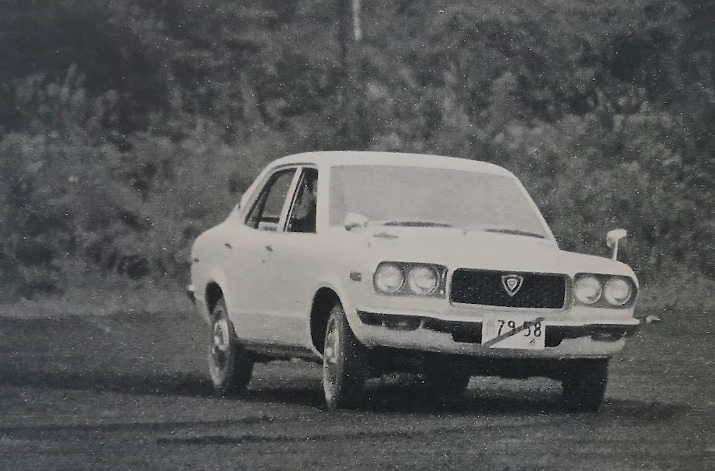
Although I cannot say for sure because the roads were wet, there was remarkably little feeling of insecurity for a car on narrow 6.15-13 tires, which would normally give the impression of being under-tired. I found the handling easy enough for even the average driver to manage. Along the way, the road was completely dry on both the ascent and descent of Misaka Pass, so I tried some sporting driving within the limits of what was possible on public roads. Here, too, the rear wheels gripped well except when cornering very hard through the hairpins. If one wants to enjoy sliding the tail out with the rigid rear axle, one has to enter a corner much too fast. For those who enjoy driving in a more practical sense, this is a car that may seem docile but can maintain quite high speeds.
One point that bothered me during this sort of sporting driving was that, although the gearshift was smooth, the clutch lacked the precision to match it, spoiling the sporting performance somewhat. The light pedal effort is welcome, but considering the power available from the rotary engine, I would prefer a somewhat more masculine clutch action.
As for the rotary engine itself, it might be best described as a “Capella-type engine for the Presto.” However, as a result of improvements to the carburetor, ignition advance, spark plugs, and so forth, aimed at both increasing output and reducing emissions, the engine seems to have lost some of its pulling power below 2000rpm, as well as the seemingly limitless acceleration above 5000rpm that characterized the Capella. In the Savanna, the feeling of acceleration remains steady from 3000rpm upward. Consequently, I made frequent use of third gear when keeping up with traffic on ordinary roads, while on expressways, cruising is most enjoyable in the range between 3000rpm (80km/h) and 4000rpm.
One often hears that rotary engines return poor fuel economy, and from past experience I have come to accept this by thinking of them as equaling cars in the 2-liter class. With this Savanna, however, although I thought I had driven the rotary very much in the manner favored by younger drivers, winding it out to 5000 or 6000rpm as circumstances allowed, I recorded fuel economy of nearly 10km/l. Even with this level of performance, if one avoids “wasteful” driving (and taking mechanical improvements into account as well), perhaps the rotary’s reputation as a “gas guzzler” can be revised.
Finally, I tried applying the brakes, which incorporate a dual proportioning valve, as hard as I could on a downhill stretch, but I never managed to lock the rear wheels. From my own experience, I can say that this is a car in which one can brake hard in an emergency even on a wet road. I would recommend that anyone buying this car first try this for themselves somewhere where it is safe.
In my overall assessment, among the family cars available in the 700,000 yen class, this is a car that would earn high marks even on the international market for its space, power, handling, and safety. Moreover, beneath the seemingly ordinary appearance of a four-door sedan, it is a car that allows one to entertain a dream different from other people’s – that of the rotary engine.
Postscript: Story Photos