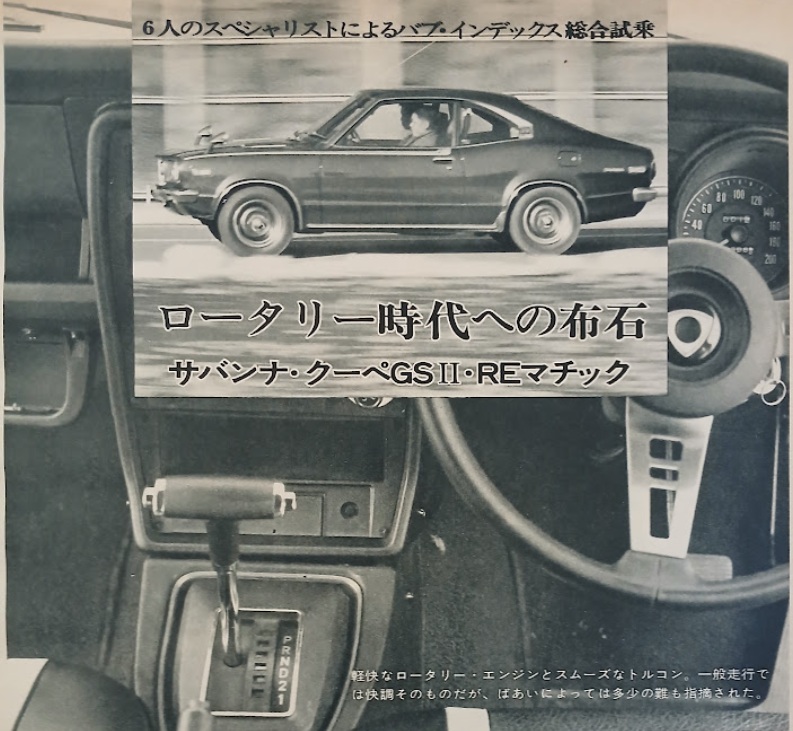
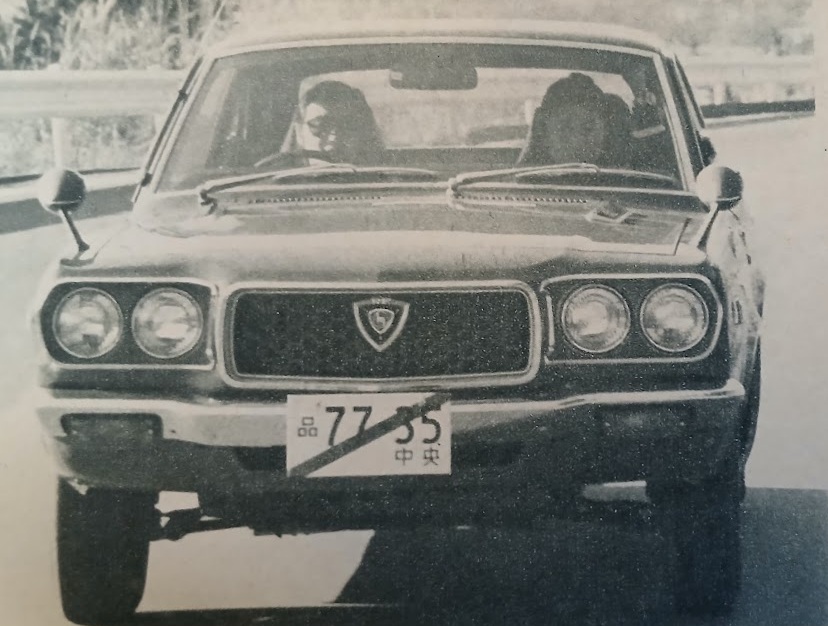
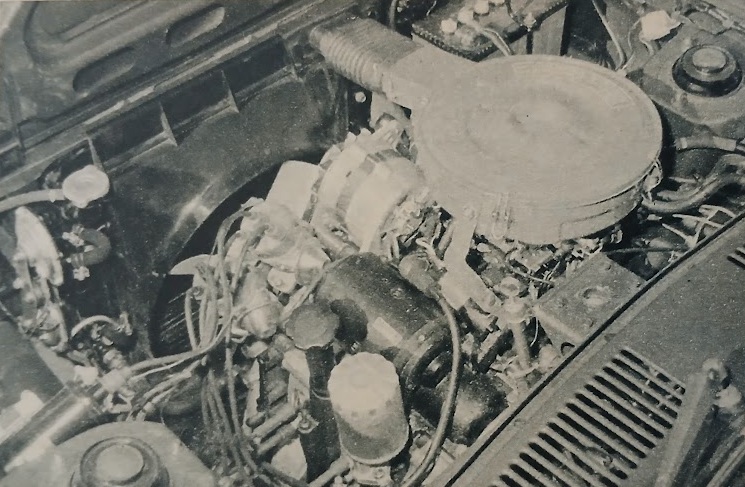
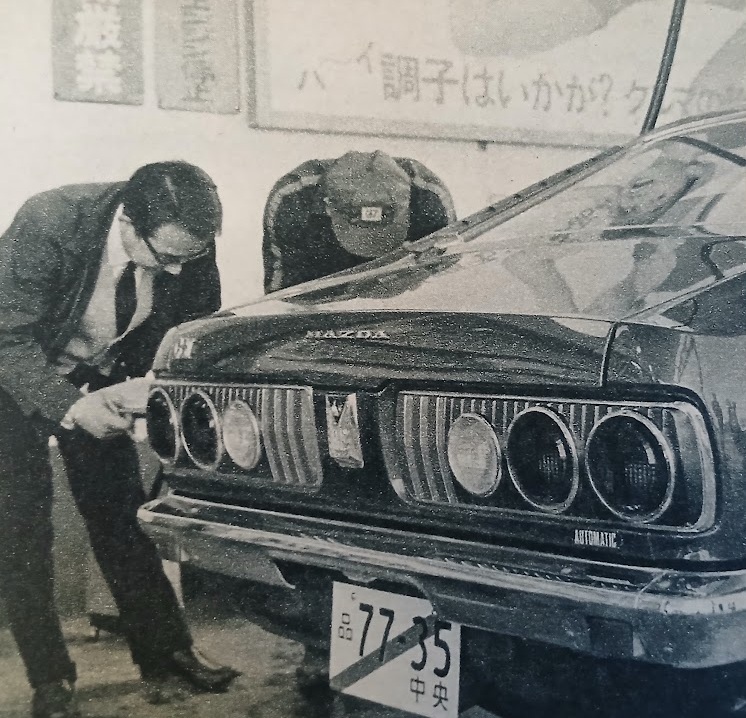
Mazda Savanna GS II RE-Matic (1972)
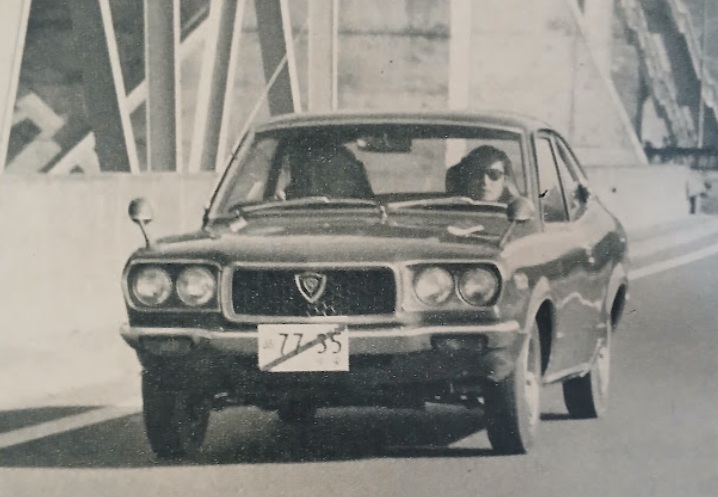
Publication: Motor Fan
Format: “Bubble Index” Road Test
Date: March 1972
Authors: Osamu Mochizuki, Katsuzo Kageyama, Shigeki Asaoka, Yasuhei Oguchi, Reiko Ikuuchi, Kensuke Ishizu
Laying the Groundwork for the Rotary Era
The lively rotary engine and smooth torque converter automatic make for thoroughly enjoyable everyday driving. Under certain conditions, however, the panel also found a few points open to criticism.
The Second Rotary/Automatic Combination
The first manufacturer to pair a rotary engine with an automatic transmission (hereafter abbreviated as AT) in a production car was Toyo Kogyo, with the introduction of the Capella RE-Matic. That was in October of last year.
The combination of the rotary engine’s exceptionally smooth power delivery with a relaxed, easy-driving AT attracted considerable attention from all sides and earned the Capella RE-Matic this magazine’s Car of the Year award. Rather than recount that car’s road test here—which is covered elsewhere in these pages—we turned our attention in this Bubble Session to the Savanna RE-Matic, introduced at the beginning of the new year.
Although both cars use essentially the same automatic transmission from the same manufacturer, the Savanna’s engine is smaller, displacing 491cc × 2 rotors compared with the Capella’s 593cc × 2. Maximum output also differs, at 105ps for the Savanna against the Capella’s 120ps.
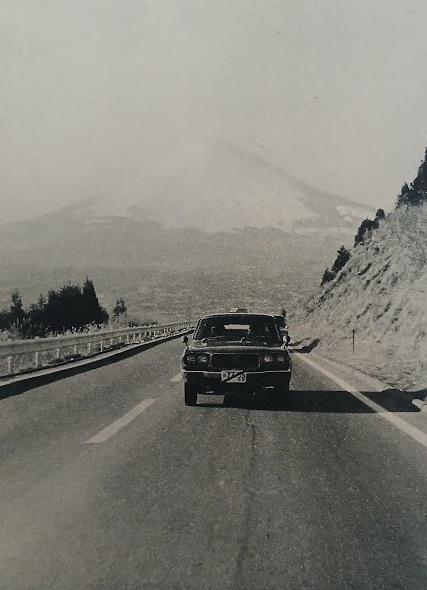
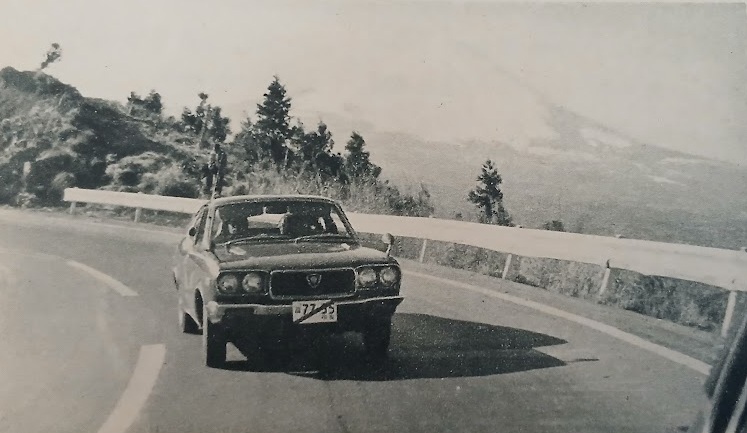
As usual, our test group set out from its regular base—the Fantasy drive-in restaurant on Tamagawa-dori near the Tokyo Interchange of the Tomei Expressway. Beneath brilliantly clear skies that afforded a crisp view of Mount Fuji from Tokyo, we followed our customary route: from Tokyo IC to Gotenba IC, the Otome Pass, and the Hakone Turnpike, then returning via the Otome Pass, Gotenba IC and Tokyo IC.
Once the drive was over and everyone had returned to Fantasy, discussion naturally centered on the combination of the rotary engine and AT.
As several of the panelists mention in the following pages, kickdown performance became the subject of particularly lively debate. Among the representative opinions were:
“Isn’t the kickdown effect a little too aggressive? It doesn’t always respond the way you’d like.”
“Most ATs are designed with family driving in mind, but this one is decidedly sporting. You could use it in any number of ways.”
“Maybe the idea was to compensate for the leisurely feel of an AT by taking advantage of the rotary engine’s eagerness to rev.”
(Regarding this point, the Survey Section of Toyo Kogyo’s Tokyo Branch explained that the behavior observed was peculiar to the condition of the test car. On other Savanna RE-Matics, they stated, kickdown does not occur until the throttle is opened much further.)
The group also discussed the reasoning behind offering an AT in the Savanna—a car whose character seems to invite the sort of brisk, connected driving that appeals to younger motorists.
For the details, we invite readers to continue with the reports from our six specialists beginning on the following pages. (Throughout the text, MT denotes a manual transmission.)
Finally, it should be noted that this test car was driven immediately after the model’s announcement and was evaluated in “line-off” condition, before any post-production preparation had been carried out.
Performance: Does the RE-Matic Belong in the Savanna? (Osamu Mochizuki)
Following the Capella, the Savanna series has now gained its own RE-Matic model. The transmission is the now-familiar Japan Automatic Transmission Co. (JATCO) automatic with a conventional three-element, single-stage, two-phase torque converter.
This automatic has been made available in both a coupe and a sedan model up to now. However, when it comes to the Savanna GS II we tested, opinion on whether the transmission is truly suited to the car is likely to be divided. One issue concerns the inevitable reduction in performance; the other relates to everyday usability.
By nature, the Savanna GS II is a sporting coupe with an unmistakably purposeful character. Fitting it with the RE-Matic inevitably compromises outright performance. Whether that will be readily accepted by the car’s intended buyers is an open question.
As noted during our previous test of the Cedric 2600 AT, an automatic transmission generally reduces performance by some 15-20% compared with an equivalent MT model. In other words, the Savanna’s 105ps engine feels as though it is delivering little more than 80ps.
This is illustrated by the results of our regular hill-climb test. Whereas the MT Savanna completed the climb in 41.6 seconds, the RE-Matic required 46.2 seconds. The difference is equally apparent in acceleration: the MT reaches 100km/h in the eleven-second range, while the AT requires around fourteen seconds. The convenience of an automatic inevitably comes at the expense of some performance.
Such a trade-off would probably be easy to accept in a four-door sedan. In the GS II coupe, however, with its strongly established sporting image, it is likely to be more controversial.
In terms of usability, the kickdown characteristics deserve particular attention. Even without opening the throttle fully, the transmission downshifts surprisingly easily. On the highway, for example, while cruising at 90km/h in top gear, a modest press of the accelerator was enough to trigger a downshift into second, making overtaking especially easy.
However, this proved to be a characteristic of our particular test car rather than the standard calibration. Under normal conditions, kickdown is said to occur only with a much larger throttle opening. In any event, as the owner’s handbook explains, there is little difficulty on hilly or winding roads provided the driver makes full use of the second-range position.
The RE-Matic uses the familiar six-position selector pattern. With the accelerator held fully open, it shifts into second at approximately 60km/h and into top gear at around 110km/h. Under normal acceleration, upshifts occur at roughly 20km/h and 40km/h, respectively.
At the 800rpm idle speed, creep from a standstill is quite pronounced, making it necessary to keep firm pressure on the brake pedal. Likewise, if the selector is moved manually from top gear straight down into first while travelling at 80km/h, the transmission automatically remains in second until road speed falls below 50km/h. On the other hand, if kickdown occurs while cruising in top gear at 50km/h, the transmission immediately shifts all the way down into first. This characteristic has both advantages and disadvantages, but it does provide the driver with a variety of useful operating possibilities.
“The well-judged shift timing gives it excellent acceleration response.” — Oguchi
Handling and Stability: Does It Still Feel Like an Automatic? (Katsuzo Kageyama)
When I first drove the Savanna Coupe GS II, I was thoroughly impressed by its sporting character. So when I heard that the Savanna was now available with the RE-Matic transmission, I approached this test with high expectations. Rather than repeat my earlier observations, I’ll concentrate here on the impressions from this latest drive.
Our previous test took place in torrential rain, and with so much attention devoted to coping with the slippery road surface, I now feel my impressions were influenced in several respects. This time, the weather was ideal and we were able to drive the car in earnest, leaving me with the feeling that some of my earlier conclusions should be revised.
The steering is on the heavy side. At high speeds, however, the amount of weight is entirely appropriate. The steering system is also very rigid, giving it a reassuringly solid feel at speed and making the car easy to place. Around town at lower speeds, however, somewhat lighter steering effort would undoubtedly be less tiring.
Steering response is excellent and well suited to the car’s sporting character. It settles quickly after lane-change maneuvers, while body roll is kept to a commendably low level. This, too, contributes to the Savanna’s sporting nature and is largely attributable to its substantially wider track and firmly tuned suspension. The suspension itself is decidedly stiff, and even on paved roads vertical movement in the rear seat is quite pronounced. Given the character of the car, however, this is probably unavoidable.
The most distinctive feature of this car, of course, is its automatic transmission—or, more precisely, the fact that it is a sporting torque-converter automatic paired with a rotary engine. We are told the manufacturer devoted considerable effort to developing an automatic transmission suited to the rotary engine’s unique characteristics, and the results of that effort are obvious.
To improve response during overtaking, the kickdown function has been made extremely sensitive, with the transmission shifting almost incessantly. One can readily understand why this approach was taken in the interest of maximizing performance. At the same time, however, it sacrifices some of the relaxed, unhurried character traditionally associated with an automatic, giving the car a noticeably more aggressive personality.
There are also occasions, such as when applying the throttle in mid-corner, when the shock of an unexpected shift can even influence steering control.
By its very nature, the rotary engine is exceptionally smooth, while smoothness is likewise one of the defining characteristics of a torque-converter automatic. One might therefore expect that combining the two would naturally produce an exceptionally smooth-driving car. On the other hand, the objective here was clearly to overcome the sluggish response so often associated with an automatic and develop a transmission capable of making full use of the rotary engine’s performance. Judged in that light, the result must be regarded as a considerable success.
In terms of performance, the transmission comes remarkably close to the responsiveness of manual control. Yet in terms of the smoothness traditionally expected of a torque-converter automatic, it still leaves room for improvement.
“If possible, I’d like to see just a little more damping.” — Oguchi
Interior and Comfort: Smooth Acceleration, Minimal Shift Shock (Shigeki Asaoka)
Having already driven the Savanna for our January issue, this was my second opportunity to evaluate the same car. The difference this time, of course, was the addition of the JATCO automatic transmission.
Since the interior, seating and other cabin features were covered in detail in the January issue, there is little point in repeating those observations here.
In fact, the only real difference inside is that the MT gearlever has been replaced by the AT selector lever.
The first thing one notices under acceleration is that, compared with most automatics, this transmission allows the engine to rev considerably higher. Perhaps because of that, even when cruising in top gear at around 40km/h, opening the throttle causes an immediate kickdown all the way to low gear, producing rather abrupt acceleration. Even so, shift shock is minimal, and the shifts are completed quickly and smoothly—a testament to the quality of the transmission itself.
That said, those expecting the AT to deliver smoother driving than the MT may not find that to be the case.
Since I said relatively little about the Savanna’s styling in my previous report, I’d like to add a few comments here.
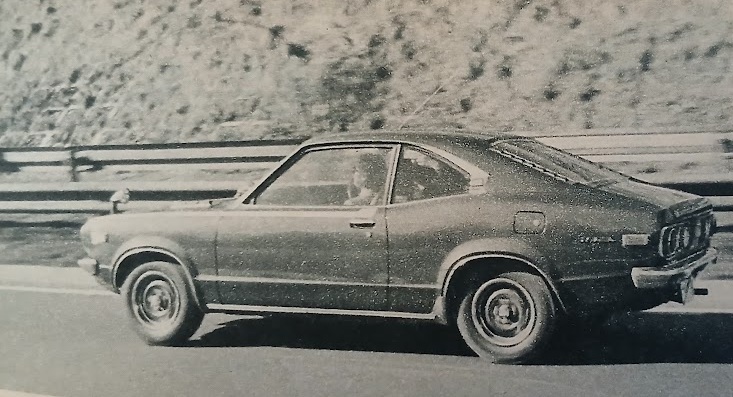
I have never been especially generous in my assessment of automotive styling. Even allowing for that, far too many of the Savanna’s design details strike me as excessively ornate. The rear-pillar air extractors and the taillights, in particular, came as quite a shock. Surely Mazda didn’t hand the styling over to a student working part-time after spending too much time reading comic books and boys’ magazines. But if the company genuinely believes that such grotesque, reptilian shapes will appeal to buyers, then its market research leaves something to be desired.
The overall proportions are no better. Wherever one looks, the car resembles something else, with little of its own originality. Perhaps because of that, it has been dressed up with unnecessarily heavy cosmetic touches and garish ornamentation in an effort to make it stand out—an approach that diminishes its sense of dignity.
There is no question that Mazda’s rotary-engined cars attract enormous interest. But that interest is directed overwhelmingly toward the rotary engine itself. I imagine the manufacturer must grow weary of hearing me criticize its cars every time I have the opportunity to drive one. It is not my intention to be sarcastic. As I have said repeatedly, what I truly hope to see is a genuinely new kind of car—one that can only exist because of the rotary engine.
Today, as the car seems increasingly destined to become just another household appliance, no different from an electric washing machine or vacuum cleaner, is this merely nostalgia on my part to hope for a return to the automobile in its truest sense?
“The poor ride comfort in the rear seat reinforces the impression that this is a car aimed more at young drivers than family buyers.” — Kageyama (a point raised by several of the panelists)
“Ventilation is exceptionally good.” — Mochizuki
“The seats don’t provide enough lateral support.” — Oguchi
“From the rear seat, the shift shock is much more noticeable.” — Ikuuchi
Safety: A Higher Standard of Active Safety (Yasuhei Oguchi)
Even with the addition of the AT, the Savanna retains much of the rotary engine’s high-performance character. The engine’s ample output largely compensates for the transmission’s lower mechanical efficiency and slower response, giving it a distinctly different character from the automatic versions of conventional reciprocating-engine models.
Initial acceleration from rest, and the first moments of pickup at lower engine speeds, are admittedly less impressive than the car’s outstanding high-speed performance. Since impressions can be misleading, I checked both the response (the initial rise in acceleration) and the time constant (the slope of the acceleration curve) with an accelerometer. The resulting waveform confirmed exactly what the seat of the pants suggested.
Viewed in detail, these are the characteristics that emerge. Taken as a whole, however—including its ability to accelerate, brake and corner—the overall impression is that all three of the fundamental elements required for safe driving have been raised to a higher level.
Human perception is subjective and often unreliable. Yet if we accept that true safety depends just as much upon the human element as upon the mechanical one, then this kind of overall improvement is an effect that should not be overlooked. The only reservation concerns the transmission’s highly sensitive kickdown, which tends to encourage rather rushed acceleration in city and suburban driving. Even so, the fact that the AT has been tuned for such responsive acceleration without sacrificing the grand touring character expected of an automatic is very much to its credit.
This is not unique to the RE-Matic model, but the Savanna’s braking system reflects a thorough commitment to fail-safe design. The rear hydraulic circuit incorporates a WP (Double Proportioning) valve, which regulates hydraulic pressure to the rear wheel cylinders during heavy braking to prevent rear-wheel lock-up and preserve braking effectiveness right up to the limit.
The WP valve is one form of hydraulic pressure-limiting system. Whereas a conventional proportioning valve uses a single calibrated spring to regulate hydraulic pressure, the WP valve uses a more sophisticated arrangement with two springs to achieve a more appropriate distribution of braking force between the front and rear wheels. The car is also equipped with a tandem master cylinder as part of its dual-circuit braking system, ensuring that a minimum level of braking force remains available even if there is a hydraulic leak in the front circuit.
Engine braking is inherently limited by the combination of a rotary engine and an automatic transmission, but the system is so well done that this rarely becomes a concern. If the selector is moved manually from “D” into first gear, the transmission remains in second above approximately 50km/h, only engaging first—and its accompanying engine braking—once road speed falls below 50km/h.
One minor point deserves mention. The lowest compartment of the three-tier storage tray ahead of the passenger seat is easy to strike with one’s knee, particularly because the seat cushion is mounted fairly high. Likewise, since the lighting switch is used so frequently, a longer control stalk would make it easier to operate.
“The armrest built into the console box is a welcome feature as long as it suits your build. In my case, though, it’s positioned a little too high and gets in the way.” — Ikuuchi
Economy: Fuel Economy Nearly Identical Between the AT and MT (Reiko Ikuuchi)
The Savanna Coupe GS II RE-Matic tested here is priced at 805,000 yen in Tokyo, Osaka and Nagoya. The equivalent GS II Coupe with a manual transmission sells for 750,000 yen, making the cost of the RE-Matic option 55,000 yen.
Other models—including the Bluebird U, Skyline and Carina—also command a 55,000 yen premium for an automatic transmission, so the price can be considered perfectly reasonable.
I discussed the Savanna’s overall pricing in this column in our January issue, so I will not repeat it here. It is fair to say, however, that the old notion that rotary-powered cars are expensive has now largely disappeared. From an economic standpoint, they no longer carry a significant handicap.
The one reservation is that the addition of the RE-Matic pushes the Savanna beyond the 800,000 yen mark. Standard 2000cc models can still be purchased for less than 800,000 yen—the Crown at 782,000 yen and the Cedric at 774,000 yen, for example. Among hardtops, the Bluebird U 1800 GL sells for 804,000 yen, while a Corona 1900 with AT costs 805,000 yen. Ultimately, it comes down to personal preference: whether one values the spaciousness of those larger cars or the sporting character and distinctive rotary-engine feel of the Savanna.
It is generally accepted that an AT car consumes roughly 10-15% more fuel than its MT equivalent. The published figures for the RE-Matic support this: the Capella G returns 11.5km/l, while the Savanna achieves 12.0km/l. With a manual transmission, the Capella is rated at 13.5km/l. No official figure was released for the MT Savanna, but according to the Survey Section of Toyo Kogyo’s Tokyo Branch, readers should expect fuel economy comparable to that of the Presto Rotary—around 15km/l. On paper, then, the AT appears to consume more fuel.
Our own test results, however, told a somewhat different story. The RE-Matic returned 8.4km/l over the first section of the test route, 6.4km/l over the second, and 8.0km/l over the third, for an overall average of 7.6km/l. In our January issue we recorded the same measurements for the MT Savanna, which achieved 8.1km/l, 7.5km/l and 8.3km/l respectively, averaging 7.93km/l. Overall, there was remarkably little difference between the two. Since approximately two-thirds of our Bubble Session test route consists of expressway driving, however, I wondered whether the automatic might prove more advantageous in city traffic, and conducted a separate comparison of my own.
Both the AT and MT test cars were the same vehicles used in this Bubble Session evaluation. I drove each for approximately 100 kilometers through some of the most crowded streets in central Tokyo. The results were 5.4km/l for the AT and 5.1km/l for the MT. Sure enough, the advantage went to the automatic.
Finally, the Savanna’s annual road tax amounts to 21,000 yen, placing it in the same bracket as engines of approximately 1000-1500cc. Although the rotary engine’s actual displacement is 491cc × 2—less than 1000cc in total—it is unfortunate that its unique design requires it to be taxed under this higher classification.
“Once you’ve decided on a rotary-powered car, fuel economy and the rest probably aren’t foremost in your mind.” — Ishizu
Product Appeal: Is the Capella RE-Matic Its Real Rival? (Kensuke Ishizu)
Suppose someone asked you to name your favorite athlete. Where would you begin? In golf there is Ozaki; in baseball someone else; in sumo another champion entirely. Every field has its own outstanding competitors, and choosing just one is no easy task.
Buying a car is much the same. Every manufacturer offers an abundance of different models, and deciding which one to purchase can be difficult.
With this month’s test car, however, the situation changes somewhat. Its most obvious point of comparison is the Capella, since it, too, combines a rotary engine with an AT. In effect, the competition is between two members of the same family.
Which one, then, is the consumer likely to choose? My inclination is toward the Capella. It develops 120ps against the Savanna’s 105ps, and although the difference in power-to-weight ratio is only slight, that is not the decisive point. More important is that, as a car equipped with an AT, the Capella simply feels like the more appropriate package.
The Savanna, on the other hand, appeals primarily to a relatively young group of buyers. Even allowing for the novelty of a rotary engine coupled with an AT, I find it difficult to understand exactly what Mazda hoped to achieve by offering an automatic to this particular market.
Seen in that light, one begins to wonder whether the AT Savanna has something of an experimental role from a product-planning standpoint. By introducing rotary-engine automatics in both the Capella and the Savanna, Mazda may simply be putting both concepts before the public, using them as trial balloons to see which proves more commercially successful.
Even so, the question becomes rather different when price enters the picture. For the cost of a rotary AT, buyers could purchase a larger-class model from another manufacturer. That is a separate argument altogether. In any case, the real significance of this month’s Savanna lies precisely in the fact that it combines a rotary engine with an AT. That, in itself, is what gives the car its product appeal.
I cannot help feeling that Japan now has far too many different kinds of cars. Worse still, so many of them look alike. As I observed in our January issue, this is not genuine diversification, but merely an increase in the number of models. True diversification means narrowing the range while developing each product more thoroughly. Such an approach is better suited to mass production and naturally leads to lower manufacturing costs.
At present, however, it seems to me that manufacturers are responding to consumer demand in the wrong way. At a time when so many cars lack any real individuality or clear sense of purpose, perhaps the arrival of the rotary-engine AT provides an opportunity to pause and reflect once again on the direction of Japanese motoring.
“It was developed with the American market in mind, where automatic transmissions are regarded as indispensable.” — Kageyama
“The over-decoration is difficult to ignore.” — Oguchi
How to Read the Bubble Index
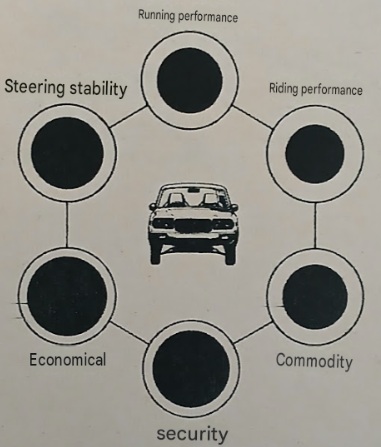
The purpose of this comprehensive road test is to evaluate a car’s overall capabilities through six principal categories: performance, handling and stability, comfort and accommodation, safety, economy, and product appeal.
The evaluation method is what we call the “Bubble Session.” Borrowing an approach from systems engineering, six specialists from different fields gather around a hexagonal table–the “bubble” referring to a honeycomb cell–and discuss the car from their respective viewpoints.
The black circles shown within the six evaluation fields indicate the rating assigned in each category. A car whose circles are relatively equal in size may be regarded as a well-balanced design, whereas one with larger disparities can be said to have a stronger individual character.
Postscript: Story Photos