Mazda Savanna GT (1972)
Publication: Car Graphic
Format: Road Impressions
Date: December 1972
Author: Shotaro Kobayashi
Road testing the Savanna GT
Mazda’s rotary-powered cars are more highly regarded overseas than they are at home, particularly in the United States, where exports have grown dramatically. (Combined exports of all rotary models recently exceeded 10,000 units per month.) Overseas, the Savanna is known as the RX-3, but unlike the domestic model, the American version replaces the 491cc × 2 engine with the Capella’s 573cc × 2 12A unit.
The new Savanna GT, introduced as the flagship of the Savanna range, can be regarded as the domestic version of the RX-3. Or, racing enthusiasts may find it easier to think of it as the production version of the works Savanna (573cc × 2, naturally), which has fought consistently thrilling battles in domestic touring-car racing, and has finally begun to challenge the Skyline GT-R’s supremacy.
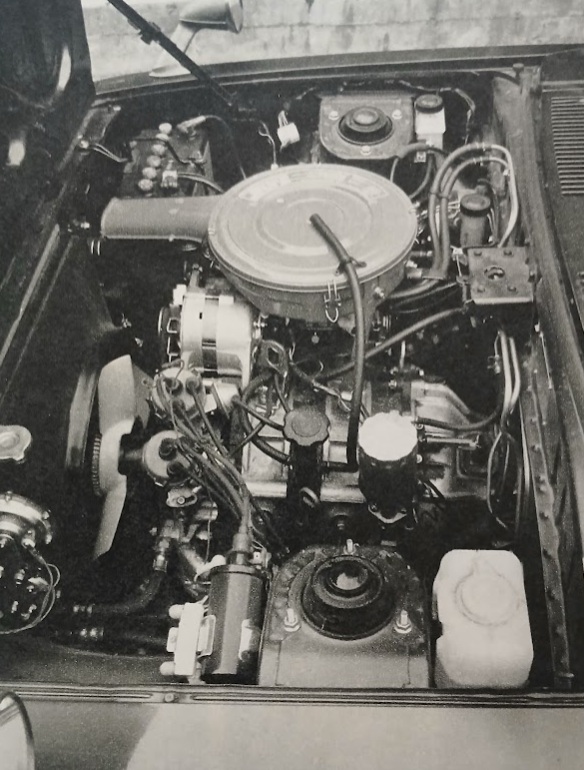
The main differences between the GT and the existing Coupe GS II are as follows. First, the 10A engine (491cc × 2, 105ps/7000rpm) has been replaced by the 12A (573cc × 2, 120ps/6500rpm). Second, the 4-speed gearbox has been replaced by the same 5-speed unit fitted to the Capella GS II. Third, the suspension has been stiffened and the ride height lowered by 15mm. (In terms of spring constants, the front increases from 1.65kg/mm to 2.0kg/mm, and the rear from 2.0kg/mm to 2.5kg/mm.) High-performance Z78-13 4PR cross-ply tires with a 78% low-profile section, developed specifically for the Savanna GS II, are fitted as standard equipment.
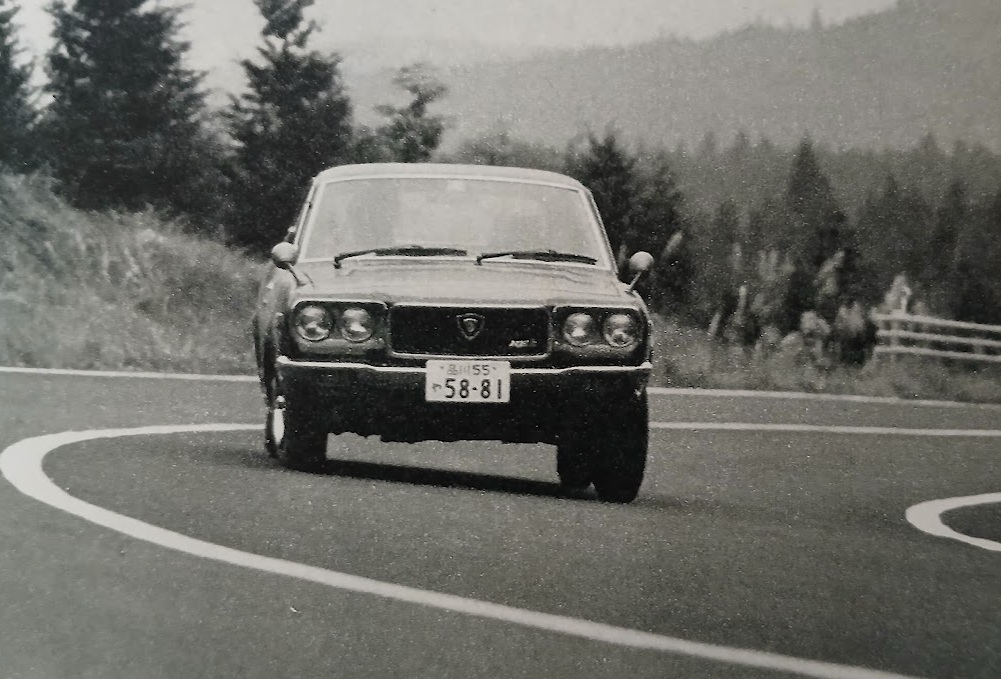
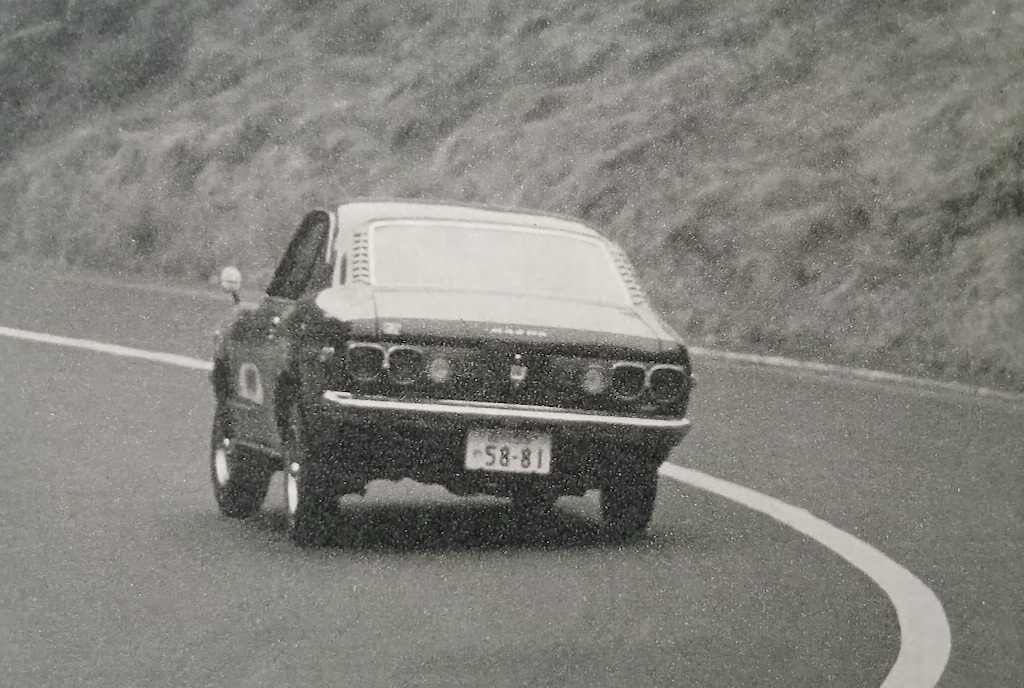
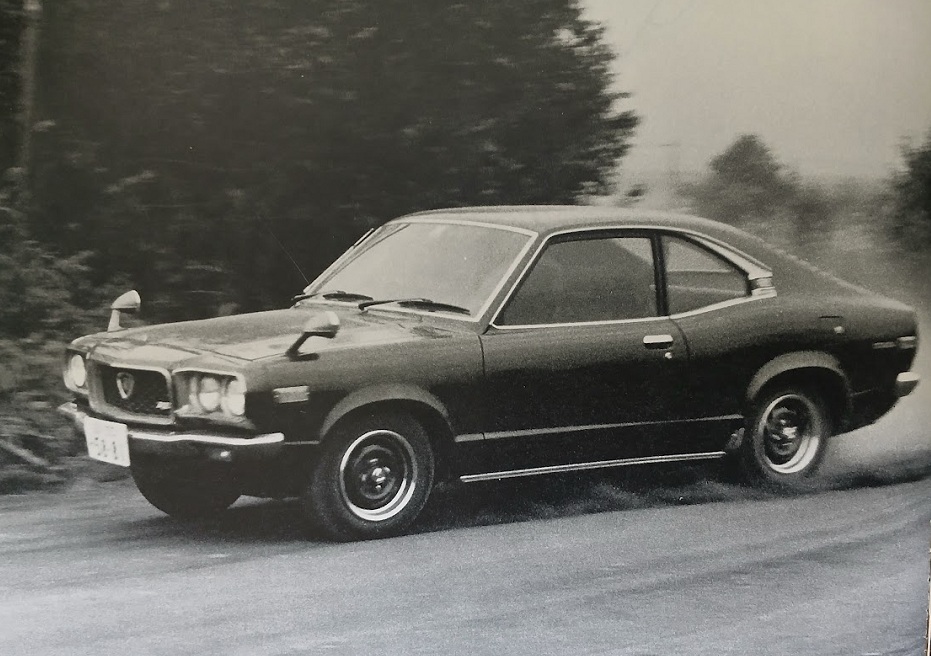
Externally, the changes are limited to minor details: “RE12” badges front and rear identifying the 12A engine, a “GT” emblem on the rear quarter panel, and “5-Speed” lettering on the rear. Three new body colors have also been added, bringing the total to four. Our test car was finished in a dark gray known as Beat Black Metallic, a color particularly prone to showing dust from static electricity. Price is 795,000 yen, 45,000 yen more than the 4-speed GS II.
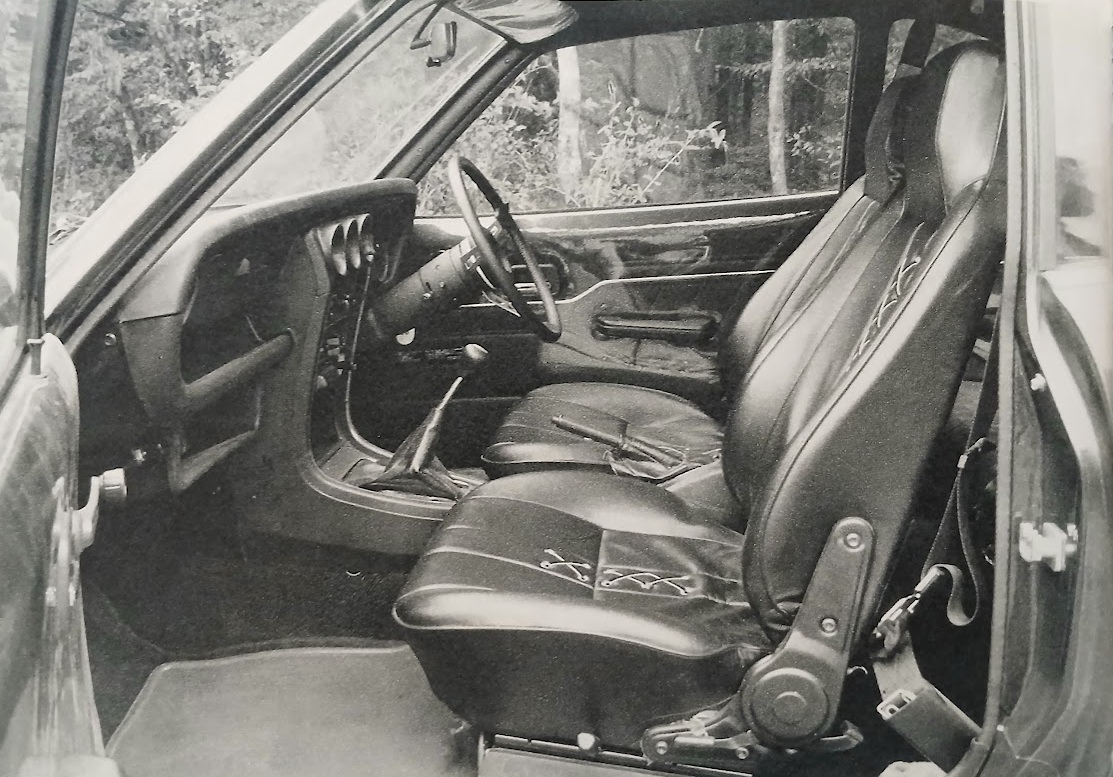
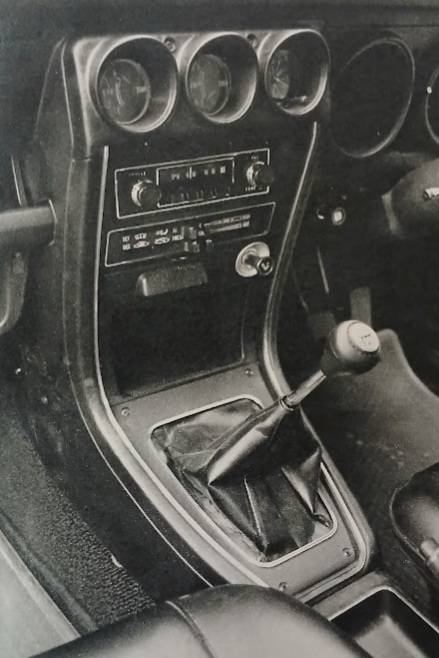
Settling into the driver’s seat, one notices several small changes. The seats have been revised, and the addition of ventilation holes in the center sections of both the cushions and backrests is a welcome improvement. The three auxiliary gauges in the center of the dashboard (clock, fuel level/electrical current, and water temperature, from right to left) have been enlarged and changed from rectangular to round dials, making them much easier to read. Below them in the console are the car stereo with automatic station-seeking and the heater and ventilation controls. The latter are illuminated at night, which is convenient, but the lighting is actually brighter than that of the instrument panel and proved distracting.
Since people who buy a car like the Savanna GT are likely to be most concerned with performance and handling, we will focus mainly on those aspects in comparison with the GS II.
We tested the GS II in C/G No. 125, where we noted that its handling was markedly improved over both the Familia Rotary Coupe and the Capella, while the engine’s greater low- and medium-speed flexibility made it easier to drive. Since then, however, C/G has purchased a Savanna Sport Wagon as a long-term test car, and after more than 20,000km of everyday use, one aspect continues to disappoint us greatly: somehow, it lacks the punch one expects of a rotary. Admittedly, its output is 5ps lower than the GS II’s, and vehicle weight is slightly heavier, but even allowing for that, it lacks vitality overall.
Nor was this an isolated case. When we tested the 5-speed Capella Rotary GS II in C/G No. 133, it reached a maximum speed of only 181.82km/h, well short of the 187.5km/h recorded by C/G’s own long-term Capella GS, a very early 4-speed model. From experiences such as these, we had begun to believe that, partly because recent Mazda rotary engines had been developed with greater emphasis on low- and medium-speed drivability than on high-speed performance, and partly because of emissions-control measures, the remarkable performance they once delivered could no longer be expected.
However, when driving the Savanna GT, we were able—for the first time in quite a while—to experience the exhilarating acceleration characteristic of a rotary engine. The tachometer’s yellow zone begins at 6500rpm and extends to 7000rpm, yet during fast hill climbs or overtaking it is easy to over-rev the engine inadvertently in second or third gear. Throughout the rev range it is both exceptionally powerful and quiet. (Note that, according to the owner’s handbook, exceeding 7000rpm invalidates the warranty.)
We did not conduct any instrumented tests this time, so the reader must accept our subjective impressions, but the increase in torque from 13.7kgm to 16.0kgm is unmistakably felt at higher speeds. According to the manufacturer’s published figures, the top speed has increased by 10km/h over the GS II, at 190km/h, while the 0-400m time (with two occupants) is an almost unbelievable 15.6 seconds. Clearly, this improvement reflects not only the increase in power but also the closer indirect ratios of the new 5-speed gearbox. A comparison of the GS II’s 4-speed and the GT’s 5-speed ratios is below. The final-drive ratio remains unchanged at 3.70, and both cars use the same Z78-13 4PR tires.
| 1st | 2nd | 3rd | 4th | 5th | |
|---|---|---|---|---|---|
| GS II | 3.737 | 2.202 | 1.435 | 1.000 | - |
| GT | 3.683 | 2.263 | 1.397 | 1.000 | 0.862 |
At 6500rpm in each gear, the GS II reaches 49, 83, and 127km/h in first, second, and third respectively. The GT, with its 5-speed gearbox, reaches 50, 82, 132, and 185km/h in first through fourth. The GS II’s catalog top speed is 180km/h (approximately 6400rpm), whereas the GT will exceed 185km/h in direct fourth at 6500rpm, and can reach 190km/h in overdrive at the relatively low engine speed of 5800rpm.
These figures are, of course, theoretical. However, judging from our experience with previous C/G long-term test cars, we believe the Savanna GT is fully capable of reaching 190km/h. Instrumented testing at Yatabe with our own long-term cars recorded 184.0km/h for the Familia Rotary Coupe, with a power-to-weight ratio of 8.15kg/ps, and 187.5km/h for the Capella Rotary Coupe GS, where the figure was 8.00kg/ps. Since the Savanna GT enjoys a still more favorable power-to-weight ratio of 7.37kg/ps, there is nothing surprising about the prospect of it reaching 190km/h.
The engine’s generous power reserve makes itself felt under every driving condition. Because the rotary revs so freely, there is a tendency to rev it higher than necessary, yet in city traffic at no more than about 60km/h, it is perfectly possible to keep the engine below 3000rpm, use up to fourth gear, and still stay ahead of the traffic flow. Overdrive becomes fully usable from around 60km/h. On the Tomei Expressway, therefore, fifth gear can be used at nearly all times, with fourth needed only occasionally for overtaking on uphill grades.
Below 100km/h, the overall noise level is so low that, once in fifth gear, the slight transmission whine becomes more noticeable than the reduced engine noise. The speedometer is exceptionally accurate—for example, an indicated 100km/h corresponds to an actual 99.5km/h—and at 115km/h a soft overspeed warning begins to sound. At that speed, it is the loudest noise in the car.
Mazda’s rotary gearboxes have generally suffered from weak synchronizers, and regrettably the Savanna GT is no exception. Quick, quiet shifts into first, second, and third gear were simply not possible. Fifth gear, to the upper right of the H-pattern, is selected by moving the lever against a fairly strong spring. Although there is little danger of selecting it by mistake, the lever stroke is quite long. Moreover, immediately after a cold start, the lower gears were extremely stiff until the gearbox oil warmed up after several kilometers of driving.
We expected the 5-speed gearbox to improve the relatively high fuel consumption that has long been characteristic of rotary-powered Mazdas. The results, however, were rather surprising. Over a 420km route that took us along the Tomei Expressway, around the Fuji Five Lakes, and back over the Chuo Expressway—with frequent use of fifth gear—the Savanna GT averaged just 6.84km/l. For comparison, the 491cc × 2, 105ps Savanna GS II with its 4-speed gearbox returned 7.46km/l over a broadly similar route, while the 5-speed Capella GS II recorded 6.71km/l.
The Savanna GT’s ride is hard by any standard. Or rather, it would be more accurate to say that it is simply too hard. Even on paved roads, there are constant sharp, short vertical motions. The ride does become flatter as speed increases over the same road surface, but even at 100km/h on the Tomei Expressway, crossing drainage channels still produces sharp vertical jolts. The tires were set to the recommended high-speed pressures of 1.8kg/cm² front and rear.
On the other hand, the ride over relatively smooth dirt roads is as good as that of a typical rally-prepared car, allowing speeds of 70-80km/h to be maintained with ease. In other words, the suspension reacts dramatically to isolated bumps, yet copes well with regularly repeated surface irregularities when driven quickly. In any case, as far as ride comfort is concerned, it is on par with the old Fairlady 2000 and Bellett GT-R. It is certain that, after a half-day of driving, one will be left thoroughly exhausted.
Compared with the GS II, the handling can only be said to have improved slightly—and only at the cost of a substantial sacrifice in ride comfort. Body roll has certainly been reduced, and cornering speeds have increased accordingly, but it has also become more difficult to trace a clean line through a corner.
To explain this point, let us use the example of an uphill corner that we regularly use for cornering evaluations, one that can normally be taken at 80-90km/h. The test car was fitted with Bridgestone Skyway Deluxe Z78-13 4PR tires, inflated to 1.8kg/cm² front and rear.
The variable-ratio steering still has a small amount of elastic free play around the straight-ahead position, requiring a fairly large initial steering input. There is also a slight phase lag before the front wheels begin to respond. Once they do, however, the Z78 tires develop exceptionally high cornering power for a cross-ply tire, and understeer remains mild, just as fast drivers prefer. Almost simultaneously with the steering taking effect, the body roll—already slight—stops increasing, allowing some steering lock to be returned. Immediately afterward, the car enters the full-throttle acceleration phase, but understeer increases again, requiring more steering lock. At about 4000rpm in third gear (approximately 80km/h), however, the engine’s power really comes on. The inside rear wheel reaches its limit of adhesion and spins, and the car ultimately transitions into oversteer. The steering must then quickly be unwound again.
Written down, the sequence appears rather drawn out, but in reality it all takes place within only a few seconds. It demands very delicate coordination of throttle and steering, and unless the timing of both is exactly right, the car’s cornering line becomes a series of small corrections rather than one continuous curve. In short, when driven well the GT is faster than the GS II, but its behavior at the limit has become more delicate, making it more difficult to place accurately.
Despite the wider tires, steering effort remains agreeably light even at low speeds.
In conclusion, the Savanna GT is not a practical GT suited to long-distance, high-speed touring, but is closer to a sports car intended purely for the enjoyment of driving. Drivers confident in their abilities will appreciate its character, but for the average driver, the far more comfortable GS II is more than sufficient.
Postscript: Story Photos