Mazda Savanna GS II (1971)
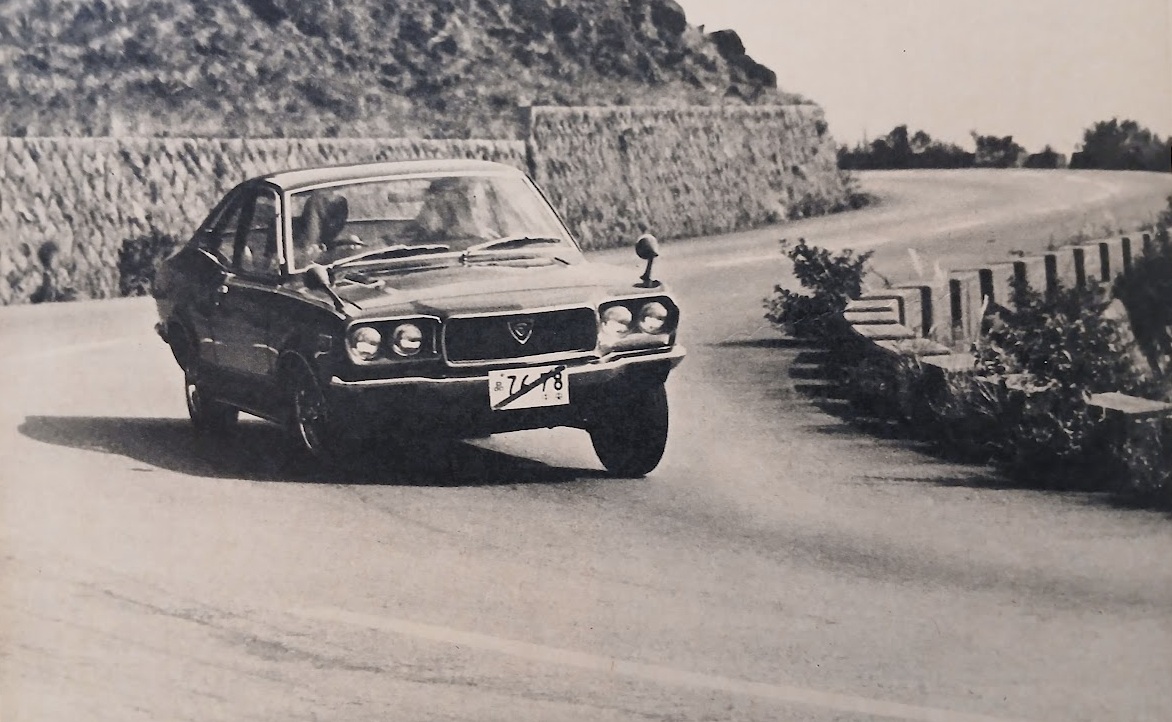
Publication: Car Graphic
Format: Road Impressions
Date: November 1971
Author: Shotaro Kobayashi
Road testing the Savanna GS II
Over the past three years, C/G has purchased two of Toyo Kogyo’s rotary-engined models and used them continuously as staff cars. In July 1969, we purchased a Familia Rotary Coupe as soon as it went on sale, drove it for 47,000km over the course of two years, and then replaced it with a Capella. During the one year and two months since, the Capella has covered a further 43,000km. After a combined total of 90,000km of demanding everyday use with these two cars, our confidence in Toyo Kogyo’s rotary engine has become absolute.
So, when we tested the new Savanna, neither its outstanding performance nor its quietness surprised us at all. What made a much stronger impression on us was its handling, which is a dramatic improvement.
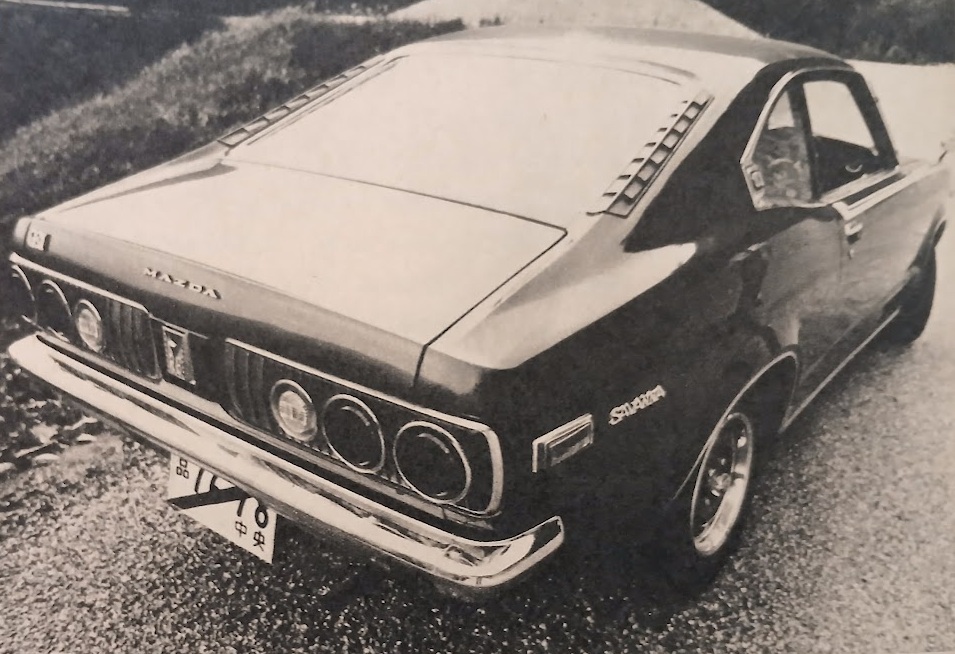
Like the Familia Rotary on which it is based, the Savanna is available as both a four-door sedan and a two-door coupe, all versions being powered by the 491cc × 2 rotary engine. The lineup consists of three sedan models and four coupes, but the variations are almost entirely confined to differences in interior and exterior trim. Mechanically, they are virtually identical. Our test car was the most luxurious and expensive version, the Coupe GS II (750,000 yen).
Let us begin with the handling. To be frank, our greatest criticism of the previous Familia Rotary Coupe was that its generally poor handling fell far short of its outstanding performance. First, its basic layout combined an unusually narrow track with a suspension that was too soft, making the car extremely unstable at high speeds. Second, the performance of the standard tires was far too meager to keep pace with the car’s speed potential. Those were the two main shortcomings.
With the Capella, the rear suspension was much improved through the adoption of coil springs and a properly located four-link arrangement, bringing modest gains in both handling and ride comfort. Fundamentally, however, the track remained narrow, the tires remained too small, and our dissatisfaction persisted.
For that reason, while strongly criticizing these shortcomings in our road-test reports on both cars, we also carried out a series of modifications to our long-term-test Capella. As recorded in our monthly reports, those changes ultimately brought the car to a level with which we were nearly satisfied.
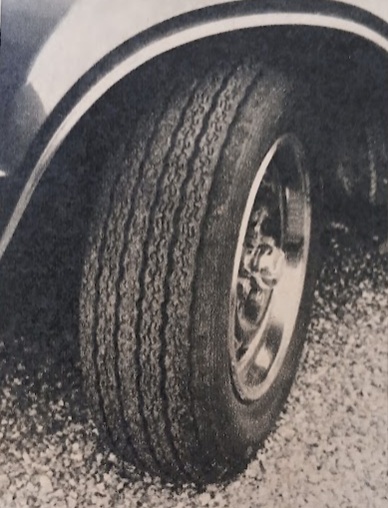
What pleasantly surprised us when we tested the Savanna was that nearly all of the shortcomings previously pointed out by C/G had been addressed, resulting in dramatically improved handling. The main chassis revisions can be summarized as follows: 1) The front track has been widened by 100mm, while the wheelbase has been extended by 50mm. 2) The suspension has been stiffened overall. At the rear, the De Carbon dampers are mounted asymmetrically, with the right-hand unit positioned ahead of the axle and the left-hand unit behind it, thereby counteracting the reaction forces generated by driving and braking torque and improving tire contact. 3) The Coupe GS II is fitted with specially developed Bridgestone Z78-13-4PR ultra-low-profile cross-ply tires mounted on 4.5J rims.
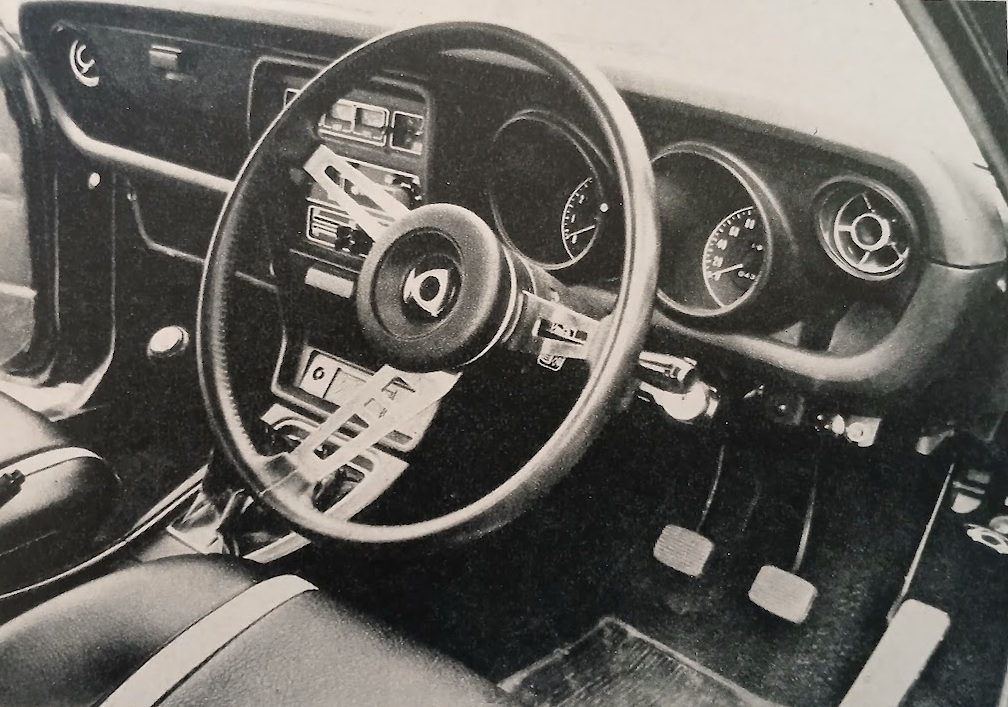
The first thing one notices when driving is that the steering is far more rigid than that of either the Familia or the Capella. Response, particularly the initial response as the wheel is first turned away from the straight-ahead position, is much more positive. The steering wheel itself is now of an appropriate diameter—it was unnecessarily large before—yet steering effort remains light, even at low speeds.
The Familia was strongly affected by crosswinds at high speeds. On elevated expressways, even a light breeze demanded constant steering corrections. The Savanna’s body has much the same aerodynamic characteristics, so a trace of this tendency remains, but overall stability has been greatly improved. Even when buffeted by the wind, the chassis now feels far more firmly planted, making corrections much easier.
Cornering stability is in a different league from that of the Familia. We increased tire pressures to 2.2kg/cm² front and rear for our test. Understeer remains pronounced, but it has been reduced considerably from the Familia’s, making it much better suited to the “fast driver.” The car enters a corner with moderate understeer, but as power continues to be applied, body roll gradually increases, the inside rear wheel progressively loses grip, and eventually the tail begins to slide. The limit speed, however, is remarkably high for a car with a live rear axle, and because breakaway is easy to anticipate, it is easily controlled. In slow, tight corners, the engine has sufficient power that the tail can be made to slide deliberately in the lower gears, while the steering remains positive right to the limit.
On the day of the test, C/G’s own Capella—equipped with 5-inch rims and Michelin XAS 175-13 tires—accompanied the Savanna, allowing the two cars to be compared under identical conditions. In terms of absolute cornering speed, the Capella proved superior, benefiting both from its greater power and the higher grip of the Michelin tires. The lower lateral stiffness of radial tires, however, means that breakaway occurs more abruptly, which made the Capella more difficult to control. In this respect, the Savanna, with its cross-ply tires, felt easier to drive. At the very least, its handling is vastly superior to that of a Capella on standard tires.
The effectiveness of the diagonally mounted rear dampers is also readily apparent. Even under hard acceleration or while cornering hard over uneven road surfaces, the leaf-sprung rear axle maintains excellent tire contact.
The suspension is firmer than that of both the Capella and the Familia Rotary Coupe, but ride comfort is actually superior to the latter’s. In the Rotary Coupe, raised manhole covers and similar road irregularities produce abrupt vertical motions, but these are much less noticeable in the Savanna.
Brake performance cannot be described as exceptional, but it is entirely adequate. Only the GS II is equipped with a servo as standard, while all models are fitted with a PCV to prevent premature rear-wheel lock-up. This system provides two-stage front-to-rear brake-force distribution. Under heavy braking, pressure to the rear circuit is initially reduced, but if pedal pressure continues to increase, rear brake pressure progressively rises again.
As for the Savanna’s performance, it is beyond reproach. Its engine is based on the Familia’s 491cc × 2 rotary, but incorporates many of the refinements first introduced successfully on the Capella. The increase in output (from 100ps to 105ps) is naturally too small to be noticeable in itself. What has unmistakably improved, however, is smoothness at very low engine speeds.
In the Capella, when slowing for a traffic light and lifting off the throttle to use engine braking, combustion tends to become incomplete once the revs fall below about 1500rpm, producing a phenomenon rather like knocking. Because this never occurs during unloaded idling, we adopted the habit of shifting into neutral early in order to avoid it.
In the Savanna, however, the carburetor has been fitted with an auxiliary idle circuit to eliminate this incomplete combustion under light load and at low engine speeds. The effect is immediately apparent. Even if the clutch is left engaged until the car almost comes to a stop, as one would do in a conventional reciprocating-engine car, the engine no longer shudders and bucks.
Another improvement concerns the operating mechanism for the carburetor’s secondary butterflies. On previous models, there was a noticeable delay in their operation, and when they did open, the transition was rather abrupt. In practical terms, this meant that, while cruising at speed, abruptly applying full throttle produced no immediate response. Only as the engine approached 6000rpm did the secondaries seem to suddenly come in. Conversely, lifting off the throttle at high speed did not produce immediate engine braking; instead, the car would continue to coast for several seconds. In the Savanna, this behavior has been eliminated completely.
The tachometer marks the red zone from 6500-8000rpm, but in a well-run-in engine the revs will keep rising seemingly without limit. Anyone unfamiliar with rotary engines would almost certainly over-rev it in the lower gears. According to the handbook, the maximum speeds at 6500rpm are 49, 83, and 127km/h in first, second, and third respectively, but these figures are conservative. In practice, the engine will easily exceed them by some 10%.
Those driving a Savanna for the first time tend to use unnecessarily high revs simply because the engine is so smooth and quiet. Once the initial excitement wears off and one becomes accustomed to the car, however, its remarkable flexibility becomes apparent. If one is so inclined, it will amble along in top gear at only 1200rpm, and with a gentle application of the throttle, it will accelerate cleanly from that speed. Third gear is particularly useful, responding instantly to the throttle and pulling willingly from 20km/h to well over 130km/h. The throttle linkage itself is light, precise, and well proportioned in its travel, making the engine exceptionally easy to control.
The manufacturer’s claimed top speed is 180km/h. Judging from C/G’s own measured figures at Yatabe—184.0km/h for the Familia and 187.50km/h for the Capella—the Savanna’s 180km/h claim appears entirely credible. Unfortunately, such speeds cannot realistically be attained in Japan, but there is no question that, for now, no other engine but the rotary combines such excellent torque characteristics from low to high engine speeds with such smoothness and quietness.
Cruising at a steady 100km/h on the Tomei Expressway, the engine is turning 3500rpm in top gear, exactly where maximum torque is reached. With such ample power in reserve, overtaking and climbing grades can both be accomplished in top. Indeed, if one were so inclined, it seems entirely possible to drive all the way from Tokyo to Osaka using top gear alone.
The speedometers of Japanese cars are almost invariably optimistic, but the Savanna proved to be an exception. At an indicated 100km/h, the actual speed was 102km/h. Similarly, the odometer under-recorded distance by 1.2%. The car was fitted with Bridgestone Skyway Deluxe Z78 tires, inflated to 2.2kg/cm² front and rear.
The gearbox is identical to that of the Familia, but on our test car, which had covered approximately 4,100km, the second- and third-gear synchronizers were weak, making quick, quiet gear changes impossible.
Although overall body width has been increased by 115mm, usable interior width differs little from that of the Familia. The most significant improvement is in the coupe’s rear seat. A deeper cushion and a more generous backrest angle allow two adults to travel for extended periods in a much more natural seating position. The front seats are also well judged in both size and shape, allowing a natural driving position. Whereas the Familia tended to leave the driver feeling rather low in the seat, the Savanna’s seating will suit a much wider range of drivers.
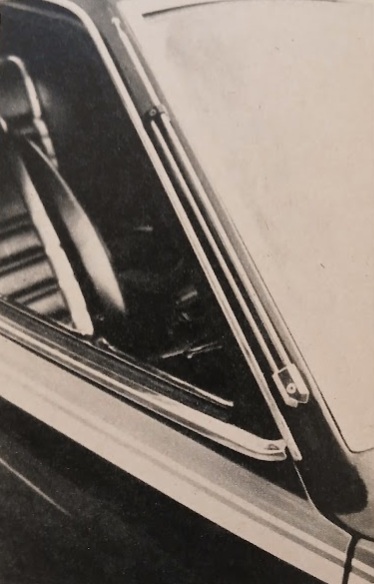
Equipment levels are among the most comprehensive in this price class. On the GS II, a car stereo with signal-seeking radio tuning is fitted as standard. The antenna mounted on the front pillar is divided into twin rods in its lower section, which is said to reduce the wind noise that commonly originates there. The adhesive bonding of the windshield and rear window to the body also contributes to very low wind noise at highway speeds.
One small inconvenience is that the light switch lever on the left of the steering column is too short. The same criticism applies to the Capella, and on C/G’s long-term test car, extending the lever by about 60mm made it considerably easier to use.
Finally, regarding fuel consumption, the average from our touring around Tokyo and Hakone, along with city driving in Tokyo, came to 7.46km/l—a respectable figure considering the car’s performance. (The accompanying Capella averaged 6.08km/l.) Of course, regular-grade gasoline is sufficient. The fuel tank is generous, with a capacity of 60 liters, although its location behind the rear seats reduces the depth of the trunk.
With its excellent suspension and tires, the Savanna Coupe GS II is already a compact grand tourer as it is. At the same time, it provides an ideal foundation for building a practical GT car through further tuning.
Postscript: Story Photos