Mazda Savanna GS II (1971)
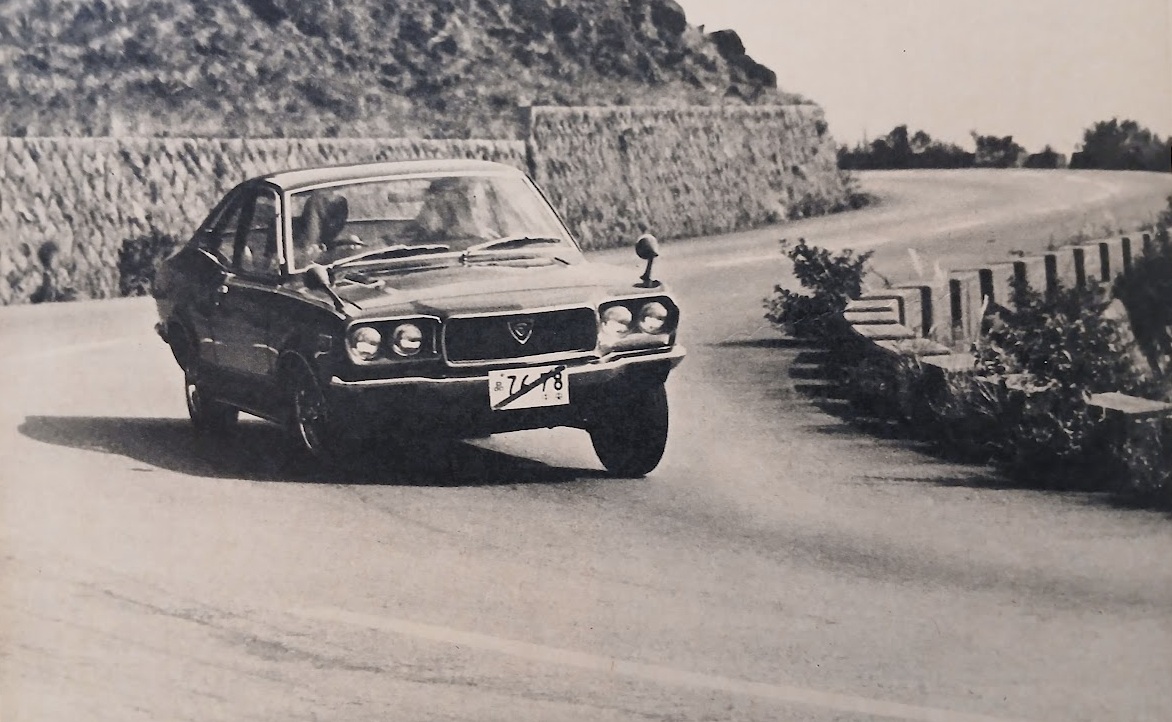
Publication: Car Graphic
Format: Road Impressions
Date: November 1971
Author: Shotaro Kobayashi
Road testing the Savanna GS II
Over the past three years, C/G has purchased two rotary-engine cars from Toyo Kogyo and has been using them continuously as transportation for our research and reporting. In July of 1969, we bought a Familia Rotary Coupe immediately upon its release, and drove it 47,000km over two years before replacing it with a Capella, which we have driven 43,000km in the past year and a half. Through a combined total of 90,000km of harsh, real-world testing with these two cars, our confidence in the company’s rotary engines has now become unshakable.
So, when we tested the new Savanna, we were no longer surprised by its outstanding power performance and quietness. What made a much stronger impression on us was its handling, which has improved dramatically.
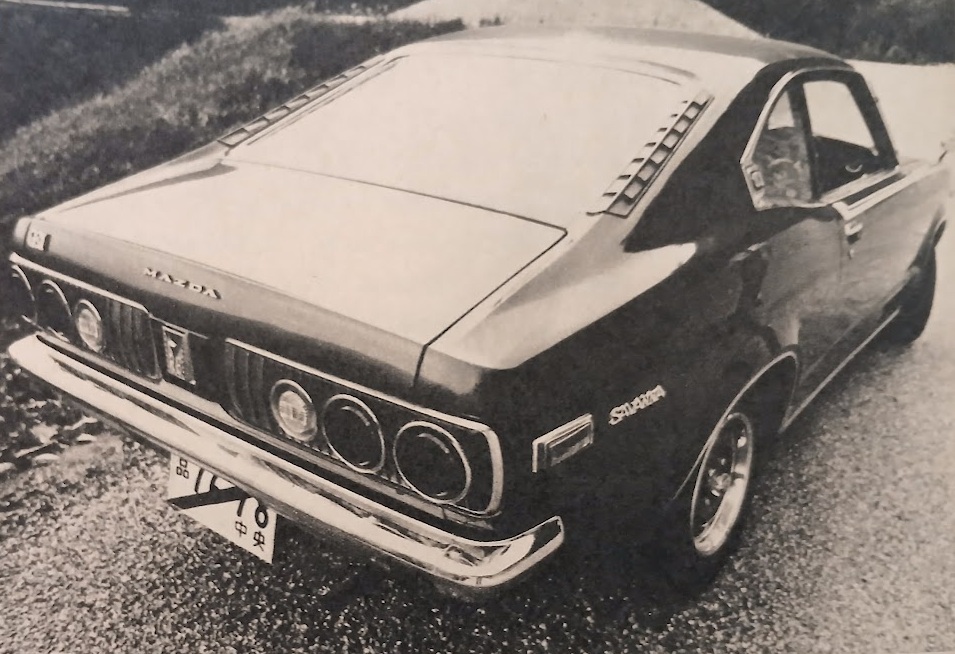
Just as with the Familia Rotary on which it is based, the Savanna is offered as a four-door sedan and a two-door coupe, both equipped with the same 491cc × 2 engine, and the three sedan and four coupe variants differ almost entirely in interior and exterior trim; mechanically, they are nearly identical. Our test vehicle was the most luxurious and most expensive version, the Coupe GS II (750,000 yen).
First, let us discuss handling. To be frank, the aspect of the previous Familia Rotary Coupe that most dissatisfied us was its handling, which was generally poor and completely out of balance with its exceptional power performance. The fundamental reasons were that, first, its basic layout gave it an unusually narrow track and the suspension was overly soft, making the car distinctly unstable at high speeds; and second, the standard tires were far too low in performance to keep up with the car’s speed potential. These two points were the key issues.
In the Capella, the rear suspension was firmly located with coils and a four-link setup, and its handling and ride comfort were improved, yet the basic problems of the narrow track and skinny tires remained, which left many people dissatisfied. Thus, in our road-test reports on the two cars, we criticized these points strongly, while in the long-term Capella test we actually carried out various modifications to improve it. These eventually managed to bring the car up to a nearly satisfactory level, as noted in our monthly reports.
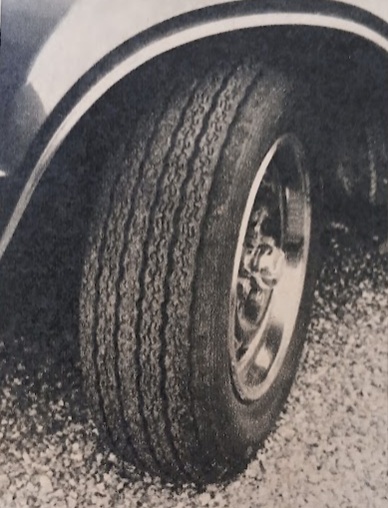
Now, the pleasant surprise when we tested the Savanna was that nearly all of the shortcomings C/G had pointed out have been corrected, and the handling is markedly improved. The chassis improvements can be summarized as follows. First, the front track has been widened by 100mm, and the wheelbase extended by 50mm. Second, the suspension has been stiffened overall, and at the rear, the DeCarbon–type dampers are mounted with the right damper positioned ahead of the rear axle and the left damper behind it, improving tire contact in resistance to the reaction forces of driving and braking torque. And third, the Coupe GS II is fitted with specially developed Bridgestone Z78-13-4PR ultra–low-profile cross-ply tires on 4.5J rims.
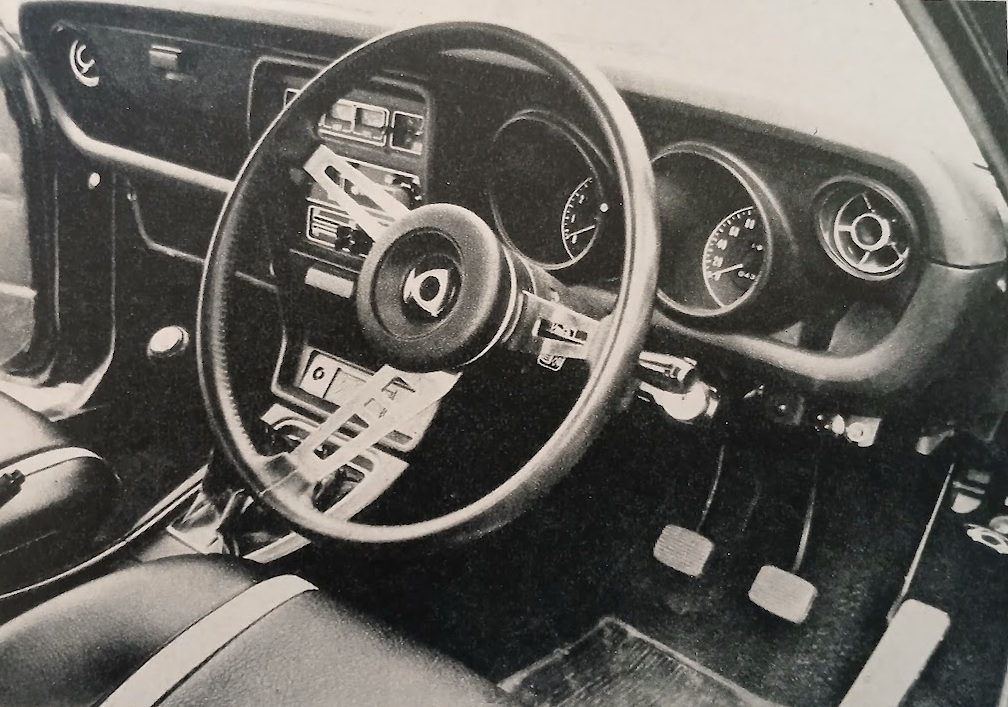
What you notice immediately when you start driving is that the steering rigidity is far higher than in the Familia or the Capella, resulting in much more positive and assured responses, especially the initial reaction when turning off-center from straight ahead. The steering wheel is now more appropriately sized (its diameter had previously been too large), yet the steering remains light even at low speeds. The Familia was strongly affected by crosswinds at high speeds, and on elevated expressways, even a slight breeze required constant counter-steering corrections. The Savanna, having nearly the same aerodynamic body characteristics, still exhibits this tendency to some extent, but overall stability is much improved, and even when blown around by the wind, the car’s suspension feels much firmer, making corrections easier.
Cornering stability is vastly superior to the Familia. We ran the test with tire pressures raised to 2.2kg all around, and although the car still shows strong understeer, the degree is far weaker than on the Familia and better suited to the preferences of fast drivers. Cornering begins with moderate understeer, but as you continue to apply power, the car rolls progressively, the inside rear wheel gradually loses grip, and eventually the tail starts to slide. However, for a car with a live rear axle, its cornering-limit speed is high, and breakaway is predictable, making it easy to control. In tight, low-speed corners, the power is strong enough that you can deliberately slide the tail out in the lower gears, and the steering retains its accuracy right to the end.
We also had the C/G long-term Capella accompanying us on the day of the test, equipped with Michelin XAS 175×13 on 5-inch rims, so we were able to compare the two cars under identical conditions. In terms of absolute cornering speed, the Capella had the advantage, thanks to its stronger power and the excellent grip of the Michelins. However, radial tires, with their low lateral rigidity, naturally break away more abruptly, which made the Capella more difficult to control. The Savanna, with its cross-ply tires, felt easier to drive in this respect.
At the very least, the Savanna’s handling is several orders of magnitude better than the Capella on standard tires. The effect of the diagonally mounted rear dampers is also clear: during hard starts or around tight corners with uneven surfaces, the leaf-sprung rear axle maintains good contact with the road. The suspension is stiffer than that of the Capella or Familia Rotary Coupe, but its ride comfort surpasses the latter car’s. In the Familia Rotary Coupe, raised manholes and similar disturbances produce a fair amount of vertical tossing, but this is much less noticeable in the Savanna.
Braking performance cannot be called excellent, but it is at least adequate. Only the GS II comes with a servo as standard, and all models are fitted with a PCV system to prevent premature rear-wheel lockup. This device alters the front–rear braking-force distribution in two stages: in a hard stop, the rear circuit is momentarily reduced in pressure, but if pedal force continues to increase, the rear pressure rises again.
As for power performance, it is, without question, superb. The engine is based on the Familia’s 491cc × 2 unit, but incorporates many of the detail improvements that proved successful in the Capella. The increase in output (from 100 to 105ps) is not something you can clearly notice on its own, but what has definitely been improved is smoothness at very low speeds. In the Capella, if you ease off the throttle approaching a stoplight, apply engine braking, and let the revs drop below about 1500rpm, combustion tends to become incomplete, producing a knocking sensation. Under no-load idling, this phenomenon never occurs, so we had avoided it by shifting into neutral early. In the Savanna, however, an auxiliary slow-speed circuit has been added to the carburetor to eliminate this incomplete combustion under light load at low rpm. The effect is obvious: you can now keep the clutch engaged almost until the car comes to a full stop without any shuddering, just like a conventional reciprocating engine.
Another improvement is in the opening mechanism of the carburetor’s secondary throttle butterfly. In previous models, there was a noticeable time lag in the opening and closing of the secondary butterfly, and its operation was abrupt. To be more specific, when cruising at a steady high speed and suddenly flooring the throttle, the secondary butterfly would not respond immediately; instead, it seemed to open suddenly only as the engine approached around 6000rpm. Conversely, when lifting off the throttle at high speed, engine braking did not come in at once, and the car would “freewheel” for several seconds. On the Savanna, this behavior has been completely eliminated.
The tachometer has the red zone marked from 6500-8000rpm, but if the engine is well run-in, the revs will keep rising seemingly without limit. A driver unfamiliar with rotary engines will almost certainly over-rev it in the lower gears. According to the handbook, the maximum speeds at 6500rpm in each gear are 49, 83, and 127km/h, but these figures are conservative–in reality, the engine can easily exceed these by 10%. First-time drivers of the Savanna will tend to rev the engine unnecessarily high, impressed by its uncanny smoothness and quietness. But once the initial excitement wears off and one becomes accustomed to the car, its remarkable flexibility becomes apparent. If you want to, you can dawdle along in top gear at a leisurely 1200rpm, and with a gentle press of the throttle, it will accelerate cleanly from that speed. Third gear is especially effective: from 20km/h to over 130km/h, the car responds instantly to throttle input, exactly as the driver intends. The throttle linkage itself operates precisely and lightly, with just the right amount of travel, making it easy to control.
The manufacturer quotes a top speed of 180km/h. Considering that C/G’s Familia recorded an actual top speed of 184.0km/h at Yatabe, and the Capella recorded 187.5km/h, the Savanna’s 180km/h claim is undoubtedly genuine. Of course, such speeds are practically impossible to reach in Japan, but regardless of this unfortunate reality, the rotary engine is the only power unit currently available that combines excellent torque from low to high speeds with such smooth and quiet operation. Cruising at 100km/h on the Tomei Expressway places the engine at 3500rpm in top gear, right at the maximum-torque point, and the ample reserve of power means that overtaking and hill climbing can both be done in top gear. In fact, if one were so inclined, it seems entirely possible to drive from Tokyo to Osaka using top gear alone. Speedometers on Japanese cars are almost always optimistic, but the Savanna’s is the opposite—an indicated 100km/h corresponded to an actual 102km/h. Likewise, the odometer under-registered by about 1.2%.
The gearbox is the same as the Familia’s, but on this test car–which had accumulated about 4,100km–the synchronizers for second and third were weak, making it impossible to shift quickly and quietly.
Although the body has been widened by 115mm overall, the usable interior width is not much different from the Familia’s. What has been greatly improved is the rear seating of the coupe. The cushions are now deeper and the backrest is more reclined, allowing two adults to sit for long periods in a natural posture. The dimensions and shape of the front seats are appropriate, allowing a relaxed, natural driving position. In the Familia, you tended to feel as if you were sinking too low into the seat, but the Savanna’s position will suit a far wider range of drivers.
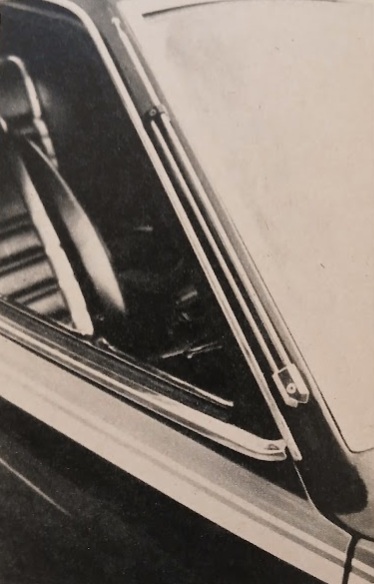
As for equipment, the Savanna’s is among the most comprehensive in this price class. The GS II even comes with a car stereo with signal-seeking radio tuning as standard. The lower half of the antenna mounted on the front pillar is divided into two rods, which is said to reduce the wind noise that tends to originate from this area. The adhesive bonding of the windshield and rear window to the body also contributes to very low wind noise at highway speeds. One small ergonomic annoyance: the light switch lever on the left of the steering column is too short. The same was true on the C/G long-term Capella, and extending the lever by about 60mm would make it much easier to use.
Finally, regarding fuel consumption, the average for our Tokyo-Hakone touring plus city driving came to 7.46km/l, which is quite acceptable considering the performance. (The accompanying Capella returned 6.08km/l.) Regular gasoline is of course sufficient. The fuel tank is large, at 60 liters, but since it sits behind the rear seat, it shortens the trunk front-to-rear.
With its fundamentally excellent suspension and tires, the Savanna Coupe GS II is already a compact grand tourer in its own right, but it also provides an ideal foundation for tuning it up and creating a true practical GT car.
Postscript: Story Photos