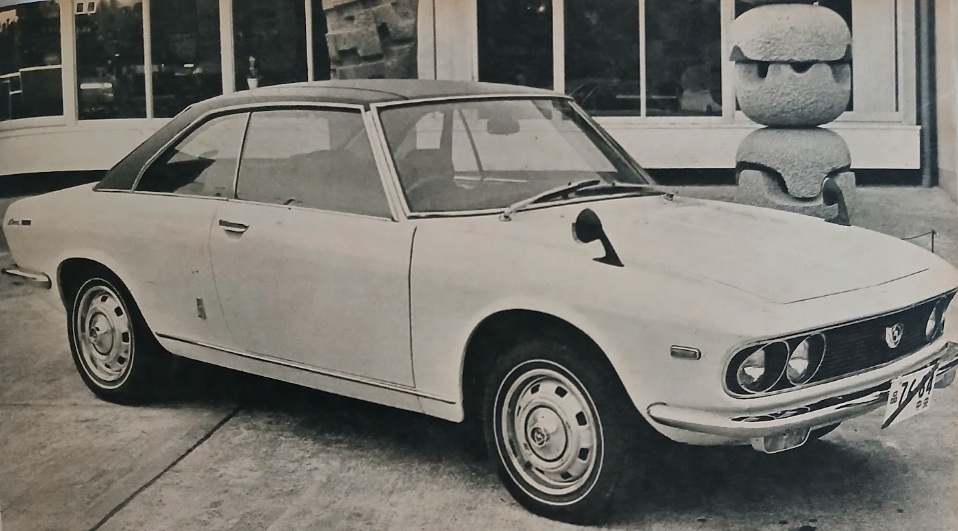
Mazda Luce Rotary Coupe (1969)
Publication: Motor Fan
Format: Test Drive Report
Date: December 1969
Author: Katsuzo Kageyama
From the Cosmo Sport to the Familia Rotary series, Toyo Kogyo’s mission of “rotaryization” is steadily showing signs of success.
The Luce Rotary Coupe is an attempt to further upgrade their rotary technology and apply it to luxury passenger cars. This car, which debuted at the Tokyo Motor Show two years ago under the name RX87, has lines similar to the Luce in appearance, but in terms of overall quality, it should be seen as a car that concentrates all of Toyo Kogyo’s technology into one vehicle and serves as the spark for the upcoming rotary offensive.
Styling Makes a Strong First Impression
I was recently offered the chance to test drive this newly released car on short notice, so without any background knowledge or prior research, I decided to take the opportunity and share my firsthand impressions of it.
Since it was named “Luce,” I mistakenly assumed this car would be a conventional Luce body with a rotary engine installed, but the moment I saw it in person, I was shocked to realize how wrong I was.
Although it bears the name Luce, it is a completely different car underneath. It’s nothing like the relationship between the Familia and the Familia Rotary Coupe; rather, the Luce Rotary Coupe is fundamentally different in every way from the conventional Luce. If you had to identify a point of commonality, the strongest one would be its Italian-esque styling and image.
Certainly, the visual impression is similar. Moreover, it is far more beautiful than the existing Luce. To be honest, ever since the Mazda R360 Coupe, I had always been dissatisfied with the styling of Toyo Kogyo’s passenger cars. However, when the Luce was announced, I thought, “Huh?” It may be a very impolite thing to say, but my honest impression at the time was that it was “too beautiful to be from Toyo Kogyo.” The new Luce Rotary Coupe is even better-styled than that. It is no exaggeration to say that it is flawless; there is no obvious room for improvement.
I think the key to the beauty of this styling lies in the proportions of the body dimensions. Compared to the conventional Luce, the overall length is 215mm longer, the overall width is 5mm wider, and the overall height is 45mm lower. It is noteworthy that despite the low overall height, the ground clearance is actually 5mm higher than the Luce sedan, probably because the FF system integrates the differential with the transmission, located between the front suspension springs.
The long hood is also a key element of the car’s distinctive style. Moreover, taking full advantage of the rotary engine’s compact size, the hoodline is low and slopes downwards towards the front, which not only improves visibility but also contributes to the car’s aesthetics.
Moving Away From Engine Comparisons
Since the rotary engine first appeared, there has been much discussion comparing it with reciprocating engines. Naturally, the discussion has focused on the power performance, durability, and manufacturability of the rotary engine in automotive applications.
At this point, if we were talking about a car that simply had a rotary engine mounted on the body of a conventional reciprocating-engine vehicle, the evaluation would naturally tend to focus on comparing the relative merits of the engines themselves.
Fortunately, the Luce Rotary Coupe cleverly integrates the rotary engine’s unique characteristics in the overall design of the car, creating something new in both style and function. From now on, I feel it’s necessary to not simply discuss the pros and cons of the rotary engine, but to consider the pros, cons, and character of the vehicle as a “rotary car;” that is, to evaluate it from the perspective of the car as a whole. Looking at this car with that in mind, one realizes that its distinctive and elegant style would not have been possible with a comparable reciprocating engine.
Because it is a two-door, the doors open fairly wide, and as you get in, you notice that the driver’s seat area feels very spacious. Thanks to the hardtop window arrangement, which has no triangular vent window or center pillar, you have a wide field of view. As mentioned earlier, the lowered nose also helps improve forward visibility.
The front-wheel drive (FF) configuration means that the floor is nearly flat, which also helps to expand the interior space. The effect is particularly noticeable in the rear seats. However, although the car is 215mm longer in overall length than the conventional Luce, the length of the passenger compartment is actually 175mm shorter. This makes the rear seats feel a bit cramped, but this should be acceptable given the car’s design objective as a coupe.
All Equipment Included
The car I drove was a Super Deluxe model, and it was equipped with literally every possible luxury feature. It’s rare to see a car of this size with such luxurious equipment. In this sense, it feels like a scaled-down version of an American luxury car. It comes with air conditioning and dehumidification, power steering, power windows, a rear defogger, and a radio with car stereo… it’s such a lavishly-equipped car that it makes you wonder if it was designed under the supreme directive, “give it everything expensive.”
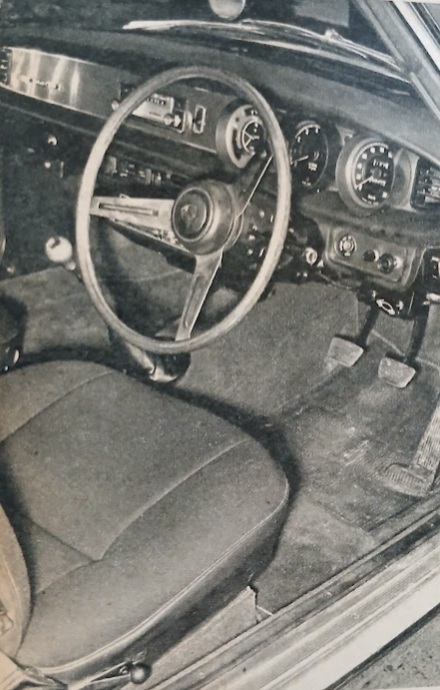
The instruments are easy to read, and incorporating the clock in the center of the combination meter is an interesting idea. The cloth seats are a little shallow in the cushion, but they feel good. The wipers, washer, turn signals, and passing flasher, all frequently used while driving, are controlled with a single lever to the right of the steering wheel. This is not a bad idea, but since I wasn’t used to it, I accidentally turned on the wipers several times. However, the intermittent wiper setting is certainly convenient.
The other switches were generally easy to operate, but the four power window switches on the inside of the doors were not. Power windows are now considered necessary for this kind of luxury car, so I approve of the decision to adopt them, and it’s nice that there are no cumbersome window handles on the inside door panels. However, the convenience of these power windows is premised on the assumption that they won’t stop working, and if they do, there’s nothing you can do about it.
I was made to realize this fact when the left window became loose during the test drive and couldn’t be fully closed. Is expecting such thoughtfulness as providing a sturdy crank handle too extravagant in such a luxury car?
Still Plenty of Engine Space
Opening the hood and looking into the engine bay, one can see that even though the rotary engine has been enlarged to a single chamber volume of 655cc, it is still very compact, and the advantages of the FF layout are clearly shown in the all-in-one power unit. This combination of rotary engine and front-wheel-drive once again highlights the ingenuity of the car’s basic design.
The air conditioning compressor doesn’t get in your way when you reach around the engine, and since the engine’s bulk is smaller than that of a reciprocating engine, everything appears to fit relatively easily in the engine bay, even though the height of the hood is very low. This simplified packaging is one of the rotary engine’s advantages.
The more luxurious the equipment, the more crowded the engine bay becomes with various devices, so in this respect, it seems that there is room for rotary cars to further demonstrate their advantages in the future, as such features become more commonplace.
Finally, I returned to the driver’s seat, started the engine, and began driving. The smooth, quiet engine rotation and the ease of use that comes from the flat torque curve were instantly familiar… these are the joys of rotary cars that I had already experienced with the Familia Rotary Coupe.
High output at high engine speeds and maximum torque at low speeds, realizing a wide rotation range and flexible characteristics, are the ideal conditions for a practical passenger car, and reciprocating engines simply cannot match the rotary in this respect. In the Luce Rotary Coupe’s case, the larger-displacement rotary’s ample horsepower reserves and tenacity at low speeds make it perfect for the goals of a luxury passenger car.
I entered the highway and accelerated at full throttle. The engine speed rose evenly, smoothly, and without vibration, again that unique rotary-engine sensation. Despite being an elegantly-styled luxury car, it exhibited impressive acceleration performance.
With plenty of power in reserve, changing highways at the interchange to follow the pre-planned route was easy. While familiarizing myself with the car, I was reminded of the excitement I felt when I first drove a Familia Rotary Coupe a little over a year ago. At the time, I got a little carried away with my enthusiasm, and the smooth, almost uncanny acceleration made me want to shout, “No reciprocating engine can keep up with me!” Compared to that car, this one’s engine is larger and more powerful, but its acceleration isn’t as impressive. It can’t be helped, as the car is larger and quieter, and it’s heavier with all the luxury equipment.
After all, the Luce Rotary Coupe is 200kg heavier than the conventional Luce, and its aim is to be luxurious, so the standing quarter-mile isn’t as important, and it should be fine as long as it satisfies practical requirements such as accelerating easily around town and entering the highway effortlessly. Another thing I noticed after accelerating repeatedly was that the first gear ratio seemed significantly lower than the tall second gear. This also seems to be a good indication of the aim and character of this car.
Problems With Power Steering
Let’s take another look at the area around the driver’s seat. The car offers a tilt steering wheel, since simply sliding the seat back and forth is not enough to create a natural connection between the driver and the car; naturally, the steering wheel must also be designed with this in mind. The adjustment is also extremely easy. All of the pedals are light. The shift lever has a rather long stroke and is positioned a far reach away. Of course, it could be that my arms are shorter than average. However, the fact that the stroke is too long has nothing to do with the location, and I wish it were a little shorter.
What’s more, the lever’s flexibility is quite noticeable. I later heard that rubber is inserted between the lever and the linkage to prevent the small shocks from gear engagements from being transmitted to the driver’s hand. I know that there are other manufacturers that do the same thing, but I wonder why they would go to the trouble of blocking the sensation of gear changes in the first place.
As soon as I started driving this car, I thought, “Huh?” What struck me was the lightness of the steering. This is due to the steering being power assisted, which is a major feature of this car, but also a major problem. The reason why Toyo Kogyo chose to use power steering was to prevent the natural tendency for steering to become heavy in FF cars, due to the disproportionately heavy front wheel load.
By the way, if you ask most drivers, “Which is better, heavy steering or lighter steering?”, the majority will answer, “light steering is better.” In particular, most female drivers will say, “The lighter, the better.” Therefore, it is only natural that manufacturers will try to make the steering as light as possible and use this as a selling point.
It is often said that when women drive larger and heavier cars - in truth, anyone physically smaller or less experienced - the problem they often face is not simply a lack of arm strength, but the overall effort required to turn the steering wheel. For example, when maneuvering a car into a garage, which requires lock-to-lock twirling while moving at a very slow speed, the lack of steering assistance can easily lead to late corrections or misjudgments, causing the car to hit a telephone pole or scrape the side of the body. Therefore, power steering is an important aid to offset the driver’s physical strain, making it easier to steer and allowing women and other drivers to maneuver without exertion. I agree with this approach; in fact, it’s a natural prerequisite for a luxury car. I personally found it very useful as it allowed me to easily make U-turns and maneuver in tight spaces.
Relationship Between Steering Angle and Sensation
So far, so good. However, there is one more important thing to consider when it comes to steering weight. This is an essential point for safe high-speed driving, and it is to ensure that the change in the restoring moment of the front wheels caused by side forces acting on the front wheels is transmitted to the driver’s hands via the steering mechanism.
In other words, at the same time that the driver turns the steering wheel to change the direction of the front wheels, any sideslip of the front wheels must provide feedback to the driver in the form of a change in the weight of the steering wheel. This is a necessary condition for safety. The driver cannot tell how much the side forces are building on the front wheels visually; rather, he or she indirectly senses the degree of sideslip through the weight of the steering wheel, and makes a judgment along the lines of, “this much feels okay” or “this is getting dangerous,” which is what enables the driver to safely negotiate high-speed turns.
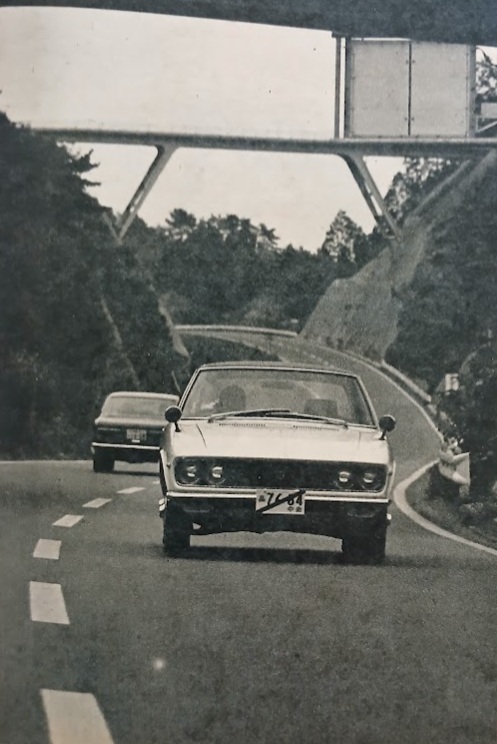
However, in the Luce Rotary Coupe, this feedback seems to be extremely weak. As I wound my way up the twisting Otome Pass, carving left and right through the curves, I was often surprised by the sudden, loud squealing of the front tires. However, the steering wheel gave no real feedback at all when this occurred.
In a normal car, the steering wheel would gradually become heavier long before it got to that point, alerting the driver to the increasing sideslip, but in this car, it seems that the build-up is very difficult to feel unless you are a very sensitive person. The design of the power steering mechanism is apparently meant to make the steering wheel heavier according to the steering moment, but the change is very slight.
Another strange sensation I noticed was that the steering wheel felt momentarily heavy when I first started to turn it, but then suddenly became lighter as I continued to turn it.
This “sticky” sensation is common with power steering, and it is inevitable to some extent due to friction in various parts until the valve opens and the hydraulic pressure begins to work.
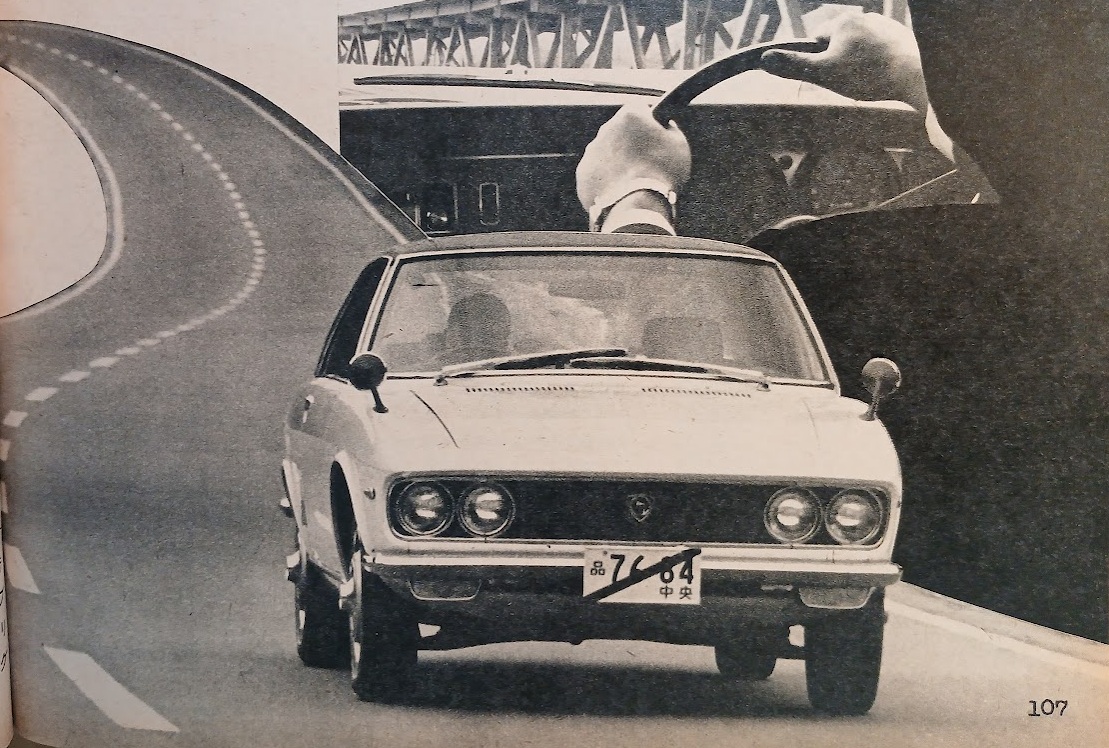
However, it should be possible to make it just that bit smoother, and in fact, it wasn’t much of a problem when I test drove another car later. But in the test car, every time I tried to change lanes to overtake while speeding down the Tomei Expressway, I was made painfully aware of the poor steering characteristics. The wheel had a sticky weight when I first started to turn, then suddenly gave way as the car veered sideways. Even after changing heading, the same thing would happen when I tried to steer back to stay in the passing lane, and it didn’t settle down well.
Generally, in FF vehicles, the steering weight changes as the throttle is opened and closed in corners. This is because the front wheel sideslip angle changes. However, thanks to the characteristics of the power steering, this FF “quirk” has been completely eliminated in this car, to the point where you can’t even tell it’s a FF car when you drive it.
Looking back at the power steering of this car as a whole, it seems that the emphasis on making parking, U-turns, and tight corners easier has resulted in steering characteristics that are convenient for low-speed operation, but are honestly undesirable at high speeds. In other words, it is by no means a sporty steering system; rather, it is suited to those who prefer a relaxed, leisurely, and elegant driving style. It will probably be well-received by drivers attracted to luxury cars.
For my taste, the power steering is too strong. I would prefer it to be less pronounced and rely more on manual effort, which would give more road feel and make control easier at high speeds.
Exquisite Brakes
I ended up spending a lot of space on the power steering, so I’ll leave it at that and move on to the next topic.
When I was accelerating, I let the engine rev too far and the tachometer went into the red zone, which sounded a beeper. This was quite a good feature. The sound reminded me of the danger of over-revving. Other sounds in the Luce Rotary Coupe are less useful. While I was waiting at an intersection with my turn signal flashing, the loud clicking noise blared incessantly inside the car. All Toyo Kogyo cars use this feature. While it may be effective in making it easier to notice when the signal is left on after going around a corner, is such a loud noise really necessary? At busy intersections, this noise is especially irritating to the driver.
When I tried using engine braking on the descent at Hakone, I felt that the engine braking was not very effective, a typical characteristic of rotary engines. On a reciprocating engine car, the engine braking would have been immediately effective just by downshifting from top gear to third, but on this car it felt like this had almost no effect, and only finally worked when I shifted down to second. In this sense, the feeling is similar to that of a two-stroke engine.
As a result, you have no choice but to rely on the wheel brakes. Fortunately, the brakes, with discs at the front, leading/trailing drums at the rear, a masterback vacuum booster, and a tandem master cylinder, work very well with only light pedal pressure. The feel is exquisite, and it was one of my favorite features of this car.
Simply achieving “light pedal pressure” is not difficult at all. However, to achieve a good braking effect while making delicate control easy with even lighter pedal pressure requires advanced technology. Also, because this car is FF, the static front wheel load is heavy and the rear wheel load is light, so when braking, the rear wheel load becomes especially light, which can easily cause the rear wheels to lock and result in dangerous tail sliding. To prevent this, a proportioning valve is provided to automatically prevent the rear wheels from locking.
Safety Design Prototype
It is true that the aim of this car seems to be “luxurious equipment at any cost,” but at the same time, it is very good that the idea of “safety design” is applied not only to the brakes but also to seemingly everything else. The various attempts at “safety design” realized in such a high-end car will likely appear in various forms in low-priced mass-market cars in the future. Bearing in mind the price, it’s hard to imagine that this car will sell in large numbers, but if we consider it as a “prototype of safety design,” it is far from irrelevant to the general public who buy mass-market cars.
The suspension is a four-wheel independent system with wishbones and rubber torsion springs in the front and semi-trailing arms in the rear. Like other cars from this company, the springs are soft with a fluffy feel, but there seems to be little roll. However, perhaps due to the radial tires and the high-frequency vibrations transmitted through the shock absorbers, the car tends to pick up joints in the pavement quite strongly. Sound insulation is very good, and as long as the windows are sealed, there is virtually no noise, not even wind noise at high speeds. Combined with the quiet rotary engine, this car has an atmosphere that lives up to its luxury car positioning.
Luxury cars need large trunks for carrying their owners’ many personal belongings, so let’s examine the cargo area. The trunk is somewhat shallow and its floor is raised to accommodate the spare tire and 65-liter fuel tank, but the flat floor extends all the way forward to the rear bulkhead and is very wide.
What’s more, if you pull out the armrest in the middle of the rear seat by undoing a fastener, you can reach inside and take out items from the trunk, and you can also load long items like skis by threading them through the trunk and into the interior, which is an interesting and highly practical idea.
Finally, regarding fuel consumption, the route was slightly different over the round trip from Tokyo to Hakone, but the consumption data measured on the outbound journey was 7.2km/l over 110.6km. If we consider this rotary engine, with a single chamber capacity of 655cc, to be equivalent to a 2620cc (655 x 2 x 2) reciprocating engine, then we must say that its fuel consumption is somewhat high. Also, it seems that for tax purposes it will be treated as an 1800cc engine depending on its “vehicle class,” but compared to an 1800cc reciprocating engine, its fuel consumption will be significantly higher. However, since the car can run on regular-grade gasoline, the difference in fuel cost will not be as great as with a high-performance reciprocating engine that requires high-octane gasoline.
Finally, I should add that on my round trip from Tokyo to Hakone, the tolls on the toll road were always priced at “small passenger car” rates.
Postscript: Story Photos