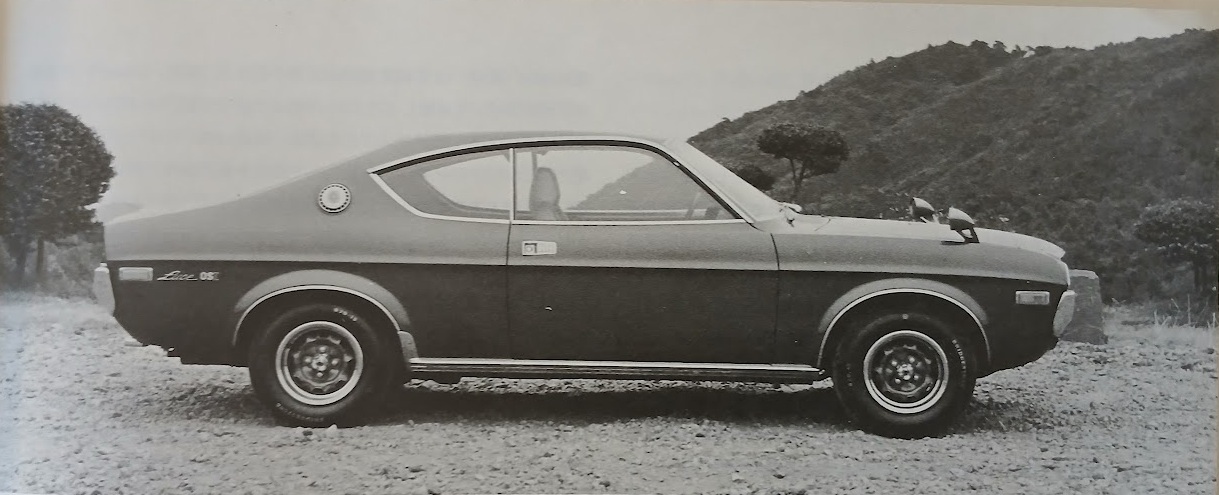
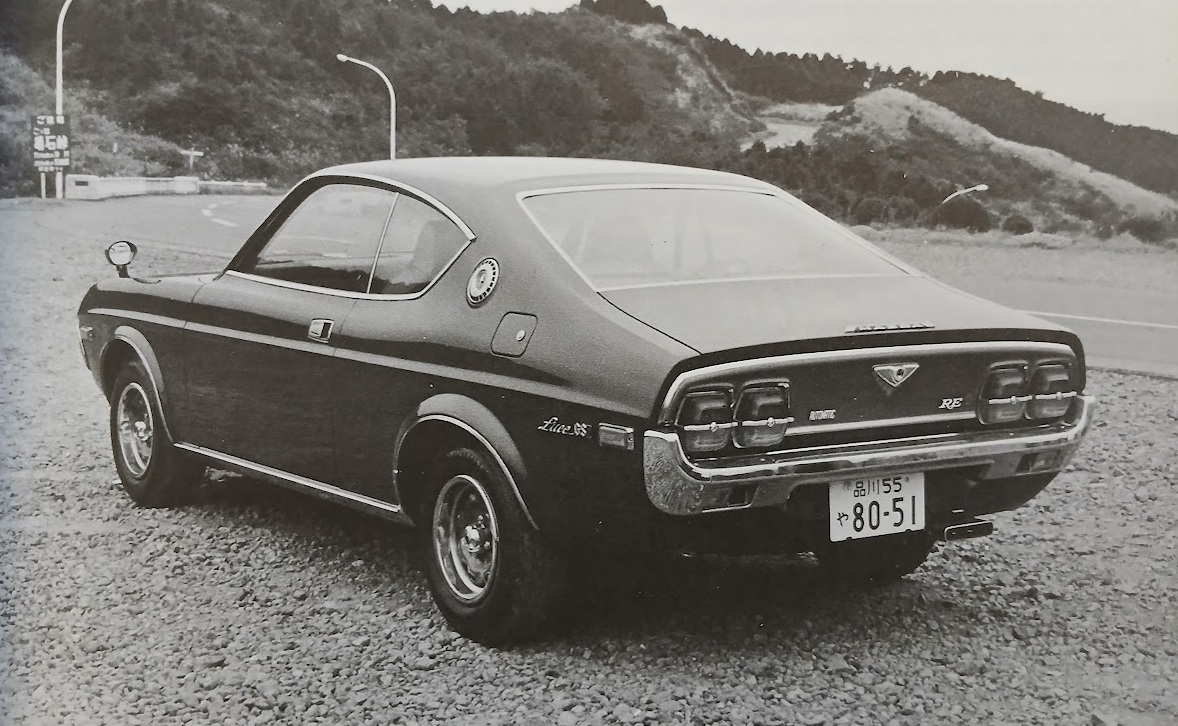
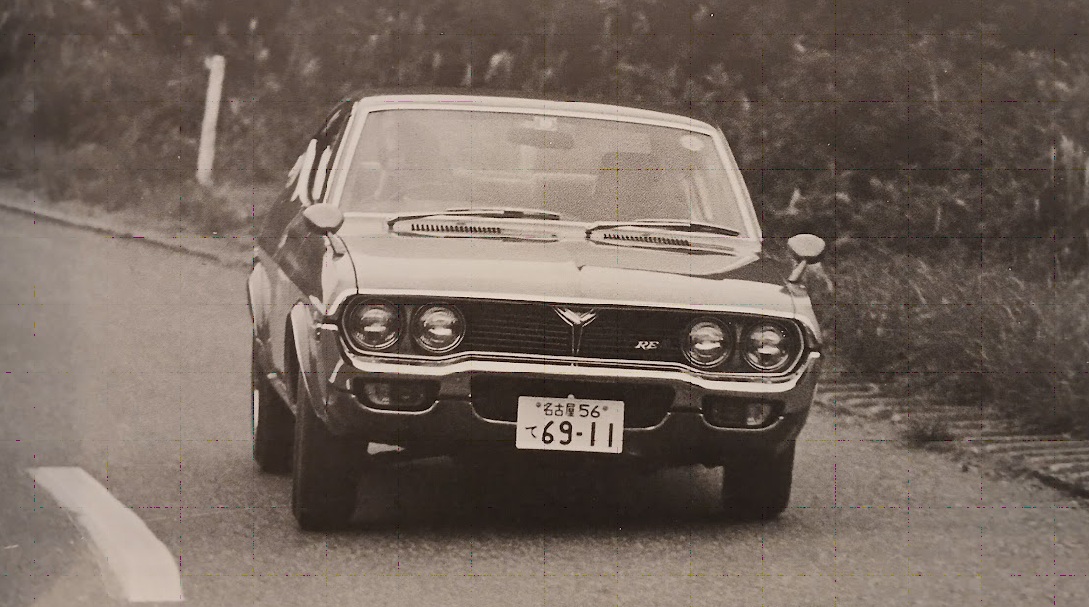
Mazda Luce Hardtop GS II (1973)
Publication: Car Graphic
Format: Road Impressions
Date: April 1973
Author: “C/G Test Group” (uncredited)
Summary: The highest-performance version of the new Luce. A refined personal luxury car with a smooth and quiet rotary engine. Despite its enticing specifications, handling is no better than the average domestic passenger car. Excellent ride comfort and accommodation. Fuel economy is improved over the AP version.
Road testing the Luce Hardtop GS II
Of the new Mazda Luce series introduced last October, we chose the highest-performance Hardtop GS II for this test, covering approximately 850km. We had already had a brief opportunity to drive this model shortly after its introduction, and came away deeply impressed by its handling, which was on a level completely unlike anything previously found in a Mazda production car.
In last month’s road test (No. 141), we covered the Luce Sedan GR AP, fitted with the much-discussed thermal reactor exhaust-emissions system. Contrary to what the name “clean engine” might imply, it proved capable of producing genuinely effective power. Along with its excellent automatic transmission, one of its most striking qualities was, again, an exceptionally well-balanced chassis. Even the standard sedan—equipped with 5J × 13-inch wheels (wide by Japanese passenger-car standards) and ordinary 6.45-13 4PR cross-ply tires—was already well above the level of the average family car.
That naturally heightened our interest in the sporting version of the range. Its rims are widened by a further half inch and fitted with unusually wide B70-13 4PR tires, developed specifically for the Luce—roughly equivalent to 195/70-13 radials. The rear suspension, a live axle suspended on semi-elliptic leaf springs, is further reinforced by a pair of robust torque rods. Our expectations for this model were therefore extremely high.
The test car was the hottest model in the catalog, combining the 573cc × 2-rotor, 130hp engine—without the thermal reactor—with a 5-speed manual gearbox. Equipped with the optional power windows (30,000 yen), it was priced at 1.04 million yen. Mazda also offers the GR II Custom—a sporting version of the standard four-door sedan—using the same chassis. Both models can alternatively be ordered with the thermal-reactor AP engine, rated 5ps lower, or with an automatic transmission.
Let us begin with the area that interested us most: the handling. Here, the results of our test proved to be a major disappointment.
The chassis’ potential is simply insufficient for truly spirited driving. Overall, it belongs very much to the “sluggish” category and has moved little beyond the level of typical Japanese sporting cars (most of which still have chassis that fail to keep pace with their engines).
If the thoroughbred we drove over the mountain roads of Izu at the time of its introduction (see C/G No. 139, p. 68) was indeed a Luce Hardtop GS II, then the GS II before us now ought to be, at least on paper, exactly the same car. Yet once behind the wheel, it behaved like a different car altogether. The disparity between the two goes far beyond anything that could reasonably be explained by differences in mileage, normal wear, or the degree of individual variation acceptable in a mass-produced vehicle.
The “GS II” we praised so highly was unquestionably the best-handling among Japanese production cars. Although entirely conventional in its chassis layout, its handling was, for all practical purposes, neutral. Even in fast corners, once the desired steering angle had been set, the car could be driven through the curve under full power in third gear without the slightest correction, tracing its line as if running on rails.
The steering was fairly heavy, yet almost completely free of the elastic on-center play so common in passenger cars. It was appropriately responsive while, despite the exceptionally high lateral stiffness of the tires, almost completely shutting out kickback over rough surfaces. As the steering of a sporting car, it could even have been described as “textbook.”
Equally remarkable was the way it combined this handling with an exceptionally high level of passenger-car ride comfort.
The GS II subjected to our second test, which included comprehensive measurements at Yatabe, shared only one significant characteristic with the earlier test car: its exceptionally solid, composed ride, regardless of road surface.
The steering, in particular, came as a genuine shock. Not only did it lack overall rigidity, but the elastic on-center play—including pure mechanical free play before any steering movement was transmitted to the car—amounted to more than 10cm at the rim. In fact, even while travelling in a straight line at 100km/h, one could swing the steering wheel vigorously some 45 degrees side-to-side with very little response from the car.
As a result, when driving on an expressway in a strong crosswind, for example, one must anticipate this dead zone whenever correcting the car’s course. Until one gets used to it, this inevitably demands more concentration than it should.
The car’s overall behavior is also characterized by pronounced understeer throughout. Even on the B70-13 cross-ply tires (the test car was fitted with Bridgestone Skyway Deluxe), said to provide cornering power roughly halfway between 175SR-13 and 195/70SR-13 radials, it becomes difficult to hold the intended line unless the steering—already turned in to an unusually large degree—is turned farther still into the corner. Despite this, steering effort remains extremely heavy, so that pressing on along a winding road soon leaves one’s arms tired.
Even the Capella Rotary Coupe GS II, with the most highly developed chassis in the Capella range, falls short of being fully satisfactory in the handling department. This Luce GS II is at much the same level. Indeed, allowing for the difference in tires—the Capella GS II being fitted with 165SR-13 radials—the Luce may actually be the inferior of the two.
The strength of its understeer can best be illustrated this way: lift off the throttle in mid-corner, and the nose immediately tucks in, almost like that of a powerful front-wheel-drive car. On top of this, the body rolls considerably. In tighter corners, the inside rear wheel becomes light enough to spin furiously, causing speed to fall away abruptly.
What accounts for such a stark difference between the two cars, we cannot say. According to the manufacturer’s official position, the earlier example and the one tested this time should be identical in every detail. One can only hope that, through some mistake, this car had been fitted with the standard suspension instead. When we first expressed our admiration for the Luce’s handling, we added that we hoped the production version would faithfully retain those specifications. Regrettably, we were right to be concerned.
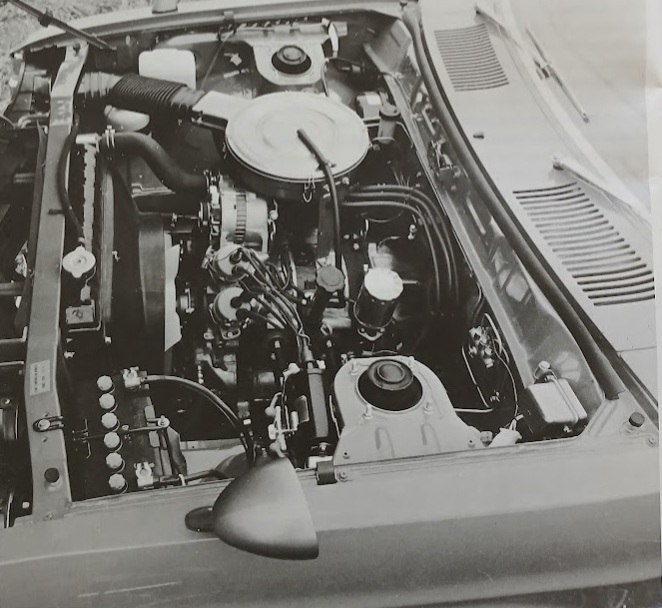
The GS II version of the 573cc × 2-rotor 12A engine, which belongs to the same family as that fitted to the Capella but dispenses with the thermal reactor (designated Type 3), is rated at 130ps/7000rpm and 16.5kgm/4000rpm—the highest output achieved by any production rotary engine from Toyo Kogyo.
For a car weighing 1,035kg, this provides more than adequate performance. Whatever one’s style of driving, there is no sense of the engine being overmatched. Without the special emissions-control equipment, however, the carburetors are set as lean as possible in the interest of reducing CO emissions. (Conversely, thermal-reactor models are supplied with a mixture nearly twice as rich to promote the reactor’s operation.) As a result, the engine lacks a strong feeling of punch overall, and is particularly slow to pick up revs beyond 5000rpm.
Unfortunately, the engine in our test car was not in perfect tune, and this loss of eagerness at high engine speeds became especially evident during the maximum-speed tests.
Unusually for a Japanese car of this type, maximum speed is reached not in the 0.862:1 overdrive fifth gear, but in direct fourth. In the flying-kilometer test, the car recorded 177.43km/h in fourth gear at 6900rpm (the speedometer indicated the catalog figure of 190km/h), while fifth gear resulted in a slightly lower 174.08km/h at approximately 5600rpm (about 181km/h on the speedometer). The taller ratio simply reduced the available driving force, and the car’s speed fell away accordingly.
Indeed, if left in fifth gear, the moment the car entered a headwind, the tachometer needle immediately dropped to around 5300rpm.
If the engine had been in proper condition, though, it would have almost certainly exceeded 180km/h. The Capella GS II, with nearly identical gearing—overall ratios of 15.141, 9.303, 5.743, 4.111, and 3.544, with 13-inch wheels—recorded 181.82km/h in fifth gear over Yatabe’s 1km straight during C/G’s own tests. The two cars are also very closely matched in power-to-weight ratio, at 7.96kg/ps for the Luce and 7.84kg/ps for the Capella.
Both standing-start acceleration and in-gear overtaking performance fell slightly short of the figures C/G previously recorded for the Capella at Yatabe. While this may have partly reflected the engine’s state of tune, the more important factor lies in Toyo Kogyo’s evolving approach to rotary-engine development. With each successive generation, the company’s rotary engines have become progressively more civilized and more flexible.
Indeed, in the early Capella, even measuring fourth-gear acceleration from 20-60km/h, if only to obtain the data, was virtually impossible, because the engine suffered from a kind of knocking. Since then, considerable effort has been devoted to giving the engine sufficient usable torque for smooth running at low speeds, making the car easier to drive. The price paid has been a gradual softening of the rotary engine’s once-ferocious character.
The 5-speed gearbox is the same one fitted to the Capella and Savanna GT, with fifth gear forward and to the right of the usual H-pattern. As with earlier examples of this transmission, however, its shift quality and the capacity and durability of its synchronizers leave something to be desired. The gearbox in our test car—which had already endured some 3,000km of almost certainly hard use—consistently produced pronounced gear clash whenever we made hurried shifts during acceleration tests.
Nor is this an exceptional case. Even in C/G’s own Savanna, subjected to nothing more than normal everyday driving, the 4-speed gearbox cannot be said to have especially strong synchronizers. For now, the best choice is probably a model equipped with the JATCO automatic transmission. Although it costs 35,000 yen more than the 5-speed, its smoothness fully brings out the rotary engine’s unique qualities. At the same time, it is entirely capable of sporting driving as well.
The servo-assisted disc/drum brakes provide adequate stopping power for the car’s weight and performance, their only real shortcoming being a pedal that feels somewhat springy and lacking in firmness. In our fade test—acceleration from rest to 100km/h, followed immediately by braking at approximately 0.5g, repeated ten times—pedal effort increased only from 16kg on the first run to 23kg on the tenth. Resistance to fade can therefore be considered exceptionally high.
As for fuel economy, we had expected some improvement over the Luce AP tested previously, where the excessively rich mixture—required to promote operation of the thermal reactor—had made it particularly uneconomical at low and medium speeds. In the end, however, after driving the car hard at Yatabe, Hakone, and Izu, making full use of the tachometer’s 7000rpm range, the overall average was 5.35km/l. This is probably about the poorest figure the car is capable of returning. Even so, its steady-speed fuel consumption at low and medium speeds was markedly better than that of the AP model, which was at least some consolation.
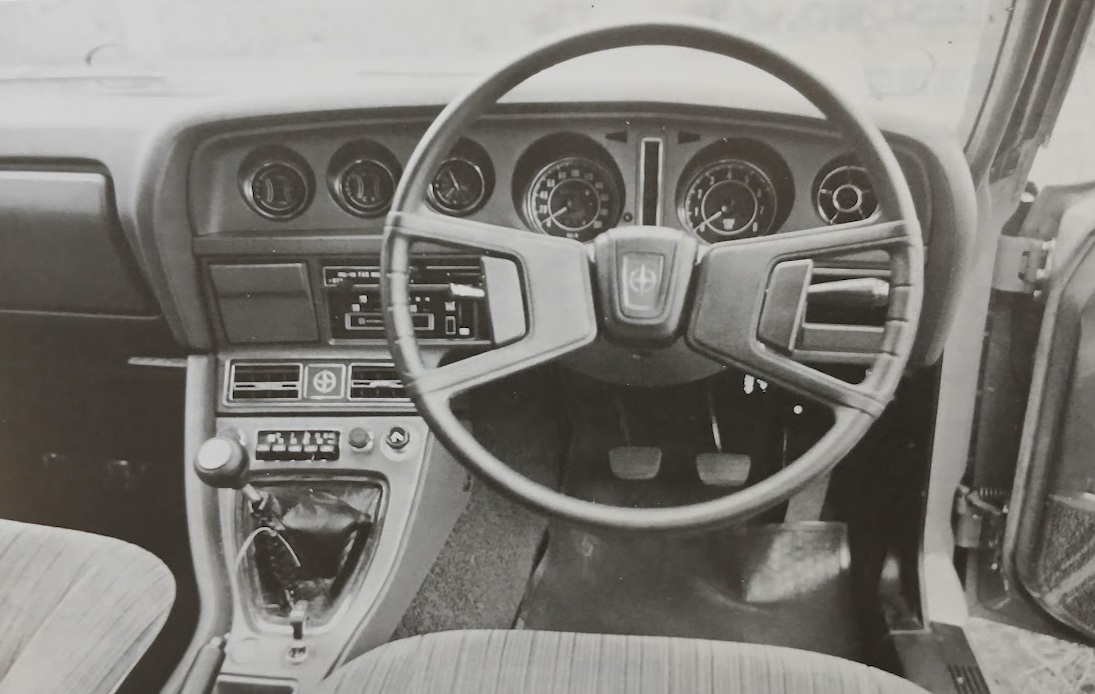
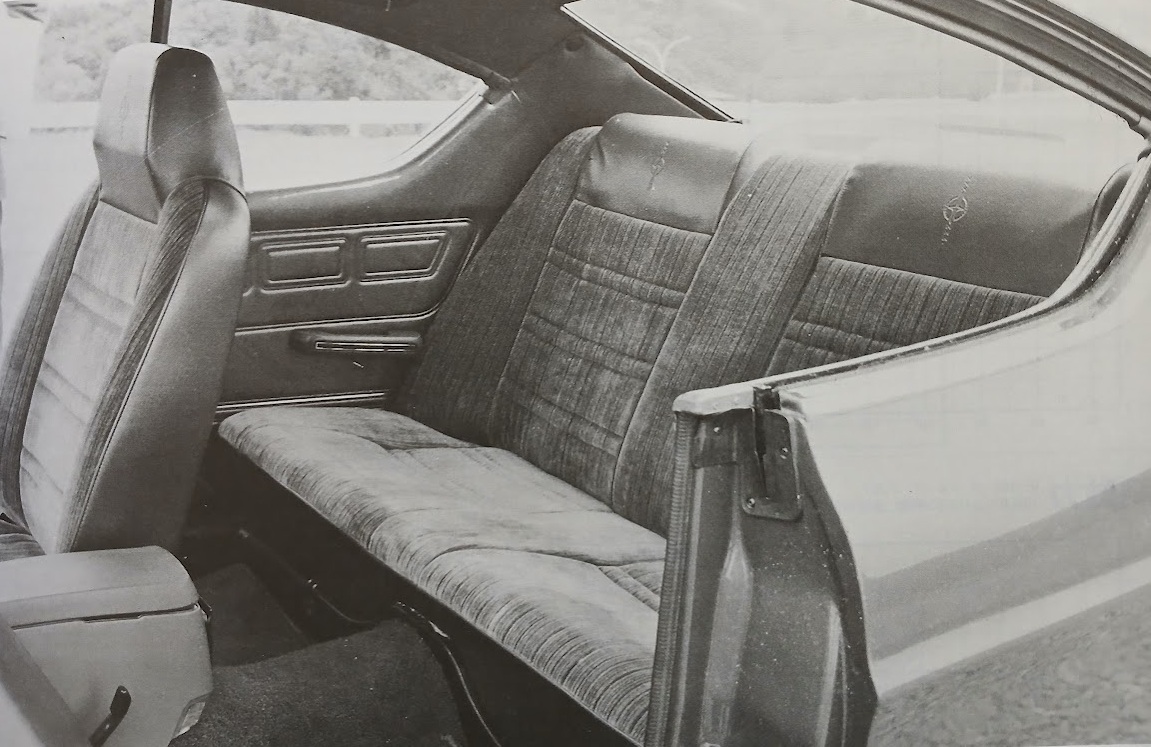
The cockpit-style driving position, with the entire instrument panel curving toward the driver, is well judged. The steering wheel, pedals, and gear lever are all naturally positioned, allowing a relaxed and comfortable driving posture. The seats are slightly short in cushion length, but their shape provides excellent support, while the wide-ribbed corduroy upholstery offers a secure grip. The rear seat is adequately sized, with sufficient legroom, but the fastback body style inevitably requires a steeply sloping rear window. Leaning back in the seat, the large window frame ends up directly above one’s head. The optional power windows are controlled by individual switches, with a group of four under the right-hand side of the dashboard. These, however, are difficult to reach while driving—particularly when wearing the standard three-point seat belt. The bi-level heater and ventilation system is very effective, and the outlets at either end of the dashboard deliver an impressive volume of air. Among the smaller details, the offset wiper arms and blades (the GS II also provides an intermittent setting) further improve forward visibility.
So far as we are now able to judge, the Luce Hardtop GS II is essentially a larger, more comprehensively equipped Capella. Its basic character remains that of a long-distance, high-speed cruiser. However, its greatest appeal compared to the Capella is that with only modest changes to its steering and suspension, it can become a genuinely sporting car, fully capable of bringing out the rotary engine’s power. This is exactly what the much-publicized wide-track layout—with a front tread of 1380mm, equal to the car’s overall height—the 5½J wheels, and the exceptionally wide tires were all intended to achieve. We know such a Luce existed, because we have driven it ourselves. Our only wish is for the production Luce to be returned to the specifications of the “pre-production prototype” (or “press test car”) that we first drove in Izu.
Postscript: Story Photos