Mazda Luce Rotary Coupe (1969)
Publication: Car Graphic
Format: Road Impressions
Date: December 1969
Author: Shotaro Kobayashi
Road testing the Mazda Luce Rotary Coupe
The third stage in Toyo Kogyo’s “Rotaryization” program, the Luce Rotary Coupe, was finally placed on sale on October 15. Prior to its public announcement, a press test drive was held over the Tokyo-Hakone route, and since this recently recovered C/G editor was able to participate, we would like to record a few brief impressions here.
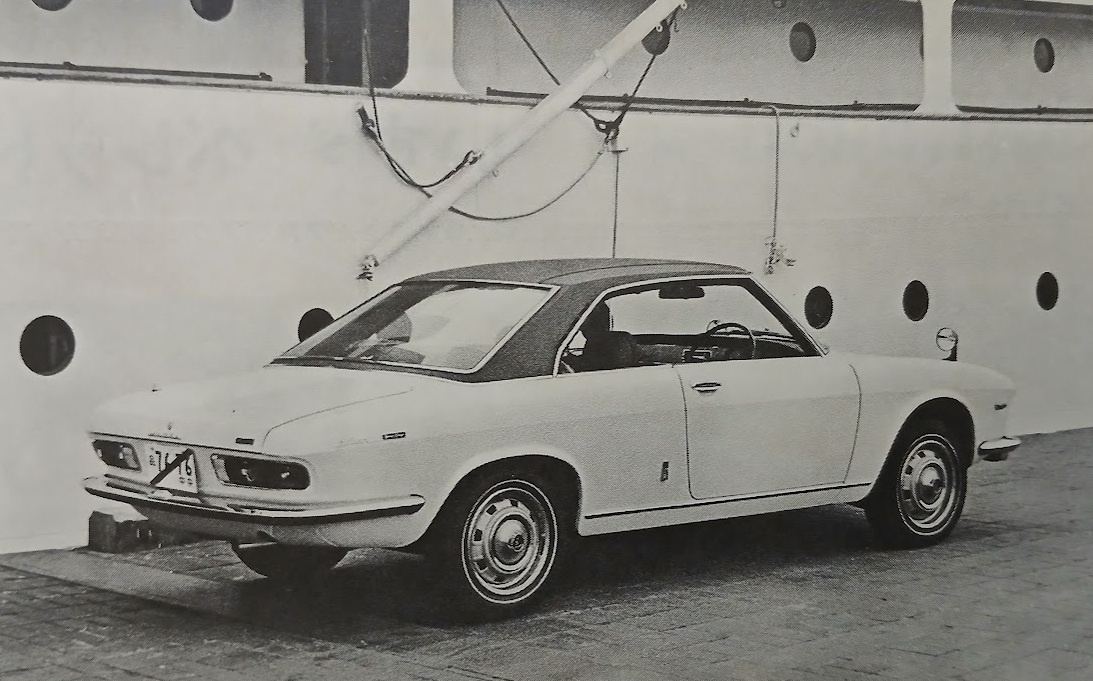
Before doing so, however, it is worth taking a quick look at the car’s specifications. As its name suggests, the Luce Rotary Coupe is a rotary-engined front-wheel-drive car. Although it bears the Luce name, there is in fact remarkably little that is shared between the sedan and coupe beyond certain body pressings.
To begin with, the coupe is considerably larger than the sedan. Wheelbase has been extended by 80mm, and overall length by no less than 215mm, giving dimensions roughly comparable to those of a Crown Hardtop. Weight has likewise increased substantially, with the Super Deluxe version tipping the scales at 1255kg–fully 200kg heavier than the Luce 1800 sedan.
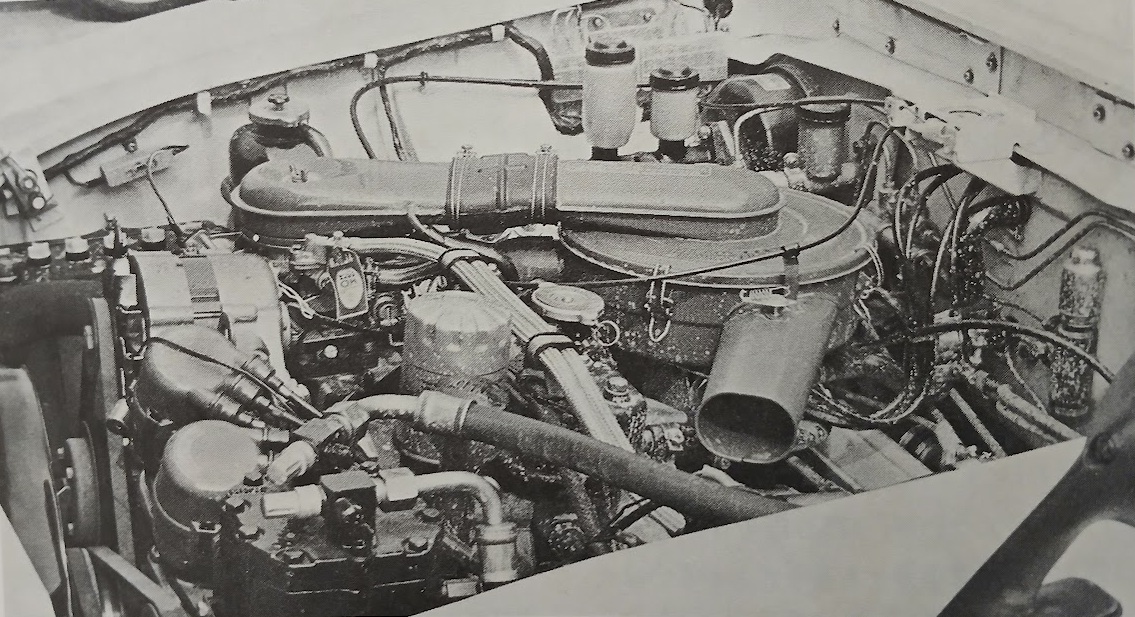
The engine is also entirely new. Instead of the existing 491cc×2 rotary used in the Cosmo and Familia Rotary, the Luce uses a larger 655cc×2 rotor unit. By international convention, when comparing a rotary engine directly with a reciprocating engine, displacement is doubled; accordingly, the Luce should be regarded as equivalent to a 2.6-liter car. Under the Japanese taxation system, however, the non-rational–or political?–concept of “vehicle class” intervenes, allowing it to remain within the 5-number category.
Mechanically, the engine follows the same basic design as the Familia Rotary, with side housings manufactured from special cast iron rather than the light alloy used in the Cosmo. The increase in displacement has been achieved by enlarging the trochoid dimensions themselves.
The reason for not accomplishing this simply by increasing the thickness of the rotor housings–which would almost certainly have been more economical in terms of production cost–arises from the packaging requirements of the layout. Overall engine length had to be kept to an absolute minimum in order to mount the power unit ahead of the front axle line while still driving the front wheels.
As in all Toyo Kogyo rotary engines since the Cosmo, the induction and exhaust arrangement uses side intake ports with peripheral exhaust ports. The design places particular emphasis on low- and medium-speed torque to suit Japanese driving conditions. (By contrast, the NSU Ro80 and Mercedes-Benz’s experimental C111 use peripheral ports, placing greater emphasis on high-speed performance.)
Compared with the earlier Familia/Cosmo rotary units, the main changes are the adoption of a quieter chain-driven oil pump and a water-cooled oil cooler mounted directly above the engine, eliminating the need for external oil hoses.
The powertrain layout closely resembles that of the NSU Ro80, with the engine suspended ahead of the front axle line, followed in sequence by the differential and 4-speed gearbox. The driveshafts employ Burfield constant-velocity joints both inboard and outboard, while the inner joints are designed to accommodate a limited degree of axial movement, thereby eliminating the undesirable sliding joints often found on powerful front-wheel-drive cars.
As already mentioned, radial tires are fitted as standard equipment. Their size–165HR-15–is exceptionally large by the standards of Japanese passenger cars.
The suspension, naturally, is entirely different from that of the Luce sedan and is fully independent at all four wheels. The front suspension uses double wishbones, and is notable mainly for its use of torsion-bar springing. As is well known, Toyo Kogyo has used this type of spring for many years on the 360cc Coupe and Carol.
The main reason for its adoption on the Luce Coupe was to reduce the transmission of road noise into the cabin. Since the Luce Coupe comes standard with radial tires, this was a point of particular concern.
At the rear is an independent semi-trailing-arm arrangement. On last year’s Tokyo Motor Show prototype, rubber springs had been used, but for the production model these have been replaced by conventional coil springs.
The brakes are large Bendix-Akebono front discs of no less than 274mm diameter, assisted by a vacuum servo. At the rear are leading-trailing shoe drums equipped with a proportioning valve to prevent premature wheel lock. Rear brake clearance is automatically adjusted each time the handbrake is applied.
Steering is likewise entirely different from that of the Luce sedan, adopting a rack-and-pinion system with an impact-absorbing steering shaft. On the Super Deluxe model, power steering is standard equipment; its steering ratio is approximately 19:1, compared with 22:1 on the unassisted Deluxe version.
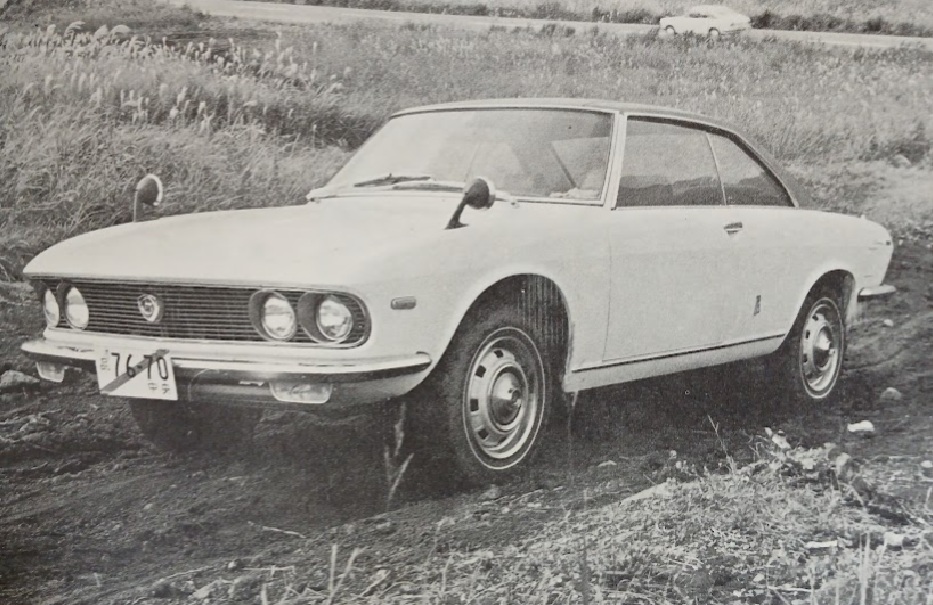
Although the body retains the general image of the Luce sedan, it is in fact a completely new design. Because of its pillarless hardtop structure, the lower body has been extensively reinforced, resulting in a semi-monocoque construction of considerable rigidity.
At 1255kg in Super Deluxe form, curb weight exceeds that of the Luce 1800 by more than 200kg, owing largely to far more extensive soundproofing and insulation, together with the incorporation of power-operated equipment, air conditioning, and other accessories.
The smoothness and quietness of the rotary engine are qualities we have already noted many times during our tests of the Cosmo and Familia Rotary, but aided by exceptionally thorough sound insulation, the Luce’s engine feels even more refined in operation. Low-speed flexibility is vastly superior to that of reciprocating engines with comparable high-speed performance. The car will pull away smoothly from as little as 1000rpm–and can even start in second gear without requiring particularly high revs–while in top gear it accelerates effortlessly from below 40km/h.
As a result, frequent gear-changing becomes unnecessary, and the car is remarkably easy to drive even in city traffic. Its true character, however, only emerges out on the open highway.
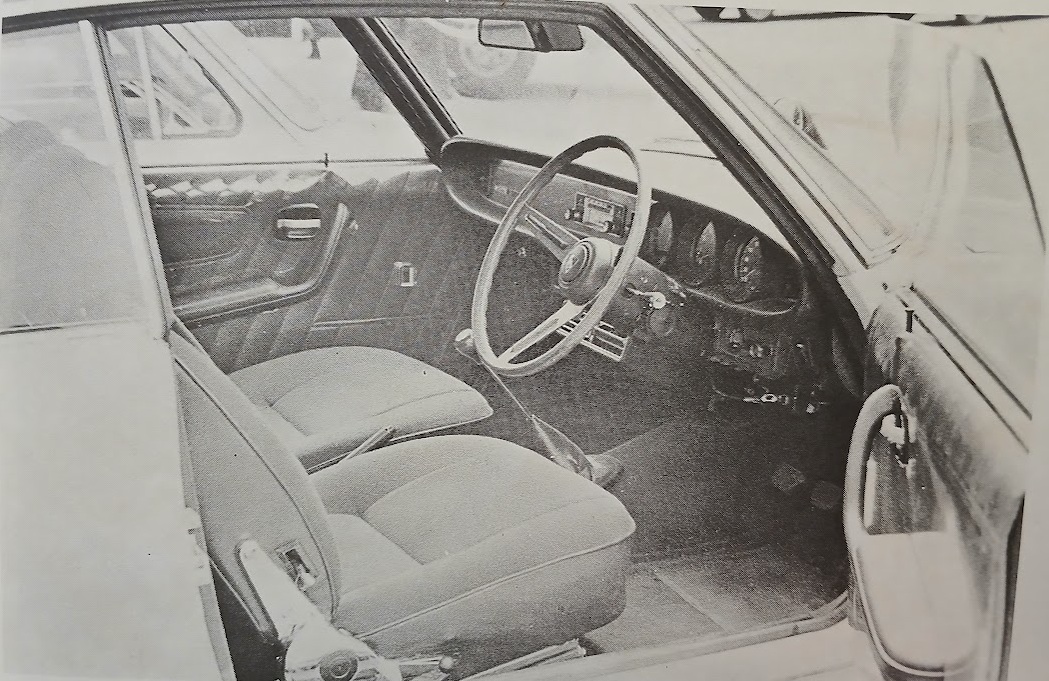
The centrally positioned tachometer, placed directly in the driver’s line of sight, marks 6000-6500rpm as the yellow zone, yet the engine will spin beyond 7500rpm without the slightest sense of strain, at which point a warning buzzer sounds to indicate over-revving. Gear ratios are very well matched to both the engine’s output and the car’s weight, allowing approximately 50km/h, 90km/h, and 140km/h in first, second, and third gear respectively at 6000rpm.
At 100km/h the engine is turning at roughly 3300rpm, emitting little more than a subdued hum. Vibration is entirely absent, and with the windows closed it is possible to converse quietly with one’s passenger. The transmission, in which top gear is indirect rather than direct-drive, remains consistently quiet as well.
Because the torque curve lacks any pronounced peak, the engine responds willingly over an extraordinarily wide range; wherever one opens the throttle, the power is simply there.
Years ago Rolls-Royce and Bentley employed the phrase “silent sports car” in their advertising, but if anything, it is the Luce Rotary Coupe that truly deserves to be called a silent sporting coupe. If the law allowed, 140km/h would be an entirely comfortable cruising speed in ordinary use.
The car’s silence and smoothness are such that it rarely feels especially fast, yet its 0-400m acceleration time of 17.1 seconds qualifies as genuinely rapid performance. The engine is sufficiently powerful that, even on dry pavement and despite the grip afforded by the 165HR radial tires, the front wheels will spin easily if the throttle is applied with even moderate enthusiasm from a standing start.
Power delivery is exceptionally smooth, and the complete absence of driveline snatch even under abrupt acceleration or deceleration is particularly noteworthy in such a powerful front-wheel-drive car.
One characteristic of the rotary engine that feels somewhat strange, at least initially, is the near-total absence of engine braking when the throttle is lifted, giving the impression that the car is almost freewheeling.
The servo-assisted disc/drum brakes can only be described as superb. Pedal effort is light, and because the front-to-rear distribution of braking force is very well judged–thanks to the proportioning valve–all four wheels take hold progressively and securely even under heavy braking. Another welcome characteristic is the remarkably small amount of nose-dive despite the relatively soft suspension.
The car driven to Hakone was the Super Deluxe model, equipped as standard with power steering.
One can certainly understand why power steering was adopted. This is a front-wheel-drive car carrying some 800kg over the front wheels even unladen, and fitted with 165HR-15 tires with a substantial contact patch. Frankly speaking, however, this power steering largely spoils what is otherwise an excellent car.
To begin with, it is extraordinarily light–too light, in fact. Light steering effort is by no means objectionable in itself, but what is troublesome is when all sensation from the road surface is isolated from the driver, and in the Luce this is precisely the case. Response around the straight-ahead position is especially over-sensitive, so that it is all too easy to feed in more steering than intended.
At lower speeds this presents little difficulty, and in city traffic or while parking one is very grateful for the assistance. At high speeds, however, the car would frankly be better without it. Even at a relatively moderate 100km/h, changing lanes demands a degree of concentration on the steering that soon becomes tiring.
On days with strong crosswinds–as during our test–even a front-wheel-drive car with good directional stability will be disturbed to some extent, but the constant small steering corrections required proved surprisingly fatiguing because of the over-light steering.
Later, we had the opportunity to drive a Luce Rotary Coupe without power steering, and found that even in city driving, it was by no means excessively heavy–roughly comparable to a Crown Hardtop SL. Caster action was entirely appropriate, which only made the purpose of the power steering more difficult to understand.
Without assistance, the steering ratio is slightly slower, though with 3.8 turns lock-to-lock it never feels unduly busy. Turning radius is only 5.3m–exceptionally small for a long-wheelbase front-wheel-drive car–and maneuverability is correspondingly excellent.
This author is not necessarily opposed to power steering as such; the systems used by Mercedes-Benz and the NSU Ro80, for example, are both excellent. The Luce’s system, however, is difficult to approve of in its current state. We would like to urge the engineers to reconsider it.
Ride comfort is suitably substantial for a luxury coupe, and together with the thick, generously cushioned seats, the overall impression is one of considerable comfort. In preparation for the adoption of radial tires as standard equipment, the suspension makes extensive use of rubber bushings, and road noise is correspondingly well suppressed.
Handling, too, is extremely good aside from the shortcomings of the power steering already mentioned. Despite its considerable weight and the strong influence of its powerful front-wheel-drive layout, understeer is kept within moderate limits, while attitude changes under power-on and power-off conditions are minimal. For such a softly sprung suspension, body roll is also relatively restrained, and as noted earlier, nose dive under braking is remarkably slight.
In short, the Luce Rotary Coupe succeeds admirably in overcoming the traditional disadvantages of front-wheel drive while making full use of its advantages.
Next, regarding fuel consumption–the weak point traditionally associated with the rotary engine–the average for this day’s 125km drive from Tokyo to Hakone via the Tomei Expressway and Otome Pass was 6.7km/l on regular gasoline. This can hardly be called economical, but for the owner of a 1.75 million yen coupe, somewhat heavy fuel consumption is unlikely to constitute a major concern.
The interior is luxurious, though executed with restraint and good taste. Naturally, priority has been given to front-seat accommodation, and the reclining seats permit virtually any driver, regardless of height or build, to find a satisfactory driving position. Owing in part to the thick backrests with integrated headrests, however, the rear seat is noticeably tighter than that of the Luce sedan, and neither headroom nor knee room can be called generous.
The front floor retains a transmission tunnel almost as large as that of a rear-wheel-drive car, but the rear floor is, as one would expect, nearly flat. Features such as power windows, air conditioning, a powerful ventilation system, and a heated rear-window defogger add still further appeal to this 1.75 million yen traction avant coupe.
Postscript: Story Photos