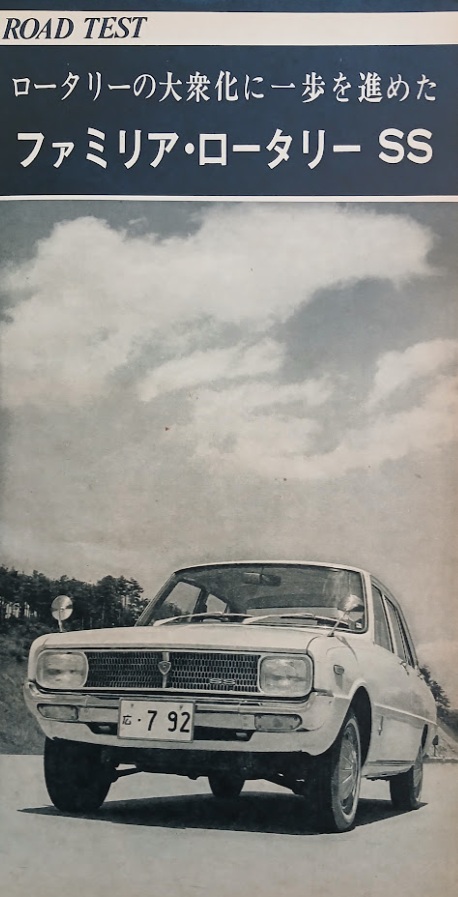
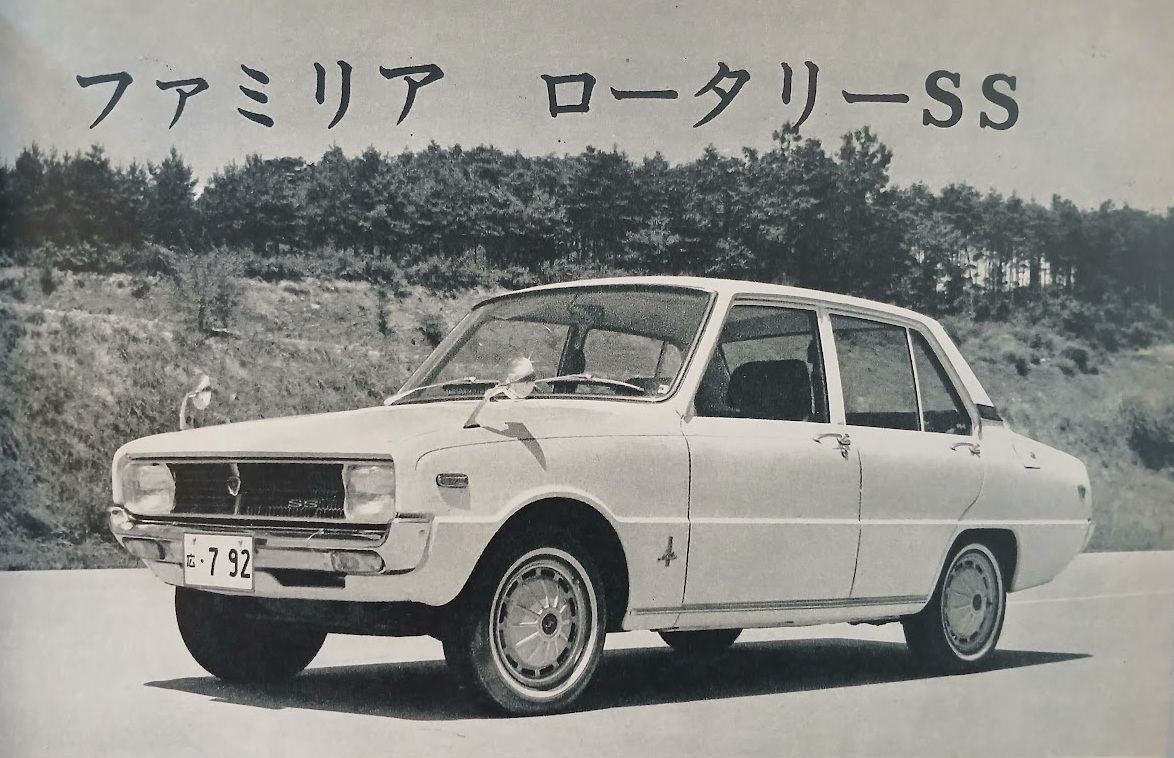
Mazda Familia Rotary SS (1969)
Publication: Motor Fan
Format: Road Test
Date: October 1969
Authors (Roundtable): Yasuhisa Minawagawa, Moriyuki Watanabe, Kenichi Yamamoto, Osamu Hirao, Kenji Higuchi, Kunitaka Furutani, Toshio Takada, Atsushi Watari, Taizo Tateishi, Fumihiko Arakawa, Akio Miyamoto, Yasuhei Oguchi, Masahide Sano, Takashi Kuroda, Minoru Onda, Zo Doi, Tadashi Okada, Kenzaburo Ishikawa, Toshihide Hirata, Takashi Mitsunari, Motor Fan Editorial Staff (uncredited)
Outstanding Power Performance in a Sedan
Magazine: Our test of the Familia Rotary SS took place at Toyo Kogyo’s Miyoshi proving ground this time. To get started, we would like to ask about the outline of this model and the intentions behind its release.
Minagawa: Our rotary-engine cars began with the Cosmo Sport in May 1967, followed by the Rotary Coupe in July 1968. This Rotary SS represents the third development. We would like its introduction to be understood as part of a broader strategy to promote the wider adoption of rotary-engine vehicles.
With the Cosmo and the Rotary Coupe, the market has, for the most part, settled on its evaluation of the rotary engine. With this car, we feel we have reached a certain milestone, in the sense that the rotary can now move into the stage of wider popularization.
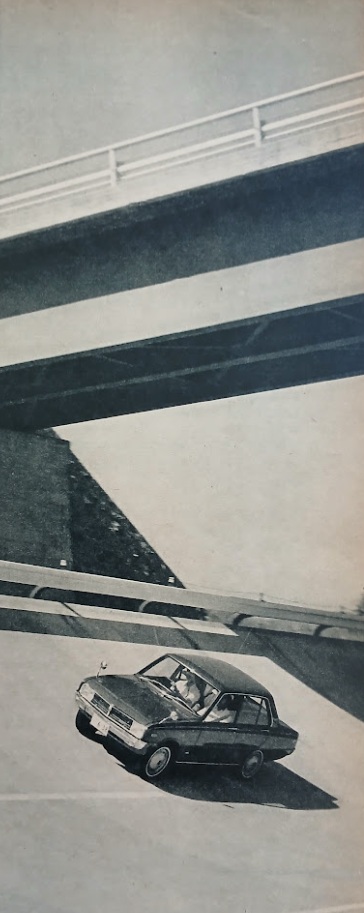
At the same time, to make practical use of a high-performance car, the surrounding environment must also be ready for it–meaning the road network. Following the Meishin Expressway, the opening of the Tomei Expressway has helped create the conditions that encourage the release of a rotary-powered car as a practical vehicle.
Furthermore, the manufacturing process for the rotary engine has now been established, and we have achieved a reasonable outlook in terms of cost. As a result, we believe we are approaching a stage where the rotary can exist alongside the reciprocating engine as an equal, standing shoulder-to-shoulder with it.
As for the specific planning intent of the Rotary SS itself, in a sense, it simply takes the original concept of the Familia–literally, a family car–one step further.
Magazine: We imagine there must have been a number of issues to consider when fitting a rotary engine to the existing four-door Familia sedan. Perhaps Mr. Watanabe, as head of the design department, could comment on that point.
Watanabe: When we introduced the Rotary Coupe, we conducted a very careful market survey. One of our particular concerns was that, in this class, its fuel consumption might be criticized rather severely.
With an engine producing this level of output–100ps at 7000rpm–we assumed that customers would have to tolerate a certain trade-off in fuel economy. However, those who choose to drive this type of car did not seem especially concerned about fuel consumption. Nor were there many complaints that the performance was out of balance with the car’s size or interior space.
On the contrary, we received many favorable comments; specifically, we heard that because the car is compact, its acceleration feels particularly powerful, and that even at low speeds the engine operates without strain.
Since the concerns we had anticipated did not, in fact, materialize, we decided to try installing the rotary engine in the sedan. Structurally, this did not pose any particular difficulties.
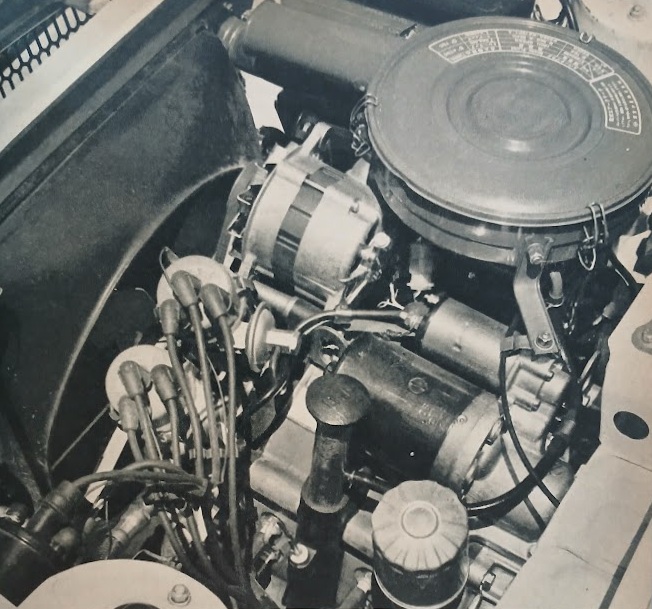
That said, with a sedan, one expects that the rear seats will be occupied more frequently. For this reason, we paid special attention to preventing heat from the exhaust system from being transmitted through the floor, taking care with the heat insulation of the exhaust pipe and silencer.
Magazine: Given that the engine’s output is quite high relative to the size of the car, were there any areas that required particular reinforcement?
Watanabe: Since the engine is indeed powerful, the chassis has been reinforced compared to the version fitted with the reciprocating engine. The suspension spring rates have been increased by roughly 30%. In addition, the front stabilizer has been strengthened, and because the car is capable of higher speeds, it is equipped with disc brakes and low-profile tires.
Essentially, we have applied the same measures that were already used on the Rotary Coupe to the sedan. Beyond the fact that it is a sedan, very little else is different. For example, the gear ratios are carried over directly from the Rotary Coupe.
Magazine: When you say the engine is almost the same as that of the Rotary Coupe, does it mean that its characteristics are not at all different?
Yamamoto: In order to improve production efficiency, the basic specifications of the engine remain unchanged from the Rotary Coupe. However, in the case of the sedan, we considered that, rather than extremely sharp performance, there might be some demand for somewhat milder characteristics in areas such as noise and fuel consumption.
For example, the Rotary Coupe uses a four-barrel carburetor. However, this is not the simplest type to maintain, and costs are higher. For a sedan, we felt it might not be necessary to pursue power above all else, so we considered both four-barrel and two-barrel carburetors.
In the end, however, we found that even for the sedan, demand for stronger performance proved quite strong, so we decided to go with the four-barrel specification. At present, we are only offering the four-barrel version. That said, we do not believe that a four-barrel carburetor is absolutely necessary. As a future theme, we are working on the development of various simplified versions as well.
Hirao: Is the engine compartment the same as that of the standard Familia with the reciprocating engine?
Watanabe: The front section differs in design, but in terms of space it is the same. The engine brackets and mounting position are slightly different, but it has been arranged so that production can be carried out largely with shared facilities.
Hirao: And in terms of the engine’s physical dimensions?
Watanabe: From the time design work on the body began, it was planned so that both reciprocating and rotary engines could be installed, although this required some effort. In a reciprocating engine, the crankshaft sits relatively low within the engine as a whole. In a rotary, the shaft is located centrally. Therefore, in order to use a common body, the rotary engine must be installed at an incline.
Hirao: With a rotary engine, wouldn’t it be possible to move the toe board slightly farther forward, to increase footwell space?
Watanabe: It does not make a great deal of difference. There are various auxiliary components, and since we have made them interchangeable with those of a roughly 1000cc-class engine, they take up more space than one might expect. In addition, because of the crankshaft issue I mentioned earlier, the transmission bulge becomes somewhat larger than with a reciprocating engine.
Hirao: So space efficiency may be slightly reduced, but in exchange you gain a substantial increase in power compared with a reciprocating engine.
Watanabe: In terms of the level of performance achieved by the rotary engine, the appropriate comparison would be with a six-cylinder engine in the 2000cc class. Considering vibration and ride comfort, it would be difficult to obtain equivalent results from a four-cylinder 2000cc unit. So, compared with installing a reciprocating engine of truly comparable performance, we would say that space efficiency is, in fact, better with the rotary.
Aiming for Wider Adoption of the Rotary
Higuchi: Merely having greater power feels somewhat unsatisfying. Rather than that, if you were to mount the air cleaner to the side and lower the front end–in the manner of a Porsche–creating a sedan with very low frontal height and reduced air resistance, like those seen at Italian shows, wouldn’t that allow the unique advantages of the rotary engine to stand out more clearly?
Minagawa: Our primary objective at present is to promote the wider adoption of the rotary. In particular, reducing cost is a major point. Once this car has fulfilled that role of popularization, we would like to produce a car that expresses the rotary’s distinctive character more strongly, as you suggest.
Higuchi: I had hoped that you might first introduce a sedan that could only be realized with a rotary engine, and then pursue broader adoption from there.
Minagawa: If we had begun with a high-grade sedan, it would have been difficult to expect mass production and large sales volumes. The Cosmo represented a stage with an experimental element, intended to introduce the market to the rotary engine. The Rotary Coupe strengthened the practical side of the equation somewhat, and with this Rotary SS, the policy is to move further toward wider adoption.
Hirao: I understand that reasoning. Certainly, we have entered an era in which even a small car is expected to run as fast as a large one. A larger car may offer greater comfort and space, while a smaller car may feel somewhat confined inside. But in terms of speed, there should no longer be a distinction.
At present, smaller cars still tend to have lower maximum speeds, and so a high top speed is associated with the image of a high-grade car. In reality, however, 100mph–160km/h–ought to be attainable whether the car is small or large. In that sense, although the Rotary SS is modest in size, the fact that it can sustain 100mph in regular use carries considerable significance.
Higuchi: You describe this car as a product meant to promote wider adoption of the rotary, but if one looks at the figures from a user’s perspective, it is undeniably more expensive than the reciprocating version. A 100,000-yen increase over the Familia’s optional higher-output reciprocating engine seems somewhat removed from the idea of popularization, doesn’t it?
Watanabe: Not necessarily. For the rotary to become widespread, it must first be driven in large numbers. Compared with previous rotary models, this car is significantly more attainable. If it succeeds in expanding the market for rotary engines, costs will fall further in future models.
There are also questions of production efficiency and contribution to the company. And even when evaluated simply as a performance option, a reciprocating engine must be pushed quite hard–with higher compression and other measures–to achieve high performance. With a rotary, that performance can be obtained much more easily.
Hirao: In time, as expressways continue to expand, perhaps fewer people will choose the reciprocating Familia, and only the rotary version will sell. (Laughs.) If cars capable of 100mph become the norm, then in a sense the competition over top speed may disappear. Except for town cars or commuters, a car that cannot run at 100mph may simply no longer be considered viable.
Watanabe: The merit of the rotary lies in its ability to deliver that level of performance without strain.
Magazine: The plan to install a rotary engine in a sedan must have existed for some time. Why did you decide to introduce this sports sedan at this particular point?
Watanabe: If this were a purely experimental stage, fitting the engine to a coupe or sports car would be the safer course from a company standpoint. However, when we surveyed buyers of the Rotary Coupe, we found there was also demand for a sedan. Moreover, we discovered that a considerable number of purchasers were, in fact, somewhat older customers.
Minagawa: That is why we decided that this was the moment to expand the rotary’s presence in the market.
Hirao: Recently, emissions regulations have become stricter. How does the rotary stand in that regard?
Yamamoto: To be candid, the rotary engine is not necessarily at an advantage. If hydrocarbon (HC) regulations equivalent to those in the United States are adopted, we would likely need to respond with measures such as fitting an air pump. What is difficult for the rotary is that there is no middle ground. If we address the issue, we must tackle emissions thoroughly. A partial effort to meet regulations would be problematic.
Watanabe: Looking ahead to the American regulations from 1972 onward, the rotary is in fact much better positioned. Complete removal of HC is theoretically possible. Reciprocating engines are troubled by NOx, whereas the rotary can remain comparatively unaffected in that respect.
Yamamoto: If regulations are to be imposed, we would prefer that NOx be fully addressed as well, including for reciprocating engines. In that case, the rotary would be at an advantage.
Higuchi: If appealing to safety is not an attractive selling point, and if even speed ceases to be persuasive, then perhaps it would be worthwhile to move ahead of the trend and advertise that this is a car with comprehensive emissions countermeasures and no pollution concerns.
Watanabe: That might make us the most unpopular child in the industry. (Laughs.)
Miyamoto: If the rotary’s merits include clean exhaust, that could well become an effective sales phrase.
0-400m in 16.7 Seconds
Magazine: Now then, let’s move on to the results of the performance tests.
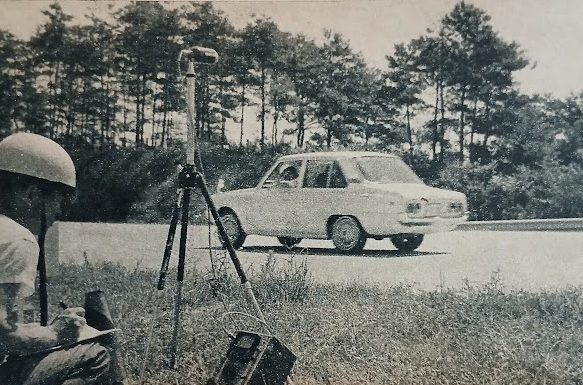
Furutani: These are the figures measured by the Hirao Laboratory. The vehicle weight listed in the catalog is 825kg. To this we added 191kg for the driver, two testers, and instruments, bringing the total test weight to 1,016kg.
From a standing start, the acceleration times were 0-50m in 4.4 seconds, 0-100m in 6.8 seconds, 0-200m in 10.6 seconds, and 0-400m in 16.7 seconds.
In terms of time to speed, the car accelerated from 0-40km/h in 1.9 seconds, 0-60km/h in 3.7 seconds, 0-80km/h in 6.2 seconds, 0-100km/h in 9.6 seconds, and 0-120km/h in 14.2 seconds.
For overtaking acceleration, starting from a steady 30km/h in third gear, the car reached 40km/h in 2.0 seconds, 60km/h in 6.1 seconds, 80km/h in 10.3 seconds, 100km/h in 14.5 seconds, and 120km/h in 19.3 seconds.
Starting in top gear from 40km/h, it reached 50km/h in 3.4 seconds, 60km/h in 6.6 seconds, 80km/h in 13.3 seconds, 100km/h in 20.4 seconds, and 120km/h in 28.5 seconds.
Although the engine is said to be identical to that in the Rotary Coupe, increased running resistance at higher speeds appears to result in somewhat slower times. The 0-400m figure for the Coupe was 16.2 seconds, whereas this SS records 16.7 seconds, about half a second behind.
Magazine: The initial acceleration is roughly the same as the Rotary Coupe.
Furutani: The 0-100m figure was exactly the same.
Hirao: The difference in body shape must show up, then.
Watanabe: Frontal area has a considerable effect.
Is Strong High-Speed Acceleration Necessary?
Hirao: I sometimes think that, in various respects, it might be preferable for a car to accelerate strongly at low speeds but then lose that urgency quite suddenly as speed rises. That could be achieved by combining a powerful engine with a body style that generates substantial aerodynamic drag.
Takada: Are you thinking of something like a speed limiter?
Hirao: A limiter feels artificial, and raises issues of adjustment and reliability, which I would rather avoid. But if the body were shaped so that aerodynamic drag increased sharply beyond a certain speed, that would be ideal. It would pull cleanly to 100mph, yet beyond that no longer respond no matter how much one pressed the accelerator.
Watanabe: That runs counter to the efforts of those working on aerodynamics.
Hirao: From the standpoint of safety, I believe the idea is worthwhile, even if it contradicts the aerodynamicists.
Higuchi: For the average driver, I suspect that around 100km/h is about the upper limit for truly safe travel. If aerodynamic resistance were to serve as an indicator, sound might be the most effective signal. With present designs, wind noise becomes pronounced at 70-80km/h, which is fatiguing. It would be better if the car only became noisy from around 100km/h.
Hirao: One could, for example, select door-seal rubber of an appropriate softness so that at high speeds it would suddenly produce a louder wind noise.
Higuchi: It’s an unpleasant sensation to restrain a car that is capable of greater speed. If the car became noisy even though it could go faster, prompting the driver to hold back, that may be preferable. Those who insist on speed could still press on, noise notwithstanding.
Watari: Still, I think 100km/h is too low to define as a safe speed. Around the world, “high speed” increasingly means something closer to 140km/h.
Hirao: Drivers’ skills will improve soon enough. More important is preventing them from unknowingly exceeding mechanical limits, such as those of the tires.
Watanabe: Those ideas are almost the reverse of the difficulties we face. Professor Hirao suggested raising drag abruptly; in fact, if we were to leave the underbody rough and uneven, resistance would suddenly increase around 140–150km/h. At present, however, we are doing the opposite, fitting airflow covers underneath to prevent precisely that. As for door seals, we are troubled in the other direction: at high speeds the doors and glass are pulled outward, producing a whistling noise. Our concern is how to prevent that suction effect.
Watari: Yes, recent cars have improved greatly, but if they become noisy between 100-120km/h, that is still not satisfactory. If such sounds emerged at somewhat higher speeds, they could serve as a kind of warning. As it stands, noise tends to appear already at speeds that are perfectly usable.
Magazine: Since the subject of sound has come up, let’s now present the noise data from the Watari Laboratory.
Tateishi: Measurements were taken at the Miyoshi test course. At the time, the ambient noise level was 0.39 phons.
The results for interior noise were 59 phons at 40km/h; 62 at 50km/h; 62 again at 60km/h; 65 at 70km/h; 69 at 80km/h; 70 at 90km/h; 72 at 100km/h; 74 at 110km/h; 75 at 120km/h; and 76 at 130km/h.
Exterior noise was measured according to the JIS method, in two modes: steady running at 50km/h and acceleration from 50km/h. Under steady conditions it recorded 75 phons; under acceleration it was 82 phons. We also measured noise at idle. The results were 43 phons inside the cabin and 57 phons outside.
As for the suspension’s natural frequencies, the sprung-mass frequency was 1.4cps at the front and 1.5cps at the rear. The unsprung frequency was 11cps for both front and rear.
Watari: It’s quiet for a car of this size. However, for a car of this engine output, one might not call it especially quiet.
The overall sound characteristics are good, with no pronounced peaks. That said, a booming resonance appears from around 100km/h, and there was a slight rise in the sound level around 70-80km/h as well. It may be difficult to shift the noise in the 100-120km/h range to still higher speeds, but it is something that ought to be addressed.
We also drove on poor surfaces; ride comfort is good. Still, given the level of engine output, one cannot entirely escape the impression that the short wheelbase has its limits. (Laughs.)
Watanabe: The booming sound from around 100km/h seems to be a resonance in the rear springs. It is not especially large, however.
Hirao: Around 100km/h I noticed a “kuu” sort of sound. Couldn’t that be reduced?
Watari: It strikes me as possibly coming from somewhere in the gearbox.
Hirao: In connection with that, couldn’t the gear noise when pulling through low, second, and third be further subdued?
Watanabe: That is a sore point.
Arakawa: The “kuu” sound may indeed be resonance, though the exhaust note may also play a part. Of course, if one is accustomed to driving high-level cars, even slight noises tend to stand out.
Watanabe: Gear noise becomes particularly difficult with a floor shift. In the past, column shifts were common, and sound insulation was comparatively easy. With a floor shift, the lever rises directly from the gearbox into the cabin, without a steel plate or similar barrier in between. How to insulate that effectively is quite a serious problem.
Hirao: Well, even if it is somewhat noisy under acceleration, one does not continue driving in that state for long, so it is tolerable.
Watanabe: Some people say it gives a feeling of strength. (Laughs.)
Watari: The noise peaks have been handled well. In that respect, one must acknowledge the progress Toyo Kogyo has made.
Watanabe: With a rotary engine, the engine’s own sound is comparatively easy to manage. If anything stands out, it tends to be resonance in the driveline. In controlling this, torsional elasticity in the clutch assembly can also become an issue.
Hirao: What about enlarging the flywheel…?
Watanabe: Yes, that would have some effect. Increasing the weight of the propeller shaft, or fitting weight dampers in the driveline–we are studying various approaches.
Difficulty Positioning the Air Conditioner
Miyamoto: Is it the case, then, that because the engine itself produces relatively little vibration and noise, other noises become more noticeable? And regarding the floor shift issue: in the old days, every car had a floor shifter, but the standard changed to column shift because it made driving easier. Now, young drivers talk about delicate shift feel and the trend is returning to the floor. That may be fine for racing cars or sports cars, but for ordinary practical cars I don’t see the need, and in terms of space I think the column shift is better.
Minagawa: In that regard, it’s a matter of the product having the right image.
Watanabe: It’s also a matter of taste.
Hirao: And it’s a matter of the times.
Watari: With a floor shift, there is the noise issue, and in any case the vibration transmitted through the lever is also a problem that must be solved.
Hirao: If it’s a column shift, the space freed up can be used for a center console or air conditioner. Especially in small cars, where space is precious, I feel a column shift has the advantage.
Minagawa: Functionally, we agree. Even with the Familia we offer both. But recent demand is probably about 70% in favor of the floor shift.
Watari: With the passenger’s-side-mounted air conditioner in this car, the front passenger gets unbearably cold, while the driver still wants more cooling. I think it needs a baffle plate in front of the cooler unit.
Watanabe: In the Luce we placed it centrally. If we put the air conditioner centrally in this car, then with a column shift the parking brake lever inevitably ends up on the dash. There would be interference between the two, so we are forced to place it where it is.
Hirao: It cramps legroom, too.
Higuchi: Why not make the dashboard fascia out of metal, hollow it out, eliminate the glove box, and integrate the air conditioner properly into the design?
Watanabe: When we tried that on the previous Familia, the reception was poor. It didn’t work out.
Oguchi: More fundamentally, what if the air conditioner unit were kept out of the cabin entirely? The rotary’s compactness is one of its advantages, so why not place the unit in the engine bay?
Minagawa: That is certainly possible, but since this car’s body is shared with the reciprocating-engine version, it is difficult at this stage.
Watari: If the air conditioner were standard equipment, I think it could be done with a body designed accordingly.
Hirao: Even if that is for the future, I still think there must be a better way to provide air conditioning while keeping the reciprocating and rotary versions common. If space really cannot be found, move the instruments behind the seats and view them through the rearview mirror. (Laughs.)
City Driving Fuel Economy Is 7.9km/l
Magazine: Let’s move on to fuel economy. Could you present the results measured by the Oguchi lab?
Sano: Starting with steady-speed fuel economy, we recorded 15.6km/l at 40km/h, 15.6km/l again at 60km/h, 14.1km/l at 80km/h, 12.3km/l at 100km/h, and 10.1km/l at 120km/h. The most economical speed is around 50km/h, at about 15.7km/l. Next, the model-driving fuel economy. This simulates urban driving in Tokyo, including repeated starts and stops. With a target speed of 40km/h, the fuel economy came out to 7.9km/l at an average speed of 21.6km/h. With a target speed of 60km/h, the result was 7.3km/l at an average speed of 25.3km/h.
Oguchi: Model-driving fuel economy is calculated using a simplified urban driving pattern. Starting from a standstill, acceleration is limited to no more than 0.3g. Once 0.3g is reached, we shift to second gear and continue at 0.2g. The same pattern is repeated for third and top gears. Deceleration is set at about 0.15g, reflecting typical city driving behavior. For reference, last year we measured the Rotary Coupe’s fuel economy on a run from Hiroshima to Tokyo. On the 340km section from Hiroshima to Kobe, we measured 18.6km/l; from Kobe to Toyohashi the figure was 9.6km/l; and from Toyohashi to Tokyo it was 9.25km/l. Since the engine is the same, the results we recorded this time seem reasonable.
Kuroda: In an era of “100-mile cars,” it’s important that average fuel economy does not suddenly drop at highway speeds.
Oguchi: With 100ps/7000rpm, this car is simply fast, and a certain amount of fuel consumption is inevitable. If someone cares deeply about fuel economy, perhaps this isn’t the car for them. But if the goal is to popularize the rotary engine, the fuel economy needs to be improved further.
Watari: It’s one thing to worry about fuel economy, but it’s another to worry about running out of fuel before you reach your destination.
Hirao: That’s why fast cars should have larger fuel tanks.
Watari: This Rotary SS has indeed grown in that respect. It now has a 60-liter tank.
Minagawa: When we surveyed Rotary Coupe owners, about 60% said they were satisfied with fuel economy.
Hirao: The remaining 40% stopped complaining once the tank was enlarged. (laughs)
Minagawa: Also, from a cost perspective, most cars in this performance class require high-octane fuel. The rotary engine, however, runs on regular gasoline, which reduces complaints. Since the tank enlargement, fuel economy has become far less of an issue.
Yamamoto: Improving fuel consumption in the current rotary engine is still a fundamental challenge for us. We see room for improvement in the carburetor characteristics, spark timing, and air-fuel ratio. Currently the mixture is kept slightly rich to avoid misfires, but we believe better spark plug placement and improved plug design will allow us to achieve better economy.
Higuchi: The “pan-pan” afterburning sounds have decreased considerably, but we still heard some during this test.
Yamamoto: Last time, during the Rotary Coupe test, you also pointed it out, so we tried installing a prevention device. Since we didn’t receive as many complaints from the market as we expected, we removed it…
Higuchi: Last time, this sound surprised us, but this time we deliberately drove in a way that would produce it. The conditions were different, but the fact remains that it was present.
Onda: For those who dislike the afterburning, this sedan can also be fitted with a prevention device.
Steering Characteristics Are Understeer
Magazine: How was the handling and stability?
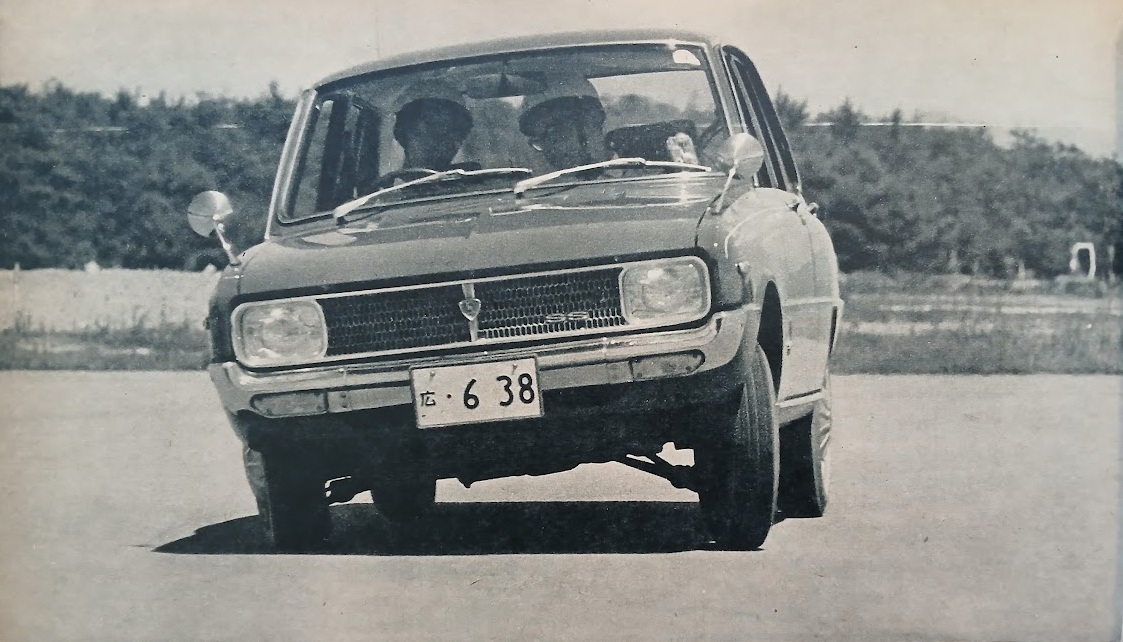
Doi: Toyo Kogyo provided the measured data, so I’d like to use this to compare the car with others in the same class. The practical minimum turning radius is 4.4m on the outside and 2.2m on the inside, with a catalog value of 4.1m. This is very small and advantageous for maneuverability. Usually, cars in the 2-liter class are around 6.3-5.4m, and even some 1-liter cars exceed 5m. Next, the understeer/oversteer characteristics: when accelerating gradually in a circle, once the speed rises above about 60km/h in a radius of roughly 40m, the car transitions from understeer to oversteer. However, even at the Higashimurayama test course where we usually take measurements, it is not usually possible to reach such conditions, so I think it is fair to call it an understeering car. Roll rate is 3.6°, which is a normal value for a sports car; for a general passenger car, most 1-liter class vehicles are under 6°, so the roll rate is relatively low. Steering effort when the car is stationary is somewhat heavy on both sides, with a maximum of 15kg. During low-speed cornering at 0.25g lateral acceleration, steering effort was 3.4kg when entering the curve, and 2.2kg when exiting, which is light.
When steering through a slalom course at high speed, again at 0.25g lateral acceleration, steering effort is 2.5kg to the right and 2.8kg to the left, which is very normal. In the free-release directional stability test, the data shows that the steering disturbance damps out in about one cycle, and the cycle is around 0.8 seconds, so it settles safely. In reality, there was a feeling of two or three small oscillations, but it still converged to a straight path without instability.
Hirao: The wind wasn’t very strong, but it seems to handle crosswinds well. Also, in the free-release test, the steering damping is very effective, but the amplitude of the oscillation itself feels rather large. I also felt that the roll was small.
Watanabe: The reason the amplitude felt large is probably because the wheelbase is short.
Magazine: Stability seems very good. What do you think is the main reason?
Watanabe: I think it is mainly because of the stiffened suspension and wider tires.
Okada: You mentioned the steering feels a bit heavy, and that the understeer is strong; I believe both are influenced by the tires. Another reason is that the steering system structure is the same as the reciprocating-engine version, and the car is somewhat front-heavy.
A Stable, Easy-to-Use Brake System
Hirao: Ideally, if the steering had a variable ratio, it would feel much easier to turn near full lock.
Magazine: How about the data for weight and braking?
Ishikawa: When measured at the Toyo Kogyo testing lab, the car weighed 885kg with spare tire, tools, and a full tank of fuel; the catalog weight is 825kg. Front-to-rear weight distribution was 53:47 unloaded, and 47:53 with five passengers on board. Power per total weight is 91ps/t, and total weight per floor area is 145kg/m². These figures are comparable to those of a 2-liter-class car.
Regarding wheel alignment, with one person aboard, the front wheels have moderate toe-in and camber; with five passengers, these become very slight. The rear wheels show almost zero camber and toe-in, with nearly no change under load.
The brakes are discs at the front and leading-trailing drums at the rear. The pedal effort required for the equivalent of 0.6g deceleration is 23.5kg, which is light for an unservoed disc brake system. At 0.6g deceleration, the front-to-rear brake force distribution is 74:26, a distinctly front-biased, high-speed setup. Load-dependent changes are minor. In repeated braking tests, the first stop required a pedal effort of 24.2kg, and by the tenth it rose to 31.7kg, an increase of only 7.5kg. This indicates excellent fade resistance. Road tests also showed values consistent with the bench tests: the pedal effort required for 0.6g deceleration was 25kg from 60km/h, 28kg from 90km/h, and 30.5kg from 120km/h.
The parking brake is a floor-mounted mechanical system acting on both rear wheels. The operating force to obtain 0.2g deceleration is 19.7kg when driving forward, and 20.5kg in reverse, both average values. The ratchet holds adequately, stopping the car on a slope with 25kg of force. In terms of the weight of other controls, moving the shift lever sideways to engage reverse requires 8kg of force, which is somewhat heavy, but otherwise its operation feels average and user-friendly.
Higuchi: I tested whether the brakes pull to one side by braking from 140km/h to 100km/h with my hands off the steering wheel, and nothing happened; the brakes are good.
Magazine: Because they are small disc brakes, were there any difficulties involved?
Watanabe: The discs are 13 inches, but we’ve been using that size since the previous Familia Coupe, so there was nothing new. However, we designed space to allow 14-inch discs. That’s intended for use in mountainous regions like Europe.
Hirao: It would be good to test it in Switzerland. It’s like a graveyard for brakes and clutches there.
Watanabe: We’re working on that. We have a sales branch in Belgium, so…
Magazine: Now, could we discuss the data on dimensions from the Higuchi lab?
Onda: The dimensional measurements were taken in Tokyo. Basically, the car is almost identical to the Familia 4-door sedan. The differences are mainly in the front grille, the use of tail lamps from the Rotary Coupe, and the hood design.
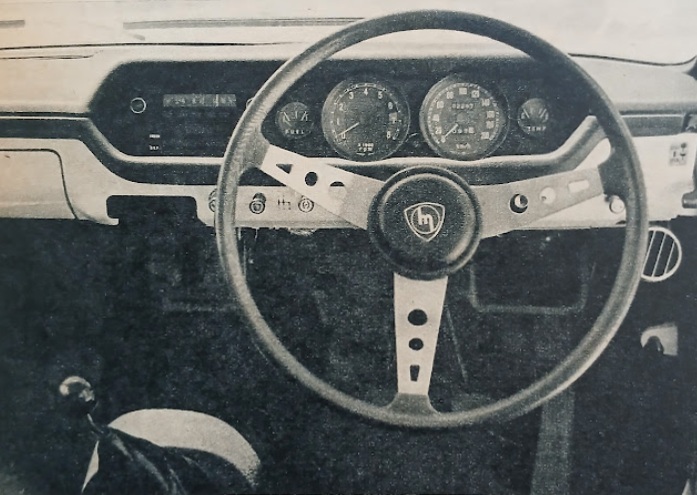
Inside, one notable point is the 375mm steering wheel diameter, significantly smaller than the reciprocating sedan’s 400mm. The seats appear to be the same as those used in the coupe, but seat cushion height is 290mm, similar to the Familia sedan. In other words, it feels like the sedan when you’re riding in it, but the power feels like the Rotary Coupe.
Compared with the sedan, the trunk space is naturally reduced, because the fuel tank is now 60 liters. In the rear seat, the 210mm tunnel height is quite high, so seating for five feels a bit tight. I also felt that a grab handle and an armrest for the front seats would be desirable.
There are no major issues in reaching the various interior controls. However, the dash panel being painted the same color as the exterior body panels feels somewhat cheap for a car of this performance level.
Higuchi: Nowadays, most cars avoid showing bare metal inside, so that detail is a little off-putting.
Safety Designed to Prevent Accidents
Onda: The pedal positioning has changed, and I wonder if this is due to fitting the rotary engine. They are placed somewhat farther forward than in the sedan, and the transmission tunnel is slightly larger, so the width of the footwell is reduced by about 20-30mm. The instrument layout is well-balanced, with the large round speedometer and tachometer in the center, and the fuel and water-temperature gauges arranged on either side.
Hirao: I agree about the grab handle, it would be nice to have something to hold on to.
Higuchi: We’ve been evaluating safety throughout these tests, but most so-called safety equipment is really only effective after an accident has occurred. Rather than calling them “safety measures,” it would be more accurate to call them injury-reduction measures. What is truly important is providing safety measures that prevent accidents in the first place. Those are things like the brakes, steering, and visibility. If we include the car’s strong acceleration and stable handling, its score would rise further, but because our safety evaluation is still based on things we can see, the lack of an armrest, for example, lowers the score. In terms of this car’s score, it comes to 80 out of 100, but the score tends to rise with accessories, so higher-priced cars score better.
Compared to other cars of similar size in the 1000cc class, the score is above standard, but since the price is one class higher, its score is low when evaluated in that category. However, the power performance is excellent, and the safety of the brakes and steering is also outstanding, so even though these aren’t reflected in the score, I’d say this is a very safe car.
Magazine: Next, let’s move on to maintenance.
Higuchi: Whether the engine is reciprocating or rotary, what matters to the owner is that it runs without trouble. This engine’s maintenance seems manageable even for someone who just wants the car to work. It is also very helpful that the manual explains, for those who have some knowledge, how you can change the spark plugs depending on how fast you drive, or even change the tires, and so on.
Another point I liked: I worried that if the rotary were emphasized too strongly, the owner’s manual would turn into a repair manual. But this car’s manual focuses more on how to drive it properly, and is very easy to understand. In terms of maintenance, the schedule specifies oil changes every 6000km, along with inspections of the engine and other components–the same as a reciprocating engine, which makes it easy to use.
Watanabe: This schedule is aligned with the regular inspection intervals. If we tried to extend it further, the maintenance plan would become disorganized, so we kept it this way.
Magazine: How were the results of the visibility measurements?
Hirata: The measurements were taken with the driver’s seat in the center of its sliding range. From this position, the height from the ground to the eyepoint is 117cm, the distance to the front glass is 53cm, and the distance to the rearview mirror is 50cm. The visible range through the windshield totals 1.55 steradians, with 88° in the horizontal plane and 26.5° in the vertical plane. The visible range through the rear window is 51.5° horizontally and 16° vertically. The wipers clear a total of 73.5°. The blind spot in the horizontal plane, including the eyepoint, is 49°. Expressed as solid angles, forward visibility is 1.1 steradians, of which the front window accounts for 0.595 steradians; the wipers cover 67% of that.
Total blind spots measure 2.75 steradians, which is slightly larger than normal, since most sedans fall in the 2.5-2.6 range.
To a Monthly Production of 3,000 Units
Magazine: Could you tell us about production plans going forward?
Minagawa: The Rotary Coupe was being produced at a rate of just over 1,000 units per month. Including the SS, production has risen to about 3,000 units per month. Production capacity has expanded to 3,500-4,000 units, so in the future, including exports, we would like to bring it up to the 4,000-unit level.
Magazine: With that many cars on the road, some users will surely want tuning options. How will you handle that?
Mitsunari: We will be offering tuning options.
Minagawa: On the service side, we’ve already assigned service personnel to all company-operated sales outlets. We are currently training dealers.
Yamamoto: Tuning can be done with the current side-port intake, but for a hotter setup, we would need a peripheral port type. In that case, it would become a separate engine sold independently. Even if that becomes the case in the future, for now we are considering a kit using the current port as a first step.
Magazine: Thank you all very much for your time today.
Postscript: Story Photos