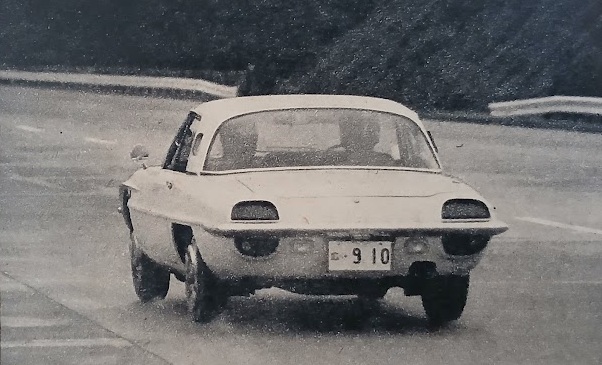
Mazda Cosmo Sport (1967)
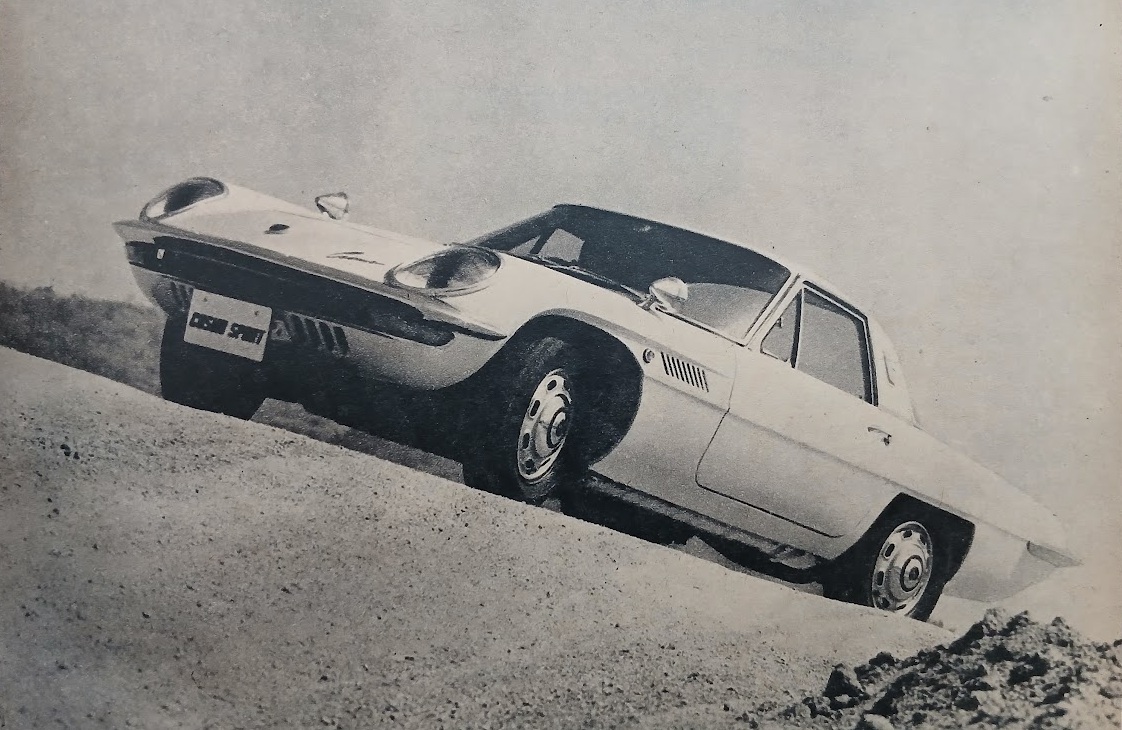
Publication: Motor Fan
Format: Group Test Drive
Date: August 1967
Authors: Katsuzo Kageyama, Fujio Uruno, Taisuke Fujishima, Daisuke Kato, Keitaro Miho, Kaoru Natsukawa, Motor Fan Editorial Staff (uncredited)
Driving the Mazda Cosmo Sport
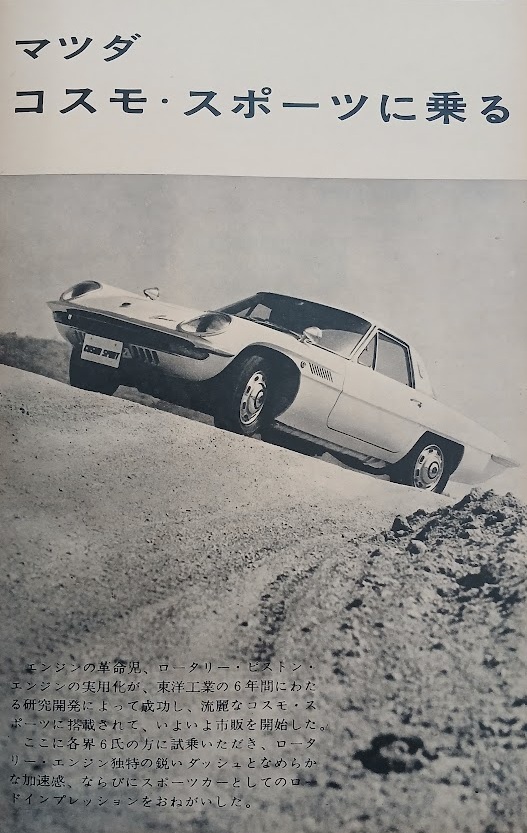
The revolutionary rotary-piston engine has been successfully brought into practical use at last, following six years of research and development by Toyo Kogyo. Installed in the sleek Cosmo Sport, production has finally begun.
For this article, we invited six specialists from various fields to drive the car and give us their impressions of the rotary engine’s uniquely sharp acceleration and remarkable smoothness, as well as their overall impressions of the Cosmo as a sports car.
The Rotary’s Unique Appeal in Acceleration
Katsuzo Kageyama
The Car We Waited So Long For
There can hardly have been another car that was promoted so extensively, and for so long, before its release. At last, the car we have waited and waited for has finally appeared.
“You certainly kept us waiting a long time,” I found myself saying, feeling a mix of longing, expectation, excitement, and just a touch of resentment. “Sorry to have kept you waiting those six years,” came the reply, without the slightest embarrassment, and with every sign of confidence. That was enough to put my mind at ease.
Then, as I heard one story after another of the hardships it had endured during those six years, I could only repeat, with sympathy and admiration, “I see, I see. You certainly had a difficult time. And yet you’ve grown up so splendidly.”
But sentimentality has no place in a road test, so I made a conscious effort to remain objective as I climbed aboard, casting the same critical eye over the car as always.
The Cosmo is an exceptionally low car, with a low driver’s eyepoint, but because the hood is also low, it offers good forward visibility. After sliding the seat into a position that placed my feet comfortably on the pedals, I noticed that the gear lever was a little too close, requiring me to bend my left elbow quite sharply.
One distinctive feature is the adjustable steering wheel, but changing its position does nothing to alter one’s relationship to the gear lever.
I started the engine, and noticed nothing particularly unusual about its sound. Vibration was only slight. I put it into gear, then reached to release the parking brake–and was somewhat startled.
The brake lever is so massive that it seems out of place in the stylish interior. It felt as though I were gripping the brake lever from a large truck, or perhaps from a winch used on a construction site.
A Delightful Surge of Acceleration
The first thing I noticed after setting off was the remarkable initial acceleration. Press the accelerator, and the engine pulls cleanly from low revs, surging ahead eagerly and delightfully in one continuous rush.
The gear change is smooth as well, making for simply exhilarating acceleration.
Once in top gear, I slowed back down and was astonished by how well the engine could pull from low speeds. The car will keep running down to around 30km/h, and if the accelerator is pressed from there, it surges forward in one strong sweep of acceleration.
This was a revelation. No conventional piston engine offers anything quite like it. With maximum power at 7000rpm and maximum torque at 3500rpm, this can only be the result of exceptional engine flexibility.
Here we find one of the great distinguishing characteristics of the rotary-engined car.
While traveling at high speed, I closed the throttle abruptly and again found myself thinking, “What’s this?” There seemed to be remarkably little engine braking.
Rather like a car with a two-stroke engine, the Cosmo simply coasts along when the throttle is closed. Yet, as one would expect, engine vibration and noise are remarkably low. It is both exceptionally quiet and exceptionally smooth.
As I increased speed, a tremendous rush of wind noise suddenly began around the left-hand quarter window at about 70km/h. Closing the quarter window stopped it, but opening it caused the noise to return.
When I tried changing lanes at high speed, the steering felt extremely light, giving the car a slightly unsettled feeling. I experienced this two or three times, but there was no opportunity to investigate it fully on public roads.
To Have Come This Far…
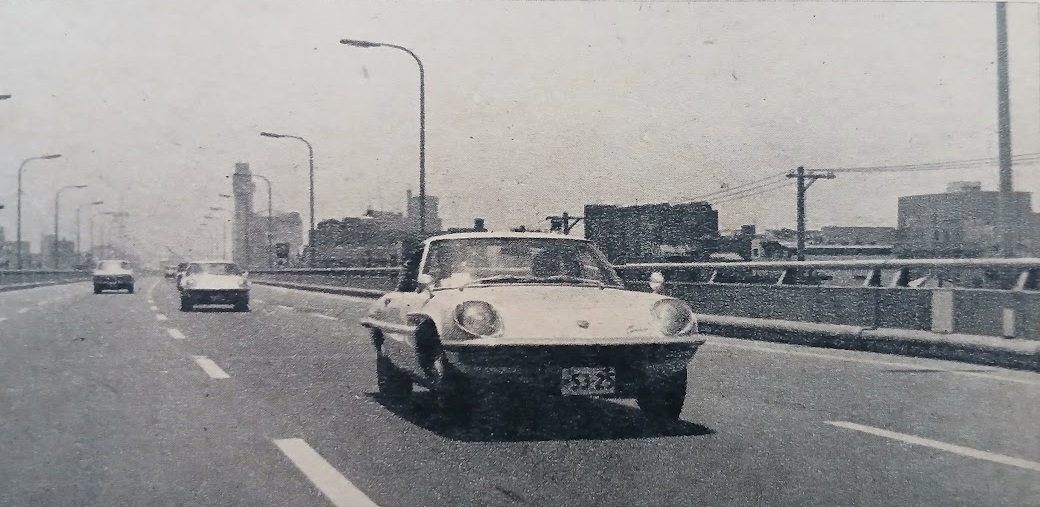
Admittedly, the wind was extremely strong that day, and our route was on an elevated expressway, so both the wind noise and the slight wavering of the steering may have been due to the conditions.
It is difficult to reach any firm conclusions from such a short drive, but as a car, the Cosmo may have two or three minor points open to criticism. As for the rotary engine itself, however, it deserves virtually nothing but praise. In fact, I never expected it to be this good.
The manufacturer also appears to have complete confidence on the question of durability…
I have the deepest respect for Toyo Kogyo’s achievement in developing the rotary engine to such an impressive level.
Even so, I do not believe that every problem has been 100% solved. Looking at it with a slightly more critical eye, one might ask about fuel economy, for example. Conventional wisdom has always regarded durability as the great question surrounding the rotary engine, but perhaps that hurdle has already been overcome, leaving difficulties in more practical and equally important areas such as fuel consumption.
This is no more than irresponsible armchair speculation arising from a simple question in the author’s mind, and I sincerely hope that my suspicions prove misplaced…
Through Toyo Kogyo’s extraordinary efforts, the much-discussed rotary engine has, for the time being, achieved success. It has reached such a degree of refinement that no shortcomings could be found during this brief test drive.
Production is now a reality. This is probably the most advanced rotary engine anywhere in the world today. Yet it has only just emerged from the experimental research stage, and has not yet fully become an “engine of today.” For now, it remains an “engine of tomorrow.”
Whether it can eventually be installed in passenger cars produced by the tens of thousands each month, and thereby fully become an “engine of today,” is something that only the future will decide. Indeed, the real challenge may only now be beginning.
(Professor, College of Science and Technology, Nihon University)
Reassuring Acceleration and a Wide Field of Vision
Fujio Uruno
The Noise Has Disappeared
It has been quite some time, I think, since I first felt that I wanted to drive the Cosmo. Back when five or so prototypes had been built, I was given a ride around the small test course at the Hiroshima factory while being told, “President Matsuda himself sometimes drives one of these prototypes between Hiroshima and Tokyo.”
The body styling was almost identical to that of the car I drove this time, but as we turned laps of the test course at an average speed of 80km/h, what struck me most was the sound of the engine.
The question that remained in my mind from then until now was, “does a rotary engine really have to make so much noise?”
Three years have passed since then, and when I drove the car this time, all the noise had completely disappeared. When I mentioned this to Kaoru Natsukawa, who was riding with me, it seemed I was alone in thinking so.
The Cosmos displayed at the Tokyo Motor Show over the past two or three years benefited from the experience gained with several dozen evaluation cars, and Toyo Kogyo seems to have listened openly to the various requests and comments from their drivers. This perhaps reflected both the caution and the confidence with which the company approached the development of this revolutionary engine.
The Bumpers Need Further Thought
The body is finished in ivory, a color that works well from the standpoint of traffic safety, but there is one thing that concerns me: the shape of the front bumper.
In styling terms, it suits the car beautifully, but its sharp ends seem likely to pose a danger to pedestrians. The rear bumper is also positioned too high.
The generous footwell on the passenger side is welcome, but the inability to brace one’s feet is a safety concern. Even at this stage, I would like to see a footrest added.
Since my impressions are based on no more than a round trip along the expressway to Haneda, I cannot say anything very detailed. I would welcome another opportunity to test the car’s characteristics under a wider variety of conditions.
The Rotary Is Smooth
My main interest, naturally, was in the rotary engine. What would it feel like to drive a car powered by this new kind of engine, with a piston moving in a circular motion, completely unlike the reciprocating pistons of a conventional engine?
Natsukawa drove to Haneda while I rode as a passenger, and I drove on the return trip. Taking both experiences together, my impression–much as it was with a Luce I drove previously–is that Toyo Kogyo’s cars have a distinctly family-car character.
You simply get into the car, grab hold of the wheel, press the accelerator, and drive away. It may sound unremarkable, but there is something strikingly effortless and natural about the whole experience. This rotary-engined car, too, has the reassuring familiarity of a conventional car, and is immediately easy to feel comfortable with.
Press the accelerator, and through the sole of your foot you can feel the rotary’s smoothness, distinctly different from that of a reciprocating engine.
Press farther, and the way the revs rise sharply and smoothly is extraordinarily satisfying.
It is this quality of acceleration that makes one truly appreciate the pleasure of the new engine. Overtaking is quick, effortless, and safe.
Surprised by Regular-Grade Fuel
The transmission is a 4-speed, but even when the car is slowed to 30km/h in top gear, there is no sign of knocking. The engine has a remarkably broad operating range and is perfectly at ease at low speeds, making this an exceptionally easy car to drive.
The effectiveness of Toyo Kogyo’s twin-rotor design is clearly apparent, and even crawling through city traffic is remarkably smooth for a high-performance sports car.
I was also impressed to learn that the engine runs on regular-grade fuel. I had naturally assumed that an engine this advanced would require high-octane gasoline.
Few drivers can be more concerned about fuel economy than those in Japan, and if this engine should eventually come into widespread use in ordinary passenger cars, that may well become an important selling point.
An Appealing Family-Car Quality
Not only is the Cosmo easy to simply get into and drive, it is also very easy to handle. Visibility is exceptionally good both forward and rearward. In particular, the relationship between the seating position and the height of the hood is well judged. Seeing how low the car is from outside, I had expected forward visibility to be restricted, but once behind the wheel, I found that, apart from the road surface immediately in front of the car, there is no danger of a person being hidden from view. Anything that matters can be seen clearly.
The steering wheel can be adjusted fore and aft through about 60mm, allowing its position to be changed according to speed, the driver’s build, or even driving fatigue, and this is a feature I appreciated. The handbrake lever, however, is positioned on the passenger side. There were presumably mechanical reasons for this, but it was awkward to operate.
On the return journey, I took the wrong exit from the motorway and ended up ambling along ordinary roads, which further strengthened my confidence in the engine’s resistance to knocking.
In any case, it seems that the very favorable impression I came away with was not due solely to having Kaoru Natsukawa as my passenger.
(Director, Traffic Safety Research Division, National Research Institute of Police Science)
A Car to Drive with Pride
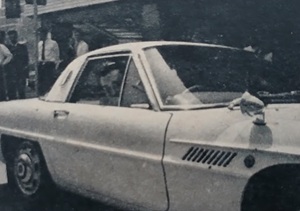
Taisuke Fujishima
Beautiful Styling and Excellent Visibility
This is a car that has kept us in suspense for a very long time.
After all, an unusually long period passed between its first appearance at the Tokyo Motor Show and the start of series production and sales. One could also say that this reflected just how cautious Toyo Kogyo has been.
The simple fact that it was powered by a rotary engine made me rather more excited than usual about this test drive. Perhaps that was why I arrived at the meeting place a full 30 minutes ahead of the appointed time–a rare occurrence for someone who is habitually late.
As usual, our route took us from Ginza to Haneda and back. Since this is, after all, a sports car, I could not help wishing for the chance to let it loose somewhere like Yatabe.
First, the exterior. It is exceptionally well resolved. It strongly recalls the 1957 Thunderbird, one of America’s outstanding bestsellers and still a common sight on its freeways today.
The rear is particularly successful. The line flowing from the rear window into the trunk is beautiful.
When I first sat in the driver’s seat, I wondered whether the body sides might be rather high, but perhaps because of the rotary engine’s compact dimensions, visibility is exceptionally good.
I set off into the rush-hour traffic of central Tokyo. In a car that had attracted so much attention, I found myself conscious of the eyes all around me. Everyone seemed to be looking with evident curiosity.
Even at low speeds in heavy traffic, the steering response is excellent. And even in top gear at 25km/h, there is not the slightest engine shudder. This came as something of a surprise. It is genuinely practical.
I entered the expressway. Press the accelerator, and the car simply glides ahead. I slowed down and tried the same thing again. Once more, it was that same effortless surge. This was where the Cosmo felt distinctly different, and it is not easy to put into words. Where another sports car might charge headlong with a harsh, urgent growl, the Cosmo simply sweeps forward. Yet a glance at the tachometer and speedometer shows that neither its acceleration nor the speed at which its revs rise are in any way inferior to other cars–and may well be superior.
I found myself thinking, this is good. Gradually, I began to want one. I even started picturing the figures in my bank account. At 1.48 million yen, perhaps it was not so expensive after all, if it meant being one of the first owners of a car powered by the revolutionary rotary engine.
I carefully checked the rearview mirror and pressed the accelerator. 70, 80, 90km/h–the speed rose almost before I knew it. Then I returned to being a law-abiding citizen and slowed back to 60km/h. I shifted down from third to second. The resulting shift shock was gentle.
So Quiet It Seems Almost Unbelievable
This may be a characteristic common to all Mazda models, but the interior is remarkably comfortable. It hardly feels like a sports car at all. It may sound strange, but that is precisely what I liked about it.
It is quiet, too. When I asked the Mazda representative sitting beside me, he explained that two versions would be offered: one quiet, and one slightly noisier. Once you’re over 30, it becomes rather embarrassing to drive a car that sounds like a thunderstorm. The thoughtfulness of offering both versions is something I can only admire.
In any case, the quietness of the engine is almost unbelievable. It seems quite possible that, while enjoying yourself, you could find the revs climbing without even realizing it. This really is a revolution after all.
A Bargain for the Performance
Before setting off, I listened to one of the development managers explain the rotary engine with the aid of a miniature model, but being mechanically hopeless myself, I could listen all day and still not understand. Apparently, two plates shaped something like onigiri spin round and round, taking the place of the up-and-down motion of conventional pistons. This is rotary motion; what we have had until now is reciprocating motion.
At Haneda, I parked in the deserted lot in front of the hotel and looked over the engine compartment and trunk. Sure enough, the engine bay is remarkably compact, which explains why the front bodywork does not need to be so deep. Even visually, the engine looks light, quite unlike the heavy machinery one expects to find in a powerful sports car.
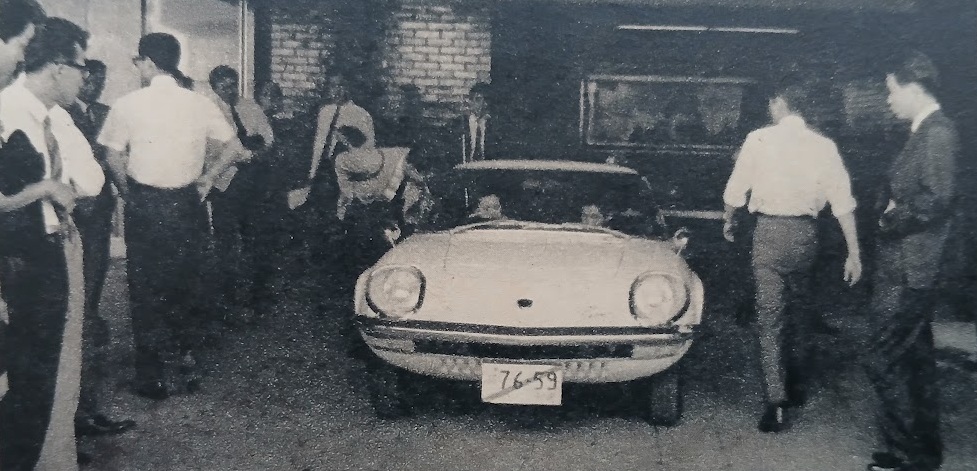
As I stood there wearing my most knowledgeable expression and inspecting such things as the fitting of the spark plugs, a dense crowd quickly gathered around.
Even taxi drivers pulled their cars over and got out for a closer look. A revolutionary car really is something different, I thought admiringly. And yet, it is remarkable to think that a nation whose people were still riding in rickshaws until quite recently has developed such enthusiasm for the automobile. More remarkable still, Japan is now about to become the first country in the world to mass-produce a rotary-engined car.
Another welcome point is that the annual road tax on this car is only 21,000 yen. From behind the wheel, it feels as though it has the performance of something larger than a 2000cc car, so that alone makes it seem something of a bargain. And with fuel economy of 13.5km/l on regular gasoline, it would make an ideal second car. If something like the Middle East conflict ever leaves us short of oil, it would be just the thing.
Comfortable Even on Long Drives
Still thoroughly impressed, I set off on the return journey. This time I resolved to be a law-abiding citizen and drove along at a leisurely pace, taking the opportunity to examine the details of the dashboard. It is good to find that the car is comfortable even at low speeds.
The dashboard is quite stylishly executed. The white instruments against a black background have a masculine appearance and also complement the wood-rimmed steering wheel nicely.
The gearshift knob is wood as well and pleasant to the touch, while the smoothness of the shift means that gearchanges require almost no physical effort, even for a woman.
I found myself thinking that this car would surely become a bestseller if it were introduced in America. This is not mere flattery: I believe it is the first Japanese car that could take its place on an American freeway without embarrassment.
One small thing that bothered me was that the window cranks turn in the opposite direction from usual. Of course, it is hardly a serious matter.
I was greatly pleased by the mature atmosphere that pervades the car as a whole. It has a calm, composed character. Indeed, it may actually be less suited to younger drivers. The price, too, is decidedly grown-up.
As for the roadholding and front disc brakes, I have no complaints. The body sits low, and there is no sense of uncertainty whatsoever. With such comfortable accommodation, I imagine that even a long-distance drive would be relatively untiring.
Rather than selling it simply as a sports car, there may be greater potential in presenting it as a refined and practical two-seater. It is an enjoyable, delightful car.
(Writer)
A Car You’ll Fall in Love with Once You Drive It
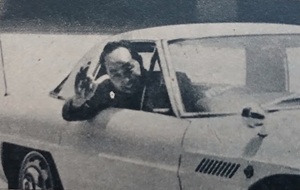
Daisuke Kato
Among the First to Drive the Long-Awaited Car
I was at home alone rehearsing for an appearance at Osaka’s Koma Theater in June when I received a phone call from the editors of Motor Fan. They told me that Mazda would be releasing a rotary-engined car at the end of May and asked whether I would like to take it for a test drive.
I had recently run into some of the Motor Fan staff at the Grand Prix race at Fuji Speedway, and apparently they had taken me for a sports-car enthusiast.
The truth is that my philosophy is strictly “safety first–please, go right ahead.” I prefer driving slowly and leisurely, and my own car does not even have a clutch pedal. I had only gone to the circuit because my son dragged me along–not on a pilgrimage to Zenkoji, but to see the Grand Prix. So I was not particularly interested in sports cars, and besides, I would already be in Osaka by the end of the month. So, I declined the invitation.
When my son heard about it later, however, he could hardly have been more disappointed. “You should have put off your rehearsals and gone for the drive!” he said, before launching into an enthusiastic explanation of just how remarkable the rotary-engined car was. “You ought to try a sports car like that at least once, Dad. It’ll be quite different from that electric car of yours.” By then, I began to feel that perhaps I had let a rather good opportunity slip away.
When I arrived in Osaka on May 30, someone from Motor Fan’s local office was waiting for me. He told me that they had spoken with Mazda and again asked whether I would like to drive the car the following morning before rehearsal. This time I was immediately enthusiastic: “Absolutely.”
The next morning, while waiting to be picked up, I looked through the newspapers. Every one of them prominently carried the news, complete with photographs: “Rotary-Engined Cosmo Goes on Sale.” My heart began to beat a little faster. To think that I would be among the very first to drive the car that sports-car enthusiasts throughout Japan had been waiting for–I found myself thinking, “What a lucky fellow I am!”
Before long, I set off with the Motor Fan representative for Mazda’s branch office on Midosuji. In the showroom, lined with handsome Luces, the general manager gave me some background on the Cosmo. When I told him that I had been driving nothing but clutchless cars for years, he advised me, “It might be safer to practice changing gear first. This car will leap forward forcefully at the slightest touch of the accelerator.”
A Cabin Roomier Than It Looks
Together we went to the nearby temple, and there they were in the spacious temple grounds–four Cosmos, gleaming in the early-summer sun, their purposeful expressions combining a sense of aggression with elegant dignity.
For a while I simply stood admiring them, but when someone said, “Well, please go ahead,” I suddenly found myself with a slight problem. After all, I am a rather portly 80kg, and I wondered whether I would even fit into the low, compact, light-looking Cosmo.
Perhaps sensing my concern, one of the staff said, “The steering wheel position is adjustable, and it’s surprisingly roomy inside.” Sure enough, once I settled into the chic, all-black interior, it felt less like the cramped cockpit of a sports car than the cabin of a two-door sedan.
The reclining bucket seat wraps securely around the body and gives a reassuring sense of support. There is also a radio, heater, and cigarette lighter. Looking at the array of instruments spread across the dashboard, I placed my foot on the footrest, adjusted the steering wheel to just the right position, and gripped it firmly. Suddenly, I felt as though I were about to start a Grand Prix race.
Thrilled by Its Sharp Acceleration
I fastened the three-point belt and, for the first time in years, tried shifting through the fully synchronized 4-speed gearbox. The shift was effortless, and I was astonished to find myself approaching 50km/h in first almost immediately after setting off. One of the staff just laughed and said, “If you really put your foot down, it’ll go even faster.”
At last, it was time for the test drive. We decided to take the expressway that circles Osaka, but with traffic badly congested along the way, I moved over to the passenger seat for the drive to the Dojima entrance.
Four sharply styled sports cars, gleaming brightly and traveling in convoy, must have made quite a spectacle. Everyone in the cars passing us seemed to stare with amazement, and I confess I felt rather proud.
At one point, while we were stopped at a red light, two young women hurried over to the roadside and called out, “Wow, that’s so cool! What a beautiful car! What kind is it? Is it yours, Pops?”
Being called “Pops” was a little deflating, but one cannot feel too bad about being complimented.
“It’s the Cosmo. It’s just gone on sale,” I told them.
Then one of them suddenly exclaimed, “Hey, aren’t you Daisuke Kato? You look younger driving such a great sports car!”
That left me completely speechless.
Save the Top Speed for the Test Track
By late morning, the expressway was almost ideally empty. I immediately took the wheel, and at last the real test began… though with safe driving as my motto, I kept to around 50km/h.
Even when I slowed to about 30km/h while leaving the car in top gear, there was no knocking. From there, it would simply accelerate again, giving me almost the illusion that I was driving a clutchless car.
Sometimes like an arrow, sometimes at a leisurely pace, the Cosmo responded exactly as I wished. Before I knew it, I had completed a full circuit of the expressway as though in a dream. Reluctant as I was to leave, it was time to report to the theater, so I handed over the wheel once more and we descended into the crowded world below.
“It must be wonderful to really let this car go,” I remarked.
“Come to our proving ground in Hiroshima,” one of the staff replied. “You can do 185km/h in this car.”
At 185km/h, I would probably become dizzy.
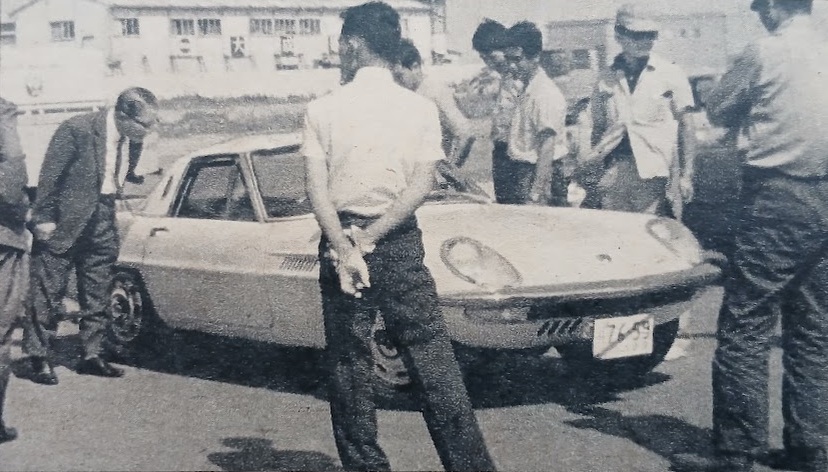
I got out near the Koma Theater and asked to have one more look at the rotary engine. In no time at all, a large crowd had gathered. The younger people immediately recognized it–“So this is the rotary-engined car!”–and eagerly began asking questions.
We could hardly remain there long enough to obstruct traffic, so I said goodbye to everyone and joined the crowd watching the four Cosmos sweep stylishly away.
I now had a fine story to take home to my son, but I also found myself feeling a little younger and wondering whether perhaps I ought to try driving a sports car myself. It seems that, in the end, the hunter had been captured by his own prey.
Ah, youth!
(Actor)
A Sharp Sports Car
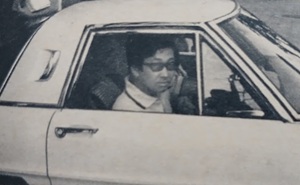
Keitaro Miho
Practicality Fully Realized
Four years after it was first revealed at the Motor Show, the long-awaited Cosmo with its rotary engine has finally gone on sale.
Toyo Kogyo has clearly acted with confidence in bringing the car to market, and the result is impressively well developed. One of the major challenges during those four years since its unveiling seems to have been providing adequate torque at low speeds–in other words, adapting an engine inherently suited to high-speed operation for touring and everyday use.
From my impressions behind the wheel, this problem has been brilliantly solved. The car can be driven at 30km/h in top gear. The engine also gains revs with remarkable smoothness. With a reciprocating engine, there is almost invariably some point in the rev range where it seems to hesitate slightly or feel reluctant to pull further, but the rotary engine has no such characteristic whatsoever. Press the accelerator, and the tachometer needle simply sweeps smoothly upward. Acceleration is excellent as well. With a standing quarter-mile time of 16.3 seconds, its performance is fully comparable to that of a conventional 2-liter car.
I tried accelerating hard away from the tollgates, taking each gear to a maximum of 6000rpm, and found the acceleration extremely impressive. At the same time, for a car weighing 940kg and capable of 185km/h, I felt the braking system was somewhat inadequate. A car like this really ought to have disc brakes on all four wheels. Servo assistance would also make it more reassuring.
The Engine Ancillaries Should Be More Compact
Turning first to the car’s exterior, the color deserves mention. The present white finish looks far more sophisticated than the rather heavy-looking two-tone scheme of the original show car. With a ground clearance of 125mm and an overall height of just 1165mm, the Cosmo is exceptionally low and certainly handsome, though there is something rather weighty about its overall appearance that leaves it slightly lacking in lightness and delicacy.
Had the body been made of fiberglass, it might have been truly remarkable.
And what of the engine compartment? The Cosmo’s twin-rotor engine is remarkably compact and weighs only about half as much as a conventional 2-liter reciprocating engine.
It sits neatly in the engine bay. Yet the ancillary equipment takes up a surprising amount of space. There is the twin-ignition system and, above the carburetor, an enormous dry-type air cleaner like something from an American car. Surely there must be some scope for making these components a little more compact.
A Well-Judged Footrest
And what of the interior? From the right are the water-temperature gauge, oil-temperature gauge, tachometer, speedometer, ammeter, and fuel gauge, together with a map light, all arranged across the dashboard. The dashboard itself is finished entirely in black. It may perhaps seem a little dark, but the overall atmosphere is pleasingly subdued.
The steering is by rack-and-pinion and can be adjusted for reach. Perhaps this was done with exports in mind, but in any case, I found it convenient to be able to set the steering wheel position to my own tastes. The gear lever is short, and the 4-speed gearbox is fully synchronized. If one were to ask for more, I would have liked either a 5-speed with overdrive or a Porsche-type sporting 5-speed gearbox. To the left of the clutch pedal is a footrest, which is an excellent idea.
On a long drive along an expressway or elsewhere, when there is no need to change gear for an extended period, the left foot can become surprisingly tired. At such times, this footrest makes things much more comfortable. It is also useful for bracing oneself during cornering.
Hoping for a Racing Version
The wiper control is incorporated into the turn-signal stalk beside the steering wheel, which is another convenient feature. Twin horns are fitted as well. However, the Cosmo I drove simply had two horns of exactly the same tone, in which case there is no point in having a twin-horn arrangement at all. Some thought should be given to the tones of the horns themselves.
I am told that the engine may routinely be taken to 7000rpm in normal driving, and that it can even be revved momentarily to 9000rpm. That being the case, I would like to see another 15km/h or so beyond its 185km/h top speed. After all, it really ought to reach 200km/h.
The Cosmo, with the world’s first twin-rotor rotary engine producing 110ps, still holds seemingly limitless potential. For those of us interested in motor racing, however, it is impossible to look at a car like this without wanting to see it taken onto the circuit. From my impressions behind the wheel, the Cosmo seems to exhibit mild understeer.
At close to one ton, however, the Cosmo would be at a disadvantage in various respects if entered in competition.
I sincerely hope that, in the near future, we will see a Cosmo with this rotary engine mounted amidships, a fiberglass body, a 5-speed gearbox, servo-assisted disc brakes on all four wheels, and a top speed of, say, 285km/h.
(Composer)
The Cosmo, for Women Too
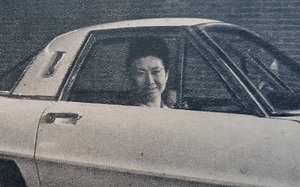
Kaoru Natsukawa
Styling That Immediately Catches the Eye
For car enthusiasts, the unveiling of the Mazda Cosmo Sport was a long-awaited event–rather like the automotive equivalent of an engagement that had gone on far too long.
Shortly after its introduction, I was given the opportunity to drive the car from central Tokyo to Haneda Airport via the expressway. Here, I will simply recount my candid impressions from that drive.
First of all, its appearance is truly outstanding. Some may feel that the tail is slightly too long, but when one considers the overall balance, it becomes clear that the styling as a whole is exceptionally beautiful.
The first thing that impressed me when I sat in the driver’s seat was how thoughtfully the instruments had been arranged for sporting driving.
For example, the water-temperature and oil-temperature gauges are grouped together at the upper right, while the tachometer and speedometer are positioned where they can be read with exceptional ease.
By contrast, items like the clock are placed at the far left. The overall layout is clearly determined by the relative importance of each instrument. The driving position is excellent, visibility is expansive, and the provision of a footrest is the kind of thoughtful touch that almost makes one envious of the designers.
A Sports Car That Whispers
The low-speed torque, which I had been particularly interested in before the test, proved better than expected, and the engine was especially impressive between 3000-5000rpm. For a sports car, however, I found the engine almost too quiet, leaving me wanting a little more sound.
Taking all these qualities together, however, I believe this is also a sports car that women could thoroughly enjoy and happily live with.
A car whose styling, performance, and interior can be enjoyed by women as well is surely something of considerable value.
Two or Three Points That Caught My Attention
Among the small details I noticed during the test were that, despite the twin horns, I could not clearly hear two different tones, and that the window crank turned clockwise to lower the window.
Regarding the horns, since most of the test drive took place in Tokyo, perhaps the surrounding noise simply prevented me from hearing the difference between the two tones. As for the windows, however, given that such care has been taken with safety that even the ends of the crank handles are covered in rubber, I feel it would be better if they turned in the usual direction, from right to left.
The steering wheel can be adjusted through a range of 6cm, and while the convenience this offers may be difficult to appreciate without actually driving the car, it is a major attraction.
As someone who enjoys motor racing, my first thought was naturally whether the Cosmo could be entered in competition. Above all, I was left with the strong impression that this car’s future will be fascinating to watch.
A Car That Has Made History in Motion
In any case, the Mazda Cosmo Sport, introduced as the culmination of six years of rotary-engine research, can surely be said to have written a stirring chapter in the history of Japanese motorization.
The rotary engine may seem an exceedingly difficult concept to grasp, but what I discovered only after actually driving the car–sitting behind the wheel and opening the hood to look underneath–is that its mechanism is something a woman can readily understand.
(Actress)
Postscript: Story Photos