Mazda Cosmo Sport (1967)
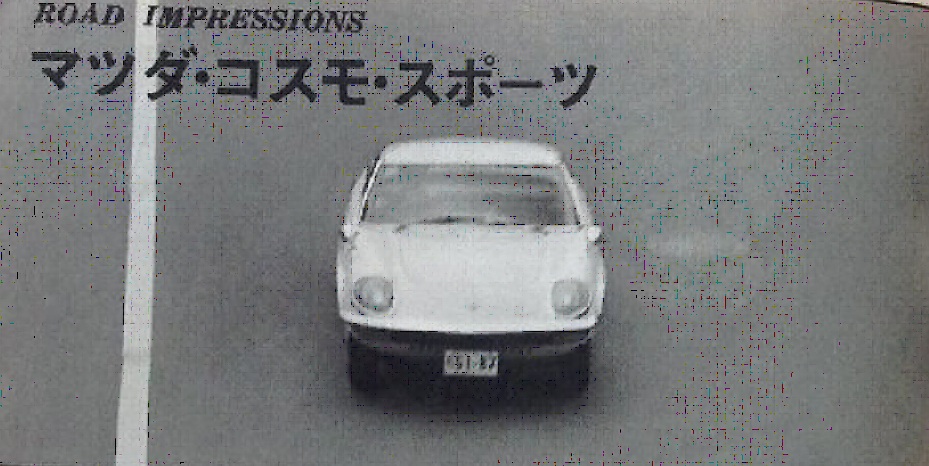
Publication: Car Graphic
Format: Road Impressions
Date: August 1967
Author: “C/G Test Group” (uncredited)
An Astonishingly Flexible Engine
There is something both exciting and faintly unnerving about testing a revolutionary mechanism for the first time. This was certainly the case with the rotary-piston engine. However, after approximately 600km behind the wheel of the Mazda Cosmo, it became clear that this remarkable powerplant combines outstanding high-speed performance with astonishing flexibility at low engine speeds. Even in crowded city traffic, it proves entirely practical and capable of everyday use.
If a driver were placed behind the wheel of the Cosmo without any prior knowledge of its mechanical layout, most would probably never suspect that it was powered by an entirely new type of engine. Even so, if asked how many cylinders it had, few would be able to answer with any confidence.
Starting was not instantaneous; at times the starter had to be engaged for rather longer than expected. At its 700rpm idle, the feeling is comparable to that of a sporting four-stroke engine, sending a pronounced tremor through the entire body. The exhaust note, meanwhile, has a deep, purposeful tone reminiscent of a two-stroke engine.
However, once engine speed rises beyond 1000rpm, the vibrations melt away and the engine’s smoothness is literally like that of an electric motor, the revs seeming to climb without limit. With no valvegear to reciprocate, mechanical noise increases very little even at high engine speeds. Moreover, the efficiency of both intake and exhaust flow is exceptionally high, so there is little in the engine’s character to discourage the use of revs.
For that reason, there is a real danger of over-revving the engine in the indirect gears, particularly first and second. Directly ahead of the driver is a large, easy-to-read tachometer with the red zone starting at 7000rpm.
Our test car was virtually brand-new, having covered only about 500km, so we carefully observed the recommended limit of 7000rpm (which corresponds to the peak output of 110ps). According to the manufacturer, however, the engine can safely be taken to around 8500rpm if limited to short bursts.
In practical terms, there is little need–or opportunity, on public roads–to use such high engine speeds. Extend the engine to just 5000rpm and very few cars this side of a Grand Prix racer will be able to keep up with the Cosmo. At 5000rpm, the car is already traveling 38km/h in first gear, 65km/h in second, and 97km/h in third. Let it rev to 7000rpm, where the red zone begins, and it will reach 53km/h, 92km/h, and 145km/h respectively.
Even at these engine speeds, the rotary still seems to have plenty in reserve, feeling as if it would continue to climb if one kept one’s foot down. The exhaust note, which resembles that of a large two-stroke at low speeds, changes at high rpm into a distinctive, powerful roar. Yet even then it never becomes loud enough to attract the attention of the police.
Because we were unable to use the Murayama test course during this test, there was no opportunity to record our own performance figures. The manufacturer’s published data, however, claims 0-400m in 16.3 seconds, 0-100km/h in 8.7 seconds, and a maximum speed of 185km/h.
Even from our limited experience, these figures struck us as somewhat conservative.
Naturally, any assessment of such performance depends upon what displacement one chooses to assign to a two-rotor rotary engine of 491cc per chamber. Yet if one ignores the engine’s unusual configuration and simply regards the Cosmo as a luxurious, practical two-seat GT powered by an approximately one-liter engine, then it must surely rank as an exceptionally high-performance car.
The rotary engine’s position relative to the conventional reciprocating engine becomes even clearer when fuel consumption is taken into account.
Our measurements returned an overall average of 7.9km/l over 593km, while the return leg alone produced an average of 9.6km/l. Considering that these 600km were driven by several members of the editorial staff in a manner that could hardly be described as economical, these were unexpectedly good results in light of the car’s performance and weight.
Moreover, despite its relatively high compression ratio of 9.4, the engine requires only regular-grade gasoline. No trace of knocking was observed, even when accelerating from low engine speeds.
The four-rotor NSU Wankel Spider has become notorious for excessive oil consumption—as much as one liter every 121km, according to Autocar—and this has provided rotary-engine skeptics with one of their favorite targets. Naturally, we were especially interested in this aspect during our test.
According to the manufacturer, the expected oil consumption is approximately one liter every 3,000km when cruising at 80–100km/h, and one liter every 2,000km during sustained high-speed running at 150km/h. These are excellent figures.
Our test car appeared not to have been serviced by the factory immediately prior to delivery. After we had driven approximately 100km, a check of the dipstick showed the oil level had fallen to barely touching the tip of the gauge. We added roughly one liter, bringing the level back to nearly the full mark. At the end of the 600km test, a careful inspection revealed no measurable decrease at all. It therefore appears that oil consumption over 600km is so slight as to be of little concern.
The fully synchronized 4-speed gearbox has well-chosen ratios, while the synchromesh itself is surprisingly robust. The synchro can occasionally be beaten during hurried downshifts, but the stubby, nearly vertical gear lever is well-positioned and its movements are short. Shift effort is not especially light, but action is smooth and positive.
Engagement of the diaphragm-spring clutch is notably smooth–more like that of a passenger car than a sports car. Perhaps partly due to the Cosmo’s substantial 940kg weight, standing-start acceleration lacks the dramatic sensation of being pressed back into the seat.
Clutch pedal effort is rather heavy, and becomes tiresome when used frequently in city driving.
Paradoxically, although the Cosmo’s engine displays astonishing flexibility at low speeds, its torque appears somewhat weaker than that of a reciprocating engine at very low rpm–around idle speed, for example, between 700-1000rpm.
In an ordinary reciprocating-engine car, one can usually move slowly away from rest simply by engaging the clutch smoothly, with little or no throttle. Attempting the same in the Cosmo invariably resulted in a stall. Once underway, however, the situation is entirely different. Exceptionally low road speeds can be maintained in top gear without complaint.
For example, even when speed falls to 30km/h in top gear–approximately 1100rpm–the car continues on with complete smoothness. Press the throttle from there and the engine accelerates quietly and cleanly, without the slightest trace of knocking. This kind of flexibility is normally associated only with large-displacement multi-cylinder engines.
Maximum torque is 13.3kgm/3500rpm, and the engine produces approximately 90% of that figure across a wide range of about 2000-6500rpm. In actual driving, this characteristic is immediately apparent. In third gear, for example, the car responds eagerly to the throttle over a range extending from roughly 35km/h all the way to 150km/h.
Where the Cosmo shines brightest is in high-speed cruising. At 120km/h in top gear, the engine is turning approximately 4500rpm. Even so, it remains exceptionally quiet and smooth, while still accelerating clearly when the throttle is opened further. Directional stability at this speed is outstanding. Simply resting one’s hands lightly on the steering wheel is sufficient to maintain an arrow-straight course.
The Cosmo’s flexibility at low speeds is, of course, partly attributable to the superior combustion efficiency of the rotary engine. Compared with a reciprocating engine, however, engine braking is noticeably weaker. We had the impression that this may reflect the flywheel effect of the engine’s entire rotating mass, including the two rotors themselves.
Throughout the test, both water temperature and oil temperature remained consistently within the normal range (there is no oil pressure gauge, only a warning lamp). After sustained high-speed running, however, engine idle occasionally rose to around 900rpm and became somewhat rougher than usual.
A Grand-Touring Ride
The Cosmo’s suspension–double wishbones and coils at the front, with a de Dion axle and leaf springs at the rear–is well suited to the car. This is not a purely performance-oriented sports car, but rather a luxurious two-seat high-speed tourer, and its ride quality reflects that character. The overriding impression is one of solidity and substance.
The ride is not so much soft as it is characterized by generous suspension stroke. Encounter a long, undulating section of road and the car moves through fairly large vertical motions, but the strong damping quickly suppresses any residual pitching.
Our test car was fitted with new-pattern Bridgestone 6.45H-14 low-profile tires. These proved prone to squealing when driven briskly around city corners. As an option, Bridgestone-built 165HR-14 radial tires patterned after the Pirelli Cinturato can also be specified.
The rack-and-pinion steering is quite sharp, while steering effort remains consistently light and free from kickback transmitted through the wheel. The wood-rim steering wheel is neither too large nor too small in diameter. A large locking screw on the steering column allows its length to be adjusted through a range of 60mm, a thoughtful feature.
To achieve the fashionable straight-arm driving position, however, the wheel must be adjusted nearly fully forward. Several drivers then complained that the rim interfered with their knees when working the pedals.
The handling maintains an appropriate degree of understeer even at high speeds. Yet it is always possible to intentionally slide the tail through tight corners in second gear under power, and the sharp steering makes this easy to control.
However, while negotiating one of the large sweepers on the Hakone Turnpike at 80km/h, we observed that uneven pavement can cause the entire body to step slightly sideways.
As far as the brakes were concerned, our particular Cosmo seemed to be an unfortunate case. The system combines front discs with Alfin drums at the rear, yet from the outset pedal travel was excessive and response felt weak. For a car capable of 185km/h, this was not entirely reassuring.
Nose-dive under braking was minimal, and repeated use from high speeds revealed no evidence of fade. Pedal effort was on the heavy side, however, and most of our drivers felt that servo assistance would have been welcome.
When we borrowed the same car again later for photography, pedal travel had improved considerably, but the initial bite remained unchanged.
The handbrake on the left side of the transmission tunnel is easy enough to use, but its travel is rather long, and when released the lever sits unusually high, which is somewhat bothersome while driving.
For a car with the differential mounted rigidly to the chassis, very little final-drive gear noise is transmitted to the interior. Our test car did, however, produce an unpleasant clunk from somewhere in the driveline whenever starting off or coming to a stop, similar to the noise produced by a worn universal joint. We mentioned this to the manufacturer, and by the next time we borrowed the car the problem had been fixed.
There was one further annoyance. From the beginning of the test, there had been a persistent squeaking noise from the left rear brake drum or hub assembly. This became progressively worse over time. Because it would occasionally disappear when the brakes were applied, we suspected that part of the brake shoe assembly was making intermittent contact with the drum.
A Luxurious Interior
The interior is finished almost entirely in black, with details such as the wood-rim steering wheel and its light-alloy spokes, the wooden gearshift knob, and black-and-white checked seat upholstery adding touches of color. The overall impression is one of genuine luxury.
The seats combine vinyl leather bolsters with check-pattern cloth inserts in the center sections. They provide excellent support, and the 140mm range of fore-and-aft adjustment offers ample travel to the rear. Combined with the reclining backrest and adjustable steering column, this should allow all but the most unusually proportioned drivers to find an ideal driving position.
The pedal layout is not ideally suited to heel-and-toe, but a footrest is provided for the left foot, allowing the driver to brace during spirited cornering. Drivers over approximately 176cm tall suggested that this footrest would be improved if it were moved several centimeters farther forward.
At the center of the steering wheel is a large safety pad incorporating the horn button. The wooden knob of the short gear lever rises from a deeply recessed position and falls naturally to hand.
The painted instrument panel places a large speedometer and tachometer directly ahead of the driver. On either side are smaller gauges for water temperature, oil temperature, electrical charge, and fuel level. All feature white markings on a black background, are attractively designed, and are easy to read.
At night, however, one notices that the lighting of the tachometer is considerably dimmer than that of the speedometer. The bulbs themselves are probably identical, but the speedometer benefits from light spilling through the two turn-signal indicator windows and consequently appears brighter. Even with the rheostat adjusted to maximum brightness, the tachometer is too dark. In fact, it was the lighting of the radio that stood out the most.
The various switches are scattered around the console and dashboard: two-speed wiper controls, a horn-tone selector (which has little noticeable effect), a map lamp, and the switch for raising and lowering the power antenna. This arrangement is actually more convenient than the usual practice of clustering everything together around the headlamp switch.
One feature that struck us as particularly thoughtful is the multi-function lever projecting from the right side of the steering column. Similar in concept to that used by Mercedes-Benz, it not only operates the turn signals and headlamp flasher, but also incorporates the wiper and washer controls. Rotating the knob activates the wipers, while pressing the end of the lever activates the electrically operated windshield washers. All of these functions can be operated with the fingertips without removing one’s right hand from the steering wheel.
In practice, opportunities to use several of these controls at once occur surprisingly frequently–for example, activating the wipers and washers while dipping the headlights for an oncoming car in the middle of a winding road. This kind of thoughtful design suggests that the Cosmo’s interior was designed by people who spend a great deal of time behind the wheel themselves.
The only drawback is that, as noted earlier, the switch for the two-stage wiper speed is mounted separately on the dashboard and must be operated with the left hand.
As for interior storage, there is a lockable glovebox on the left side of the dashboard–large enough to accommodate a camera–and a fairly spacious shelf behind the seats, sized for a small suitcase and equipped with retaining straps to secure luggage. A covered storage compartment behind the gear lever would have been a useful addition. The trunk itself is spacious and has a generously sized opening. Taken together, these storage areas should prove entirely adequate for two people on a long-distance journey.
The broad rear quarter panels incorporate cabin air extractors, but fresh-air intake is still routed solely through the heater. Face-level ventilation is provided only by opening the somewhat old-fashioned triangular vent windows.
Finally, a word about the body styling. Aesthetic matters are subjective, and opinions naturally differ. But among the editorial staff, the prevailing view was that now, three years on from the Cosmo’s debut at the Motor Show, its styling can no longer be regarded as entirely fresh.
In addition, the edges of the front and rear bumpers are rather sharp, ending almost in points rather than rounded corners. From the standpoint of safety, it would be desirable to revise them somehow, perhaps by adding rubber guards. From the driver’s seat, the thick chrome trim surrounding the headlights also produced troublesome reflections. This is another small detail that we would like to see corrected.
At present, the Cosmo is offered in only a single specification, priced at 1.48 million yen.
It is notable that Toyo Kogyo has boldly chosen to back this revolutionary rotary-powered Cosmo Sport with the same two-year or 50,000km warranty as its conventional models. As for its long-term durability, this brief test cannot honestly provide a definitive answer–that is something only time will reveal.