Mazda Cosmo Sport (1967)
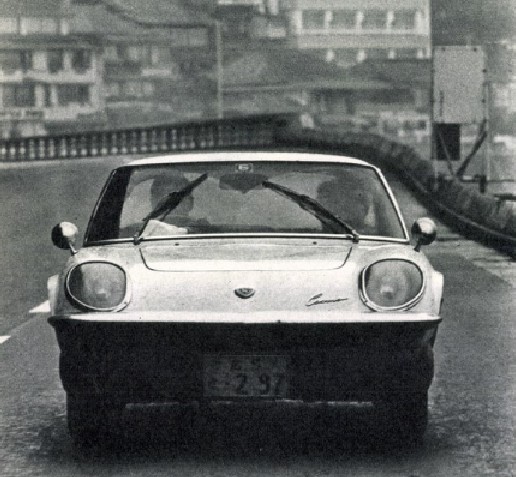
Publication: Auto Sport
Format: Road Impressions
Date: September 1967
Author: Robert Dunham, Noriko Uchida, Auto Sport Editorial Staff (uncredited)
The Mazda Cosmo That Captivated Blue Eyes
American driver Robert Dunham, a resident of Japan, takes the wheel of the revolutionary rotary-engined Mazda Cosmo. Joining him on the drive is announcer and motoring enthusiast Noriko Uchida, serving as navigator. Here are the impressions of two people who, by their own admission, were both “completely won over” by the experience.
A Car That Truly Excites
I have spent twenty years in the automobile business and ten years involved in motor racing. As a result, there are very few cars left that can truly excite me.
Formula cars, however sleek and purposeful they may be, no longer stir my emotions, while Indy cars impress only with their immense power and almost beastly sense of menace. Two-seat Group 7 racers such as the Lola and McLaren are, with the exception of the Chaparral, little more than large racing machines. (The Chaparral, by contrast, attracts me because of its unique engineering and forward-looking design philosophy.) Neither the Nissan R380 nor the Daihatsu P-5 holds any particular fascination for me. I have the utmost respect for the Porsche 906 (Carrera 6), but among this year’s prototype racers, there is probably nothing to surpass Pete Brock’s Kusamurai.
As for production sports cars, neither the Jaguar XKE, the TR4, the Fairlady, nor the Toyota 2000GT particularly excites me either. All are mass-produced sports cars intended for the ordinary buyer, and none can quite be described as a car built for the true enthusiast. The Volvo P1800 is interesting from a design standpoint, though regrettably it lacks power. I rather like the Mustang Fastback, too. But if I had 6,000 dollars (¥2.16 million) to spend, I would buy a Porsche 912. It offers the pleasure of driving a finely engineered machine.
If, on the other hand, I had only half that amount, I would choose the new Mazda Cosmo Sport without hesitation.
The reasons, I believe, will become clear in the following road impression.
An Adjustable Steering Wheel
Because I spend so much of my time racing, readers may imagine that this road impression will focus on such matters as top speed, acceleration, and high-speed cornering. This time, however, I have something different in mind. I would like to introduce the Mazda Cosmo–a new, exciting, and truly unique sports car that offers the simple pleasure of driving to anyone fortunate enough to get behind the wheel.
Leaving aside the question of traffic, there are three essentials to an enjoyable drive. The first is good weather. The second is an exciting automobile–one that offers excellent acceleration, speed, handling, and braking, yet never leaves the driver feeling fatigued. The third is a charming young lady. She will undoubtedly add to both the pleasant atmosphere and the enjoyment of the drive itself.
On July 13, the Cosmo prepared by Toyo Kogyo’s Tokyo office proved entirely satisfactory. Thanks to the charming Noriko Uchida–a freelance announcer introduced to me by the Auto Sport editorial staff–two of those three conditions had already been fulfilled. Unfortunately, the first requirement, good weather, was beyond our control. Even so, we decided to carry out the test as planned. In the end, it became clear that when a sports car is truly enjoyable to drive, the weather matters very little.
The first thing that impressed me about the Cosmo was its outstanding acceleration and the remarkable smoothness of its gear changes. Aside from Porsches, it has the easiest and smoothest gearbox of any car I’ve driven. Shift travel is short, allowing quick gear changes with little effort. The clutch felt firm and positive, but never in a way that became heavy or tiring. Working my way through Tokyo’s morning rush-hour traffic, where one is constantly stopping, starting, and changing gear, I came to appreciate just how well the clutch had been developed.
Although I had met Miss Uchida only twenty minutes before we set off, I was delighted to discover that she, too, knew a thing or two about cars. She proved to be an ideal navigator for this test.
We stopped at the entrance to the Third Keihin Expressway to check tire pressures, fuel, and oil. While doing so, I also made a few checks of my own to familiarize myself with the instruments, gear change, handling, braking, and other aspects. My legs are considerably longer than those of the average person, yet after adjusting both the seat and the steering wheel, I quickly found an exceptionally comfortable driving position.
The weather was oppressively hot, so we lowered both windows and opened all the fresh-air vents to allow as much airflow through the cockpit as possible. To be honest, however, I believe there is still room for improvement in the ventilation system. During the drive, the transmission tunnel became quite warm, and I suspect this could also be addressed through better air circulation.
Our first fuel stop brought an unexpected surprise: the Cosmo was able to deliver its full performance on low-octane regular gasoline. While the tank was being filled, Miss Uchida and I discussed our route, timing schedule, and the recording methods we would use.
Looking more closely at the dashboard, I found it to be exceptionally well laid out. Most pleasing of all was the tachometer, positioned exactly where it could be read at a glance. The water-temperature gauge, oil-temperature gauge, ammeter, and other instruments could likewise be read quickly and easily.
However, regarding the oil-pressure indicator, I think an actual gauge with numerical readings would be better than relying on a simple warning lamp. On the dashboard of a true sports car, indicator lights should be reserved for the parking brake, high-beam headlamps, and turn signals. An oil-pressure warning lamp, after all, serves little purpose beyond reassuring the inexperienced driver.
All Eyes on the New Engine
During our first stop for fuel in Ebisu, central Tokyo, the Cosmo was almost instantly surrounded by a crowd of service-station attendants and curious customers. I suspect there were two reasons for this: the new Mazda Cosmo itself, and the attractive Miss Uchida. Which of the two attracted more attention, I cannot say. In all seriousness, however, nearly every time we stopped, curious onlookers gathered around the car, and more often than not someone would ask, “Would you open the hood so we can see the engine?”
Whether that enthusiasm stemmed from Toyo Kogyo’s publicity efforts or simply from the merits of the car itself, I don’t know. One thing, however, is perfectly clear: it was because of the rotary engine. Here was an entirely new kind of engine! Different from anything that had come before! Producing a level of power unmatched by any other engine in its class! And built in Japan! Who could fail to be interested?
As the average Japanese motorist becomes more knowledgeable about automobiles, people are beginning to demand better cars–more powerful cars, more sporting cars with better styling. At the same time, there remains strong demand for economical cars and minicars, as demonstrated so clearly by the sudden success of the Honda N360.
Even so, there can be little doubt that a revolutionary machine like the Cosmo will do much to strengthen Toyo Kogyo’s reputation as a leader in technical innovation. The rotary engine, after all, can be installed in virtually any model. Pete Brock, the designer with whom I work, has often said that “the Mazda Luce is the finest-looking Japanese car from a design standpoint.” There is every reason to imagine a rotary-powered Luce as well.
It is well known that the Cosmo’s rotary engine was developed through Toyo Kogyo’s technical partnership with NSU and Wankel in West Germany. It is equally true, however, that Toyo Kogyo thoroughly modified the design and refined it through continual improvement. I have not yet had the opportunity to drive the NSU Spider, so I cannot compare the Cosmo directly with the original rotary-engined car. Fortunately, though, I did have the chance to drive the Cosmo prototype nearly two years ago. Comparing today’s production model with that earlier car, I found improvements almost too numerous to list.
In preparing the Cosmo for public sale, Toyo Kogyo clearly spared no effort in pursuing a thoroughly finished automobile–and it has succeeded.
Acceleration in the Rain
The styling is modern and attractive, though I think the car would benefit from a lighter visual impression. Its actual weight of 950kg also strikes me as somewhat greater than it should be. As for the color, I believe an icy blue-white would suit the Cosmo better than the present cream white.
Production is expected to reach 100 cars per month in the near future. Why is such a production volume necessary? Simply because larger-scale production is essential in order to reduce manufacturing costs. To succeed in the marketplace, the price will probably have to come much closer to the one-million-yen mark.
I was surprised to learn that the Fairlady sells in smaller numbers in Japan than it does overseas. I suspect the Toyota 2000GT will not sell in large numbers domestically either.
The Honda enjoys enormous popularity among younger buyers, but it is really too small to be considered a true sports car. What of the Mazda? I believe it has every opportunity, both at home and abroad, to fill the gap between these various sports cars.
Although there is considerable latent demand, the American market presently offers no high-performance sports car in the $3,000-$3,500 price range. Around $2,500 there are the TR4, the MGB, and the Datsun, while above $4,000 come the Porsche, Volvo, and Jaguar XKE. If the Cosmo can be sold for somewhere between $3,000-$3,300, I believe it could take the American market by storm. It already has the handling and performance necessary to satisfy American buyers.
But let us return to Miss Uchida and the Cosmo. The following was the route we covered during our test drive, and it should give some idea of just how varied our driving conditions were:
Tokyo (Departure)
Ebisu (6.6km / 10m 23s)
Third Keihin Expressway Entrance (12.6km / 12m 56s)
Third Keihin Expressway Exit (13.4km / 15m 50s)
Pacific Hotel, Chigasaki (26.4km / 49m 22s)
Oiso (5.0km / 6m 33s)
Odawara (21.8km / 37m 35s)
Atami (21.4km / 20m 10s)
Yugawara (18.6km / 11m 40s)
Oiso (32.8km / 24m 00s)
Tokyo (76.5km / 100m 15s)
The total elapsed time was 4 hours, 48 minutes, 44 seconds, and the distance covered was 235.1km. This works out to an average speed of 48km/h.
It began to rain just as we reached the entrance to the Third Keihin Expressway, so carrying out acceleration tests on the wet pavement demanded a good deal of caution. Our results were as follows:
0-60km/h (2nd gear): 5.6 seconds
0-80km/h (2nd gear): 6.9 seconds
0-100km/h (3rd gear): 13.8 seconds
0-140km/h (4th gear): 30.5 seconds
The rain made it impossible to continue acceleration testing to 180km/h. Nor were we able to conduct 0-400m acceleration runs, since the wet road surface and heavy traffic did not permit such a test. Under favorable conditions, however, I believe times around 16 seconds should be possible.
In actual driving, the Cosmo’s acceleration through the gears proved impressive. Maximum engine speed was 7000rpm, and the torque characteristics left little to be desired. Once engine speed climbed beyond about 2500-3000rpm, the rotary delivered its full performance in any gear, though second and third were especially impressive. Overtaking acceleration was equally strong in either third or fourth gear, making it exceptionally capable when passing slower-moving traffic.
Excellent High-Speed Cornering
The rotary engine’s mechanism is remarkably simple, so it ought to prove even more reliable than a conventional pushrod engine. Maintenance and adjustment should also be less costly. Equally important is the fact that the engine is almost completely free of mechanical noise, while its exhaust note is pleasant, sporting, and appropriately powerful. With neither tappet noise nor valve clatter to contend with, there was never any need to raise our voices as Miss Uchida and I talked along the way.
By the time we reached the end of the Third Keihin Expressway, we had decided that Chigasaki would be our next destination. Our impressions during the drive from Yokohama to Chigasaki were as follows.
-
The driving position. It accommodates drivers of virtually any build, so even after many hours behind the wheel I felt no fatigue whatsoever. In this respect, it compares very favorably with cars like the Jaguar, TR4, and Stingray.
-
The gear lever. Its position is excellent. As already mentioned, gear changes are exceptionally smooth, though I did occasionally encounter slight gear clash when making a hurried downshift from top gear into third.
-
The brakes. We carried out several braking tests from high speed and never encountered any trace of brake fade. At times the front discs emitted a slight squeal, but this appeared to result simply from the pads failing to release completely.
-
A small but thoughtful detail. Even in wet weather, the Cosmo proved remarkably practical. The radio antenna could be raised and lowered from inside the car using a switch on the dashboard.
With our acceleration and braking tests completed, we switched on the radio, listened to some jazz, and talked about cars and motor racing. Miss Uchida told me that she also competed in races, driving a Honda S800. Before long we arrived at the Pacific Hotel in Chigasaki, where we paused for a short rest and cold drinks. Then, setting off once more for our next destination, Odawara, Miss Uchida took the wheel.
Quite naturally, Miss Uchida’s priorities in a sports car centered on rather different qualities: styling, comfort, ease of driving, and everyday convenience.
The first thing that impressed her was the adjustable steering wheel. It allowed her to tailor the driving position perfectly to her own build. Since she herself drives a Honda S800, she was in an excellent position to compare the two cars. For short, sporting drives, she explained, the Honda was certainly enjoyable. But when it came to cockpit comfort and keeping occupants cool, it simply could not compare with the Cosmo. She also spoke highly of the Cosmo’s spacious cabin, excellent visibility, and reassuring steering characteristics. She also added one observation that was unmistakably feminine.
The seats in her own car are upholstered in vinyl, which, during the summer, quickly makes one’s back and legs feel hot and sticky. By contrast, the Cosmo’s well-made cloth seats remain refreshingly comfortable. Overall, her conclusion was that the Cosmo is a comfortable, practical, and easy car to drive, even for a woman of more petite stature. Another thoughtful touch was the adjustable map lamp mounted on the passenger side of the center console.
At Odawara we changed drivers again, and I returned to the wheel. By then the rain had stopped, allowing us to carry out a series of high-speed handling tests over a range of different speeds.
Before describing them, however, let me first offer a few impressions of the car’s handling.
Handling (with the standard suspension): Excellent. Although the road surface was wet and slippery, the Cosmo was able to put its full power to the road in every gear, allowing power slides to be used safely through virtually any corner. The handling tended slightly toward oversteer, but this was by no means a fault.
Stability: Very good. Road holding through corners was excellent, and the car remained easy to control. There was little pitching or excessive body roll. On the wet surface, however, the rear showed a slight tendency to step out.
Other observations: The rain soon began falling heavily again, forcing us to reduce our speed. It was under these conditions that I noticed another point deserving further attention. I would like to see the windshield wiper pattern studied more carefully, as they leave unwiped areas toward the tops of the front fenders that obscure the driver’s view of the rearview mirrors.
We stopped at Atami for lunch, took a few photographs, and then began the return journey. After carrying out a few more high-speed cornering tests around Yugawara, we headed straight back to Tokyo.
Next time, I should very much like to repeat this road test under bright sunshine.